Developing a Guide for Local Truck Parking Regulations (2026)
Chapter: 2 Stakeholder Engagement

CHAPTER 2
Stakeholder Engagement
The project team engaged local agencies, truck drivers, industrial developers, freight facility operators, and other regional, state, and federal agencies charged with direct involvement in truck parking policies, regulations, and operations. This chapter describes the plan used to execute stakeholder engagement and the results of a survey and interviews of stakeholders to understand local governmentʼs role in truck parking and how to improve parking. The goal was to develop resources for local governments.
Stakeholder Engagement Plan
This section outlines the stakeholder engagement strategy and execution to support the development of NCHRP Web-Only Document 446. In the subsequent sections, the Stakeholder Engagement Plan identifies outreach goals, target audiences, key messages, outreach challenges, and potential activities.
Outreach Goals
The outreach activities were intended to achieve the following:
- Share information about the project among varied stakeholders, including truck drivers, local government officials, industrial developers, and freight facility operators.
- Obtain information, especially activity, guidance, feedback, and perspective from all stakeholders.
- Raise awareness about opportunities for improving livability and sustainability for all through the implementation of innovative truck parking solutions.
Target Audiences
This study engaged the following audiences:
- Local agencies;
- Truck drivers;
- Industrial developers;
- Freight facility operators;
- Other regional, state, and federal agencies;
- Economic development entities;
- Local government and MPO planners; and
- National planning advocacy groups [e.g., National Association of Counties, National League of Cities, American Planning Association (APA), and Urban Land Institute].
Key Messages
The key outreach messages included the following:
- The issues and challenges related to truck parking, especially the safety and livability issues felt by residents adjacent to freight generators and truck drivers serving those communities who cannot find safe places to rest;
- A request for input that can help identify how the challenge of truck parking should be addressed at local levels, ways that local governments and stakeholders can absorb information, and where it fits within their authority;
- Collaboration with all stakeholders to identify risks, trade-offs, opportunities, and solutions; and
- Final guidance for local government interaction with truck parking.
Outreach Challenges
The following were identified as issues that may present challenges as outreach was conducted for the study:
- Local governments have few resources, especially to understand and address truck parking needs. Truck parking may not be able to compete with other day-to-day priorities.
- Stakeholder perspectives and perceptions are often misaligned, for example, drivers may not have an appreciation of local government processes, public involvement, and political pressure; and local government staff may not be aware of how industrial land use decisions create truck parking demand.
- It may be challenging to engage various stakeholders, and engagement in efforts may be low. The researchers mitigated this by engaging the driver community through REAL Women in Trucking (RWIT), which has been instrumental in high response rates for surveys like Jasonʼs Law.
Potential Activities
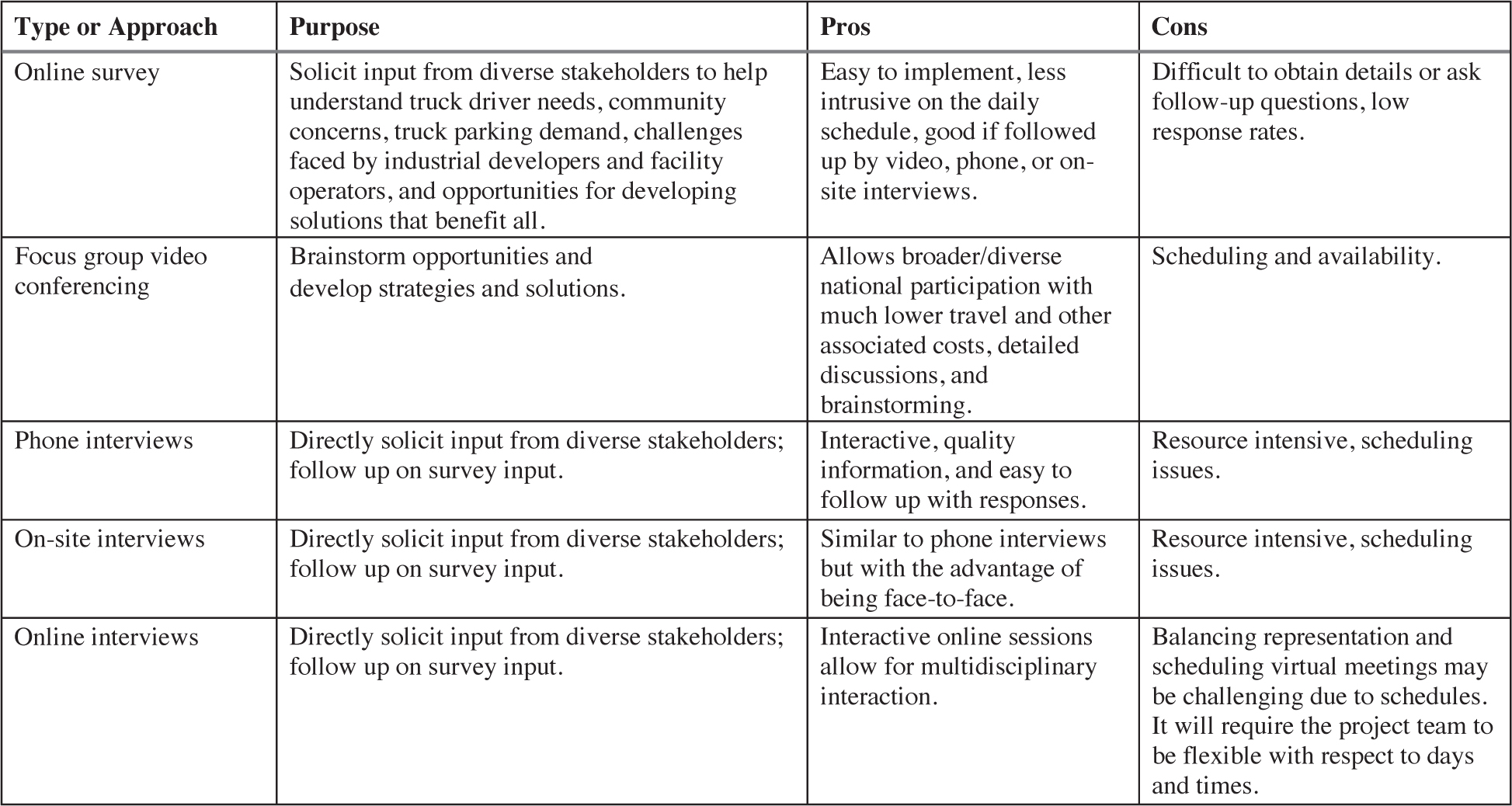
The project team used a hybrid approach [i.e., an online survey of various stakeholders, targeted interviews (focus group, phone, or on-site interview), and a working group] to brainstorm possible opportunities and develop strategies and solutions. This approach ensured broader and more diverse participation for a high-quality outcome. Table 2 contains an overview of possible engagement activities.
Stakeholder Identification
The project team sought to engage diverse stakeholders (i.e., background, geography, as required by law, and affiliation) with the following target affiliations:
- Local agencies with zoning/land use authority (e.g., cities, counties, municipalities, ports);
- Trucking associations/organizations (e.g., RWIT, state, and local trucking associations, Owner-Operator Independent Drivers Association, American Trucking Association);
- Port and trade associations (e.g., American Association of Port Authorities, Pacific Merchant Shipping Association);
- Commercial and industrial land developers, owners, and operators;
- State DOT representatives;
- Local government stakeholder organizations; and
- Industries and industry organizations.
The project team has relationships with many stakeholders (e.g., truck drivers, developers, executive staff) who often prefer verbal input over written responses. Therefore, the team interviewed them directly while waiting for survey responses from other stakeholders.
Long Description.
The table has 4 columns and 6 rows. The column headers in Row 1 are: Type or Approach; Purpose; Pros; Cons. Row 2: Online survey; Solicit input from diverse stakeholders to help understand truck driver needs, community concerns, truck parking demands, challenges faced by industrial developers and facility operators, and opportunities for developing solutions that benefit all; Easy to implement, less intrusive on the daily schedule, good if followed up by video, phone, or on-site interviews; Difficult to obtain details or ask follow-up questions, low response rates. Row 3: Focus group video conferencing; Brainstorm opportunities and develop strategies and solutions; Allows broader or diverse national participation with much lower travel and other associated costs, detailed discussions, and brainstorming; Scheduling and availability. Row 4: Phone interviews; Directly solicit input from diverse stakeholders; follow up on survey input; Interactive, quality information, and easy to follow up with responses; Resource intensive, scheduling issues. Row 5: On-site interviews; Directly solicit input from diverse stakeholders; follow up on survey input; Similar to phone interviews but with the advantage of being face-to-face; Resource intensive, scheduling issues. Row 6: Online interviews; Directly solicit input from diverse stakeholders; follow up on survey input; Interactive online sessions allow for multidisciplinary interaction; Balancing representation and scheduling virtual meetings may be challenging due to schedules. It will require the project team to be flexible with respect to days and times.
Stakeholder Working Group
Since the inception of the project, the team was in conversations with several local and state agency representatives, industrial developers, and truck drivers to ensure that the team efficiently organized the research approach. The project team formed a stakeholder working group of representatives from across the country that consisted of local agency staff, developers, operators, truck drivers, and state and federal agencies to review findings, identify gaps, and provide input on opportunities.
Survey Questionnaires
The survey focused on capturing trends in local truck parking policies, ordinances, and barriers to solving growing truck parking concerns (of both communities and truck drivers) including the following:
- Decisionmaking process developed in response to local truck parking issues;
- Key concerns regarding local truck parking from government officials, community representatives, truck drivers, and business owners;
- Agencyʼs/intervieweeʼs recommendations on truck parking and staging solutions, especially any lessons learned;
- Local truck parking solutions that have worked (best practices); and
- Quantification of truck parking strategies.
The project team had two surveys to gather input:
Survey 1. The first survey drew from other truck parking surveys like Jasonʼs Law for questions related to parking needs, issues, and solutions. It targeted truck drivers, local government and freight operators, and schedulers to collect information on local government needs, practices, and impediments related to truck parking.
Survey 2. The second survey was map-based and asked truck drivers and other stakeholders to put pins on a map with comments about problems or solutions to mine for issues, best practices, and potential solutions.
Interview Questionnaire
Interview questionnaires were tailored to each type of stakeholder. The project team sought to conduct a minimum of 40 in-depth interviews, including 25 with truck drivers who typically do not respond to surveys. In addition, the project team planned to conduct in-depth interviews with a minimum of 15 other stakeholders. These in-depth interviews targeted executives and agency directors who may prefer interviews to surveys. The interviews also provide a platform to learn more about stakeholder survey responses.
Additionally, the team reached out directly to truck drivers rather than representatives from the different trucking associations because the representatives are typically nondrivers. These representatives are well-versed in the big picture, but they are often less aware of specifics, such as a good place to stop and rest in areas without commercial truck stops. The project team understands the critical role that truck drivers play in identifying truck parking shortages and communicating the real impact that truck parking shortages have on their safety, ability to efficiently move goods, and overall quality of life. Most notably, these issues and concerns are exacerbated for women truck drivers. RWIT, a nonprofit organization and project team member, provided information on the impacts of truck parking shortages, humanized the issue, and worked toward equitable solutions. For the stakeholder engagement effort, RWIT identified and surveyed 25 truck drivers, consisting of a combination of company entry-level drivers, experienced company drivers, owner-operators, and local/regional drivers who all experience issues with truck parking in different ways.
RWIT conducted outreach through various methods that drivers could easily respond to, including digitally, in person, or through phone interviews for a duration of approximately 45 to 60 minutes to gather information on truck parking and staging problems they encounter, insight on ideas for local solutions, land spaces they may know of near rights-of-way and shipper/receiver facilities, and their basis for decisionmaking in problem areas where they experience difficulties finding suitable safe truck parking.
RWIT has access to an extensive community of diverse truck drivers in many sectors through social media networks and partner groups on Facebook, Twitter (now X), YouTube, TikTok, and Instagram.
RWIT has been a recognized and influential voice on truck parking issues since 2009. The organization members are often sought out for their ability to articulate how the lack of safe truck parking affects not only truck drivers but also places a burden on communities that feel the impact of unauthorized parking.
Stakeholder Engagement Takeaways
The objective of NCHRP Project 08-141 is to develop a set of resources for local government planning guidance, model codes, and policies for truck parking needs, especially for those associated with the approval of freight-generating land uses at the local government level. Recent truck parking stakeholder discussions targeted local governments and planning decisions as a critical component related to truck parking demand. Given the standing local governments have in solving for parking, resources are needed to support local governments in understanding and planning for truck parking.
Survey Results
The survey was conducted during June and July 2023 by sending the survey link to a large network of stakeholders. The project team relied on the vast network of RWIT, TRB committees,
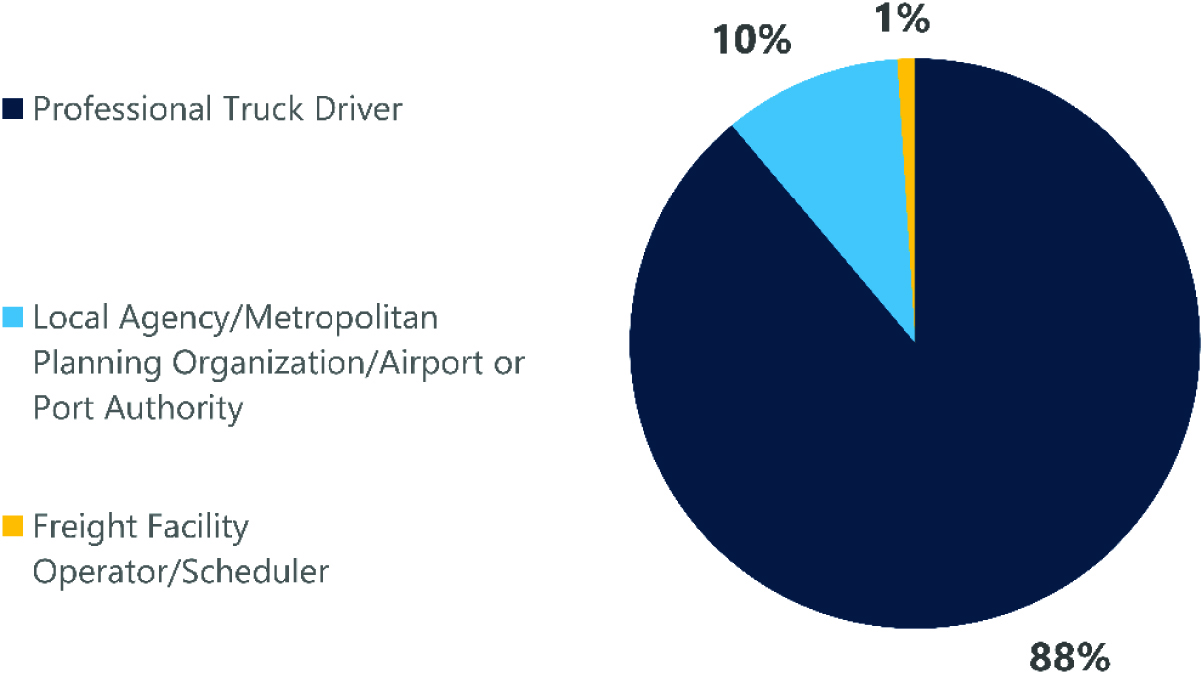
and industry groups to create awareness of the survey. The survey included questions and a mapping option allowing respondents to identify areas of truck parking challenges. The survey had 273 respondents. Of these respondents, 241 (88.3%) were truck drivers, 28 (10.3%) represented local agencies, an MPO, or airport/port authority, and 4 (1.5%) represented freight facility operators or schedulers. An illustration of the survey respondents is shown in Figure 7.
Driver Demographics and Responses
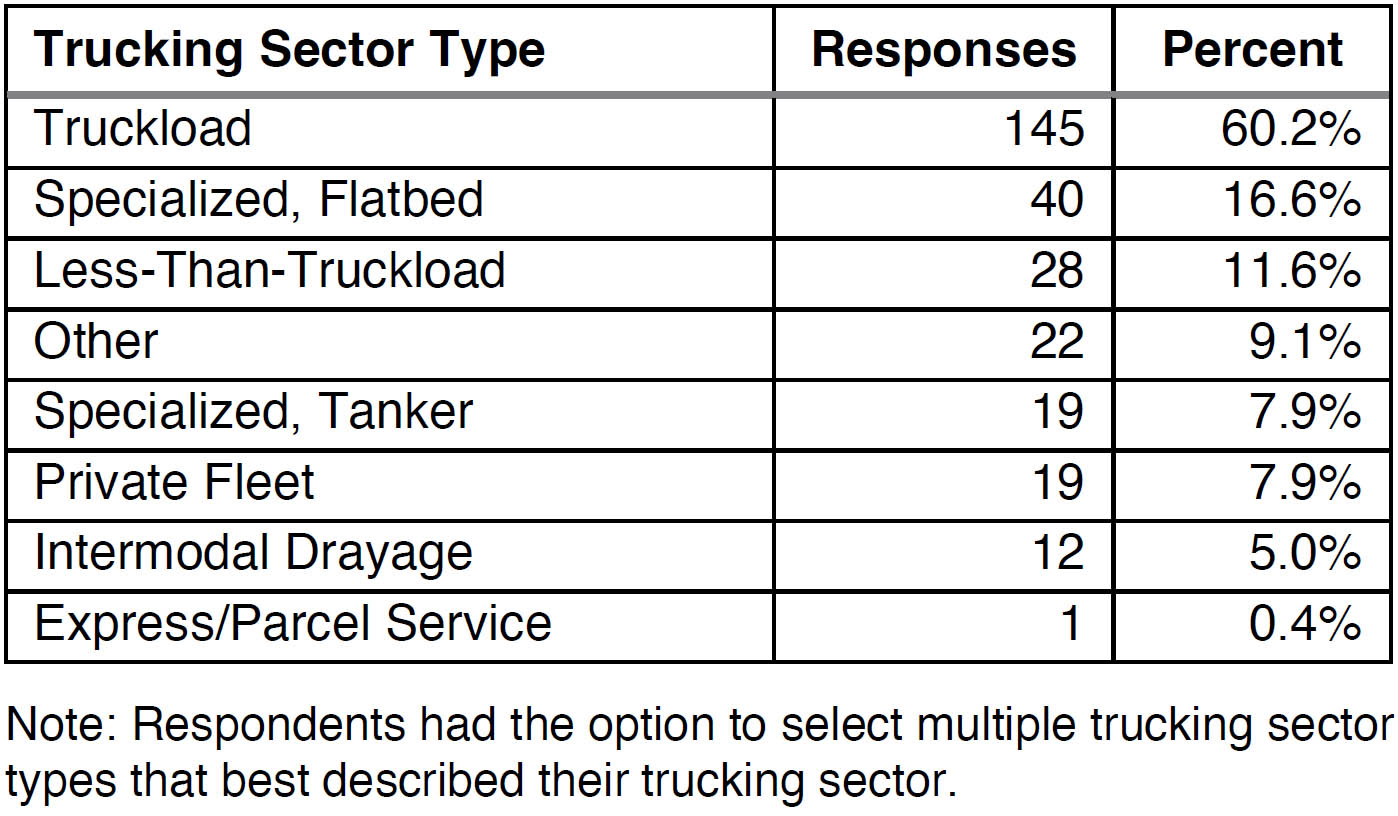
Drivers represented the most respondents to the survey. Seventy-two percent had been professional drivers for more than 10 years. Most drivers represented the truckload sector, but there were drivers from other areas, like specialized trucking, that responded as well (see Table 3).
Most drivers were owner-operators (56%). Forty-one percent were employee drivers, and the remainder classified as “other.” Most of the owner-operators parked their truck at home on their own property (39%) or in private truck parking or storage facility (38%). Some used nearby malls or vacant lots and areas in front of or near their residence. Their typical length of haul varied, with most drivers identifying as long-haul (48%) and interregional (33%). Most drivers did their own trip routing (74%).
Sixty-nine percent of drivers said they plan for parking needs before starting a commercial trip. Additionally, the most important factor in making parking decisions is safety. This is followed by proximity to delivery location and federal HOS requirements. Security is also the most important amenity or requirement for parking, followed by showers, food, and fuel. Most
Long Description.
A pie chart showing the breakdown of survey respondents by type: 88% professional truck drivers, 10% local agencies slash MPOs slash airport slash port authorities, and 1% freight facility operators and schedulers.
Long Description.
The table has 3 columns and 9 rows. The column headers in Row 1 are: Trucking Sector Type; Responses; Percent. Row 2: Truckload; 145; 60.2 percent. Row 3: Specialized, Flatbed; 40; 16.6 percent. Row 4: Less-Than-Truckload; 28; 11.6 percent. Row 5: Other; 22; 9.1 percent. Row 6: Specialized, Tanker; 19; 7.9 percent. Row 7: Private Fleet; 19; 7.9 percent. Row 8: Intermodal Drayage; 12; 5.0 percent. Row 9: Express or Parcel Service; 1; 0.4 percent. Note: Respondents had the option to select multiple trucking sector types that best described their trucking sector.
drivers prefer smartphone applications to aid in parking decisions. Fewer rely on roadside signs or DMSs.
In cities and metro areas, drivers responded that they mostly choose to park at commercial truck stops followed by shipper or receiver properties and rest areas. Seventy-seven percent of drivers report having difficulty finding parking almost always or frequently. Many drivers report that it takes 20 to 40 minutes to find parking, with 18% saying it might take more than an hour. Few companies provided designated parking or terminals. Some parking decisions are governed by parent companies and parking security concerns. Forty-five percent of drivers reported parking restrictions due to safety concerns. Most companies are not reimbursing for parking (this may be due to the large number of owner-operator drivers in the sample).
Parking at the shipper or receiver, if out of legal hours, is partially supported for the drivers (47%), but 38% reported that they are sometimes allowed to park. Drivers reported resorting to unofficial locations or areas not meant for parking frequently (32%), sometimes (40%), and rarely (21%). Less than 6% reported that this occurs almost always.
In the past 12 months, 77% of drivers said they have felt unsafe while parked during a mandatory rest period or while waiting to pick up or drop off a load. Safety issues reported include criminal activity taking place at parking areas, vandalism and theft, robbery, accidents with other trucks, and harassment of female drivers. Additionally, drivers reported problems with lighting, security, and other physical characteristics that make drivers uncomfortable and feel unsafe when parking.
Some of the major challenges cited by the truck driver respondents related to truck parking include the following:
- Community perception that drivers will destroy a property where they park;
- Options always full;
- Difficulties in finding safe and clean parking;
- Worrying about citations;
- Non-truck users like recreational vehicles taking spaces in official truck parking areas;
- Not all trucks fit in spaces; specialized carriers need appropriate parking;
- Bans and restrictions on where to park;
- Electronic logging devices make trucking inflexible and create parking challenges; and
- Parking options not near places the drivers need to be.
Recommendations cited by the truck driver respondents to solve for parking include the following:
- Add more capacity, especially simple options (e.g., parking, lighting, and restrooms), with low or no charges (e.g., publicly owned rest areas). Also have options for drivers parking their truck during their home time.
- Increase parking availability in and around urban areas.
- Educate the public on the importance of trucks and how to better support drivers.
- Ensure that any new warehouses or freight generators incorporate parking for the trucks that deliver or pick up, especially if warehouse/freight generator delays cause truckers to be out of service or to alter routing.
- Work with existing businesses to allow trucks to rest on their property if needed, especially if a business delay caused the driver to be out of service.
- Allow drivers to use facilities where they are providing services.
- Allow parking in big box or big lot locations like malls and stadiums when not in use at night.
- Improve truck parking design, ingress and egress, and angles to make lots more efficient and have higher capacity.
- Enforce no dropped trailers and ticket non-trucks in truck spots.
- Use unused or underused highway right-of-way to develop parking options and charging infrastructure.
- Create truck-only areas and separate truck parking from all vehicle parking, public and private.
- Improve zoning to require truck parking and incorporate it into development, especially in urban areas.
Public Agency Demographics and Responses
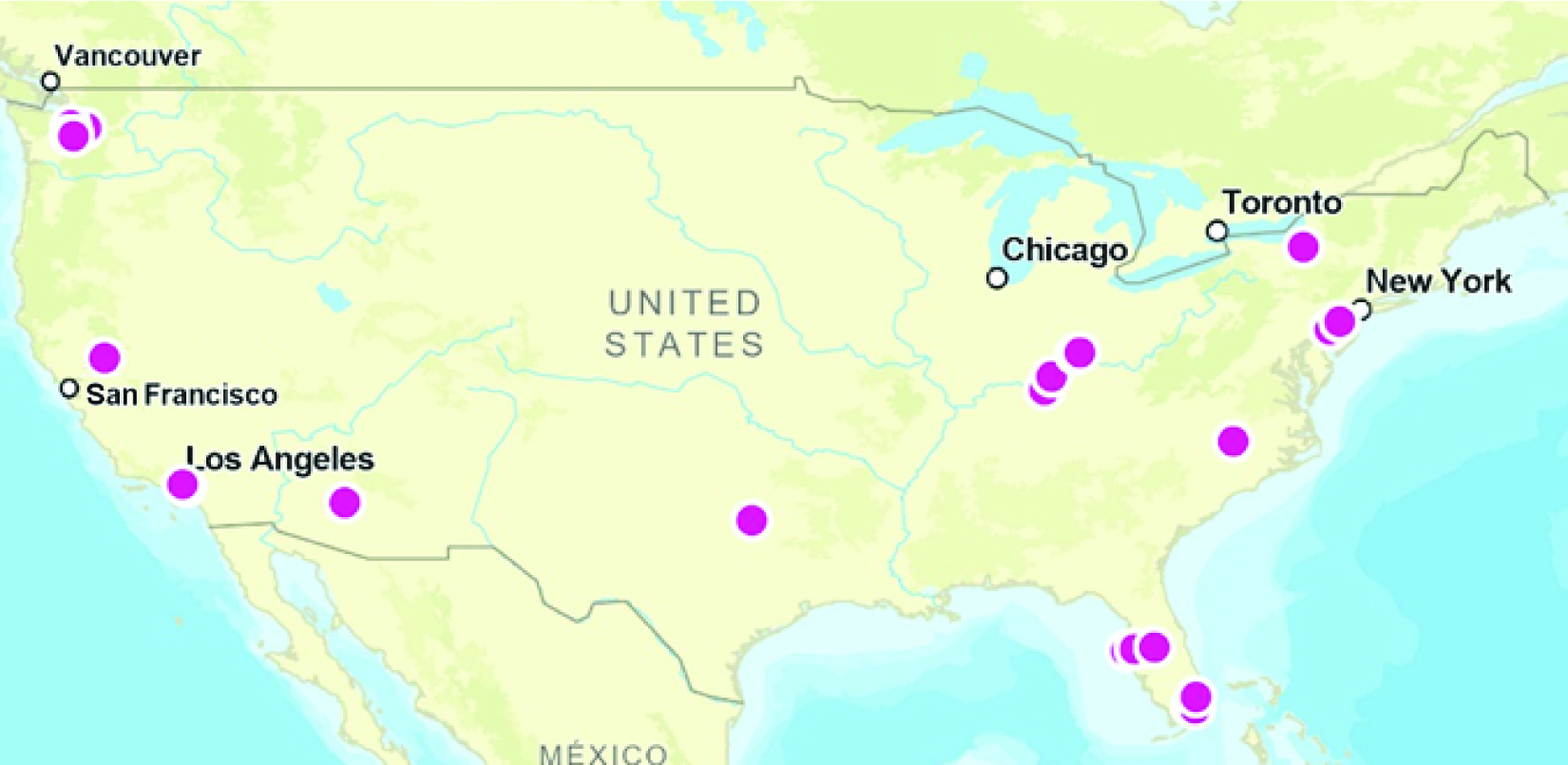
Fewer public agencies responded to the survey. As the results will show, many of the respondents correspond to the same regions that have local government truck parking efforts in place. Despite a lower number of respondents (28), there is diversity in the respondents throughout the nation, with input coming from the East Coast, West Coast, southern states, northeast, and Midwest regions, especially from urban areas and areas where there is significant freight activity. The regions represented by the survey respondents are shown in Figure 8.
Factors attracting truck traffic to the jurisdictions represented by these agencies are mostly the presence of commercial and industrial land uses in the area and the existence of through freight traffic. Other factors like commercial and industrial land uses near their jurisdiction and the presence of rail yards also attracted truck traffic.
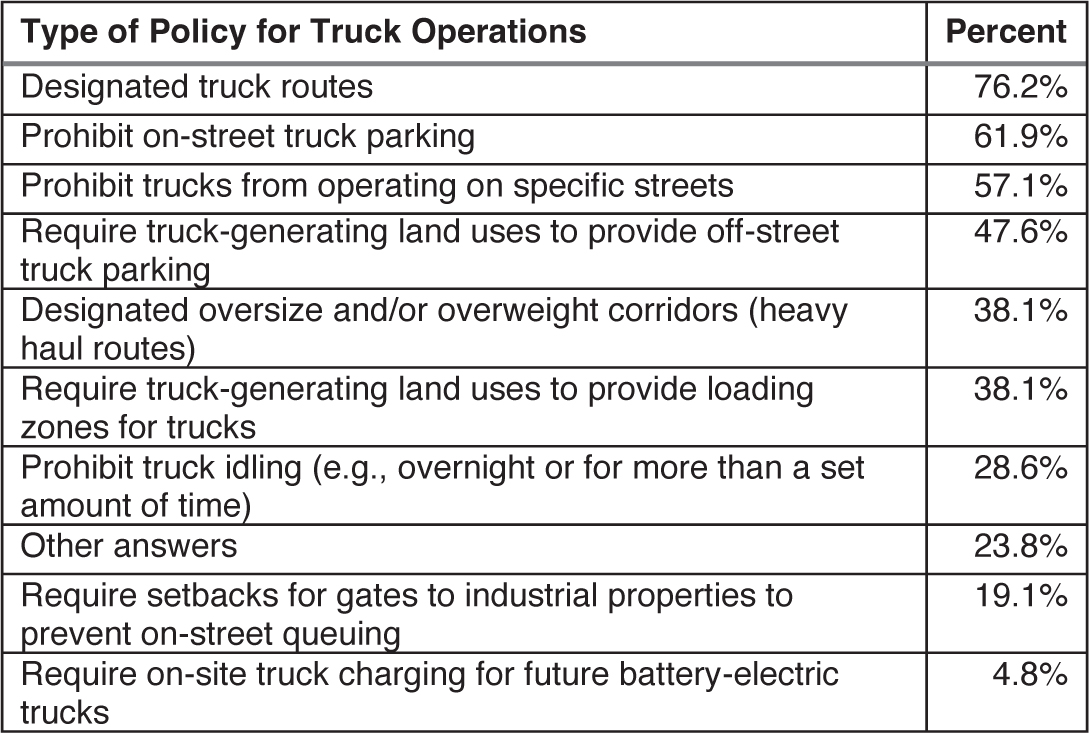
Eighty-one percent of the agencies said they have specific policies, ordinances, or codes related to truck parking operations. The types of policies or codes that these agencies have in place are detailed in Table 4. Most agencies have truck routes and some form of ban or prohibition for where trucks can park.
Agencies cited the following truck parking challenges in their jurisdictions:
- The high number (and growing number) of trucks in and out of their area;
- Not enough parking where it is needed;
- Trucks parking in places they should not be;
- Lack of policies to focus on truck operations and parking;
- Development without consideration of parking demand generated;
- Scarcity of land to put truck parking, and the cost of land; and
- Negative activities at truck parking locations.
Long Description.
A map showing pink dots for the locations of the regions represented by agencies in the survey, including several urban areas and areas with significant freight activity.
Long Description.
The table has 2 columns and 11 rows. The column headers in Row 1 are: Type of Policy for Truck Operations; Percent. Row 2: Designated truck routes; 76.2 percent. Row 3: Prohibit on-street truck parking; 61.9 percent. Row 4: Prohibit trucks from operating on specific streets; 57.1 percent. Row 5: Require truck-generating land uses to provide off-street truck parking; 47.6 percent. Row 6: Designated oversize and/or overweight corridors (heavy haul routes); 38.1 percent. Row 7: Require truck-generating land uses to provide loading zones for trucks; 38.1 percent. Row 8: Prohibit truck idling (for example, overnight or for more than a set amount of time); 28.6 percent. Row 9: Other answers; 23.8 percent. Row 10: Require setbacks for gates to industrial properties to prevent on-street queuing; 19.1 percent. Row 11: Require on-site truck charging for future battery-electric trucks; 4.8 percent.
Seventy percent of agencies said they are evaluating or implementing truck parking solutions. Most agencies are developing new facilities or coordinating with partners. Some are expanding capacity at existing facilities and engaging in truck parking information systems and messaging of parking options and availability. Agencies reported they are responding to truck parking challenges by
- Increasing capacity where possible;
- Adding temporary parking and staging support where needed;
- Considering codes, policies, and regulations to deal with truck activity;
- Restricting where trucks can park;
- Enforcing parking;
- Inventorying and monitoring capacity;
- Conducting community outreach to increase awareness of new electric trucks and space/charging requirements;
- Collaborating with partners to identify and support other solutions at the state or regional level; and
- Providing exceptions for parking (e.g., use of nontraditional space and permitting for in-demand areas).
In addition to what agencies are already doing, the respondents reported that they would be equally interested in the following options:
- Enhancing capacity at existing facilities or developing new facilities;
- Integrating truck parking needs and solutions in plans, developments, and other policies or programmatic areas;
- Developing truck parking information and management systems, or some methods of parking reservations and smartphone applications; and
- Coordinating with partners for funding, financing, and education.
However, in getting to solutions, agencies identified the following impediments:
- Cost of land;
- Issues with adjacent land uses;
- Lack of interest in freight among municipal stakeholders;
- Not enough land or space to adequately solve for parking;
- Lack of understanding of business recipes or arrangements to engage in partnerships that solve parking;
- Public opposition to trucking and truck parking;
- Hesitancy to use public dollars toward private trucking operations without a clear public benefit;
- Environmental conflicts (e.g., runoff and air quality); and
- Lack of data to understand demand and capacity.
Some of the agencies described planning for the parking needs of future freight vehicles. For example, several cited activities focused on understanding electric infrastructure, incorporating it into plans, or seeking to study this further. Some admitted they feel the technology is further out from their current planning horizon.
Seventy-seven percent of agencies said that they can provide staff time to investigate truck parking issues. One agency provided an affirmative response. Nineteen percent said they did not have capacity to work on truck parking issues. All agencies indicated they would partner with the state DOT to address truck parking shortages. While all indicated they would partner with the DOT, 46% said they would partner with private developers, 46% said they would not, and 8% indicated they might partner. Reasons for not partnering with the private sector are that private developers are typically only interested in revenue. Additionally, some indicated the city needed a better understanding of truck parking issues, that they did not have capacity, and that there are too many public competition requirements for partnerships to work.
Public agencies said that they need better data and visualization to understand the truck parking challenges and to engage in developing solutions. Further, they stated that solutions should reflect the needs, thus requiring a range of solutions for truck parking, staging, amenities, and services based on the needs of truck drivers operating in the area. Environmental factors are important in solutions.
Trucking Operations and Scheduling Representative Demographics and Responses
Of the four respondents representing trucking operations and scheduling, three have been in business for over 10 years, and all have been in business for at least 5 years. While this sample does not represent a population, some of the findings are useful.
These representatives cover facilities that allow varying amounts of truck parking. Reasons why a truck would not be able to park at their facilities include safety concerns, liability, and space limitations. They do report plans to allow battery-electric trucks to park and charge in the future.
Most facilities charge for parking. The four in this sample do not offer parking reservations (although in driver comments from the surveys, they report many are charging for reservations now).
Locations of Truck Parking Challenges
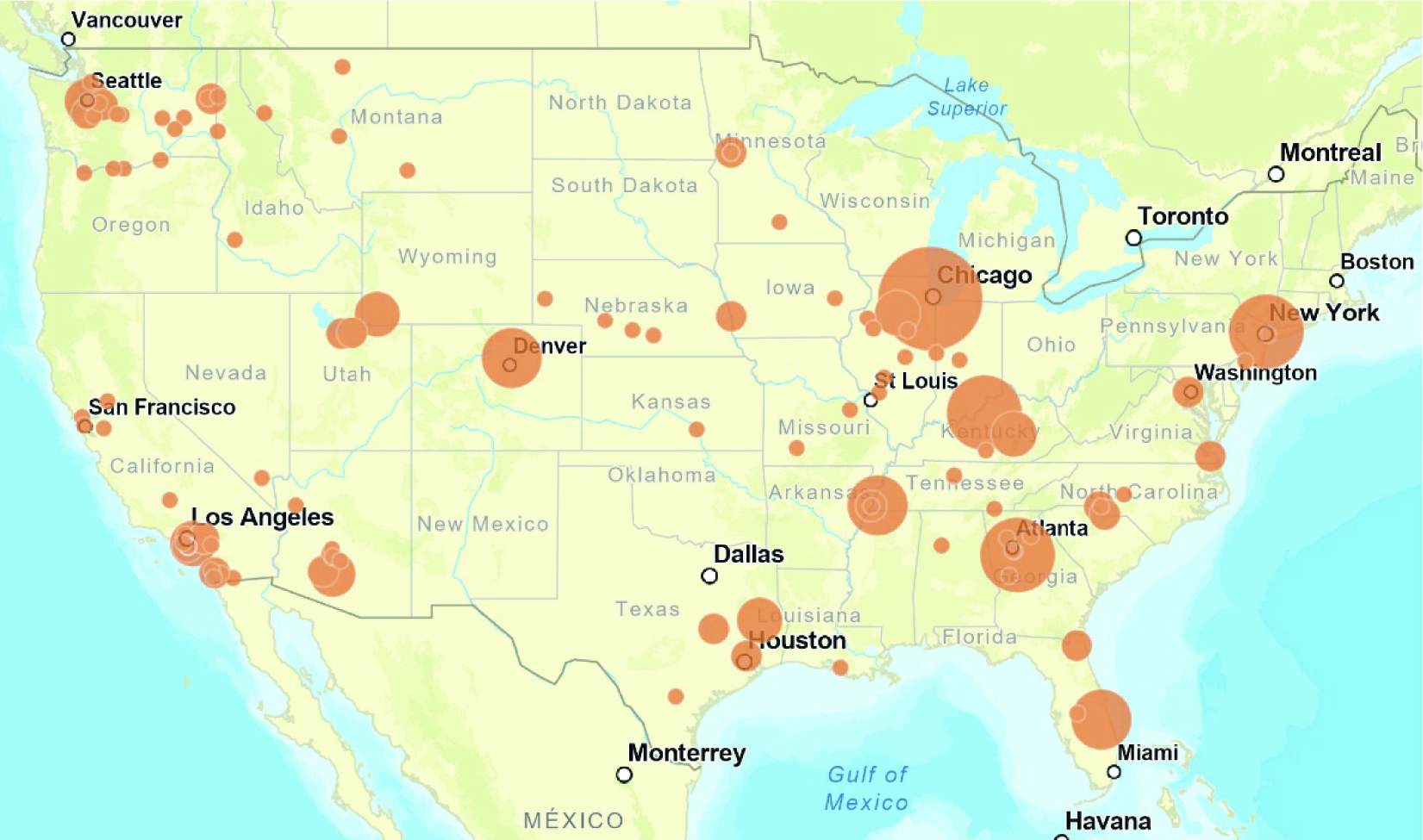
The survey respondents indicated challenges throughout the nation. Pinpointing areas of problems, however, shows most problems in urban areas like New York, Chicago, Atlanta, Miami, Denver, and Memphis or along key freight routes like I-20, I-40, I-80, I-90, and I-75. A map of locations identified is shown in Figure 9.
Interview Results
The driver interviews offered an opportunity to understand in-depth some of the challenges experienced by drivers, especially as they relate to truck parking and the juxtaposition of local
Long Description.
A map of the locations in the United States with truck parking challenges, with urban areas highly represented.
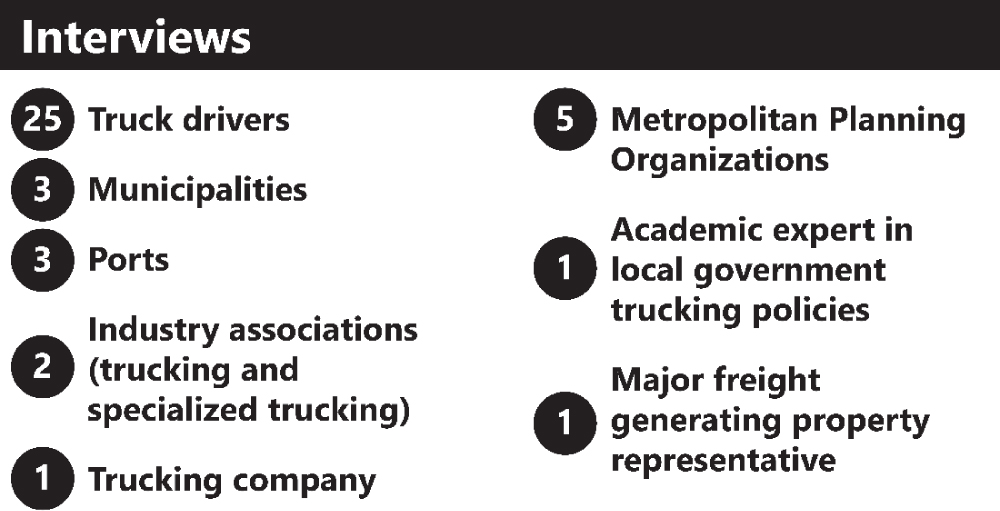
government actions. Of the 25 drivers interviewed, seven drivers operate nationwide. Sixteen stakeholder interviews provided insight into the local government issues related to truck parking. Figure 10 depicts the sector and number of interviews conducted.
Driver Interviews
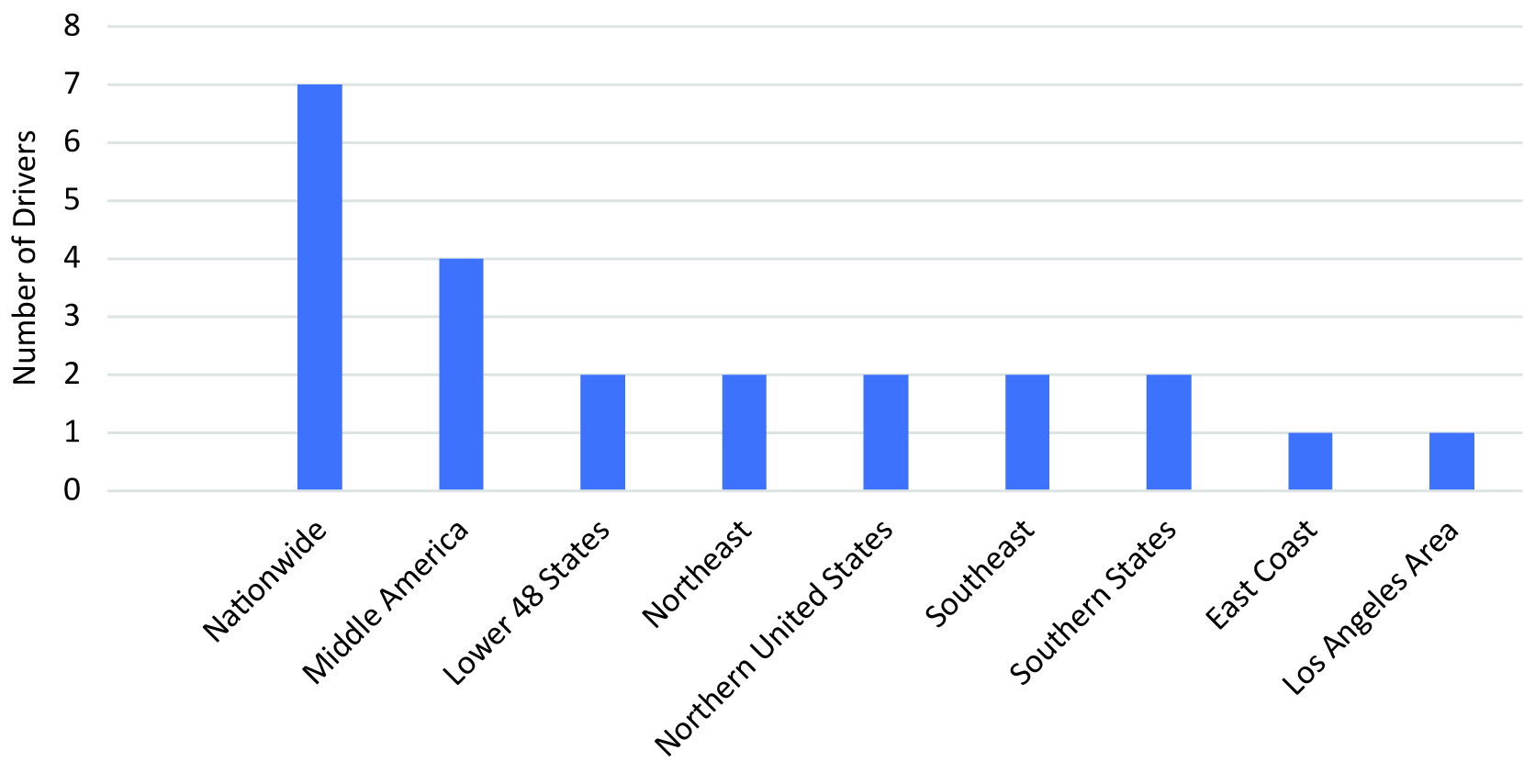
Of the 25 drivers interviewed, seven drivers operate nationwide. Some are concentrated in different sections of the United States. All areas of the nation were covered by the drivers (the Southwest is included in the southern states and Los Angeles area) (see Figure 11). Most of the drivers were truckload drivers, but several represented specialized, less-than-truckload, and flatbed operations. The average career length of the drivers interviewed was 23 years, but the range was 1 year to 54 years. Most had 20 or more years of experience. Most drivers interviewed park their truck when at home at their place of residence, but several use a paid lot near their residence, and a few use a company-owned lot either close to their home or, in some cases, a few hours away.
Long Description.
The graphic shows the breakdown of the 25 truck driver interviews and 16 stakeholder interviews (3 municipalities, 3 ports, 2 industry associations (trucking and specialized trucking), 1 trucking company, 5 MPOs, 1 academic expert in local government trucking policies, and 1 major freight generating property representative).
Long Description.
A bar graph of the areas covered by drivers. The y-axis is the number of drivers, and the x-axis lists the areas in the United States. Nationwide: 7 drivers, Middle America: 4 drivers, Lower 48 States: 2 drivers, Northeast: 2 drivers, Northern United States: 2 drivers, Southeast: 2 drivers, Southern States: 2 drivers, East Coast: 1 driver, Los Angeles Area: 1 driver.
The key findings are described as follows.
Parking Is a Problem Everywhere. All drivers interviewed indicated that they experience parking problems throughout the nation. Most identified cities and surrounding urban areas as those having the most challenges. Atlanta was mentioned as an example by many drivers, as well as Indianapolis, Chicago, and northern (Bay Area) and Southern California. Drivers described a severe lack of truck parking and difficulty accessing truck parking due to congestion. Drivers in these areas mitigate these challenges by starting their night rest much earlier in the day or beginning their trips the evening before and finding a place to sleep in the outskirts. Congestion challenges in these urban areas are already problematic and exacerbate the truck parking problem, which exists because there are too few spaces near major freight generators (i.e., seaports, land ports of entry, and intermodal rail yards). Additionally, many shippers or receivers do not allow the trucks to stay on their property in these areas, and the drivers have limited or no options except to park in an undesignated area.
Bans and Restrictions Are Problematic and Inefficient. In addition to challenges with parking in urban areas, drivers described many challenges with the local truck parking bans and restrictions. Drivers reported that on-street truck parking bans and truck routing restrictions create delivery challenges. Local regulations often restrict where trucks can travel, and where drivers can stage when waiting for their delivery, access basic human needs, or take a mandated rest. These restrictions often increase the delivery/pickup time and truck miles of travel. More time and more mileage equals more emissions and more costs. Further, drivers described situations where local governments will ban parking but not realize that the businesses in the district where parking is banned rely on trucks for deliveries. One driver cited an example of a community banning trucks in a small town with cobblestone streets. The community did not seem to realize that the trucks deliver to all the retail and restaurant establishments there. This example seems to indicate that local decisionmakers and citizens lack an understanding of how products are delivered.
Drivers Need Information on Where There Are Bans and Restrictions. Local truck routing and parking restrictions are frequently not communicated to the truck drivers. For example, one driver reported parking in a place that he thought was suitable and
legal, but a patrol officer told the truck driver that truck parking was only permitted for emergencies and cited this driver. The driver stated that there were no clear markings or signage stating it was only for emergencies. Following that incident, the local government installed boulders to keep trucks from parking there.
Capacity Issues and Existing Rest Areas. Many drivers discussed challenges with existing rest areas. Drivers said there are not enough rest areas and that many more are needed, especially on the fringe of urban areas. Drivers requested an exurban hub-and-spoke type of rest area where drivers could park on the urban fringe before a delivery or pick up, venture into the urban area for their connection, and then return to the rest area afterward. This would eliminate the need for parking in the urban area unless staging was needed.
Problems with Rest Area Design. Drivers described challenges with the way rest areas are designed. Parking demand varies by the types of drivers, trucks, and goods being moved. Drivers stated that the existing designs often pose maneuvering challenges resulting in inefficient use of the facilities. Drivers recommended redesigning or expanding rest areas with a circle loop so drivers who are out of hours are not pushed back onto the highway. The circle loop design allows drivers to make another pass through the rest area to find a space, which may allow them to avoid ramp parking.
Electronic Logging Device (ELD) Mandate Issues. Drivers lamented the ELD mandate. They acknowledge a need for safety, but they perceive the ELD as being mandated or the process designed by nondrivers for drivers, and indicated that the ELD puts them in danger rather than help with safety as intended. Many said the ELD makes it much harder for drivers because they feel it forces them all on the road at the same time, to park at the same time, and to make decisions that lead to inefficiencies. Drivers described that ELDs cause them to have to stop too early or park in undesirable places because they are out of hours and parking they had hoped would be open was not. They must pull over or stop in undesignated locations just to avoid noncompliance. Drivers believe it would be better and safer for them if they had the flexibility to drive a little longer to find safer parking and manage their processes better. For example, when drivers are delayed by a shipper, they may have had a route and parking location in mind; however, the delay puts them in a position where they may violate their HOS and be forced to park in a location where they should not be instead of having an extra 20 or 30 minutes to identify parking options, drive there, and park in a place suitable.
Parking at Point of Delivery or Pickup. Many drivers described a desire for shippers and receivers to support drivers by allowing parking on their lots in HOS situations when they are delayed by the business they are serving. Drivers said that businesses will cause drivers to wait or be delayed but will not accommodate them in terms of HOS or basic hospitality. Drivers wish businesses would be more accommodating to the drivers by allowing them to use bathrooms, for example, especially when the business causes them a delay.
Reservation System Issues. Drivers said that parking reservation systems like ParkMyRig and SecurSpace are not adequate. There is no guarantee for drivers that a spot will be there even when paying to reserve ahead of time. Drivers often arrive to find another truck parked in their spot. They report that the parking facility security will not become involved for fear of an altercation.
Quality of Rest Areas and Truck Stops. Drivers expressed many concerns about truck parking facilities, safety, and security. Many reported poorly lit lots and lack of security to enforce criminal activity, including theft and vandalism, assault and battery, prostitution, drugs, and more. Many drivers described the extreme measures they take to avoid security problems, such as carrying weapons, taking weapons training classes, parking in the most secure areas available, and even looping seat belts through door handles to wake them during a break in.
Facility Maintenance. Drivers reported that truck parking facilities are not maintained properly. They are overpriced and frequently lack amenities or decent bathrooms. Information systems alerting the availability or locations of parking are not maintained after being installed. Drivers perceive parking areas, public and private, as trashy and unclean, offering few good options for food and rest. Instead, many drivers end up building innovative contraptions to take care of personal hygiene in their truck, and resorting to other ways or strategies to work around the poor conditions they see at truck parking locations.
Community Perceptions. Many drivers discussed the negative perceptions that communities have about truck parking. Truck drivers reported that negative activities occur at truck stops, and drivers may be victimized by perpetrators, such as drug dealers, thieves, and prostitutes, rather than complicit in the illegal activities that concern local residents.
Separation of Commercial and Passenger Activity. Drivers stated that they would prefer separate parking areas for commercial trucks and non-trucks/passenger vehicles. Truck drivers are moving valuable cargo, which creates a security risk for the drivers when they park to sleep. When truck parking areas are only accessible to commercial truck drivers, it reduces ease of access for criminals. The mix of trucks and passenger vehicles also poses safety risks for the traveling public. One driver stated that travel plazas and truck stops should be completely separate facilities. This driver said that it is too dangerous for families to stop with kids due to the presence of drug dealers and human traffickers, and by creating truck stops for commercial drivers only, criminals would no longer have open access to their targets, the truck drivers. This driver suggested separating truck stops from general travel plazas as well as separating rest areas in this same manner as a solution.
Increased Security. Drivers would like to see more security measures, such as more and better lighting, fencing, security cameras, and patrols by either on-site private security guards or the police. Truck drivers would also like truck parking areas to be limited to trucks. This would avoid both security concerns and impediments to trucks posed by the traveling public, such as recreational vehicles (RVs) and passenger cars towing trailers. One survey respondent stated that RVs will often park in truck parking stalls improperly and obstruct commercial truck drivers from being able to pull out, pull in, and circulate. One driver reported an RV in a truck spot that consumed three truck parking stalls overnight because the RV owner popped out the sleeping quarters to camp at the truck stop.
Education Campaign. Truck drivers suggested strategies that local governments could implement to address truck parking shortages, encourage commerce in their region, and help citizens understand and appreciate the benefits provided by the trucking community. Several of the truck drivers remarked that public perception against trucking shows a lack of understanding by the general public about the value truck drivers and trucks bring to their communities. Drivers indicated that local governments engage in economic development, but they typically do not see the connection between the development of industrial job creators, such as industrial warehousing and manufacturing, and the trucks needed to support them. Drivers would like local governments to be more aware and cognizant of the implications of approving truck-generating development projects.
Reuse of Abandoned Property for Parking. Several drivers offered solutions for local governments to consider in addition to public education. First, drivers commented that rehabilitating strip malls, abandoned shopping malls, and other underused or blighted locations, especially in urban areas and on the fringe of urban regions, would make great truck parking options. They suggested bringing these properties back to life by allowing truck parking and providing services drivers (and the community) need, such as coin-operated laundry, restaurants, gyms, general retail options (e.g., drug stores,
clothing stores), medical/dental, and more. Demand generated by truck drivers in these economically disadvantaged areas has the potential for serving underserved populations and generating additional tax revenue.
Coordination with Business Operations. Drivers opined that more coordination is needed between the truck drivers and the facilities that they are serving. Respondents said that warehouse rules and delivery windows frequently cause truck staging and queuing issues on local streets adjacent to or near these locations. For example, one driver said that a distribution center in Nebraska has a policy that a driver will be fined if they are more than 1 hour early or 1 hour late. The facility has a long check-in line that truck drivers must wait in to obtain a time stamp proving that they are within the “no-fine” window. Avoiding the fine requires strategic planning. The site has adequate on-site space to facilitate truck staging for trucks; however, the facility operator prohibits trucks from using it. Trucks serving this facility will stage down the road at a very busy truck stop where other long-haul drivers are trying to get their 10 hours of rest. Nebraska generally has adequate truck parking and few problems, but this is an example of how policies established by one warehouse can create a truck parking shortage. This respondent stated that the policy is problematic and collaboration with the facility operator is an opportunity for changing it.
Different Types of Parking Needed. Drivers also said that there is a need for staging and short- and long-term parking. Not everything needs to be an amenity supercenter. Some lots can be basic, but clean bathrooms, good lighting, and a sense of security are always important. Drivers said sometimes they just need a place to get quick rest or to stage, and so a lot does not always have to have other amenities. Further, drivers suggested the use of underused highway right-of-way for gravel or simple lots to offer places of rest or staging in and around major freight generators.
Finally, drivers suggested that local governments reexamine industrial and commercial land use and zoning, truck routing, and on- and off-street truck parking regulations. Many respondents stated that planners and decisionmakers are more likely to respond to community complaints about trucking activity by banning on-street truck parking, prohibiting idling, limiting hours that trucks can deliver or pick up goods, and/or prohibiting trucks from using certain streets. Respondents suggested that local agencies could better solve the trucking problem by requiring freight generators to provide on-site truck parking, staging, and queuing, and by providing auxiliary power for trucks to plug into and avoid idling. Respondents further commented on the liability issue some private sector, truck-served businesses mentioned when asked about allowing truck drivers to park on their property. Respondents stated that they do not understand why businesses will say there are liability problems since the drivers are already on their property to deliver or pick up. Respondents stated that they carry liability insurance and the businesses they are serving have insurance so allowing a driver to stage or take a required rest period on-site should not pose an additional liability risk.
Trailer and Equipment Storage Conflicts. An increasingly problematic issue identified by drivers is the rise of companies using truck parking facilities for trailer storage. Some respondents mentioned an increase in day cabs and a concern that companies are using the local truck stop as their personal terminal to store, drop, and swap equipment. This issue was identified by several respondents and should be considered as an additional source of truck parking demand.
Involve Drivers in Planning and Design. Respondents indicated a strong desire to be part of the planning and design for truck-served facilities, truck stops, and public rest areas. Seaports, for example, mostly lack truck staging, queuing, parking, and basic truck driver amenities. Truck drivers witness significant capital investments occurring at the nationʼs seaports and lament that they are left out of planning and programming.
Further, drivers often feel facilities are designed without input from truck drivers, resulting in facilities that are difficult for a truck to maneuver and for drivers to serve.
Casinos. Some respondents described casinos as being driver friendly. Many casinos, especially tribal ones, are offering truck parking options and facilities that provide truck drivers with access to good food as well as showers and other needs.
Clean Truck Fueling and Charging. Respondents were generally optimistic about electric vehicle (EV) charging as a solution to the truck parking shortage. Respondents recommended that truck charging and parking be considered together. Charging will require space and time. While charging occurs, new charging facilities could also offer groceries, laundries, and other amenities for drivers while they wait. Reuse of abandoned properties, especially in urban areas, might be a great fit for charging and developing other amenities for truck drivers and the surrounding community.
All respondents described wanting more and better parking. They described being willing to spend money for safe parking with good services that they need. Many cited services and amenities like grocers, salons, gyms, showers, movie theaters, dog groomers (many travel with pets), bowling alleys, and more. Some drivers likened their parking terminal desires to what airports currently have. Airports, they said, have the type of shopping and amenities along with sleeping quarters that drivers need. Drivers likened themselves to airline pilots and personnel who patron airport services. Airports are more upscale, and many drivers are seeking these same types of options.
Stakeholder Interviews
Sixteen stakeholder interviews provided insight into the local government issues related to truck parking. Interviewees represented a cross section of the types of stakeholders involved:
- Three municipalities,
- Three seaports,
- Two industry associations (trucking and specialized trucking),
- One trucking company,
- Five MPOs,
- One academic expert in local government trucking policies, and
- One major freight-generating property representative (major warehouse and distribution freight village).
The key findings are described as follows.
Staff Capacity. Many stakeholders said that it is difficult to identify champions or local government, even state, staff to be the champions of truck parking issues and to help solve parking. Local government staff are already stretched thin and many local government staff do not see themselves as an entity with the power to do anything about parking. Some described the challenges of working with the private sector or finding ways to improve the parking situation on their own.
Not in My Backyard. Many of the municipal or MPO stakeholders described the high degree of anti-truck perceptions among their constituents. They said that the public is often vocal about NIMBY even if the trucks benefit them. They have struggled to help the public perceive trucking differently since the public perceives truck parking locations as bringing crime like human trafficking, prostitution, and drugs, and they also state air quality and noise issues. Many stakeholders described a need to improve citizen education about trucks. They said that there needs to be more education and awareness among the public that peoplesʼ “stuff” moves on a truck, and it is not good if truckers do not have a place to park. The public needs to understand trucking, HOS, and the impact of trucking to their daily lives. Further, several stakeholders suggested that
trucking needs to be seen as a public good. The Minnesota Freight Advisory Committee, for example, advised the City of Minneapolis to think about trucking as an export; it brings money into the city since drivers spend money, and it is a revenue generator. Several stakeholders opined that the City of Minneapolis missed an opportunity by enacting a ban of trucks on city streets because it will hurt the economy in the end.
Lack of Land and Parking Options. Port area representatives described challenges with finding land for parking and staging as well as trailer storage. Severe limitations on available land was a major concern. This is in addition to the expense of land around the port areas and land use designations not allowing truck parking. Some communities are enacting building and development moratoriums until congestion and parking issues can be resolved or remediated.
Differing Opinions. Freight generator stakeholders like port representatives had different opinions about parking issues. Some said that there were no issues with parking around ports. Others admitted issues, but some looked at it as a staging or equipment drop issue versus actual short-term and long-term parking. This further points to a need to look at different types of stopping activities and the needs of different freight generators. For example, there are needs for staging and queuing, equipment storage, short-term rest, long-term rest, stops, and other activities like fueling or getting food.
Bans and Routing Restrictions. Many stakeholders noted that truck parking bans are ubiquitous along with routing restrictions, which can have a significant impact. Municipal stakeholders on the side of enacting and implementing bans cited constituent concerns about trucks in residential areas. Residents said that trucks blocked visibility on roadways, created unsafe conditions, damaged streets and other infrastructure, and caused an abundance of trash. In some cases, the bans are due to issues during weather events. In the example of the City of Minneapolis, a ban went into effect because residents complained, and there was a perception that drivers were using city streets as long-term truck storage. The city found trucks parked on city streets in diverse urban neighborhoods causing hazards. It also found a significant increase in trucks in 2015 that continued until a working group recommendation resulted in an ordinance banning truck parking for trucks larger than 26,000 pounds that were not engaged in loading or unloading in 2021. While there was opposition by the Minnesota Trucking Organization and the Minnesota Department of Transportation Freight Team, the ordinance passed.
The ban in Minneapolis created a quality of life problem, which was described by several stakeholders. The ban affected a large east African community, where many residents were truck drivers. This is an issue that may need further analysis to juxtapose some residents negatively affected by trucking while others benefit as drivers.
In another city, a truck parking ban was put in place after residents submitted complaints about trash, visibility, and safety. In this situation, no truck drivers were present to contest the ban, and the measure was passed swiftly by the city council. This example brings to light the longstanding issue that freight does not vote. There are many citizens that can show support for a measure, but the trucking community may be unaware of the issue or cannot be at the council hearing to explain why truck parking is happening and provide insight.
Some municipal representatives and freight generator stakeholders described other measures to curb parking challenges, like information technology. They said that reservation systems or appointment systems at seaports may address queuing. However, these programs are still in their infancy, and at the time of these interviews, respondents indicated problems with them in some locales.
Additionally, there are other options like flex space, off hours, and signage. Some described flexible space that can be used in the peaks of freight activity at freight generators as auxiliary space, which would help when there is need for extra space. Some
stakeholders described creating off-hour deliveries but noted the need for congestion to be an incentive. Additionally, they said that in some cases, it is the problem of the actual shipper or receiver causing delays or negative externalities, so business operations need to be part of the discussion. The problem is often attributed to drivers, but it can be traced back to the businesses. Some municipal representatives, though, discussed that signage is difficult because they are concerned about sign pollution. They want to find a way to balance information via signs with other ways to inform drivers of where to park.
Planning and Development. Municipal and MPO stakeholders cited a need to make sure parking is considered as new economic development brings significant truck activity and parking demand. However, they felt that many people do not make the connections. They want the economic development, but they do not want the negative externalities of truck traffic. They will celebrate economic development and jobs but block the supporting activity of truck traffic and parking.
Local Governments Are Different. Another challenge identified by the municipal staff and MPOs is that local governments are different, and there is not a one-size-fits-all set of policies or codes that can be adopted. Even if the local governments wanted to adopt policies for truck parking, they often find that there are many differences in the structure of local governments and their authority. So, while model codes are helpful, they often cannot be easily adapted or worked within. Local staff need to determine how to work in truck parking and routing policies, and this takes extra effort and time they do not have. Then, they must work with elected officials and face public opposition.
Legacy Development Policies Do Not Fit. In one example, a stakeholder representing a major freight facility described legacy policies for planning and zoning that governed their development and prohibited adequate truck parking. This stakeholder said that during development, their unique facility was bound by county policies stipulating that because the facility was a certain number of square feet, there had to be a proportionate number of passenger car parking spaces. These spaces were built to code, but the parking spaces were not used. Those spaces could have been used to support truck parking or other activities of the tenants using the freight facility. Further, this representative said that his business was a landlord to many freight tenants, and they would be willing to work with the state and local government to use the property to offer truck parking and staging (at a cost) if the county would exempt the spaces required. This representative was open to discussing this further with the jurisdictions.
Local Governments Do Not Understand Freight Operations. Further, feedback from stakeholders said the local governments often do not understand freight operations. They apply legacy or inappropriate development codes and do not have an awareness of how different commodities require different types of routing, time-of-day operations, or parking. They try to lump everything together or assume one schedule works or one route will be appropriate. Again, they want the economic development, but they do not understand what it means for the community and how to best ensure success for all parties.
Freight Heavy Communities Have Had Success. Some local governments and MPOs have had significant success. These areas are in freight heavy communities in and around major ports or major freight corridors. In these areas, issues with high levels of freight traffic have forced local governments and states to focus on freight needs, including land use, parking, routes, and more. These communities have had to invest in data and studies, while also working together on solutions, major projects, and investments both locally and megaregionally. In these areas, there has been more success in communities adopting truck parking policies by incorporating a requirement for parking in certain areas or identifying land to support parking. While drivers still cite these areas as major
problem points, municipal and MPO planners in these freight heavy regions identify progress in the form of development requirements incorporating parking and driver lounges, better use of space and land uses, improved coordination of freight routes, and planning to reduce impacts to incompatible land use areas like residential communities. Focusing on freight and coordinating beyond local jurisdictions to megaregions is improving local government officialsʼ understanding of trucking needs.
Context Assessment. A notable practice described by an MPO is the use of segment or context analysis by local planners. This approach involves evaluating roadways, segments, and parking areas to determine their alignment with the surrounding environment. The program enables routine assessments of roadway and parking facility adequacy in supporting local economic activity. In some areas, when roads were built, there was less freight activity. Today, these roads are no longer adequate. This segment analysis helps MPOs prioritize segments for investment and coordination with local and state funding to improve a roadway or parking area and bring it up to capacity to support surrounding economic activity. Thus, this program helps routinely assess levels of service and prioritize where investment might be needed. It provides a check and balance on growth and facility demand.
Specialized Carriers. Specialized carriers are another issue for local and state governments to consider. These carriers are often moving oversize and overweight freight, which require coordination among state and local jurisdictions, their law enforcement, and permitting. Because permitting is not streamlined state to state or local government to local government, specialized carriers often need parking at every border. What should be a 3-hour trip for a truckload carrier may become a 3-day trip because drivers must stop at borders and wait for permits or law enforcement and escorts. This means that parking is required for these trucks and drivers at every state line and sometimes at local jurisdictions. Additionally, carriers typically do not fit in traditional parking facilities. It is important to assess how much truck activity of this type is occurring and for local governments and states to coordinate to streamline permitting and ensure safe parking for these vehicles and drivers.
Environmental. Environmental issues are an emerging area of concern that stakeholders expect will affect truck parking solutions. Many stakeholders raised concerns about fleet electrification due to limited land resources to accommodate truck charging facilities, truck parking, and staging facilities. Additionally, there may be pushback against any truck parking/staging if there is increased emissions or reduced air quality due to truck traffic.
Coordination and Steps Forward. Stakeholders, even those representing cities that enacted a ban, advised that it is important to take it slow when considering what to do. Bans are easy reactions to citizen complaints, but they may not really solve the larger problem of increased freight activity, surges at freight facilities, lack of land, growing population and resulting freight demands, and other issues at play. Many suggested that this is an issue that takes a coalition. Cities cannot address this alone, and they seek support and coordination with MPOs, state DOTs, and private sector partners to figure out solutions. The issue of truck parking is significantly challenging because it often requires a custom solution.
A recent study by Virginia Transportation Research Council (2025) surveyed Virginiaʼs planning district commissions and identified similar findings for the state. The study highlighted key areas of interest, including identifying critical gaps in the truck freight network, collaborating with regional freight advisory committees, and addressing load-restricted bridges that affect business deliveries. A pilot study further demonstrated that adapting these practices to specific regional needs can effectively enhance truck freight planning.
Conclusion
The surveys and interviews for this project revealed several issues, gaps in research, and opportunities focused on local governmentʼs involvement in truck parking. Many of these issues are ones that exist or have been part of other truck parking discussions, but some focus on the way that local government decisions exacerbate larger challenges that need attention. In other words, local governments that ban parking do not resolve overall freight movement issues or the needs related to growth, space, efficiency, and safety. They only solve a problem at a superficial level. At the surface, trucks may be off a residential street, but other issues result, such as trucks having no place to park, which becomes a cost of doing business, increasing the costs of goods to consumers and creating air quality issues.
The surveys and interviews revealed several common issues, including the following:
Problems with Port and Freight Generator Queuing. There are dynamic needs for parking, specifically staging or queuing that occur around freight facilities. When the demand surges (e.g., during disruptions such as strikes, weather events, or other shutdowns), there is overflow to surrounding communities. There needs to be flex space or options and operational procedures to help.
Technology and Coordination of Information. Stakeholders described needs for more information and ways to make everyone aware of demand and parking opportunities. Public sector staff need data and tools to see demand, but drivers need accurate, real-time information to support routing and parking decisions. Technology needs to be coordinated and usable.
Awareness of Parking Demand. There is a varying level of understanding of the truck parking problem, in part because the problem is a complex combination of staging and mandatory rest periods. Most local jurisdictions and their residents lack an understanding of truck parking demand and how it affects them, whereas a few were found to be strong advocates for adding capacity. Responses of different stakeholders showed that there is varying understanding of the parking problem. Some defined it differently as staging, citizens are described as not understanding demand at all and how it affects them, and others advocated for capacity development everywhere. There is a need to continue to better define the problem, see it, engage people in visualization, and to have the ability to share this information among stakeholders.
Equipment Storage versus Parking. Many stakeholders described a challenge with companies using existing parking for equipment storage. This was mentioned multiple times, and the need for land to put equipment on is in competition with trucks needing parking.
Needing a Champion. It is difficult to identify champions, and local governments are already stretched thin. Many entities do not see themselves as the champion or the entity with the power to change anything. There is a disconnect on development decisions unless they are in heavy freight regions, and even then, there is more that is needed to understand who has standing and power.
Understanding Freight Operations. Many stakeholders describe local governments as being critically important to solving for parking; however, these entities often lack fundamental understanding of how freight moves. They support economic development but try to apply legacy development codes and do not understand different types of shippers or commodity types.
Mixing Freight and Passenger Activity. Drivers want trucking and passenger parking areas to be separate and truck parking to be handled more like airline terminals.
Some of the research gaps identified include the following:
- Develop resources for local governments to implement parking codes effectively and understand how to incorporate truck parking into economic development decisions.
- Assess explosive warehouse growth and what types of requirements are necessary to support it, such as truck parking or design for truck operations.
- Diagram decisionmaking authority related to trucking issues at the local, regional, state, and mega-regional levels.
- Evaluate truck parking for urban and rural local governments and understand the different types of local government structures and parking authorities.
- Evaluate how specialized carriers need to be considered, streamlining permitting, and the effect on parking.
- Diagram and explore issues in staging, short-term, long-term, and personal-break parking, and identify what kinds of land uses affect these types of parking locally and regionally.
- Improve data on truck parking demand and visualization to support engaging stakeholders.
- Design business recipes for stakeholders to work together.
- Assess the impacts of electric vehicles (EVs) and automated vehicle hubs on parking demand.
Some opportunities that can address some of the issues and research gaps related to local governments and truck parking include the following:
- Partner on public education to improve awareness in the public of the importance of trucks in their lives. Additionally, developing a blueprint for truck parking outreach to communities, targeting entities like MPOs, cities, and others to address issues effectively and understand how trucking connects to their community goals.
- Focus on solutions like off-peak deliveries, where possible, to spread out parking and staging demand in local areas.
- Identify what makes partnerships lucrative and how to break down hurdles to have public and private solutions.
- Focus on freight mobility hubs to provide parking and trucking services between urban areas but not in urban areas to reduce conflicts with land uses and space but still allow for trucks to have an easier ingress and egress to urban shippers and receivers. Identify economic development opportunities to reuse old, abandoned, or underused properties and create truck terminals with the quality of airport amenities.
- Work with businesses to allow parking on property.
- Weave parking into assessments of roadways or planning projects to determine whether the infrastructure is adequate to support freight activity.
- Create visual tools using data that can support stakeholders so they can see and interact with truck parking demand (e.g., Marylandʼs Truck Parking Visualization Tool).
- Empower MPOs or regional organizations as facilitators to help engage stakeholders, provide data analytics, and support locals with planning and analytical support as well as regional planning efforts.
Key findings include demonstrating parking demand, engaging stakeholders in solutions for parking, with broader discussions of freight-generator planning and land uses, educating citizens about parkingʼs role in economic growth and development, demonstrating that truck driver involvement in parking discussions is instrumental, and engaging stakeholders as a coalition to develop solutions.


