Developing a Guide for Local Truck Parking Regulations (2026)
Chapter: Summary

SUMMARY
Developing a Guide for Local Truck Parking Regulations
Background
Truck parking is a critical national transportation issue compounded by population and economic activity growth, but more so by recent impacts from the COVID-19 pandemic and a growing reliance on e-commerce and trucking activity to serve consumer demand. Truck drivers need safe and secure parking, and rest is required by law. But, with more trucks and drivers on the road to serve the significant increase in demand for goods, the scarcity of parking for drivers is more problematic than ever (FHWA 2022b). Truck parking issues have been a topic of concern for freight stakeholders for several decades, especially due to the growth in globalization of trade, population, and economic activity.
However, a policy window placed the issue of truck parking more prominently in federal and state transportation policy discussions when a tragic parking-related event occurred involving a lack of safe truck parking. On March 5, 2009, a truck driver, Jason Rivenburg, did not have a safe place to park before a delivery in South Carolina. He heard from other drivers that there was a place where he could park at an abandoned gas station. While sleeping, he was attacked and murdered at this location. Following his death, his wife, Hope Rivenburg, worked with congressional representatives to pass Jasonʼs Law as part of the Moving Ahead for Progress in the 21st Century (2012) (MAP-21) surface transportation law. This law required the U.S. Department of Transportation (U.S. DOT) to study truck parking adequacy and develop metrics for evaluating truck parking (FHWA 2022b).
The passage of Jasonʼs Law set in motion a focus on truck parking supply and demand, leading to numerous studies, plans, and coalitions. It changed the narrative from the local and state impacts of truck parking (which often resorted to truck parking prohibitions) to a focus on the safety and security of the truck drivers who deliver the goods for all of us 24 hours a day, 7 days a week, 365 days a year. It elevated the topic of truck parking, the shortage for which has grown even more severe over the past couple of years. These studies have further identified truck parking needs and have developed solutions and partnerships. The National Coalition for Truck Parking and regional discussions helped expand the discussion at different levels of geographies, from federal to local, and to engage stakeholders (FHWA 2022b).
The inaugural Jasonʼs Law study found that truck parking is a problem in all states, especially along major freight corridors. There was evidence of shortages in all months, days, and times of day, but the primary shortages were overnight. One key finding in the original Jasonʼs Law study is that truck parking is not a one-size-fits-all problem. Expanding truck parking facilities does not always solve the problem. Trucks and commodities may have different parking demands and accommodation requirements. These differences are driven by short- versus long-haul trips, pickup and delivery windows, traffic congestion, and many
other factors. For example, long-haul drivers are required to take a 10-hour rest break every day. They prefer to take that break at a safe location with amenities, such as showers, food service, and fueling. Additionally, drivers prefer to rest in close proximity to where they are scheduled to deliver or pick up goods. Further, the Jasonʼs Law study identified the need to engage local and regional governments and recognized that while federal and state governments have the ability to construct and maintain public rest areas along interstates and state highways, truck stops, truck storage facilities, and other truck parking facilities fall under city or county jurisdiction that control land use and zoning decisions (FHWA 2015).
Most recently, the FHWA updated the Jasonʼs Law study as required by MAP-21. It found that states and metropolitan planning organizations (MPOs) are studying truck parking, and funding is available, but that solving for truck parking requires strong local government coordination to develop recipes for success. FHWA presented findings via a webinar in 2020 and posted the PowerPoint presentation on the U.S. DOT website. States and truck stop owners and operators stated that developing truck parking is challenging—it is a not-in-my-backyard (NIMBY) issue for communities that requires partnerships and open discussions between the trucking industry and local governments to develop win-win solutions. While truck parking is needed and provided along interstates, it is also needed near areas of delivery or receipt (first and last mile). Truck drivers frequently park on local roadways in the jurisdictions of local governments due to a lack of alternative locations to park off-street. There are two primary drivers of on-street truck parking demand: (1) the local or neighboring jurisdiction has allowed the development of truck-served facilities, or (2) local residents are owner-operators and need a place to park their trucks overnight (FHWA 2020).
Working with local governments on the topic of truck parking is not easy. Local governments have a wide berth of responsibilities but limited funding, staffing, and resources to investigate why on-street truck parking is occurring in their communities. Most truck parking in cities is directly related to industrial warehouse development and the production of goods, and these land uses and the associated zoning are locally controlled. To deal with truck parking concerns (typically learned through resident complaints), the most common response is banning and enforcing the ban. These truck parking bans often result in moving rather than solving the problem. This highlights a common disconnect between economic development goals to build major freight generators (e.g., industries, malls, dense mixed-use developments, hospitals, etc.) without provisions for truck staging or parking spaces to support truck deliveries and driver needs. Many big box stores with large lots do not allow truck parking due to safety and liability concerns and operations and maintenance costs (e.g., trash cleanup and pavement damage). Walmart does allow truck parking at some locations, but the decision to allow it is up to each store as well as the local government agency where the store is located. Unique to Walmart are the amenities provided, including well-lit parking areas behind the stores and 24-hour access to restrooms and food services. The lack of consistency across the country is further explored in this study.
Over the past few years, some regions and local governments have found winning solutions to improve truck parking while supporting their businesses and keeping constituents happy. For example, the Atlanta Regional Commission and the North Central Texas Council of Governments are embarking on truck parking programs and working with elected officials to solve truck parking shortages in their respective regions. Jurisdictions like Washington, DC, and Seattle are engaging in curb space management to support urban delivery and reduce short-term truck parking and delivery challenges in these settings. While there are some local governments that are engaged in truck parking solutions, the truck parking challenge is multifaceted, with a diverse set of stakeholders complicating the collective capability to arrive at solutions. States are adding capacity and investing in truck parking information technology.
The private sector is developing truck parking where possible, but they also face the future uncertainty of reduced truck parking demand pending commercialization and penetration of autonomous trucks. Some trucking companies, like D.M. Bowman in Hagerstown, Maryland, are buying lots in and around industrial property (that they also develop through a sister industrial development company) to support truck parking. Similarly, the Colmena Group in Salt Lake City, Utah, is developing a full-service truck stop as part of its 40,000-acre industrial development.
Both public and private sector truck parking stakeholders can encounter setbacks when trying to implement new parking or expansions due to community complaints and local pushback. Local planners and development staff as well as elected officials often do not have the knowledge and understanding of how freight operates and the truck parking demand generated by local industrial development. Addressing the externalities of industrial development during the updates of general plans, specific plans, and zoning ordinances can help local governments engage both the community and industry to act and understand the connection between land use and economic development decisions and the related transportation activity, such as truck routing, access, and parking (FHWA 2022b).
Beyond local decisions, truck parking issues are sometimes driven by the reuse of existing industrial sites, private sector business growth that does not alter an existing facility or trigger the need for entitlements, or decisions made by adjacent jurisdictions, such as truck parking bans. Each of these situations can result in unforeseen demand for truck parking for staging, short and long required rest breaks, and owner-operator overnight truck storage. While solving for truck parking requires other parts of the solution (i.e., funding, land, technology, etc.), the local government coordination and activity element is a key component for implementing truck parking solutions, especially in and around freight generators that range from dense shopping areas to major industrial warehouse clusters to areas of production. Local governments need to be engaged, proactive, and part of the discussion. With the Fixing Americaʼs Surface Transportation Act, there was funding that states could use to support parking development, and there are other implementation solutions such as public-private partnerships and grant funding. This funding has increased with the recently approved Infrastructure Investment and Jobs Act (IIJA). Resources, such as planning guidance, model codes, and policies, to address the truck parking needs associated with the approval of land uses that generate freight would be helpful. This study aims to help local governments engage in, understand the needs of, and be part of developing and implementing solutions.
Objectives and Scope of Research
This NCHRP study developed a guide for local truck parking regulations. The study sought to
- Examine how and why local municipality, county, and MPOsʼ truck staging and long-term and short-term parking policy decisions are made.
- Identify gaps and opportunities in truck parking and staging regulations.
- Develop a guide that includes a range of model truck parking and staging ordinances, rules, and regulations suitable for consideration and adoption by local municipalities.
The project approach involved five key activities: a guide visioning workshop with the NCHRP Project 08-141 panel, a literature review of local government truck parking policies, stakeholder engagement (i.e., surveys, interviews, and working groups), identification of gaps and opportunities, and case studies.
Key Findings
A scan of available literature and local government policies and stakeholder engagement for this project revealed several issues, gaps in research, and opportunities focused on local government involvement in truck parking. The key findings from NCHRP Project 08-141 are listed as follows and are discussed in the subsequent subsections:
- Current state of local truck parking regulations,
- Gaps in local truck parking regulations,
- Opportunities to address local truck parking challenges, and
- Implementation of local truck parking regulations.
Current State of Local Truck Parking Regulations
States and MPOs are studying truck parking to identify gaps, opportunities, and solutions. These studies emphasize the need for strong local government coordination. However, local governments often face challenges due to limited funding, staffing, and resources, which can exacerbate the prevalent truck parking issues. Common responses, such as banning truck parking, address resident complaints superficially but do not always resolve broader freight movement needs, leading to, for instance, increased business costs and air quality issues. Some regions and local governments have recently found successful solutions to improve truck parking while supporting businesses and satisfying constituents.
Gaps in Local Truck Parking Regulations
Several deficiencies in local truck parking regulations were identified through literature review, surveys, one-on-one interviews, and stakeholder workshops. Feedback from a stakeholder workshop underscored the concerns, namely safety, security, and community implications. The following gaps have significant impacts on truck parking and are detailed in later chapters:
- Community concerns and NIMBY,
- Safety,
- Security,
- Inconsistent federal, state, and local regulations,
- Quality of life,
- Environmental impacts,
- Value (cost and benefits),
- Lack of understanding of the truck industry,
- Emerging issues, and
- Lack of empirical studies.
Opportunities to Address Local Truck Parking Challenges
While several challenges need to be addressed to solve the truck parking problem, several possible strategies can alleviate these challenges and provide safe solutions that work for all. The project team used a literature review, interviews, and surveys to develop the potential strategies and opportunities proposed in the stakeholder workshop. Based on input from participants in the stakeholder workshop, land use and truck route planning, public-private partnerships, education, and model zoning ordinances ranked the highest as potential strategies. The following opportunities could alleviate the truck parking problem:
- Education and messaging,
- Public-private partnerships,
- Model zoning ordinances,
- Land use and truck route planning,
- On-street truck parking,
- Freight mobility hubs, and
- Off-peak deliveries.
There is opportunity for further research and the development of standardized, driver-centric, and forward-looking zoning regulations to address the challenges and opportunities associated with truck parking in the United States.
Implementation of Local Truck Parking Regulations
The review of truck parking provisions within zoning codes, as outlined in this reportʼs literature review, highlights critical gaps and opportunities for advancing the practice. There is a need for the development of empirical studies to understand zoning impact, standardize zoning provisions, consider the importance of driver amenities, and address emerging industry issues. In addition, sharing of best practices and community engagement can greatly enhance a responsive approach to developing truck parking regulations. Regional planning agencies, professional organizations, and online platforms provide useful avenues for knowledge dissemination, while engaging the community ensures that regulations are reflective of local priorities.
Cumulatively, the gaps and opportunities highlight areas for community solutions in response to emerging trends in freight movement in the United States. To develop context-sensitive solutions, it is important to understand why truck drivers park and what their needs are for short-haul, long-haul, and drayage trips. Reasons for parking may include staging, queuing, emergency road closures, vehicle breakdowns, rest/driver fatigue management, human needs, and off-duty parking (see Figure 1).
Furthermore, there is a need to increase communitiesʼ capacity to develop and effectively administer truck parking regulations within zoning codes. Addressing these gaps and embracing these opportunities will require collaborative efforts, research, and a commitment to improving truck parking efficiency, safety, and community well-being. By acting on these insights, stakeholders across the planning and trucking industry can shape a more balanced, responsive, and sustainable truck parking landscape that benefits all. Some success stories were identified in this report; these include the city truck parking lot in Elmira, New York; Mt. Olive Pickle Company on-site truck parking in Mount Olive, North Carolina; and many others. Detailed insight into model truck parking ordinances and funding recommendations are contained in Chapter 5.
Project Deliverables and Additional Research Needs
Deliverables
In addition to this report, the project team developed the following products for practitioners:
- NCHRP Web-Only Document 446: Guide for Local Truck Parking Regulations. NCHRP Web-Only Document 446 is a solutions toolbox that contains a range of model truck parking and staging ordinances, rules, and regulations suitable for consideration and adoption by local municipalities. NCHRP Web-Only Document 446 addresses truck parking needs for short-haul, long-haul, and drayage truck drivers in relation to the following key topic areas: staging, queuing, emergency road closures, vehicle breakdown, rest, human needs, and off-duty parking.
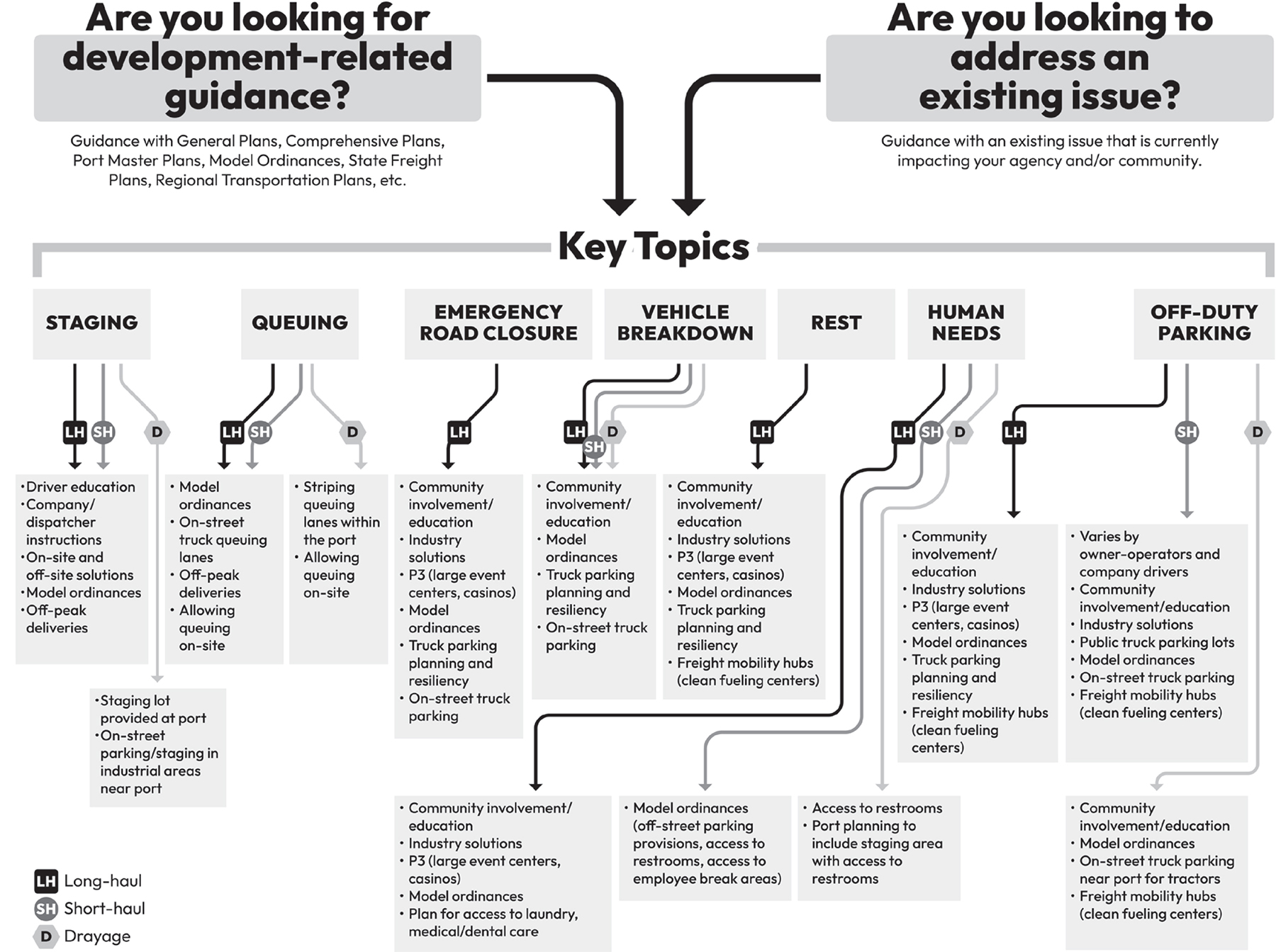
Note: P3 = public-private partnership.
Long Description.
The flowchart from NCHRP Web-Only Document 446: Guide for Truck Parking Regulations depicts the key topics that need to be addressed for different types of truck parking (e.g., long-haul, short-haul, and drayage) when developing truck parking regulations. The guide addresses seven key topics based on long-haul, short-haul, and drayage needs. First, staging needs to address driver education, company and dispatcher instructions, on-site and off-site solutions, model ordinances, and off-peak deliveries for both long-haul and short-haul truck parking. Staging needs to address a staging lot provided at the port and on-street parking and staging in industrial areas near the port for drayage parking. Second, queuing needs to address model ordinances, on-street truck queuing lanes, off-peak deliveries, and allowing queuing on-site for both long-haul and short-haul truck parking. Queuing needs to address striping queuing lanes within the port and allowing queuing on-site for drayage parking. Third, emergency road closures need to address community involvement and education, industry solutions, P3 (large event centers, casinos), model ordinances, truck parking planning and resiliency, and on-street truck parking for long-haul truck parking. Fourth, vehicle breakdowns need to consider community involvement and education, model ordinances, truck parking planning and resiliency, and on-street truck parking for long-haul, short-haul, and drayage parking. Fifth, rest break parking needs to consider community involvement and education, industry solutions, P3 (large event centers, casinos), model ordinances, truck parking planning and resiliency, and freight mobility hubs (clean fueling centers) for long-haul parking. Sixth, human needs need to be considered and addressed through community involvement and education, industry solutions, P3 (large event centers, casinos), model ordinances, and a plan for access to laundry, medical and dental care for long-haul parking. Human needs should be considered in short-haul parking through model ordinances (off-street parking provisions, access to restrooms, access to employee break areas). Human needs for drayage parking need to consider access to restrooms and port planning to include staging area with access to restrooms. Seventh, off-duty parking for long-haul parking needs to address community involvement and education, industry solutions, P3 (large event centers, casinos), model ordinances, truck parking planning and resiliency, and freight mobility hubs (clean fueling centers). Off-duty parking for short-haul parking needs to consider how parking varies by owner-operators and company drivers, community involvement and education, industry solutions, public truck parking lots, model ordinances, on-street truck parking, and freight mobility hubs (clean fueling centers). Off-duty parking for drayage parking needs to address community involvement and education, model ordinances, on-street truck parking near port for tractors, and freight mobility hubs (clean fueling centers).
- Implementation of Research Findings and Products Memorandum. This standalone technical memorandum, referred to as the implementation plan, provides recommendations on how to best put the research products developed as part of NCHRP Project 08-141 into practice. NCHRP Web-Only Document 446 and the implementation plan are available at nationalacademies.org/publications by searching for NCHRP Web-Only Document 446: Guide for Local Truck Parking Regulations.
- Local Truck Parking Regulations Presentation. The PowerPoint presentation describes the project background, objectives, research approach, findings, and conclusions. The presentation is available at nationalacademies.org/publications by searching for NCHRP Research Report 1175: Developing a Guide for Local Truck Parking Regulations.
Additional Research Needs
NCHRP Project 08-141 tackles a multifaceted topic, with numerous subtopics that warrant further research and exploration. Areas that could benefit from additional research include the following:
- Truck Parking Demand Estimation. There is often a disconnect between economic development goals and the provision of adequate truck parking. Current estimation tools from FHWA and the Institute of Transportation Engineers (ITE) could benefit from further examination and improvements.
- Benefit/Cost Analysis of Truck Parking. Understanding the economic impact of truck parking on development decisions and supply chains can help justify the use of public property for parking, which is often seen as less profitable.
- Business Strategies for Public-Private Partnerships. Exploring various formal and informal collaboration strategies can provide context-sensitive opportunities to enhance service delivery and infrastructure development.


