Developing a Guide for Local Truck Parking Regulations (2026)
Chapter: 3 Gaps and Opportunities

CHAPTER 3
Gaps and Opportunities
Introduction
In examining the current practices and the evolving landscape of truck parking and its intersection with zoning regulations in the United States, several critical gaps and opportunities come to the forefront. The challenges the trucking industry confronts raises questions about the effectiveness of existing practices, their consistency, and their responsiveness to the needs of both the trucking industry and communities. This state of the practice underscores a notable void in empirical research of the impact of land use policies on truck parking, casting a shadow over our understanding of the relationship between zoning codes and this essential facet of transportation infrastructure.
Furthermore, despite standardization and regulation of trucking technology, the disparities in the standards applied in different jurisdictions may contribute to confusion and inefficiencies, revealing an opportunity for standardization of truck parking regulations. Yet, there is limited consideration of the well-being and requirements of the truck drivers, whose role in safe and efficient freight movement is paramount. In light of the increased demands on the trucking industry, from the rise of e-commerce to the imperative for eco-friendly transport, there lies an important opportunity for communities to update their zoning codes to better accommodate emerging issues and provide a safer, more efficient, and sustainable future for truck parking in the United States. This chapter explores the gaps and opportunities of truck parking, as shown in Figure 12, highlighting the need for a more coherent, responsive, and driver-focused approach to parking regulations within zoning codes.
Gaps
Several gaps affecting truck parking have been identified in the literature, interviews, surveys, and the stakeholder workshop conducted for the project. Based on input from 21 participants in the stakeholder workshop, safety, security, and community concerns were the top issues related to truck parking. This finding is reflective of observations made during the outreach phase of the project. The following summarizes the gaps affecting truck parking:
- Community Concerns (Gap #1). Negative perceptions of truck parking, such as additional noise, pollution, crime, and decreased property values, have increased community concerns and NIMBY movements across the country, which have led to truck parking bans and route restrictions or trucks being overlooked in the planning process.
- Safety (Gap #2). Lack of truck parking can result in truck drivers parking in undesignated areas, such as on highway on- and off-ramps or along roadway shoulders, creating hazards for other roadway users.
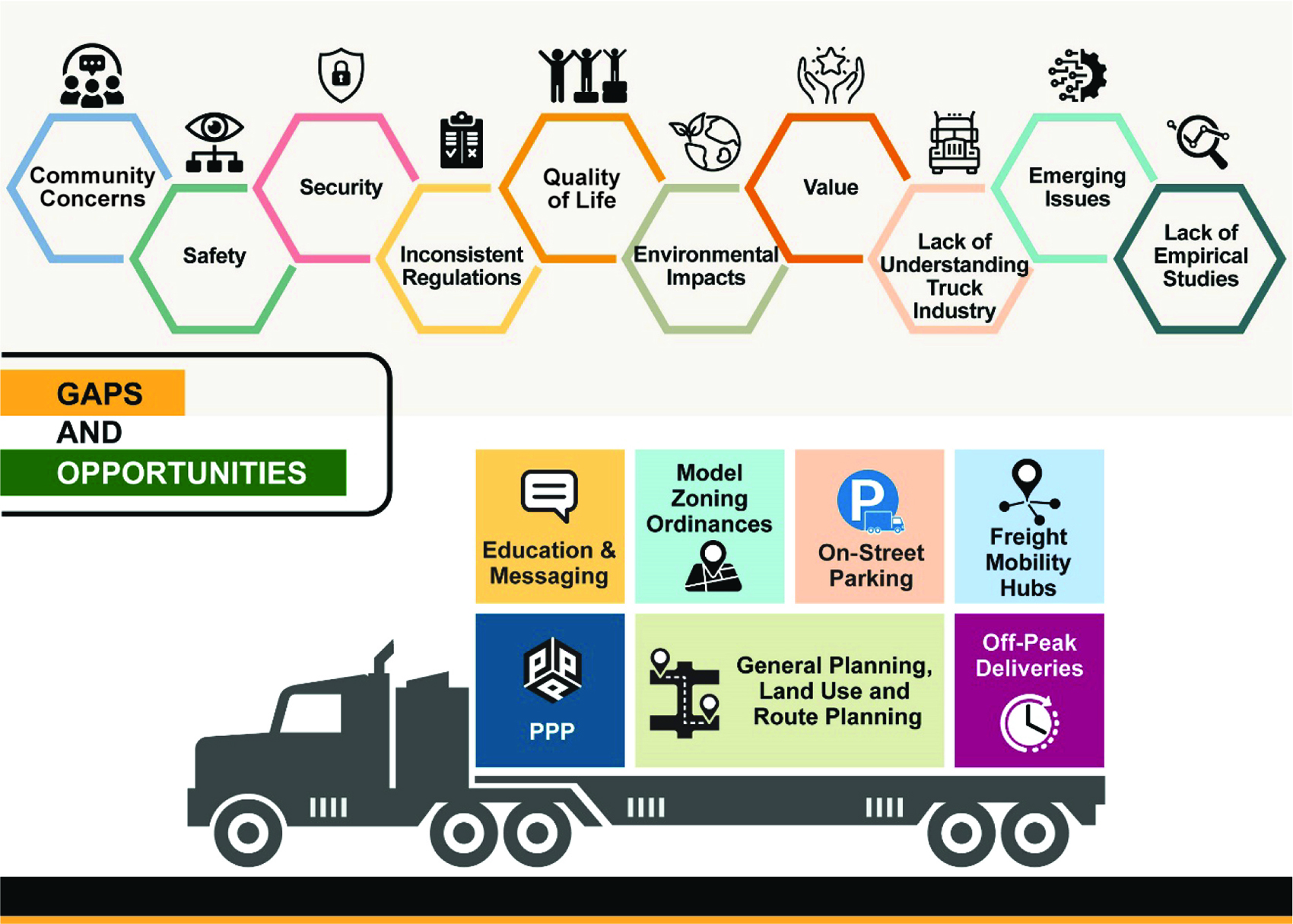
PPP = public-private partnership.
Long Description.
A diagram showing the gaps and opportunities related to local truck parking. The gaps include community concerns, safety, security, inconsistent regulations, quality of life, environmental impacts, value, lack of understanding truck industry, emerging issues, and lack of empirical studies. The opportunities include education and messaging, model zoning ordinances, on-street parking, freight mobility hubs, PPP, general planning, land use, and route planning, and off-peak deliveries.
- Security (Gap #3). The trucking industry is responsible for moving valuable goods across the country; however, the security of the cargo and the driver is often overlooked when it comes to truck parking. Oftentimes, truck parking locations are poorly lit, and there is limited to no surveillance or security, or support services, such as fire, EMS, and police.
- Inconsistent Regulations (Gap #4). Inconsistency in regulations can make it challenging for truck drivers to know when and where they can park. This can lead to additional bans and route restrictions for trucks because there is a lack of education and understanding of truck parking issues and needs, provisions in the municipal code and/or general plan, sewer availability to create new truck parking facilities, and desire by local governments to address the truck parking issue.
- Quality of Life (Gap #5). Industrial communities experience a disproportionate amount of truck parking impacts, which includes pollution, noise, and traffic congestion. Truck drivers also face quality-of-life issues when they are parking, such as insufficient support from the communities that they serve, poor working conditions, lack of understanding of HOS requirements, inadequate safety provisions for drivers (especially female drivers), and lack of available truck parking for drivers near where they live.
- Environmental Impacts (Gap #6). The environmental impacts of truck parking, such as noise, air, and light pollution, are well-known but often unaddressed. Truck parking facilities also generate stormwater runoff due to vast amounts of impervious surfaces, trash and dumping, and a loss of natural habitats and wetlands. The transition to clean truck technologies may provide an opportunity to address these issues as facilities are redeveloped and upgraded to provide clean fueling/charging for trucks.
- Value (Gap #7). Comprehensive solutions to the truck parking problem will require significant collaboration and heavy investment; however, there is a disconnect when it comes to determining who should be responsible for this investment. Once truck parking facilities are developed, they must be maintained, which requires further investment. Because the need for truck parking is not well understood, it is often overlooked as a revenue-generating opportunity.
- Lack of Understanding of the Trucking Industry (Gap #8). The freight industry is complex. Policies that directly and indirectly impact truck parking indicate a lack of understanding of the trucking industry and the needs of drivers. For example, drivers are faced with HOS regulations that strictly limit and control when they must park without regard for where they must stop and how stopping may impact the safety of the driver and the traveling public. Design standards, municipal codes, and general plan policies rarely reflect the needs of the trucking industry.
- Emerging Issues (Gap #9). Most local agencies fail to adequately address emerging issues related to truck parking in their policies, plans, or codes. The growth of e-commerce and emerging fuel technologies should be considered in updates to plans, policies, and codes.
- Lack of Empirical Studies (Gap #10). The literature review highlighted a critical gap surrounding the impact of land use and zoning policies on the trucking industry.
The subsequent sections explore these gaps in further detail.
Gap #1: Community Concerns
Most truck parking and route restriction policies are implemented in response to concerns raised by residents and businesses. These concerns stem from a desire to preserve community character and minimize the negative externalities of trucking, such as pollution and traffic congestion. Elected officials and city staff respond to these concerns with well-intentioned but poorly executed policies since restrictive bans and punitive fines fail to address the root of the problem—a lack of designated truck parking supply. Moreover, while “stick” policies that ban trucks may address a communityʼs concerns in the short-term, these bans often push the problem to an adjacent community and tend to have long-term implications, such as hindering commerce, slowing economic growth, raising costs and vulnerability within the supply chain, and creating undue hardships for truck drivers.
Truck traffic and truck parking concerns raised by residents frequently lead to the implementation of policies that serve to exacerbate the truck parking problem on two fronts. On-street parking restrictions and prohibitions limit capacity for conveniently located and affordable truck parking. Concerns around truck stop safety and quality-of-life impacts prevent the expansion and improvement of existing truck stops, planning and approval of new truck stops, and prohibition of on-site truck parking at truck-generating development projects, such as industrial warehouses. This results in a prominent NIMBY movement in communities of all sizes and geographies where truck parking is banned from most city streets and alternative solutions are not considered or permitted. In fact, in a survey of 28 cities with industrial development, 62% of them prohibit on-street truck parking and 57% prohibit trucks from operating on specific streets. Residents, private industry stakeholders, and cities still have a desire to solve the problem but believe additional truck parking capacity can be better accommodated in neighboring jurisdictions.
Literature on the perceptions of truck parking supports this finding. Trucks are overlooked in most planning decisions and viewed as incompatible with residential land uses, prompting cities to establish wide-ranging and inconsistent restrictions. Additionally, cities prevent the development of off-street alternatives, such as truck stops, and often neglect freight logistics when approving development projects. Suburban areas cite the negative activities clustered at truck
parking facilities (see Gap #3: Security) and the general unsightliness of truck facilities, while high property taxes in urban areas also discourage the development of truck parking facilities, which are typically described as not being the highest or best use of the limited developable land. When off-street truck parking spaces are not required by a cityʼs zoning code, developers typically do not include them because of the higher construction and land acquisition costs.
Trucking and truck parking are largely viewed negatively by community members. Even when residents consider the economic necessity of freight, this is outweighed by concerns about safety, congestion, security, illegal activities (e.g., human trafficking, prostitution, and drugs), pollution, and noise. Notably, interviews of truck drivers and public sector stakeholders agree with this assessment and stress the need for improved education and messaging to reframe the problem and focus on solutions that promote safety, efficiency, and economic growth.
The following feedback related to community concerns was provided by 21 participants representing cities, developers, and the trucking industry during a stakeholder workshop:
- Noise;
- Air quality;
- Roadway maintenance impacts and pavement degradation;
- Declining property values;
- Lack of understanding about truck parking needs;
- Lack of understanding of the benefits of truck parking and the importance of supply chain;
- Safety;
- Negative perception of the trucking industry;
- Too much industrial development can destroy community character;
- Trash, dumping, and waste accumulation;
- Crime magnet;
- Viewshed (views of businesses, signs, and residential views);
- Convincing elected officials that this is an important issue, even if their voters are opposed to truck parking;
- Physical impediment to traffic flow due to staging, queuing, and parking;
- Quality of life for both residents and truck drivers; and
- Traffic congestion.
While community concerns for safety, character preservation, and pollution are valid and play a significant role in the development of comprehensive solutions to the problem, adopting restrictive policies that prohibit trucks from local streets without providing, identifying, or allowing the development of legal truck parking will only exacerbate the problem. Regardless of fines or route restrictions, trucks will continue to use residential streets for overnight parking because they need a safe place to sleep and have nowhere else to go. Policies that work to address this issue should adequately accommodate trucks without affecting communities or the efficiency of the freight system.
Gap #2: Safety
Trucks raise additional safety concerns, especially on local roadways when they are forced to interact with vulnerable road users such as pedestrians, cyclists, and children. Freight can also generate congestion and safety issues without the proper designation of delivery areas or zones and limited delivery hours. In response to these concerns, cities typically use heavy vehicle restrictions and designated truck routes to segregate freight traffic from local traffic and minimize cut-through movements. While truck routes may have special design elements that promote safety (e.g., wider lanes, larger turning radii, and/or straighter alignments that are easier for trucks to navigate), trucks must be able to serve all streets that provide access to
freight-generating land uses. Truck safety is especially crucial in urban environments where space is limited for deliveries and pedestrian and cyclist volumes are higher.
Based on feedback from various participants in a stakeholder workshop, the following concerns were raised related to safety with truck parking:
- Narrowed streets;
- Obstructed sightlines;
- Obstructed regulatory signage;
- Blocked emergency lanes/shoulders;
- Trucks queue up on off-ramps and on-ramps, which is unsafe next to 75 mph traffic;
- Driver safety;
- Rear-end crashes;
- Human trafficking;
- Lack of available truck parking;
- On-street truck queuing or parking (driver safety and other road user safety);
- Trucks parked in undesignated areas;
- Oversized/overweight designated parking;
- Limited or lack of EMS/fire/police;
- Fire risks;
- Driver violations of rest requirements due to distance to parking options;
- Need for safe emergency truck parking near mountain passes, and high-wind areas when highways are shut down; and
- Truck parking limited to industrial areas (the same places unhoused people and people in crisis end up).
As cities consider changes to their street systems and adopt complete street policies (where traditional auto-oriented planning is replaced with a balanced approach considering all modes), many do not designate specific policies or make accommodations for freight. Instead, planners merge freight with traditional autos, overlooking the added risks trucks pose to pedestrians, bicyclists, and users of other modes of active transportation. Implementing policies that specifically address freight movement in the context of complete street planning is critical for cities to sufficiently plan for the safe movement of all modes (e.g., provisions for buffered or fully separated bikeways on streets that serve trucks).
Gap #3: Security
Another issue that frames the truck parking discussion is the issue of security. The high concentration of valuable goods combined with the difficulty of staffing security personnel at truck facilities (primarily in rural areas) make truck parking facilities major targets for theft and crime. Providing truck drivers with designated parking at freight facilities is often viewed as a liability or a nuisance; therefore, parking is typically limited to immediate pickup/drop off at distribution sites, and drivers are typically prohibited from accessing essential services like restrooms. Municipalities are also reluctant to transition vacant public parking lots into truck parking facilities, citing liability and crime risks, as well as maintenance and operations costs. Additionally, independent owner-operator truck drivers (which account for the majority of the workforce) often choose to park their trucks on residential streets in front of their personal residence since this is often the most secure place. Most local agencies prohibit truck parking on residential streets, and off-street truck parking is growing increasingly more difficult to find.
Illegal activity is also disproportionately concentrated at commercial truck stop facilities, with problems such as human trafficking, drug trade, and prostitution prevalent at many facilities. These concerns are used to justify the exclusion of truck parking facilities from cities and are
generally seen as valid, with 77% of drivers surveyed by the project team feeling unsafe when parked. The same survey also showed that security is the most important amenity for drivers at truck parking facilities above other needs like food, showers, and fuel. Security concerns are especially relevant when trucks park in unfamiliar or unstandardized facilities like roadside shoulders or industrial areas. Drivers in interviews reported the need for extreme security measures, such as weapons training, and argue that passenger vehicles and RVs should be prohibited from accessing and parking in truck parking spaces due to security concerns.
The following security concerns were raised by participants in a stakeholder workshop:
- Cargo security,
- Lack of lighting on sites,
- Lack of security at truck stops and truck parking facilities,
- Limited or lack of EMS/fire/police,
- Lack of enforcement in industrial areas—part of a larger enforcement need,
- Enforcement of free truck parking areas (length of stay), and
- Truck parking limited to industrial areas.
Addressing security is a complex issue because it requires collaboration among law enforcement, truck drivers, and public sector and private sector stakeholders. Crime will always be an issue whenever a large amount of valuable goods is concentrated in one location, and electric trucks (which will require additional parking time for charging) will increase exposure time. Until security issues are addressed at privately operated truck parking facilities, drivers will resort to safer alternatives, such as public rest areas and residential streets.
Gap #4: Inconsistent Federal, State, and Local Regulations
Managing truck parking is a problem that crosses jurisdictional boundaries. While all agencies share a common goal of promoting commerce and minimizing impacts on communities, it remains unclear who is responsible for carrying out policies and investments in freight infrastructure. Local governments frequently point to state DOTs and the private sector, while state governments reiterate that land use (and, therefore, parking policies and approvals of new projects) rests solely with local governments. Local governments must balance the requests from their residents, specifically those that call for bans on truck parking or traffic, with economic viability. Cities often create incentives that encourage the development of freight-generating uses to create jobs and generate tax revenue while also adopting truck parking bans to mitigate local impacts. This results in a blame game as state and national leaders argue local governments must cooperate, while local governments stress their lack of resources and public support for solutions. Local policies are inconsistent, and innovative solutions face roadblocks from other levels of government.
Truck parking facilities within development sites, whether at distribution warehouses, commercial and industrial sites, or fueling centers, are an integral part of the transportation infrastructure. Developing foundational or minimal standards for loading, unloading, parking, staging, maneuvering space, provisions for driver amenities, or other functional on-site elements is imperative to ensure the safety and efficiency of the trucking industry. The limited or varied approach to regulating or requiring these elements within local zoning codes often results in a patchwork of ad hoc measures that can hinder the smooth flow of goods and services across the nation.
The literature review shows that local regulations generally take two forms. First, many cities will use parking restrictions, routing requirements, or even bans, which can provide short-term relief. These policies are used following resident complaints and are seen as a simple solution that ignores the complex needs of the freight sector. Alternatively, some cities choose to adopt
policies that better support the freight industry, recognizing the importance that freight has in supporting the local economy. Policies, such as curb space management, delivery permits, OHD programs, and municipal parking facilities, seek to respond to the problem rather than ignore it. A handful of cities choose to embrace freight and have adopted freight studies and plans that include solutions like information sharing, truck parking development requirements, educational campaigns, and public-private partnerships.
Despite progress from some cities, municipalities generally struggle with solving the problem, citing a lack of staff capacity, a lack of available land, community opposition, and overreliance on legacy development policies. Notably, freight-intensive communities surveyed by the project team have had success through collaboration, the use of data, and a recognition that parking bans do not support the freight industry.
Outside local government, the federal government plays an advisory role on the issue, with the recent FHWA Truck Parking Development Handbook outlining development standards and mitigation strategies (FHWA 2022b). Additionally, the federal government encourages collaboration between public and private stakeholders and oversees the NHFN funding program. Federal truck driving regulations, including HOS requirements, also affect truck parking needs and issues. Meanwhile, state governments control most federal funding for truck parking infrastructure, maintain roadside rest areas (primarily in rural areas), and, in some cases, provide guidance on local truck policies.
The following stakeholder concerns during the outreach phase related to inconsistent federal, state, and local regulations with truck parking:
- Lack of education about truck parking issues for staff developing regulations;
- Lack of desire by local governments to provide truck parking;
- Lack of model zoning;
- Complex federal/state/local regulations make it difficult to relate driver needs to residents;
- Every state has different enabling legislation for land use/zoning;
- Inflexibility of liability regulations for commercial sites;
- Lack of sewers available to create a truck stop [e.g., North Bend, Washington (see Table B.2)] outside the urban growth area;
- Public sewer is not legally allowed outside of the city limits;
- Competing maintenance and investment priorities by states;
- Local jurisdictions want industrial development for the tax revenue but may be opposed to truck parking and other driver needs;
- Need for public investment but no support;
- Politicization of trucking and freight operational needs;
- Dillonʼs rule states lack of specific enabling legislation;
- Potential liability for truck drivers parked at industrial businesses or public locations;
- Challenges in getting projects approved;
- Opportunity for regional coordination of practices suited to needs;
- After educating local staff and elected officials, there is staff turnover and new elections, and you have to start educating all over again;
- Incentivize amenity provisions for drivers in site development regulations;
- Prioritizing funding/spending on truck parking;
- Lack of dedicated federal funding for truck parking;
- Banning of commercialization on the interstate system; and
- State-to-state corridor planning for truck parking.
In summary, solving the freight parking problem requires collaboration and consistency between all levels of government. Establishing clear responsibilities for each level of government
and shared priorities will be critical to improving the development and delivery of solutions. Regulations should also be flexible for local contexts yet not too flexible that the outcomes are contradictory.
Gap #5: Quality of Life
Industrial communities disproportionately experience the truck parking problem due to their proximity to freight-generating uses and major highways. The negative externalities from truck parking, including pollution, noise, and traffic congestion, make these communities less attractive and pose challenges for residents. As a result, municipalities may seek to implement parking bans or truck movement restriction policies to prevent further concentration of these problems and make other communities share some of the problem. For instance, the literature review cites Washington County, Maryland, which banned the construction of a new truck stop facility (since the region already had three facilities at the junction of I-81 and I-70) to force neighboring regions in Pennsylvania and West Virginia to consider solutions or experience part of the problem. This behavior may benefit an individual community; however, it fails to recognize the broader regional need for parking or the benefits of locating truck parking facilities closer to interstate highways and logistics centers.
Industrial communities tend to be home to more low-income residents and racial/ethnic minority groups. Wealthier communities may be better positioned to minimize or eliminate truck parking, while low-income/minority areas often experience the negative externalities of truck parking as a result of poor planning decisions. Industries will continue to be clustered in these communities; as such, the focus should shift toward mitigation and involve community members in future planning decisions.
The following list of stakeholder concerns is related to quality-of-life impacts associated with truck parking that were captured in this outreach phase of the project:
- Lack of understanding of HOS requirements.
- Feasible housing options needed for truck drivers.
- Truck driving is a living-wage job, but most drivers cannot afford housing in dense urban locations. This means a 20+-mile commute just to get to their work area (e.g., port/rail/warehousing).
- If delivery points want freight deliveries, they need to let trucks stage prior to and after deliveries.
- Drayage drivers as independent owners are unsupported by public policy.
- Safety for female drivers.
- New immigrant communities make up the majority of new truck drivers.
- Rest as a human need.
- Zoning permissions adjacent to low-income neighborhoods.
- Poor work conditions make it difficult to recruit and train new workers.
- Land use/development incompatibility especially in disadvantaged neighborhoods.
- Lack of available truck parking for owner-operators near where they live.
While ensuring cities and regions have their fair share of truck parking may seem to be the most fair solution, efficiency can be achieved when parking is concentrated in areas that are more conveniently located to industrial clusters or along major transportation corridors. Moreover, the existing built environment and reality that truck bans alone are largely ineffective at curbing long-term parking issues show that a more nuanced approach to the problem must be considered. Potential region-wide mitigation strategies, including impact fees could help offset the negative externalities of truck parking in industrial hub cities while still ensuring a balance between cities. Above all, collaboration is needed in this space, with cities working alongside MPOs, state DOTs, and the private sector.
Gap #6: Environmental Impacts
Current freight emissions are a major problem associated with existing truck parking facilities, particularly in urban and suburban environments where pollution can impact other land uses such as parks and schools. Community opposition and strict regulatory requirements against pollution derail new projects and threaten limited existing parking supply. Other concerns with truck parking facilities, including large impervious surfaces that create challenges with handling stormwater, light pollution, and increased waste, must be addressed by truck parking-intensive communities. These issues are often cited as reasons for restricting truck traffic because they remove the culprit of emissions.
While these issues cannot be addressed directly due to the nature of truck parking facilities, the focus of municipal policies should be on mitigation and developing sustainable alternatives where freight parking can best integrate with the surrounding community. This includes specific development standards that address storm runoff and idling pollution.
Additionally, as truck fleets transition to electric and alternative fuels, parking for the purpose of recharging will become even more important. The availability of high-capacity charging infrastructure will become more important in formalized parking settings because current informal parking options, including streets and vacant parking lots, do not offer charging. Charging infrastructure is expensive and will require collaboration across stakeholders.
Based on feedback from participants in a stakeholder workshop, the following concerns were raised related to environmental impacts with truck parking:
- Runoff from impervious surfaces;
- Air quality, idling trucks/emissions;
- Importance of charging infrastructure;
- Noise pollution;
- Trash and dumping;
- Urine in bottles left on shoulders;
- Excessive vehicle miles traveled due to travel distance to parking options;
- E-trucks and particulate matter emissions due to tires;
- Loss of natural habitats and wetlands due to large spatial needs of truck parking at industrial sites;
- Extreme weather parking considerations;
- Unauthorized maintenance being performed on-site;
- Fire safety of battery technology for EV trucks; and
- Stormwater runoff if not captured (on old sites).
Gap #7: Value
Most comprehensive solutions to the truck parking problem require significant investments from the public and private sector, potentially derailing action. Oftentimes, bans and restrictions are imposed due to their relatively low implementation cost. However, once the downstream impacts on the supply chain are considered, the overall cost of the strategy is much higher in the form of higher business costs and decreased economic activity. Rather than focusing on the required initial investments of truck parking solutions, viewing them from a broader perspective of value highlights the resulting benefits of increased reliability, resiliency, and safety. Resolving the freight parking issue will inevitably require significant investment and coordination of public and private sector resources.
In urban and suburban environments where land is scarce, constructing new designated off-street truck parking is cost-prohibitive. Using vacant public land may not be valuable since
truck parking alone is not a major revenue-generating activity. Moreover, land scarcity presents the issue of trade-offs, where vacant public land may better serve other priorities, including redevelopment. While public land reutilization has had some success, with cities such as Weed, California; Elmira, New York; and Carson, California, receiving fewer resident complaints following the opening of municipal lots, many cities see other opportunities with higher revenue generation potential. Truck parking can also attract more freight traffic to the community, which is not a desirable outcome for most cities.
The private sector also faces cost pressures when it comes to advancing solutions to the problem. The supply of truck parking facilities is constrained by regulation, limited land, and low revenue generation potential from parking alone. Currently, truck stop operators must rely on ancillary revenue-generating services, such as fuel, rest areas, and even gambling, to offset losses from parking. Interviews with stakeholders also revealed that enhancing design standards and imposing requirements, such as electric charging infrastructure, will only increase costs for private sector providers, and parking may not be supplied where it is most warranted. Furthermore, updating zoning ordinances for freight-generating uses will increase construction costs and may discourage future industrial development. Policies, such as off-street freight parking requirements, staging and queuing capacity, on-site driver amenities, and EV charging infrastructure, will mitigate the negative externalities from truck traffic but may stall development or relocate future projects to areas with less restrictive development standards.
The following concerns related to the value of truck parking were raised by stakeholders:
- Public versus private investment into truck parking.
- Public government: state versus local, regional government investment in truck parking.
- Who should be financially responsible for building a $10 to $100 million regional truck stop?
- Who should be financially responsible for road improvements near a new regional truck facility?
- Who will pay to maintain the truck parking lot?
- How do landowners generate income?
- High land costs can make it impossible to build profitable truck parking in some areas.
- Increases in pavement maintenance costs.
- Security costs.
- Affordable housing.
- Many communities are short-staffed and have limited capacity to amend zoning.
- Spatial needs for stacking and parking increase development costs.
- Needs are not broadly understood/supported by the public.
- Finite land resources and specific land-based local government revenue models.
- How truckers are paid is different from most; it affects how and when they can move or park (i.e., truckers are paid per mile or successfully delivered load versus paid by the hour).
Resources may be better used if funds are pooled for regional-scale solutions instead of requiring individual developers to accommodate all freight parking needs. There is also debate between expecting quality solutions or focusing more on increasing the quantity of parking spaces quickly. Low-cost, high-value alternatives, such as allowing for the use of unpaved parking and repurposing underused parking lots during off hours (e.g., shopping mall or stadium parking lots), can address the problem with existing infrastructure but will require specific arrangements to be made among a wide range of stakeholders. Drivers and government stakeholders view these strategies as quick wins but require further evaluation since these policies may come at the expense of security or proper integration within the community.
Gap #8: Lack of Understanding of the Truck Industry
Existing policies around freight movement and storage fail to understand the complexity of the freight industry. The different ownership structures, variation in goods transported, and
complex rules around HOS all must be accounted for in solutions that address the problem. Interviews with drivers reiterate this gap since many expressed concerns with uncoordinated business operations and inflexible arrangements at shipping and receiving sites. Likewise, in interviews, local governments admit lacking complete understanding of freight operations. They tend to apply legacy development codes that view freight as an afterthought and assume a one-size-fits-all approach will work for all freight scenarios.
A majority of truck drivers nationally are independent owner-operators, which makes truck storage difficult since there is no central facility for drivers to return to during their periods of rest. Therefore, owner-operators surveyed said they regularly park their truck at home on their own property, which can be difficult if cities impose residential truck parking restrictions. Oftentimes owner-operators will choose to park in residential neighborhoods due to the higher costs of off-street lots and lack of security at these locations. Developing safe and conveniently located alternatives for owner-operators to affordably park their trucks during their time at home should be a priority.
Additional national freight regulations, such as HOS requirements (where rest is mandated following 14 hours of driving) and ELDs (that electronically track the hours driven by each driver to ensure compliance), work to promote safety but can affect when and where trucks park. Currently, ELDs cause drivers to all begin their trips right at the start and may force drivers to end their trip before reaching their intended parking location in the event of delays, even if it would be safer for the truck to continue to its destination as scheduled. Drivers also face challenges when business operations at shipping and receiving hubs are delayed because few facilities provide queuing space or essential services like restrooms. Reviewing these supplemental policies and providing flexibility when it makes sense are key opportunities to explore.
Many existing design standards on roadways and in parking facilities neglect the unique challenges faced by truck drivers. Many drivers cite issues with limited capacity at public roadside rest areas, difficulties circling through parking lots, and challenges navigating urban streets that lack designated freight curb space. Moreover, existing rest areas are generally of poor quality, lacking basic amenities drivers need, such as restrooms, waste receptacles, and lighting. Thus, drivers will resort to suboptimal parking and rest conditions, which creates a negative perception of trucking and fuels community opposition.
The oversight in zoning regulations is underscored by innovative practices in a few select communities. For instance, the Township of Upper Macungie, Pennsylvania, stands out by mandating the inclusion of rest lounges in new industrial warehouse developments. These rest lounges are proportionate to the number of loading docks in the facility, ensuring that drivers have a dedicated space to relax and recharge. Notably, the townshipʼs approach recognizes the importance of the driverʼs wellness during their mandatory rest breaks, aligning with the goal of a safer and more efficient truck parking system.
While the inclusion of provisions for rest lounges, restrooms, and amenities in zoning codes presents a promising opportunity to enhance the well-being of truck drivers and ensure compliance with federal HOS requirements, it is not without its share of challenges for jurisdictions. While these driver-centric provisions have the potential to significantly improve the quality of life for drivers and contribute to safer and more efficient truck parking, there are several hurdles that need to be addressed, including the following:
- Cost Considerations. Rest lounges, restrooms, and other facilities necessitate an initial investment and ongoing maintenance costs for the developer. Ensuring that rest lounges and restrooms remain clean, safe, and well-maintained requires resources and monitoring, which place an extra cost burden on the developer and may create resistance to requiring these facilities on a development site.
- Space Constraints. Many urban and suburban areas, where the demand for truck parking is high, often face spatial limitations. Finding adequate space or a developer willing to allocate driver amenities within existing development truck parking facilities can be a limiting factor. The allocation of space for amenities must be balanced with the need for parking capacity, maneuvering areas, and other essential elements of truck parking. It requires careful spatial planning and the consideration of the trade-offs involved.
- Regulatory Compliance. Ensuring that driver amenities in zoning codes support federal regulations and standards is essential. The requirement for these amenities must align with the intent by the FMCSA for drivers to meet HOS requirements.
- Stakeholder Collaboration. Collaborating with industry stakeholders, including trucking companies and driversʼ associations, is vital to understanding the specific needs and preferences of drivers. Jurisdictions should engage in meaningful dialogue to ensure that the amenities provided are practical, functional, and genuinely contribute to driver well-being.
While there are indeed challenges associated with incorporating driver amenities into zoning codes for development sites, these obstacles are not impossible to integrate. With careful planning, community engagement, and a commitment to driver well-being, jurisdictions can successfully address these challenges and create zoning provisions that enhance the quality of life for truck drivers and contribute to safer and more efficient truck parking. The goal is to strike a balance between the needs of the industry, the community, and the drivers themselves, fostering a truck parking environment that benefits all stakeholders.
Ultimately, truck drivers are important stakeholders in the planning process and, because of their firsthand experience, they should have an influence on final plans, policies, and ordinances.
Gap #9: Emerging Issues
Emerging issues related to truck parking, such as the growth of e-commerce, and newer fuel technologies, such as electric truck hookups, are not comprehensively addressed in most zoning codes. The rise of e-commerce in recent years has transformed the movement of freight, leading to an increased reliance on the trucking industry to move products to the consumer or client. However, many zoning codes have yet to adapt to the evolving demand for e-commerce. The result is often a misalignment between the designated truck parking facilities and the actual demand generated by e-commerce distribution centers. Such misalignment can lead to congestion, inefficient operations, and disruptions in communities.
Furthermore, the transition toward more sustainable transportation options involves considerations regarding a robust network of charging infrastructure.
Gap #10: Lack of Empirical Studies
The literature review within this report highlights the need to expand on empirical studies regarding the impact of land use/zoning policies on truck parking. It has become challenging to fully understand the relationship between zoning codes and truck parking practices and to grasp the full scope and nuances of the relationship between land use policies and the practices surrounding truck parking.
While some studies, such as FHWA and U.S. DOTʼs 2015 survey, examined factors contributing to truck parking shortages, they only provided a glimpse into the multifaceted challenges (FHWA 2015). Other studies related to zoning or land use and truck parking have focused on challenges in large urban settings for off-loading (McDonald and Yuan 2021), on-street parking (McDonald et al. 2021), and delivery conditions (Kawamura and Menninger 2018), yet there remains a gap in empirically understanding conditions or challenges in more rural and suburban settings.
There is a need for comprehensive, in-depth studies that delve into the intricacies of how specific zoning codes and land use policies affect not only the availability of off-street truck parking spaces but also the overall well-being of truck drivers, community residents, and the efficiency of the freight transportation system. These studies should examine how zoning codes affect various aspects of truck parking facilities, including location, site design elements, and required amenities. Without such knowledge, the ability of communities to craft effective, driver-focused, and community-responsive zoning regulations will likely be limited.
Another key area to explore would be the impact of zoning regulations on truck parking availability and distribution. This research could delve into the correlation between zoning codes and the supply of truck parking spaces, helping policymakers and planners understand the extent to which zoning regulations influence the provision of parking facilities. By identifying these causal relationships, empirical studies can offer data-driven evidence that can inform the revision and enhancement of zoning codes to ensure that they align with the industryʼs demands and community needs.
Moreover, researchers can explore the effects of truck parking regulations on communities. Studies could assess the impact of zoning codes on noise, air quality, traffic congestion, and the overall quality of life for residents in proximity to truck parking facilities. This holistic analysis can aid in striking a balance between the needs of the trucking industry and the well-being of communities. The results of these studies would be informative for communities to identify site development provisions, such as screening, buffering, dock locations, and other parameters that mitigate adverse effects of commercial trucks on surrounding communities.
Additionally, there are opportunities for collaboration and data sharing through a variety of professional organizations and academic institutions. These entities are best oriented to facilitate data collection, analysis, and dissemination of best practices, enabling a more comprehensive and rigorous approach to studying the impact of zoning regulations on truck parking. Regional partnerships between local or regional governments, academic institutions, and industry stakeholders can provide a broader perspective on the issue and promote the sharing of best practices and data-driven policy recommendations.
The potential for broadening the knowledge of truck parking regulations is significant, and the findings can lead to a more robust and efficient regulatory framework that aligns with the needs of the trucking industry while protecting the safety and welfare of communities. By leveraging the power of data and research, an environment where truck parking regulations are evidence-based, consistent, and responsive to the evolving challenges and opportunities in the freight transportation sector is the ultimate response.
Opportunities
While several challenges need to be addressed to solve the truck parking problem, several possible strategies can alleviate these challenges and provide safe solutions that work for all. The literature, interviews, and survey helped to develop the potential strategies and opportunities that were proposed in the stakeholder workshop. Based on input from 14 participants in the stakeholder workshop, land use and truck route planning, public-private partnerships, education, and model zoning ordinances ranked the highest as potential strategies. The following summarizes the opportunities that could alleviate the truck parking problem.
- Education and Messaging (Opportunity #1). Due to the overall lack of understanding about the needs of the trucking industry, more can be done to educate communities; federal, state, and local governments; planners; businesses; and other stakeholders. Drivers also need better messaging about where they can and cannot park.
- Public-Private Partnerships (Opportunity #2). Partnerships between the public and private sectors can lead to inspiring and creative ideas to alleviate the truck parking problem. These partnerships potentially lead to improved maintenance and quality of truck parking facilities along with more amenities that truck drivers want and need and, ultimately, lead to revenue generation and economic development for communities.
- Model Zoning Ordinances (Opportunity #3). While it is important to remember that there will always be unique situations in the freight industry, having a model or standardized zoning ordinance that local governments can use and learn from can help the truck parking problem, especially for truck drivers who may not be aware of local ordinances.
- Land Use and Truck Route Planning (Opportunity #4). Oftentimes, truck routes are inefficiently planned due to community concerns and negative perceptions. These restrictions can overlook the truck industry needs and add to the truck parking problem. Route planning and street design need to be coordinated to avoid unintended consequences. Generally, truck parking facilities are not considered an appropriate use of many land parcels; however, this overlooks the economic development and revenue-generating opportunities that can occur with additional truck parking facilities.
- On-Street Truck Parking (Opportunity #5). While on-street parking is generally a parking location of last resort, local governments—especially those in dense, urban areas—need to accommodate short-term parking for deliveries, and, as a result, there is a need to manage the curb space more efficiently with trucks in mind. Local governments and city planners can implement effective strategies, such as truck-only permitting and parking zones, that can improve truck parking. Communities also need to consider the needs of truck drivers who live in residential areas and have no other place to park their trucks when they are home on their breaks.
- Freight Mobility Hubs (Opportunity #6). Freight mobility hubs have the potential to remove truck traffic from congested areas or areas incompatible with trucks. As a result, these hubs can also provide a safe, secure truck parking location that includes opportunities for amenities that truck drivers want and need, as well as emerging technology and alternative fuel and charging infrastructure.
- Off-Peak Deliveries (Opportunity #7). Using off-peak deliveries can also remove trucks from dense, urban areas where traffic congestion is at its highest. However, incentives may be required for businesses to remain open in off-peak hours. Developing off-peak delivery windows may have the potential for businesses to have a better understanding of the need for truck parking.
The subsequent sections explore these opportunities.
Opportunity #1: Education and Messaging
Many of the existing restrictive policies around truck parking stem from a lack of understanding of the trucking industry. Truck drivers are consumers, too, which is often overlooked. More needs to be done to educate local governments, businesses, and communities that the trucking industry is critical for everyone to get their goods and services, but also truck drivers are spending money within these communities. The trucking industry brings revenue into communities, not only from the goods that are delivered but also from the services that truck drivers undertake when they are parked. Education and awareness campaigns are key steps all stakeholders can take and learn from to ensure policies best support the needs of truck drivers and the industries they serve. The focus of education should be on the economic importance of a healthy freight network and the range of needs truck drivers require.
Education includes multiple components and audiences. State and local governments should focus on expanding training for planners and elected officials to promote policies that take a balanced approach to the truck parking problem. The current lack of understanding of truck parking needs results in short-sighted policies; comprehensive training can highlight other
policy alternatives and key considerations for future policy adoption. Potential strategies such as collaborative workshops, training guides/design handbooks, and ongoing research in truck parking solutions should continue to be expanded on. These efforts will help policymakers gain a better understanding of the needs of truck drivers and the wide variation in operational practices and space requirements. Education at a national and state level is important to ensure consistency between local jurisdictions, while also explaining how cities should adapt policies to local context, recognizing that no single policy can work for all jurisdiction types. Moreover, such education would ideally identify clear responsibilities for each level of government and each stakeholder (i.e., planners, engineers, and economic development personnel).
Beyond educating planners and government officials on truck parking needs and key considerations, education can serve as a powerful tool to counter NIMBY and community opposition against trucking. Community members who express concern with truck parking tend to view the problem on a local scale, ignoring the broader consequences of truck parking bans, such as decreased economic activity and increased concentration of the parking problem. While their concerns are valid and should be considered by elected officials and planners, educating community members on the importance of a healthy freight network and the economic benefits of new developments can remind residents of trade-offs and dispel stereotypes. Furthermore, as industrial development continues to grow in communities, education should emphasize the benefits of economic growth, stressing that trucks can be safely integrated into the communities they serve when infrastructure is designed properly and appropriate accommodations are made. Expanding education also provides opportunities for community engagement in the planning process, where residents can develop workable solutions to accommodate truck traffic and new developments. Education should also focus on explaining best practices for how drivers can safely share roadway space with trucks and the dangers of personal vehicles sharing high-risk areas like rest areas and truck fueling facilities.
Enhanced messaging for truck drivers, shipping/receiving site operators, and truck stop management can help improve coordination between all levels of the freight industry. Drivers need additional information on parking availability and real-time congestion/queuing through mobile applications and DMSs. Moreover, communication on local truck parking regulations, permit requirements, and loading zone availability in advance of drivers arriving at their destination can reduce confusion.
Based on feedback from 14 participants in the stakeholder workshop, the following strategies were raised related to education and messaging:
- Educate elected commissioners about freight needs.
- Educate and hold workshops with the industrial development community.
- Educate local land use/zoning planners about truck parking and how to integrate it.
- Educate other drivers about how to share the road with truckers.
- Educate economic development personnel.
- Engage with organizations such as the APA and the Urban Land Institute to publish articles and sponsor research on truck parking.
- Engage with the community on the benefits of trucks in the community.
- Collaborate with job training sites/community colleges.
- Use marketing campaigns to combat NIMBY.
- Conduct internal (e.g., government/regulating authority/engineering) planning.
- Ensure succession planning so that this niche specialty information is not lost at each agency.
- Parking needs are a regional/state need issue. Cities do not have the ability to provide truck driver information when the drivers are 1 to 2 hours from their borders.
- Improve communications with drivers by implementing more video messaging signs on freeways.
Communities that have addressed truck parking issues through zoning can serve as examples for others. Sharing best practices can improve the state of truck parking across the country. Regional planning agencies, such as demonstrated by the Lehigh Valley Planning Commission and its 2022 Northampton County Freight-Based Land Use Management Guide, demonstrate how information sharing and cooperation on a regional basis can facilitate better implementation of truck parking practices. Sharing best practices is a powerful opportunity to create a collective knowledge pool for communities seeking to address truck parking issues through zoning. Doing so not only facilitates information exchange but also serves as a catalyst for improving truck parking across the country. There are several avenues and platforms through which this can be achieved.
Professional organizations, such as the APA, play a pivotal role in disseminating best practices related to zoning and land use. The APA offers resources, including through its Planning Advisory Service Report series, zoning practices, and continuing education opportunities, which can be helpful training tools for planners and decisionmakers. These resources provide a platform for the systematic exchange of knowledge, offering insights into successful approaches and innovative solutions that can be integrated into zoning codes across the nation.
Industry-specific organizations within the trucking and transportation sectors, such as AASHTO, NCHRP, and TTI, also serve as effective conduits for sharing best practices and have a direct stake in addressing truck parking issues. They can disseminate valuable insights, and reports, and can provide educational opportunities to their members, which include trucking companies, logistics providers, and other stakeholders. By leveraging their industry expertise, these organizations can promote practices that align with industry needs and standards.
The digital age has ushered in new opportunities for sharing best practices related to truck parking regulations within zoning codes. Online platforms, forums, social media, and knowledge-sharing networks can facilitate real-time collaboration and information exchange among a diverse community of stakeholders. These digital hubs can serve as accessible repositories of best practices, case studies, and success stories, offering a dynamic and interactive space for stakeholders to learn from one another, ask questions, and access valuable resources.
Organizing workshops, conferences, and symposiums dedicated to truck parking and zoning issues can foster meaningful dialogue and knowledge exchange. These events can bring together experts, practitioners, and decisionmakers to share their experiences, challenges, and solutions. They offer a valuable opportunity for face-to-face discussions and networking, enabling participants to gain practical insights and build collaborative relationships.
Local, regional, and federal government agencies can establish technical assistance programs to support communities in implementing best practices. These programs can provide direct guidance, expertise, and resources to jurisdictions looking to improve their truck parking regulations. By offering technical assistance, government agencies can facilitate the adoption of successful provisions within their codes and ensure that they are tailored to local contexts.
In conclusion, the sharing of best practices in addressing truck parking issues through zoning is an inclusive and cooperative approach that has the potential to elevate the standards of truck parking facilities nationwide. Whether through regional planning agencies, professional organizations, industry-specific groups, online platforms, collaborative events, or technical assistance programs, there are numerous pathways for knowledge dissemination. By tapping into these opportunities for sharing, communities can benefit from the collective wisdom of those who have successfully tackled truck parking challenges, leading to safer, more efficient, and well-planned truck parking solutions.
Opportunity #2: Public-Private Partnerships
Embracing partnerships between the public and private sectors is a promising solution that can deliver additional parking. Partnerships can work both ways—with the private sector supporting local government efforts and local government incentives assisting with private sector development.
First, local governments interested in unlocking vacant municipal land by converting space into truck parking currently face many roadblocks, such as high construction costs relative to revenue potential, community pushback against large parking lots, and challenges coordinating private sector development projects. Yet, municipalities can overcome these challenges by partnering with the private sector, increasing the profitability and attractiveness of parking facilities. While the specifics of each partnership vary, many existing arrangements rely on leasing or selling public property for private developers and service providers to co-locate on the improved parking lot. Potential services that could be provided by the private sector include vehicle maintenance, truck driver services (e.g., showers, laundry, recreation, and entertainment), and battery-electric truck charging infrastructure. This increased activity will also make parking facilities more secure since traffic is higher and law enforcement has a responsibility to monitor major commercial activity centers. Governments can unlock underused public land, such as land adjacent to freeway rights-of-way.
The public sector can also better support the private provision of parking supply through incentives and flexible zoning codes. By removing onerous requirements like minimum parking requirements for passenger cars, some noise mitigation rules, and rules against off-peak deliveries, developers can redirect construction funds toward needed truck parking. Moreover, governments can expedite permitting and enable creative revenue generation strategies at truck stops. For instance, Louisiana has seen success with allowing truck stops to install a limited number of slot machines at truck stops in exchange for expanding parking capacity and driver amenities.
Localities can also partner with RV parks and other underused properties, such as shopping malls, sports stadiums, and universities, to allow off-period truck parking away from residential streets. This is especially valuable for providing surge parking capacity during periods of high freight demand (e.g., during the holiday season and responding to shocks following disruptions to the supply chain).
The following strategies related to public-private partnerships for truck parking are raised based on feedback from the stakeholder workshop:
- Establish industrial development density bonuses for on-site truck parking and driver amenities provisions.
- Co-locate truck parking with publicly owned facilities, such as RV parks.
- Co-locate with heavy-duty truck EV charging stations.
- Collaborate with local healthcare providers (e.g., Texas Department of Transportation physicals and pharmacies).
- Use gray fields (i.e., paved unused parking lots), airports, malls, and drive-in movie lots.
- Explore local visitor center and truck parking lot development.
- Identify off-street and on-street truck parking in areas to understand existing inventory and needs.
- Use partnerships to develop and operate truck parking facilities.
- Explore nonprofit-sector-led truck parking.
Opportunity #3: Model Zoning Ordinances
The focus of this research project is to develop ordinances local governments can adopt to best manage truck parking demand and improve the integration of freight in communities.
Recognizing this, it is important to develop policies that communities can adjust to fit unique contexts and still be consistent enough to cohesively support national freight needs. This differs from todayʼs approach, where truck parking ordinances tend to be developed locally, are inconsistent, and do not integrate with the broader freight industry.
A handful of cities have adopted a range of policies that successfully manage the needs of freight while responding to concerns from residents. Cities like Chicago, Washington, DC, San Francisco, and Seattle use curb management policies, such as permits, flexible pricing, and larger freight loading zones because freight is important for their economic prosperity, and managing demand is the best approach.
In locations with distribution center clusters, local governments should work together to make sure that warehousing facilities are providing some truck parking as a condition of business in their community since they will be increasing the truck traffic to the area. Just as a certain number of accessible spaces are required for a new business, warehouses and distribution centers should be required to have truck parking if the business will be bringing in truck traffic.
Certain jurisdictions have recognized the need for more defined and standardized regulations for truck parking. For instance, the City of Carson, California, located within the metropolitan Los Angeles area, has taken a proactive approach by setting specific requirements for truck parking and loading facilities within its zoning codes. Carsonʼs regulations are comprehensive, focusing on the efficient movement of trucks. Its standards are tied to a defined typology of loading docks, including large dock-high, small dock-high, large grade level, small grade level, and mini- or self-storage loading docks. Each of these facility types is associated with precise parking requirements, thereby offering a clear, consistent, and driver-centric approach to truck parking.
Similarly, the Township of Upper Macungie in the Lehigh Valley of Pennsylvania has set forth regulations mandating a model approach to truck parking allocation. It has established a connection between the number of loading docks and the provision of on-site truck queuing spaces, ensuring that these spaces are directly linked to the operational needs of the facility. Such specific standards, which directly address the efficiency of truck parking and loading facilities, reduce off-site challenges for drivers, and confusion or frustration within communities, and promote a safer and more streamlined operation for the trucking industry. Standardization can also contribute to improved safety and functionality of truck parking facilities. By defining specific dimensions, maneuvering requirements, and access parameters consistently, local authorities can ensure that truck parking spaces are designed to meet industry standards and safety protocols. Standardized regulations can help avoid situations where facilities lack the adequate space needed for safe operations or where maneuvering is hindered, which can lead to accidents and operational inefficiencies.
Moreover, standardization is an opportunity to address the needs of different types of truck parking facilities, whether in urban, semi-urban, or suburban contexts. It allows local governments to tailor regulations to the specific demands of their communities while adhering to a common framework. For example, an urban setting may require regulations that focus on space utilization, noise reduction, and community integration, while a suburban area may prioritize larger facilities with more relaxed constraints.
Standardization can also foster greater consistency across regions, making it easier for the trucking industry to operate efficiently and safely across different localities. It can reduce compliance issues for trucking companies that operate in multiple areas because the drivers can expect a degree of consistency in the regulations they encounter.
Examples from jurisdictions in this report highlight the opportunity to establish a baseline of best practices to define these minimal standards. The current landscape is marked by a lack of
uniformity and consistency in zoning code provisions, creating a labyrinth of regulations that can be challenging for developers, trucking companies, and local authorities to navigate. Local governments, in collaboration with industry stakeholders and experts, have an opportunity to develop standardized provisions for truck parking in zoning codes. The process of standardization can be a collaborative effort that considers the specific needs of the community, the trucking industry, and residents. By doing so, local governments can create a regulatory framework that is both robust and flexible, promoting safety, efficiency, and clarity while accommodating the evolving needs of the freight transportation sector.
Closing these gaps necessitates a reevaluation of existing zoning codes to incorporate provisions that are responsive to the demands of e-commerce, electric truck infrastructure, and other emerging issues. Zoning codes should consider the location and capacity of truck parking facilities, taking into account the increased need for urban and last-mile delivery centers. Provisions or incentives for electric truck hookups should be integrated to support the growing adoption of cleaner transportation technologies. As the trucking industry continues to evolve, zoning codes must adapt accordingly to ensure that truck parking regulations align with the contemporary needs of the industry, communities, and the impending regulatory mandates set by states like California and the broader community.
Site development regulations within zoning codes should be updated to address emerging issues in the trucking industry, such as the need for electric truck hookups, to support the transition to cleaner transportation solutions. The opportunities for integration are multifaceted, as outlined in Table 5.
By taking these opportunities for integration, local governments can contribute to the advancement of the trucking industry while fostering sustainable and responsive communities.
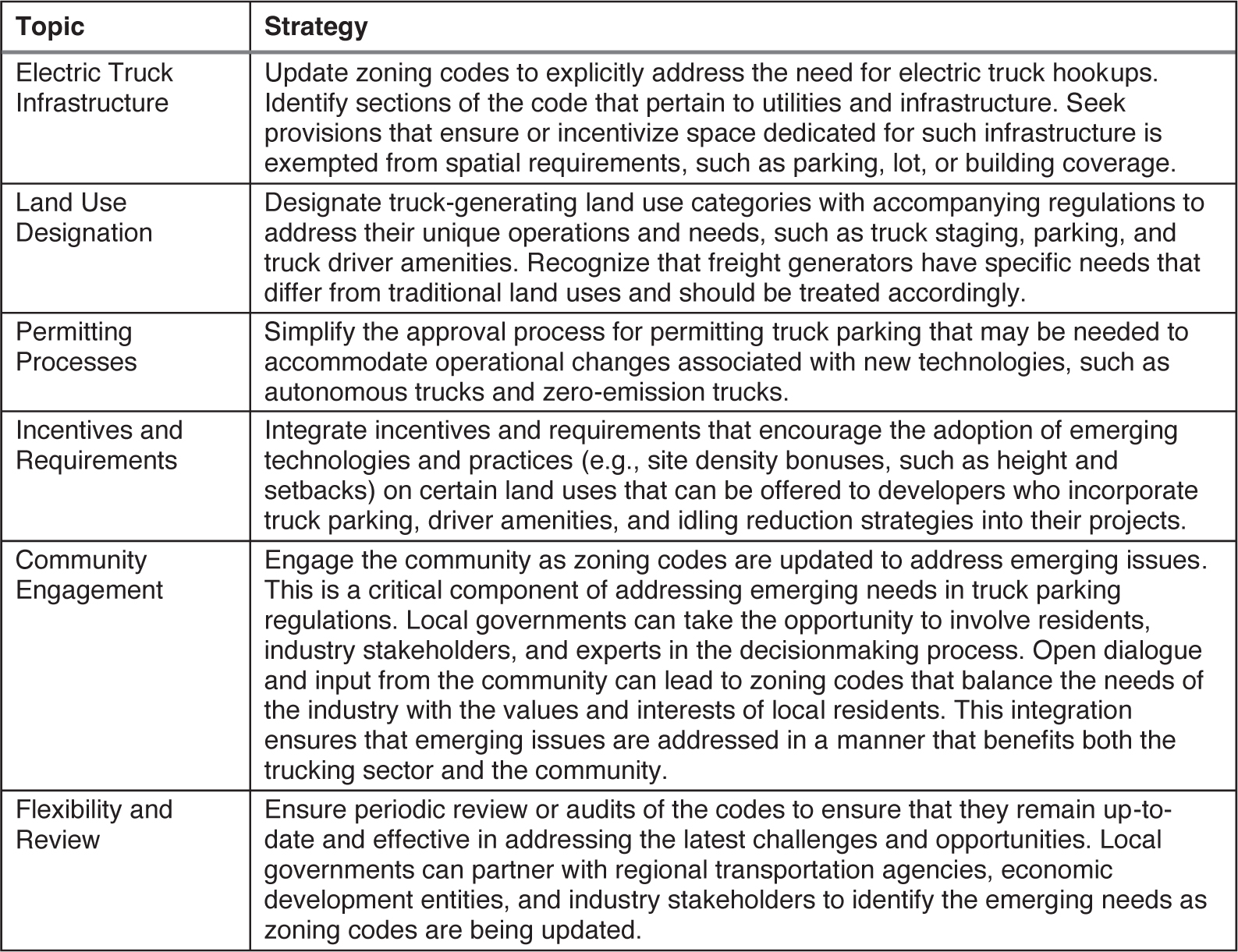
Long Description.
The table has 2 columns and 7 rows. The column headers in Row 1 are: Topic; Strategy. Row 2: Electric Truck Infrastructure; Update zoning codes to explicitly address the need for electric truck hookups. Identify sections of the code that pertain to utilities and infrastructure. Seek provisions that ensure or incentivize space dedicated for such infrastructure is exempted from spatial requirements, such as parking, or for building coverage. Row 3: Land Use Designation; Designate truck-generating land uses categories with accompanying regulations to address their unique operations and needs, such as truck staging, parking, and truck driver amenities. Recognize that freight generators have specific needs that differ from traditional land uses and should be treated accordingly. Row 4: Permitting Processes; Simplify the approval process for permitting truck parking that may be needed to accommodate operational changes associated with new technologies, such as autonomous trucks and zero-emission trucks. Row 5: Incentives and Requirements; Integrate incentives and requirements that encourage the adoption of emerging technologies and practices (for example, site density bonuses, such as height or setbacks) on certain land uses that can be offered to developers who incorporate truck parking, driver amenities, and idling reduction strategies into their projects. Row 6: Community Engagement; Engage the community as zoning codes are updated to address emerging issues. This is a critical component of addressing emerging needs in truck parking regulations. Local governments can take the opportunity to involve residents, industry stakeholders, and experts in the decision-making process. Open dialogue and input from the community can lead to zoning codes that balance the needs of the industry with the values and interests of local residents. This integration ensures that emerging issues are addressed in a manner that benefits both the trucking sector and the community. Row 7: Flexibility and Review; Ensure periodic review or audits of the codes to ensure that they remain up-to-date and effective in addressing the latest challenges and opportunities. Local governments can partner with regional transportation agencies, economic development entities, and industry stakeholders to identify the emerging needs as zoning codes are being updated.
Zoning codes that embrace emerging issues reflect a commitment to innovation, environmental responsibility, and economic progress, ultimately benefiting both the industry and the broader community.
Incorporating truck parking and driver needs into zoning reviews for heavy freight-generating land uses is also critical. All land uses should have designated space for freight deliveries, since sites that lack adequate delivery facilities may cause disruptions and safety hazards to vehicle traffic. Standards for driveway design, clearances in alleys, and minimum sight distances should also be adopted nationally, building on efforts by FHWAʼs Truck Parking Development Handbook. At industrial centers, zoning codes should designate specific areas for loading/unloading, staging/queuing, trailer storage, and long-term parking if drivers reach HOS caps. Staging areas should be conveniently located adjacent to loading areas so drivers do not need to navigate complicated parking lots. Furthermore, since trucks may require EV charging at various points during their journey, ordinances would ideally consider provisions for charging needs.
The most successful zoning ordinances standardize parking space size, curb radii, screening/noise barrier requirements, lighting, and drainage. These standards should be based on best practices and incorporate feedback from truck drivers and freight operators. Drivers should also have access to basic amenities like restrooms to prevent unsanitary conditions and promote driver well-being. Likewise, regulations should address operational procedures, such as delivery windows and restricted access points at warehouses, to avoid staging problems.
Based on feedback from participants in a stakeholder workshop, the following strategies were raised related to model zoning ordinances for truck parking:
- Require on-site truck parking for warehouses, big-box stores, manufacturers, and other truck-generating uses.
- Reform truck parking at the local level that bans truck parking citywide; consider changes that permit truck parking on designated industrial corridors.
- Align staging space requirements with loading dock requirements.
- Standardize truck parking spaces.
- Require driver lounges beyond a threshold of truck parking spaces.
- Provide model site development standards for screening, surfacing, lighting, and drainage.
- Require on-site truck parking at industrial developments for overnight and staging needs.
- Allow other vendors to park at warehouse lots.
- Differentiate between types of commercial freight vehicles and uses.
- Provide adequate trailer storage to accommodate dual transactions.
- Ensure that deployment of EV chargers for passenger vehicles does not take away from commercial motor vehicle parking.
- Code enforcement and education for police and stakeholders.
- Clearly define elements, such as staging areas, parking spaces, and vehicles, in the zoning code.
Finally, in areas where truck parking is difficult to construct due to land constraints or in already developed areas, cities can adopt truck parking mitigation fee programs to allow freight-generating uses to fund alternative solutions in lieu of on-site parking. This can help fund public parking facilities and supplemental staging lots.
Opportunity #4: Land Use and Truck Route Planning
Currently, most truck routes are established to limit trucks on local roadways, often in reaction to community concerns. These restrictions fail to consider the most efficient routing of trucks and tend to concentrate the parking problem on the few roads where trucks are permitted. Routing restrictions ignore the complexity of the trucking industry, including the large number of
independent owner-operators that choose to park in front of their place of residence. Additionally, truck route planning is done at the local level, and routes may end at jurisdictional boundaries even if it would be most efficient for routes to extend beyond city limits.
Local governments should work collaboratively to develop regional trucking routes and regulations. A prominent example of this is the Truck Action Plan in Lehigh Valley, Pennsylvania. The regional plan calls for an education program for municipal officials to foster consistent parking and routing rules. Truck route designations should be consistent across a region and specify routes for through/regional trips versus local-serving trips. Routes should ensure access to all major industrial developments and provide alternatives in the event of road closures or disruptions. Routing regulations can also designate approved vehicle sizes; smaller vehicles should be encouraged for narrow or urban streets where access and curb radii are difficult to navigate with larger vehicles. Plans should also focus on safety, avoiding wide low-volume streets, where speeding is an issue, and critical destinations, such as schools and parks, where possible. Ultimately, communities must recognize that having an incredibly limited truck route network will harm economic prosperity; instead, planners should focus on best accommodating truck traffic within the existing street network.
Land use policies can also work to mitigate residential concerns and provide buffers between heavy industrial uses and residential areas. For example, the Killeen-Temple MPOʼs Mobility 2045 plan calls for designated gaps between truck parking locations and residential uses while also encouraging shared-use parking permits to minimize overall parking needs. Regional planning can also prioritize industrial development near existing freeways/expressways and freight logistics hubs to reduce local traffic and freight vehicle miles traveled.
The following strategies related to land use and truck route planning were raised by participants in a stakeholder workshop:
- Integrate truck movements and truck parking into land use planning.
- Consider truck parking in highway project scoping.
- Establish emergency management/disaster resiliency—evacuation routes.
- Coordinate route planning and street design to avoid unintended consequences (e.g., wide low-volume streets lead to speeding).
- Identify land uses in conjunction with freight routes in regional and local long-range plans.
- Connect government information systems (truck parking information management systems, truck parking availability systems, and local curbside signs).
- Provide signage for routing and truck parking.
- Standardize truck parking data to aid in route planning.
- Provide services for truckers.
To further enhance the functionality and awareness of truck routes, signage should be increased and information should be made available to drivers through mobile applications and at major truck parking hubs. Oftentimes, drivers can be confused about the requirements of each city; centralizing information and developing a single set of nomenclature for route identification are key considerations. State and national transportation officials should lead the rollout of this system.
Opportunity #5: On-Street Truck Parking
Recognizing the need to accommodate rather than prohibit freight movement, especially in heavily urbanized areas without on-site loading facilities, several cities have adopted strategies to manage curb space and on-street parking. The primary goal of on-street truck parking policies is to increase vehicle turnover and maximize capacity. One promising solution involves developing
user-paid permits for deliveries instead of business-paid commercial curbside loading zones. By shifting costs to drivers, they are disincentivized from remaining parked in high-demand areas, and businesses can share loading zones. Chicago embraced a pilot program in 2017 and has seen great success, resulting in expansion of the program throughout the city.
Street parking in most settings is seen as a parking location of last resort, usually when there is no other parking facility or staging area available. Drivers repeatedly raise safety and security concerns with on-street parking yet continue to use public right-of-way because of a lack of alternatives and street parking offers convenient access to delivery sites or personal residences. Improving security along roadways in industrial areas is key to enhancing the quality of this parking option; cities should work to increase lighting in industrial areas and may explore permitting programs to manage who is using curb space in industrial areas.
Paid truck parking permits are another opportunity that local governments can implement to mitigate urban truck parking demand. These permits can allow for truck-only parking during specific time periods, such as before or after normal business hours. These parking permits would be a revenue-generating source for local governments. Ideally, revenue generated from paid parking permits would be put back into the development of future truck parking strategies and implementation of the amenities that truck drivers need, such as restroom facilities, healthy food options, and other necessities.
Feedback from participants in the stakeholder workshop included the following strategies and comments about on-street truck parking:
- Find underused street ends in industrial areas (e.g., as in Seattle).
- In dense urban areas, there is not a place to drop a load and get the tractor to a location with facilities. This links a driver to their load with no way to move independently.
- Permits in industrially zoned areas.
- Some cities permit trucks to park on the street from 10:00 p.m. to 7:00 a.m.
- Permit parking for owner-operators to park their trucks overnight.
- On-street parking can be problematic for narrow streets and turning movements.
- Incorporate curb bump outs for truck parking on the street for industrial and commercial zones.
- Identify clear local truck routes.
- Parking shoulders in cities are typically 7 to 8 feet wide, but trucks are over 10 feet wide with mirrors.
- Designate spots for trucks during loading and overnight.
In residential and commercial settings, community opposition will continue to push cities to adopt parking restrictions and policies that prohibit truck traffic. Rather than adopting blanket bans, cities should work to identify areas that are suitable for parking (e.g., streets appropriately screened from residential areas, streets adjacent to major freeways/expressways), permit these spaces to regulate demand, and develop ways to inform drivers of on-street parking availability via mobile applications to minimize circulating truck traffic. On-street parking can also be used during periods with higher truck volumes, providing a flexible supply. Ultimately, cities should leverage their existing roadway space for parking since it is a solution that can be quickly implemented without high construction or operation costs.
Opportunity #6: Freight Mobility Hubs
Freight mobility hubs are centralized locations where goods movement is managed and freight transfers are facilitated. These locations also provide important services for truck drivers, including fuel/recharging, secure parking, and general amenities. Today, privately owned/
operated roadside truck stops and transportation hubs like seaports, airports, and rail shipping yards, serve as informal freight mobility hubs. These facilities tend to operate in isolation and lack long-term parking and staging capacity. With the advent of autonomous vehicles, developing a network of freight mobility hubs is a promising opportunity that can solve problems regionally and nationally.
Freight mobility hubs serve multiple purposes. Primarily, they can provide an increased parking supply that is safe, predictable, and easily accessible. Drivers waiting for their delivery windows or during their periods of rest can use these facilities without resorting to unsafe or congestion-inducing parking arrangements. Furthermore, freight mobility hubs can offer amenities for drivers that can improve their quality of life. Drivers repeatedly mentioned in their responses to the survey conducted by the project team that they want access to amenities like sleeping quarters, groceries, gyms, and pet grooming, akin to airport terminals. At the very least, freight mobility hubs can provide access to restrooms and refueling, and amenities can be scaled to meet market demands and driver needs.
These hubs can be strategically placed at the junction of major interstate highways, in locations just outside metropolitan areas, and near major industrial development clusters to allow truck drivers to manage their HOS and park outside of urban areas during the evening. Since these facilities will serve longer-distance freight travel, they should be planned and managed by state governments, with involvement from the private sector to support operations and increase revenue generation.
While it is unclear what role autonomous vehicles will play in transporting goods, the need to transfer shipments between autonomous and standard vehicles will be an issue to be addressed. Freight mobility hubs can provide a location for these transfers, especially on the outskirts of urban areas where long-haul autonomous trucks need to transfer their goods to standard trucks for final delivery. Locating freight mobility hubs near industrial centers can also provide opportunities for shipments to be easily transferred to autonomous vehicles.
Equally important to the development of freight hubs is the operation and coordination between freight hubs. State DOTs should consider developing permit/reservation systems to manage capacity, similar to the way air traffic control manages air traffic at airports. Drivers who experience delays or time out of their HOS requirements early should have the flexibility to stop at another freight hub or receive an emergency exemption to travel to their originally planned mobility hub (when feasible). Roadside message signs and mobile applications can provide real-time availability status for drivers.
The following two strategies related to freight mobility hubs were raised during the stakeholder outreach:
- Regional coordination.
- EV/alternative fuel capabilities across the network.
Integrating freight planning into the development of standard mobility hubs is also critical. Alternative delivery strategies like centralized parcel lockers, first-/last-mile e-bike transport, and drones can work to reduce heavy freight volumes, especially on local streets where trucks do not fit the local context.
Opportunity #7: Off-Peak Deliveries
Employing off-peak deliveries (OPDs) where appropriate is another strategy that can minimize peak period and evening parking demand while reducing congestion associated with trucking. This strategy is especially useful in urbanized areas where vehicle traffic congestion can affect
delivery reliability and high truck volumes can cause increased delays for other road users. Cities like New York and Chicago have piloted OPD programs, with varying degrees of success. New Yorkʼs program saved drivers 1 to 3 hours in total service time and 30% to 40% in delivery costs, while Chicagoʼs program determined that businesses need financial incentives to be willing to accept OPD.
As part of an integrated freight movement management system that assigns permits for curb space and loading/unloading, cities can use the pricing of these permits to incentivize OPD and disincentivize peak-hour deliveries. While permits would increase delivery costs, savings could be achieved due to improved reliability and overall delivery speed. Deliveries that must be completed during peak hours would also benefit from improved speeds since nonessential deliveries would be moved to times with more capacity.
Feedback obtained in the stakeholder workshop included the following strategies related to OPD:
- Establish regional coordination similar to air traffic control to help with individual shipper scheduling and encourage OPD.
- Provide urban delivery window incentives for OPD.
- Provide parking for after/before OPD.
- Incentivize businesses to accept OPD if they are not open during off-peak hours.
OPD schemes must be carefully planned due to the complications associated with this policy. Most notably, OPD increases business costs for shippers/receivers, and, in some cases, may not be feasible due to a shortage of available workers for off-hour shifts. Additionally, OPD increases noise during the evening hours, which may not be feasible in commercial areas that are adjacent to residential zones. Daytime parking needs will also increase, warranting additional parking and staging capacity outside of urban areas as drivers wait to complete their deliveries in the off-peak hours.


