Developing a Guide for Local Truck Parking Regulations (2026)
Chapter: 4 Case Studies

CHAPTER 4
Case Studies
Introduction
This chapter presents examples that showcase effective ordinances, regulations, and best practices for truck parking and staging based on rural and urban land uses and geographies. Some of these case studies are also used in NCHRP Web-Only Document 446 to serve as examples.
The case studies described in this chapter were identified through conversations with the NCHRP Project 08-141 panel followed by a review of the available literature, insight from stakeholder survey responses and interviews, a review of Jasonʼs Law top-performing states, and the project teamʼs experiences developing local truck parking solutions. The case studies have the following characteristics:
- Geographically diverse (encompass various regions and states in the United States).
- Varied land use context (includes local jurisdictions in rural and urban settings).
- Truck parking issues/concerns common throughout the country.
- Creative solutions that are transferable to other local jurisdictions (e.g., policy and ordinance solutions, infrastructure investment and intelligent transportation system examples, solutions for short-haul and long-haul overnight truck parking, local delivery staging and short-term breaks, and examples that capture geographical challenges and extreme weather).
The case studies provide creative solutions for addressing local truck parking shortages associated with a variety of causes, such as short-term parking outside of a pickup or delivery location, long-term parking associated with mandated driver rest periods, emergency truck parking when corridors are closed to through traffic or when a truck breaks down, and overnight truck parking for local residents that own trucks.
Case Study 1: Maricopa County, Arizona
MAG Truck Parking Study—On-Site Truck Parking Sample Zoning Language
Maricopa Association of Governments (MAG) is a group of local governments that work together on issues that affect more than 4 million people who live in the greater Phoenix area. MAG conducted a truck parking study to assess commercial truck parking supply and demand in the region. Freight is an essential part of Arizonaʼs economy and delivers food, clothing, gas, medicines, and other essential goods to the region. The movement of goods by trucks continues to grow both nationally and locally. This growth in trucking, coupled with new safety regulations, has created truck parking challenges nationwide, with drivers reporting difficulty in locating safe spaces to park (Maricopa Association of Governments 2021).
The MAG Truck Parking Study assessed truck parking patterns, freight demand, impact of safety regulations, and impact of future technologies on truck parking (e.g., autonomous trucking). It concluded in September 2021 and provided recommendations to address current and future truck parking needs and safe solutions for truck drivers and the surrounding community. The plan serves as a road map for future truck parking solutions. Figure 13 outlines Maricopa Countyʼs updated zoning code, which specifies the requirements for loading and unloading as a result of the study.
Case Study 2: Newville, Pennsylvania
Unilever—Shippers of Choice
Unilever teamed up with Kriska Transportation Group to launch the Safe Haven Program. This program provides drivers with the option to park either on-site or adjacent to Unileverʼs
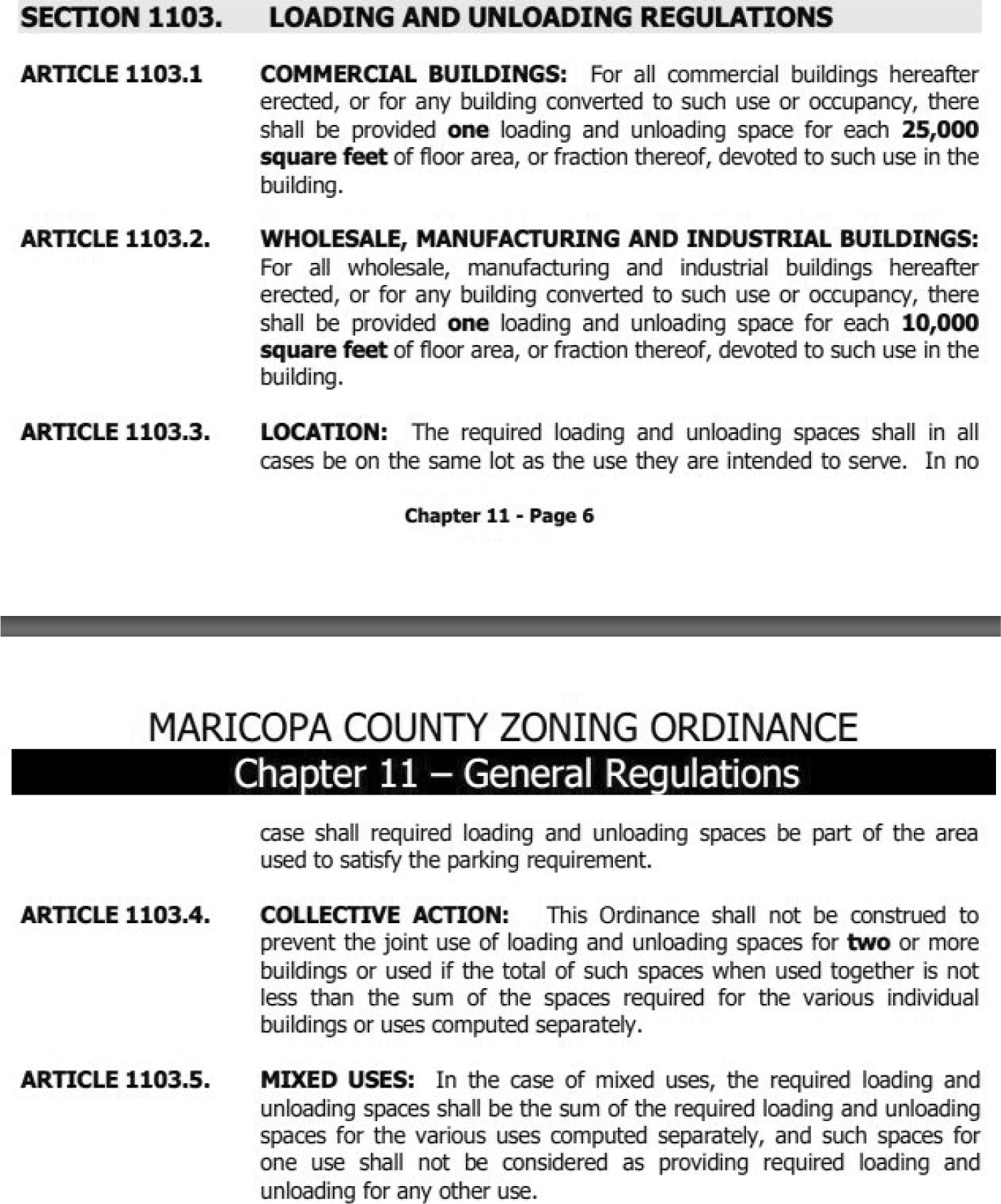
Source: Maricopa County website accessed on 1/19/2025 at: https://www.maricopa.gov/DocumentCenter/View/73124/Chapter-11---General-Regulations-12-15-21.
Long Description.
An image of Maricopa County, Arizona, Zoning Ordinance that reads: “Section 1103. Loading and Unloading Regulations. Article 1103.1: Commercial Buildings: For all commercial buildings hereafter erected, or for any building converted to such use or occupancy, there shall be provided one loading and unloading space for each 25,000 square feet of floor area, or fraction thereof, devoted to such use in the building. Article 1103.2: Wholesale, Manufacturing and Industrial Buildings: For all wholesale, manufacturing and industrial buildings hereafter erected, or for any building converted to such use or occupancy, there shall be provided one loading and unloading space for each 10,000 square feet of floor area, or fraction thereof, devoted to such use in the building. Article 1103.3: Location: The required loading and unloading spaces shall in all cases be on the same lot as the use they are intended to serve. In no case shall required loading and unloading spaces be part of the area used to satisfy the parking requirement. Article 1103.4: Collective Action: This Ordinance shall not be construed to prevent the joint use of loading and unloading spaces for two or more buildings or used if the total of such spaces when used together is not less than the sum of the spaces required for the various individual buildings or uses computed separately. Article 1103.5: Mixed Uses: In the case of mixed uses, the required loading and unloading spaces shall be the sum of the required loading and unloading spaces for the various uses computed separately, and such spaces for one use shall not be considered as providing required loading and unloading for any other use.
distribution centers for staging and overnight rest. The program was developed to make truck parking more efficient and to better use on-site resources for capacity efficiencies. By allowing parking on-site, drivers maximize allowable drive time without the risk of being late to a scheduled appointment. When drivers park (stage) off-site, they frequently spend their limited HOS driving a short distance just to wait in line to enter a facility, and once on-site, they spend more time waiting to access their designated loading dock. On average, truck drivers state that they frequently waste 2 hours of their designated service hours waiting (FHWA 2018b).
Initially piloted at the Newville, Pennsylvania, distribution center (see Figure 14), the program has now been permanently rolled out across all Unileverʼs North American distribution centers and manufacturing plants. The goal of allowing on-site parking is to establish Unilever as a shipper of choice for drivers and ease the stress of adhering to transportation laws. The program has been operating since 2015 without any incidents (FHWA 2018b).
Implementation and Operating Costs
The cost for implementation and operation is unknown, but this has been a joint partnership between Unilever and Kriska Transportation Group.
Key Features
Truck parking is allowed on-site or adjacent to Unilever facilities across North America. Spaces vary by site and are assigned on a need basis, administered by Kriska. Stage on-site and rest parking is allowable. The program began as a pilot initiative, which has been scaled to all sites across North America. This has changed the way business is done, better integrating truck parking needs into the operations of facilities, helping to create efficiency, and allowing drivers to adhere to transportation laws.
Supplemental Information and Application
Kriskaʼs dispatch team is responsible for assigning parking spots at these centers, based on need. While on-site, drivers must adhere to specific safety protocols, including wearing safety vests at all times and carrying a flashlight during nighttime hours, decoupling the tractor from the trailer before parking for the night, and not moving the tractor on-site once parked, except to
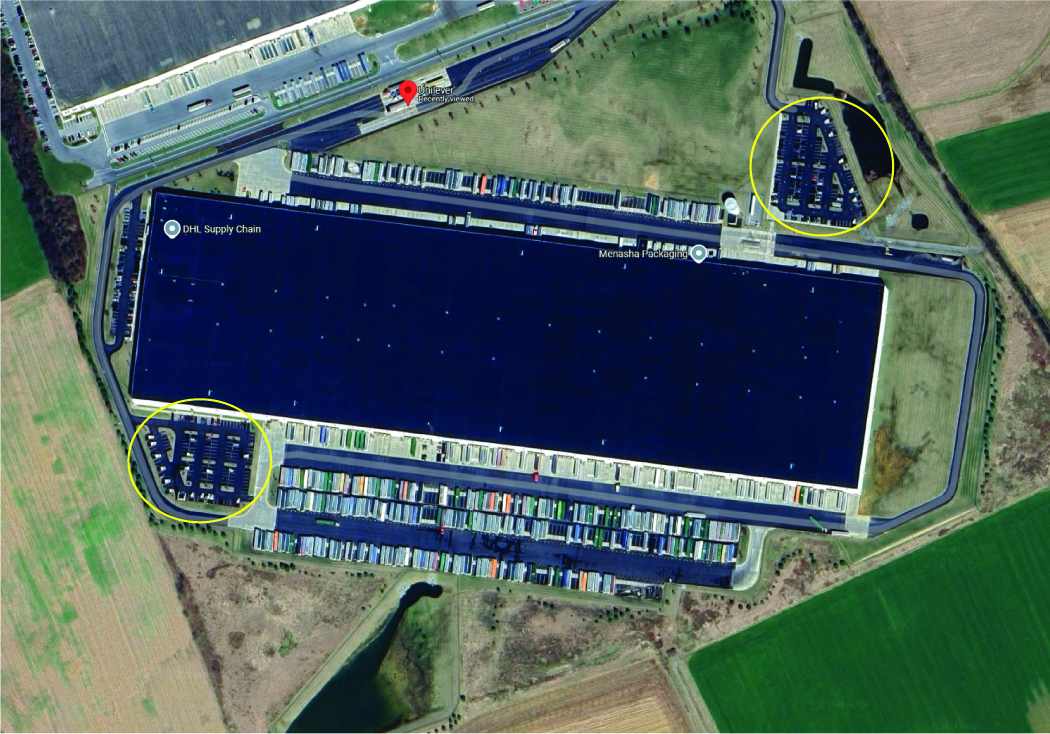
Source: FHWA 2018d.
Note: Two parking lots for truck drivers to stage before/after a delivery (depicted in circled areas).
Long Description.
An aerial view of the Unilever facility in Newville, Pennsylvania showing two staging parking lots for trucks (circled in yellow).
back into the loading dock at their appointment time. As often as possible, Kriska assigns parking spots to trucks equipped with no-idle cab comfort systems to comply with Unileverʼs anti-idling policies (FHWA 2018b).
Case Study 3: Mount Olive, North Carolina
Mt. Olive Pickle On-Site Truck Parking
The Mt. Olive Pickle Company in Mt. Olive, North Carolina, experiences an influx of 50,000 tractor trailer trucks annually, servicing the companyʼs warehouse and distribution centers. The high volume of truck traffic led to impacts on local shopping center parking and heavy truck traffic in the downtown and residential areas of Mt. Olive. In addition, the lack of wayfinding led to drivers getting lost on local streets, and, as a result, their maneuvering damaged utility poles, fire hydrants, and signs (FHWA 2022b).
A public-private partnership between the town, Mt. Olive Pickle Company, and North Carolina Department of Transportation (NCDOT) led to the development of 60 on-site truck parking spaces and amenities, a new direct access roadway from NC 55 to the staging area/truck parking lot, and signage to direct drivers to and from facilities. These comprehensive improvements have enhanced conditions for truck drivers and the community (FHWA 2022b).
Implementation and Operating Costs
The new road and staging area cost approximately $3 million and was implemented via the public-private partnership (P3) between the town, NCDOT, and Mt. Olive Pickle Company. Operating and lot maintenance costs are unknown; it is likely provided by the pickle company as part of its distribution, staging, and warehousing operations.
Key Features
The truck parking site includes the following:
- Parking spaces: 60 truck parking spaces and staging area;
- Operational hours: during operational hours; overnight parking;
- Parking cost: unknown;
- Primary use: rest, staging, and P3;
- Amenities: Scales, break area, restrooms, and refrigeration hookups;
- Security: lighting;
- Maintenance: unknown; and
- Services: locally available.
The installation of Pickle Road connects NC 55 to the staging area and truck parking lot (on Talton Street), alleviating congestion off the main thoroughfares, Breazeale Avenue, Church Street, and Park Avenue, and residential areas and in shopping center parking lots (see Figure 15). GPS routing information sent to the county helps optimize trucker navigation. Wayfinding signage assists with further directing truckers to the proper routing.
Supplemental Information and Application
There may be barriers to the development of such a facility at other agencies due to local zoning requirements and policies. The primary benefits of such a facility are that it concentrates parking supply at the point of staging demand, improves driver conditions, and helps to achieve shipper of choice status with the carriers (FHWA 2022b).
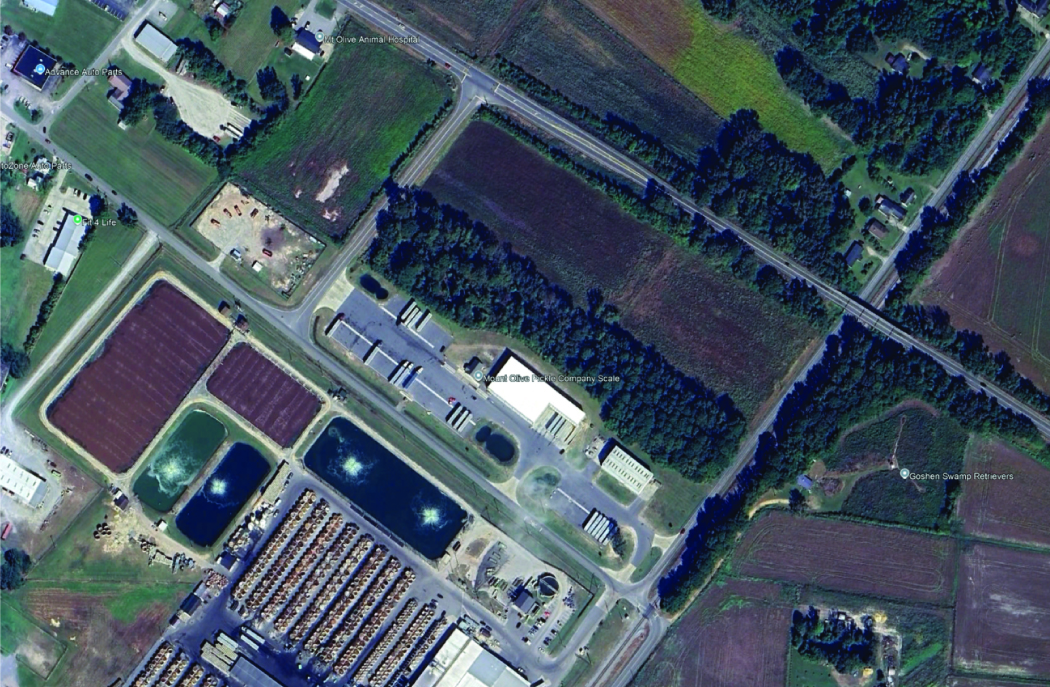
Source: Google Maps, accessed on January 3, 2025.
Long Description.
An aerial image of the truck parking for the Mt. Olive Pickle Company.
Case Study 4: Moreno Valley, California
World Logistics Center Master Plan—Development Agreement Requires 7- to 10-acre Truck Parking Facility
The World Logistics Center Master Plan development, covering 2,610 acres in Moreno Valley, California, is designed to support up to 40.6 million square feet of logistics operations. As seen in Figure 16, the facility includes three land use designations: logistics development (LD) for high-cube logistics warehouses, light logistics for smaller warehouses, and open space to preserve open areas. The plan also details necessary infrastructure improvements, including roads, water, sewer, utilities, and stormwater management, with a focus on safe and efficient circulation (City of Moreno Valley 2015).
For truck parking, the plan includes designated truck parking lanes for limited duration parking, ensuring unobstructed through traffic and avoiding overnight parking. The circulation system directs heavy truck traffic to and from SR 60 and Gilman Springs Road, avoiding residential areas, with specific routes and roundabouts to facilitate efficient movement. Logistics support sites within
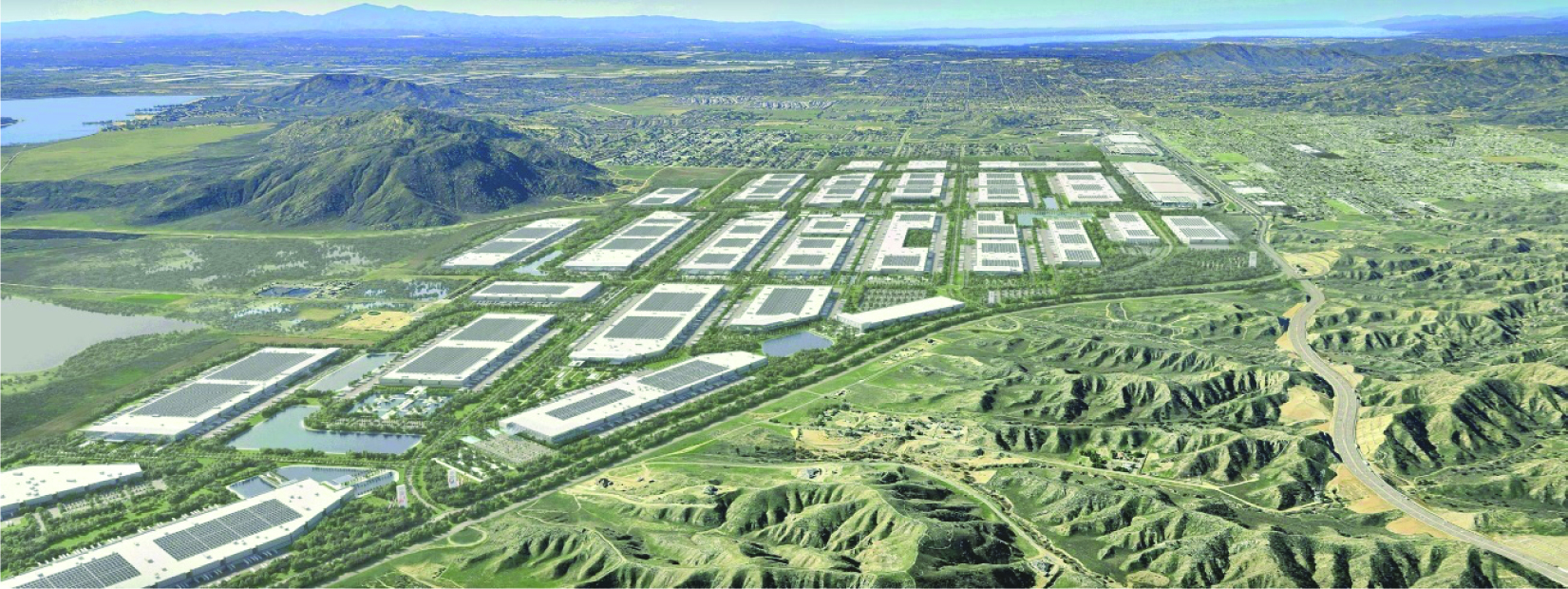
Source: Highland Fairview.
Long Description.
An aerial view with a conception of the planned World Logistics Center.
the LD category will provide services like fueling facilities and limited commercial uses for truck operators. Special edge treatment areas will create buffers between the logistics center and adjacent land uses, featuring setbacks, landscaping, and measures to screen truck activity from view (City of Moreno Valley 2015).
A settlement came about as a result of legal challenges and environmental concerns raised against the project. The agreement was reached to address these concerns and to ensure the project could proceed while balancing development with environmental protection and community benefits; there are specific outcomes relating to truck parking (i.e., dedicated 7 to 10 acres of truck parking).
Implementation and Operating Costs
The total cost of the project is estimated to be $25 billion, and the truck parking portion would be a significant subset of that total cost. The actual cost is not known (City of Moreno Valley 2015).
Key Features
Through the master planning and settlement agreement, a 7- to 10-acre on-site truck parking facility will be implemented to discourage parking in residential areas. The facility will include fueling, trucker services (e.g., food service, showers, and resting), truck washes, a repair facility, and auxiliary power unit plug-ins for each designated Class 8 truck parking spot. Conduit and pre-wiring will be provided to accommodate potential heavy-duty truck charging facilities. Ongoing private security will be provided within the truck service area. Sufficient on-site truck parking will accommodate all trucks reasonably expected to visit the World Logistics Center. Permanent signs in English and Spanish will inform truck drivers of the on-site amenities (City of Moreno Valley 2015).
Supplemental Information and Application
Truck parking lanes are designated on some sections of the circulation system to allow for limited duration stops, all other street parking is prohibited, and no overnight parking is allowed on streets (see Figure 17). The plan prohibits residential streets and neighborhood parking outside of the facility with a $1,000 fine to encourage truckers to park on-site. Signs will be installed within 1 mile of the facility to display “no-truck parking” information. Trucks will not be permitted to travel along certain roads (i.e., Cactus Avenue and Redlands Boulevard).
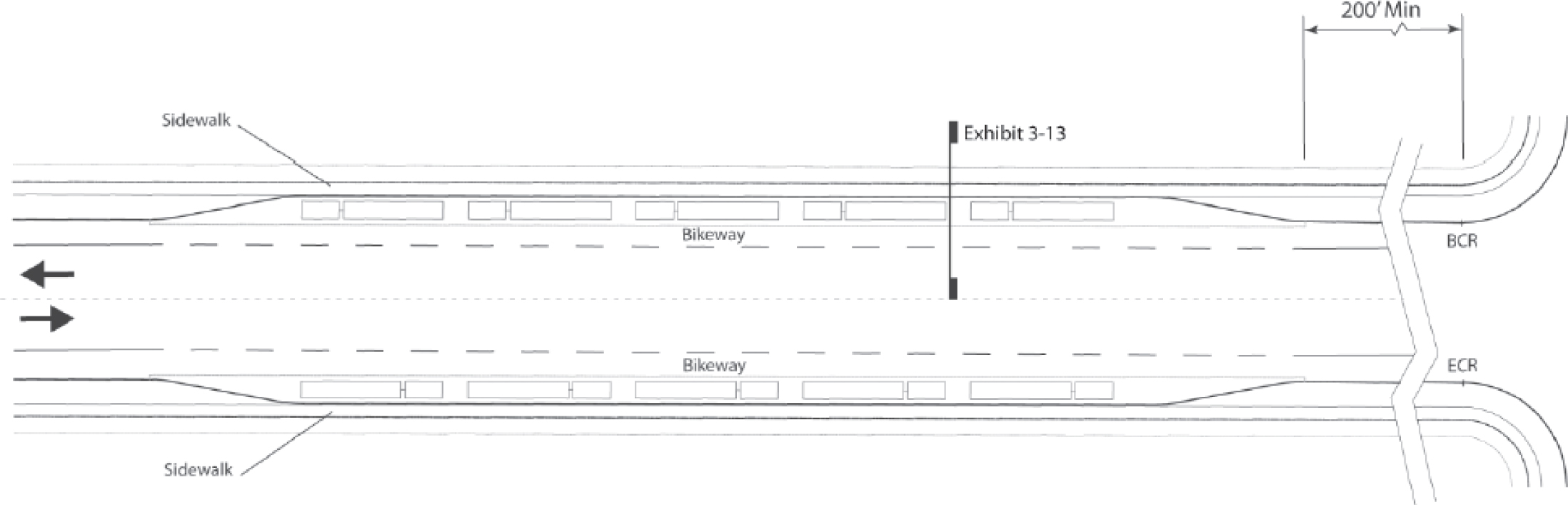
Source: City of Moreno Valley, California. World Logistics Center Specific Plan (November 24, 2015), Page 187 (Exhibit E-19).
Long Description.
A drawing of the roadway design for the planned World Logistics Center, showing minimum on-street truck parking (200 feet), sidewalks, and bikeways.
Physical measures will be designed and installed to discourage trucks from turning in prohibited directions when entering or leaving the World Logistics Center (City of Moreno Valley 2015).
Case Study 5: Lehigh Valley, Pennsylvania
Lehigh Valley Truck Action Plan
Unique to Pennsylvania, municipalities are required to provide locations for all land use types, including truck stops/travel plazas, in their general plan land use elements and zoning codes. However, the state allows for multijurisdictional land use planning and zoning whereby a group of cities may develop a land use plan and zoning code that allocate specific land uses to one or more of the cities where the use is most compatible. This multijurisdictional approach eliminates the need for a truck stop in every city. This region showcases several good examples of collaborative multijurisdictional planning to address regional truck parking needs, such as facilitation of multijurisdictional land use planning guidance and support, information and guidance on how to address truck parking (Lehigh Valley Planning Commission 2020), and model zoning code ordinances, land use policies, and development standards for industrial warehouse development, such as requirements for off-street truck parking, loading, and staging/queuing, as well as truck driver access to restrooms and break areas.
Case Study 6: Rancho Cucamonga, California
Industrial Warehouse Truck Access Regulations
Rancho Cucamonga updated its municipal code to require industrial warehousing projects to provide on-site truck queuing and truck staging locations. Residents were growing concerned about an influx in industrial warehousing development, most notably, the long lines of trucks queuing up and staging on local streets as truck drivers wait to access the facilities. Truck parking is not a permitted use within the city because it is not considered the highest and best use of the cityʼs limited and high-value land. This land use prohibition applies to truck stops as well as to industrial warehouses. Provisions for truck driver parking for federally mandated breaks is not allowed to be accommodated at the industrial warehouses due to resident concerns with idling (emissions and noise). This case study focuses on off-street truck queuing and staging as well as loading space requirements. Some of the key code updates include the following:
- All industrial uses shall provide a minimum of one loading space per proposed loading bay.
- For every 10 loading bays proposed, a minimum of one on-site truck queuing space must be provided.
- Each on-site truck queuing space shall be a minimum of 9 feet in width and 65 feet in length and shall be included in the circulation management plan if required by the approving authority.
- The entrance gate to all industrial buildings shall be a minimum of 135 feet from the public right-of-way.
- One parking space for a trailer is required for each loading dock door. The minimum dimensions of a single trailer parking space is 50 feet in length, 14 feet in width, and 14 feet vertical clearance (City of Rancho Cucamonga n.d.).
Case Study 7: Seattle, Washington
Port of Seattle On-Street Truck Parking
The Port of Seattle and SDOT focused on stakeholder coordination (i.e., local government, property owners, and trucking community) to define truck parking needs, identify feasible
options, and implement solutions. The key milestones for the cityʼs efforts consist of collaborative stakeholder engagement with Port of Seattle staff, truck drayage drivers, and local residents and businesses. In July 2022, SDOT introduced legislation to the Seattle City Council to establish specific industrially zoned areas where truck tractors (that are typically owned by independent owner-operators) would be permitted to park overnight (see Figure 18). Many of these independent owner-operators of drayage trucks reside near the Port, but in most residential areas of the city, trucks are prohibited from parking on residential streets. This poses a challenge for truck owners. Leasing a parking space is cost-prohibitive for most drivers. SDOT worked closely with the port to develop a truck parking solution that would reduce truck driver stress, minimize impacts on local neighborhoods, reduce truck vehicle miles traveled searching for parking or parking off-port, and ensure efficient drayage operations by creating parking certainty for drayage drivers. Truck parking spaces are provided at a few locations throughout the Port. The spaces allow for the cabs to be parked overnight, and when the owners start their workday, they swap out their truck for their passenger vehicle. Passenger car parking is prohibited from 6:00 PM to 10:00 PM to ensure the spaces are reserved for trucks when they end their workday. This policy intends to reduce the amount of truck tractor parking in Georgetown and South Park and to keep truck tractors closer to the port to limit environmental impacts.
Case Study 8: Oakland, California
Port of Oakland/City of Oakland Shipyard Redevelopment—Development Agreement Established Truck Parking Requirements
The West Oakland Truck Management Plan (TMP) is an action-based plan designed to reduce the effects of transport trucks on local streets in West Oakland, California. The TMP is the result of a joint planning effort undertaken by the Port of Oakland and the City of Oakland with substantial input from West Oakland residents, workers, trucking and other businesses, community groups, business organizations, underrepresented community members, and other stakeholders. The need for the TMP was identified during the CEQA analysis completed in 2002 and again in 2012 for redevelopment of the former Oakland Army Base (OAB). As part of the OAB redevelopment, the city and the port were both required to dedicate 15 acres each (total of 30 acres) for truck parking within the Port of Oaklandʼs jurisdictional boundary (port). Currently,
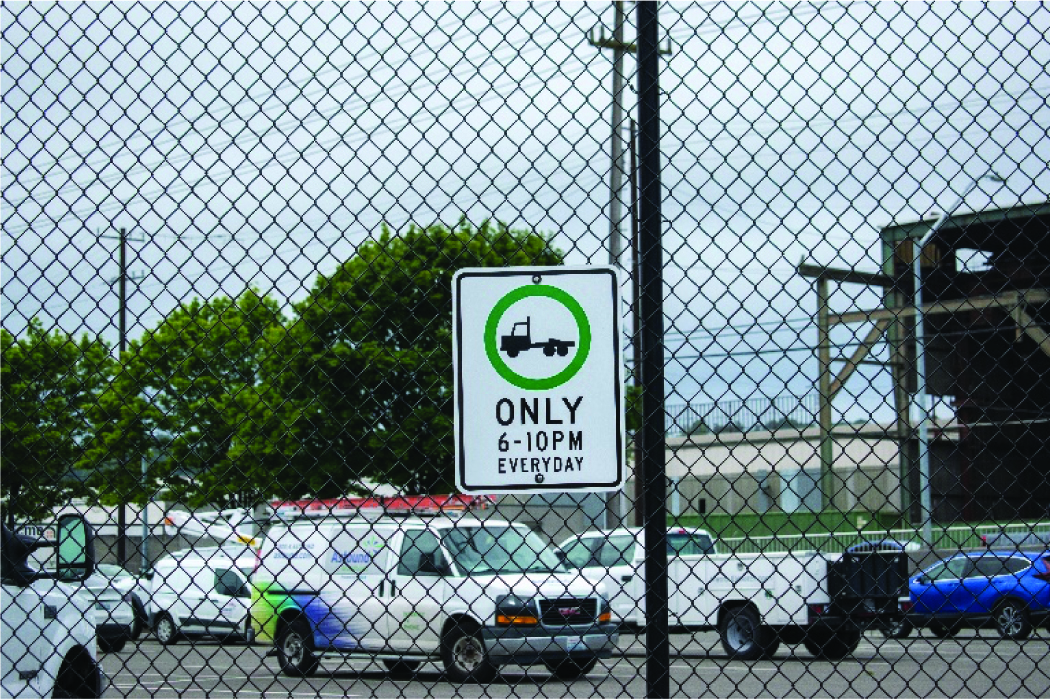
Source: Fehr & Peers (2024).
Long Description.
A sign on a fence that shows a picture of a truck in a green circle with the words “Only 6-10pm Everyday”. The image shows vans and passenger vehicles in a lot behind a fence.
truck parking is designated on 61 acres located in three different areas of the port and is only 74% used (City of Oakland/Port of Oakland 2019).
The Oakland City Council adopted new parking regulations in April 2022 to limit truck parking in West Oakland (City of Oakland/Port of Oakland 2019).
Figure 19 shows the only locations where truck parking is legal in West Oakland, based on these new regulations.
New signage in support of West Oaklandʼs new truck parking regulations was installed in 2022. The Oakland Department of Transportationʼs (OakDOTʼs) Parking Enforcement (PE) unit completed work in support of these regulations, including training of technicians, programming citation enforcement systems, and conducting a community meeting in August 2022. PE responds to requests from the community to enforce violations on almost a daily basis. After receiving citations, several West Oakland businesses with trucking operations worked with OakDOT to find ways to comply with the new regulations (City of Oakland/Port of Oakland 2019).
Implementation and Operating Costs
The implementation of truck parking on the former OAB was developed on land acquired through the base acquisition process. The current West Oakland Truck Parking Management Plan received a funding allocation of $2.35 million from the port for installing truck routing and parking signage, engaging stakeholders, improving intersections near the port, and increasing truck routing and parking enforcement.
Key Features
Key features include the following:
- Truck parking provisions focused on drayage trucks at the port.
- On-street truck parking provisions to serve West Oakland businesses.
- Collaborative strategies aimed to protect the community, support local businesses, and maintain efficient port drayage operations.
Case Study 9: Elmira, New York
City Truck Parking Lot
The City of Elmira, New York, demonstrates how adequate truck parking provisions can be provided, devoid of federal funding and formal studies, to address local parking impacts within the community and garner public support and efficiently used spaces. The city revised an existing multiuse trailhead parking lot (already zoned commercial/industrial) for truck parking (see Figure 20). This was in response to a lack of truck parking in the city, and the realization that large trucks (big rigs) were being parked along narrow streets and on residential lawns when truck drivers would come to visit friends and family.
The city sought an implementation approach with limited impacts on the community that could garner strong public support. No formal study was conducted for the parking lot, nor were federal funds used (absent of Jasonʼs Law). Using an existing parcel that matched zoning needs ensured that sensitive areas like residential land uses were not affected. Locating the lot near the main interstate ensured convenience and mitigated impacts to local streets. The city implemented the needed elements to accommodate truck parking, including resurfacing and adding a parking fee kiosk. Fees collected were used to operate and maintain the lot.
Early use of the truck parking spaces was low but has grown to 80%. This is in part due to added signage and Google Maps information, but most notably through word of mouth between drivers. With 30 available spaces, formalized marketing has not been needed.
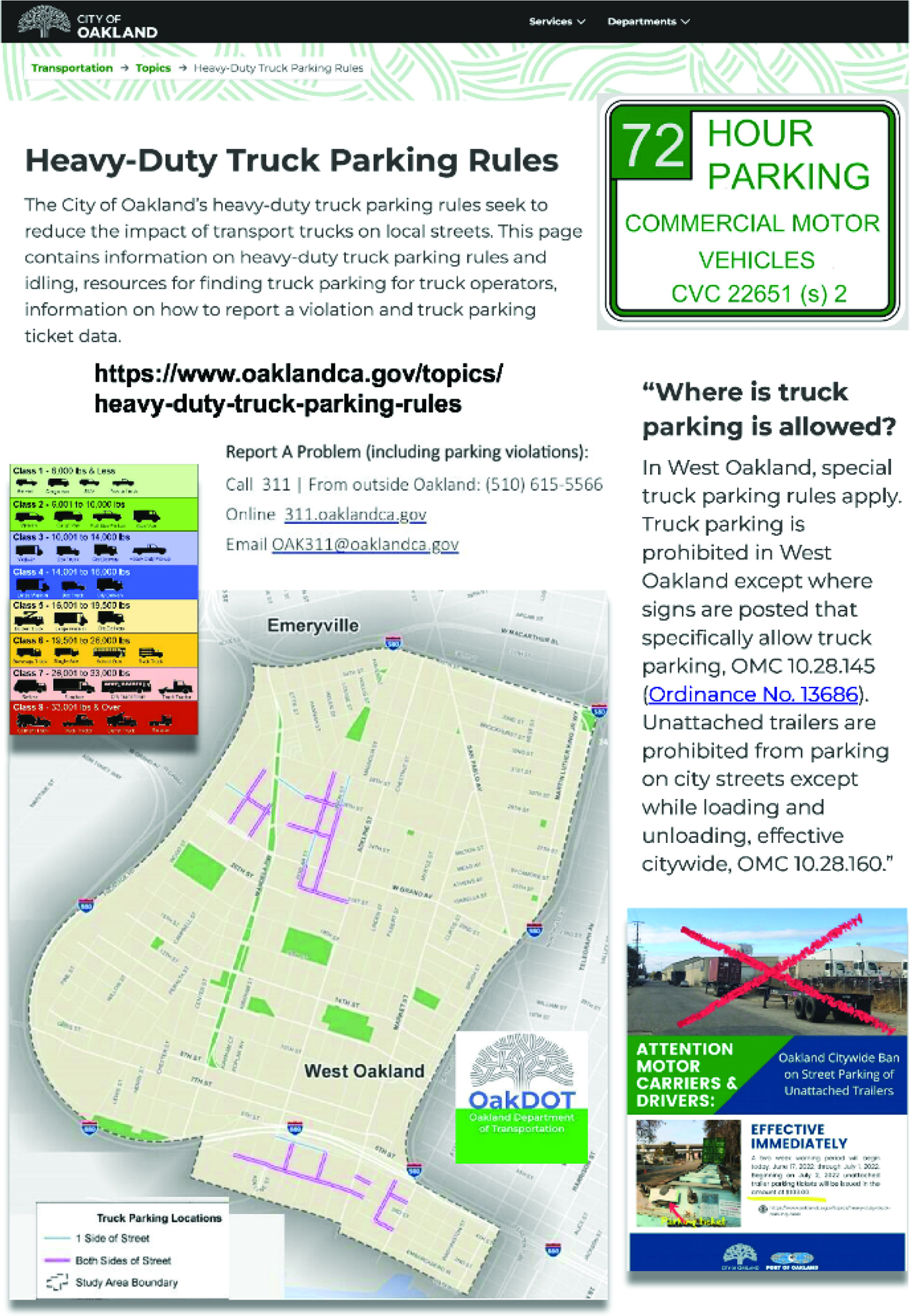
Source: City of Oakland Heavy-Duty Truck Parking Rules. Accessed on 1/19/2025 on the website at: https://www.oaklandca.gov/topics/heavy-duty-truck-parking-rules.
Long Description.
A flier showing the heavy-duty truck parking rules for Oakland, California. It states: “The City of Oakland’s heavy-duty truck parking rules seek to reduce the impact of transport trucks on local streets. This page contains information on heavy-duty truck parking rules and idling, resources for finding truck parking for truck operators, information on how to report a violation and truck parking ticket data. ‘Where is truck parking allowed? In West Oakland, special truck parking rules apply. Truck parking is prohibited in West Oakland except where signs are posted that specifically allow truck parking, OMC 10.28.145 (Ordinance No. 13686). Unattached trailers are prohibited from parking on city streets except while loading and unloading, effective citywide, OMC 10.28.160.’” The image shows a map of truck parking locations and the vehicle classes allowed, signage posted throughout the city, and information on how to report a problem (including parking violations): Call 311 | From outside Oakland: (510) 615-5566, Online: 311.oakland c a dot g o v or Email: OAK311@oakland c a dot g o v.
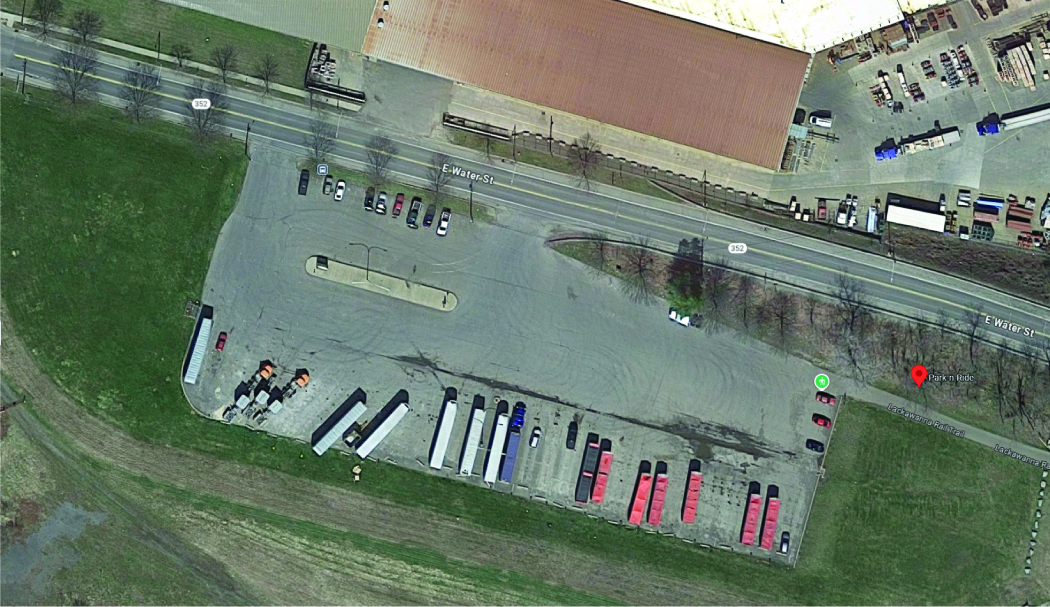
Source: Google Maps, accessed on January 3, 2025.
Long Description.
An aerial view of a truck parking lot in Elmira, New York.
Implementation and Operating Costs
The cost of implementation was low since the parcel was already municipally owned. Resurfacing and striping were performed and a parking fee kiosk was installed for a cost of $40,000 in 2015. The parking lot fees cover the cost of maintenance and operations of the parking lot. Little to no profit is made by the city to operate the parking lot.
Key Features
Key features include the following:
- Parking spaces: 30 spaces with no reservations;
- Operational hours: parking lot is open and available 24 hours, 7 days a week;
- Parking cost: parking rates are $5.00 daily, $30.00 weekly, and $50.00 monthly for 30 spaces;
- Primary use: parking and staging;
- Amenities: electronic parking fee kiosk;
- Security: LED lighting and regular police patrols;
- Maintenance: refuse collection, regular street sweeping, and resurfacing (as needed); and
- Services: 5- to 10-minute walk to downtown or be picked up, take transit, or drive.
Supplemental Information and Application
The parking fee rates could be increased in the future, but the city has balanced providing essential amenities for drivers over making profit. All proceeds are used to maintain and operate the lot. This case study is helpful to understand how best to garner both public support and truck driver industry support in a win-win scenario. An existing parcel was used that met zoning needs, was co-located with a multipurpose trailhead to increase activity and reduce crime, and was positioned near the primary interstate highway, which is far enough away from residential parcels. For agencies with limited resources or access to Jasonʼs Law funding, this case study could inform siting a truck parking lot with the principles used in Elmira.
Case Study 10: Weed, California
Municipal Truck Parking Lot
The City of Weed, located off I-5 approximately 50 miles south of the Oregon border, constructed a municipal parking lot of about 30 spaces for truck-only parking, catty-corner to a
Pilot truck parking facility to address truck parking spillover. This location near the existing Pilot facility provides drivers with access to amenities at the Pilot facility. Parking is free and available for up to 72 hours or longer with special permission from the city. The city has issued fewer than five truck parking-related tickets to truck drivers throughout the community (FHWA 2018b).
Implementation and Operating Costs
States, cities, and municipalities are increasingly looking for ways to add truck parking capacity using innovative funding mechanisms.
Some states are converting existing property or constructing new truck parking adjacent to truck stops. This allows drivers to take advantage of the services (e.g., restrooms, food) offered by truck stops without the state having to construct these amenities. Some arrangements are formal, others are informal. There is an opportunity to create a P3 arrangement with a truck stop for operation and maintenance of the state facility (FHWA 2018b).
However, should an agreement be entered into, truck stops are usually concerned with liability and maintenance costs. This is a potential impediment to the development of P3 relationships for this purpose (FHWA 2018b).
The Weed truck parking facility is an example of a P3 with a nontraditional funding agreement to create additional truck parking.
Key Features
Key features include the following:
- Thirty truck parking spaces are free of charge.
- The lot is located across the street from fast-food restaurant.
- Lot is also close to two sit-down restaurants and a Pilot Travel Center.
- On-street truck parking is permitted on the adjacent streets (Shastina Drive and Black Butte Drive).
Supplemental Information and Application
The truck parking lot has been a significant success story. The city is committed to providing more truck parking and continues to seek out a new location.
Case Study 11: Springfield, Georgia
Loveʼs Truckstop Serving Underserved Communities
Loveʼs partnered with the community in Springfield, Georgia, to develop a travel plaza that could address community needs and Loveʼs primary customers, truck drivers. Unique aspects include the following:
- Community collaboration,
- Fresh kitchen concept that serves truck drivers and the community,
- Seventy-four truck parking spaces,
- Showers,
- Laundry facilities,
- Dog park,
- Certified automated truck (CAT) scale, and
- Towing and on-site maintenance and repair services.
Case Study 12: Evanston, Wyoming
Wyoming Department of Transportation Road Closure Data and U.S. DOT Supported Emergency Truck Parking
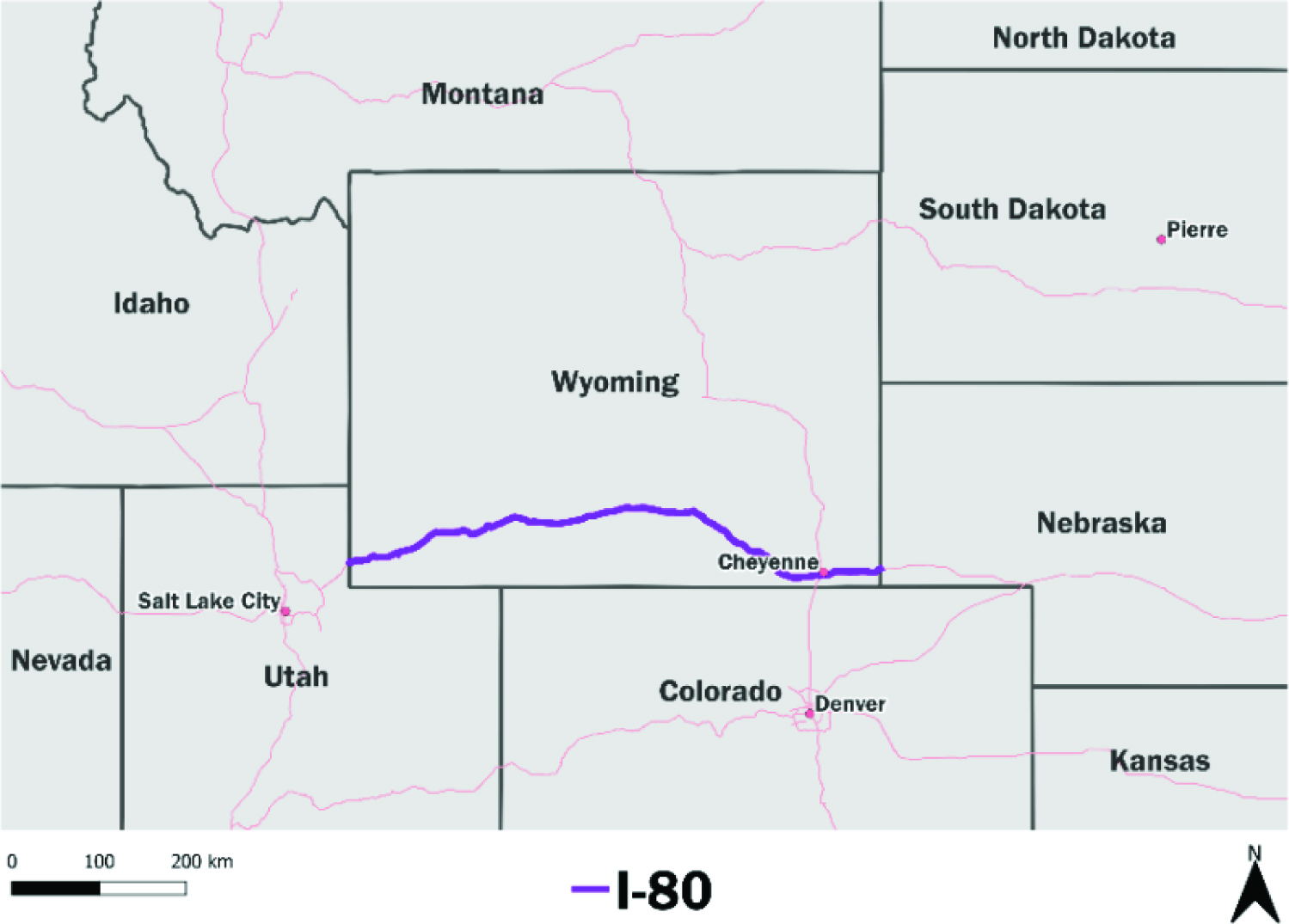
Evanston experiences significant strain due to closures of I-80 (the primary east–west travel and commerce corridor) resulting from crashes and adverse weather conditions. During closures, the city and interstate become congested as trucks seek parking and wait for I-80 to reopen. This leads to congestion on local roads, at local businesses, and in any available space.
Secondarily, when the Wyoming Department of Transportation (WYDOT) closes I-80, travelers and commerce are rerouted onto county roads, which are often even more dangerous during inclement weather. WYDOT expanded third-party access to road closure data through Situation Data Exchange (SDX), which was developed in partnership with support from Wyoming Connected Vehicle Pilot, a project funded by U.S. DOT and an engineering and environmental consulting firm (U.S. DOT n.d.).
The SDX stores and distributes data collected from wirelessly connected vehicles, including WYDOT fleet vehicles and snowplows. Navigation companies with access to the SDX have a reliable source of real-time travel information, including weather advisories, variable speed limits, road-closure notifications, and vehicle weight restrictions (U.S. DOT n.d.).
The third-party adoption (i.e., Google Maps) of high-quality SDX road-closure data can help drivers avoid unsafe conditions and find truck parking. The City of Evanston, through a 2023 truck parking study, has identified three potential locations using a data-driven approach. In addition, U.S. DOT has awarded WYDOT a grant to install a 365-truck parking lot along I-80, which would meet the demand of truck parking needs when SDX data support WYDOT road closures.
Implementation and Operating Costs
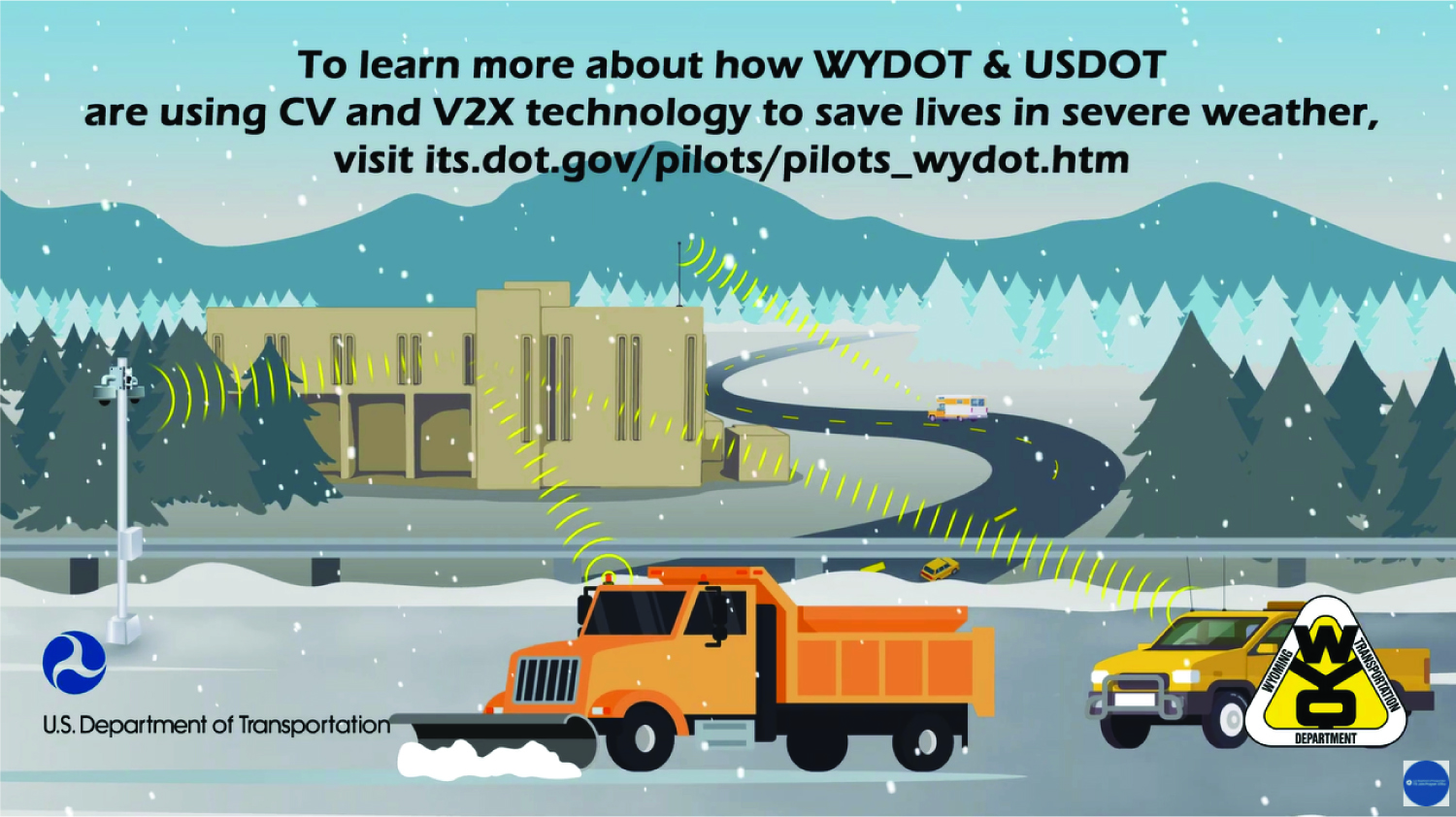
WYDOT has been awarded $26.6 million from U.S. DOT to build hundreds of new truck parking spaces along I-80 in Evanston. The SDX was developed as part of the Wyoming Connected Vehicle Pilot, which was funded by U.S. DOT, as shown in Figures 21 and 22.
Source: U.S. DOT n.d.
Long Description.
A flier showing information for severe weather in Wyoming with a snowplow and a yellow truck on a snowy road. The flyer says: “To learn more about how WY DOT and US DOT are using CV and V2X technology to save lives in severe weather, visit I t s dot gov slash pilots slash pilots underscore wy d o t dot h t m. The flyer includes a logo for US DOT and WY DOT.
Source: OpenStreetMap, U.S. Census Bureau, and U.S. DOT.
Long Description.
A map of the state of Wyoming showing the 402 miles of I-80 with a CV deployment.
The pilot project, including the development of the SDX, received a grant of approximately $4.4 million (https://www.itskrs.its.dot.gov/sites/default/files/doc/WYDOT_CV_Pilot_Case_Study_FINAL_508c_V3.pdf). This funding supported the creation of a centralized data retention and distribution system for connected vehicle data, enhancing road safety and efficiency in Wyoming (U.S. DOT n.d.).
Key Features
Key features include the following:
- Parking spaces: 365,
- Operational hours: 24 hours, 7 days a week,
- Parking cost: unknown,
- Primary use: emergency road closure,
- Amenities: restroom,
- Security: lighting,
- Maintenance: unknown, and
- Services: unknown.
Supplemental Information and Application
A truck parking lot study was completed in 2023 to identify potential locations using a data-driven approach. The following selection criteria for the lot were that it should be within 2 miles of I-80; be undeveloped or partially developed land; have a slope of 6% or less, with 2% or less preferred; and be a minimum of 5 acres. This is a good example of a grant-funded project that leveraged data to optimally locate the lot to best meet the demand of truck parking along I-80.
Case Study 13: Buffalo and Niagara Falls, New York
Technology Solutions for Truck Parking During Border Crossing Closures
The Buffalo-Niagara border crossings can be closed or experience long crossing wait times due to weather, traffic congestion, or safety-related reasons. A variety of technology solutions are being used with planned expansion to monitor and inform drivers of available truck parking options in real time. The Niagara International Transportation Technology Coalition (NITTEC), in collaboration with the Buffalo Regional Integrated Mobility Management System, is primarily responsible for gathering data and messaging outputs to drivers/partners.
The system uses transportation inputs, like border wait time data, weather forecast data, parking availability through detectors and software systems, and border crossing closure status, to deliver messages to connected devices to optimize routing, driver timeouts, and suggested parking options. This can be configured through connected vehicle infrastructure, smart phone applications, and a 511 system. A comprehensive assessment of these data through the system helps direct drivers to available parking, part of the parking management services arm of the system.
Implementation and Operating Costs
Funding has been provided through grants from FHWA ($7.8 million), to NITTEC for the Advanced Transportation and Congestion Management Technologies Deployment project. Related data collection projects, all of which support in the advisory of border closures to support decisionmaking for truck parking (e.g., border wait time data system), have been funded by FHWA.
Key Features
The key features of this case study are technology driven, as compared to truck parking lot features:
- A comprehensive multi-input transportation system and software service to assess real-time truck-related travel impacts (i.e., border closures, parking availability, weather forecasts, and delays);
- Grant funded multiregional coordination and support for continuous technology enhancements for travel monitoring and advisories;
- Higher fidelity parking data, using machine learning analytics, sensor infrastructure, and integration into a web interface;
- Connected vehicle technology with embedded devices and data fusion of vehicle-to-infrastructure data in regional transportation management systems; and
- Support of freight efficiency, promotion of safe operation and adherence to operating hour maximums, and improvement of border crossings through decreased congestion.
Supplemental Information and Application
Emerging technology solutions are currently being used, but new and higher fidelity data are being onboarded with increasing adoption, which will improve the connected vehicle messaging and truck parking insights sent to drivers. Not all the system infrastructure is in place now, and iterative changes will need to be made for a complete and higher accuracy transportation management system. However, this is a good example of using the FHWA grant to fund a data-driven approach to monitor delays and closures and assign parking information to drivers in real time.
Case Study 14: Crow Wing County, Minnesota
State Legislation That Permitted Commercialization of a State-Owned Facility
The Brainerd Lakes Area Welcome Center in Minnesota was funded through a P3 and is sited in the middle of the highway right-of-way. A gift shop featuring local products helps financially support the operating costs of the facility. The site provides separate, short-term truck parking that is accessible from both sides of the highway as well as bathrooms and vending machines. The site is operated as a rest area and has 30 truck parking spaces (FHWA 2018b).
The center required special state legislation (Minn. Stat. Ann. §§160.84 to 98) to create a unique P3 with the Brainerd Chamber, Crow Wing County, Minnesota DOT, Minnesota Department of Natural Resources, and Minnesota State Patrol.
Implementation and Operating Costs
The legislative process cost is unknown, and the implementation cost is generally considered to be medium-high cost. If truck parking is installed on the right-of-way already owned by the municipality, some cost saving is assumed.
Key Features
Key features include the following:
- Parking spaces: 30 truck parking spaces,
- Operational hours: 24 hours, 7 days a week,
- Parking cost: $0.00,
- Primary use: Rest area,
- Amenities: outdoor seating and restrooms,
- Security: lighting, and
- Services: visitor center, gift shop (open 10 a.m. to 4 p.m.), and vending machine.
Supplemental Information and Application
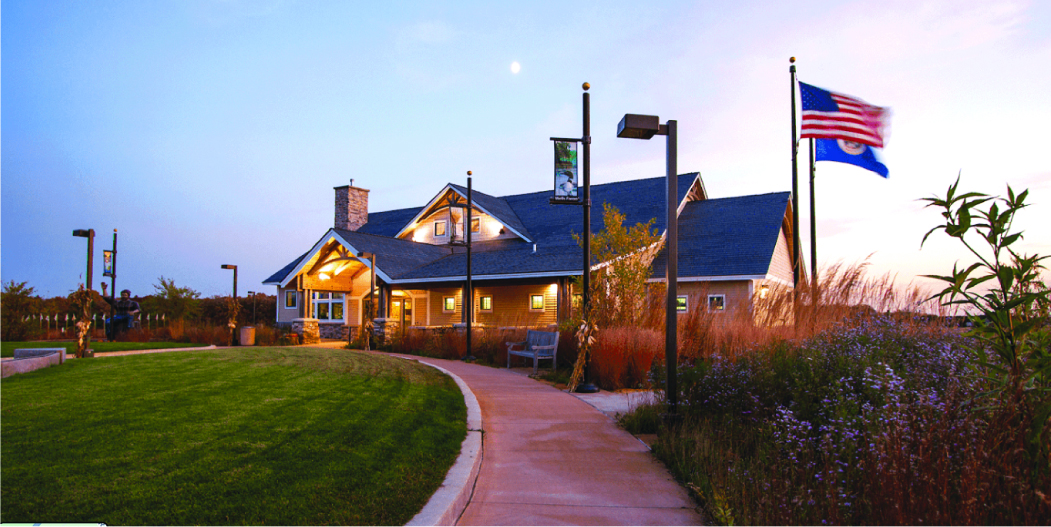
The Brainerd-Baxter Travel Center in Minnesota, as shown in Figure 23, is an example of a state-owned facility that was commercialized through specific state legislation. Agencies without such legislation can follow a similar process to commercialize properties and provide essential truck parking amenities.
The key legislation that facilitated this commercialization is part of Minnesotaʼs broader efforts to enhance its transportation infrastructure and support economic development. The legislation
Source: Brainerd Lakes Chamber of Commerce.
Long Description.
A visitor center building with a lawn, benches, a path, lighting, and flags.
typically involves amendments to existing statutes or the introduction of new bills that permit the leasing or management of state-owned properties by private entities.
Case Study 15: Fallbrook, California
I-15/SR 76 Rideshare Lot/Truck Parking Facility/Service Station
The parking facility located at I-15 and SR 76/Pala Road in Fallbrook, California, serves both commuters looking to carpool or transfer to public transportation as well as truck drivers in search of a safe place to park. The parking lot is adjacent to a gas station that provides a full convenience store and restrooms for travelers.
The dual-use parking facility provides safe access for autos, transit buses, and trucks by separating the entrances for the park-and-ride lot and the truck parking lot. The facility is well-lit and regularly patrolled to ensure safety and security for all users (TransNet n.d.).
Implementation and Operating Costs
The truck parking lot was part of an improvement of the interchange with an overall project cost of $202 million (2017). This project was funded with a combination of local, state, and federal funds, specifically: the regional TransNet half-cent sales tax for transportation, federal funds, developer fees, County of San Diego Transportation Impact Fee, and Native American tribesʼ contributions (TransNet n.d.).
Key Features
Key features include the following:
- Convenience store,
- Restrooms, and
- Open 24 hours, 7 days a week.
Case Study 16: Harford and Cecil Counties, Maryland
Maryland Transportation Authority in Partnership with Areas USA
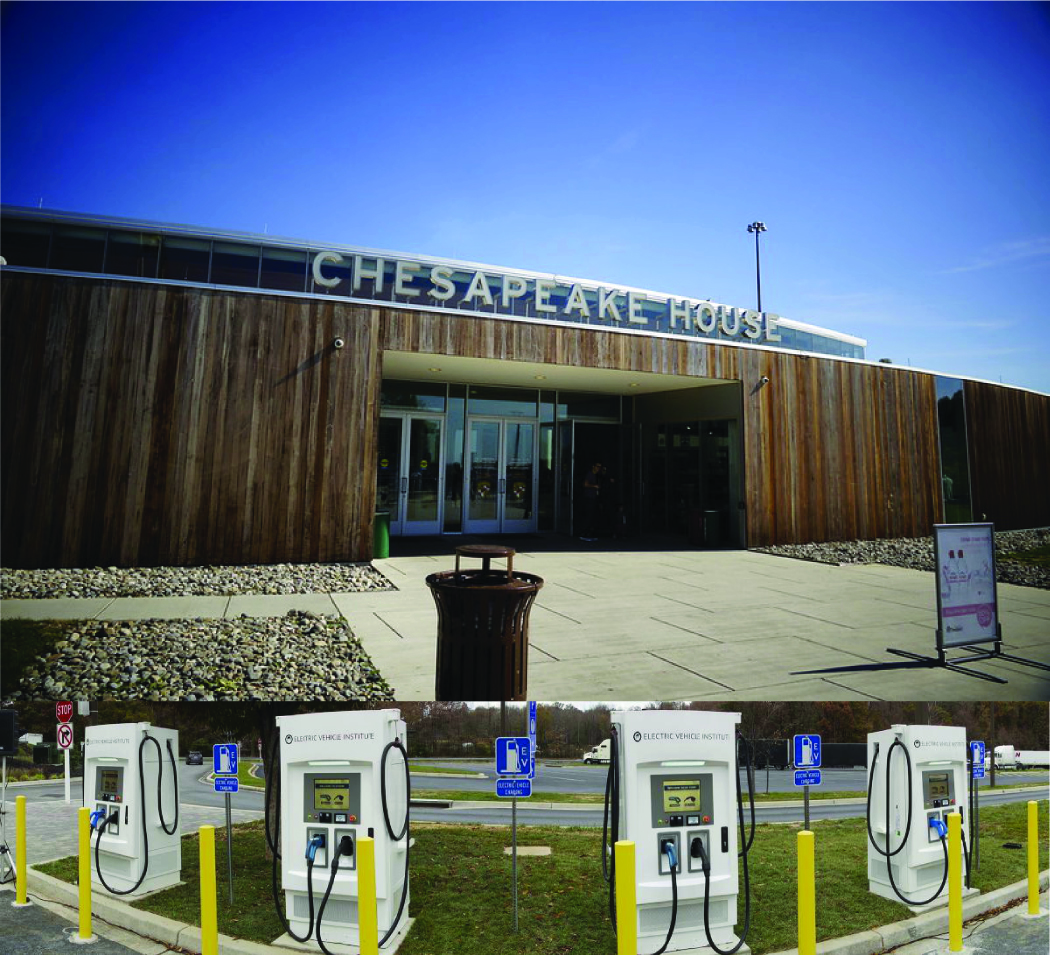
The Maryland Transportation Authority sought a P3 to redesign and rebuild two Maryland Travel Plazas along I-95 (John F. Kennedy Highway). Thanks to the $56 million investment from private sector partners, Areas USA, and their partner Sunoco, the Maryland House Travel Plaza in Harford County and the Chesapeake House Travel Plaza in Cecil County, Maryland are both open for business. These redeveloped, modern facilities serve to meet the needs of millions of motorists who travel along this vital economic corridor. The redeveloped Maryland House and Chesapeake House are supporting 575 facility jobs (Maryland I-95 Travel Plazas n.d.; Maryland Welcome Centers and Rest Areas n.d.).
- Maryland House Travel Plaza
I-95 at mile marker 82 between Exit 80 (MD 543) and Exit 85 (MD 22); and GPS Coordinates: 39.496640, −76.233187.
- Chesapeake House Travel Plaza
I-95 at mile marker 97 between Exit 93 (MD 222) and Exit 100 (MD 272); and GPS Coordinates: 39.611788, −76.009365.
Implementation, Operating Costs, Key Features
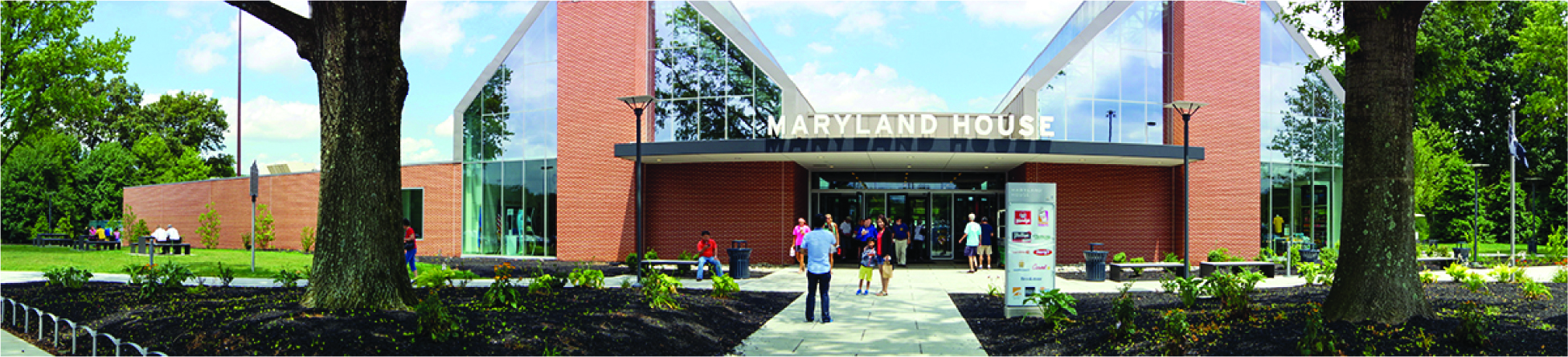
The $30 million Maryland House Travel Plaza along I-95 in Harford County opened to the public on January 16, 2014 (see Figure 24). The 42,000-square-foot facility features food from a
Source: Maryland Office of Tourism.
Long Description.
A group of people outside of a building with a path and trees.
variety of vendors. The new 5,700-square-foot convenience store at the high-speed fueling gas station features food from a well-known burger vendor (Maryland I-95 Travel Plazas n.d.).
The Chesapeake House Travel Plaza along I-95 in Cecil County opened to the public on August 5, 2014 (see Figure 25). The 30,000-square-foot facility also features food from a variety of vendors. The 4,300-square-foot convenience store at the high-speed fueling gas station features custom crafted food and drinks (Maryland I-95 Travel Plazas n.d.).
Case Study 17: Baker, California
EV Charging and Truck Parking
Baker, California, is a desert town with a reported population of 504 in 2024. It is in the Mojave Desert on I-15, the primary freight corridor connecting California to Nevada, and the gateway to Death Valley. The elevation of Baker is 942 feet above sea level. The claim to fame of this tiny town is the 134-foot-tall Worldʼs Tallest Thermometer, a roadside attraction that is the midway point across the California desert on the road to Las Vegas where millions of passenger cars and freight traffic travel year-round.
Source: Maryland Transportation Authority.
Long Description.
A building with glass doors, concrete sidewalk, and trash can.
Baker is a quick exit from the interstate where recreation and commercial travelers have stopped for decades for a restroom break and food. The primary industry for Baker is pass-through hospitality services and emergency road repair services.
The Baker EV Charging and Truck Parking facility illustrates how a massive dirt lot where truck drivers have parked for decades has turned into a solar-powered EV charging station that has improved services for truck drivers.
Key Features
Key features include the following:
- Free truck parking,
- Food court that serves drivers and the community, and
- On-site towing and tire service.
Case Study 18: Navajo Nation Casino and Travel Plaza
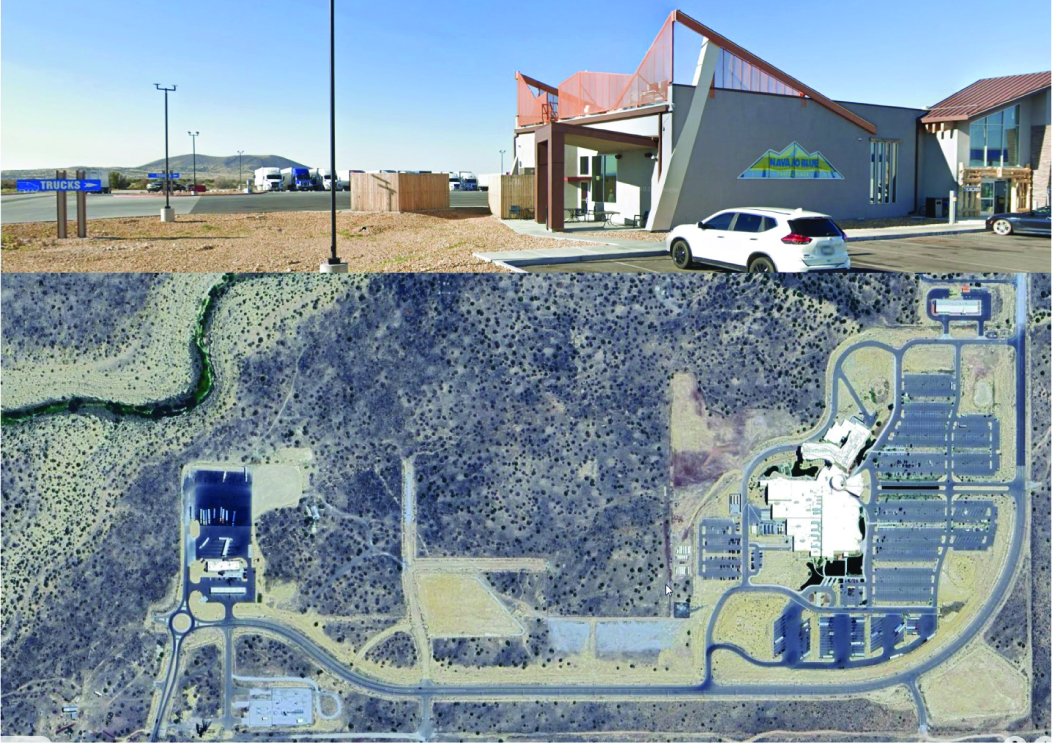
The Twin Arrows Navajo Casino Resort and Navajo Blue Travel Plaza, located in Flagstaff, Arizona, near I-40, offers truck parking at both its travel center and its nearby casino (see Figure 26). The casino consists of a four-star hotel with room rates averaging $300 a night (2024 rates) and has six restaurants. The Navajo Tribe developed the casino to cater to high-end visitors from nearby Flagstaff, but also understood the opportunity to serve another customer base, long-haul truck drivers in need of rest, fuel, food, and entertainment. The casino is equipped with a truckers lounge and ample truck parking. The nearby Travel Plaza is equipped with four commercial driver licensed (CDL) fueling positions, overnight truck parking, and another truckers lounge equipped with sofas and big screen televisions, two private showers, and two washers/dryers units.
Case Study 19: Shoshone Bannock Tribal Enterprises
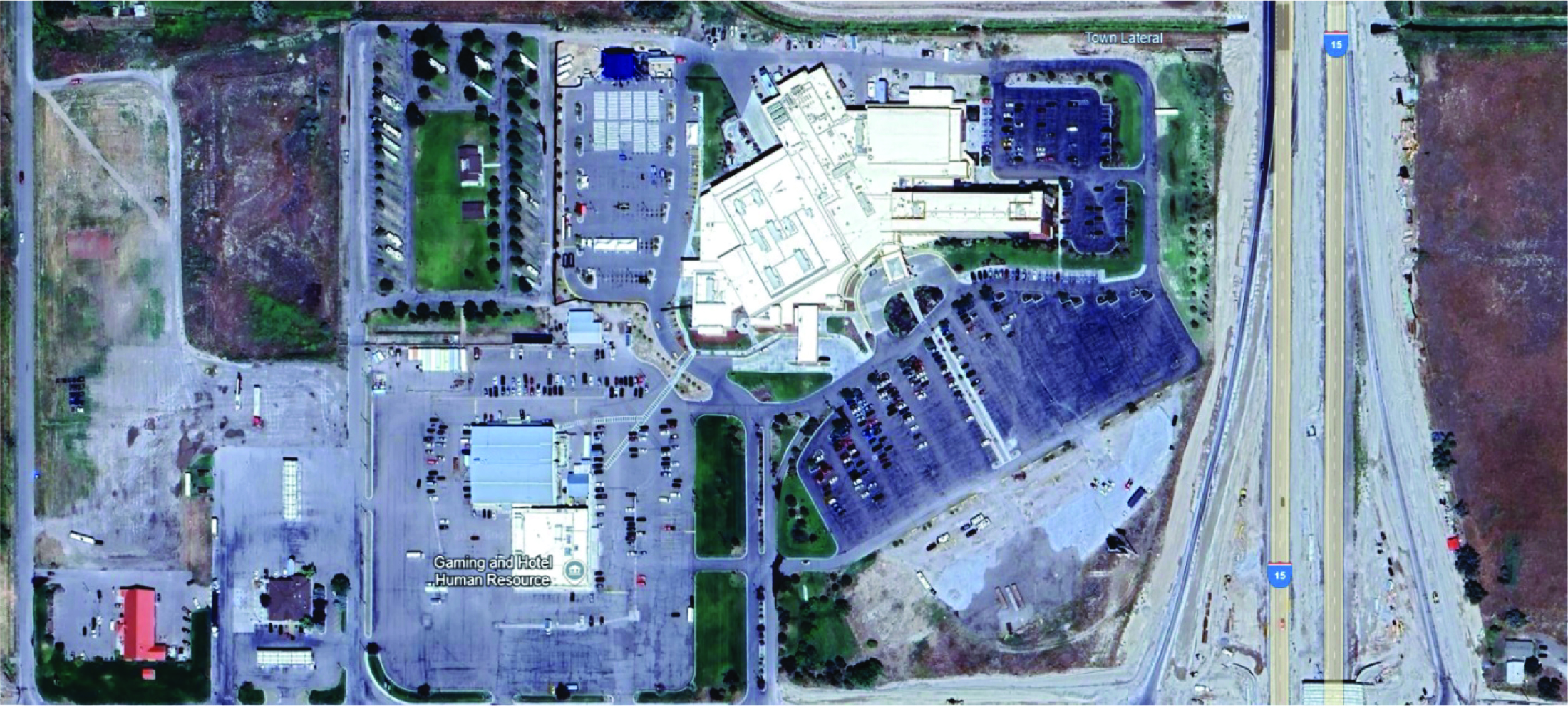
The Shoshone-Bannock Tribal Enterprises, located in Pocatello, Idaho, near I-15, offers free truck parking and a truckers lounge at its travel center, situated between a 10,000-square-foot full-service grocery store and the Hotel and Casino Resort (see Figure 27). The tribe also maintains an
Source: Karl Jim, Navajo Nation Gaming Enterprise.
Long Description.
An aerial view of the Navajo Nation Casino and Travel Plaza.
Source: Google Earth.
Long Description.
An aerial view of truck parking available at the Shoshone-Bannock Tribal Enterprises.
RV park in the same area, where trucks are welcome to pay for parking around a pleasant park. The casino features a three-star hotel with room rates averaging $130 per night (2024 rates) and four restaurants open to the general public.
Case Study 20: Buffalo Run Casino and Resort
The Buffalo Run Casino and Resort, located in Miami, Oklahoma, features a three-star hotel with average rates of $250 per night (as of 2024) and four restaurants. The casino offers free truck parking and a truckers lounge that is free for CDL holders. The lounge is equipped with two private showers, three washers and two dryers, and a complementary coffee bar. Additionally, the resort includes the Peoria Ridge Golf Course and a Top Golf Gaming Room within the casino.
Case Study 21: Golden Acorn Casino and Travel Plaza
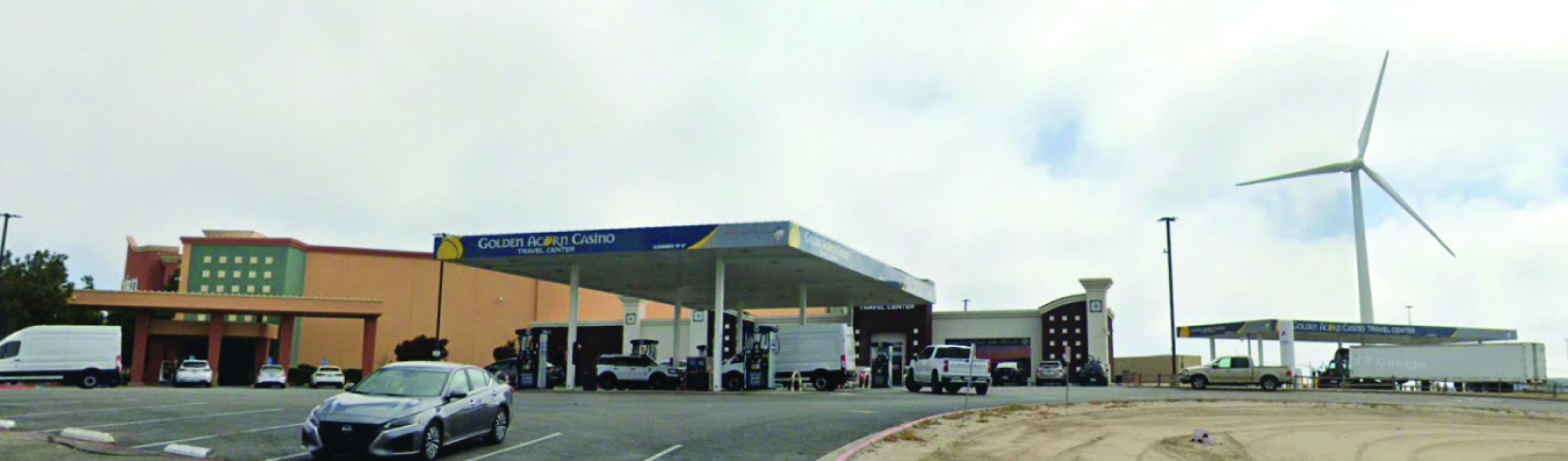
Located near I-8 just east of San Diego in Campo, California, the Golden Acorn Casino has three restaurants, and its adjacent travel plaza has eight CDL fueling lanes, free overnight truck parking, and a truckers lounge with sofas and big screen televisions, private showers, and laundry facilities (see Figure 28). This is one of the few locations outside of the busy San Diego region where truck drivers can find a reliable place to rest.
Case Study 22: We Realize Truck Parking
We Realize is partnering with existing owners/operators of underused entertainment facilities, such as the Las Vegas Raceway in Las Vegas, Nevada. The facility is only used a few weekends a year and is located adjacent to I-15 in the northern part of the city. This region is a growing
Source: Golden Acorn Casino and Travel Center website.
Long Description.
A building with car and truck fuel pumps. A windmill is in the background.
logistics hub, and as such, has been experiencing high demand for truck parking. The Las Vegas Motor Speedway has partnered with We Realize to establish both long-haul and local truck parking solutions. We Realizeʼs concept was first tested in Las Vegas and has since grown to include eight additional facilities across the nation with 10 more scheduled to go online this year. We Realizeʼs truck parking solution concept is to use underused, industrial-zoned facilities, such as the Las Vegas Motor Speedway. The facility details include the following:
- Seventeen acres of land at the Las Vegas Motor Speedway provides approximately 440 spaces.
- App-based access using a smart phone ($20/night with in/out privileges).
- Security guard at entrance takes payment and also serves as a concierge providing services such as facilitating food delivery orders and rideshare services.
- Amenities include the following:
- Security fencing,
- Portable shower and toilet facilities (contracted with a national provider to provide high-quality, safe, and clean restrooms),
- Stadium-grade lighting, and
- Ten EV charging spaces and 10 auxiliary power spaces (mostly used by refrigerated units).
Case Study 23: Giddings, Texas
Truck Parking for Economic Development
Giddings Economic Development Corporation (GEDC) in Giddings, Texas, provides an example of how communities can support and invest in truck parking as both a community benefit and a truck driver parking solution. This effort was led by the GEDC, a quasi-governmental entity and nonprofit arm of the city. CEFCO Convenience Stores and Gas Stations initiated the idea of building a truck stop that included incentives. GEDC seized this opportunity to address the truck parking impacts caused by the cityʼs ideal geographic location between Austin and Houston and the cityʼs lack of available truck parking. Working closely with the developer and the community, the city identified incentives for two truck stops, one on either end of the city. The truck parking is close to nearby services needed by the drivers, such as restaurants, retail stores, and medical facilities, which not only help the drivers, but also generate more business for local businesses. GEDC staff credits the successes of this effort to public-private collaboration.


