Protecting Maternal Heart Health: Prevention and Care Before, During, and After Pregnancy (2026)
Chapter: Summary
Summary1
MISSED OPPORTUNITIES TO PREVENT PREGNANCY-RELATED CARDIOVASCULAR MORBIDITY AND MORTALITY
Cardiovascular disease (CVD) is a leading cause of morbidity and mortality among women in the United States and a key driver of pregnancy-related morbidity and mortality. In 2024, cardiovascular conditions collectively were the dominant cause of pregnancy-related death. Pregnancy is a period of profound physiologic stress, during which cardiovascular demands increase substantially, and both pregnancy and the postpartum period are associated with elevated cardiovascular risk. It can also reveal unrecognized CVD and accelerate the development of conditions that increase future risk, such as hypertension and diabetes. This underscores the importance of delivering clinical preventive services across the reproductive years—including the prepregnancy, pregnancy, postpartum, and interpregnancy periods.
However, clinical preventive services for cardiovascular risk reduction are not consistently delivered before, during, after, or between pregnancies. Preventive care for pregnancy-related cardiovascular morbidity and mortality is typically focused narrowly on the prenatal and immediate postpartum periods, with limited attention to prepregnancy counseling, care transitions, sustained continuity of care, or longer-term cardiovascular risk. Postpartum follow-up care frequently ends within weeks of delivery,
___________________
1 This summary does not include references. Citations for the information presented herein are provided in the main text.
even though pregnancy-related cardiovascular risk may persist or emerge months or years later. Fragmented care delivery, gaps in insurance coverage, limited guidance on postpartum and interpregnancy preventive services, and uneven access to care further constrain the ability of clinicians and health systems to address cardiovascular risk comprehensively.
These shortcomings have substantial consequences. Many pregnancy-related cardiovascular complications are preventable or modifiable with timely identification and management of risk factors, appropriate follow-up, and coordinated care across clinical settings. Maternal Mortality Review Committee (MMRC)2 reviews of pregnancy-related cardiovascular deaths also indicate that more than three-quarters of them are potentially preventable. They identify contributing factors related to clinical recognition and treatment, chronic disease management, continuity and coordination of care, and access and financial barriers. Failure to deliver effective preventive services before, during, after, and between pregnancies is a missed opportunity to improve maternal health in the short term and reduce lifelong CVD burden.
STATEMENT OF TASK AND STUDY APPROACH
In response to these challenges, the National Academies of Sciences, Engineering, and Medicine convened an ad hoc committee to examine clinical preventive services that could reduce pregnancy-related cardiovascular morbidity and mortality. The Health Resources and Services Administration (HRSA), the study sponsor, asked the committee to identify gaps in current recommendations for preventive services and screenings relevant to CVD among women of reproductive age, during pregnancy, and postpartum; assess considerations related to the timing and targeting of these services; evaluate how HRSA programs could help mitigate barriers to access and use; and identify research priorities to address evidence gaps.
The committee’s work focused on clinical preventive services—defined as health system–based screenings, counseling, and interventions designed to identify risk factors early and prevent downstream disease. The study considered preventive services delivered before, during, and after pregnancy, including the postpartum and interpregnancy periods, with particular attention to services that could be feasibly implemented in real-world clinical settings.
___________________
2 These committees systematically review deaths that occur during pregnancy and up to 1 year postpartum to understand causes and contributing factors and to identify opportunities to prevent future deaths. Preventability determinations are made through multidisciplinary case review and reflect whether there was at least some chance the death could have been averted through one or more reasonable changes in clinical care and other factors at the patient, health system, facility, or community level.
To guide its work, the committee developed a conceptual framework that situates clinical preventive services within a life-course perspective on cardiovascular risk, spanning prepregnancy, pregnancy, postpartum, interpregnancy, and the post-childbearing periods, reflecting the cumulative and lifelong nature of cardiovascular risk. The framework illustrates how patient-level factors—including cardiometabolic comorbidities, family history, adverse pregnancy outcomes, and social and demographic context—and health system–level barriers, shaped in part by social, environmental, and policy contexts, influence intermediate outcomes, such as blood pressure control and detection of cardiometabolic risk and ultimately pregnancy-related cardiovascular morbidity and mortality. This framework also reflects the committee’s guiding principles, including attention to timing across the reproductive life course, focus on populations at elevated risk, consideration of feasibility and scalability in different care settings, and emphasis on continuity and coordination of care (Figure S-1).
To inform its conclusions, the committee reviewed the epidemiology of CVD in relation to pregnancy; examined existing clinical preventive services guidelines and coverage policies; and conducted formal evidence reviews for nine priority clinical services selected through an iterative process. These services span two broad domains: (1) screening, early detection, and clinical management of cardiovascular risk and conditions and (2) care delivery and supportive services intended to enhance access, coordination, and continuity of care. The committee applied a structured five-tier framework to assess the strength of evidence for each service and developed conclusions and recommendations accordingly.3 Taken together, the committee’s evidence reviews and framework emphasize pregnancy and the first year postpartum as high-opportunity periods for preventing maternal cardiovascular morbidity and mortality and initiating longer-term cardiovascular risk reduction.
THE BURDEN AND TIMING OF CARDIOVASCULAR DEATHS AROUND PREGNANCY
In 2024, the Centers for Disease Control and Prevention reported that 665 U.S. women died of maternal causes (18.4 deaths per 100,000 live births), and cardiovascular conditions were among the leading causes of mortality (see Figure 2-1). Pregnancy Mortality Surveillance System data for 2024 show that cardiovascular-related causes collectively accounted for the largest share of pregnancy-related deaths, including cardiovascular conditions (22 percent [N = 146], including cardiomyopathy [10.7 percent,
___________________
3 The five levels of evidence are (1) conclusive, (2) substantial, (3) moderate, (4) limited, and (5) none or insufficient.
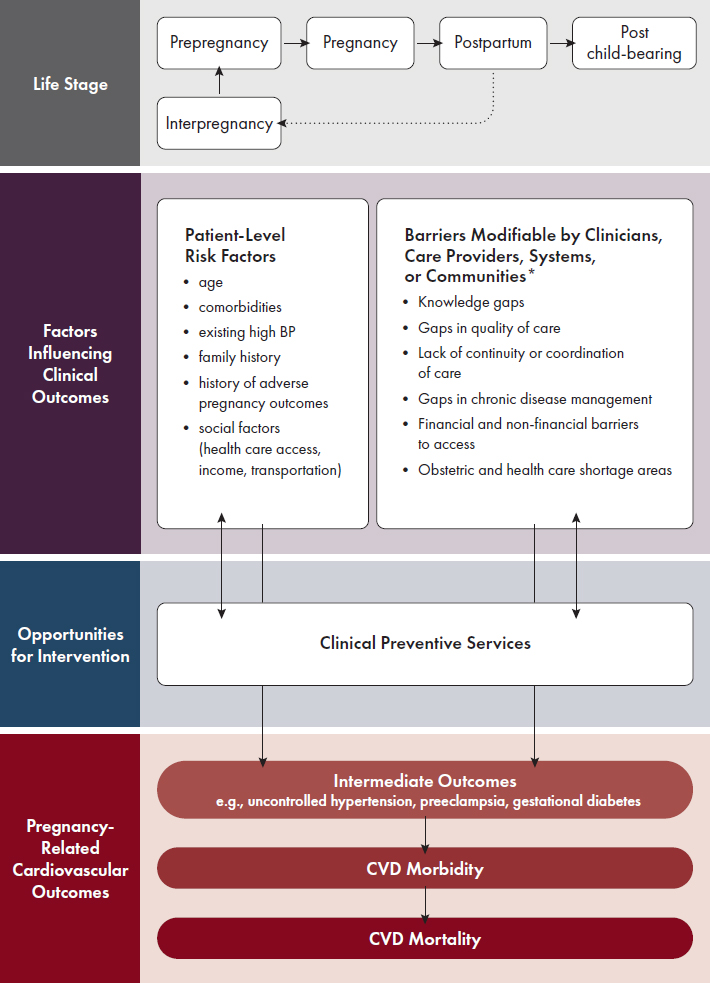
NOTES: * Broader system factors—including long-standing differences in resource distribution, neighborhood and environmental conditions, and policies that have differentially affected racial and ethnic groups—shape the barriers shown in the “modifiable barriers” box and contribute to disparities in pregnancy-related cardiovascular outcomes. These barriers are also influenced by provider, facility, health system, and community factors, such as provider training, service availability, insurance and payment policies, and local resource constraints. BP = blood pressure; CVD = cardiovascular disease.
N = 71]), hypertensive disorders of pregnancy (7.7 percent, N = 51), and cerebrovascular accident [stroke] (3.8 percent, N = 25). Hypertensive disorders of pregnancy (e.g., gestational hypertension, chronic hypertension, and preeclampsia) are among the most common contributors to pregnancy-related cardiovascular morbidity, affecting an estimated 16 percent of hospital deliveries, and associated with elevated risk of severe maternal complications and death. Although serious cardiovascular conditions (e.g., stroke, heart failure, cardiomyopathy, and ischemic heart disease) occur in a relatively small proportion of pregnancies, they account for a disproportionate share of pregnancy-related deaths. While many cardiovascular events during pregnancy and the postpartum period present acutely, they often reflect underlying or emerging chronic disease processes that may have existed before pregnancy and extend well beyond it.
MMRC data indicate that most pregnancy-related deaths occur after delivery: 57 percent between 7 days and 1 year postpartum and 23 percent during delivery or within the first 6 days postpartum. A substantial share of such deaths due to cardiovascular conditions also occur in the late postpartum period (43–365 days postpartum), including about 53 percent of cardiomyopathy deaths and 31 percent of deaths due to other cardiovascular conditions. Although cardiovascular risk increases with maternal age, most births are among women younger than 35; accordingly, they accounted for 66 percent of cardiovascular deaths in one multistate analysis. Profound disparities persist; in an analysis of 2018–2022 data, pregnancy-related mortality rates were about 3.8 times higher among American Indian and Alaska Native women and 2.8 times higher among non-Hispanic Black women than among non-Hispanic White women. In a multistate MMRC analysis, 51.2 percent of pregnancy-related cardiomyopathy deaths occurred among non-Hispanic Black women. (See Box S-1 and Figure S-2 for more information.)
GAPS IN EXISTING PREVENTIVE SERVICES AND GUIDELINES
Existing preventive services guidelines issued by national bodies, such as the U.S. Preventive Services Task Force, the Women’s Preventive Services Initiative, and Bright Futures, provide an important foundation for cardiovascular risk reduction across the life course. These guidelines address services such as blood pressure screening, diabetes screening, lipid management, tobacco cessation, and lifestyle counseling and are covered without cost sharing under the Affordable Care Act.
However, when viewed through the lens of pregnancy-related cardiovascular risk, important gaps and inconsistencies remain. Some recommendations address pregnancy but not the early or extended postpartum period or apply to adults broadly without specific considerations for
BOX S-1
Pregnancy and Cardiovascular Disease Risk
- Cardiovascular disease (CVD) is a leading cause of maternal mortality (pregnancy-related death), with the highest rates in the postpartum period (7–365 days postpartum).
- Pregnancy functions as a physiological stress test, revealing underlying cardiovascular and metabolic vulnerabilities that may not be apparent before.
- After adverse pregnancy outcomes (such as preeclampsia, gestational hypertension, and gestational diabetes), women have higher incidence of chronic hypertension and are more likely to develop adverse cardiometabolic risk profiles, including dyslipidemia (e.g., elevated triglycerides/low high-density lipoprotein), impaired glucose metabolism/diabetes, obesity, and metabolic syndrome.
- Hypertensive disorders of pregnancy are associated with a substantially increased risk of chronic hypertension postpartum. Although estimates vary across studies, the risk is several-fold higher in the first years after delivery and remains elevated for decades, with the largest relative differences in the early postpartum years.
- Many women who experience adverse pregnancy outcomes have underlying cardiometabolic risk factors that may be unrecognized or undiagnosed years before pregnancy. These include elevated blood pressure, adverse lipid profiles (e.g., high triglycerides or low high-density lipoprotein), impaired glucose metabolism, obesity, or metabolic syndrome, pointing to opportunities for earlier prevention.
- Pregnancy offers a critical window for identifying CVD risk early and initiating preventive care across the life course.
pregnancy. Guidance is often limited on how to integrate services across clinical settings—such as between obstetric care, primary care, and home visiting—when and for whom to conduct cardiometabolic screening in the postpartum period, or how to communicate the long-term cardiovascular implications of pregnancy complications. ACA-covered preventive services are limited with respect to care transitions; education on postpartum warning signs; and supportive services, such as doulas, peer navigators, and other community-based health workers, which are not uniformly available.
These gaps reflect, in part, structural challenges in the evidence base, including the historical exclusion of pregnant women from clinical trials, limited funding for women’s cardiovascular health research, and fragmented data systems across federal, state, and health system levels that hinder longitudinal follow-up. As a result, clinicians and health systems
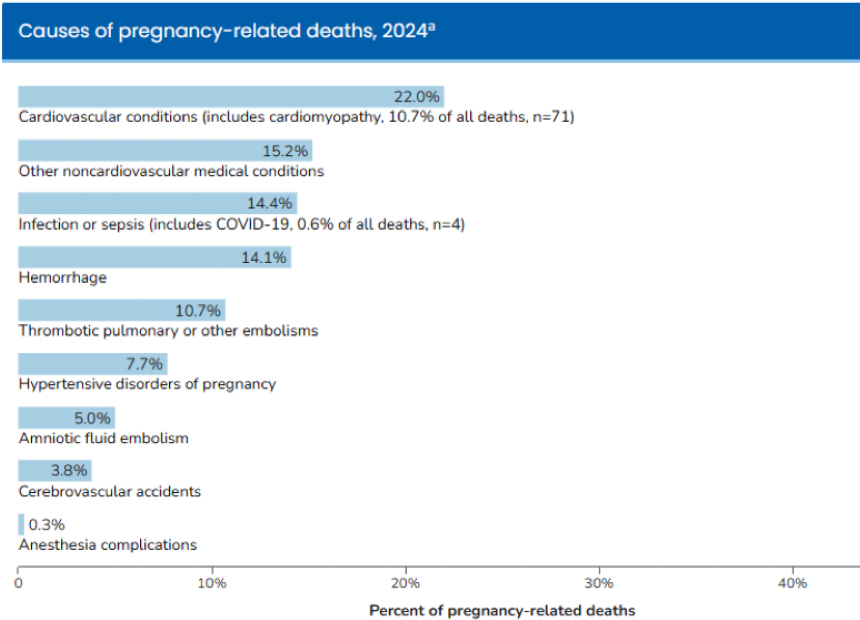
NOTES: a The cause of death is unknown for 6.9 percent of all 2024 pregnancy-related deaths; data from the Centers for Disease Control and Prevention Pregnancy Mortality Surveillance System.
sometimes lack clear, evidence-informed guidance on how best to deliver coordinated cardiovascular preventive care around pregnancy.
Evidence on Priority Clinical Preventive Services
The committee conducted formal evidence reviews of nine priority clinical services spanning screening, early detection, and care delivery (see Box S-2). Across these services, the committee found substantial variation in the strength and nature of the evidence.
For some services, particularly prenatal treatment of chronic hypertension to achieve lower blood pressure targets, high-quality evidence demonstrates clear benefit. Treating chronic hypertension during pregnancy to a target of less than 140/90 millimeters of mercury (mmHg) reduces severe-range hypertension, preeclampsia, medically indicated preterm birth, and related adverse outcomes without evidence of harm to fetal growth. This
BOX S-2
Clinical Preventive Services Reviewed by the Committee
The committee conducted structured evidence reviews in nine clinical preventive service areas to assess the strength of evidence and identify gaps related to pregnancy-related cardiovascular risk (see Chapters 4 and 5 for the full research questions and evidence reviews). Inclusion in this box indicates that a service was reviewed, not that it is recommended. Recommendations are presented separately and limited to areas where the committee determined that evidence was sufficient to support implementation guidance.
- Blood Pressure Thresholds for Treatment During Pregnancy
Managing blood pressure using a treatment initiation or titration threshold of 140/90 millimeters of mercury or higher during pregnancy, compared with higher blood pressure thresholds, and its impact on maternal outcomes. - Enhanced Postpartum Hypertension Management
Strategies to improve postpartum blood pressure monitoring, treatment, and follow-up for individuals with hypertensive disorders of pregnancy (such as chronic hypertension). - Urgent Maternal Warning Signs Postpartum
Screening for urgent cardiovascular warning signs (or urgent maternal warning signs) postpartum, including counseling patients to self-screen for such signs and clinical protocols for health care teams, to reduce maternal severe morbidity or mortality.
body of evidence supports implementing this approach as part of routine prenatal care.
In contrast, evidence for many other services remains limited or focused primarily on intermediate or process outcomes. Enhanced postpartum hypertension management programs, including self-measured blood pressure monitoring with clinical follow-up, show promise in improving blood pressure control and early engagement in care, supporting their implementation. However, data on whether these programs improve long-term cardiovascular outcomes are sparse. Similarly, interventions designed to improve transitions from the delivery hospitalization to outpatient postpartum care may improve appointment attendance, short-term risk factor management, and avoid missed opportunities for care, yet evidence is insufficient to demonstrate reductions in cardiovascular morbidity or mortality. Approaches that emphasize recognition of urgent maternal warning signs
- Cardiovascular Risk Assessment Tools in Pregnancy and Postpartum
Using tools such as the California Maternal Quality Care Collaborative Cardiovascular Disease in Pregnancy Toolkit and Malhamé et al.’s cardiovascular risk assessment tools in pregnancy and postpartum to identify previously unrecognized cardiovascular disease (CVD) and improve outcomes. - Comprehensive Cardiovascular Health Assessment (Life’s Essential 8)
Screening and intervention for cardiovascular risk factors in women of reproductive age at increased risk of CVD, using Life’s Essential 8, to reduce pregnancy-related cardiovascular morbidity and mortality. - Telehealth Approaches Across the Reproductive Continuum
Using telehealth in the prepregnancy, prenatal, and postpartum periods to improve CVD outcomes. - Integrated Cardio-Obstetrics Care Models
Multidisciplinary care models that integrate cardiology and obstetrics to improve cardiovascular and pregnancy outcomes among high-risk pregnant patients. - Supportive Services (Doulas, Peer Navigators, and Other Community Health Workers)
Using supportive personnel and programs to improve cardiovascular-related outcomes across the perinatal period and postpartum. - Transitions of Care from Postpartum to Preventive Care
Interventions to improve transitions from hospital deliveries to outpatient postpartum care and to primary/longitudinal preventive care within 12 months postpartum for individuals with CVD risk factors.
and timely escalation of care may also help reduce missed opportunities when postpartum symptoms arise, but available evidence is similarly limited and often focused on process outcomes rather than downstream cardiovascular morbidity or mortality.
For CVD screening and risk assessment tools, studies often show improved identification of previously unrecognized cardiovascular risk or disease, but evidence is insufficient to determine whether these tools improve downstream health outcomes in pregnancy or beyond. Follow-up after positive screens varies widely across settings, limiting the potential impact of screening alone. Across topics, few studies include long-term follow-up or assess outcomes in subsequent pregnancies.
Taken together, these findings underscore both the promise of preventive services delivered around pregnancy and the limitations of the current evidence base. Opportunities for prevention exist at multiple points in time, but stronger evidence, including assessment of long-term impact, is needed to guide implementation and optimize intervention design.
The committee notes that the absence of evidence regarding the effectiveness of a service is not equivalent to demonstrating ineffectiveness and more often represents a lack of studies. In real-world settings, policy makers or clinical leaders may opt to support some services based on clinical judgment, feasibility, and potential benefit, despite lack of large-scale evidence of effectiveness. However, developing more robust evidence about promising services will be highly valuable to support decisions on the best investments of resources to improve pregnancy outcomes and women’s health.
CROSSCUTTING BARRIERS TO ACCESS AND IMPLEMENTATION
Beyond the evidence base for individual services, the committee identified crosscutting barriers that limit access to and uptake of cardiovascular clinical preventive services around pregnancy. Financial barriers, fragmented care delivery, and uneven availability of services across settings and time points reduce access to preventive services during the prepregnancy, pregnancy, and postpartum periods, including interpregnancy. Insurance coverage interruptions, particularly during the transition from pregnancy to postpartum, and limited reimbursement for preventive services impede timely identification and management of cardiovascular risk.
Geographic access and workforce maldistribution are additional barriers to preventive cardiovascular care around pregnancy. A March of Dimes analysis found that 35.1 percent of U.S. counties are “maternity care deserts,” defined as areas with no providers, hospitals, or birth centers offering obstetric care. Half of counties lack a hospital that provides obstetric care,
and women in maternity care shortage areas travel about 2.6 times longer to reach a birthing hospital than women in counties with full access.
Data infrastructure limitations further hinder improvement. Disjointed and incomplete data systems that lag in time constrain the ability of health care systems and programs to track up-to-date pregnancy-related cardiovascular complications, monitor preventive service delivery, and support longitudinal follow-up across the reproductive life course. Inconsistent documentation of pregnancy complications and limited linkages among clinical, claims, and public health data impede quality improvement and research.
In addition, quality standards and measurement approaches for maternal cardiovascular prevention remain underdeveloped. Existing measures often focus on delivery or short-term postpartum outcomes and do not capture longitudinal preventive care. Without aligned measures and incentives, accountability for sustained cardiovascular prevention is limited.
The committee also recognized the unique role of HRSA-supported programs, including health centers and maternal health initiatives, in expanding access to preventive cardiovascular services. Underserved communities—including uninsured women and women with Medicaid—are more likely to receive care in clinic settings, such as community health centers. In a 2020 national survey, 23 percent of women with Medicaid and 30 percent of uninsured women reported receiving care in clinics, compared with 85 percent of women with private insurance who received care in private doctors’ offices. HRSA-funded health care centers served 611,000 prenatal care patients and supported 174,000 births in 2024, underscoring their reach as a setting for implementing and sustaining preventive services. When supported by aligned incentives, data systems, and workforce capacity-building, HRSA programs are well positioned to address nonfinancial barriers to care (e.g., transportation, child care, and limited broadband access for telehealth), integrate medical and supportive services, and strengthen continuity of care across the reproductive life course.
The evidence reviews and crosscutting considerations point to a small set of services ready for implementation now and a broader set of system actions and research priorities to close persistent gaps in preventing cardiovascular-related maternal morbidity and mortality.
COMMITTEE RECOMMENDATIONS
Based on its review of the evidence, the committee issued 12 recommendations aimed at strengthening prevention, early identification, and management of cardiovascular risk across the reproductive life course (see Box S-3) in three categories: (1) clinical preventive services for which the evidence base supports implementation now; (2) crosscutting system and
BOX S-3
Committee Recommendations at a Glance
Recommendations are presented in summary form. Chapter 7 provides the full exposition, including context, rationale, and implementation considerations.
Implement clinical preventive services with evidence supporting implementation now
- Recommendation 1: Implement prenatal treatment of chronic hypertension to achieve a blood pressure (BP) target of less than 140/90 millimeters of mercury.
- Recommendation 2: Prioritize clinical trials to determine optimal prenatal and postpartum BP thresholds, targets, and treatments.
- Recommendation 3: Implement enhanced postpartum hypertension management programs and education, including self/remote BP monitoring with clinical follow-up.
Develop crosscutting system, workforce, and delivery strategies
- Recommendation 4: Improve maternal care access, insurance coverage continuity, care transitions, and care coordination across the reproductive life course.
- Recommendation 5: Use telehealth, rural health, and maternal health programs to expand access to preventive cardiovascular services (prioritizing evidence-supported models such as remote/self-measured
workforce strategies to improve access, continuity, and quality of preventive cardiovascular care; and (3) research and data infrastructure priorities needed to strengthen the evidence base. Recommendations in the first category reflect areas where evidence was sufficient to support near-term implementation and do not encompass all elements of cardiovascular risk assessment or prevention discussed elsewhere in the report.
Clinical Preventive Services
Two recommendations address clinical preventive services with sufficient evidence to support implementation now: (1) prenatal treatment of chronic hypertension to achieve a blood pressure target of less than 140/90 millimeters of mercury and (2) enhanced postpartum hypertension management interventions, including self/remote blood pressure monitoring with clinical follow-up.
- blood pressure monitoring with structured clinical response), particularly for communities with the greatest needs.
- Recommendation 6: Strengthen data systems, quality measurement, and learning from real-world care settings to test what works and improve care.
- Recommendation 7: Expand patient, clinician, and community education on pregnancy-related cardiovascular risk.
- Recommendation 8: Strengthen workforce competencies and team-based models for pregnancy-related cardiovascular disease (CVD) prevention.
- Recommendation 9: Support Federally Qualified Health Centers and other community programs administered by the Health Resources and Services Administration to expand preventive CVD services across the reproductive life course.
Establish research and evidence-generation priorities
- Recommendation 10: Standardize core outcomes for pregnancy-related CVD studies; design studies to prioritize health outcomes and strongly linked intermediate outcomes.
- Recommendation 11: Implement a national research network encompassing diverse settings to conduct multicenter studies of severe maternal morbidity and maternal mortality.
- Recommendation 12: Support a continuum of research on clinical services to reduce adverse cardiovascular outcomes in the 12 months postpartum.
Treatment of Chronic Hypertension to a Blood Pressure Target of Less Than 140/90 Millimeters of Mercury
High-quality evidence shows that treating chronic hypertension in pregnancy to achieve targets of less than 140/90 millimeters of mercury reduces severe-range hypertension, preeclampsia, indicated preterm birth, and related adverse outcomes, with no demonstrated harm to fetal growth. While blood pressure thresholds during pregnancy were examined across hypertensive conditions, the strongest and most consistent evidence supports this treatment target for women with chronic hypertension that predates pregnancy. Evidence supporting treatment to this threshold for women with gestational hypertension4 is more limited, and data are insufficient to
___________________
4 New-onset [de novo] hypertension after 20 weeks’ gestation without proteinuria or end-organ dysfunction.
determine whether lowering treatment targets to <140/90 mmHg improves outcomes for other hypertensive disorders of pregnancy; these areas remain priorities for research (see Recommendation 2). Blood pressure definitions and treatment thresholds in pregnancy differ from those for nonpregnant adults under recent American College of Cardiology/American Heart Association guidelines; obstetric practice uses pregnancy-specific thresholds that reflect differences in physiology and fetal considerations.
Recommendation 1: The Health Resources and Services Administration should support implementation of clinical care models and educational efforts that enable clinicians and pregnant women with preexisting chronic hypertension to implement antihypertensive therapy to achieve a blood pressure standard of less than 140/90 millimeters of mercury during pregnancy.
This recommendation aligns with several professional society practice advisories. For HRSA, implementation could include support for standardized treatment protocols (e.g., clinical decision support tools and standardized treatment templates), reliable blood pressure measurement workflows, and team-based care in health centers and other clinics that serve women with limited access to care, as well as maternity care settings. HRSA could also support affordable access to pregnancy-safe antihypertensive medications and home blood pressure monitoring, particularly in clinics serving women with limited access to care. It could strengthen tracking of blood pressure control and outcomes to identify gaps and differences in care. For hypertensive disorders of pregnancy other than chronic hypertension, evidence regarding optimal treatment thresholds is more limited; Recommendation 2 calls for clinical trials to help determine prenatal and early postpartum blood pressure treatment thresholds and targets.
Enhanced Postpartum Hypertension Management
Hypertensive disorders of pregnancy, including chronic hypertension and pregnancy-onset hypertensive conditions, are a leading contributor to severe maternal morbidity and mortality in the postpartum period, a time when many women experience gaps in access to timely care. Blood pressure typically peaks 3–7 days postpartum, yet many women do not have an in-person clinical encounter until weeks after delivery, and one-third or more do not have one at all. This creates a predictable gap during a high-risk window for detection and treatment.
Enhanced postpartum hypertension management programs consistently improve early blood pressure ascertainment, engagement in care, and short-term blood pressure control, although studies have not yet assessed direct
reductions in severe maternal morbidity, mortality, or long-term cardiovascular outcomes. The improvements in process measures and short-term control are clinically meaningful, given the biological importance of managing chronic hypertension and elevated risk of complications after delivery. Providing support for approaches such as self-measured blood pressure monitoring with structured clinical follow-up offers a practical pathway to strengthen postpartum care and support improvement in communities with worse outcomes.
Recommendation 3: The Health Resources and Services Administration should support clinical programs and education that strengthen postpartum hypertension management for women with chronic hypertension or other hypertensive disorders of pregnancy. Efforts should focus on approaches with demonstrated benefit to increase early blood pressure (BP) assessment, improve engagement in follow-up care, and enhance short-term BP control—such as remote or self-measured BP monitoring paired with timely clinical review and treatment adjustment.
In HRSA-supported care settings, postpartum hypertension programs could pair validated home blood pressure cuffs and patient training with clear thresholds for clinician review and reliable follow-up (by phone, text, telehealth, or in person). Multilingual education materials, accommodations for limited telehealth connectivity, and minimizing postpartum insurance coverage interruptions can help services reach women after hospital discharge; team-based workflows aligned with maternal health quality initiatives can support more consistent results across communities.
Crosscutting System, Workforce, and Delivery Strategies
A second set of recommendations focuses on strengthening the systems that enable preventive cardiovascular care across the reproductive life course. Collectively, these recommendations aim to improve continuity and coordination of care across settings and time, expand access to evidence-supported services (including through telehealth and maternal health programs), strengthen the clinical workforce and team-based models, and improve the data, quality measurement, and practice-based learning needed to support implementation and accountability (Recommendations 4–9).
Research and Evidence-Generation Priorities
Finally, the committee identified research and evidence-generation priorities to strengthen the evidence base for preventing pregnancy-related cardiovascular morbidity and mortality. These recommendations aim to
standardize outcomes so studies can be compared and synthesized, build the infrastructure for multicenter research on severe maternal morbidity and mortality, and support rigorous studies—especially in the first postpartum year—to determine which interventions improve clinically meaningful health outcomes (Recommendations 10–12).
IMPLICATIONS AND LOOKING AHEAD
This report highlights the reproductive years—including prepregnancy, pregnancy, postpartum, and interpregnancy—as a critical opportunity to improve cardiovascular health and reduce preventable maternal morbidity and mortality. While evidence supports implementing selected preventive services, substantial gaps remain in clinical practice guidelines, data, and care delivery infrastructure. Addressing these gaps will require coordinated action among clinicians, health systems, payers, public health agencies, and community partners, as well as alignment of federal and state policy levers that influence coverage, data infrastructure, and workforce capacity. Strengthening clinical preventive services across the reproductive life course can help identify cardiovascular risk, support timely interventions, and improve continuity of care—protecting women’s long-term health and benefiting families and communities. Continued investment in research, data infrastructure, and workforce capacity by federal agencies, states, payers, and health systems will be essential to refine preventive strategies and ensure that emerging evidence translates into improved maternal cardiovascular outcomes.


