Protecting Maternal Heart Health: Prevention and Care Before, During, and After Pregnancy (2026)
Chapter: 5 Preventive Services to Address Gaps in Cardiovascular Risk: Care Delivery and Supportive Services
5
Preventive Services to Address Gaps in Cardiovascular Risk: Care Delivery and Supportive Services
INTRODUCTION
Chapter 4 discussed part one of the committee’s evidence review, including an explanation of how the review was structured, and covered five research questions related to screening and early detection of cardiovascular risk and conditions in the prepregnancy, prenatal, postpartum, and interpregnancy periods. This chapter reviews the four remaining research questions in the areas of care delivery and supportive services.
CARE DELIVERY AND SUPPORTIVE SERVICES
Identifying cardiovascular risk is necessary but not sufficient to improve outcomes, as patients also need effective, accessible, and sustained preventive care. This section focuses on models and modalities of care delivery that may enhance access to, coordination of, and continuity of cardiovascular preventive services for pregnant and postpartum women.
The research questions in this chapter examine four broad approaches. First, the committee reviewed the use of telehealth to extend monitoring and follow-up beyond traditional clinical settings across the prepregnancy, prenatal, postpartum, and interpregnancy periods. Second, it considered integrated cardio-obstetrics care models that coordinate multidisciplinary management for high-risk patients during pregnancy. Third, it evaluated supportive services—including doulas, peer navigators, and other community health workers—as strategies to improve engagement with care, adherence to treatment, and navigation of complex health systems. Finally,
the committee examined interventions designed to strengthen the postnatal transition of care, including efforts to ensure timely follow-up with primary or specialty care and support ongoing management of cardiovascular risk factors in the year after delivery.
Collectively, these topics address the fragmentation that often characterizes the maternal care continuum and highlight opportunities to design systems that better support longitudinal cardiovascular health. Subsequent sections summarize the evidence for each approach and describe the committee’s considerations regarding their potential contribution to preventing cardiovascular disease (CVD) and related adverse pregnancy outcomes (APOs).
TELEHEALTH
Overview of the Question and Rationale
Telehealth is defined by the Health Resources and Services Administration (HRSA) as “the use of electronic information and telecommunication technologies to support long-distance clinical health care, patient and professional health-related education, health administration, and public health” (HRSA, 2022). As a rapidly expanding component of the U.S. health care system, it offers a promising mechanism to enhance access to maternal care, particularly for populations disproportionately affected by system barriers and health disparities (e.g., rural, low-income, and minority populations) (Hawkins, 2023; HRSA, 2025). Its relevance across the prepregnancy, pregnancy, postpartum, and interpregnancy periods lies in its potential to support timely monitoring, improve continuity of care, and allow earlier identification of cardiometabolic complications.
Despite increased adoption, substantial gaps persist in evidence-based guidelines and clinical practice for the use of telehealth during pregnancy and postpartum, limiting consistent implementation and evaluation. The rapid expansion of virtual care during the COVID-19 pandemic, when remote visits often substituted for in-person care, highlighted both the feasibility of telehealth for maternal health services and the urgent need for evidence-based standards (Hawkins, 2023). Together, these factors emphasize the importance of establishing clear guidance to optimize telehealth’s role in improving maternal cardiovascular outcomes.
This review evaluated a broad range of telehealth interventions, including synchronous virtual visits, asynchronous digital communication, remote physiologic monitoring, and mobile health (mHealth) applications to assess whether they improve CVD outcomes in the prepregnancy, prenatal, postpartum, or interpregnancy periods.
Summary of the Evidence
The literature search on telehealth approaches yielded 4,244 records with publication dates from January 2010 to July 2025, including 2,422 duplicates. Of the 1,822 unique articles screened at the abstract level, 603 were identified as potentially relevant. Given the evolving nature of the field of telehealth and the need for evidence to be applicable to the United States, these articles were filtered for only U.S. populations and publication in 2020 and later. After filtering, 48 articles moved to full-text review, and 27 met inclusion criteria, with the most common reasons for exclusion being wrong intervention or no relevant outcomes. The committee conducted quality assessments and data extraction for the 16 empirical studies that remained after full-text review: three systematic reviews, one pre–post study, eight observational or cross-sectional studies, and four controlled intervention studies. An additional 11 narrative and scoping reviews and expert opinion pieces were identified, and while the committee did not include these in the evidence synthesis, it did use them to provide background and context. The committee also scanned the reference lists to ensure it did not miss any relevant intervention studies.
Of the articles reviewed, five studies focused on use of telehealth for weight gain or management during pregnancy, postpartum, or both; seven included blood pressure (BP) monitoring for hypertensive disorders of pregnancy (HDPs); and five included gestational diabetes (GDM) or glycemic control as a variable. Other variables of interest included using telehealth for prenatal, postpartum care, or both; preterm birth (PTB); depression; and access to care, with several articles using more than one variable. Chapter 4 reviewed enhanced postpartum hypertension (HTN) management, including a detailed review of remote BP monitoring.
The evidence base evaluating telehealth interventions during pregnancy and postpartum consists predominantly of observational studies and pre–post designs, with relatively few large, controlled interventional trials (see Table 5-1). As a result, its overall quality is limited. The committee rated most studies as fair with respect to risk of bias. Of the four controlled intervention trials, three were rated good quality and one poor quality. Heterogeneity in telehealth modalities, implementation strategies, and outcome measures further complicate cross-study comparisons and precludes metaanalysis or other meaningful synthesis. The paucity of definitive randomized controlled trials (RCTs) represents a major gap in the literature.
Interventions varied widely. Telehealth approaches reviewed by the committee can be grouped into several broad categories: (1) remote physiologic monitoring models, most commonly home BP monitoring paired with structured clinical response and escalation protocols; (2) asynchronous communication models, such as text messaging, portal-based messaging, or
automated coaching applications; (3) synchronous virtual visits substituting for or supplementing in-person care; and (4) hybrid or multicomponent models combining remote monitoring with clinician review, medication titration, or team-based follow-up. Evidence of benefit was strongest for remote BP monitoring models with defined clinical response pathways (see Chapter 4 section on Enhanced Postpartum Hypertension Management), while other approaches more commonly demonstrated improvements in process measures or short-term intermediate outcomes rather than clinical cardiovascular endpoints. Examples of representative interventions included the following:
- In the prenatal period, providing telephone-based live interactive coaching to promote healthy behaviors and appropriate gestational weight gain;
- In the prenatal period, installing a telephone application that delivers coaching messages to promote healthy lifestyle behaviors; and
- In the prenatal or postpartum periods, providing a BP cuff for home monitoring and having the cuff or the woman report BP measurements via a digital platform.
Intervention complexity ranged from simple remote BP monitoring or automated messaging to multicomponent telemonitoring with a clinician or mobile health app1 programs targeting lifestyle change, weight management, or glycemic control. The health outcomes the interventions assessed also varied widely and included gestational weight gain, diabetes, HTN, postpartum HTN, and infant outcomes. Some studies assessed health behaviors or use outcomes, such as engagement with visits or other postpartum care services, depression screening, postpartum rehospitalization, or diabetes awareness.
Despite this variation, several consistent findings emerged. In multiple studies of varying quality, telehealth interventions deployed during pregnancy or postpartum were associated generally with modest improvements in key cardiometabolic indicators, including BP and glycemic control, and, in some studies, reductions in PTB (Abelman et al., 2023; Forna et al., 2024; He et al., 2024). Telehealth delivered as an adjunct to traditional in-person care appears safe, with no evidence of increased adverse maternal outcomes (Lekshmi et al., 2025; Nelson et al., 2023). However, the absence of documented harms may reflect small sample sizes and short follow-up windows rather than definitive safety.
___________________
1 The committee included mobile apps only if they incorporated clinician involvement (e.g., monitoring, messaging, or treatment adjustment), excluding standalone self-management apps.
A review of RCTs2 of telehealth and mobile health interventions designed to improve cardiovascular health and associated risk factors (such as weight gain and diabetes control) found highly variable results, with some studies showing modest improvements in blood glucose control or less weight gain. Few studies showed meaningful benefits in pregnancy-related outcomes, such as HDP, GDM, PTB, or cesarean rates, and these outcomes were not consistently measured as primary endpoints or powered for in most studies. Several mobile health interventions yielded improved measures of blood glucose control, including hemoglobin A1c (HbA1c), blood glucose levels, and glucose tolerance testing (Al-Ofi et al., 2019; Bartholomew et al., 2015; Miremberg et al., 2018; Rasekaba et al., 2018). Numerous other studies showed no benefit in glycemic measures (Guo et al., 2019; Homko et al., 2012; Horwitz et al., 2023; Mackillop et al., 2018), and one showed mild worsening of HbA1c compared to standard of care (Mackillop et al., 2018). One meta-analysis noted improvements in the incidence of GDM among pregnant women with overweight and obesity (He et al., 2024), but most individual RCTs did not demonstrate a benefit in diabetes outcomes. RCTs of interventions designed to improve achieving healthy weight goals by addressing diet, exercise, or both also showed some variability, but a majority of studies demonstrated some degree of benefit. Of the studies evaluating the effect on maternal HTN, most telehealth lifestyle interventions showed no benefits.
Timing and Frequency
Although research has not firmly established the optimal timing or frequency of telehealth encounters, studies generally incorporate regular remote monitoring and communication tailored to maternal needs (Nelson et al., 2023), though protocols varied considerably across studies. Followup and engagement consistently improved with the addition of telehealth monitoring (Arias et al., 2022; Eberle et al., 2021; Khosla et al., 2022).
Reproductive Stage and Risk Stratification
Telehealth interventions for maternal cardiometabolic health are relevant across multiple points in the reproductive life cycle, with evidence supporting their use during pregnancy, the early postpartum period, and up to 12 months postpartum (Nelson et al., 2023). No studies were identified in the prepregnancy period, and no studies extended meaningfully into the interpregnancy period beyond 12 months postpartum.
___________________
2 Including RCTs from the last 5 years and RCTs included in systematic reviews and metaanalysis that were conducted in the last 5 years and U.S. based.
Potential Benefits and Harms
No studies have reported significant harms attributable to telehealth interventions. Outcomes are often comparable to standard care, with no evidence of psychological, social, or population-specific adverse effects (Mueller et al., 2025). At the same time, potential risks may be function specific; for some clinical services, telehealth could limit the ability to identify problems, such as structural abnormalities, that may be more easily detected during in-person visits (e.g., arrhythmias, murmurs, and heart failure). The absence of documented harms may reflect the limitations of existing study designs rather than definitive safety.
Cost and Cost-Effectiveness
No studies demonstrated reductions in hospitalizations or emergency department use attributable to telehealth interventions related to pregnancy, and information on economic outcomes is sparse. Cost-effectiveness analyses are lacking, and no studies have assessed patient-level expenses for factors such as devices, data plans, or connectivity—which have significant implications for access, especially for underserved populations.
Population Considerations
Most studies focused on women with pre-existing conditions, such as diabetes, obesity, or HTN, which limits generalizability to low-risk populations. No validated risk-stratification tools specific to telehealth in the perinatal context were identified, representing an ongoing research need. Nevertheless, the findings suggest several potential benefits, with clinical improvements varying by outcome domain. Across multiple studies, telehealth was associated with better BP control (Burgess et al., 2024; Forna et al., 2024; Lemon et al., 2024; Mueller et al., 2025), increased adherence to antihypertensive therapy (Forna et al., 2024; Lemon et al., 2024), and enhanced glycemic management (Lemon et al., 2024). Some evidence suggests potential reductions in PTB (He et al., 2024), and, in one scoping review, increased rates of spontaneous labor (Mohamed et al., 2025). Although modest, these benefits may also yield indirect advantages for infant health.
Most studies have been conducted in urban settings and include diverse populations, with strong representation of Black women and some inclusion of Hispanic women. While telehealth could improve access for populations historically underserved by the health care system, existing evidence does not suggest meaningful reductions in maternal cardiovascular disparities, in part because of persistent system and technological barriers. Some
evidence suggests improvement in process outcomes—such as postpartum visit attendance among Black patients—but no studies demonstrated reductions in clinical CVD outcomes by race or ethnicity (Mueller et al., 2025).
Implementation Considerations
Implementing telehealth appears broadly feasible across obstetric, primary care, and community health settings, with programs using nurse-led BP triage models, automated messaging workflows, or hybrid care structures. Persistent barriers include variable technology access, limited broadband access, inconsistent insurance reimbursement, and fluctuating patient engagement. Workforce and training needs for interdisciplinary telehealth delivery models are recognized but not well defined.
Overall, the emerging evidence supports telehealth as a feasible and potentially beneficial adjunct to standard maternal cardiovascular care. However, substantial uncertainties remain regarding optimal intervention components and the populations most likely to benefit. In addition, variability in state policies and uncertainty regarding long-term reimbursement for telehealth by the Centers for Medicare & Medicaid Services continue to pose challenges to sustainable implementation, including limitations on coverage for services delivered across state lines (see Chapter 6 section on Policy and Coverage Environment for more information) (CMS, 2025).
Summary and Conclusions
The evidence suggests that telehealth interventions aimed at improving cardiovascular and metabolic health during pregnancy and postpartum represent a promising set of strategies with no evidence of associated harms. Although heterogeneous in design and scope, existing studies consistently demonstrate modest benefits in BP and glycemic control and potential reductions in PTB and indicate that telehealth is a safe adjunct to in-person care.
Despite these encouraging findings, substantial uncertainties remain. The absence of standardized intervention models, wide variability in telehealth components, few randomized trials, and lack of validated risk-stratification tools limits the ability to compare results across studies and hinders the development of evidence-based guidelines. Work is needed to clarify which telehealth modalities, frequencies, and patient populations are most effective and which components drive benefit.
Given these limitations, the committee characterizes the overall strength of the evidence as limited to moderate. Telehealth holds potential value as a preventive strategy for maternal cardiovascular health, but its integration
into clinical guidelines would ideally be based on stronger and more consistent evidence, greater standardization of intervention approaches, and clearer expectations for staffing, reimbursement, and how programs will reach patients with barriers to in-person care.
Conclusion 5-1: Among telehealth interventions used during pregnancy and the postpartum period, evidence is moderate that remote or self-measured blood pressure (BP) monitoring with structured clinical response improves process outcomes and short-term BP control. For other telehealth interventions, evidence is limited that they improve maternal cardiovascular and metabolic health, with some studies showing modest benefits in glycemic metrics or process outcomes, such as postpartum engagement. Given the predominance of small, heterogeneous observational studies and the focus on surrogate or process outcomes, the effectiveness of other telehealth interventions in reducing maternal cardiovascular morbidity or mortality remains uncertain.
Research Considerations
Rigorous research is needed to determine the effectiveness of telehealth interventions in improving maternal cardiovascular outcomes during pregnancy and postpartum. Studies need to include adequately powered RCTs and well-designed comparative effectiveness studies that (1) evaluate standardized telehealth intervention components (e.g., frequency of monitoring, communication modalities, and integration with clinical workflows), (2) measure clinically meaningful maternal cardiovascular outcomes rather than surrogate or process measures alone, and (3) assess longer-term effects across the postpartum and interpregnancy periods. Research should also examine differential effects across subpopulations, including those experiencing barriers to care, and evaluate implementation factors, such as cost, reimbursement, workforce needs, and technology access, to support scalable telehealth models that reduce gaps in access and follow-up.
TABLE 5-1 Summary of Evidence for Telehealth Interventionsa
| Author/Year/Journal | Study Type/Setting | Population Description | Intervention/Comparison | Key Outcomes | Main Findings | Quality Ratingb |
|---|---|---|---|---|---|---|
|
Ferrara et al., 2020 Lancet Diabetes & Endocrinology |
Controlled intervention; five antenatal clinics of Kaiser Permanente, U.S. | N = 398 women at 8–15 weeks’ gestation with singletons (200 intervention; 198 control) Reproductive period: PN |
Lifestyle counseling (2 in person, 11 phone sessions) Comparison group: usual care |
GWG; maternal and neonatal outcomes | Reduced GWG; no differences in macrosomia, SGA/LGA, PTB, cesarean, HTN disorders, or GDM | Good |
|
Eberle et al., 2021 Pregnancy and Childbirth |
Systematic review of MEDLINE (PubMed), Cochrane Library, Embase, CINAHL and Web of Science Core Collection, Google Scholar (2008–2020) | Women diagnosed with GDM and using specific mHealth apps (N = 408 GDM patients, N = 405 controls) (5 RCT, 1 CCT) Reproductive period: PN |
mHealth apps Comparison group: usual care |
Pregnancy-induced HTN and/or PE; neonatal outcomes | Compared to control groups, improving trends in fasting blood glucose, 2-hour postprandial blood glucose, off-target blood glucose measurements, delivery mode (more vaginal deliveries and fewer [emergency] cesarean sections) and patient compliance | Fair |
| Author/Year/Journal | Study Type/Setting | Population Description | Intervention/Comparison | Key Outcomes | Main Findings | Quality Ratingb |
|---|---|---|---|---|---|---|
|
Arias et al., 2022 American Journal of Obstetrics & Gynecology: Maternal-Fetal Medicine |
Retrospective cohort; resident or faculty obstetrics clinics at academic institution; U.S. | N = 1,579 PP patients (780 preimplementation [March 16–June 30, 2019)]; 799 postimplementation [March 16–June 30, 2020]) Reproductive period: PP |
Telehealth (video or audio encounters) Comparison group: in-person PP care |
PP visit attendance; PPD; contraception method; breastfeeding status, PP 2-hour glucose tolerance test; cardiology follow-up | Subjects in postimplementation group with 90% increased odds of attending a PP visit (82.9% vs. 72.4%) and more likely to be screened for PPD (86.3% vs. 65.1%) | Fair |
|
Khosla et al., 2022 American Journal of Obstetrics & Gynecology: Maternal-Fetal Medicine |
Retrospective cohort; urban academic tertiary care center; U.S. | N = 473 patients with HDPs who delivered between December 2019 (pretelehealth) and June 2020 (posttelehealth) (215 pre; 258 post) Reproductive period: PP |
Telehealth (primarily telephone only) Comparison group: in-person appointments |
PP 6-week visit attendance; BPs | Improved compliance with appointments; no significant change in BPs with telehealth | Fair |
|
Lekshmi et al., 2025 Journal of Obstetrics & Gynecology Canada |
Retrospective cohort; academic medical center; MA, U.S. | N = 347 women with singleton, low-risk pregnancies who delivered at Tufts Medical Center October 1, 2021–September 30, 2022 Reproductive period: PP |
OB Teleflex (hybrid virtual appointments, including BP cuff and fetal Doppler for remote monitoring) Comparison group: routine PN care |
HDP; primary cesarean delivery; neonatal ICU admission; PTB, insufficient GWG | No difference with hybrid PN telemedicine compared to standard PN care in the rate of adverse maternal and perinatal outcomes | Fair |
|
Abelman et al., 2023 American Journal of Obstetrics & Gynecology: Maternal-Fetal Medicine |
Retrospective cohort; urban tertiary care center | N = 498 PP patients who delivered between April–October 2019 (231) and April 2020–October 2020 (267) with HDP Reproductive period: PN |
Telehealth (remote virtual visits) Comparison group: in-person visits |
Mean gestational age at initial diagnosis of an HDP; severity of diagnosis (initially and at time of delivery) | Cohort year (telehealth use) not significantly associated with severity of initial diagnosis or severity of diagnosis at delivery | Good |
| Author/Year/Journal | Study Type/Setting | Population Description | Intervention/Comparison | Key Outcomes | Main Findings | Quality Ratingb |
|---|---|---|---|---|---|---|
|
Horwitz et al., 2023 American Journal of Preventive Medicine |
Randomized intervention; WIC offices; U.S. | N = 180 pregnant women with gestational diabetes or BMI>25 kg/m2 (89 intervention, 91 control) Reproductive period: PP |
5-month postpartum telephone-based health coaching in English or Spanish Comparison group: standard educational materials |
PP weight change at 9–12 months after delivery; PP glycemic testing; adherence to DPP-recommended diet and exercise; breastfeeding; self-rated health literacy | Intervention effects remained nonsignificant but varied in direction: effects were favorable among English speakers and those with higher perceived diabetes risk, and unfavorable among Spanish speakers and those with lower perceived risk | Poor |
|
Kumar et al., 2023 AJOG MFM |
Retrospective cohort; urban tertiary care center; U.S. | N = 1,579 PP patients (780 preimplementation [3-month period before implementation, March 16, 2019–June 16, 2019]; 799 postimplementation [identical calendar months in 2020]) Reproductive period: PP |
Telehealth (video and audio or audio only) Comparison group: in-person visits |
PP visit attendance; PPD screening; contraception selection; breastfeeding status; completion of PP 2-hour glucose tolerance test; cardiology follow-up for HDP | Preimplementation period: Black patients less likely to attend a PP visit than non-Black patients (63.9% vs. 88.7%) Postimplementation period: No difference in PP visit attendance by race (79.1% in Black patients vs. 88.6% in non-Black patients) Significantly reduced racial disparities in PP visit attendance |
Fair |
|
Nelson et al., 2023 Joint Commission on Quality and Patient Safety |
Cross sectional/observational; Parkland Health system; Dallas, TX, U.S. | 1,479 PP women enrolled in eMCAP Reproductive period: PP |
eMCAP enrollment (home visits, in-person mobile clinic van, and care coordination) Comparison group: matched controls living outside of the target region; provided standard of care referrals to primary care services |
Enrollment in eMCAP; PP attendance |
Improvement in both attendance and quality of PP care for women living in underserved areas; significantly higher follow-up PP attendance for women with cHTN at 2 weeks compared to control group at 2 weeks and 1, 3, 9 and 12 months PP
|
Poor |
|
Burgess et al., 2024 American Journal of Maternal/Child Nursing |
Pre–post; Wellspan Health system; U.S. | N = 1,260 PP patients in BabyScripts myBloodPressure module across five birthing hospitals September 2020–July 2022 Reproductive period: PP |
Remote BP monitoring app; patients with HDP given automatic BP cuff and instructions Patients identified with HTN provided an automatic BP cuff to remotely monitor and enrolled in education module | BP entries; readmissions, ED evaluations and observation; patient satisfaction | Of those enrolled, 74% (N = 938) entering seven or more BPs; and of those who entered at least one, 9% (N = 107) entering at least one critical-range BP (>150 mmHg systolic and or >100 mmHg diastolic) | Good |
| Author/Year/Journal | Study Type/Setting | Population Description | Intervention/Comparison | Key Outcomes | Main Findings | Quality Ratingb |
|---|---|---|---|---|---|---|
|
Forna et al., 2024 Pregnancy Hypertension |
Matched retrospective cohort, Kaiser Permanente of Georgia; Atlanta metropolitan area, GA, U.S. | N = 1,030 patients in RPM HTN program (517 antepartum; 513 PP) who delivered November 2019–October 2021; 937 matched to historical controls Reproductive period: PN, PP |
RPM HTN (Bluetooth-enabled BP monitor and cuff; weekly telehealth visits) Comparison group: matched patients who delivered in the 48-month period before implementation of RPM HTN |
Obstetric outcomes: Mean gestational age at delivery; PTB; Cesarean section; maternal death; mean LOS, postpartum readmission, ICU admission during pregnancy to 6 weeks PP Perinatal outcomes: FGA, placental abruption, fetal demise, neonatal demise, NICU admission, mean NICU LOS |
Patients in the RPM HTN cohort more likely to
|
Poor |
|
He et al., 2024 Journal of Medical Internet Research mHealth and uHealth |
Systematic review and meta-analysis (5 English databases [MEDLINE, Embase, Web of Science, CENTRAL, CINAHL]; 4 Chinese databases [CBM, CNKI, Vip, Wanfang]) | 16 RCTs with 7,351 participants receiving mobile interventions to prevent GDM Reproductive period: PP |
mHealth interventions Comparison group: usual care |
Incidence of GDM, PTB, macrosomia, and GWG | Significantly reduced incidence of GDM, PTB, macrosomia, and GWG with mHealth-based lifestyle interventions in women with overweight/obesity | Fair |
|
Herring et al., 2024 Obesity |
Randomized controlled trial; WIC clinics; U.S. | N = 300 PP African American women with overweight/obesity (149 intervention; 151 control) Reproductive period: PP |
A 12-month mHealth-delivered intervention with behavior change goals, interactive self-monitoring text messages, and counseling support Comparison group: usual WIC care |
PP weight change over 12 months; changes in SBP, DBP, lipids, glycosylated hemoglobin | Participants with reduced systolic BP but not additional cardiometabolic risk factors or weight; high engagement associated with significantly better PP weight outcomes | Good |
| Author/Year/Journal | Study Type/Setting | Population Description | Intervention/Comparison | Key Outcomes | Main Findings | Quality Ratingb |
|---|---|---|---|---|---|---|
|
Lemon et al., 2024 Obstetrics & Gynecology |
Retrospective cohort; Magee-Women’s hospital; PA, U.S. | N = 12,038 patients with HDPs (6,556 participants, 5,482 controls) Reproductive period: PP |
Enrollment in a remote HTN management program (BP cuff, BP management education); text prompts to check BP at various time points Comparison group: usual care |
PP care use (including hospital readmission and ED visits); office visit within 6-weeks PP; BP measurement within 10 days; initiation of antihypertensives | Remote monitoring associated with fewer readmissions, increased adherence to national clinical guidelines, and initiation of antihypertensives for individuals with HDPs | Fair |
|
Nicklas et al., 2024 PLoS ONE |
Randomized intervention; University of Colorado Hospital, U.S. | N = 81 PP women randomized 2:1; participants recruited September 4, 2017–October 7, 2019; study completed August 13, 2020 Reproductive period: PP (6 weeks) |
mHealth program Fit After Baby (facilitated tracking of weight, diet, activity, and weekly coaching and gamification with points and rewards) Comparison group: Text4Baby publicly available app (active control) |
Weight loss, dietary intake; PA; and lipid measurements | No significant differences between groups for PP weight loss for the entire study population; among those unaffected by the COVID-19 pandemic, significantly more weight lost for women randomized to the program than comparison group | Poor |
|
Zullo et al., 2025 Journal of. Perinatal Medicine |
Systematic review (with or without meta-analysis), U.S., U.K. | N = 714 (randomized participants diagnosed with HDPs across four RCTs): (Telemonitoring group: 356; standard care group: 358) Reproductive period: PP |
Remote or digital PP BP monitoring Comparison: Standard PP care |
Hypertensive-related PP readmission; ED visits, BP assessment; PP visit attendance | No reduction in hypertensive-related readmissions; increased ED visits; no improvement in PP follow-up care completion | Good |
NOTES: a Studies are listed by publication year (oldest first), then alphabetically by first author within each year. b Quality was assessed using the National Heart, Lung, and Blood Institute Quality Assessment Tools; ratings: Good = low risk of bias; Fair = some concerns; Poor = serious risk of bias. BMI = body mass index; BP = blood pressure; CCT = controlled clinical trial; cHTN = chronic hypertension; dBP= diastolic blood pressure; DM = diabetes mellitus; DPP = Diabetes Prevention Program; ED = emergency department; eMCAP = Extending Maternal Care After Pregnancy; FGA = fetal growth restriction; GDM = gestational diabetes mellitus; GWG = gestational weight gain; HDP = hypertensive disorder of pregnancy; HbA1c = hemoglobin A1c; HTN = hypertension; ICU = intensive care unit; LGA = large for gestational age; LOS = length of stay; mHealth = mobile health technology; PA = physical activity; PE = preeclampsia; PN = prenatal; PP = postpartum; PPD = postpartum depression; PTB = preterm birth; RCT = randomized controlled trial; RP = reproductive period; RPM = remote patient monitoring; SBP = systolic blood pressure; SGA = small for gestational age; WIC = Special Supplemental Nutrition Program for Women, Infants and Children.
SOURCES: Abelman et al., 2023; Arias et al., 2022; Burgess et al., 2024; Eberle et al., 2021; Ferrara et al., 2020; Forna et al., 2024; He et al., 2024; Herring et al., 2024; Horwitz et al., 2023; Khosla et al., 2022; Kumar et al., 2023; Lekshmi et al., 2025; Lemon et al., 2024; Nelson et al., 2023; Nicklas et al., 2024; Zullo et al., 2025.
INTEGRATED CARDIO-OBSTETRICS CARE MODELS
Overview of the Question and Gap
Cardiology and obstetric societies, including the American Heart Association, American College of Cardiology (ACC), American College of Obstetricians and Gynecologists (ACOG), and European Society of Cardiology, have recommended cardiologists and obstetric clinicians collaborate to provide multidisciplinary care and issued calls to action on the importance of specialized care and training in cardio-obstetrics (Bello et al., 2022; Brown et al., 2018; Lindley, 2022; Sharma et al., 2020a; Sharma et al., 2020b; Windram and Siu, 2021). An ACC expert panel similarly recommended multidisciplinary “heart teams” in cardiovascular medicine more generally (Batchelor et al., 2023). Against the backdrop of rising U.S. maternal mortality driven primarily by CVD, the goal of a multidisciplinary cardio-obstetric team is to maximize maternal and fetal health and minimize morbidity and mortality among pregnant and postpartum women with CVD or high cardiovascular risk (Batchelor et al., 2023).
The team is envisioned to contribute across three main domains (Wolfe and Guerrero, 2025; Wolfe and Yellin, 2021):
- Prepregnancy and interpregnancy: To provide risk stratification and counseling to women with known CVD before pregnancy and between pregnancies; optimize cardiac status; develop a reproductive life plan and determine whether pregnancy is advisable; and, when pregnancy is not planned or medically contraindicated, prescribe safe, effective contraception options (see Figure 5-1);
- During pregnancy and postpartum: To help manage CVD safely during pregnancy and the first postpartum year for women with pre-existing CVD, new cardiac diagnoses, or pregnancy complications that increase cardiovascular risk (e.g., HDP or GDM); develop coordinated delivery plans; and ensure postpartum surveillance and referral to long-term specialty or primary care for continued management of diabetes, HTN, dyslipidemia, and other risk factors; and
- Cardiac emergencies: To coordinate acute management of cardiac decompensation in pregnancy and postpartum by applying pregnancy-adapted advanced cardiac life support protocols, leveraging institutional cardiovascular emergency pathways, and integrating screening approaches, such as the California Maternal Quality Care Collaborative3 CVD toolkits.
___________________
3 See https://www.cmqcc.org/ (accessed January 9, 2026) and Chapter 4 for more information.
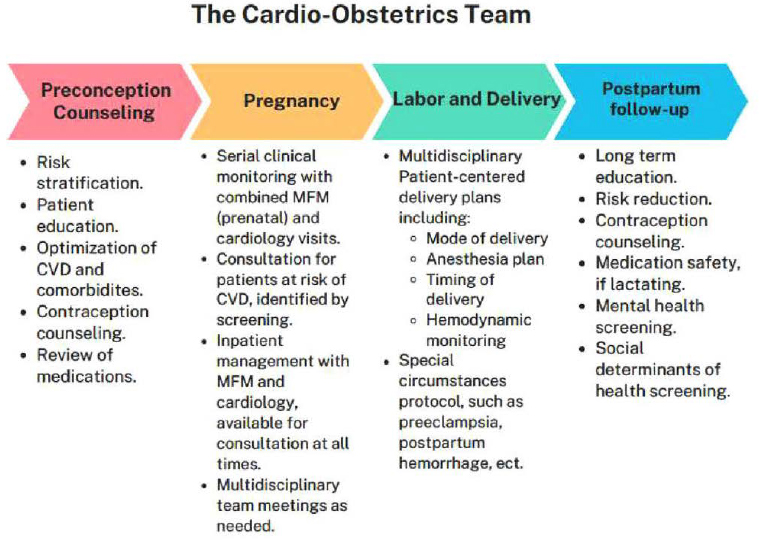
NOTES: Postpartum follow-up is also relevant to the interpregnancy period. CVD = cardiovascular disease; MFM = maternal-fetal medicine.
SOURCE: Reprinted from Wolfe and Guerrero, 2025.
Proposed team members typically include the pregnant woman; obstetricians; maternal-fetal medicine (MFM) specialists; nurse midwives; cardiologists; anesthesiologists; nurses; patient care coordinators; and primary care clinicians (including family medicine and internal medicine), who play a central role in interpregnancy care, long-term cardiovascular risk-factor management, and care transitions. The team may also include specialists and subspecialists, such as cardiothoracic surgeons, hematologists, pulmonologists, intensivists, neonatologists, pediatricians, endocrinologists, nephrologists, geneticists, pharmacists, mental health professionals, and social workers (Easter et al., 2020; Ernst et al., 2024; Grodzinsky et al., 2019; Minhas et al., 2022; O’Kelly et al., 2021; Wolfe, 2020; Wolfe and Guerrero, 2025; Wolfe and Yellin, 2021). Beyond pregnancy-specific care, pediatric clinicians play a critical role in advancing cardiovascular health across the life course and interrupting intergenerational risk, as described in the Chapter 2 APO section). For individuals with APOs, pediatricians and specialists are uniquely positioned to support early identification and management of cardiometabolic risk in offspring through longitudinal growth
monitoring, BP assessment, and early screening for risk factors, alongside promotion of healthy nutrition, physical activity, and sleep behaviors beginning in childhood and adolescence. These early prevention and intervention efforts can not only mitigate long-term cardiovascular risk in offspring but also contribute to healthier cardiometabolic profiles entering adulthood—ensuring if and when a future pregnancy is desired, individuals are better positioned for optimal maternal and fetal outcomes.
To inform whether this model should be recommended as a standard of care, the committee conducted a targeted review to address the question “Do integrated cardio-obstetrics care models improve cardiovascular and pregnancy outcomes among high-risk pregnant patients?”
Summary of the Evidence
The initial literature search yielded 192 records (two duplicates) with publication dates from January 2010 to October 2025 that were screened at the abstract level. Articles were eligible for full-text review if they were conducted in the United States and other very high–income United Nations (UN) countries and reported outcomes relevant to the committee’s research question. The committee conducted full-text review for 83 articles, with 12 meeting all inclusion criteria; the most common reasons for exclusion were wrong intervention and wrong population. The committee conducted risk-of-bias assessments and data extraction for the 12 studies (see Table 5-2). The search identified an additional 17 relevant studies, including review articles (Khalid et al., 2023; Lucà et al., 2023; Sharma et al., 2020b), descriptions of the cardio-obstetrics team and how to build one (Canobbio and Afshar, 2022; Easter et al., 2020; Ernst et al., 2024; Grodzinsky et al., 2019; O’Kelly et al., 2021; Wolfe, 2020; Wolfe and Guerrero, 2025; Wolfe and Yellin, 2021), a qualitative study (Hart et al., 2024), a patient satisfaction study (Florio et al., 2022), and an expert panel review (Batchelor et al., 2023). The committee used these articles for background and context and reviewed the reference lists to ensure it did not miss any relevant intervention studies.
The majority of included studies were retrospective cohort studies (Lam et al., 2023; Magun et al., 2020; McCoy et al., 2024; Nashat et al., 2025; Ornaghi et al., 2022; Quiñones et al., 2021; Yellin et al., 2023), with one prospective cohort study (Richardson et al., 2024), one systematic review and meta-analysis (Sebastian et al., 2025), one systematic review (Bick et al., 2014), a case series (Vaidya et al., 2022), and a case-control study (Saxena et al., 2024).
The evidence base for multidisciplinary cardio-obstetrics care is largely observational. The strongest synthesis comes from a good-quality systematic review and meta-analysis (Sebastian et al., 2025), which analyzed six
observational studies (N = 1,109 pregnant women with CVD; mean age 30.8; high risk based on Cardiac Disease in Pregnancy Study [CARPREG] II greater than 2)4 (Silversides et al., 2018). The most common CVDs included arrhythmias, congenital heart disease, and valvular heart disease. Multidisciplinary cardio-obstetrics care was associated with significantly lower 30-day postpartum readmission and fewer postpartum arrhythmias compared with standard care, with no significant difference in maternal mortality (Sebastian et al., 2025). However, reliance on observational designs and, in some studies, modeled national averages for comparators limits causal inference. Nonetheless, the overall findings suggest potential benefits for short-term use and rhythm complications.
An earlier fair-quality review (Bick et al., 2014) included 19 studies of multidisciplinary models for women with cardiac disease and diabetes, but only two small studies evaluated cardiac disease populations and suggested improved heterogeneity in team composition, lack of standardized models and methodologic limitations restricted conclusions, and most studies predated contemporary cardio-obstetrics programs.
Several single-center or network cohort studies have described outcomes in multidisciplinary cardio-obstetrics programs, with mixed comparative findings and important potential for selection and case-mix effects. A good-quality retrospective pre–post cohort study among pregnant women with preexisting congenital heart disease at a single academic institution compared outcomes before a formal cardio-obstetrics program (2002–2010; N = 84) to those after implementation of a multidisciplinary program with MFM and adult congenital cardiologists (2011–2020; N = 200) (McCoy et al., 2024). Although the number of pregnancies increased over time, the study found no difference in the adjusted composite adverse maternal cardiac outcome between groups. After implementation, fewer patients entered pregnancy with more severe disease (New York Health Association class II–IV or systemic ventricular dysfunction), and postpartum diuresis was more common, though shifting referral patterns toward less severe disease could have contributed. The postprogram group had one cardiac arrest/cardiac death 5 months postpartum and a higher rate of HDP (20 versus 10 percent preprogram), possibly due to increased attention and detection.
A fair-quality case-control study in a nonuniversity setting (102 cases in a multidisciplinary program versus 102 historical controls seen by cardiology preprogram) found the program served a more diverse population and
___________________
4 The CARPREG II risk score is a tool to predict severe maternal cardiac events in pregnant women with heart disease. It adds points for 10 predictors, including prior cardiac events, heart failure symptoms (New York Heart Association III/IV), mechanical valves, ventricular dysfunction, and high-risk heart conditions. A score of greater than 2 (more than 2 points) indicates a higher risk of cardiac complications during pregnancy or the early postpartum period.
was associated with higher intensity of cardiovascular testing/monitoring and more appropriate medication use in pregnancy. However, obstetric complications were similar, and no deaths occurred (Saxena et al., 2024). Another fair-quality retrospective cohort study followed 232 patients managed by a multidisciplinary MFM–cardiology team. The overall outcomes were favorable, but women with acquired heart disease (e.g., coronary artery disease, HTN, prior myocardial infarction) had higher rates of preeclampsia and PTB than those with congenital heart disease, arrhythmias/channelopathies, or aortopathies, and prepregnancy counseling may have reduced observed event rates by influencing pregnancy decisions (Quiñones et al., 2021).
A fair-quality study described a retrospective cohort of 306 pregnant women with CVD in a high-risk, predominantly Medicaid-insured population managed by a broad multidisciplinary team (MFM, cardiology, endocrinology, neurology, and surgery). It reported one maternal death attributed to Eisenmenger syndrome, a higher preeclampsia rate than national averages (attributed to high BMI/low socioeconomic status), and overall low rates of maternal/fetal complications and postpartum readmissions despite high-risk CARPREG II profiles (Magun et al., 2020). A fair-quality prospective study of 209 pregnancies at a European tertiary center found major cardiovascular events occurring in 16 women during pregnancy and three during the first postpartum year, with most concentrated among women whose CVD was not diagnosed before pregnancy. In addition, the cohort had a higher rate of severe postpartum hemorrhage attributed to anticoagulant/antiplatelet therapy (Richardson et al., 2024).
In contrast, a fair-quality study described 197 pregnancies with heart disease monitored by MFM without a multidisciplinary team and reported cardiac complications in 10.7 percent, higher risk with higher modified World Health Organization (mWHO) class, multiple gestation, urgent cesarean delivery, and adverse fetal/neonatal outcomes, including stillbirths and neonatal deaths among preterm infants (Ornaghi et al., 2022). Finally, two small studies in highly specialized populations—one of good quality in pulmonary arterial HTN (Vaidya et al., 2022) and a poor-quality study in rheumatic heart disease (Lam et al., 2023)—reported reassuring maternal and fetal outcomes with specialized multidisciplinary care, but both were limited by small samples and lack of comparison groups.
These observational studies and the good-quality systematic review and meta-analysis (Sebastian et al., 2025) suggest that multidisciplinary cardioobstetrics programs
- are feasible to implement in tertiary and specialized centers,
- can achieve acceptable cardiovascular and pregnancy outcomes in high-risk populations, and
- may reduce specific short-term use and arrhythmia outcomes (e.g., 30-day readmissions, postpartum arrhythmias) relative to modeled standard care benchmarks.
However, the absence of randomized or prospective controlled comparisons, heterogeneity in program design, and reliance on modeled comparator data substantially limit the strength of evidence that cardio-obstetrics programs result in benefit for maternal mortality, severe maternal morbidity, or fetal/neonatal outcomes.
Timing and Frequency
While this review question and literature search focused on the benefit of multidisciplinary care during pregnancy, many of the programs spanned prepregnancy, pregnancy, and postpartum care. Some cohorts included structured prepregnancy visits, where women with known CVD receive risk stratification, optimization, and counseling that sometimes led to deferral of pregnancy in very high-risk situations (McCoy et al., 2024; Quiñones et al., 2021). Other programs emphasized coordinated prenatal care with shared decision making around delivery timing and mode, with postpartum follow-up extending up to 6–12 months to monitor volume status, adjust medications, and transition patients to long-term cardiovascular, other specialty, or primary care (Magun et al., 2020; Quiñones et al., 2021; Wolfe and Guerrero, 2025; Wolfe and Yellin, 2021; Yellin et al., 2023).
Evidence supports the conceptual value of this continuum approach, particularly for helping high-risk patients enter pregnancy with better-controlled disease and facilitating transition to chronic CVD management. However, direct evidence that specific timings or intensities of multidisciplinary care (e.g., prepregnancy clinics versus pregnancy-only programs versus extended postpartum follow-up) differentially improve maternal cardiovascular or pregnancy outcomes was not the focus of this review, and additional literature may exist.
Potential Benefits and Harms
Some studies have found improved maternal and fetal outcomes for pregnant patients seen in multidisciplinary programs (Magun et al., 2020; Yellin et al., 2023). Data also suggest that patient satisfaction with multidisciplinary cardio-obstetric programs is high (Florio et al., 2022). Women have many monitoring appointments during pregnancy, and it can be beneficial to see multiple specialists in the same location at the same time and for the specialists to work together to discuss a pregnancy and delivery care plan.
Unnecessary treatment is possible when patients receive more specialized care. One study found an increased rate of labor induction and diuresis after delivery in patients who were seen by the multidisciplinary cardio-obstetrics program (McCoy et al., 2024). Another potential harm is the need to travel long distances to a multidisciplinary care center, given the considerable U.S. maternity care shortages (Adashi et al., 2025). No studies systematically evaluated adverse effects or compared patient-reported harms between multidisciplinary care and usual care.
Cost and Cost-Effectiveness
No studies in the committee’s literature review reported intervention costs, resource use, or formal cost-effectiveness analyses for multidisciplinary cardio-obstetric programs. It is plausible that if these models reduce preventable cardiovascular complications, readmissions, and intensive care unit (ICU) or neonatal intensive care unit (NICU) use, they could generate health system savings, but this remains speculative.
At the patient level, financial impact likely depends on insurance benefit design. In many U.S. systems, global pregnancy fees cover obstetric or MFM care but not subspecialty care, including cardiology. As a result, multidisciplinary visits may generate additional copayments or out-of-pocket costs for cardiovascular consultations. Conversely, integrated same-day multidisciplinary visits may reduce the indirect costs to the patient (transportation, child care, and time off work) resulting from multiple separate specialist appointments.
Population Considerations
Several studies demonstrated that multidisciplinary cardio-obstetrics programs can be implemented among underserved populations, including predominantly Medicaid-insured patients and socioeconomically disadvantaged women with congenital heart disease. Two studies both reported favorable maternal and fetal outcomes in such settings, with low in-hospital maternal mortality (Magun et al., 2020; Yellin et al., 2023).
However, because nearly all published programs are housed in specialized centers, it remains unclear whether multidisciplinary models reduce, have no effect on, or inadvertently widen population-level disparities in maternal cardiovascular outcomes. The literature is also sparse regarding implementation in rural or resource-limited settings.
Implementation Considerations
The literature contains rich descriptions of how cardio-obstetrics programs have been implemented, although empirical evaluation of which components are necessary or sufficient for improved outcomes is limited. Implementation considerations for integrated cardio-obstetrics care include the following:
- Specialized workforce and training. Programs typically rely on cardiologists with interest or expertise in pregnancy-related CVD, MFM specialists, anesthesiologists, and nurses trained in both cardiac and obstetric care. Multiple publications describe recommended team compositions and training pathways for current and future cardiologists (e.g., Canobbio and Afshar, 2022; Easter et al., 2020; Ernst et al., 2024; Grodzinsky et al., 2019; Lindley, 2022; Minhas et al., 2022; O’Kelly et al., 2021; Wolfe and Guerrero, 2025).
- Clinical pathways and shared protocols. Successful programs often develop standardized clinic referral criteria, risk-stratification algorithms (e.g., CARPREG II and mWHO), delivery plans, and postpartum surveillance schedules to guide consistent decision-making.
- Infrastructure for coordination. Colocated clinics, shared electronic health records (EHRs), and structured case conferences facilitate real-time communication among team members and support collaborative planning for delivery and acute decompensation.
- Referral networks and telehealth. Most cardio-obstetrics clinics reside in tertiary centers. Thus, regional referral pathways, telehealth consultation models, and clear criteria for which patients should be managed locally versus in specialized programs are needed to ensure access and avoid overwhelming specialized centers (Wolfe and Yellin, 2021).
Summary and Conclusions
Pregnancy with preexisting or newly diagnosed CVD carries substantial risk. The committee’s review identified 10 observational studies, one meta-analysis, and one earlier systematic review describing multidisciplinary cardio-obstetrics programs in high-risk populations. These consistently show that specialized programs can be implemented in tertiary and referral centers, are acceptable to patients, and can deliver coordinated care with relatively low rates of maternal death and manageable cardiovascular event rates in very high-risk cohorts. One meta-analysis suggests that multidisciplinary programs may reduce 30-day postpartum readmissions and postpartum arrhythmias relative to estimates modeled from standard care.
However, the committee noted that nearly all evidence comes from nonrandomized designs, often without concurrent control groups, and with substantial heterogeneity in program structure and underlying populations. Effects on maternal mortality and severe maternal morbidity (SMM) remain uncertain, with no randomized or prospective controlled studies that compare integrated cardio-obstetric care to usual care.
Given the compelling clinical rationale, alignment with professional society recommendations, and consistent feasibility and acceptability of these programs, the committee judges that multidisciplinary cardio-obstetrics care is a promising strategy for managing high-risk pregnancies. However, the evidence base provides limited support for definitive claims about improved maternal cardiovascular or pregnancy outcomes, and robust comparative effectiveness studies are needed.
Conclusion 5-2: Limited evidence suggests that integrated cardio-obstetrics care models may improve selected short-term intermediate, process, or use outcomes—such as 30-day postpartum readmissions and postpartum arrhythmias—among pregnant women with preexisting cardiovascular disease cared for in specialized centers. Direct evidence is limited about the effects of these models on maternal mortality and severe maternal morbidity outcomes.
Research Considerations
To strengthen the evidence base on multidisciplinary cardio-obstetrics care, the committee identified several research priorities:
- Comparative effectiveness research. Conduct adequately powered randomized or high-quality non-RCT studies comparing integrated cardio-obstetrics programs with usual care, with outcomes including maternal mortality, SMM, major cardiovascular events, readmissions, APOs, and neonatal outcomes. Ongoing federally funded studies, such as the National Institutes of Health–supported Heart Outcomes in Pregnancy Expectations for Mom and Baby Study trial, which includes an aim to evaluate cardio-obstetrics care structures and multidisciplinary coordination, may provide additional evidence regarding which multidisciplinary models most effectively improve maternal cardiovascular outcomes (Clinicaltrials.gov, 2025).
- Component and timing studies. Evaluate which elements of multidisciplinary care (e.g., prepregnancy counseling, colocated clinics, standardized delivery planning, or extended postpartum follow-up) drive observed benefits, and assess whether particular timings or intensities of involvement are most effective.
- Access evaluations. Examine whether cardio-obstetrics programs reduce or widen disparities in cardiovascular and pregnancy outcomes across populations with differing social, economic, geographic, and insurance-related barriers to care, and test models explicitly designed for rural, remote, and safety-net settings, including telehealth-enabled approaches.
- Implementation science. Study how best to integrate cardio-obstetrics teams into existing care systems, including training pathways, referral criteria, financing models, and strategies to ensure sustainable staffing and interdisciplinary collaboration.
SUPPORTIVE SERVICES
Overview of the Question and Gap
Current professional society guidelines recommend discussing, beginning in the prenatal period, the importance of care in the fourth trimester of pregnancy (ACOG, 2018). The guidelines acknowledge the use of patient navigation systems, support staff, postpartum nurses, and doulas to enhance attendance at visits that can restore and improve the health and well-being of the woman. Patient navigation systems provide the opportunity to develop a relationship with a health care individual who can troubleshoot and provide support for overcoming patient-level barriers to accessing care (i.e., work schedule, transportation, child care, and managing multiple appointments). The potential for this approach to improve health outcomes is one reason the Women’s Preventive Services Initiative (WPSI) recommended patient navigation services for breast and cervical cancer screening starting in 2026 (WPSI, 2026). Doulas are trained nonmedical professionals who likewise provide support to pregnant women by addressing their emotional, physical, and informational knowledge needs that can extend through the postpartum period. Both types of services have been shown to improve birth outcomes and adherence with clinical visits in general (Knocke et al., 2022; Kozhimannil et al., 2016; Yee et al., 2021).
Postpartum guidelines recommend ongoing care throughout the first year after giving birth, designed to specifically address common contributors to maternal death, such as HTN and mental health disorders (see Appendix B). Given this, the committee sought to understand what evidence exists about whether supportive services (e.g., doulas, peer navigation, or community health workers) improve CVD-related outcomes in the prenatal and postpartum periods.
TABLE 5-2 Summary of Evidence on Prenatal Integrated Cardio-Obstetrics Care Modelsa
| Author/Year/Journal | Study Type/Setting | Population Description | Intervention/Comparison | Key Outcomes | Main Findings | Quality Ratingb |
|---|---|---|---|---|---|---|
|
Bick et al., 2014 BMC Pregnancy and Childbirth |
Systematic review of CINAHL, MEDLINE, Cochrane Library, EMBASE, Maternal & Infant Care, Scopus and PsycINFO (January 2002 to February 2013) | 19 studies discussing MDT management; 4 on women with diabetes, 15 on women with cardiac disease Reproductive period: PN → PP |
Formalized cardio-obstetrics collaboration with coordinated cardiac + obstetric care; no consistent definition of “standard care” | Identification of MDT models; maternal and perinatal outcomes | Very heterogeneous MDT models; few studies evaluating outcomes rigorously; only two small cardiac cohorts suggesting improved outcomes, with no clear conclusions about effectiveness for women with cardiac disease or diabetes | Fair |
|
Magun et al., 2020 Journal of the American College of Cardiology |
Retrospective descriptive cohort; university medical center, U.S. | N = 306 patients with CVD seen 2010–2019; predominantly Medicaid-insured, high-risk cohort (elevated CARPREG II scores) Reproductive period: PN → PP |
Formalized cardio-obstetrics collaboration with coordinated cardiac + obstetric care | Maternal and fetal outcomes; cardiac readmissions; maternal mortality | 48 antepartum readmissions and one maternal death (Eisenmenger syndrome) in a very high-risk population; PE rate higher than national averages, but overall maternal and neonatal complications and readmissions relatively low, given baseline CVD severity | Fair |
|
Quiñones et al., 2021 American Journal of Obstetrics & Gynecology: Maternal-Fetal Medicine |
Retrospective single-center cohort; U.S. | N = 232 women with 253 pregnancies with diagnostic evidence of CVD (2010–2019) Reproductive period: prepregnancy → PP |
Formalized cardio-obstetrics collaboration with coordinated cardiac + obstetric care | Serious cardiac events, maternal mortality, neonatal outcomes, obstetric complications (e.g., PE) | Compared to other studies, cohort with a lower rate of serious cardiac events and higher PE rate; high-risk patients often counseled against or deferred pregnancy, which may have attenuated adverse outcome rates | Fair |
|
Ornaghi et al., 2022 Open Heart |
Retrospective single-center cohort study; Italy | N = 162 women with 197 pregnancies with CVD Reproductive period: PN → PP |
Management of pregnancies with heart disease using MFM-led care; patients categorized by prior and updated mWHO classification; no formal multidisciplinary program | Cardiac adverse events, cesarean delivery, and pregnancy complications, neonatal outcomes; HDP; GDM | Cardiac complications in 10.7% of pregnancies, with higher risk among those with higher mWHO class, multiple gestations, and urgent cesarean delivery; no maternal deaths but stillbirths and neonatal deaths reported, and adverse fetal/neonatal outcomes more frequent than in general obstetric populations | Fair |
| Author/Year/Journal | Study Type/Setting | Population Description | Intervention/Comparison | Key Outcomes | Main Findings | Quality Ratingb |
|---|---|---|---|---|---|---|
|
Vaidya et al., 2022 Journal of Cardiovascular Development and Disease |
Retrospective case series; accredited pulmonary HTN center, U.S. | 7 pregnancies in six patients managed to delivery Reproductive period: PN → PP hospitalization |
Formalized cardio-obstetrics collaboration with coordinated cardiac + obstetric care vs. preprogram usual care | Composite maternal cardiac outcome; HF; pulmonary edema; arrhythmia; induction; PP diuresis | Very high-risk pregnancies (PAH) managed with specialized multidisciplinary care with low maternal mortality and acceptable maternal and neonatal outcomes; small sample size and lack of a comparator limit causal inferences | Good |
|
Lam et al., 2023 Australian and New Zealand Journal of Obstetrics and Gynaecology |
Retrospective single-center descriptive study; Australia | N = 129 pregnancies (RHD) diagnosed by antenatal EKG (2010–2019) Reproductive period: PN |
Multidisciplinary referral center model with obstetrics, cardiology, anesthesia, and midwifery group practice supporting remote telehealth coordination | ICU admissions, incidence of HDP, delivery complications | No maternal mortality observed despite high baseline risk; detailed complication rates by RHD severity provided | Poor |
|
Yellin et al., 2023 American Journal of Obstetrics & Gynecology: Maternal-Fetal Medicine |
Retrospective cohort, U.S. | N = 150 pregnancies with ACHD seen in urban MFM–cardiology joint program (2015–2021) Reproductive period: PN |
Comparing different mWHO risk classification groups in a multidisciplinary care setting | Maternal mortality; maternal pregnancy outcomes; anesthetic and monitoring requirements; contraceptive uptake | Women with mWHO ≥II/III more likely to require invasive monitoring and general anesthesia than those with lower-risk classification but with similar cesarean delivery rates; no inhospital maternal deaths | Poor |
|
McCoy et al., 2024 American Journal of Obstetrics & Gynecology: Maternal-Fetal Medicine |
Retrospective cohort; single academic cardio-obstetrics program, U.S. | N = 284 pregnant women with CHD (84 preprogram; 200 postprogram) Reproductive period: PN → 6 months PP |
Formalized cardio-obstetrics collaboration with coordinated cardiac + obstetric care vs. preprogram usual care at the same institution | Composite maternal cardiac outcome; HF; pulmonary edema; arrhythmia; induction; PP diuresis | Cardiac morbidity unchanged; more women entering pregnancy as NYHA I; fewer with ventricular dysfunction; labor induction ↑; PP diuresis ↑, consistent with closer volume management | Good |
|
Richardson et al., 2024 Archives of Cardiovascular Disease |
Prospective cohort; France | N = 209 pregnancies in 202 patients with history of CVD Reproductive period: PN → PP |
Formalized cardio-obstetrics collaboration with coordinated cardiac + obstetric care | Major cardiovascular events during pregnancy or within 1 year, severe PP hemorrhage, and cesarean section | Rate of major cardiovascular events during pregnancy (7.7%) and 1-year follow-up (2.4%), severe PP hemorrhage (7.7%), and cesarean section (38.3%) | Fair |
| Author/Year/Journal | Study Type/Setting | Population Description | Intervention/Comparison | Key Outcomes | Main Findings | Quality Ratingb |
|---|---|---|---|---|---|---|
|
Saxena et al., 2024 Journal of Maternal, Fetal, and Neonatal Medicine |
Retrospective pre–post matched cohort; multicenter study; U.S. | N = 113 pregnancies managed by a multidisciplinary cardio-obstetrics program vs. N = 338 preprogram pregnancies; analysis of 102 intervention and 102 control pregnancies matched by mWHO class Reproductive period: PN → PP |
Formalized cardio-obstetrics collaboration with coordinated cardiac + obstetric care vs. preprogram usual care | Cardiovascular risk; visits and admission during pregnancy; PP visits and readmission; obstetric or cardiology complications during pregnancy; delivery outcomes | Intervention group with more cardiovascular testing and monitoring and more guideline-concordant medication use, with no significant differences in ED visits, inpatient admissions, cardiovascular complications, or delivery outcomes during pregnancy or PP; no deaths reported in either group | Fair |
|
Nashat et al., 2025 International Journal of Cardiology |
Retrospective single-center observational cohort study; U.K. | N = 32 pregnancies in women with mWHO Class IV CVDS Reproductive period: PN → PP |
Formalized cardio-obstetrics collaboration with coordinated cardiac + obstetric care | Cardiovascular events; cardiac-related hospitalizations; maternal mortality | No pregnancies complicated by acute cardiac events requiring hospitalization, with high rates of PTB and NICU admission; no maternal deaths during pregnancy or the immediate PP period; three during longer-term follow-up | Poor |
|
Sebastian et al., 2025 Current Problems in Cardiology |
Systematic review and meta-analysis of MEDLINE, Web of Science, Scopus, and Cochrane through March 5, 2025 | Six observational studies including N = 1,109 pregnant women with CVD Reproductive period: PN → PP |
Formalized cardio-obstetrics collaboration with coordinated cardiac + obstetric care vs. indirect comparison using national averages | Maternal mortality; 30-day PP readmission rates; incidence of PP arrhythmias | Maternal mortality unchanged; multidisciplinary care associated with reduced 30-day PP readmissions and fewer PP arrhythmias compared with modeled standard-care estimate | Good |
NOTES: a Studies are listed by publication year (oldest first), then alphabetically by first author within each year. b Quality rating was assessed using the National Heart, Lung, and Blood Institute Quality Assessment Tools; ratings: Good = low risk of bias; Fair = some concerns; Poor = serious risk of bias. ACHD = adult congenital heart disease; CARPREG II = Cardiac Disease in Pregnancy Study II risk score; CHD = congenital heart disease; CVD = cardiovascular disease; ED = emergency department; EKG = electrocardiogram; GDM = gestational diabetes mellitus; HDP = hypertensive disorder of pregnancy; HF = heart failure; ICU = intensive care unit; mWHO = modified World Health Organization cardiac risk classification; MDT = multidisciplinary team; MFM = maternal-fetal medicine; NICU = neonatal intensive care unit; NYHA = New York Heart Association functional class; PAH = pulmonary arterial hypertension; PE = preeclampsia; PN = prenatal; PP = postpartum; PTB = preterm birth; RHD = rheumatic heart disease.
SOURCES: Bick et al., 2014; Lam et al., 2023; Magun et al., 2020; McCoy et al., 2024; Nashat et al., 2025; Ornaghi et al., 2022; Quiñones et al., 2021; Richardson et al., 2024; Saxena et al., 2024; Sebastian et al., 2025; Vaidya et al., 2022; Yellin et al., 2023.
Summary of the Evidence
The initial literature search yielded 482 records with publication dates from January 2010 to August 2025, including 56 duplicates. Of the 426 unique articles screened at the abstract level, the committee identified 35 as potentially relevant and moved them to full-text review; 11 met inclusion criteria, with the most common reasons for exclusion being wrong population, wrong intervention, or no relevant outcomes. Articles conducted in the United States and other very high–income UN countries were eligible for inclusion. The committee conducted risk-of-bias assessments and data extraction for the nine empirical studies that remained after full-text review.
Most of the included studies were observational, with designs such as prospective cohort with propensity matching or retrospective cohort (Brown et al., 2023; Cunningham et al., 2020; Falconi et al., 2022; Meghea et al., 2023; Mendez-Figueroa et al., 2014; Nelson et al., 2023). Two were randomized clinical trials (Burris et al., 2025; Zaman et al., 2024) and one was a quality-improvement study (Schubert et al., 2024). Populations studied were often high-risk, safety-net, or Medicaid-insured cohorts. Details of each are shown in Table 5-3.
Five studies focused only on the postpartum period; the remainder covered both the perinatal and postpartum periods. Three evaluated outcomes associated with doula care (Burris et al., 2025; Falconi et al., 2022; Schubert et al., 2024), and six evaluated intensive case management that included patient navigation and/or community health workers (Brown et al., 2023; Cunningham et al., 2020; Meghea et al., 2023; Mendez-Figueroa et al., 2014; Nelson et al., 2023; Zaman et al., 2024). This section summarizes key findings on effectiveness for preventing CVD risk factors or outcomes in postpartum/interpregnancy women from this body of evidence.
Supportive services, such as care coordination and navigation programs, were associated with improved postpartum engagement. One good-quality retrospective cohort study of postpartum navigation observed reduced all-cause rehospitalization within 30 days after delivery, including for SMM based on the Centers for Disease Control and Prevention definition (N = 2,590 enrolled in navigation, N = 3,229 not enrolled); the largest absolute benefit was observed among Black women (Brown et al., 2023). These data suggested supportive services could reduce hypertensive complications that contribute to future CVD risk.
Extended postpartum programs improved clinical follow-up for women with chronic HTN and diabetes and were associated with better intermediate measures of cardiometabolic control (Nelson et al., 2023; Zaman et al., 2024). For example, in one fair-quality cohort study (N = 1,479 women; N = 133 with diabetes or HTN), participants in a multicomponent care management program with community health workers had lower postpartum
HbA1c than those receiving usual care, indicating benefit for this proximal CVD risk factor (Nelson et al., 2023).
Models that brought comprehensive postpartum care earlier (Burris et al., 2025; Cunningham et al., 2020; Falconi et al., 2022; Meghea et al., 2023) found important process improvements for CVD risk identification and early management, including increased timely BP measurement, initiation of treatment when indicated, depression screening/referral, and overall completion of core postpartum care elements. For example, a good-quality RCT found that embedding doulas and certified nurse midwives in the NICU reduced the time to first postpartum visit and increased adherence with BP measurements (N = 20 intervention, N = 17 control) (Burris et al., 2025). Similar results were seen in a good-quality retrospective cohort study of a doula care services model begun in the prenatal period among Medicaid-insured women (N = 298 doula, N = 298 matched controls) (Falconi et al., 2022). However, this study also assessed inpatient admission within 30 days postpartum, SMM, and hospital readmissions and found no differences. A fair-quality retrospective cohort study found that a home visiting program with 1,081 participants (versus 123,922 controls) was associated with reduced PTB and low birth weight, higher postpartum care attendance, and improved follow-up for chronic HTN and diabetes compared with propensity-matched nonenrolled participants (Meghea et al., 2023).
Overall, supportive services delivered during the prenatal and postpartum periods showed improved prenatal and postpartum care adherence, monitoring of BP and glycemic measures, and HbA1c. However, direct evidence was limited about effects on long-term cardiovascular events or interpregnancy CVD risk. Most studies were underpowered for hard CVD endpoints and had short follow-up periods.
Limitations of the studies included observational designs, which suffer inherently from residual confounding and can only weakly support inference of causality, despite the appropriate temporal sequence (Brown et al., 2023; Cunningham et al., 2020; Falconi et al., 2022; Meghea et al., 2023; Mendez-Figueroa et al., 2014; Nelson et al., 2023). Those that used administrative data were at risk for misclassification of the exposure (e.g., doula care program or enhanced coordination) and did not ensure exclusion from other intervention programs that may have been delivered in the community (Falconi et al., 2022; Meghea et al., 2023; Schubert et al., 2024). The quality-improvement program study lacked randomization, and use of single-site or regionally concentrated studies limit generalizability (Schubert et al., 2024). The two RCTs had small sample sizes (37 and 94 participants) and lacked power to detect differences, especially for categorical outcomes (Burris et al., 2025; Zaman et al., 2024).
Conducting RCTs on the use of supportive services is challenging because it can be difficult or impossible to blind providers and assessors to treatment assignment, and cross-contamination between treatment and comparison groups may occur. This makes linked administrative/EHR sources an asset in evaluating programs delivered in real-world health care settings. Strengths in this body of evidence included matched designs, such as propensity-score matching to adjust for sociodemographic confounders (Falconi et al., 2022; Meghea et al., 2023; Nelson et al., 2023). Several studies used adjusted multivariable models and reported sensitivity analyses and correction for multiple comparisons, which enhanced the rigor of analyses.
Timing and Frequency
In terms of timing and frequency of the services examined in the literature, early, proactive, intentional contact (at hospital discharge or within days and up to 2 weeks postpartum) and repeated contact and outreach during the early postpartum window produced measurable improvements in process and intermediate health outcomes. These included increased use of postpartum visits, reduced 30-day hospitalizations, improved BP management, and improved diabetes screening and control.
Potential Benefits and Harms
Interventions that incorporated navigation, community health workers, or doula support were consistently associated with improvements in processes of care (e.g., higher rates of postpartum visit attendance, BP monitoring and treatment, and diabetes screening) and better intermediate outcomes, such as lower HbA1c among women with diabetes and reduced PTB and low birth weight in some home-visiting programs (Brown et al., 2023; Knocke et al., 2022; Meghea et al., 2023; Yee et al., 2017). Several studies also reported lower odds of cesarean delivery and postpartum depression/anxiety in doula-supported groups and reduced short-term rehospitalization and SMM among postpartum women enrolled in navigation programs, suggesting potential for both clinical and experiential benefit.
Direct medical harms were not reported in these intervention or quality-improvement studies, and no excess adverse events attributable to supportive services were identified. However, potential burdens include increased contact with the health care system (e.g., more visits, monitoring, or communication), which may add time, logistical, or financial strain for some women if services are not aligned with their preferences or integrated with existing care. There is also a risk that, if these programs are only available in certain systems or for specific payer groups, they could inadvertently widen disparities in access to comprehensive postpartum care.
These potential harms and burdens were not systematically measured in the evidence base.
Cost and Cost-Effectiveness
None of the reviewed studies conducted cost–benefit analyses. Several authors mentioned increased staffing of patient navigators and workforce training of doula and community health workers needed to perform the services, in addition to an evaluation of the cost-effectiveness of the programs delivered. The studies reported process and short-term clinical outcomes that had the potential to mitigate the risk of further disease progression. However, none identified long-term reductions in CVD events (myocardial infarction, stroke, or heart failure) attributable to the services/interventions delivered during the prenatal and postpartum period.
Population Considerations
The literature provided some evidence that supportive services have greater benefits for some groups at higher risk of adverse outcomes. Postpartum navigation produced larger absolute reductions in early rehospitalization and SMM among Black women, suggesting greater benefit in populations with higher baseline risk and access barriers (Brown et al., 2023).
Studies found that doula programs and community-based supports delivered to Medicaid or Medicaid-eligible populations were associated with improved maternal outcomes (lower odds of cesarean and PTBs and lower rates of postpartum depression/anxiety) and particularly beneficial for socioeconomically vulnerable women who experienced health disparities (Falconi et al., 2022; Meghea et al., 2023; Schubert et al., 2024).
For women with comorbidities, extended postpartum care models directed toward populations with high rates of chronic HTN and diabetes reported improved follow-up HbA1c and HTN care in the year after delivery (Nelson et al., 2023). Similarly, in women with HDP (including chronic HTN), additional visits for BP monitoring or care coordination reduced postpartum hospitalizations (Brown et al., 2023). No reported differences by age or parity were mentioned.
Implementation Considerations
Implementation of supportive services requires intentional integration into existing prenatal and postpartum care workflows rather than ad hoc referrals. Effective models described in the literature used systematic
approaches to identify eligible patients (e.g., EHR-based risk algorithms at delivery, program eligibility tied to chronic conditions, or Medicaid enrollment) and initiated contact early, often at hospital discharge or within the first 1–2 weeks postpartum. Programs that specified a minimum “dose” of contact (such as multiple navigator touchpoints over 30 days) and offered flexible outreach modalities (e.g., phone, text, telehealth, home visits, or care embedded in the NICU) were more likely to achieve improvements in postpartum engagement, HTN followup, and postpartum diabetes screening after GDM diagnosis.
Successful implementation also depends on a trained, supported workforce of doulas, community health workers, nurses, and navigators who are integrated into clinical teams and able to coordinate with obstetric, primary care, cardiology, behavioral health providers, and other specialists. Several studies emphasized the value of culturally and linguistically concordant doulas or community health workers and formalized communication pathways between supportive service providers and clinicians for triage, medication management, and referral. Ensuring sustainable financing (e.g., reimbursement for doula services, navigation, and extended postpartum care), building data systems to track outreach and follow-up, and aligning with community-based resources are key to maintaining programs over time and avoiding duplication or fragmentation of services.
Summary and Conclusions
Interventions that started at or before discharge and included active, repeated outreach (e.g., navigation, doula support, remote BP monitoring, and early clinic access) led to improved detection and early management of postpartum HTN and completion of postpartum diabetes screening, both key modifiable contributors to future CVD risk. Evidence is limited that these interventions during pregnancy and postpartum improve maternal cardiovascular outcomes; one study suggested benefits for intermediate outcomes, such as hemoglobin A1c levels.
Conclusion 5-3: Evidence is moderate that supportive services such as navigation and doula support—when initiated before delivery and continued with repeated, active outreach in the postpartum period—lead to improvements in processes of care that mitigate future cardiovascular risk. Direct evidence is limited on whether these services improve maternal cardiovascular outcomes.
Research Considerations
Research, including controlled trials with extended follow-up and incorporating economic evaluations, is needed to evaluate longer-term reductions in CVD events and inform health care policy (e.g., Medicaid postpartum coverage extensions, reimbursement for doulas/navigation).
TRANSITION FROM POSTPARTUM CARE
Overview of the Question and Gap
Effective transitions from inpatient postpartum care to outpatient primary or preventive care are critical for women at increased risk for future CVD. Professional societies, including ACOG and the International Federation of Gynecology and Obstetrics, recommend that those with chronic medical conditions—particularly with HDP or other cardiovascular risk factors—receive timely and coordinated follow-up with obstetric or primary care clinicians (ACOG, 2018; Adam et al., 2023; Burgess et al., 2024; Poon et al., 2023). Nevertheless, primary care follow-up rates in the first year postpartum remain low, and many postpartum women face barriers to a smooth transition to ongoing preventive or primary care (Bennett et al., 2014; Jones et al., 2019; Lewey et al., 2020; Triebwasser et al., 2023). Gaps in care or disjointed follow-up may result in missed opportunities for prepregnancy risk-factor identification, management, and counseling, which may predispose the patient to increased cardiovascular risk in that pregnancy (ACOG, 2018; Bennett et al., 2014; Lewey et al., 2020). To address this gap, the committee examined the following question: “Do interventions designed to improve the transition from postpartum to longitudinal preventive or primary care reduce cardiovascular morbidity or improve outcomes in subsequent pregnancies among women with cardiovascular risk factors?”
The committee intended to assess interventions and strategies that could improve the transition from postpartum care to longitudinal preventive/primary care and ensure management of cardiovascular risk factors after delivery. An integrated handoff between teams could enhance recognition of APOs as a cardiovascular risk marker, support early and sustained risk mitigation, and reduce short- and long-term maternal morbidity and mortality.
Summary of the Evidence
The initial literature search yielded 713 records with publication dates from January 2010 to August 2025 that the committee screened at the abstract level. Articles deemed eligible for full-text review included those
TABLE 5-3 Summary of Evidence on Prenatal and Postpartum Peer Supportive Services and CVD-Related Outcomesa
| Author/Year/Journal | Study Type/Setting | Population Description | Intervention/Comparison | Key Outcomes | Main Findings | Quality Assessmentb |
|---|---|---|---|---|---|---|
|
Mendez-Figueroa et al., 2014 Archives of Gynecology & Obstetrics |
Retrospective cohort (pre–post program) | 181 pre- vs. 207 postimplementation Reproductive period: PP |
Nurse/outreach case-management program to increase PP glucose testing | OGTT completion, new diabetes or prediabetes diagnoses | OGTT completion 43%→59%; 42% abnormal results detected; improved metabolic follow-up; no CVD or morbidity endpoints | Poor |
|
Cunningham et al., 2020 American Journal of Public Health |
Prospective cohort with comparison | 291 Safe Start participants vs. 300 controls Reproductive period: PN, PP |
CHW-led PN and PP coordination for women with chronic conditions | Adequate PN care, antenatal admissions, PP visit, contraception use | Improved PN care adequacy and PP follow-up; fewer antenatal admissions; no direct CVD or mortality outcomes | Poor |
|
Falconi et al., 2022 EClinicalMedicine |
Retrospective cohort with propensity-score matching; Medicaid claims; three statewide doula pilot programs | 298 doula vs. 298 matched controls (from >339,000 potential controls); 2014–2020 Reproductive period: PP (up to 84 days) |
Medicaid-funded doula care (pregnancy–PP) vs. standard care | Cesarean delivery, PP depression/anxiety, SMM (CDC definition) | 53% lower cesarean odds; 58% lower odds of PP depression/anxiety; no significant difference in SMM | Good |
|
Nelson et al., 2023 Joint Commission Journal on Quality and Patient Safety |
Matched observational cohort, U.S. safety-net hospital | 1,479 women; 133 with diabetes or HTN Reproductive period: PP |
eMCAP—nurse, CHW, telehealth model vs. standard care | PP follow-up, HbA1c, cHTN management | Higher PP attendance; lower HbA1c in diabetes group; no direct CVD or mortality outcomes reported | Fair |
|
Meghea et al., 2023 JAMA Pediatrics |
Retrospective cohort using Medicaid and program data, U.S. | 1,081 CHW home-visited women vs. 123,922 controls Reproductive period: PN, PP |
Strong Beginnings home visiting program vs. usual care | PTB, LBW, HTN disorders, PP visit | Reduced PTB and LBW; higher PP care attendance; no maternal deaths; improved follow-up for cHTN/diabetes | Fair |
| Author/Year/Journal | Study Type/Setting | Population Description | Intervention/Comparison | Key Outcomes | Main Findings | Quality Assessmentb |
|---|---|---|---|---|---|---|
|
Brown et al., 2023 American Journal of Obstetrics & Gynecology |
Retrospective cohort, three large hospitals, U.S. | N = 5,819 PP women identified as high risk for SMM at delivery, April 2020–November 2021; high-risk conditions largely HTN (54.5%), diabetes, infection, VTE, PTB, behavioral health Enrolled in navigation: N = 2,590; Not enrolled: N = 3,229 Reproductive period: PP |
PP navigation program (MOMs):
Comparison: Eligible high-risk women who did not enroll |
All-cause 30-day rehospitalization; 30-day rehospitalization for CDC-defined SMM indicators (e.g., eclampsia, organ failure); subgroup results by race/ethnicity | All-cause rehospitalization reduced by 20% and SMM-related rehospitalization by 56% among high-risk PP women, with the largest impact among Black women (up to 77%), with structured navigation program with clinical follow-up, social support, and 24/7 triage reduced | Good |
|
Schubert et al., 2024 American Journal of Maternal/Child Nursing |
Quality-improvement study, single hospital; KY, U.S. | ~110 doula participants vs. 1,463 controls Reproductive period: PN, PP |
Integration of culturally congruent doulas into hospital teams | HTN, PE, cesarean, PP visits | Similar HTN and cesarean rates; markedly lower PP no-show rate (15% vs. 40%); no maternal mortality | Poor |
|
Zaman et al., 2024 Journal of Immigrant and Minority Health |
RCT, safety-net hospital; University of Southern California Medical Center, U.S. | 94 women with recent GDM Reproductive period: PP |
Promotora (bilingual CHW) intervention vs. standard care | Postpartum OGTT completion, referral for diabetes prevention/treatment | OGTT completion 96% vs. 74%; referral 83% vs. 17%; no CVD or mortality outcomes; strong linkage to preventive care | Fair |
| Author/Year/Journal | Study Type/Setting | Population Description | Intervention/Comparison | Key Outcomes | Main Findings | Quality Assessmentb |
|---|---|---|---|---|---|---|
|
Burris et al., 2025 American Journal of Obstetrics & Gynecology: Maternal-Fetal Medicine |
Parallel RCT; Level III NICU, tertiary hospital, Philadelphia, PA, U.S |
N = 37 postpartum parents of infants <34 weeks’ gestation, <2 weeks old, expected NICU stay ≥1 week.; November 2022–November 2023 Randomized: 20 intervention, 17 control; majority publicly insured (80–88%) and Black (65–85%) Reproductive period: PP (0–12 weeks) |
PeliCaN PP care model:
|
|
Much earlier and more complete PP care, including universal BP checks and screening/treatment for mood disorders. | Good |
NOTES: a Studies are listed by publication year (oldest first), then alphabetically by first author within each year. b Quality rating was assessed using the National Heart, Lung, and Blood Institute Quality Assessment Tools; ratings: Good = low risk of bias; Fair = some concerns; Poor = serious risk of bias. HbA1c = hemoglobin A1c; BP = blood pressure; CDC = Centers for Disease Control and Prevention; cHTN = chronic hypertension; CHW = community health worker; CNM = certified nurse midwife; CVD = cardiovascular disease; EHR = electronic health record; eMCAP: Extending Maternal Care After Pregnancy; GDM = gestational diabetes mellitus; HbA1c = hemoglobin A1c; HTN = hypertension; LBW = low birth weight; MFM = maternal-fetal medicine; MOMs = Maternal Outreach/Outpatient/Management of MaServices; NICU = neonatal intensive care unit; OB = obstetrics/obstetric care; OGTT = oral glucose tolerance test; PeliCaN = postpartum care in the NICU; PN = prenatal; PP = postpartum; PTB = preterm birth; RCT = randomized controlled trial; SMM = severe maternal morbidity; VTE = venous thromboembolism.
SOURCES: Brown et al., 2023; Burris et al., 2025; Cunningham et al., 2020; Falconi et al., 2022; Meghea et al., 2023; Mendez-Figueroa et al., 2014; Nelson et al., 2023; Schubert et al., 2024; Zaman et al., 2024.
describing studies conducted in the United States and other very high–income UN countries describing an outcome relevant to the committee question. The committee identified 62 as potentially relevant and moved them to full-text review; 22 met inclusion criteria, with the most common reasons for exclusion being wrong intervention or wrong population. The committee conducted risk-of-bias assessments and data extraction for the 14 empirical studies that remained after full-text review. It identified an additional eight narrative and scoping reviews and expert opinion pieces that were not included in the evidence synthesis but were used to provide background and context; reference lists were screened to ensure relevant intervention studies were not missed.
The 14 articles eligible for quality review included three RCTs, 9 observational studies, 2 before–after/pre–post studies, and no meta-analyses or case-control studies. Study quality varied: the RCTs were rated fair to good, whereas all but two observational studies (Chan et al., 2021; Roman et al., 2025) were rated poor on risk-of-bias metrics. In addition, the evaluated outcomes were predominantly short-term proxy outcomes or process measures (e.g., visit attendance, receipt of patient education) rather than cardiovascular endpoints. A few studies measured intermediate outcomes, such as BP control, but none directly evaluated cardiovascular outcomes. This section does not discuss the poor-quality studies, but Table 5-4 includes them (Aldridge et al., 2022; Bisson et al., 2024; Bose Brill et al., 2022; Cameron et al., 2024; Celi et al., 2019; Cusimano et al., 2014; Dubrofsky et al., 2025; Oishi et al., 2023; Sliwa et al., 2018).
The lack of systematic evaluation of postpartum transition interventions and use of process-based and proxy outcomes led the committee to conclude that no direct evidence shows whether such interventions reduced cardiovascular morbidity, mortality, or APOs.
A few studies in the review demonstrated potential benefit for process outcomes that could ultimately reduce perinatal CVD risk. For example, one fair-quality RCT among patients with chronic conditions (N = 173 control, N = 180 intervention) evaluated automatically scheduling a primary care physician (PCP) follow-up visit within 4 months of delivery coupled with nudge reminders that used behavioral economics–informed language (Clapp et al., 2024). Compared with the control group, the intervention group had a clinically and statistically significant 18 percent increase in PCP visits (40.0 versus 22.0 percent) (Clapp et al., 2024) and were 1.5 times more likely to have BP screening at their follow-up visit (42.8 versus 28.3 percent). A planned secondary good-quality analysis of this trial demonstrated that these differences persisted at 1 year, though the significant effect on visit completion was driven by completion within the first 4 months postpartum (Delgado et al., 2025). Interestingly, at 1 year postpartum, BP monitoring did not vary between the intervention and control groups,
except among women with PCPs within the same health system, where those in the intervention group were more likely to have had a BP screening. This finding suggests that patients with chronic conditions who do not have a medical home or whose primary clinicians are outside the health system in which they deliver could remain at risk for lapses in preventive health care in the postpartum period.
Another fair-quality RCT (N = 107 intervention, N = 114 control) evaluated EHR inbox messages directly alerting a patient’s obstetric care clinician to their diagnosis of a hypertensive disorder before a scheduled postpartum visit. These electronic “nudges” increased documentation of counseling on the importance of transition to ongoing primary care, future CVD risk, and use of aspirin in a future pregnancy (Triebwasser et al., 2023). However, the intervention did not result in increased preventive care visit attendance, except among those whose obstetricians documented providing CVD risk counseling at the postpartum follow-up. These findings suggest that electronic reminders can increase counseling for women with HTN but that barriers exist to actually accessing the recommended postpartum preventive care.
Observational studies further illustrate gaps in knowledge regarding postpartum transitions of care and offer insight into potential benefits, barriers, and implementation concerns. None of the observational studies assessed primary cardiovascular outcomes or endpoints. However, multiple studies addressed systems or methods to enhance postpartum attendance at cardiovascular or primary care visits. One group conducted a fair-quality study of a health system–wide program for scheduling follow-up for postpartum women with HDPs (N = 1,240) (Burgess and Stover, 2023). Compared to a retrospective baseline of 16 percent, 26 percent of those receiving visit reminders had a visit during which a PCP counseled them about CVD. An additional 23 percent saw a PCP but received no documented CVD counseling.
Another fair-quality study assessed a multicomponent hospital system–wide program for pregnant women with severe hypertensive disorders (N = 157) (Roman et al., 2025). Key components included outpatient followup with a postpartum HTN clinic within 72 hours of hospital discharge, bedside education on hypertensive disorders, and automatic BP cuffs at discharge (Roman et al., 2025). Compared to a retrospective baseline, the program was associated with a 21 percent increase in 72-hour follow-up (26 to 47 percent), but the authors did not assess or control for confounders. Most women who should have received the inpatient components did receive them: 86 percent received patient education (from 9 percent), and 89 percent received BP monitors (from 45 percent). Of those following up with the postpartum HTN clinic, 28 percent achieved their goal BP at first visit, and 60 percent did so by their last visit (Roman et al., 2025),
suggesting the benefit of continued follow-up. However, the BP control assessment had no comparison group, so the relationship between the intervention and outcome remains unclear. No long-term outcomes were measured (Roman et al., 2025).
A fair-quality study assessed patients’ experiences and self-assessment of CVD after referral to a maternal heart health clinic via a fair-quality pre–post survey study (N = 137 clinic attendees, N = 81 nonattendees) (Chan et al., 2021). Of the women who could not attend their appointment, 44 percent cited child care concerns as the reason; others identified the distant location of the clinic as a barrier. Others decided to see their PCP or family medicine physician instead. These findings suggest that implementing effective postpartum CVD reduction strategies, including transition-of-care strategies, will need to account for the logistical barriers facing parents of young children and newborns. The authors did not ask whether a telehealth appointment or virtual option would have improved follow-up, as this was not an option for the clinic at the time. However, the results suggest that telehealth could improve follow-up for postpartum women at highest risk for cardiovascular complications. It has proven beneficial for risk-factor modification, medication adherence, and symptom monitoring in other high-risk CVD populations, although evidence during and after pregnancy is limited (Takahashi et al., 2022) (see the committee’s review on telehealth for reproductive-age women earlier in this chapter).
Based on the committee’s review, evidence for the effectiveness of postpartum transition interventions to reduce pregnancy-related cardiovascular morbidity and mortality is extremely limited. The strongest studies demonstrated effectiveness in using the EHR for automatic scheduling and nudge reminders to improve primary care visit attendance and cardiovascular risk counseling. Health care access and visit attendance presumably could have a downstream effect on maternal CVD risk, but large gaps in the chain of evidence remain. Small sample sizes, lack of comparison groups, heterogeneity of interventions, and inconsistent outcome definitions further weaken the evidence base. Few studies assessed any clinical outcome parameters (e.g., BP control), and those that did have significant methodological flaws. Furthermore, the studied interventions frequently had multiple components that were not assessed individually.
Cost and Cost-Effectiveness
No studies evaluated costs, cost-effectiveness, or resource implications of large, multicomponent postpartum transition programs. At least two of the observational studies described follow-up in a specialty cardiology clinic (Chan et al., 2021; Roman et al., 2025), which may limit generalizability, given the cost and limited access to subspecialists.
Population Considerations
Small sample sizes prohibited the committee from drawing conclusions regarding intervention effect on demographic groups most affected by HDP. Furthermore, studies frequently excluded patients without a medical home (as indicated by having no identified PCP in the medical record), a group that likely has a higher risk of future CVD and being lost to follow-up, limiting generalizability. Patients with higher maternal CVD risk often also have higher socioeconomic barriers to care, potentially limiting the effectiveness of interventions that require established access to primary care as a means to risk reduction.
Summary and Conclusions
The committee concludes that the evidence provides limited support for the effectiveness of transition-of-care interventions in improving maternal cardiovascular outcomes. The research demonstrates that default appointment scheduling, reminder systems, and structured postpartum HTN clinics may improve early engagement in care, postpartum preventive visit attendance, patient education, and short-term risk-factor modification. However, the studies do not establish that these interventions improve long-term cardiovascular health, reduce subsequent APOs, or prevent pregnancy-related CVD morbidity and mortality. Large gaps in research remain, particularly regarding long-term outcomes, optimal intervention components, and the needs of women without an established source of primary care. Additional rigorous studies are needed to determine how best to support postpartum women with cardiovascular risk factors in successfully transitioning to ongoing preventive care.
Conclusion 5-4: Evidence is limited that interventions designed to improve the transition from postpartum care improve short-term process outcomes and insufficient that they reduce maternal cardiovascular morbidity or improve outcomes in subsequent pregnancies.
Research Considerations
Well-designed studies are needed to evaluate the effectiveness of interventions intended to improve postpartum transitions to longitudinal preventive and primary care for women with cardiovascular risk factors. Research needs to include adequately powered, rigorous comparative effectiveness studies that (1) assess the impact of specific intervention components (e.g., default scheduling, care coordination, telehealth modalities, and patient navigation) on cardiovascular outcomes; (2) measure intermediate and
long-term cardiovascular outcomes, including in subsequent pregnancies; (3) evaluate effects among the most at-risk populations, including those from marginalized communities or without an established primary care clinician; and (4) examine implementation factors, such as cost, insurance coverage, workforce requirements, and system barriers, such as child care or transportation. Such research is essential to determine how transition-of-care strategies can meaningfully reduce cardiovascular morbidity and improve maternal health.
SUMMARY
The nine preventive service topics reviewed in Chapters 4 and 5 illustrate both the promise and limitations of the current evidence base for addressing cardiovascular risk across the reproductive life course. The services span prepregnancy, prenatal, postpartum, and interpregnancy periods; target a range of cardiovascular risk factors and care settings; and include interventions from individual-level risk assessment tools to system-level models of care delivery. Taken together, they underscore that opportunities for prevention exist at multiple points in time and across multiple sectors of the health care system.
Across topics, several common themes regarding the strength and nature of the evidence emerge. For many services, studies focus primarily on intermediate or process outcomes—such as BP control, detection of unrecognized CVD, appointment adherence, or patient knowledge—rather than hard cardiovascular endpoints, health outcomes, or maternal mortality. Follow-up durations are often short, limiting the ability to assess sustained effects on cardiovascular health or long-term risk of subsequent APOs. Evidence on cost and cost-effectiveness is sparse, and relatively few studies are designed to compare different implementation strategies or evaluate the impact of multicomponent interventions that combine several preventive services.
The evidence base also reflects the important gaps in representation and setting. Populations at highest risk of maternal morbidity and mortality—particularly Black, American Indian, and Alaska Native women; women with low income; and those facing barriers to care because of geography, immigration status, or insurance coverage—are frequently underrepresented in studies of preventive services. In addition, limited data are available on how interventions perform in resource-constrained settings, safety-net systems, or smaller practices and system and social factors shape the feasibility and effectiveness of these services.
Despite these limitations, the topics reviewed in Chapters 4 and 5 point to several promising directions. Enhanced postpartum HTN management, telehealth-enabled monitoring and follow-up, integrated cardio-obstetrics
TABLE 5-4 Summary of Evidence on Transition from Postpartum Carea
| Author/Year/Journal | Study Type/Setting | Population Description | Intervention/Comparison | Key Outcomes | Main Findings | Quality Assessmentb |
|---|---|---|---|---|---|---|
|
Cusimano et al., 2014 American Journal of Obstetrics & Gynecology |
Retrospective cohort study MHC at Kingston General Hospital, Queen’s University, Canada |
N = 210 patients with one or more CVD indicators in their index pregnancy (GH, PE, GDM, GIGT, idiopathic PTB, placental abruption, or IUGR) Reproductive period: PP |
History/physical examination, testing, discussion of pregnancy complications, suggested lifestyle modifications Comparison group: normotensive PP control group (N = 118) from the Preeclampsia New Emerging Team prospective longitudinal cohort |
Lifetime and 30-year CVD risk estimates | Patients in the clinic analysis group with significantly increased lifetime and 30-year CVD risk estimates compared with healthy controls; 17.4% of the clinic analysis group with metabolic syndrome, compared with 6.78% of controls | Poor |
|
Sliwa et al., 2018 International Journal of Cardiology |
Prospective single-center pragmatic pilot study (pre–post cohort) Dedicated cardiac-obstetric clinic, Cape Town, South Africa |
N = 269 consecutive PP women with CVD in pregnancy or within 6 months PP CDM Group I (2010–2012; n = 152) CDM Group II (2013–2015; n = 117) Reproductive period: PP (2–6 weeks–2 months) |
Both groups: managed by dedicated cardiac-obstetric team Intervention (Group II vs Group I): targeted PP care bundle |
Late maternal death (≤12 months PP); HF admission/readmission; perinatal outcomes | Group I vs Group II: deaths within 12 months PP 9 vs. 1 (p = 0.047); HF admission within 1 year PP 32% vs. 14% (p = 0.0008); higher beta-blocker use peripartum in Group II (p = 0.009); perinatal mortality 22/1,000 live births with no differences between groups | Poor |
|
Celi et al., 2019 Maternal and Child Health Journal |
Retrospective single-center cohort study; Cardiometabolic Clinic (academic tertiary center), MA, U.S. | N = 412 PP after HDP; all referred immediately PP Reproductive period: PP (immediate–4 months) |
Structured PP HTN + CVD-risk clinic (BP monitoring, medication titration, nutrition referrals, PCP transition) | Home BP monitoring; medication adjustment; PCP transition | Home BP monitor use ↑ from 57%→94%; 48% required medication changes; strong PCP linkage (80%) | Poor |
| Author/Year/Journal | Study Type/Setting | Population Description | Intervention/Comparison | Key Outcomes | Main Findings | Quality Assessmentb |
|---|---|---|---|---|---|---|
|
Chan et al., 2021 Journal of Obstetrics and Gynaecology Canada |
Observational study; PP MHC within a tertiary care academic hospital, Canada | N = 301 referred, including 137 MHC attendees and 81 nonattendees after HDP, GDM, IUGR, or PTB Reproductive period: PP (~6 months) |
Dedicated PP CVD-risk clinic (provides PP CV risk counseling and follow-up vs. nonattendance) | Risk perception; CVD-risk knowledge; visit barriers | Improved accuracy of lifetime CVD-risk perception among attendees; persistent overall underestimation; major barriers of child care (44%), reliance on PCP (37%), and hospital access | Fair |
|
Aldridge et al., 2022 Diabetology & Metabolic Syndrome |
Preliminary registry analysis (pre–post intervention analysis); tertiary public hospital, South Australia | N = 64 PP women who attended both baseline (~6 months PP) and review (~18 months PP) clinic visits after pregnancies with HDP, GDM, IUGR/SGA, or spontaneous PTB Reproductive period: PP (6–18 months) |
Nurse practitioner–led PP cardiometabolic risk clinic (screening labs, BP measurement, waist circumference, lifestyle counseling, exercise/diet guidance, specialist referrals) | Metabolic syndrome; individual cardiometabolic risk factors (waist circumference, BP, triglycerides, HDL, glucose, insulin) | Metabolic syndrome 34% → 30%; modest improvements in SBP, triglycerides, HDL, glucose, insulin, and WC, though none statistically significant; among women with metabolic syndrome at baseline, 36% no longer meeting criteria at follow-up; also identified women needing intensification of medical therapy (↑ medicated HTN/T2DM by follow-up) |
Poor |
|
Bose Brill et al., 2022 Journal of Maternal, Fetal, and Neonatal Medicine |
QI evaluation with propensity-matched comparison group; academic primary care clinic, U.S. | N = 75 dyad participants; N = 62 Medicaid controls; all with GDM Reproductive period: PP (0–6 months) |
Integrated maternal + infant visits; reminders; diabetes screening; navigation | PP visit attendance; T2DM screening; new diagnoses | PP visit 95% vs. 58%; T2DM screening 87% vs. 79%; higher identification of prediabetes (12% vs. 6%); lower new T2DM (17% vs. 29%) | Poor |
|
Burgess and Stover, 2023 American Journal of. Maternal/Child Nursing |
QI program using EHR (pre–post); WellSpan Health, PA, U.S. (5 birthing hospitals; ~6,000 births/year) | N = 1,240 PP (May 2021–July 2022) with HDPs identified in EHR registry Reproductive period: PP (~3 weeks to 6 months) |
Automated EHR outreach to patients and their PCPs, including education about HDP-related CV risk, importance of PCP follow-up, recommended labs, care coordination | PCP follow-up within 6 months PP; viewing of outreach messages; documentation of CV risk counseling; PCP-ordered labs | HDP prevalence = 15% of all births (1,240 patients) Patient outreach: 92% with active personal EHR; ~90% read message PCP outreach: 76% of PCPs contacted; 18% of patients lacking PCP PCP visits to discuss CV risk 16% → 26% postimplementation Among those seen: 70% with recommended labs ordered |
Fair |
| Author/Year/Journal | Study Type/Setting | Population Description | Intervention/Comparison | Key Outcomes | Main Findings | Quality Assessmentb |
|---|---|---|---|---|---|---|
|
Oishi et al., 2023 Journal of Maternal, Fetal, and Neonatal Medicine |
Retrospective cohort; structured annual HDP clinic, Japan | N = 155 preexisting HDP followed ≥1 year; N = 92 continuously followed ≥3 years Reproductive period: PP (1–3 years PP) |
Annual HDP follow-up clinic with BP, labs, lifestyle counseling, reminders | New-onset HTN/DM/dyslipidemia; renal markers; retention | High rates of incident HTN/DM/dyslipidemia at 1–3 years; BMI and γ-GTP increased; eGFR declined; 79% retention; dropouts due mainly to relocation/self-interruption | Poor |
|
Triebwasser et al., 2023 Obstetrics & Gynecology |
Pragmatic RCT; urban academic medical center, U.S. | N = 221 PP women with HDP enrolled in a remote BP monitoring program; N = 107 intervention vs. N = 114 control Reproductive period: PP (4–12 weeks) |
EMR clinician “nudge” message vs. usual care | Counseling documentation; preventive-care follow-up | Increased counseling on transitions of care (39% vs. 26%), CVD risk (21% vs. 8%), aspirin counseling (14% vs. 2%); no difference in PCP/cardiology visits; counseling itself associated with higher follow-up (40% vs. 17%) | Fair |
|
Bisson et al., 2024 Pregnancy Hypertension |
Retrospective cohort; academic medical center, IL, U.S. | N = 1,480 PP with HDP N = 939 with any follow-up vs. 541 without Reproductive period: PP (6 weeks–12 months) |
STAMPP program: standardized HDP education + BP cuff + scheduled BP checks; evaluated natural follow-up patterns | PCP/cardiology visits; BP control; ED visits | Only 10% PCP and 8% cardiology follow-up; majority remained hypertensive (~65% stage 1–2); cardiology patients ↑ medication intensification; ED visits for 37% of no-follow-up group; disparities by race/insurance | Poor |
|
Cameron et al., 2024 Journal of Women’s Health |
Posttest-only comparison (program referral vs. usual care); large urban academic medical center, IL, U.S. | N = 129 referred, N = 1,750 not referred pregnant/PP individuals with GDM, HDP, or both, without a PCP Reproductive period: PP (0–13 months) |
Enhanced referral pathway (OB-initiated referral → EHR message → scheduled PCP visit) vs. no referral | PCP visit attendance; >1 PCP visit; cholesterol and HbA1c testing | PCP visit attendance 48% vs. 14%; >1 PCP visit 35% vs. 12%; cholesterol 31% vs. 16%; HbA1c 42% vs. 23%; earlier PCP visits in referred group (61% ≤3 months PP) | Poor |
| Author/Year/Journal | Study Type/Setting | Population Description | Intervention/Comparison | Key Outcomes | Main Findings | Quality Assessmentb |
|---|---|---|---|---|---|---|
|
Clapp et al., 2024 JAMA Network Open |
Individual-level RCT; one hospital-based + 5 community obstetric clinics, MA, U.S. | N = 353 PP with chronic or pregnancy-related condition; 173 control, 180 intervention Reproductive period: PP (0–4 months) |
Behavioral economics transition bundle (default PCP scheduling + tailored messages + reminders) vs. standard EHR message | PCP visit completion ≤4 months; readmission; PCP-delivered screenings | PCP visit 40% vs. 22% (↑18.7 PP); PP readmission 1.7% vs. 5.8%; ↑ BP screening (43% vs. 28%), ↑ weight screening (43% vs. 28%), ↑ mood screening (33% vs. 17%), ↑ contraception planning (19% vs. 11%); effect consistent across subgroups | Fair |
|
Delgado et al., 2025c Obstetrics and Gynecology |
Secondary RCT analysis; integrated academic health system, CT, U.S. | N = 353 with CVD-risk conditions + PCP; 173 in control group, 180 in intervention group Reproductive stage: PP (hospital discharge–12 months) |
Intervention: Facilitated transition to primary care, including default (opt-out) scheduling of an annual PCP visit Comparison: Routine PP care |
Annual exam; any PCP visit; screenings | Increased PCP visits: annual exam 59% vs. 39%; any PCP visit 73% vs. 61%; stronger early effect (0–4 months); in-system PCP subgroup with higher BP, weight, and mental health screening | Good |
|
Dubrofsky et al., 2025 Journal of Obstetrics and Gynaecology Canada |
Mixed-methods evaluation (questionnaire + focus groups); postpartum CV prevention clinic, Canada | 27 patients w/HDP; majority 26–35 years; initial visit ~12 weeks PP. Reproductive period: PP (~3–12 months) |
Dedicated PP CV clinic (education, lifestyle counseling, virtual/in-person visits) | HDP/CVD-risk understanding; behavior change; support needs | 81% improved HDP/CVD-risk understanding; diet/exercise knowledge 62–74%; behavior change ~40–50%; BP follow-up 63%; preference for blended virtual/in-person care; major unmet need = mental health support (70%); some care fragmentation | Poor |
|
Roman et al., 2025 Journal of Women’s Health |
Retrospective cohort of referred patients; single tertiary care hospital and associated cardiology practices, CT, U.S. | N = 157 with severe HDP to PPHTN clinic Reproductive period: PP (72 hours postdischarge through 12 months) |
Hospital-wide PPHTN clinic with early (goal within 72 hours) cardiology/advanced practice provider follow-up plus longitudinal visits vs. historical standard care | Early follow-up; BP control; readmission | Early follow-up improved (53% ≤72 hours vs. prior 26%); BP control improved across visits (28% → 60%); readmissions low (5%); extensive education and cuff uptake (80–90% range) | Fair |
NOTES: a Studies are listed by publication year (oldest first), then alphabetically by first author within each year. b Quality assessment was assessed using the National Heart, Lung, and Blood Institute Quality Assessment Tools; ratings: Good = low risk of bias; Fair = some concerns; Poor = serious risk of bias. c Delgado (rated as good) is a secondary analysis of the Clapp et al. 2024 RCT, which was, in part, rated as fair because it had a high dropout rate; however, this did not apply to the study question and outcome of the secondary analysis (Delgado 2025) that followed every patient, since it was EHR based only. BMI = body mass index; BP = blood pressure; CDM = cardiometabolic disease; CV = cardiovascular; CVD = cardiovascular disease; ED = emergency department; EMR = electronic medical record; GDM = gestational diabetes mellitus; HDL = high-density lipoprotein; HDP = hypertensive disorders of pregnancy; HF = heart failure; HTN = hypertension; IGT/GIGT = impaired glucose tolerance/gestational impaired glucose tolerance; IUGR = intrauterine growth restriction; MHC = Maternal Health Clinic; PCP = primary care provider; PE = preeclampsia; PP = postpartum; PPHTN = postpartum hypertension; PTB = preterm birth; SGA = small for gestational age; STAMPP = Systematic Treatment and Management of Postpartum Hypertension; T2DM = type 2 diabetes mellitus; QI = quality improvement; WC = waist circumference.
SOURCES: Aldridge et al., 2022; Bisson et al., 2024; Bose Brill et al., 2022; Burgess and Stover, 2023; Cameron et al., 2024; Celi et al., 2019; Chan et al., 2021; Clapp et al., 2024; Cusimano et al., 2014; Delgado et al., 2025; Dubrofsky et al., 2025; Oishi et al., 2023; Roman et al., 2025; Triebwasser et al., 2023.
care models, supportive services, and strengthened postnatal transitions of care are among the interventions that may help to close gaps in detection and management of cardiovascular risk during critical periods. Structured risk assessment tools—such as Life’s Essential 8 and pregnancy-specific cardiovascular risk algorithms—offer potential frameworks for systematically identifying women at elevated risk and targeting preventive interventions more effectively, although additional research is needed to refine these tools and to confirm their impact on clinical outcomes.
A consistent finding across the reviews is that preventive services are most likely to be effective when embedded within coordinated systems of care and supported by approaches that address barriers to access and engagement. Supportive services, community-based partners, and culturally responsive models of care can play an important role in reaching populations at highest risk and addressing long-standing disparities in cardiovascular and maternal health.
Finally, Chapters 4 and 5 highlight substantial opportunities for future research. Rigorously designed, adequately powered studies are needed to evaluate the impact of preventive services on major cardiovascular outcomes and pregnancy-related morbidity and mortality, include long-term follow-up across multiple pregnancies, and assess implementation across diverse populations and care settings. Studies that compare different models of enhancing longitudinally and coordination of care, leverage real-world data, and incorporate patient and community perspectives will be particularly valuable.
CONCLUSION
Research on pregnancy-related CVD risk and prevention is fragmented across disciplines and often constrained by how research is funded and data are captured. Many studies are designed—and supported by funding mechanisms, clinical workflows, and surveillance systems—to focus on pregnancy and immediately postpartum, when women have more frequent contacts with the health care system and outcomes are more consistently documented. As a result, longitudinal evidence is limited to inform preventive services in the interpregnancy interval, extended postpartum (beyond 6 weeks), and later periods. Postpartum research frequently ends at 6 weeks, overlooking longer-term CVD risk trajectories and opportunities for prevention. System barriers—including limited funding for longer follow-up, fragmented data systems, inconsistent use of diagnosis codes, and poor interoperability across clinical and public health datasets—further constrain the ability to track outcomes and generate robust evidence. Underrepresentation of key populations (e.g., racial and ethnic minority, rural, and uninsured/underinsured patients) in maternal health research also limits the
generalizability of findings. These gaps hinder the development and implementation of effective clinical screening tools, risk-stratification methods, and care pathways for reproductive-age and postpartum women.
Conclusion 5-5: Insufficient and fragmented research limits the evidence base needed to guide the design, delivery, and evaluation of preventive clinical services for cardiovascular risk reduction during and after pregnancy. Without more comprehensive, inclusive, and longitudinal studies, clinicians and health systems lack the evidence to accurately identify, monitor, and manage cardiovascular disease risk in reproductive-age and postpartum populations. Strengthening research capacity and infrastructure and improving data integration are critical to advancing preventive services that are evidence based, sustainable, and cost effective, while reducing gaps in access and follow-up.
Chapter 6 synthesizes crosscutting considerations relating to access and implementation of clinical preventive services that emerged across these topics and discusses broader strategies for strengthening systems of care to reduce cardiovascular risk among women of reproductive age and pregnant and postpartum women. Chapter 7 provides recommendations on clinical preventive services, crosscutting system and workforce strategies to improve access, continuity, and quality of preventive cardiovascular care, and research and data infrastructure priorities needed to strengthen the evidence base.
REFERENCES
Abelman, S. H., S. Svetec, L. Felder, and R. C. Boelig. 2023. Impact of telehealth implementation on diagnosis of hypertensive disorders of pregnancy. American Journal of Obstetrics & Gynecology MFM 5(8):101043. https://doi.org/10.1016/j.ajogmf.2023.101043.
ACOG (American College of Obstetricians and Gynecologists). 2018. ACOG committee opinion no. 736: Optimizing postpartum care. Obstetrics & Gynecology 131(5). https://doi.org/10.1097/AOG.0000000000002633.
Adam, S., H. D. McIntyre, K. Y. Tsoi, A. Kapur, R. C. Ma, S. Dias, P. Okong, M. Hod, L. C. Poon, and G. N. Smith. 2023. Pregnancy as an opportunity to prevent type 2 diabetes mellitus: FIGO best practice advice. International Journal of Gynecology & Obstetrics 160:56–67. https://doi.org/10.1002/ijgo.14537.
Adashi, E. Y., D. P. O’Mahony, and I. G. Cohen. 2025. Maternity care deserts: Key drivers of the national maternal health crisis. Journal of the American Board of Family Medicine 38(1):165–167. https://doi.org/10.3122/jabfm.2024.240198R1.
Al-Ofi, E. A., H. H. Mosli, K. A. Ghamri, and S. M. Ghazali. 2019. Management of postprandial hyperglycaemia and weight gain in women with gestational diabetes mellitus using a novel telemonitoring system. Journal of International Medical Research 47(2):754–764. https://doi.org/10.1177/0300060518809872.
Aldridge, E., M. Pathirana, M. Wittwer, S. Sierp, S. Y. Leemaqz, C. T. Roberts, G. A. Dekker, and M. A. Arstall. 2022. Effectiveness of a nurse practitioner–led cardiovascular prevention clinic at reduction of metabolic syndrome following maternal complications of pregnancy: A preliminary analysis. Diabetology & Metabolic Syndrome 14(1):144. https://doi.org/10.1186/s13098-022-00916-8.
Arias, M. P., E. Wang, K. Leitner, T. Sannah, M. Keegan, J. Delferro, C. Iluore, F. Arimoro, T. Streaty, and R. F. Hamm. 2022. The impact on postpartum care by telehealth: A retrospective cohort study. American Journal of Obstetrics & Gynecology MFM 4(3):100611. https://doi.org/10.1016/j.ajogmf.2022.100611.
Bartholomew, M. L., K. Soules, K. Church, S. Shaha, J. Burlingame, G. Graham, L. Sauvage, and I. Zalud. 2015. Managing diabetes in pregnancy using cell phone/internet technology. Clinical Diabetes 33(4):169–174. https://doi.org/10.2337/diaclin.33.4.169.
Batchelor, W. B., S. Anwaruddin, D. D. Wang, E. M. Perpetua, A. Krishnaswami, P. Velagapudi, J. F. Wyman, D. Fullerton, P. Keegan, A. Phillips, L. Ross, B. Maini, G. Bernacki, G. S. Panjrath, J. Lee, J. B. Geske, F. Welt, P. D. Thakker, A. Deswal, K. Park, M. J. Mack, M. Leon, S. Lewis, and D. Holmes. 2023. The multidisciplinary heart team in cardiovascular medicine. JACC: Advances 2(1):100160. https://doi.org/10.1016/j.jacadv.2022.100160.
Bello, N. A., A. Agrawal, M. B. Davis, C. M. Harrington, K. J. Lindley, M. B. Minissian, G. Sharma, M. N. Walsh, and K. Park. 2022. Need for better and broader training in cardio-obstetrics: A national survey of cardiologists, cardiovascular team members, and cardiology fellows in training. Journal of the American Heart Association 11(8):e024229. https://doi.org/10.1161/jaha.121.024229.
Bennett, W. L., H. Y. Chang, D. M. Levine, L. Wang, D. Neale, E. F. Werner, and J. M. Clark. 2014. Utilization of primary and obstetric care after medically complicated pregnancies: An analysis of medical claims data. Journal of General Internal Medicine 29(4):636–645. https://doi.org/10.1007/s11606-013-2744-2.
Bick, D., S. Beake, L. Chappell, K. M. Ismail, D. R. McCance, J. S. Green, and C. Taylor. 2014. Management of pregnant and postnatal women with pre-existing diabetes or cardiac disease using multi-disciplinary team models of care: A systematic review. BMC Pregnancy Childbirth 14:428. https://doi.org/10.1186/s12884-014-0428-5.
Bisson, C., E. Patel, A. Mueller, S. Suresh, C. Duncan, A. Premkumar, S. Shahul, and S. Rana. 2024. Extended postpartum outcomes with systematic treatment of and management of postpartum hypertension program. Pregnancy Hypertension 37:101138. https://doi.org/10.1016/j.preghy.2024.101138.
Bose Brill, S., S. May, A. M. Lorenz, D. Spence, L. Prater, C. Shellhaas, M. Otsubo, S. Mao, M. Flanigan, S. Thung, M. Leonard, F. Jiang, and R. Oza-Frank. 2022. Mother–infant dyad program in primary care: Evidence-based postpartum care following gestational diabetes. Journal of Maternal-Fetal & Neonatal Medicine 35(25):9336–9341. https://doi.org/10.1080/14767058.2022.2032633.
Brown, M. A., L. A. Magee, L. C. Kenny, S. A. Karumanchi, F. P. McCarthy, S. Saito, D. R. Hall, C. E. Warren, G. Adoyi, and S. Ishaku. 2018. Hypertensive disorders of pregnancy: ISSHP classification, diagnosis, and management recommendations for international practice. Hypertension 72(1):24–43. https://doi.org/10.1161/HYPERTENSIONAHA.117.10803.
Brown, Z., C. Messaoudi, E. Silvia, H. Bleau, A. Meskill, A. Flynn, A. C. Abel-Bey, and T. J. Ball. 2023. Postpartum navigation decreases severe maternal morbidity most among Black women. American Journal of Obstetrics & Gynecology 229(2):160.e161–160. e168. https://doi.org/10.1016/j.ajog.2023.01.002.
Burgess, A., and S. Stover. 2023. Improving cardiovascular follow-up after diagnosis of a hypertensive disorder of pregnancy using the electronic health record. American Journal of Maternal/Child Nursing 48(3):127–133. https://doi.org/10.1097/nmc.0000000000000911.
Burgess, A., T. Deannuntis, and J. Wheeling. 2024. Postpartum remote blood pressure monitoring using a mobile app in women with a hypertensive disorder of pregnancy. American Journal of Maternal/Child Nursing 49(4):194–203. https://doi.org/10.1097/nmc.0000000000001019.
Burris, H. H., N. Darden, M. Power, L. Walker, R. Ledyard, J. Reiter, J. Lewey, K. K. Trout, M. Tan, E. F. Gregory, S. B. DeMauro, S. A. Lorch, L. Christ, S. C. Handley, D. Montoya-Williams, and C. Durnwald. 2025. Postpartum care in the neonatal intensive care unit, PeliCaN: A randomized controlled trial. American Journal of Obstetrics & Gynecology MFM 7(7). https://doi.org/10.1016/j.ajogmf.2025.101689.
Cameron, N. A., H. Birdsell, C. M. Niznik, R. Michon, E. Donelan, L. M. Yee, and B. M. Dolan. 2024. An enhanced postpartum transition program to primary care. Journal of Women’s Health 33(10):1417–1422. https://doi.org/10.1089/jwh.2023.0465.
Canobbio, M. M., and Y. Afshar. 2022. Development of delivery plans for pregnant women with complex heart disease. International Journal of Cardiology Congenital Heart Disease 9:100375. https://doi.org/10.1016/j.ijcchd.2022.100375.
Celi, A. C., E. W. Seely, P. Wang, A. M. Thomas, and L. E. Wilkins-Haug. 2019. Caring for women after hypertensive pregnancies and beyond: Implementation and integration of a postpartum transition clinic. Maternal and Child Health Journal 23(11):1459–1466. https://doi.org/10.1007/s10995-019-02768-7.
Chan, S. E., C. M. Nowik, J. Pudwell, and G. N. Smith. 2021. Standardized postpartum followup for women with pregnancy complications: Barriers to access and perceptions of maternal cardiovascular risk. Journal of Obstetrics and Gynaecology Canada 43(6):746–755. https://doi.org/10.1016/j.jogc.2021.03.006.
Clapp, M. A., A. Ray, P. Liang, K. E. James, I. Ganguli, and J. L. Cohen. 2024. Postpartum primary care engagement using default scheduling and tailored messaging: A randomized clinical trial. JAMA Network Open 7(7):e2422500. https://doi.org/10.1001/jamanetworkopen.2024.22500.
Clinicaltrials.gov. 2025. The Heart Outcomes in Pregnancy Expectations for Mom and Baby study (HOPE). https://clinicaltrials.gov/study/NCT06517628 (accessed February 18, 2026).
CMS (Centers for Medicare & Medicaid Services). 2025. Telehealth FAQ Calendar Year 2026. https://www.cms.gov/files/document/telehealth-faq-updated-11-26-2025.pdf (accessed January 5, 2026).
Cunningham, S. D., V. Riis, L. Line, M. Patti, M. Bucher, C. Durnwald, and S. K. Srinivas. 2020. Safe Start community health worker program: A multisector partnership to improve perinatal outcomes among low-income pregnant women with chronic health conditions. American Journal of Public Health 110(6):836–839. https://doi.org/10.2105/ajph.2020.305630.
Cusimano, M. C., J. Pudwell, M. Roddy, C.-K. J. Cho, and G. N. Smith. 2014. The maternal health clinic: An initiative for cardiovascular risk identification in women with pregnancy-related complications. American Journal of Obstetrics & Gynecology 210(5):438. e431–438.e439. https://doi.org/10.1016/j.ajog.2013.12.001.
Delgado, A., P. Liang, T. Bender, A. Ray, K. E. James, I. Ganguli, J. L. Cohen, and M. A. Clapp. 2025. Primary care utilization within 1 year after a facilitated postpartum-to-primary care transition. Obstetrics & Gynecology 145(4):409–416. https://doi.org/10.1097/aog.0000000000005848.
Dubrofsky, L., L. Boesch, C. Cox, A. Wyne, T. Anpalaga, and S. Gundy. 2025. Evaluation of a postpartum cardiovascular prevention clinic after hypertensive disorders of pregnancy: A mixed-methods study. Journal of Obstetrics and Gynaecology Canada 47(9). https://doi.org/10.1016/j.jogc.2025.103024.
Easter, S. R., A. M. Valente, and K. E. Economy. 2020. Creating a multidisciplinary pregnancy heart team. Current Treatment Options in Cardiovascular Medicine 22(1):3. https://doi.org/10.1007/s11936-020-0800-x.
Eberle, C., M. Loehnert, and S. Stichling. 2021. Effectivness of specific mobile health applications (mHealth-apps) in gestational diabtetes mellitus: A systematic review. BMC Pregnancy and Childbirth 21(1):808. https://doi.org/10.1186/s12884-021-04274-7.
Ernst, L., M.-L. Meng, J. Quist-Nelson, D. Zentner, and A. T. Dennis. 2024. Managing cardiovascular disease in pregnant people: Defining the pregnancy heart team. Best Practice & Research Clinical Anaesthesiology 38(3):278–292. https://doi.org/10.1016/j.bpa.2024.10.001.
Falconi, A. M., S. G. Bromfield, T. Tang, D. Malloy, D. Blanco, R. N. S. Disciglio, and R. N. W. Chi. 2022. Doula care across the maternity care continuum and impact on maternal health: Evaluation of doula programs across three states using propensity score matching. eClinicalMedicine 1;50:101531. https://doi.org/5010.1016/j.eclinm.2022.101531.
Ferrara, A., M. M. Hedderson, S. D. Brown, S. F. Ehrlich, A. L. Tsai, J. Feng, M. Galarce, S. Marcovina, P. Catalano, and C. P. Quesenberry. 2020. A telehealth lifestyle intervention to reduce excess gestational weight gain in pregnant women with overweight or obesity (GLOW): A randomised, parallel-group, controlled trial. Lancet Diabetes & Endocrinology 8(6):490–500. https://doi.org/10.1016/s2213-8587(20)30107-8.
Florio, K. L., D. White, K. Gosch, N. Patel, T. Daming, E. M. Williams, S. Hostetter, R. Gray, L. Nelson, K. Swearingen, C. Henricks, A. Grodzinsky, V. Rader, J. Lee, A. Magalski, and L. Schmidt. 2022. Patient-perceived satisfaction and knowledge uptake in a combined cardio-obstetrics clinic. Journal of Cardiovascular Development and Disease 9(12). https://doi.org/10.3390/jcdd9120433.
Forna, F., E. Gibson, A. Miles, P. Seda, F. Lobelo, A. Mbanya, B. Pimentel, G. Sobers, S. Leung, and K. Koplan. 2024. Improving obstetric and perinatal outcomes with a remote patient monitoring program for hypertension in a large integrated care system. Pregnancy Hypertension 35:37–42. https://doi.org/10.1016/j.preghy.2023.12.007.
Grodzinsky, A., K. Florio, J. A. Spertus, T. Daming, J. Lee, V. Rader, L. Nelson, R. Gray, D. White, K. Swearingen, M. Thomas, A. Singh, A. Magalski, and L. Schmidt. 2019. Importance of the cardio-obstetrics team. Current Treatment Options in Cardiovascular Medicine 21(12):84. https://doi.org/10.1007/s11936-019-0789-1.
Guo, H., Y. Zhang, P. Li, P. Zhou, L. M. Chen, and S. Y. Li. 2019. Evaluating the effects of mobile health intervention on weight management, glycemic control and pregnancy outcomes in patients with gestational diabetes mellitus. Journal of Endocrinological Investigation 42(6):709–714. https://doi.org/10.1007/s40618-018-0975-0.
Hart, W. M., B. Cobb, J. Quist-Nelson, and K. P. Tully. 2024. Development and implementation of a pregnancy heart team at a southeastern United States tertiary hospital: A qualitative study. American Journal of Obstetrics & Gynecology MFM 6(4)10. https://doi.org/1016/j.ajogmf.2024.101336.
Hawkins, S. S. 2023. Telehealth in the prenatal and postpartum periods. Journal of Obstetric, Gynecologic & Neonatal Nursing 52(4):264–275. https://doi.org/10.1016/j.jogn.2023.05.113.
He, Y., C. Huang, Q. He, S. Liao, and B. Luo. 2024. Effects of mHealth-based lifestyle interventions on gestational diabetes mellitus in pregnant women with overweight and obesity: Systematic review and meta-analysis. JMIR Mhealth Uhealth 12:e49373. https://doi.org/10.2196/49373.
Herring, S. J., D. Yu, N. Darden, B. Bailer, J. Cruice, J. J. Albert, C. Santoro, V. Bersani, C. N. Hart, E. A. Finkelstein, L. M. Kilby, X. Lu, G. B. Bennett, and G. D. Foster. 2024. Efficacy of an mHealth-delivered behavioral intervention on weight loss and cardiometabolic risk in African American postpartum people with overweight or obesity: The SNAP-BACK randomized controlled trial. Obesity 32(9):1646–1657. https://doi.org/10.1002/oby.24091.
Homko, C. J., L. C. Deeb, K. Rohrbacher, W. Mulla, D. Mastrogiannis, J. Gaughan, W. P. Santamore, and A. A. Bove. 2012. Impact of a telemedicine system with automated reminders on outcomes in women with gestational diabetes mellitus. Diabetes Technology & Therapeutics 14(7):624–629. https://doi.org/10.1089/dia.2012.0010.
Horwitz, M. E. M., C. V. Edwards, P. Athavale, L. McCloskey, H. J. Cabral, E. J. Benjamin, and M. A. Handley. 2023. The STAR-MAMA RCT: Bilingual mobile health coaching for postpartum weight loss. American Journal of Preventive Medicine 65(4):596–607. https://doi.org/10.1016/j.amepre.2023.03.021.
HRSA (Health Resources and Services Administration). 2022. What Is Telehealth? https://www.hrsa.gov/telehealth/what-is-telehealth (accessed February 21, 2026).
HRSA. 2025. Telehealth Policy Updates. https://telehealth.hhs.gov/providers/telehealth-policy/telehealth-policy-updates#rural-health (accessed December 23, 2025).
Jones, E. J., T. L. Hernandez, J. K. Edmonds, and E. P. Ferranti. 2019. Continued disparities in postpartum follow-up and screening among women with gestational diabetes and hypertensive disorders of pregnancy: A systematic review. Journal of Perinatal & Neonatal Nursing 33(2):136–148. https://doi.org/10.1097/jpn.0000000000000399.
Khalid, H., F. Karishma, H. Mumtaz, M. Saqib, M. Iftikhar, and R. Shahab. 2023. Current status and future of cardio-obstetrics-review. Annals of Medicine and Surgery 85(6):2774–2780. https://doi.org/10.1097/ms9.0000000000000773.
Khosla, K., S. Suresh, A. Mueller, J. L. Perdigao, K. Stewart, C. Duncan, V. Oladipo, E. Fess, S. Heimberger, and S. Rana. 2022. Elimination of racial disparities in postpartum hypertension follow-up after incorporation of telehealth into a quality bundle. American Journal of Obstetrics & Gynecology MFM 4(3):100580. https://doi.org/10.1016/j.ajogmf.2022.100580.
Knocke, K., A. Chappel, S. Sugar, N. De Lew, and B. Sommers. 2022. Doula Care and Maternal Health: An Evidence Review. (issue brief no. HP-2022-24). https://aspe.hhs.gov/sites/default/files/documents/dfcd768f1caf6fabf3d281f762e8d068/ASPE-Doula-Issue-Brief-12-13-22.pdf (accessed December 23, 2025).
Kozhimannil, K. B., C. A. Vogelsang, R. R. Hardeman, and S. Prasad. 2016. Disrupting the pathways of social determinants of health: Doula support during pregnancy and childbirth. Journal of the American Board of Family Medicine 29(3):308–317. https://doi.org/10.3122/jabfm.2016.03.150300.
Kumar, N. R., M. P. Arias, K. Leitner, E. Wang, E. G. Clement, and R. F. Hamm. 2023. Assessing the impact of telehealth implementation on postpartum outcomes for Black birthing people. American Journal of Obstetrics & Gynecology MFM 5(2):100831. https://doi.org/10.1016/j.ajogmf.2022.100831.
Lam, C. K. M., J. Thorn, X. Lyon, E. Waugh, B. Piper, and E. Wing-Lun. 2023. Rheumatic heart disease in pregnancy: Maternal and neonatal outcomes in the top end of Australia. Australian and New Zealand Journal of Obstetrics and Gynaecology 63(1):74–80. https://doi.org/10.1111/ajo.13559.
Lekshmi, D., S. Nader, J. Roberts-Barry, L. E. Baecher Lind, A. S. Charles, E. F. Werner, and S. Z. Ramos. 2025. Perinatal outcomes among patients using OB Teleflex, a hybrid prenatal telemedicine program. Journal of Obstetrics and Gynaecology Canada 47(6):102911. https://doi.org/10.1016/j.jogc.2025.102911.
Lemon, L. S., B. Quinn, A. Binstock, J. C. Larkin, H. N. Simhan, and A. Hauspurg. 2024. Clinical outcomes associated with a remote postpartum hypertension monitoring program. Obstetrics & Gynecology 144(3):377–385. https://doi.org/10.1097/aog.0000000000005665.
Lewey, J., L. D. Levine, L. Yang, J. E. Triebwasser, and P. W. Groeneveld. 2020. Patterns of postpartum ambulatory care follow-up care among women with hypertensive disorders of pregnancy. Journal of the American Heart Association 9(17):e016357. https://doi.org/10.1161/JAHA.120.016357.
Lindley, K. J. 2022. Call for action to address increasing maternal cardiovascular mortality in the United States: Strategies for improving maternal cardiovascular care. Circulation 145(7):502–504. https://doi.org/10.1161/circulationaha.122.058772.
Lucà, F., F. Colivicchi, I. Parrini, M. G. Russo, S. A. Di Fusco, R. Ceravolo, C. Riccio, S. Favilli, R. Rossini, and S. Gelsomino. 2023. The role of the pregnancy heart team in clinical practice. Frontiers in Cardiovascular Medicine 10:1135294. https://doi.org/10.3389/fcvm.2023.1135294.
Mackillop, L., J. E. Hirst, K. J. Bartlett, J. S. Birks, L. Clifton, A. J. Farmer, O. Gibson, Y. Kenworthy, J. C. Levy, L. Loerup, O. Rivero-Arias, W.-K. Ming, C. Velardo, and L. Tarassenko. 2018. Comparing the efficacy of a mobile phone–based blood glucose management system with standard clinic care in women with gestational diabetes: Randomized controlled trial. JMIR Mhealth Uhealth 6(3):e71. https://doi.org/10.2196/mhealth.9512.
Magun, E., E. M. DeFilippis, S. Noble, A. LaSala, C. Waksmonski, M. E. D’Alton, and J. Hay-the. 2020. Cardiovascular care for pregnant women with cardiovascular disease. JACC 76(18):2102–2113. https://doi.org/10.1016/j.jacc.2020.08.071.
McCoy, J. A., Y. Y. Kim, A. Nyman, and L. D. Levine. 2024. Pregnancy-related cardiac outcomes among patients with congenital heart disease after formalization of a cardio-obstetrics program. American Journal of Obstetrics & Gynecology MFM 6(4):101335. https://doi.org/1016/j.ajogmf.2024.101335.
Meghea, C. I., J. E. Raffo, X. Yu, R. Meng, Z. Luo, P. Vander Meulen, C. S. Lloyd, and L. A. Roman. 2023. Community health worker home visiting, birth outcomes, maternal care, and disparities among birthing individuals with Medicaid insurance. JAMA Pediatrics 177(9):939–946. https://doi.org/10.1001/jamapediatrics.2023.2310.
Mendez-Figueroa, H., J. Daley, P. Breault, V. V. Lopes, V. Paine, D. Goldman, M. J. Francis, B. Delgado, and D. R. Coustan. 2014. Impact of an intensive follow-up program on the postpartum glucose tolerance testing rate. Archives of Gynecology and Obstetrics 289(6):1177–1183. https://doi.org/10.1007/s00404-014-3157-0.
Minhas, A. S., S. A. Goldstein, A. J. Vaught, J. Lewey, C. Ward C, S. P. Schulman, and E. D. Michos. 2022. Instituting a curriculum for cardio-obstetrics subspecialty fellowship training. Methodist DeBakey Cardiovascular Journal 18(3):14–23. https://doi.org/10.14797/mdcvj.1011.
Miremberg, H., T. Ben-Ari, T. Betzer, H. Raphaeli, R. Gasnier, G. Barda, J. Bar, and E. Weiner. 2018. The impact of a daily smartphone-based feedback system among women with gestational diabetes on compliance, glycemic control, satisfaction, and pregnancy outcome: A randomized controlled trial. American Journal of Obstetrics & Gynecology 218(4):453.e451–453.e457. https://doi.org/10.1016/j.ajog.2018.01.044.
Mohamed, H., A. Ismail, R. Sutan, R. A. Rahman, and K. Juval. 2025. A scoping review of digital technologies in antenatal care: Recent progress and applications of digital technologies. BMC Pregnancy and Childbirth 25(1):153. https://doi.org/10.1186/s12884-025-07209-8.
Mueller, H. J., E. L. Pennington, A. S. Carr, and J. C. Barner. 2025. Effectiveness of telehealth for disease management during the perinatal period: A scoping review. Telemedicine and e-Health 31(8):938–957. https://doi.org/10.1089/tmj.2024.0501.
Nashat, H., A. Masding, K. Krishnathasan, G. Guglielmi, L. Ferrara, L. Swan, D. Alexander, S. Price, A. Pires, R. Patel, L. C. Price, S. J. Wort, G. Wander, P. Steer, M. Gatzoulis, K. Dimopoulos, M. Johnson, and I. Rafiq. 2025. Pregnancy outcomes in women with the highest cardiovascular risk (mWHO class IV): A single-centre study. International Journal of Cardiology 441. https://doi.org/10.1016/j.ijcard.2025.133774.
Nelson, D. B., R. Martin, E. L. Duryea, A. K. Lafferty, D. D. McIntire, J. Pruszynski, E. Rochin, and C. Y. Spong. 2023. Extending maternal care after pregnancy: An initiative to address health care disparities and enhance access to care after delivery. Joint Commission Journal on Quality and Patient Safety 49(5):274–279. https://doi.org/10.1016/j.jcjq.2023.02.003.
Nicklas, J. M., L. Pyle, A. Soares, J. A. Leiferman, S. S. Bull, S. Tong, A. E. Caldwell, N. Santoro, and L. A. Barbour. 2024. The Fit after Baby randomized controlled trial: An mHealth postpartum lifestyle intervention for women with elevated cardiometabolic risk. PloS One 19(1):e0296244. https://doi.org/10.1371/journal.pone.0296244.
O’Kelly, A. C., N. Scott, and D. DeFaria Yeh. 2021. Delivering coordinated cardio-obstetric care from preconception through postpartum. Cardiology Clinics 39(1):163–173. https://doi.org/10.1016/j.ccl.2020.09.012.
Oishi, M., K. Tanaka, K. Ishihara, K. Iino, A. Ito, and Y. Yokoyama. 2023. Current status of long-term follow-up system for women with a history of hypertensive disorders of pregnancy: The HDP-PPAP study (HDP-Postpartum in Aomori prefecture study). The Journal of Maternal-Fetal & Neonatal Medicine 36(1):2183757. https://doi.org/10.1080/14767058.2023.2183757.
Ornaghi, S., N. Bellante, A. Abbamondi, M. Maini, F. Cesana, M. Trabucchi, D. Corsi, V. Arosio, S. Mariani, A. Scian, E. Colciago, M. Lettino, and P. Vergani. 2022. Cardiac and obstetric outcomes in pregnant women with heart disease: Appraisal of the 2018 mWHO classification. Open Heart 9(1)e001947. https://doi.org/10.1136/openhrt-2021-001947.
Poon, L. C., L. Nguyen-Hoang, G. N. Smith, L. Bergman, P. O’Brien, M. Hod, P. Okong, A. Kapur, C. V. Maxwell, H. D. McIntyre, B. Jacobsson, E. Algurjia, M. A. Hanson, M. L. Rosser, R. C. Ma, S. L. O’Reilly, L. Regan, S. Adam, V. P. Medina, F. M. McAuliffe, and FIGO Committee on Impact of Pregnancy on Long-Term Health and the FIGO Division of Maternal and Newborn Health. 2023. Hypertensive disorders of pregnancy and long-term cardiovascular health: FIGO best practice advice. International Journal of Gynecology & Obstetrics 160:22–34. https://doi.org/10.1002/ijgo.14540.
Quiñones, J. N., L. Walheim, K. Mann, M. Rochon, and A. M. Ahnert. 2021. Impact of type of maternal cardiovascular disease on pregnancy outcomes among women managed in a multidisciplinary cardio-obstetrics program. American Journal of Obstetrics & Gynecology MFM 3(4):100377. https://doi.org/10.1016/j.ajogmf.2021.100377.
Rasekaba, T. M., J. Furler, D. Young, D. Liew, K. Gray, I. Blackberry, and W. K. Lim. 2018. Using technology to support care in gestational diabetes mellitus: Quantitative outcomes of an exploratory randomised control trial of adjunct telemedicine for gestational diabetes mellitus (TeleGDM). Diabetes Research and Clinical Practice 142:276–285. https://doi.org/10.1016/j.diabres.2018.05.049.
Richardson, M., J. P. Bonnet, C. Coulon, O. Domanski, B. Constans, M. G. Estevez, S. Gautier, L. Marsili, Y. O. Hamoud, A. Coisne, H. Ridon, A.-S. Polge, S. Mouton, Y. Haddad, F. Juthier, M. Moussa, C. M. Vehier, G. Lemesle, G. Schurtz, C. Garabedian, M. Jourdain, S. Ninni, F. Brigadeau, D. Montaigne, N. Lamblin, and L. Ghesquiere. 2024. Management and outcomes of pregnant women with cardiovascular diseases in a cardio-obstetric team. Archives of Cardiovascular Diseases 117(5):343–350. https://doi.org/10.1016/j.acvd.2024.02.009.
Roman, A., E. Faircloth, J. Tortora, E. Deckers, M. Ferraro-Borgida, and S. Saucier. 2025. Implementation and integration of a hospital-wide postpartum hypertension clinic. Women’s Health Reports 6(1):169–177. https://doi.org/10.1089/whr.2024.0149.
Saxena, R., G. Benson, A. C. Sidebottom, B. Okeson, J. Hayes, K. Shaw, C. Jordan-Baechler, and W. Wagner. 2024. Reach and effectiveness of a non-university cardio-obstetrics program. Journal of Maternal-Fetal & Neonatal Medicine 37(1):2367090. https://doi.org/10.1080/14767058.2024.2367090.
Schubert, M., M. C. Logsdon, C. Sears, E. Miller, A. A. Alobaydullah, and K. L. Lain. 2024. Integrating community-based doulas into the maternity health care system in an urban hospital. American Journal of Maternal/Child Nursing 49(5):261–267. https://doi.org/10.1097/nmc.0000000000001032.
Sebastian, S. A., H. Atwal, T. Ayyalu, and M. Gulati. 2025. Impact of cardio-obstetrics care on maternal outcomes in pregnant women with heart disease: A systematic review and meta-analysis. Current Problems in Cardiology 50(12):103190. https://doi.org/10.1016/j.cpcardiol.2025.103190.
Sharma, G., K. Lindley, and A. Grodzinsky. 2020a. Cardio-obstetrics: Developing a niche in maternal cardiovascular health. Journal of the American College of Cardiology 75(11):1355–1359. https://doi.org/10.1016/j.jacc.2020.02.019.
Sharma, G., S. Zakaria, E. D. Michos, A. B. Bhatt, G. P. Lundberg, K. L. Florio, A. J. Vaught, P. Ouyang, and L. Mehta. 2020b. Improving cardiovascular workforce competencies in cardio-obstetrics: Current challenges and future directions. Journal of the American Heart Association 9(12):e015569. https://doi.org/10.1161/jaha.119.015569.
Silversides, C. K., J. Grewal, J. Mason, M. Sermer, M. Kiess, V. Rychel, R. M. Wald, J. M. Colman, and S. C. Siu. 2018. Pregnancy outcomes in women with heart disease: The CARPREG II study. Journal of the Americna College of Cardiology 71(21):2419–2430. https://doi.org/10.1016/j.jacc.2018.02.076.
Sliwa, K., F. Azibani, J. Baard, A. Osman, L. Zühlke, A. Lachmann, E. Libhaber, A. Chin, M. Ntsekhe, P. Soma-Pillay, M. R. Johnson, J. Roos-Hesselink, and J. Anthony. 2018. Reducing late maternal death due to cardiovascular disease—a pragmatic pilot study. International Journal of Cardiology 272:70–76. https://doi.org/10.1016/j.ijcard.2018.07.140.
Takahashi, E. A., L. H. Schwamm, O. M. Adeoye, O. Alabi, E. Jahangir, S. Misra, C. H. Still, American Heart Association Council on Cardiovascular Radiology and Intervention, Council on Hypertension, Council on the Kidney in Cardiovascular Disease, and Stroke Council. 2022. An overview of telehealth in the management of cardiovascular disease: A scientific statement from the American Heart Association. Circulation 146(25):e558–e568. https://doi.org/10.1161/CIR.0000000000001107.
Triebwasser, J. E., J. Lewey, L. Walheim, H. M. Sehdev, and S. K. Srinivas. 2023. Electronic reminder to transition care after hypertensive disorders of pregnancy: A randomized controlled trial. Obstetrics & Gynecology 142(1):91–98. https://doi.org/10.1097/aog.0000000000005237.
Vaidya, A., E. Oliveros, W. Mulla, D. Feinstein, L. Hart, and P. Forfia. 2022. Management of pulmonary arterial hypertension in pregnancy: Experience from a nationally accredited center. Journal of Cardiovascular Development and Disease 9(6):195. https://doi.org/10.3390/jcdd9060195.
Windram, J., and S. C. Siu. 2021. “Cardio-obstetrics”: A burgeoning field in need of increased awareness, training, and collaboration. Canadian Journal of Cardiology 37(12):2076–2079. https://doi.org/10.1016/j.cjca.2021.09.019.
Wolfe, D. S. 2020. Introduction to building the cardio-obstetric team. Clinical Obstetrics and Gynecology 63(4):791–798. https://doi.org/10.1097/grf.0000000000000557.
Wolfe, D. S., and K. Guerrero. 2025. The contemporary cardio-obstetrics team: The path to improving maternal outcomes in high-risk patients. American Heart Journal 281:140–148. https://doi.org/10.1016/j.ahj.2024.12.001.
Wolfe, D. S., and S. Yellin. 2021. Maternal cardiology team: How to build and why it is necessary. International Journal of Cardiology Congenital Heart Disease 5:100236. https://doi.org/10.1016/j.ijcchd.2021.100236.
WPSI (Women’s Preventive Services Initiative). 2026. Patient Navigation Services for Breast and Cervical Cancer Screening. https://www.womenspreventivehealth.org/recommendations/patient-navigation-services-for-breast-and-cervical-cancer-screening/ (accessed December 4, 2025).
Yee, L. M., N. G. Martinez, A. T. Nguyen, N. Hajjar, M. J. Chen, and M. A. Simon. 2017. Using a patient navigator to improve postpartum care in an urban women’s health clinic. Obstetrics & Gynecology 129(5):925–933. https://doi.org/10.1097/AOG.0000000000001977.
Yee, L. M., B. Williams, H. M. Green, V. Carmona-Barrera, L. Diaz, K. Davis, M. A. Kominiarek, J. Feinglass, C. A. Zera, and W. A. Grobman. 2021. Bridging the postpartum gap: Best practices for training of obstetrical patient navigators. American Journal of Obstetrics & Gynecology 225(2):138–152. https://doi.org/10.1016/j.ajog.2021.03.038.
Yellin, S., S. Wiener, R. Kankaria, T. Vorawandthanachai, D. Hsu, K. Haberer, A. E. Bortnick, and W. S. Diana. 2023. Characteristics and outcomes of socioeconomically disadvantaged pregnant individuals with adult congenital heart disease presenting to a cardio-obstetrics program. American Journal of Obstetrics & Gynecology MFM 5(11):101146. https://doi.org/10.1016/j.ajogmf.2023.101146.
Zaman, A., B. Ovalle, C. Reyes, and P. Segall-Gutierrez. 2024. Enhanced participation in diabetes screening and care after gestational diabetes through community health workers: Results from the Es Mejor Saber randomized controlled trial. Journal of Immigrant and Minority Health 26(1):45–53. https://doi.org/10.1007/s10903-023-01547-5.
Zullo, F., D. Di Mascio, F. H. Amro, S. Sorrenti, E. D’Alberti, A. Giancotti, G. Rizzo, and S. P. Chauhan. 2025. Postpartum remote blood pressure monitoring and risk of hypertensive-related readmission: Systematic review and meta-analysis of randomized controlled trials. Journal of Perinatal Medicine 53(4):439–448. https://doi.org/10.1515/jpm-2024-0515.
This page intentionally left blank.


