Protecting Maternal Heart Health: Prevention and Care Before, During, and After Pregnancy (2026)
Chapter: 1 Introduction and Committee Approach
1
Introduction and Committee Approach
COMMITTEE STATEMENT OF TASK
The United States has the highest maternal mortality rate among high-income nations (Gunja et al., 2024). In 2024, it was 18.4 deaths per 100,000 live births (see Box 1-1 and Chapter 2 for more information) (CDC, 2025b). Because more than 80 percent of overall maternal deaths are potentially avoidable and cardiovascular conditions are a leading cause of pregnancy-related death, clinical preventive services to reduce cardiovascular risk before, during, and after pregnancy, including the interpregnancy period, are urgently needed to improve outcomes, save lives, and protect women’s cardiovascular health across the lifespan (CDC, 2024b).
To address cardiovascular disease (CVD)–related maternal morbidity and mortality, the Health Resources and Services Administration (HRSA) asked the National Academies of Sciences, Engineering, and Medicine (the National Academies) to identify gaps in and recommend new clinical preventive services to reduce pregnancy-related cardiovascular risk and deaths. HRSA requested that recommendations be formulated to complement current recommendations from other evidence-based guideline organizations (U.S. Preventive Services Task Force [USPSTF], Women’s Preventive Services Initiative [WPSI], and Bright Futures) without duplicating them.
HRSA asked the committee to focus on preventive services that could be provided in a clinical setting (Warren, 2025) and consider their timing during the reproductive health period: prepregnancy, during pregnancy, postpartum, and interpregnancy. HRSA also tasked the committee with examining how HRSA programs can improve access to and uptake of these
BOX 1-1
Maternal Morbidity and Mortality: By the Numbers
Pregnancy-related deaths and severe maternal morbidity affect thousands of U.S. families each year.
- The United States had 665 pregnancy-related deaths in 2024 (defined as a death during pregnancy or within 1 year postpartum).
- The maternal mortality rate for 2024 was 18.4 deaths per 100,000 live births.
- Severe maternal morbidity affects ~1–2 percent of deliveries (about 50,000–60,000 women annually).
Cardiovascular disease is a leading cause of pregnancy-related death.
Based on 2024 Pregnancy Mortality Surveillance System data, pregnancy-related maternal deaths attributed to cardiovascular causes included the following:
- Cardiovascular conditions: 22 percent (including 10.7 percent from cardiomyopathy)
- Hypertensive disorders of pregnancy: 7.7 percent
- Cerebrovascular conditions (stroke): 3.8 percent
Most pregnancy-related deaths occur during the postpartum year.
Based on 2021 Maternal Mortality Review Committee (MMRC) data of pregnancy-related deaths:
- 19.5 percent of deaths occur during pregnancy.
- 23.2 percent occur during delivery or within the first week postpartum.
- 57.3 percent occur between 7 days and 1 year postpartum (29.2 percent are 7–42 days postpartum).
Most pregnancy-related deaths are potentially preventable.
- >80 percent of pregnancy-related deaths overall
- >75 percent of pregnancy-related cardiovascular deaths
Common contributing factors are modifiable, based on MMRC findings.
- Patient/family factors: lack of knowledge of warning signs and when/where to seek care; underlying chronic conditions
- Provider factors: delayed or missed diagnosis, ineffective or delayed treatment
- Health system factors: poor care coordination, communication gaps, and limited access to appropriate expertise
SOURCES: Boghossian et al., 2024; Briller et al., 2024; Building U.S. Capacity to Review and Prevent Maternal Deaths, 2018; CDC, 2024b, 2025a, 2025b; Declercq and Zephyrin, 2021; Dude et al., 2022; Hoyert, 2025.
services and identifying research priorities for strengthening the evidence base where information on promising interventions remains inconclusive. Box 1-2 presents the full Statement of Task.
BOX 1-2
Committee Statement of Task
An ad hoc committee of the National Academies of Sciences, Engineering, and Medicine will review what clinical services are necessary for preventing cardiovascular conditions among women to reduce pregnancy-related morbidity and mortality. In conducting this work, the committee will identify gaps in recommended services and screenings for women, including interventions identified as effective in recent research. The committee’s recommendations will not include specific services already graded A or B by the U.S. Preventive Services Task Force or included in current Health Resources and Services Administration–supported Women’s Preventive Services Guidelines but may include enhancements to them. Specifically, the committee will consider the following questions:
- What services and screenings are needed to fill gaps in recommended women’s preventive services in order to better address cardiovascular disease (CVD) and associated risk factors such as hypertension among women of reproductive age, during pregnancy, and postpartum?
- Are there considerations associated with the timing of these services (e.g., before, during, and after pregnancy)?
- Are there considerations about which services and screenings should apply to women at different stages of life (e.g., all reproductive-age women) and/or women at different levels of risk for CVD?
In addition to providing actionable recommendations for services and screenings the committee will respond to the following questions:
- How can various HRSA programs mitigate or eliminate barriers pertaining to accessibility, provision, uptake, and/or utilization of these services for the prevention of CVD among women?
- What research on promising but not yet conclusive interventions could be supported to close identified evidence gaps in recommended services and screenings for CVD among women?
This chapter provides overviews of the following:
- A definition of clinical preventive services and their role in averting pregnancy-related cardiovascular morbidity and mortality;
- An explanation of how insurance coverage for clinical preventive services recommended in specified guidelines is mandated by federal law;
- A description of USPSTF, WPSI and Bright Futures, organizations that develop and update evidence-based clinical guidelines on primary preventive care, women’s health, and child and adolescent health;
- The committee’s process for information gathering, guiding principles for the report, framework for identifying clinical preventive services for review, and approach to evidence review; and
- An overview of the nine research questions the committee examined.
BACKGROUND
Clinical Preventive Services
Clinical preventive services are health system–based screenings, counseling, and other interventions designed to identify conditions and risks early on, address modifiable factors, and prevent downstream disease (HHS, n.d.). Regarding reproductive and cardiovascular care, these preventive services create structured opportunities to detect cardiovascular risk before, during, and after pregnancy. Interventions to address these risk factors can reduce pregnancy-related cardiovascular morbidity and mortality in both the short term (during pregnancy) and long term (throughout the reproductive and postchildbearing years) (Morales-Suarez-Varela and Guillen-Grima, 2025).
The Affordable Care Act and Preventive Services
The Patient Protection and Affordable Care Act (ACA) was signed into law in 2010 and added Section 2713 to the Public Health Service Act. Section 2713 was designed to make preventive services more accessible and affordable by requiring that most health plans cover, without copayment, coinsurance, deductible, or other cost-sharing, certain recommended preventive services (HRSA, 2025). These include the following:
- Preventive services with strong scientific evidence supporting their health benefits (i.e., those with USPSTF Grade A and B recommendations);
- Vaccinations recommended by the Centers for Disease Control and Prevention (CDC) Advisory Committee on Immunization Practices (ACIP);
- Preventive health care and screenings for women as specified in HRSA-supported Women’s Preventive Services Guidelines; and
- Preventive health care and screenings for infants, children, and adolescents as specified in HRSA-supported Bright Futures guidelines.
These coverage protections have improved access significantly, but pregnancy-related mortality and severe morbidity—particularly those driven by cardiovascular conditions and risks—have continued to rise, indicating missed opportunities for timely and effective preventive care before, during, and after pregnancy.
Box 1-3 provides further detail on the preventive services covered by Section 2713. This chapter focuses on guidelines from three organizations most relevant to the committee’s charge: the USPSTF guidelines for primary preventive care, HRSA-supported Women’s Preventive Services Guidelines (developed and updated through WPSI), and HRSA-supported Bright Futures guidelines for children and adolescents. Box 1-4 summarizes types of preventive interventions and how they are defined for the purposes of this report.
U.S. PREVENTIVE SERVICES TASK FORCE
USPSTF was created in 1984 by congressional mandate to develop evidence-based recommendations on clinical preventive services related to primary care—such as screenings, behavioral counseling, and preventive medications—for patients without obvious signs or symptoms of the target condition (USPSTF, n.d.–a). USPSTF recommendations cover more than 80 topics across the lifespan and apply to services offered in primary care settings or provided through referral from primary care (USPSTF, 2025b).
USPSTF comprises 16 volunteer experts in preventive medicine and primary care (including internal medicine, family medicine, pediatrics, behavioral health, obstetrics and gynecology, and nursing), most of whom are practicing clinicians. It is convened by the Agency for Healthcare Research and Quality, which provides scientific, administrative, and dissemination support (USPSTF, 2025a,b, n.d.-a).
All USPSTF recommendations or statements are graded A, B, C, D, or I based on the strength of the evidence and balance between benefits and harms of the preventive service (USPSTF, 2018, n.d.-a). Grades A and B indicate services with high or moderate certainty of substantial or moderate
BOX 1-3
Section 2713 of the Public Health Service Act and Covered Preventive Services
Section 2713 of the Public Health Service Act, Coverage of Preventive Health Services, added through the Affordable Care Act, requires that group health plans and health insurance issuers offering health insurance coverage for groups or individuals provide benefits and prohibit the imposition of cost-sharing requirements for the following:
- Medical devices or services that are evidence based and that have, in effect, a rating of Grade A or B in the current recommendations of the United States Preventive Services Task Force (USPSTF) for the individual involved.
- Immunizations for routine use in children, adolescents, and adults that have, in effect, a recommendation from the Advisory Committee on Immunization Practices (ACIP) of the Centers for Disease Control and Prevention (CDC) for the individual involved. A recommended ACIP immunization is considered to be “in effect” after it has been adopted by the CDC director. A recommended immunization is considered to be for routine use if it appears on the CDC immunization schedules.
- Preventive health care and screenings for infants, children, and adolescents informed by scientific evidence and provided for in the comprehensive guidelines supported by the Health Resources and Services Administration (HRSA).
- Preventive health care and screenings for women informed by scientific evidence and provided for in comprehensive guidelines supported by HRSA (not otherwise addressed by the recommendations of the USPSTF).
SOURCE: Adapted from Box 1-1 in IOM, 2011b.
net benefit and are strongly recommended and covered without cost-sharing under ACA. Table 1-1 provides the current definitions of USPSTF recommendation grades, and Box 1-5 lists the categories relevant to this report.
USPSTF develops primary care preventive recommendations for the general public and specific populations. The former may still be highly relevant to pregnancy-related cardiovascular risk because they address preventive services (e.g., screening for hypertension [HTN], diabetes, or hyperlipidemia) that can reduce cardiovascular risk throughout the lifespan.
BOX 1-4
Key Definitions: Preventive Interventions
For the purposes of this report, preventive interventions are grouped into several categories: screening, testing, counseling, immunization, preventive medication, and preventive treatment (IOM, 2011b).
- Screening refers to tests or tools used to assess the likelihood of a disease or condition in individuals who are not yet known to have it. It may be universal or risk targeted (e.g., by age, pregnancy history, family history, social and environmental factors, or adverse pregnancy outcomes). Screening tests are not diagnostic, and positive screens should be followed by confirmatory testing.
- Testing refers to procedures used to determine whether a condition is present or monitor its status. Testing may be used to screen individuals at risk, diagnose a condition in symptomatic individuals, or monitor treatment and disease progression (e.g., blood pressure monitoring, imaging studies, laboratory testing).
- Counseling involves structured discussions between clinicians and patients to support behavior change or informed decision-making (e.g., tobacco cessation counseling, shared decision-making about genetic testing).
- Immunization protects individuals from specific communicable diseases through vaccination.
- Preventive medications are drugs used to reduce the risk of developing a disease or complication (e.g., low-dose aspirin therapy to prevent cardiovascular events).
- Preventive treatments include clinical interventions intended to prevent the onset of a disease or halt or slow its progression; they may involve medications, lifestyle prescriptions or procedures, or supportive services that facilitate prevention and timely care (e.g., care coordination, patient navigation, doula support).
SOURCE: Adapted from IOM, 2011b.
In addition, USPSTF develops primary care preventive recommendations specific for pregnancy (e.g., screening for hypertensive disorders of pregnancy [HDPs], aspirin to prevent preeclampsia, screening for gestational diabetes mellitus [GDM], healthy weight and weight gain during pregnancy) that can affect pregnancy-related cardiovascular morbidity and mortality.
BOX 1-5
U.S. Preventive Services Task Force Recommendation Categories
- Cancer
- Cardiovascular Disorders (Heart and Vascular Diseases)
- Development and Behavior
- Infectious Diseases
- Injury Prevention
- Mental Health Conditions and Substance Abuse
- Metabolic, Nutritional, and Endocrine Conditions
- Miscellaneous
- Musculoskeletal Disorders
- Obstetric and Gynecologic Conditions
- Perinatal Care
- Vision and Hearing Disorders
SOURCE: USPSTF, n.d.–b.
WOMEN’S PREVENTIVE SERVICES GUIDELINES
In 2011, the Office of the Assistant Secretary for Planning and Evaluation of the U.S. Department of Health and Human Services tasked the Institute of Medicine—then the health arm of what are now the National Academies—with convening an expert committee “to review what preventive services are necessary for women’s health and well-being and should be considered in the development of comprehensive guidelines for preventive services for women” (IOM, 2011b). The committee’s report, Clinical Preventive Services for Women: Closing the Gaps (IOM, 2011b), included eight service recommendations that formed the basis for the original HRSA-supported Women’s Preventive Services Guidelines, which took effect on August 1, 2012 (HHS, 2012; HRSA, 2025).
Women’s Preventive Services Initiative
In 2016, HRSA awarded a 5-year cooperative agreement to the American College of Obstetricians and Gynecologists (ACOG) to develop and lead a comprehensive program to review new scientific evidence and update the HRSA Women’s Preventive Service Guidelines (ACOG, n.d.; HRSA, 2025). Using the 2011 Institute of Medicine report as a foundation, ACOG developed WPSI, a multidisciplinary and multispecialty collaborative of experts in women’s health that develops preventive services recommendations following a transparent and public methodology (ACOG, n.d.). WPSI
TABLE 1-1 USPSTF Recommendation Grades
| Grade | Definition | Suggestions for Practice |
|---|---|---|
| A | USPSTF recommends the service. Certainty is high that the net benefit is substantial. | Offer or provide this service. |
| B | USPSTF recommends the service. Certainty is high that the net benefit is moderate or moderate that the net benefit is moderate to substantial. | Offer or provide this service. |
| C | USPSTF recommends selectively offering this service to individual patients based on professional judgment and patient preferences. Certainty is at least moderate that the net benefit is small. | Offer or provide this service for selected patients depending on individual circumstances. |
| D | USPSTF recommends against the service. Certainty is moderate or high that it has no net benefit or that the harms outweigh the benefits. | Discourage the use of this service. |
| I statement | USPSTF concludes that the evidence is insufficient to assess the balance of benefits and harms. Evidence is lacking, poor quality, or conflicting, and the balance of benefits and harms cannot be determined. | Read the clinical considerations section of the USPSTF Recommendation Statement. If the service is offered, patients should understand the uncertainty about the balance of benefits and harms. |
NOTE: USPSTF = U.S. Preventive Services Task Force.
SOURCE: Reproduced from USPSTF, 2018.
emphasizes evidence-based recommendations, clinical effectiveness, and feasibility, with focus on improving access, reducing unintended variations in care, and ensuring that preventive services address meaningful health needs of women across the lifespan (ACOG, 2023; HRSA, 2025). Under the ACA, when HRSA adopts recommendations by WPSI, those services are covered without cost-sharing, helping women receive a comprehensive set of preventive services without copayments, coinsurance, or deductibles (ACOG, n.d.; HRSA, 2025). WPSI works “to complement, build upon, and fill gaps in existing guidelines” set forth by USPSTF, Bright Futures, and ACIP (ACOG, n.d.).
WPSI submitted its first report, Recommendations for Preventive Services for Women, to HRSA in December 2016 (ACOG, 2016a). In 2021, HRSA, awarded another cooperative agreement to ACOG (ending February 2026) for WPSI to continue reviewing and updating the guidelines. The goal is for WPSI guidelines to be reviewed at least once every 5 years, sooner when new evidence emerges or new topics are proposed (HRSA, 2024b). Appendix A lists current WPSI recommendations relevant to CVD and pregnancy.
WPSI Structure and Methodology
WPSI’s structure and methodology are based on eight standards outlined in the 2011 IOM report Clinical Practice Guidelines We Can Trust (IOM, 2011a): (1) establishing transparency; (2) managing conflicts of interest; (3) guideline development group composition; (4) the intersection between clinical practice guidelines and systematic reviews; (5) establishing evidence for and rating the strength of recommendations; (6) articulation of recommendations; (7) external review; and (8) updating guidelines over time (ACOG, 2023; IOM, 2011a).
Structure
WPSI operates through three interconnected bodies: an Advisory Panel, a Multidisciplinary Steering Committee, and a Dissemination and Implementation Committee. The Advisory Panel provides overarching guidance, ensures alignment with HRSA’s scope, and reviews nominations for committee membership (ACOG, 2023).
The Multidisciplinary Steering Committee—comprising representatives from national professional organizations spanning obstetrics and gynecology, family medicine, internal medicine, nursing, public health, women’s health research, and patient advocacy—develops evidence-based recommendations, drawing on members’ expertise in clinical preventive care, evidence appraisal, and implementation in practice (ACOG, 2023). Members work in topic-specific subcommittees and are expected to contribute independent, methodologically grounded assessments.
The Dissemination and Implementation Committee includes a similar multidisciplinary group, with additional expertise in implementation science, health disparities, community health, payer perspectives, and communication (ACOG, 2023). It develops strategies to disseminate and operationalize new or revised recommendations, including educational tools, presentations, and resources that support uptake in clinical and community settings (ACOG, 2023).
Across all components, WPSI emphasizes transparency, disclosure and management of conflicts of interest, and balanced representation of stakeholder perspectives, following standards established by the National
Academies (ACOG, 2023; IOM, 2011b). All participants and project staff adhere to a conflict of interest disclosure policy, with the Advisory Panel reviewing disclosures and addressing or mitigating before appointment annually. This structure is intended to ensure that preventive service recommendations are rigorous, unbiased, and relevant to the diverse populations of women they aim to serve.
Methodology
When considering new topics for recommendations, WPSI focuses on areas that fill gaps in existing screening and prevention guidelines for women and assesses candidate topics based on the availability and quality of evidence. Individuals or organizations can nominate topics for consideration on a rolling basis (ACOG, 2023), but WPSI does not select topics that duplicate existing recommendations from USPSTF, Bright Futures, or ACIP unless there is a specific gap to be filled or new evidence that may warrant updating or supplementing existing recommendations. The topics selected need to meet all the following criteria (ACOG, 2023):
- The condition affects a broad population of women.
- The condition is specific to, more common in, more serious in, or meaningfully different in women.
- Preventing the condition has substantial potential impact on women’s health and well-being.
- The health service is a primary or secondary preventive service feasible for U.S. practice.
- The quality and strength of the evidence directly or indirectly support the service’s effectiveness.
WPSI has developed recommendations on screening for anxiety, cervical cancer, breast cancer, HIV, sexually transmitted infections, and diabetes during and after pregnancy and for intimate partner violence and urinary incontinence. WPSI also issues recommendations related to contraception, breastfeeding supplies and counseling, patient navigation, and well-woman visits. As part of this work, WPSI developed and regularly updates a well-woman chart that incorporates preventive services recommended for women by WPSI, USPSTF, Bright Futures, and ACIP, including sections specific to pregnant and postpartum populations.
BRIGHT FUTURES
The Bright Futures program develops and disseminates age-specific, evidence-based clinical guidelines for children and adolescents. The goal is to improve the quality and consistency of primary and preventive care services delivered at routine well-child visits. These recommendations are
relevant to this report because they apply to adolescents of childbearing age and address topics (e.g., nutrition and activity) that can influence cardiovascular risk profile well before pregnancy (AAP, 2025; HRSA, 2024a, 2025). Bright Futures guidelines are known as the Recommendations for Preventive Pediatric Health Care (also commonly called the “Periodicity Schedule”).
HRSA funds Bright Futures through a cooperative agreement with the American Academy of Pediatrics (AAP), similar to the cooperative agreement that supports WPSI (HRSA, 2024a). AAP assembles expert panels that include nongovernmental pediatricians, nurses, and other specialists who work to develop and update the Periodicity Schedule as a consensus between Bright Futures and AAP (HRSA, 2024a). Recommendations are intended for children and adolescents who are growing and developing satisfactorily, without significant identified health problems. AAP and Bright Futures emphasize that those with developmental, psychosocial, or chronic disease concerns often require additional visits and services beyond the standard preventive care schedule outlined in the Periodicity Schedule (Hagan et al., 2017). The recommendations are covered without cost-sharing under the ACA (HRSA, 2024a).
U.S. PREVENTIVE SERVICES TASK FORCE, WOMEN’S PREVENTIVE SERVICES INITIATIVE, AND BRIGHT FUTURES GUIDELINES RELEVANT TO CARDIOVASCULAR DISEASE AND PREGNANCY
Together, USPSTF, WPSI, and Bright Futures have made numerous preventive services recommendations pertaining to overall cardiovascular risk and cardiovascular risk related to pregnancy. These are discussed in Chapter 3 and outlined in detail in Appendix A. For example, USPSTF has recommendations on blood pressure (BP) screening, diabetes screening, lipid management, and tobacco cessation counseling. Some of these apply to both adults and adolescents, while others apply only to adults (but include pregnant patients), and they are restricted to certain populations based on age, gender, and risk factors. USPSTF also has pregnancy-specific recommendations, such as screening for HDPs, screening for GDM, and aspirin to prevent preeclampsia (USPSTF, 2018, 2025b). WPSI issues recommendations for women’s health, such as screening for diabetes during and after pregnancy and well-woman visits, that provide opportunities for comprehensive risk assessment and preventive care counseling. Bright Futures provides guidance on age-specific preventive services for well-child visits, including screening and counseling related to nutrition, physical activity, obesity, and tobacco and substance use (Hagan et al., 2017; HRSA, 2024a)—factors that shape cardiovascular risk entering pregnancy.
USPSTF, WPSI, and Bright Futures provide a substantial foundation for preventive services that can lower cardiovascular risk across the life course. However, gaps between these guidelines may exist when considering how to reduce pregnancy-related risk, such as gaps in timing (e.g., address pregnancy but not the postpartum period), age (e.g., for adults but not adolescents of reproductive age), or population (e.g., adults with high body mass index [BMI] but not whether to screen adults with normal BMI). Gaps may also exist regarding how pregnancy-related cardiovascular risk should be identified or monitored across pregnancy-related care, how preventive services are sequenced before, during, or after pregnancy, how services are integrated across clinical settings (coordination between obstetrics, primary care, and specialists/subspecialists), and implementation approaches that enable continuity of care across these periods, including smoother transitions and minimizing interruptions in insurance coverage.
These gaps reflect, in part, that many preventive service recommendations are oriented toward nonpregnant adults because of the difficulty in including pregnant patients in clinical trials, insufficient funds for research on women’s health, and women’s historical underrepresentation in studies (NASEM, 2022, 2025). The committee was tasked to review and identify potential gaps in recommendations and develop new evidence-based recommendations to reduce pregnancy-related cardiovascular morbidity and mortality (see Chapter 3).
Appendix A summarizes existing USPSTF, WPSI, and Bright Futures recommendations relevant to CVD and pregnancy, women of reproductive age, and adults more broadly. These formed a starting point for the committee’s work.
INFORMATION GATHERING
The committee gathered information to inform its work through multiple complementary approaches. It held public information-gathering meetings between April–August 2025 (in person and virtual) to hear from invited experts in cardiology, obstetrics and gynecology, maternal-fetal medicine, endocrinology, primary care, epidemiology, and implementation science and from patient advocacy groups. Federal agencies and professional societies briefed the committee on current guidelines, programs, and initiatives relevant to CVD and pregnancy (see Appendix E for meeting agendas). The committee also received general public input through public comment sessions and written submissions online by individuals with lived experience, clinicians and researchers, advocacy and community organizations, professional societies, and other interested individuals and organizations.
Commenters highlighted gaps in clinical preventive services across the reproductive life course, barriers to accessing high-quality care (e.g.,
fragmented care, limited coverage and follow-up, clinician knowledge gaps, and care experiences in which symptoms or concerns were not promptly recognized or fully evaluated), and patients’ lack of awareness of pregnancy-related cardiovascular risks, symptoms, and the necessity for follow-up care in the postpartum period. Commenters indicated a need to strengthen multidisciplinary and community-based care, increase home monitoring efforts (e.g., for BP and diabetes), create comprehensive national data systems to track pregnancy outcomes, support patient education and empowerment, and conduct more comprehensive research on pregnancy and cardiovascular risk.
Committee members and staff also reviewed National Academies and external reports, current clinical guidelines, and relevant policy documents. This contextual information, together with expert and public input, complemented the structured evidence review (described in greater detail elsewhere in this chapter and in Appendix D), helped the committee to identify priority topics, understand implementation challenges, and situate its recommendations within the broader preventive services landscape.
GUIDING PRINCIPLES AND FRAMEWORK
To guide its work and ensure a coherent approach across diverse topics and evidence streams, the committee developed a set of guiding principles and an overarching conceptual framework.
Guiding Principles
The guiding principles (see Box 1-6) were used to interpret the Statement of Task, structure the evaluation of preventive services for CVD across the reproductive life course, interpret scientific evidence, and develop and prioritize clinical service recommendations. The committee considered the epidemiology of pregnancy-related morbidity and mortality, cardiovascular risks, established guideline frameworks, lived experiences of patients and clinicians, and committee expertise.
Life-Course and Prevention-Oriented Approach
Because cardiovascular risk develops over years, taking a life-course approach underscores identifying and modifying the risks beginning in adolescence and extending through the postpartum period. Pregnancy is a time of heightened cardiovascular stress that increases vulnerability but also provides a critical opportunity to prevent future morbidity and mortality if conditions are detected appropriately and managed well during and after pregnancy. The postpartum period (including interpregnancy) is often
BOX 1-6
Report Guiding Principles
- Life-Course and Prevention-Oriented Approach: Address women’s cardiovascular risk both in the reproductive years and across the broader lifespan. Focus on prevention.
- Evidence Informed and Complementary to Existing Guidelines: Rely on the best available evidence, and build on—not duplicate—existing guideline structures.
- Consistent Access: Promote consistent access by evaluating and addressing barriers related to financial resources, insurance, culture, language, and geographic location.
- Timing and Tailoring: Deliver preventive services when they are most effective (i.e., targeted to critical intervention windows). Tailor prevention to individual risk and life stage.
- Net Benefit: Balance benefits and harms, including clinical, psychosocial, and system-level considerations.
- Public Health Impact: Prioritize services with the most potential for meaningful population-level benefit and scalability.
- Interdisciplinary Integration: Support coordination across obstetrics, primary care, cardiology and other specialties, behavioral health, nutrition, and community-based care.
- Patient-Centeredness, Trust, and Continuity of Care: Reflect patient experiences, and promote respectful, culturally responsive care across settings and over time.
- Responsiveness to Emerging Science: Remain adaptable in light of rapidly evolving evidence and clinical tools.
- Implementation Strategies and Technology: Ensure services are feasible across various settings and leverage technology to strengthen access and continuity.
a missed chance to prevent cardiovascular events in future pregnancies and initiate steps to protect long-term cardiovascular health. The committee focused on preventive services for individuals without advanced heart disease, including those with no known risk before pregnancy, early heart disease before or during pregnancy, or established CVD risk factors, such as chronic hypertension and other prior HDPs.
Evidence Informed and Complementary to Existing Guidelines
The committee’s review needed to be grounded in high-quality evidence from clinical guidelines, systematic reviews, and epidemiologic studies.
Because research involving pregnant women and studies of disproportionately affected populations remains limited, the committee distinguishes between areas where evidence is strong, early evidence is promising, and gaps remain. The goal was to focus on evidence for preventive services that complement but do not duplicate existing recommendations from USPSTF, WPSI, and Bright Futures. However, recommendations might be justifiably adapted or expanded if the committee finds evidence to support this, such as need for pregnancy-specific considerations or clarification of the timing of preventive services as they relate to pregnancy.
Consistent Access
Efforts to prevent cardiovascular complications need to account for structural, geographic, and socioeconomic factors that influence access to care. Pregnancy-related cardiovascular morbidity and mortality disproportionately affect Black and American Indian and Alaska Native women, among others (Chen et al., 2025; Ferranti et al., 2021). Individuals living in rural areas; receiving care in safety-net settings; or facing language, cultural, or other barriers may have more limited access to effective preventive services (Gomez et al., 2025). Recommended preventive strategies need to be implemented in a way that allows consistent access and improved outcomes for populations with the highest risks of pregnancy-related cardiovascular morbidity and mortality.
Timing and Tailoring
Preventive services need to be delivered when they are most effective. Therefore, recommendations need to account for whether services should be offered before, during, and/or after pregnancy. Preventive services also need to reflect individual risk profiles. Some services may benefit nearly all individuals, while others are more beneficial for those with certain risk factors. Because predicting cardiovascular events is challenging and some risk factors are quite prevalent, recommendations will likely include both broad population-level approaches and targeted strategies tailored to specific populations.
Net Benefit
The committee evaluated preventive services by weighing potential benefits against potential harms in terms of clinical, psychosocial, and system-level measures. Pregnant and postpartum women may have unique risk–benefit profiles requiring careful attention. For instance, the USPSTF recommendation for aspirin to prevent preeclampsia considered both maternal and
neonatal harms (e.g., bleeding) in addition to benefits. Evaluation of harm needs to include consideration of patient-level harms (e.g., consequences of false positive and false negative results from a screening test; side effects from a preventive medication; unnecessary psychosocial stress; or financial and logistical burdens) and system-level harms (e.g., strain on health care workforce or an inability to manage an influx of newly diagnosed individuals).
Public Health Impact
The committee prioritized interventions that can meaningfully reduce cardiovascular morbidity and mortality for individuals but are also scalable, sustainable, and feasible across diverse settings. Furthermore, the committee considered reach, resource requirements, and alignment with existing maternal health programs to prioritize those interventions that could have the most benefit at a population level.
Interdisciplinary Integration
Because cardiovascular risk and prevention in pregnancy intersects with multiple domains of care, collaboration across specialties is important. Integrated models of care that promote coordination among obstetrics, primary care, cardiology and other specialties, doulas, patient navigators, behavioral health, nutritionists, and others may offer additional benefits. Many preventive services can be delivered effectively by multiple clinician types, depending on the clinical context and available workforce.
Patient-Centeredness, Trust, and Continuity of Care
Preventive services are most effective when they align with individuals’ experiences, preferences, and needs. The committee considered the perspectives of women who have experienced pregnancy-related cardiovascular complications and emphasized the importance of respectful communication, cultural and linguistic responsiveness, and attending to factors such as health literacy. Pregnancy represents a key and sometimes initial opportunity to build long-term trust and engagement with the health care system. Continuity of care across prepregnancy, prenatal, postpartum, and ongoing primary care—including clear handoffs and follow-up—can reduce missed opportunities to deliver recommended preventive services.
Responsiveness to Emerging Science
Cardiovascular science—particularly related to sex-specific risk factors and pregnancy-associated risk—continues to evolve rapidly. The review that informs a recommendation reflects the current state of evidence and includes mechanisms to incorporate any new findings that emerge during recommendation development. Furthermore, recommendations need to be drafted to be adaptable as new findings emerge after publication. Ongoing data collection, evaluation, and research will be essential for refining preventive services going forward.
Implementation Strategies and Technology
Preventive services need to be feasible in diverse real-world settings, including rural hospitals, community health centers, and large health systems. The committee considered issues including workforce capacity (e.g., access to specialties); reimbursement; and delivery models, such as telehealth and remote monitoring. Digital tools can extend preventive reach but may also introduce challenges related to digital literacy, privacy, or clinician workload (e.g., increased patient portal messaging). Implementation strategies need to strengthen access and continuity without exacerbating disparities.
Applying the Guiding Principles
These guiding principles shaped the committee’s approach to evaluating evidence, identifying preventive services, and formulating recommendations. For example, a life-course perspective and attention to access led the committee to highlight services that can identify cardiovascular risk early among women who face barriers to consistent preventive care and followup. The emphasis on net benefit and feasibility ensured consideration of whether an intervention is beneficial under ideal circumstances and also can be scaled and sustained across diverse care settings without causing unintended harmful consequences.
Framework
To operationalize these guiding principles, the committee developed a conceptual framework showing how clinical preventive services can influence pregnancy-related cardiovascular outcomes across the life course (see Figure 1-1). It is organized by life stage—prepregnancy, pregnancy, postpartum, interpregnancy, and postchildbearing—and illustrates how cardiovascular risk accumulates over time, how it can be modified, and where preventive services can be most impactful.
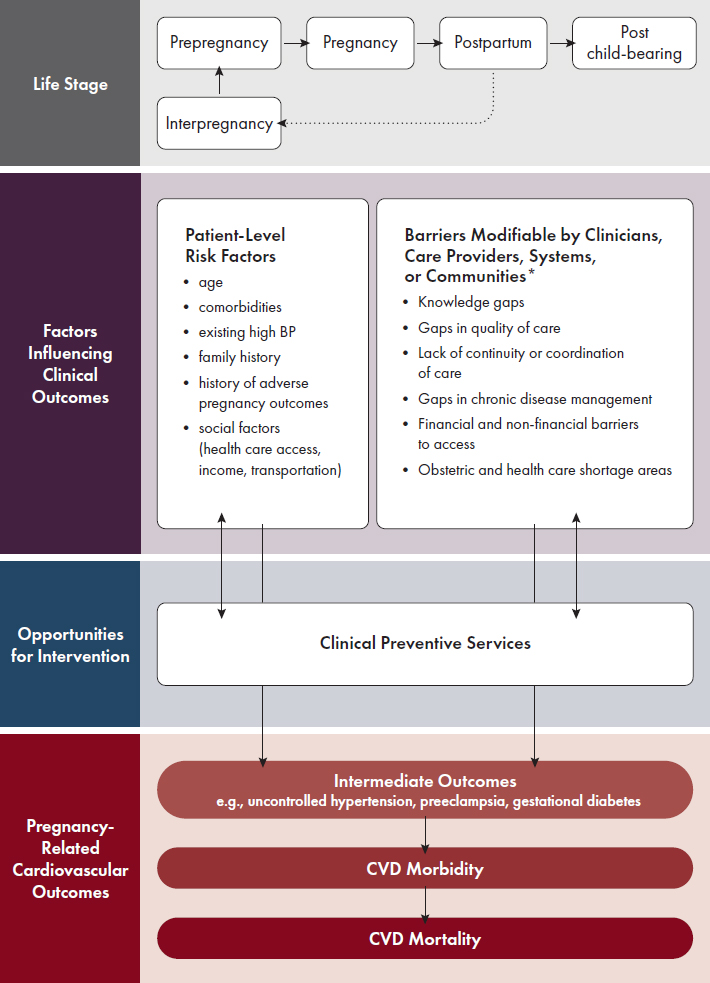
NOTES: * Broader system factors—including long-standing differences in resource distribution, neighborhood and environmental conditions, and policies that have differentially affected racial and ethnic groups—shape the barriers shown in the “modifiable barriers” box and contribute to disparities in pregnancy-related cardiovascular outcomes. These barriers are also influenced by provider, facility, health system, and community factors, such as provider training, service availability, insurance and payment policies, and local resource constraints. BP = blood pressure; CVD = cardiovascular disease.
The framework highlights patient- and system-level factors that influence clinical outcomes. Patient-level factors influencing outcomes include age, cardiometabolic comorbidities (e.g., HTN, diabetes, obesity), family history, and a history of adverse pregnancy outcomes (APOs), as well as social and demographic factors—such as health care access, income, and transportation, neighborhood conditions, and race and ethnicity as social constructs—that shape exposure to risk and access to care (see Chapter 2 for specific examples). Parallel to these are system-level barriers that are modifiable by clinicians, care teams, health systems, and communities. These include knowledge gaps, gaps in quality of care, lack of continuity or coordination, gaps in chronic disease management, financial and nonfinancial barriers to access, and obstetric and broader health care shortage areas. Clinical preventive services sit at the center of the framework as a key opportunity for interventions to affect intermediate outcomes (e.g., BP measurements, uncontrolled HTN, preeclampsia, and GDM) and, ultimately, the primary outcomes: pregnancy-related cardiovascular morbidity and mortality.
REPORT TERMINOLOGY
The committee adopted working definitions for key terms used to ensure clarity and consistency in this report. These are not meant to supplant formal definitions used by specific agencies or organizations.
Pregnancy-Associated Terms
Various terminologies can be used to refer to maternal deaths. The committee uses pregnancy-related terminology consistent with definitions from CDC and other federal agencies:
- Pregnancy-associated death (termed “deaths associated with pregnancy” in National Center for Health Statistics vital statistics) is one that “occurs during pregnancy, at the time of delivery, or within 1 year postpartum, regardless of cause, location of pregnancy, or pregnancy outcome. These deaths comprise the broader category from which pregnancy-related deaths are identified” (NCHS, 2022).
- Pregnancy-related death is defined as “the death of a woman during pregnancy or within 1 year of the end of pregnancy from a pregnancy complication, a chain of events initiated by pregnancy, or the aggravation of an unrelated condition by the physiologic effects of pregnancy” (CDC, 2024b).
This report uses “maternal mortality” interchangeably with pregnancy-related deaths, including up to 1 year postpartum. Pregnancy-related morbidity and mortality includes health complications and deaths that result from or are aggravated by pregnancy or its management.
No universally accepted case definition exists of severe maternal morbidity (SMM), and the measure used varies by the data source. In general, “SMM involves unintended outcomes of the process of labor and delivery that result in significant short-term or long-term consequences to a woman’s health” (ACOG, 2016b). CDC uses administrative hospital discharge data and International Classification of Diseases codes to identify one or more of 21 indicators of SMM typically present during the delivery hospitalization (CDC, 2024a). Some experts recommend and have begun studying SMM up to 42 days postpartum (Callaghan, 2022). Other organizations, such as the Society for Maternal-Fetal Medicine (SMFM), have developed a case definition of SMM as emergent, life-threatening conditions requiring immediate medical intervention, such as an unplanned intensive care unit admission, transfusion of four or more units of blood products, or both (ACOG, 2016b). In this report, the case definition of SMM varies by data source: analyses of hospital discharge data use the CDC definition, but clinical descriptions and case examples may draw on the SMFM’s or others’ frameworks.
Hypertensive Disorders of Pregnancy
HDPs refer to a spectrum of hypertensive conditions that occur before, during, or after pregnancy and are associated with maternal and long-term cardiovascular risk. Some organizations and research sources distinguish pregnancy-induced HTN (gestational HTN and preeclampsia) from chronic HTN for certain analytic or clinical purposes; in this report, HDP is used inclusively to reflect conditions that influence cardiovascular risk across the reproductive life course. For the purpose of this report, HDP includes the following:
- Chronic HTN (HTN diagnosed or present before pregnancy or before 20 weeks’ gestation, or HTN that persists beyond 12 weeks postpartum following an HDP);
- Gestational HTN (new-onset [de novo] HTN after 20 weeks’ gestation without proteinuria or end-organ dysfunction);
- De Novo Postpartum HTN (new onset [de novo] HTN appearing post-delivery through 6 weeks postpartum after a normotensive pregnancy);
- Preeclampsia (with or without severe features); and
- Chronic HTN with superimposed preeclampsia.
Distinguishing chronic HTN from gestational HTN can be difficult for women who initiate prenatal care after 20 weeks’ gestation or when chronic HTN is masked due to a physiologic decrease in BP during the first 20 weeks’ gestation; chronic HTN may be apparent when the BP has not normalized within 3 months postpartum and reclassified retrospectively. When distinctions among these conditions are clinically relevant, they are specified in the text.
Adverse Pregnancy Outcomes
This report defines APOs as maternal or fetal complications that are associated with increased maternal cardiovascular risk during pregnancy and long term. These include preeclampsia, eclampsia, gestational HTN, Hemolysis, Elevated Liver enzymes, and Low Platelet count (HELLP) syndrome, GDM, preterm delivery, intrauterine growth restriction, neonate with low birth weight, small or large for gestational age delivery, placental abruption, stillbirth, miscarriage, and recurrent pregnancy loss (Parikh et al., 2021; Shah et al., 2021).
Reproductive Age
For the purposes of this report, reproductive age is generally defined as 15–49 years for females, recognizing that pregnancies do occur outside this range and that guidelines need to remain sufficiently flexible to encompass such uncommon cases. The report uses the following time-period terms:
- Prepregnancy refers to the period before any pregnancy, including interpregnancy periods and periods before use of assisted reproductive technologies, such as in vitro fertilization.
- Pregnancy is defined as beginning with the implantation of a fertilized embryo into the uterine wall.
- Interpregnancy interval refers to the period from the end of one pregnancy to the beginning of the next.
- Postpartum period is defined as the 12-month period immediately after delivery of a 20-week or more pregnancy, with specific time points (e.g., 6 weeks, 12 weeks, or 6 months) referenced when relevant.
When the report refers broadly to “before, during, and after pregnancy,” it is describing all phases in which preventive services could be delivered to reduce pregnancy-related cardiovascular outcomes.
This report often discusses the early interpregnancy period together with the postpartum period. Because many individuals do not conceive again within the first year after delivery and whether they will ever do
so remains unknown until later, and because this is the time when most follow-up and risk-factor management occur, references to “postpartum” care and monitoring necessarily incorporate the interpregnancy interval for individuals who will conceive in the future. When the committee intends to distinguish postpartum services from later interpregnancy care (more than 12 months postpartum), it states this explicitly in the text.
Cardiovascular Disease and Associated Risk Factors
CVD in this report encompasses a group of disorders affecting the heart and blood vessels, including coronary artery disease, stroke, heart failure, hypertensive disorders, vascular dissections, venous thromboembolism, and arrhythmias. Risk factors include medical and behavioral characteristics that increase the likelihood of developing CVD, such as HTN, diabetes, obesity, dyslipidemia, smoking, family history, suboptimal dietary patterns, and physical inactivity. The committee also considers APOs in a prior pregnancy (e.g., HDPs and other conditions as defined earlier), substance use disorder, alcohol use, metabolic syndrome, mental health conditions, chronic stress, and sleep disorders as relevant risk factors or modifiers of cardiovascular risk across the life course. In this report, HTN is considered both a clinical cardiovascular condition and a major modifiable risk factor for other cardiovascular diseases.
Clinical Preventive Services
As noted, clinical preventive services are medical services delivered in or through clinical settings that can prevent illness by detecting conditions or risks early and managing or treating them before symptoms occur. Examples include screening for BP, blood glucose, and cholesterol; screening for psychosocial symptoms or risk factors; counseling on behaviors such as tobacco, alcohol, or substance use; and immunizations (AHRQ, 2023, 2024; IOM, 2011b). For this report, the committee focuses on those that can plausibly reduce pregnancy-related cardiovascular morbidity and mortality, while recognizing that their effectiveness may depend on broader systems of care and social supports. The committee did not evaluate treatments for established cardiovascular disease or nonclinical services delivered outside of clinical settings, except when they intersected with the delivery or effectiveness of clinical preventive services.
Consistent with its Statement of Task, the committee uses “clinical preventive services” to encompass both primary prevention—interventions delivered before CVD or APOs occur—and secondary prevention, in which services are targeted to individuals who already have risk factors or conditions that confer elevated morbidity and mortality risk. For example,
enhanced postpartum BP monitoring for individuals with HDPs (including chronic HTN) is considered preventive in this report because it is secondary prevention aimed at cardiovascular complications and adverse outcomes, including in subsequent pregnancies for those with an existing risk factor.
APPROACH TO EVIDENCE REVIEW
Overview
To address its Statement of Task, the committee conducted a structured, iterative process to identify and prioritize research questions, review the evidence, and draw conclusions. The process integrated the committee’s guiding principles, insights from existing guidelines, and practical constraints of the study time line and considered input from expert panels convened by the committee and public input from online submission and public committee meetings.
BOX 1-7
Clinical Preventive Services Reviewed by the Committee
The committee conducted structured evidence reviews in nine clinical preventive service areas to assess the strength of evidence and identify gaps related to pregnancy-related cardiovascular risk (see Chapters 4 and 5 for the full research questions and evidence reviews). Inclusion in this box indicates that a service was reviewed, not that it is recommended. Recommendations are presented separately in Chapter 7 and limited to areas where the committee determined that evidence was sufficient to support implementation guidance.
- Blood Pressure Thresholds for Treatment During Pregnancy
Managing blood pressure (BP) using a treatment initiation or titration threshold of 140/90 mmHg or higher during pregnancy, compared with higher BP thresholds, and its impact on maternal outcomes. - Enhanced Postpartum Hypertension Management
Strategies to improve postpartum blood pressure monitoring, treatment, and follow-up for individuals with hypertensive disorders of pregnancy (such as chronic hypertension). - Urgent Maternal Warning Signs (UMWS) Postpartum
Screening for urgent cardiovascular warning signs (or UMWS) postpartum, including counseling patients to self-screen for such signs and clinical protocols for health care teams, to reduce maternal severe morbidity or mortality.
First, the committee compiled relevant preventive clinical services already included in WPSI, USPSTF, and Bright Futures to understand which services are recommended and where gaps between these recommendations might exist (see Appendix A). The committee also reviewed expert recommendations and reports from professional societies (e.g., American Heart Association, American College of Cardiology, American Diabetes Association, the Endocrine Society, AAP, SMFM, and ACOG) to identify promising services or approaches that might address cardiovascular risk related to pregnancy but are not yet reflected fully in preventive service guidelines (see Appendix B).
Based on this mapping exercise, an initial literature scan, and the expertise of its members, the committee developed an extended list of potential research questions. Given the time frame for the study, the committee determined it could feasibly conduct structured reviews for 8–10 questions. Through deliberation and voting, the committee selected nine research questions to review in depth (see Box 1-7). Chapter 3 provides additional
-
Cardiovascular Risk Assessment Tools in Pregnancy and Postpartum.
Using tools such as the California Maternal Quality Care Collaborative Cardiovascular Disease in Pregnancy Toolkit and Malhamé et al.’s cardiovascular risk assessment tools in pregnancy and postpartum (Malhamé et al., 2022) to identify previously unrecognized cardiovascular disease (CVD) and improve outcomes. - Comprehensive Cardiovascular Health Assessment (Life’s Essential 8).
Screening and intervention for cardiovascular risk factors in women of reproductive age at increased risk of CVD, using Life’s Essential 8, to reduce pregnancy-related cardiovascular morbidity and mortality. - Telehealth Approaches Across the Reproductive Continuum.
Using telehealth in the prepregnancy, prenatal, and postpartum periods to improve CVD outcomes. - Integrated Cardio-Obstetrics Care Models.
Multidisciplinary care models that integrate cardiology and obstetrics to improve cardiovascular and pregnancy outcomes among high-risk pregnant patients. - Supportive Services (Doulas, Peer Navigators, and Other Community Health Workers).
Using supportive personnel and programs to improve cardiovascular-related outcomes across the perinatal period. - Transitions of Care from Postpartum to Preventive Care.
Interventions to improve transitions from hospital deliveries to outpatient postpartum care and to primary/longitudinal preventive care within 12 months postpartum for individuals with CVD risk factors.
discussion of existing guidelines and topics that were considered but not selected for full evidence review.
For each research question, the committee undertook a structured, targeted evidence review (not a full systematic review). It conducted a targeted literature search with strategies tailored to the specific population, intervention, comparator, and outcomes of interest (see Chapters 4, 5, and Appendix C and D for full details). It screened titles and abstracts for relevance based on these prespecified inclusion and exclusion criteria, followed by full-text review of potentially eligible studies to confirm eligibility. It extracted data from included studies using a standardized template that captured study design, population characteristics, intervention components, comparator(s), outcomes, and key methodological limitations.
Assessment of Study Quality and Risk of Bias
For each included study, the committee assigned a quality rating (good, fair, poor) using the National Heart, Lung, and Blood Institute quality assessment tools, which operationalize evaluation of a study’s risk of bias (NHLBI, 2021). Each study underwent dual review by a methodologist from the literature review consulting group PICO Portal1 and a committee member, with the committee chair serving as a final adjudicator for substantial differences in assigned quality ratings. The committee notes that fair and poor ratings could reflect limitations inherent to the population, setting, or topic—for example, the ethical constraints of randomizing pregnant patients or small sample sizes for rare conditions—rather than shortcomings in investigators’ methods.
Findings across studies were synthesized narratively, and the committee prepared streamlined evidence tables summarizing key characteristics and results for each research question. Additional methodological details, including search strategies and abstraction details, appear in Appendix D. Chapters 4 and 5 present the synthesis of evidence for the nine research questions. See Box 1-8 for a high-level overview of the evidence review process.
Types of Outcomes
Evidence reviews for the nine clinical preventive services addressed a range of outcomes, including health, intermediate, and process outcomes. The committee evaluated some outcomes (e.g., maternal death) for all services but assessed others only when appropriate for a given service, such as identifying women with previously unrecognized CVD (coronary
___________________
1 See https://picoportal.org/ (accessed December 14, 2025).
BOX 1-8
High-Level Overview of Committee Evidence Review
- Targeted searches were developed for nine research questions on clinical services to reduce pregnancy-related cardiovascular morbidity and mortality.
- Titles and abstracts were screened using structured inclusion and exclusion criteria, followed by full-text review of potentially eligible studies to confirm eligibility.
- Study quality (good, fair, poor) was assessed using National Heart, Lung, and Blood Institute tools, which evaluated a study’s risk of bias, with dual review (PICO Portal methodologist and a committee member) and adjudication by the committee chair for significant score differences. Fair and poor ratings may reflect constraints inherent to the population or topic—not investigators’ methods.
- Data were abstracted into a standardized template capturing study design, population characteristics, intervention features, outcomes, and limitations.
- Evidence was synthesized narratively, and a streamlined evidence table was created for use in the report.
- Conclusions regarding the overall strength of evidence were developed for each of the nine questions using a five-tier evidence framework.
- Full methodological details are provided in Appendix D.
artery disease, stroke, heart failure, hypertensive disorders, vascular dissections, venous thromboembolism, and arrhythmias). For this report, health outcomes include pregnancy-related cardiovascular morbidity (e.g., heart attack, stroke, or heart failure) and mortality. Definitive health outcomes can be difficult to measure because they often require larger sample sizes and longer follow-up to capture. Intermediate outcomes, such as preeclampsia, eclampsia, and BP or diabetes control (e.g., hemoglobin A1c level), occur along the pathway to, and may mediate, cardiovascular health outcomes. Process outcomes reflect processes of care, such as attendance at prenatal or postpartum preventive visits and adherence to BP self-monitoring. A preventive service may improve process outcomes without necessarily improving intermediate or health outcomes (e.g., increased prenatal visits with no corresponding improvement in BP control).
CONCLUSIONS AND RECOMMENDATIONS FRAMEWORK
Based on its review of the evidence, the committee reached a conclusion for each research question using a five-tier framework commonly employed in National Academies reports (see Box 1-9) to describe the strength and consistency of the evidence. This framework also reflects committee’s judgment about the likelihood that additional research would change the conclusion. While all nine research questions were assigned conclusions, only those with sufficient strength of evidence received recommendations for the preventive service.
The committee also developed crosscutting conclusions and recommendations regarding how HRSA programs can reduce barriers to obtaining preventive services and support implementation strategies that advance the use of clinical preventive services to reduce pregnancy-related cardiovascular morbidity and mortality. It identified research priorities to close evidence gaps in existing and emerging services and screenings for CVD among women, including promising interventions for which current evidence is not yet conclusive.
REPORT OVERVIEW
The remainder of this report is organized as follows:
- Chapter 2 describes the epidemiology of CVD in women before, during, and after pregnancy, including trends in pregnancy-related morbidity and mortality, patterns of risk across the life course, and differences by race, ethnicity, geography, and other factors.
- Chapter 3 reviews existing preventive service guidelines and related recommendations relevant to CVD and pregnancy, highlighting gaps and opportunities to strengthen preventive care across reproductive stages.
- Chapters 4 and 5 present the committee’s evidence reviews and conclusions and research opportunities for the nine reviewed clinical services, applying the five-tier strength of evidence framework described in this chapter.
- Chapter 6 discusses barriers to accessing clinical preventive services during the reproductive years and offers the committee’s crosscutting conclusions.
- Chapter 7 provides committee recommendations on clinical preventive services, crosscutting factors, and research recommendations.
- Appendixes provide additional detail on methods, search strategies, existing guideline recommendations, and other technical materials supporting the committee’s work.
BOX 1-9
Five-Tier Evidence Framework for Cardiovascular Disease and Pregnancy Clinical Services
-
Conclusive Evidence of Effectiveness
- High-quality, consistent evidence (e.g., multiple well-designed randomized controlled trials, strong systematic reviews, or overwhelming epidemiologic data) demonstrates that the clinical service improves maternal cardiovascular health outcomes and/or reduces pregnancy-related morbidity/mortality.
- Interpretation: Further research is very unlikely to change the conclusion. The clinical service should be considered standard of care in the relevant context.
-
Substantial Evidence of Effectiveness
- Strong evidence from several studies (which may include well-conducted cohort or case-control studies, smaller randomized controlled trials, or systematic reviews with some limitations) consistently indicates that the clinical service provides meaningful benefit.
- Interpretation: Additional research may refine effect size or applicability but is unlikely to overturn the overall conclusion. The service can be reasonably recommended with high confidence.
-
Moderate Evidence of Effectiveness
- Evidence suggests benefit, but data are mixed, limited in quality, or indirect (e.g., small trials, observational studies with potential bias, surrogate outcomes).
- Interpretation: Further research could change the conclusion or magnitude of benefit. The clinical service may be recommended with caution when benefits appear to outweigh harms, especially in higher-risk populations.
-
Limited Evidence of Effectiveness
- Some studies suggest possible benefit, but evidence is sparse, inconsistent, or methodologically weak.
- Interpretation: The effectiveness of the clinical service remains uncertain. Use may be justified in selected settings but only with careful monitoring and research.
-
No or Insufficient Evidence of Effectiveness
- No studies of adequate quality exist, or available studies provide inadequate information to evaluate effectiveness.
- Interpretation: No conclusions can be drawn. The clinical service should not be recommended as evidence based at this time, though it may be the subject of research or pilot implementation.
REFERENCES
AAP (American Academy of Pediatrics). 2025. Preventive Care/Periodicity Schedule. https://www.aap.org/en/practice-management/care-delivery-approaches/periodicity-schedule/ (accessed February 25, 2026).
ACOG (American College of Obstetricians and Gynecologists). n.d. About WPSI. https://www.womenspreventivehealth.org/about-wpsi/ (accessed October 30, 2025).
ACOG. 2016a. 2016 final report: Women’s preventive services initiative. Washington, DC: American College of Obstetricians and Gynecologists.
ACOG. 2016b. Severe Maternal Morbidity: Screening and Review. https://www.acog.org/clinical/clinical-guidance/obstetric-care-consensus/articles/2016/09/severe-maternal-morbidity-screening-and-review (accessed January 7, 2026).
ACOG. 2023. Women’s Preventive Services Initiative Methodology. https://www.womenspreventivehealth.org/wp-content/uploads/METHODOLOGY-April-2023.pdf (accessed March 5, 2025).
AHRQ. 2023. U.S. Preventive Services Task Force (USPSTF): An Introduction. https://www.ahrq.gov/cpi/about/otherwebsites/uspstf/introduction.html (accessed November 26, 2025).
AHRQ. 2024. Person-Centered Preventive Healthcare: Prioritizing Clinical Preventive Services. https://www.ahrq.gov/sites/default/files/wysiwyg/ncepcr/research/prioritizing-clinical-preventive-services-full.pdf (accessed November 26, 2025).
Boghossian, N. S., L. T. Greenberg, J. S. Buzas, J. Rogowski, S. A. Lorch, M. Passarella, G. R. Saade, and C. S. Phibbs. 2024. Severe maternal morbidity from pregnancy through 1 year postpartum. American Journal of Obstetrics & Gynecology MFM 6(7). https://doi.org/10.1016/j.ajogmf.2024.101385.
Briller, J., S. L. Trost, A. Busacker, N. T. Joseph, N. L. Davis, E. E. Petersen, D. A. Goodman, and L. M. Hollier. 2024. Pregnancy-related mortality due to cardiovascular conditions: Maternal Mortality Review Committees in 32 U.S. states, 2017 to 2019. JACC: Advances 3(12):101382. https://doi.org/10.1016/j.jacadv.2024.101382.
Building U.S. Capacity to Review and Prevent Maternal Deaths. 2018. Report from Nine Maternal Mortality Review Committees. Atlanta, GA. https://stacks.cdc.gov/view/cdc/51660 (accessed March 2, 2026).
Callaghan, W. M. 2022. Identifying cases of severe maternal morbidity: Moving beyond the delivery hospitalization. Obstetrics & Gynecology 139(2):163–164. https://doi.org/10.1097/aog.0000000000004665.
CDC (Centers for Disease Control and Prevention). 2024a. Identifying Severe Maternal Morbidity (SMM). https://www.cdc.gov/maternal-infant-health/php/severe-maternal-morbidity/icd.html (accessed June 11, 2025).
CDC. 2024b. Preventing Pregnancy-Related Deaths. https://www.cdc.gov/maternal-mortality/preventing-pregnancy-related-deaths/index.html (accessed November 26, 2025).
CDC. 2025a. Data from the Pregnancy Mortality Surveillance System. https://www.cdc.gov/maternal-mortality/php/pregnancy-mortality-surveillance-data/index.html (accessed November 3, 2025).
CDC. 2025b. Pregnancy-Related Deaths: Data from Maternal Mortality Review Committees. https://www.cdc.gov/maternal-mortality/php/data-research/mmrc/index.html (accessed December 19, 2025).
Chen, Y., M. S. Shiels, T. Uribe-Leitz, R. L. Molina, W. R. Lawrence, N. D. Freedman, and C. C. Abnet. 2025. Pregnancy-related deaths in the U.S., 2018–2022. JAMA Network Open 8(4):e254325. https://doi.org/10.1001/jamanetworkopen.2025.4325.
Declercq, E., and L. Zephyrin. 2021. Severe Maternal Morbidity in the United States: A Primer. https://www.commonwealthfund.org/publications/issue-briefs/2021/oct/severe-maternal-morbidity-united-states-primer (accessed February, 2026).
Dude, A. M., K. Schueler, L. P. Schumm, M. Murugesan, and D. B. Stulberg. 2022. Preconception care and severe maternal morbidity in the United States. American Journal of Obstetrics & Gynecology MFM 4(2):100549. https://doi.org/10.1016/j.ajogmf.2021.100549.
Ferranti, E. P., E. J. Jones, S. Bush, L. L. Hayman, K. Larimer, P. Martyn-Nemeth, C. D. Villavaso, and L. A. Coke. 2021. A call to action: Cardiovascular-related maternal mortality: Inequities in Black, Indigenous, and persons of color. Journal of Cardiovascular Nursing 36(4):310–311. https://doi.org/10.1097/JCN.0000000000000823.
Gomez, I., B. Frederiksen, and A. Salganicoff. 2025. Women’s Experiences with Preventive and Health Care Services: Findings from the 2024 KFF Women’s Health Survey. https://www.kff.org/womens-health-policy/womens-experiences-with-preventive-and-health-care-services-findings-from-the-2024-kff-womens-health-survey/ (accessed January 7, 2026).
Gunja, M. Z., E. D. Gumas, R. Masitha, and L. C. Zephyrin. 2024. Insights into the U.S. Maternal Mortality Crisis: An International Comparison. https://www.commonwealthfund.org/publications/issue-briefs/2024/jun/insights-us-maternal-mortality-crisis-international-comparison (accessed April 16, 2025).
Hagan, J. F., J. S. Shaw, and P. M. Duncan, eds. 2017. Bright Futures guidelines for health supervision of infants, children, and adolescents, 4th ed. Washington, DC: AAP Books.
HHS (U.S. Department of Health and Human Services). n.d. Clinical Preventive Services. https://opa.hhs.gov/adolescent-health/physical-health-developing-adolescents/clinical-preventive-services (accessed December 15, 2025).
HHS. 2012. 47 Million Women Have Guaranteed Access to Women’s Preventive Services with Zero Cost-Sharing under the Affordable Care Act. https://aspe.hhs.gov/reports/47-million-women-have-guaranteed-access-womens-preventive-services-zero-cost-sharing-under (accessed December 15, 2025).
Hoyert, D. L. 2025. Maternal Mortality Rates in the United States, 2023. https://www.cdc.gov/nchs/data/hestat/maternal-mortality/2023/Estat-maternal-mortality.pdf (accessed December 1, 2025).
HRSA (Health Resources and Services Administration). 2024a. Bright Futures. https://mchb.hrsa.gov/programs-impact/bright-futures (accessed April 7, 2025).
HRSA. 2024b. Preventive Guidelines and Screenings for Women, Children, and Youth. https://mchb.hrsa.gov/programs-impact/programs/preventive-guidelines-screenings-women-children-youth (accessed March 5, 2025).
HRSA. 2025. Women’s Preventive Services Guidelines. https://www.hrsa.gov/womens-guidelines (accessed March 5, 2025).
IOM (Institute of Medicine). 2011a. Clinical practice guidelines we can trust. Washington, DC: The National Academies Press.
IOM. 2011b. Clinical preventive services for women: Closing the gaps. Washington, DC: The National Academies Press.
Malhamé, I., C. A. Raker, E. J. Hardy, H. Spalding, B. A. Bouvier, H. Hurlburt, R. Vrees, S. S. Daskalopoulou, K. Nerenberg, D. A. Savitz, N. Mehta, and V. A. Danilack. 2022. Development and internal validation of a risk prediction model for acute cardiovascular morbidity in preeclampsia. Canadian Journal of Cardiology 38(10):1591–1599. https://doi.org/10.1016/j.cjca.2022.05.007.
Morales-Suarez-Varela, M., and F. Guillen-Grima. 2025. Cardiovascular risk during pregnancy: Scoping review on the clinical implications and long-term consequences. Journal of Clinical Medicine 14(21):7516. https://doi.org/10.3390/jcm14217516.
NASEM (National Academies of Sciences, Engineering, and Medicine). 2022. Improving representation in clinical trials and research: Building research equity for women and underrepresented groups. Edited by K. Bibbins-Domingo and A. Helman. Washington, DC: The National Academies Press.
NASEM. 2025. A new vision for women’s health research: Transformative change at the National Institutes of Health. Edited by S. P. Burke, A. Salganicoff, and A. Geller. Washington, DC: The National Academies Press.
NCHS (National Center for Health Statistics). 2022. A reference guide for certification of deaths associated with pregnancy on death certificates. Hyattsville, MD: NCHS. https://stacks.cdc.gov/view/cdc/114453 (accessed March 6, 2026).
NHLBI (National Heart, Lung, and Blood Institute). 2021. Study Quality Assessment Tools. https://www.nhlbi.nih.gov/health-topics/study-quality-assessment-tools (accessed December 15, 2025).
Parikh, N. I., J. M. Gonzalez, C. A. M. Anderson, S. E. Judd, K. M. Rexrode, M. A. Hlatky, E. P. Gunderson, J. J. Stuart, D. Vaidya, American Heart Association, Council on Epidemiology and Prevention, Council on Arteriosclerosis Thrombosis and Vascular Biology, Council on Cardiovascular and Stroke Nursing, and Stroke Council. 2021. Adverse pregnancy outcomes and cardiovascular disease risk: Unique opportunities for cardiovascular disease prevention in women: A scientific statement from the American Heart Association. Circulation 143(18):e902–e916. https://doi.org/10.1161/CIR.0000000000000961.
Shah, L. M., B. Varma, K. Nasir, M. N. Walsh, R. S. Blumenthal, L. S. Mehta, and G. Sharma. 2021. Reducing disparities in adverse pregnancy outcomes in the United States. American Heart Journal 242:92–102. https://doi.org/10.1016/j.ahj.2021.08.019.
USPSTF (U.S. Preventive Services Task Force). n.d.-a. About the USPSTF. https://www.uspreventiveservices-taskforce.org/uspstf/about-uspstf (accessed April 7, 2025).
USPSTF. n.d.-b. Published Recommendations. https://www.uspreventiveservicestaskforce.org/uspstf/topic_search_results?topic_status=P (accessed June 18, 2025).
USPSTF. 2018. Grade Definitions. https://www.uspreventiveservicestaskforce.org/uspstf/aboutuspstf/methods-and-processes/grade-definitions (accessed April 7, 2025).
USPSTF. 2025a. AHRQ’s Support of the USPSTF. https://www.uspreventiveservicestaskforce.org/uspstf/about-uspstf/task-force-resources/ahrqs-support-uspstf (accessed April 7, 2025).
USPSTF. 2025b. USPSTF: Who We Are & How We Work. https://www.uspreventiveservicestaskforce.org/uspstf/sites/default/files/2025-03/uspstf-who-we-are-how-we-work-2025.pdf (accessed April 7, 2025).
Warren, M. 2025. Introduction from HRSA. Presentation to Committee on Clinical Creventive Cervices for Addressing Cardiovascular Disease Risk to Reduce Pregnancy-Related Deaths Among Women, meeting 1 (April 1, 2025). https://www.nationalacademies.org/projects/HMD-BPH-24-07/event/44759 (accessed December 16, 2025).


