Ramp Safety Practices: Update (2026)
Chapter: Appendix E: Airport Survey Results

APPENDIX E
Airport Survey Results
Long Description.
The text in the screenshot is as follows:
APPENDIX E
AIRPORT SURVEY RESULTS
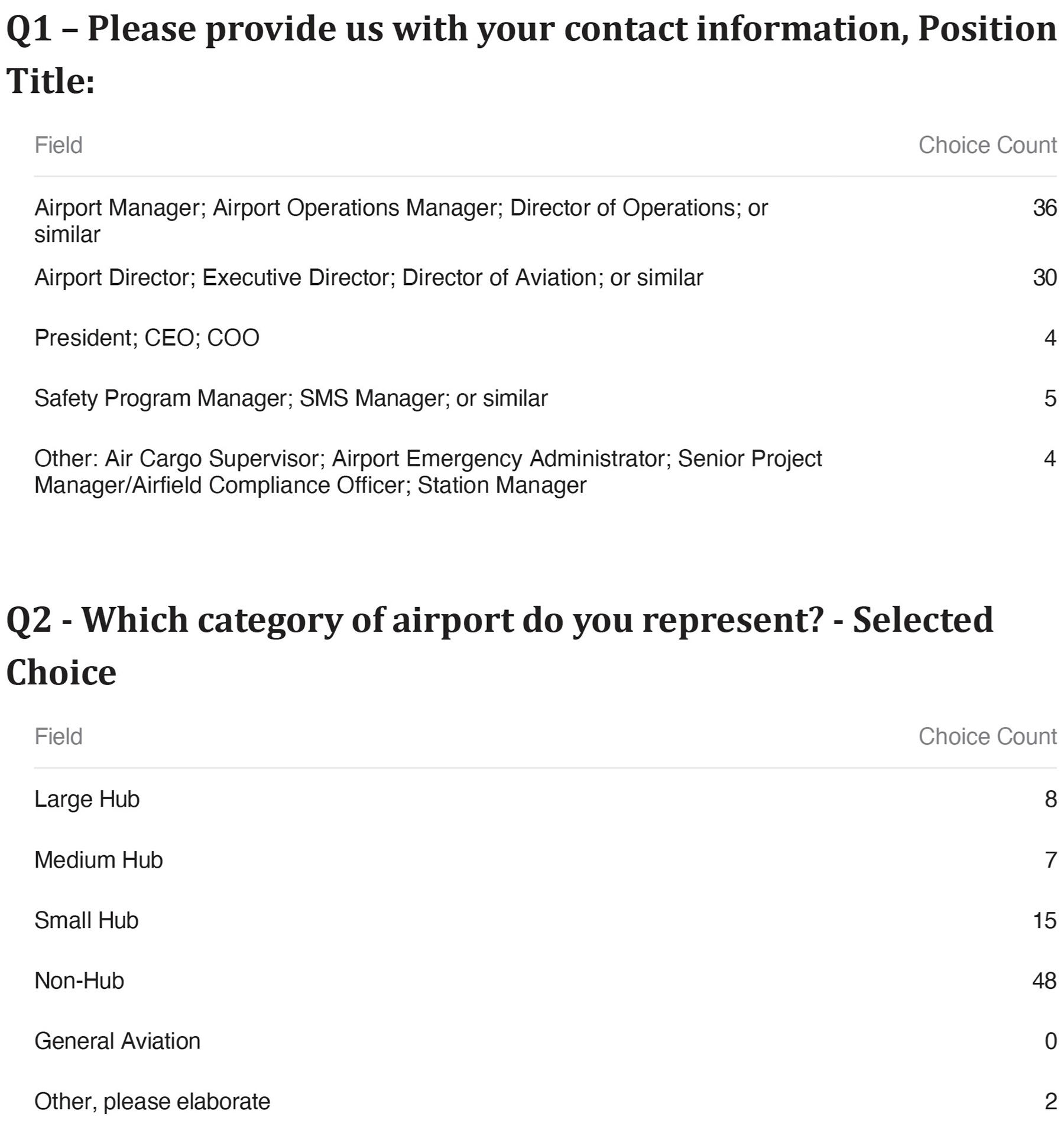
Q1 - Please provide us with your contact information, Position Title:
The column headers of the table are Field and Choice count. The data in the table row-wise are as follows: 1, Airport Manager; Airport Operations Manager; Director of Operations, or similar: 36. 2, Airport Director; Executive Director; Director of Aviation, or similar: 30. 3, President; CEO; COO: 4. 4, Safety Program Manager; SMS Manager, or similar: 5. 5, Other: Air Cargo Supervisor; Airport Emergency Administrator; Senior Project Manager / Airfield Compliance Officer; Station Manager: 4.
Q2 - Which category of airport do you represent? - Selected Choice
The column headers of the table are Field and Choice count. The data in the table row-wise are as follows: 1, Large Hub: 8. 2, Medium Hub: 7. 3, Small Hub: 15. 4, Non-Hub: 48. 5, General Aviation: 0. 6, Other, please elaborate: 2.
Long Description.
The text in the screenshot is as follows:
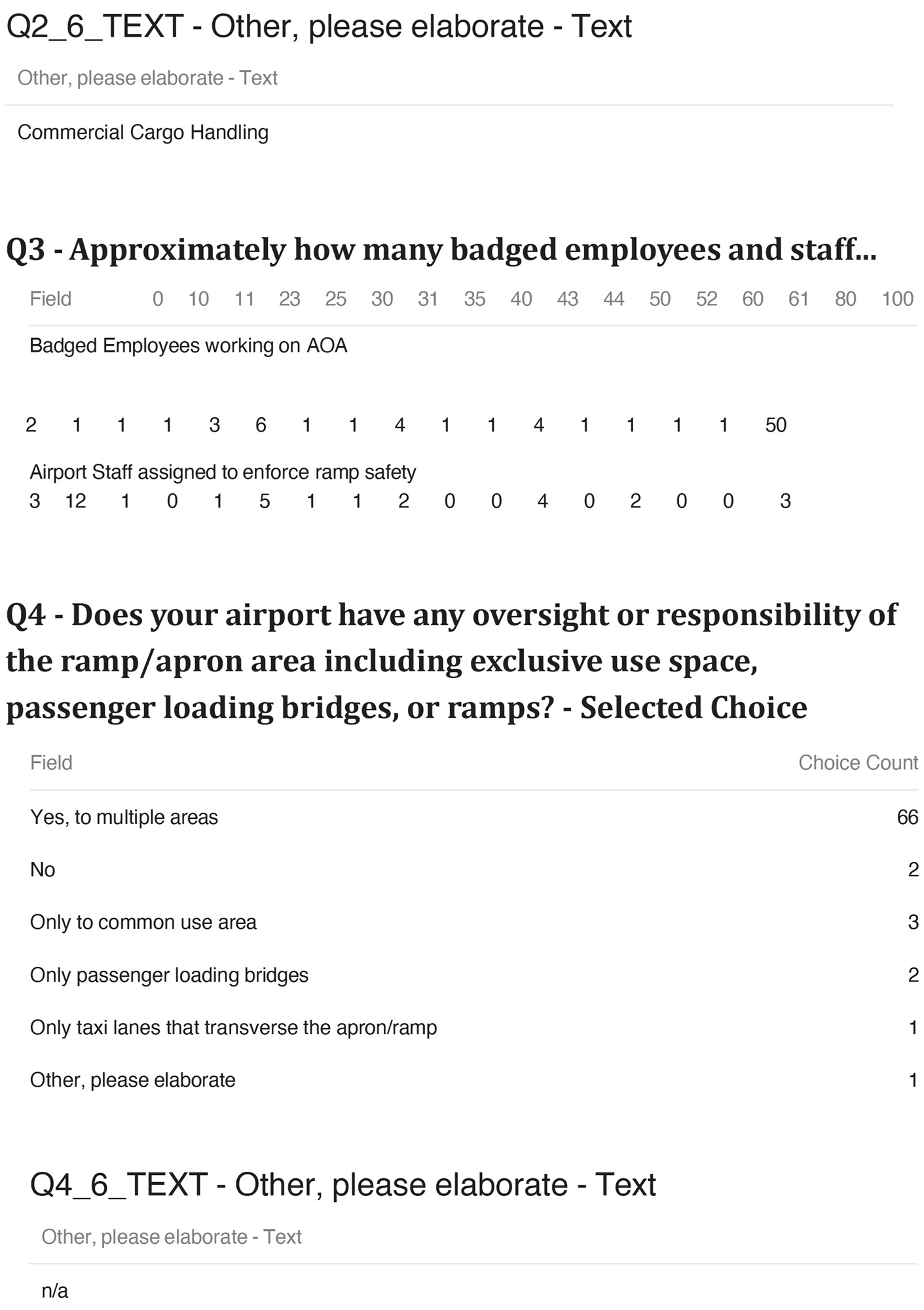
Q2_6_TEXT - Other, please elaborate - Text
Other, please elaborate - Text
Commercial Cargo Handling.
Q3 - Approximately how many badged employees and staff, ellipsis.
The data in the table are as follows: Field: 0, 10, 11, 23, 25, 30, 31, 35, 40, 43, 44, 50, 52, 60, 61, 80, 100
Badged Employees working on AOA
2, 1, 1, 1, 3, 6, 1, 1, 4, 1, 1, 4, 1, 1, 1, 1, 50
Airport Staff assigned to enforce ramp safety
3, 12, 1, 0, 1, 5, 1, 1, 2, 0, 0, 4, 0, 2, 0, 0, 3
Q4 - Does your airport have any oversight or responsibility of the ramp / apron area, including exclusive use space, passenger loading bridges, or ramps? - Selected Choice
The column headers of the table are Field and Choice Count. The data in the table row-wise are as follows: 1, Yes, to multiple areas: 66. 2, No: 2. 3, Only to common use area: 3. 4, Only passenger loading bridges: 2. 5, Only taxi lanes that traverse the apron / ramp: 1. 6, Other, please elaborate: 1.
Q4_6 TEXT – Other, please elaborate - Text
Other, please elaborate - Text
n a.
Long Description.
The text in the screenshot is as follows:
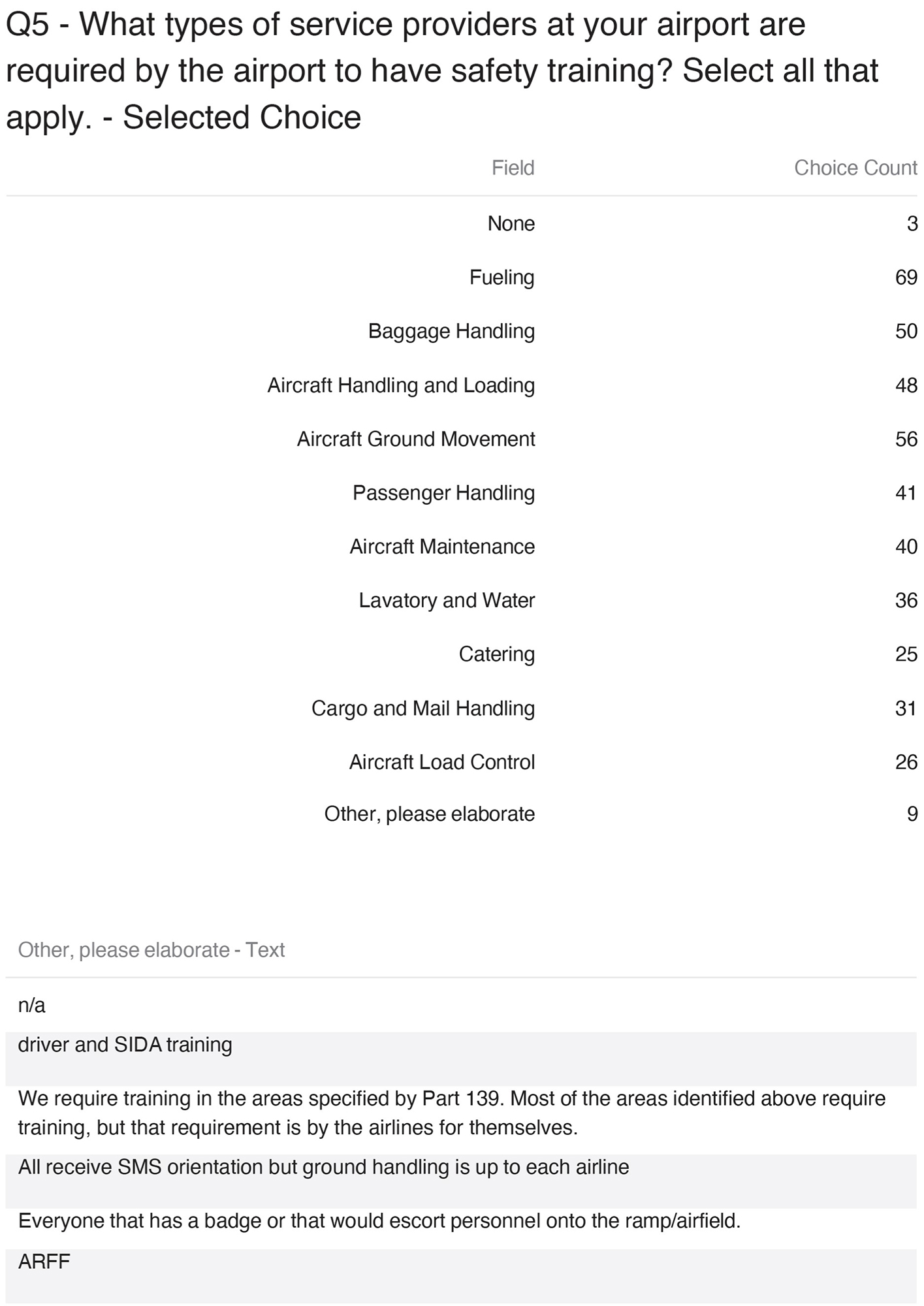
Q5 - What types of service providers at your airport are required by the airport to have safety training? Select all that apply. - Selected Choice
The column headers of the table are Field and Choice count. The data in the table row-wise are as follows: 1, None: 3. 2, Fueling: 69. 3, Baggage Handling: 50. 4, Aircraft Handling and Loading: 48. 5, Aircraft Ground Movement: 56. 6, Passenger Handling: 41. 7, Aircraft Maintenance: 40. 8, Lavatory and Water: 36. 9, Catering: 25. 10, Cargo and Mail Handling: 31. 11, Aircraft Load Control: 26. 12, Other, please elaborate: 9.
Other, please elaborate – Text
n a
driver and SIDA training
We require training in the areas specified by Part 139. Most of the areas identified above require training, but that requirement is left to the airlines themselves.
All receive SMS orientation, but ground handling is up to each airline.
Everyone who has a badge or who would escort personnel onto the ramp or airfield.
ARFF
Long Description.
The text in the screenshot is as follows:
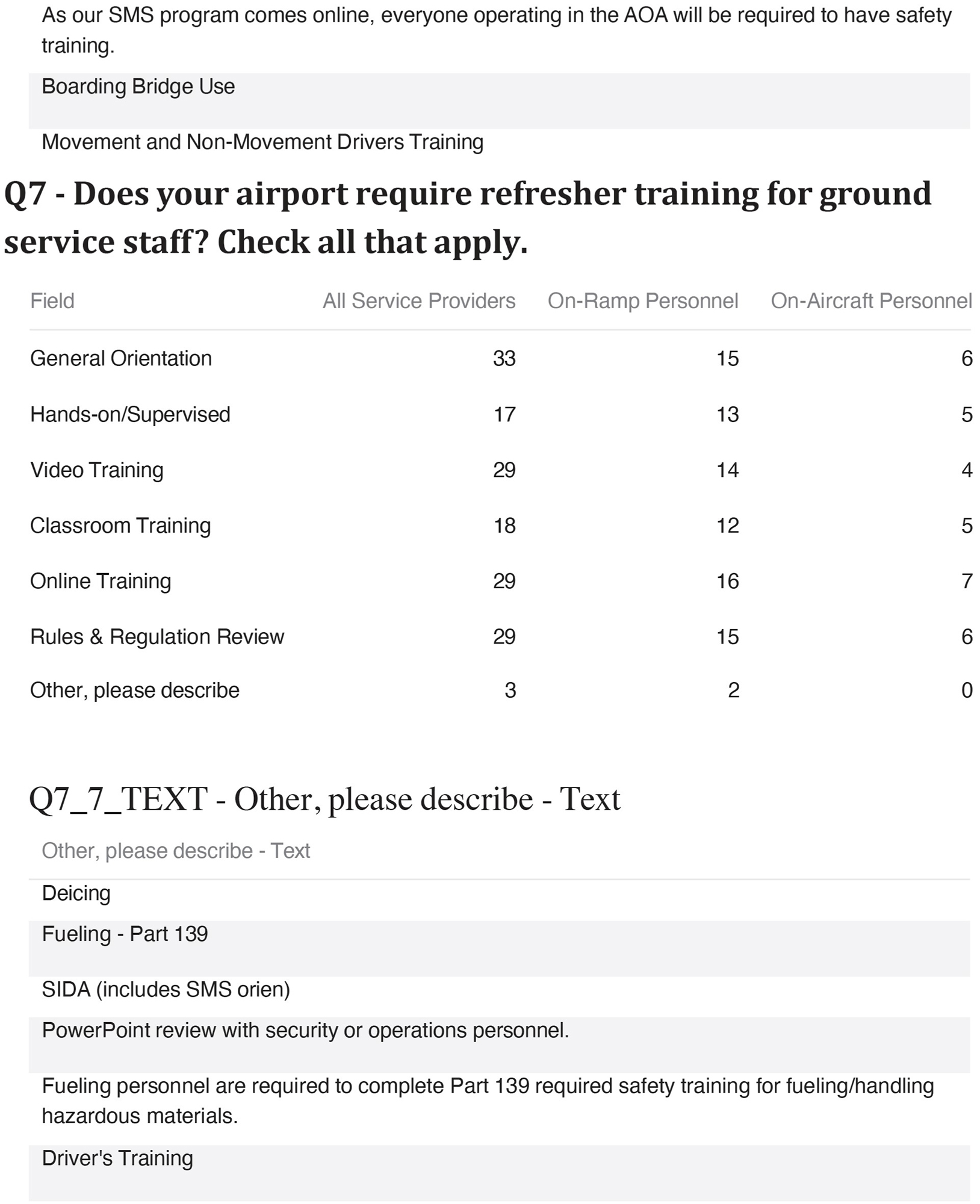
As our SMS program comes online, everyone operating in the AOA will be required to have safety training.
Boarding Bridge Use
Movement and Non-Movement Drivers Training
Q7 - Does your airport require refresher training for ground service staff? Check all that apply.
The column headers of the table are Field, All service providers, On-ramp personnel, and On-aircraft personnel. The data in the table row-wise are as follows: 1, General Orientation: 33, 15, 6. 2, Hands-on / Supervised: 17, 13, 5. 3, Video Training: 29, 14, 4. 4, Classroom Training: 18, 12, 5. 5, Online Training: 29, 16, 7. 6, Rules and Regulation Review: 29, 15, 6. 7, Other, please describe: 3, 2, 0.
Q7_7 TEXT - Other, please describe - Text
Other, please describe - Text
Deicing
Fueling - Part 139
SIDA (includes SMS Oriel)
PowerPoint review with security or operations personnel.
Fueling personnel are required to complete the Part 139 required safety training for fueling / handling hazardous materials.
Driver’s Training
Long Description.
The text in the screenshot is as follows:
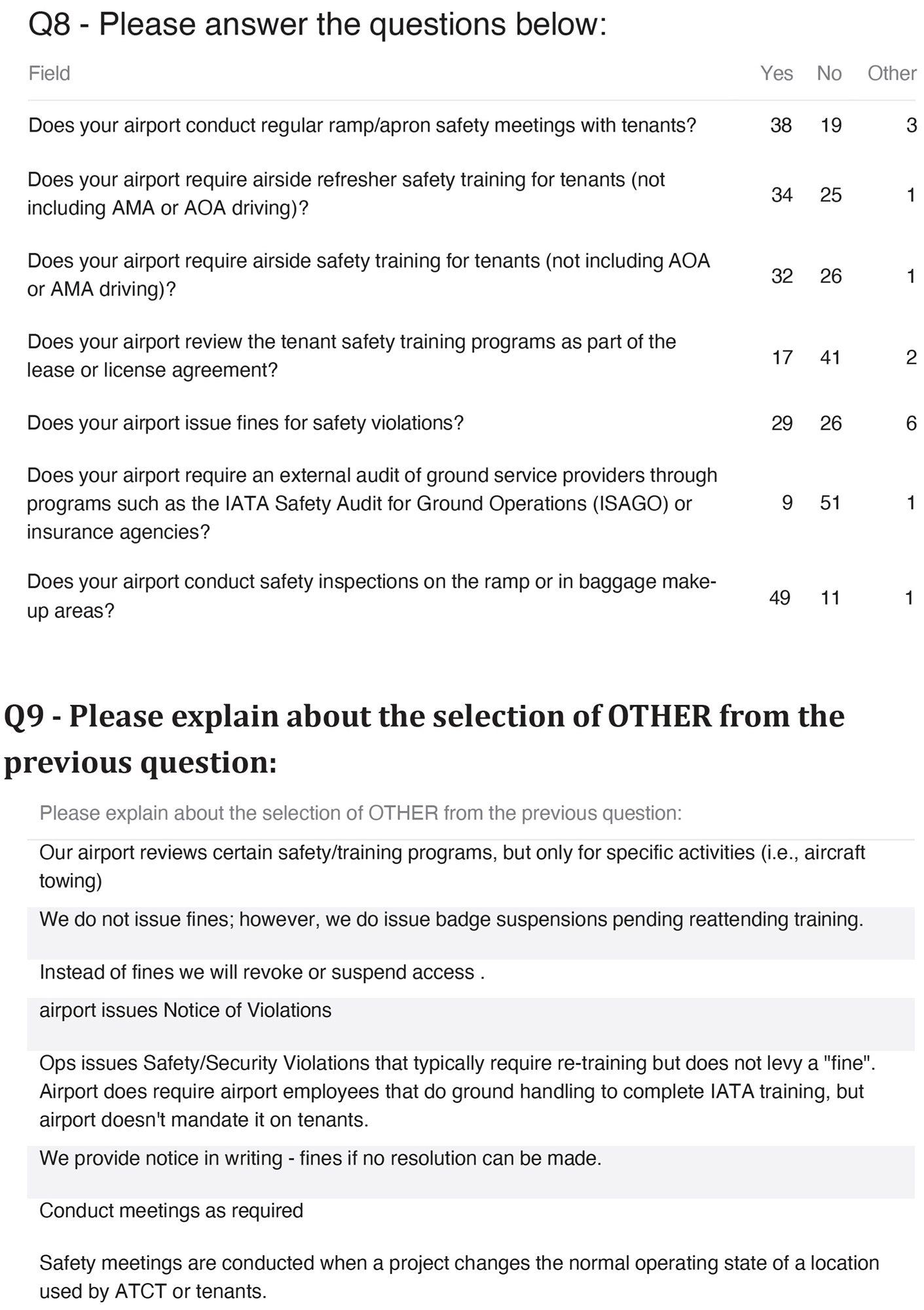
Q8 – Please answer the questions below:
The column headers of the table are: Field, Yes, No, Other. The data in the table row-wise is as follows: 1. Does your airport conduct regular ramp or apron safety meetings with tenants? 38, 19, 3. 2, Does your airport require airside refresher safety training for tenants (not including AMA or AOA driving)? 34, 25, 1. 3, Does your airport require airside safety training for tenants (not including AOA or AMA driving)? 32, 26, 1. 4, Does your airport review the tenant safety training programs as part of the lease or license agreement? 17, 41, 2. 5, Does your airport issue fines for safety violations? 29, 26, 6. 6, Does your airport require an external audit of ground service providers through programs such as the IATA Safety Audit for Ground Operations (ISAGO) or insurance agencies? 9, 51, 1. 7, Does your airport conduct safety inspections on the ramp or in baggage make-up areas? 49, 11, 1.
Q9 - Please explain the selection of OTHER from the previous question:
Please explain the selection of OTHER from the previous question:
Our airport reviews certain safety / training programs, but only for specific activities (i.e., aircraft towing)
We do not issue fines; however, we do issue badge suspensions pending reattending training.
Instead of fines, we will revoke or suspend access.
Airport issues Notices of Violations.
Ops issues safety / security violations that typically require re-training but do not levy a 'fine.' Airport does require airport employees who do ground handling to complete IATA training, but the airport doesn’t mandate it on tenants.
We provide notice in writing - fines are issued if no resolution can be made.
Conduct meetings as required
Safety meetings are conducted when a project changes the normal operating state of a location used by ATCT or tenants.
Long Description.
The text in the screenshot is as follows:
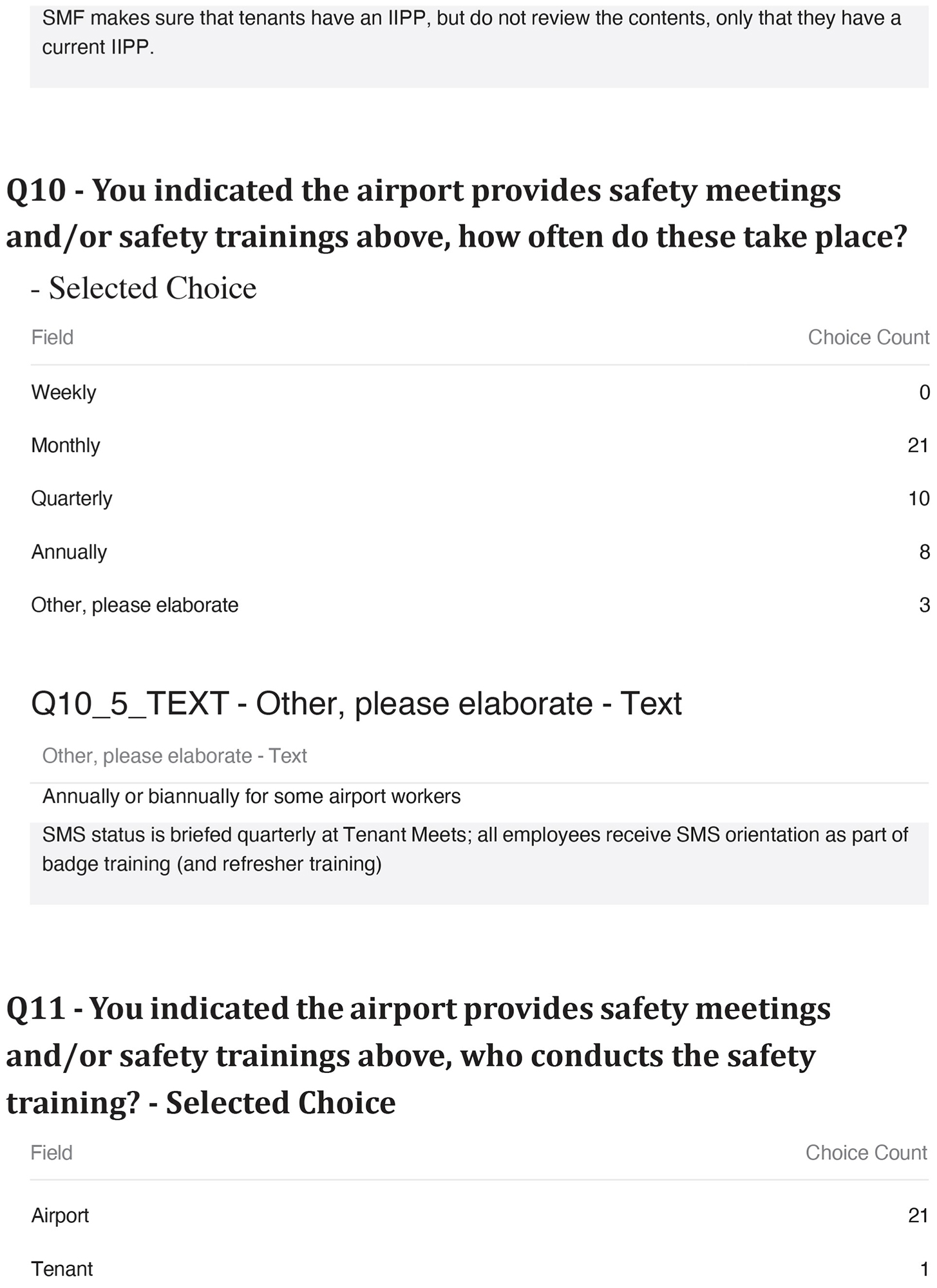
Q9 continued. SMF makes sure that tenants have an IIPP, but does not review the contents, only that they have a current IIPP.
Q10 - You indicated the airport provides safety meetings and or safety trainings above, how often do these take place?
- Selected Choice
The column headers of the table are Field and Choice count. The data in the table row-wise are as follows: 1, Weekly: 0. 2, Monthly: 21. 3, Quarterly: 10. 4, Annually: 8. 5, Other, please elaborate: 3.
Q10_5 TEXT - Other, please elaborate -Text
Other, please elaborate -Text
Annually or biannually for some airport workers
SMS status is briefed quarterly at Tenant Meets; all employees receive SMS orientation as part of badge training (and refresher training)
Q11 - You indicated the airport provides safety meetings and or safety trainings above, who conducts the safety training? - Selected Choice
The column headers of the table are Field and Choice count. The data in the table row-wise is as follows: 1, Airport: 21. 2, Tenant: 1.

Long Description.
The text in the screenshot is as follows:
3, Both: 20
4, Other, please elaborate: 1.
Q11_4 TEXT - Other, please elaborate - Text.
Other, please elaborate - Text
SMS Manager or SIDA training is computer-based
Q12 - You indicated the airport requires airside refresher training for tenants above. How frequent is the safety refresher training? - Selected Choice
The column headers of the table are Field and Choice count. The data in the table row-wise are as follows: 1, More than once a year: 2. 2, Once a year: 33. 3, Less than once a year : 3. 4, Other, please elaborate: 5.
Q12_4_TEXT - Other, please elaborate - Text
Other, please elaborate - Text
every two years
Once a year for Movement Area badges; every 2 years for all others.
Currently, as required per Part 139, for fueling or handling hazardous materials.
This seems to be an error. We do not do refresher training on this.
Every 2 years.
Long Description.
The text in the screenshot is as follows:
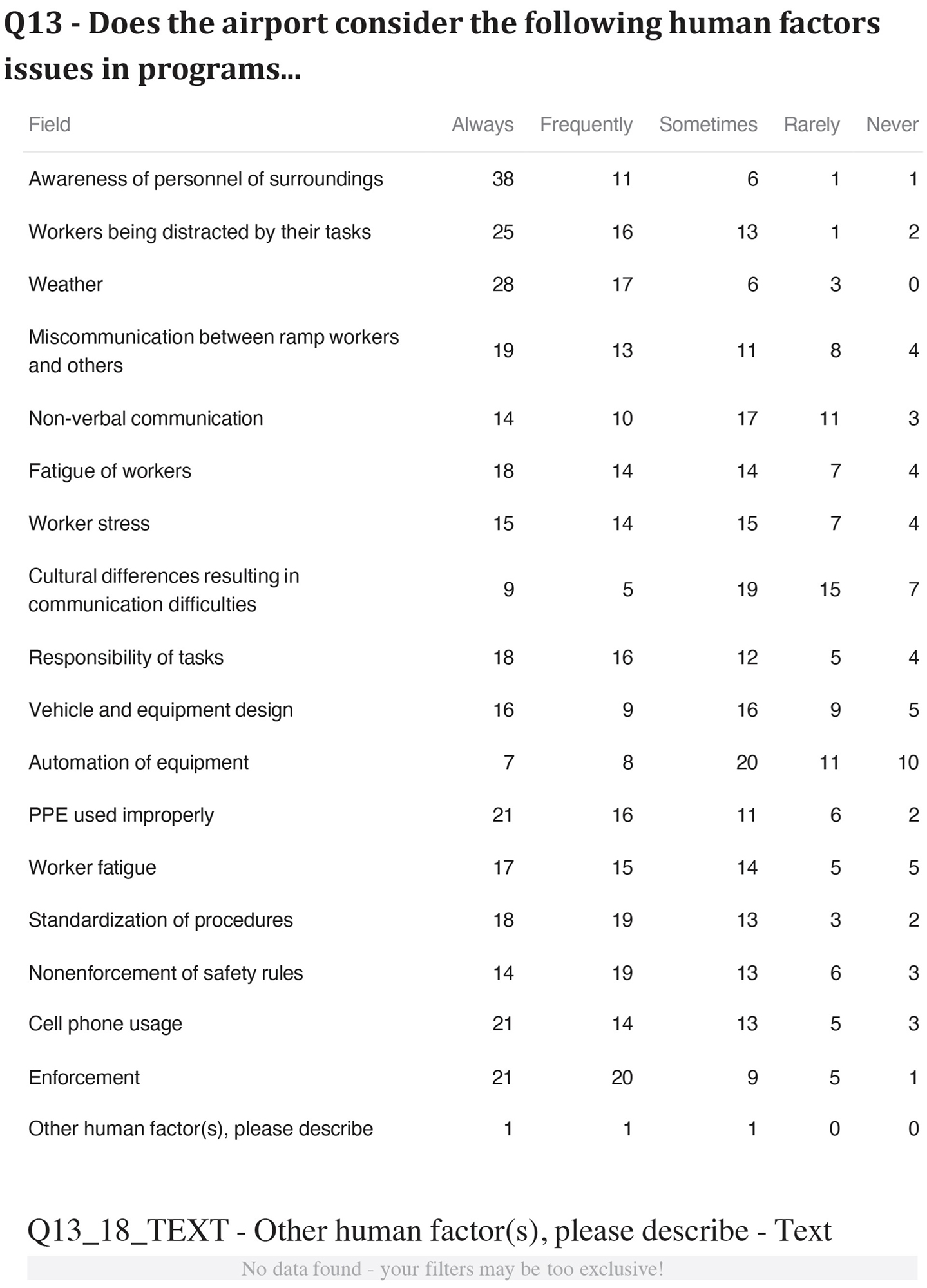
Q13 - Does the airport consider the following human factors issues in programs, ellipsis.
The column headers of the table are Field, Always, Frequently, Sometimes, Rarely, Never. The data in the table row-wise are as follows: 1, Awareness of personnel of surroundings: 38, 11, 6, 1, 1.
2, Workers being distracted by their tasks: 25, 16, 13, 1, 2. 3, Weather: 28, 17, 6, 3, 0. 4, Miscommunication between ramp workers and others: 19, 13, 11, 8, 4. 5, Non-verbal communication: 14, 10, 17, 11, 3. 6, Fatigue of workers: 18, 14, 14, 7, 4. 7, Worker stress: 15, 14, 15, 7, 4. 8, Cultural differences resulting in communication difficulties: 9, 5, 19, 15, 7. 9, Responsibility of tasks: 18, 16, 12, 5, 4. 10. Vehicle and equipment design: 16, 9, 16, 9, 5. 11, Automation of equipment: 7, 8, 20, 11, 10. 12, PPE used improperly: 21, 16, 11, 6, 2. 13, Worker fatigue: 17, 15, 14, 5, 5. 14, Standardization of procedures: 18, 19, 13, 3, 2. 15, Nonenforcement of safety rules: 14, 19, 13, 6, 3. 16, Cell phone usage: 21, 14, 13, 5, 3. 17, Enforcement: 21, 20, 9, 5, 1. 18, Other human factor(s), please describe: 1, 1, 1, 0, 0.
Q13_18_TEXT - Other human factor(s), please describe - Text
No data found - your filters may be too exclusive
Long Description.
The text in the screenshot is as follows:
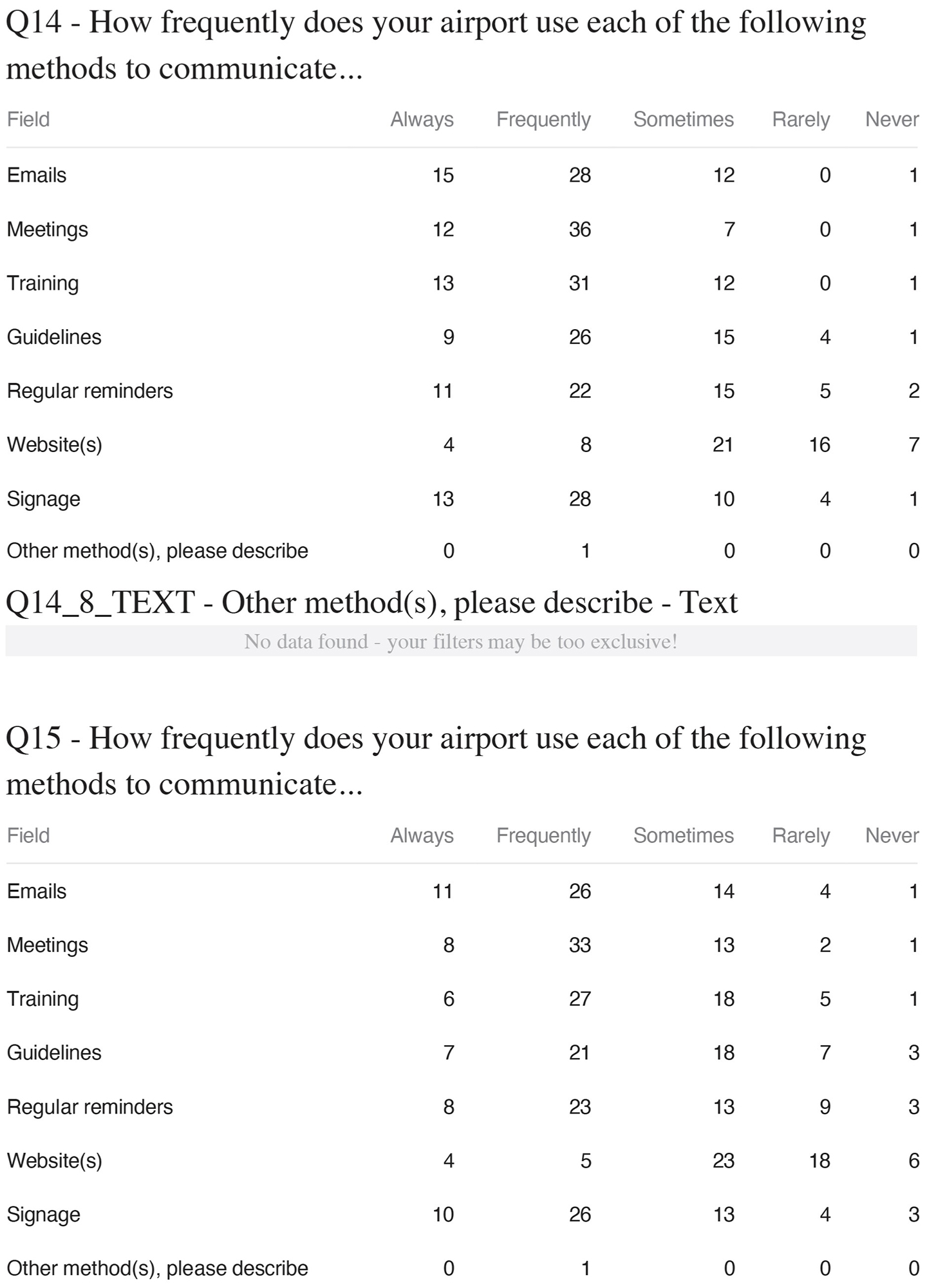
Q14 - How frequently does your airport use each of the following methods to communicate, ellipsis.
The column headers of the table are Field, Always, Frequently, Sometimes, Rarely, Never. The data in the table row-wise are as follows: 1, Emails: 15, 28, 12, 0, 1. 2, Meetings: 12, 36, 7, 0, 1. 3, Training: 13, 31, 12, 0, 1. 4, Guidelines: 9, 26, 15, 4, 1. 5, Regular reminders: 11, 22, 15, 5, 2. 6, Website(s): 4, 8, 21, 16, 7. 7, Signage: 13, 28, 10, 4, 1. 8, Other method(s), please describe: 0, 1, 0, 0, 0.
Q14_8_TEXT - Other method(s), please describe - Text
No data found - your filters may be too exclusive
Q15 - How frequently does your airport use each of the following methods to communicate, ellipsis.
The column headers of the table are Field, Always, Frequently, Sometimes, Rarely, Never. The data in the table row-wise are as follows: 1, Emails: 11, 26, 14, 4, 1. 2, Meetings: 8, 33, 13, 2, 1. 3, Training: 6, 27, 18, 5, 1. 4, Guidelines: 7, 21, 18, 7, 3. 5, Regular reminders: 8, 23, 13, 9, 2. 6, Website(s): 4, 5, 23, 18, 6. 7, Signage: 10, 26, 13, 4, 3. 8, Other method(s), please describe: 0, 1, 0, 0, 0.
Long Description.
The text in the screenshot is as follows:
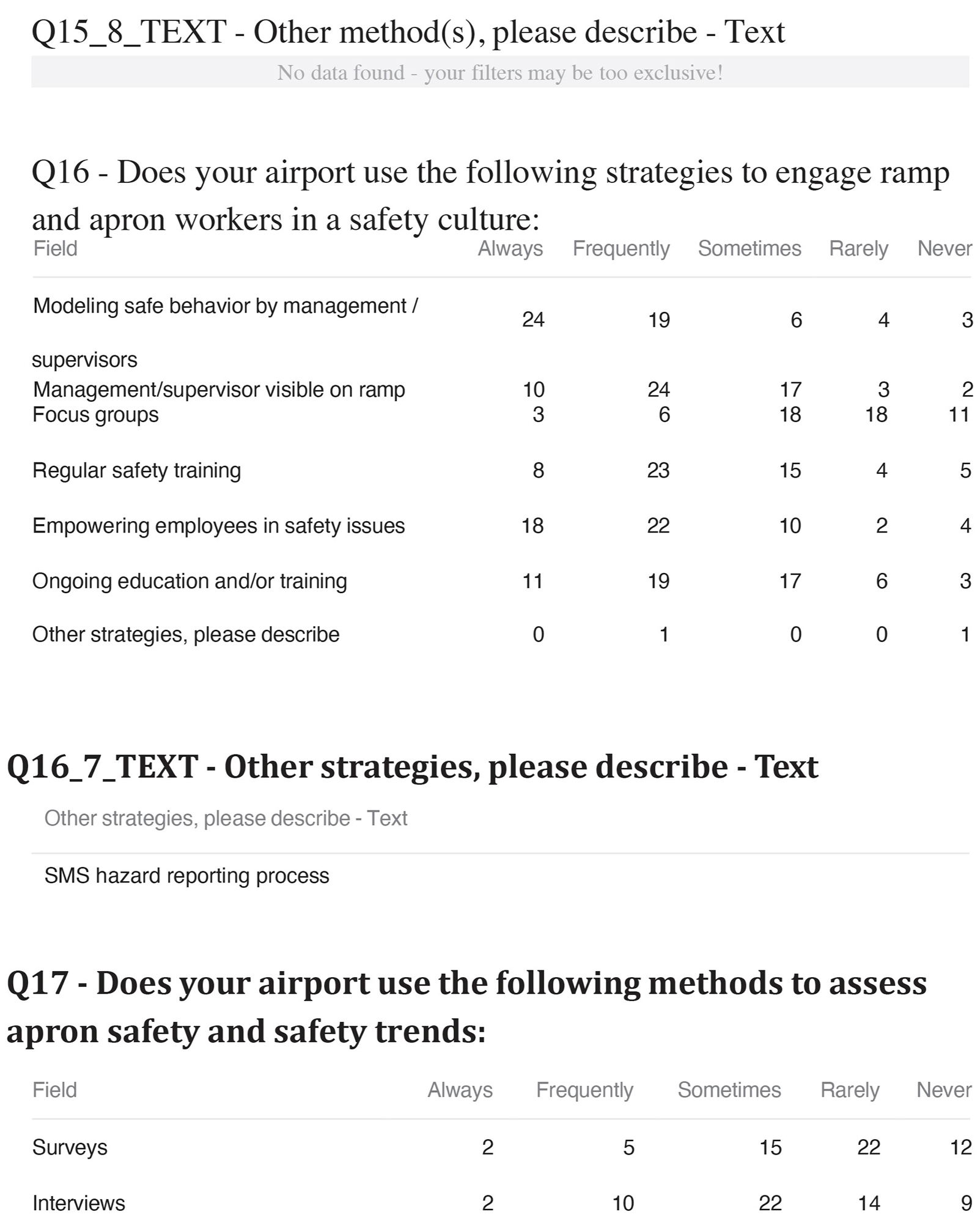
Q15_8_TEXT - Other method(s), please describe - Text
No data found - your filters may be too exclusive
Q16 – Does your airport use the following strategies to engage ramp and apron workers in a safety culture:
The column headers of the table are Field, Always, Frequently, Sometimes, Rarely, Never. The data in the table row-wise are as follows: 1, Modeling safe behavior by management / supervisors: 24, 19, 6, 4, 3. 2, Management / supervisor visible on ramp: 10, 24, 17, 3, 2. 3, Focus groups: 3, 6, 18, 18, 11, 4, Regular safety training: 8, 23, 15, 4, 5. 5, Empowering employees in safety issues: 18, 22, 10, 2, 4. 5, Ongoing education and or training: 11, 19, 17, 6, 3. 7, Other strategies, please describe: 0 , 1, 0, 0, 1.
Q16_7_TEXT - Other strategies, please describe - Text
Other strategies, please describe - Text
SMS hazard reporting process
Q17 - Does your airport use the following methods to assess apron safety and safety trends:
The column headers of the table are Field, Always, Frequently, Sometimes, Rarely, Never. The data in the table row-wise are as follows: 1, Surveys: 2, 5, 15, 22, 12. 2, Interviews: 2, 10, 22, 14, 9.
Long Description.
The text in the screenshot is as follows:
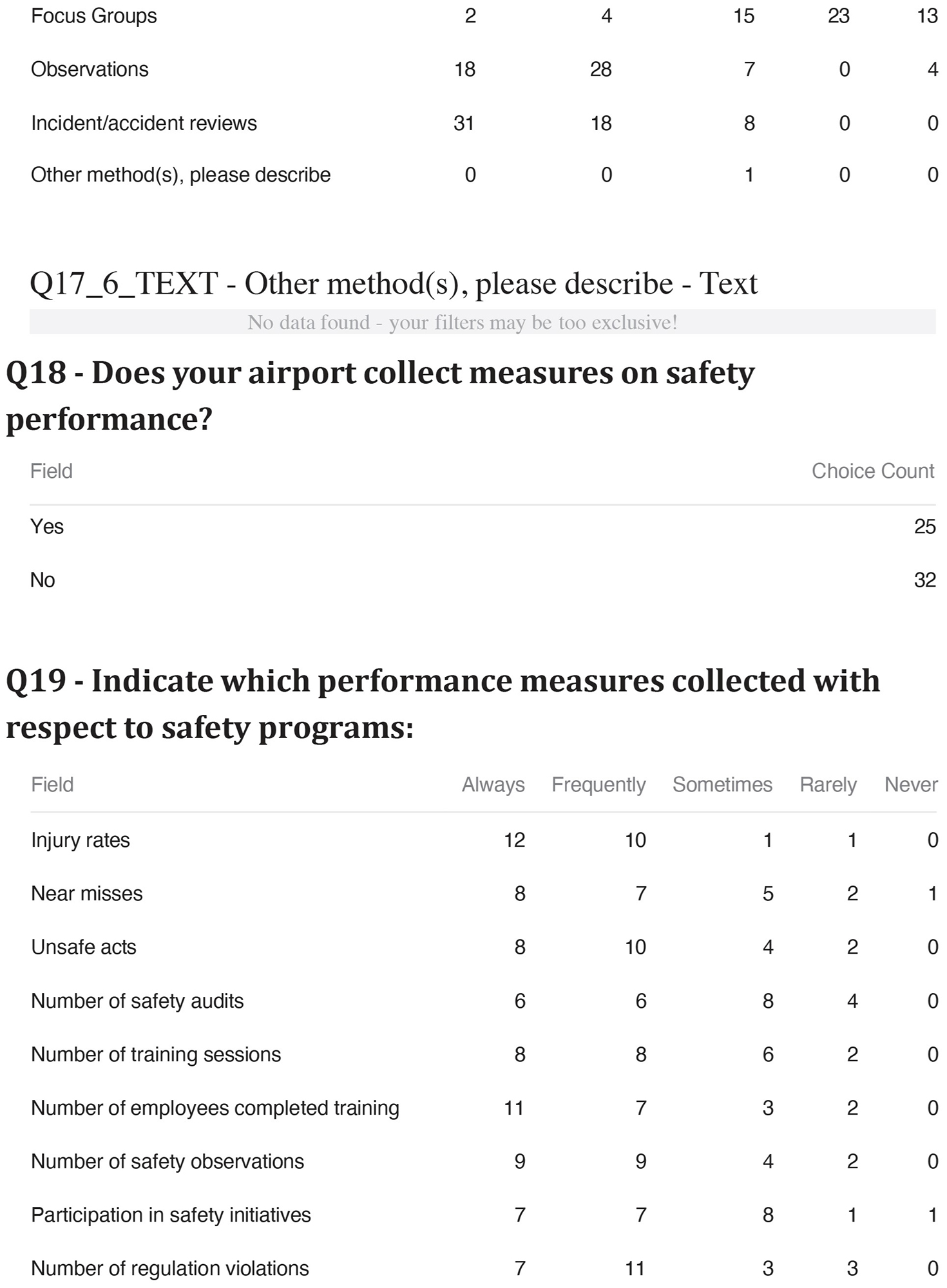
Q17 continued. 3, Focus Groups: 2, 4, 15, 23, 13. 4, Observations: 18, 28, 7, 0, 4. 5, Incident / accident reviews: 31, 18, 8, 0, 0. 6, Other method(s), please describe: 0, 0, 1, 0, 0.
Q17_6_TEXT - Other method(s), please describe - Text
No data found - your filters may be too exclusive
Q18 - Does your airport collect measures on safety performance?
The column headers of the table are Field and Choice count. The data in the table row-wise are as follows: 1, Yes: 25. 2, No: 32.
Q19 - Indicate which performance measures collected with respect to safety programs:
The column headers of the table are Field, Always, Frequently, Sometimes, Rarely, and Never. The data in the table row-wise are as follows: 1, Injury rates: 12, 10, 1, 1, 0. 2, Near misses: 8, 7, 5, 2, 1. 3, Unsafe acts: 8, 10, 4, 2, 0. 4, Number of safety audits: 6, 6, 8, 4, 0. 5, Number of training sessions: 8, 8, 6, 2, 0. 6, Number of employees completed training: 11, 7, 3, 2, 0. 7, Number of safety observations: 9, 9, 4, 2, 0. 8, Participation in safety initiatives: 7, 7, 8, 1, 1. 9, Number of regulation violations: 7, 11, 3, 3, 0.
Long Description.
The text in the screenshot is as follows:
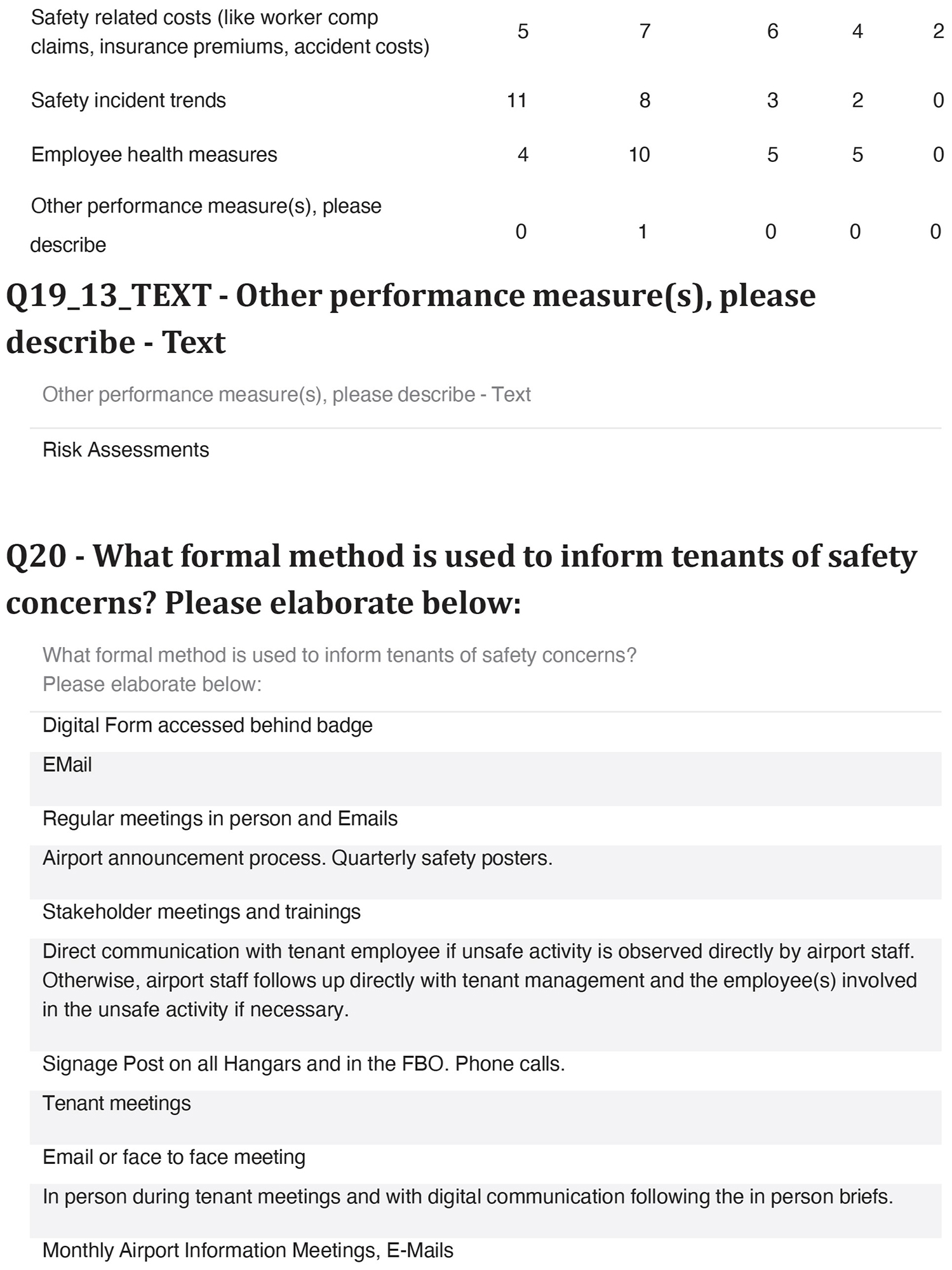
Q19 continued. 10, Safety related costs (like worker comp claims, insurance premiums, accident costs): 5, 7, 6, 4, 2. 11, Safety incident trends: 11, 8, 3, 2, 0. 12, Employee health measures 4, 10, 5, 5, 0. 13, Other performance measure(s), please describe: 0, 1, 0, 0, 0.
Q19_13_TEXT - Other performance measure(s), please describe - Text
Other performance measure(s), please describe - Text
Risk Assessments
Q20 – What formal method is used to inform tenants of safety concerns? Please elaborate below:
Digital Form accessed behind badge
Regular meetings in person and Emails
Airport announcement process. Quarterly safety posters.
Stakeholder meetings and trainings
Direct communication with the tenant employee if unsafe activity is observed directly by airport staff. Otherwise, airport staff follow up directly with tenant management and the employee(s) involved in the unsafe activity if necessary.
Signage Post on all hangars and in the FBO. Phone calls.
Tenant meetings
Email or face-to-face meeting
In person during tenant meetings and with digital communication following the in-person briefs.
Monthly Airport Information Meetings, E-Mails.
Long Description.
The text in the screenshot is as follows:
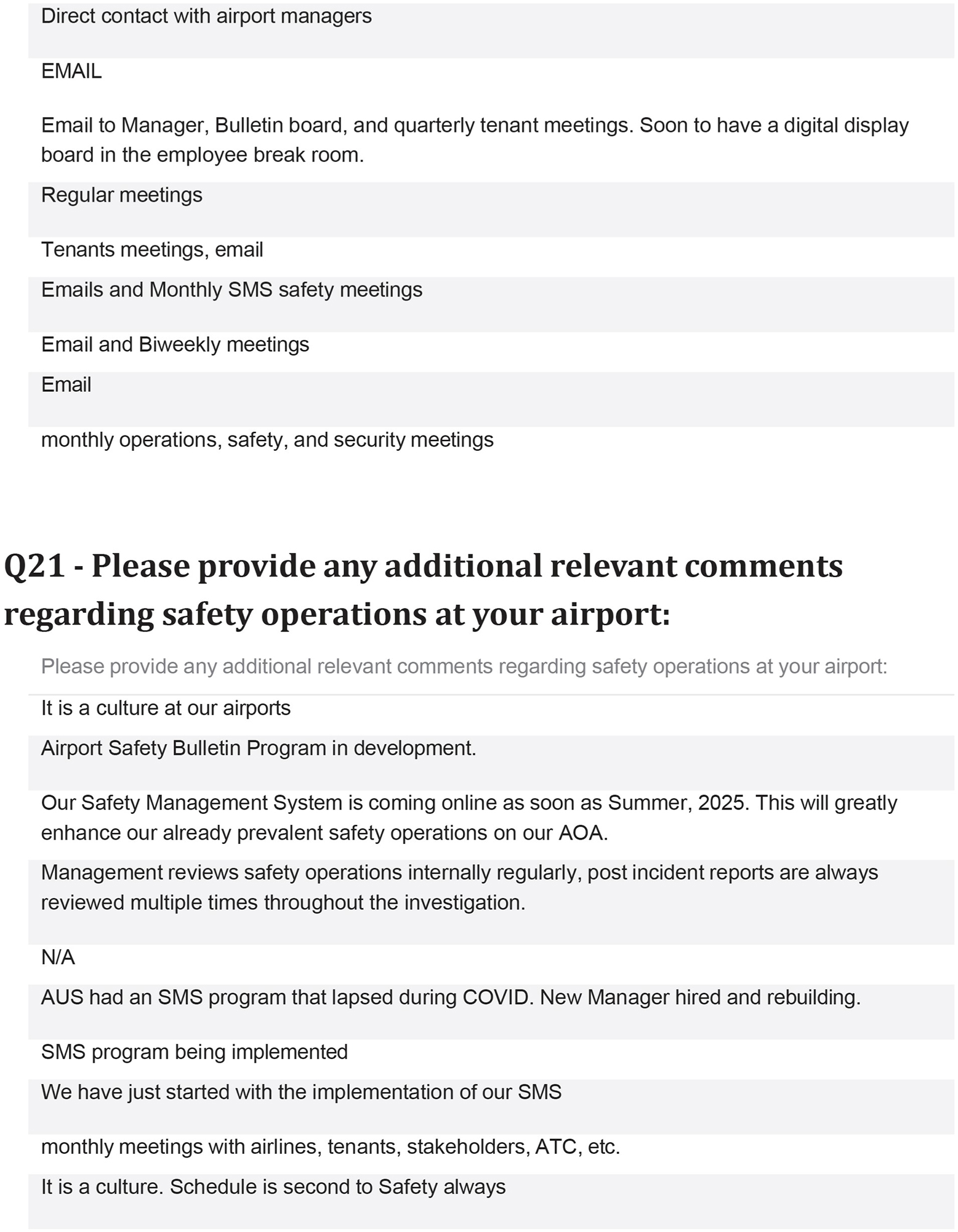
Q20 continued. Direct contact with airport managers
Email to Manager, bulletin board, and quarterly tenant meetings. Soon to have a digital display board in the employee break room.
Regular meetings
Tenants' meetings, email
Emails and monthly SMS safety meetings
Email and biweekly meetings
Monthly operations, safety, and security meetings
Q21 – Please provide any additional relevant comments regarding safety operations at your airport:
Please provide any additional relevant comments regarding safety operations at your airport:
It is a culture at our airports
Airport Safety Bulletin Program in development.
Our Safety Management System is coming online as soon as Summer 2025. This will greatly enhance our already prevalent safety operations on our AOA.
Management reviews safety operations internally regularly; post-incident reports are always reviewed multiple times throughout the investigation.
N by A
AUS had an SMS program that lapsed during COVID. A new manager hired and rebuilding.
SMS program being implemented.
We have just started with the implementation of our SMS
monthly meetings with airlines, tenants, stakeholders, ATC, etc.
It is a culture. The schedule is second to safety, always
Long Description.
The text in the screenshot is as follows:
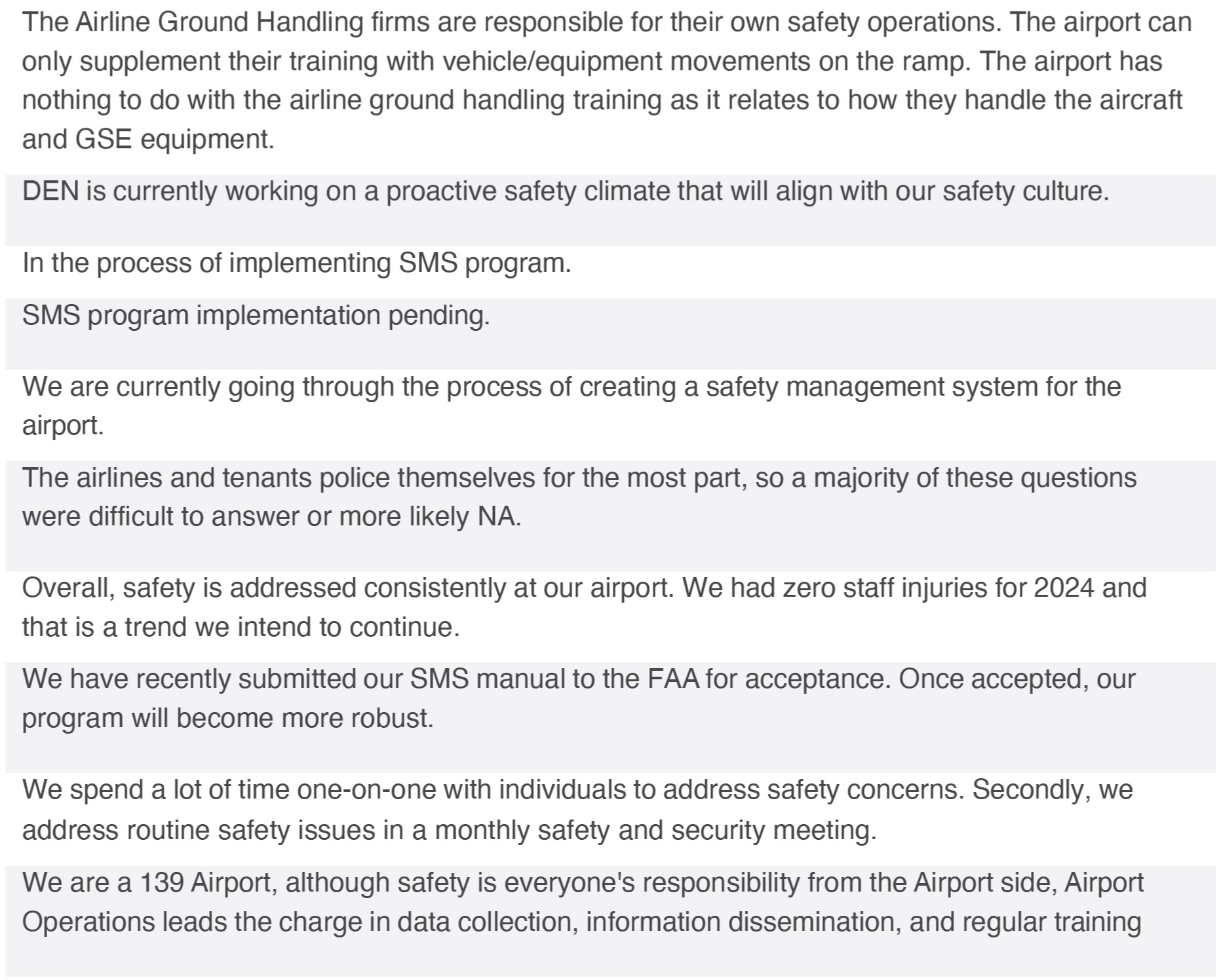
Q21 continued. The airline ground handling firms are responsible for their own safety operations. The airport can only supplement its training with vehicle or equipment movements on the ramp. The airport has nothing to do with the airline ground handling training as it relates to how they handle the aircraft and GSE equipment.
DEN is currently working on a proactive safety climate that will align with our safety culture.
In the process of implementing SMS program.
SMS program implementation pending.
We are currently going through the process of creating a safety management system for the airport.
The airlines and tenants police themselves for the most part, so a majority of these questions were difficult to answer or more likely NA.
Overall, safety is addressed consistently at our airport. We had zero staff injuries for 2024, and that is a trend we intend to continue.
We have recently submitted our SMS manual to the FAA for acceptance. Once accepted, our program will become more robust.
We spend a lot of time one-on-one with individuals to address safety concerns. Secondly, we address routine safety issues in a monthly safety and security meeting.
We are a 139 Airport. Although safety is everyone’s responsibility from the Airport side, Airport Operations leads the charge in data collection, information dissemination, and regular training.


