Clean Ships, Clean Ports, Clean Oceans: Controlling Garbage and Plastic Wastes at Sea (1995)
Chapter: ISSUES RELATED TO SPECIAL AREAS
Surveillance by Citizens
Given the vastness of the oceans, it is clear that the U.S. Coast Guard cannot singlehandedly enforce the requirements of Annex V at sea. The MPPRCA envisioned that additional "eyes" for witnessing and reporting violations might be provided by seafarers, beach goers, and vessel passengers. The MPPRCA includes an unprecedented provision that empowers anyone to report a violation. The Act further rewards citizen reporting by authorizing the courts to give some of the fines collected to those reporting the violation.
Citizen reporting has proven to be worthwhile. Beginning in 1990, EPA funded a pilot program conducted by the Center for Marine Conservation to develop, test, and evaluate a Citizen Pollution Patrol Program (Podlich, 1992). In addition to educating the maritime community about marine debris and related federal and state regulations, the program was designed to involve citizens in reporting Annex V and MPPRCA violations. A standard form was developed to assist eyewitnesses in documenting suspected violations. In the most highly publicized incident of this type to date, citizen reports led to the criminal conviction of a cruise line operator and the maximum fine allowed—$500,000—for illegal discharge of garbage from a ship (U.S. Department of Justice, 1993). In that case, cruise passengers witnessed and videotaped more than 20 plastic bags of garbage being discharged into the sea near the Florida Keys (U.S. Department of Justice, 1993).
If more citizens were educated in how to recognize violations of Annex V and report them, their tips could assist in enforcement. In fact, as mere awareness of the provision for citizen reporting increases, would-be violators may be deterred from carrying out illegal discharges (Weikart, 1993).
All mariners should know that they are encouraged to report Annex V violations by any vessel, just as if they had witnessed any other illegal act. The Coast Guard recently added Annex V violations to the types of reports handled by the National Response Center.9 Through the Coast Guard Auxiliary, a campaign recently was initiated in several states to foster public awareness of how to recognize violations and report them to the center's toll-free telephone number (1-800-424-8802). Plans to expand the campaign nationally should be encouraged.
ISSUES RELATED TO SPECIAL AREAS
As noted in Chapter 1, MARPOL permits the designation of special areas where overboard discharge of garbage other than food waste is prohibited. The
convention does not spell out in detail the criteria and characteristics to be considered in designating special areas. Such direction is provided, however, under guidelines recently adopted by the IMO (International Maritime Organization, 1991)10 Significantly, even when the MEPC adopts a proposal for a special area, the requirements become binding only when IMO determines that sufficient numbers of adequate port reception facilities are provided in the region.
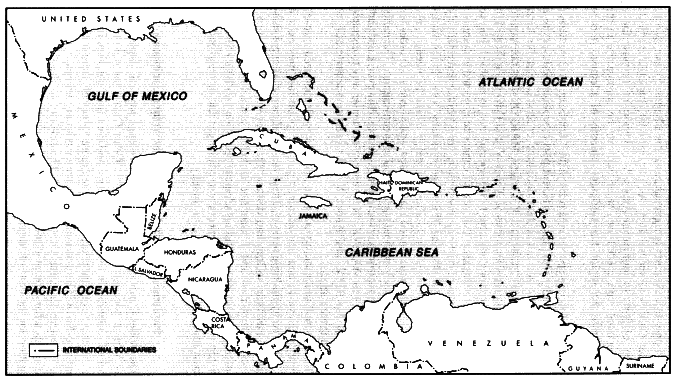
Eight special areas have been designated under Annex V, although the rules have entered into force in only three.11 Of particular interest to the United States, for reasons of proximity, is the Wider Caribbean special area, which includes the Gulf of Mexico (see Figure 7-1). The United States pushed for the designation of that area12 and has a distinct interest in minimizing pollution there. The U.S. Navy also is concerned with other special areas, such as the Mediterranean Sea, where its missions may demand frequent transits or extended stays.
The existence of special areas means that vessels using those waters must achieve zero-discharge capability. An operator can treat garbage on board the vessel, bring the garbage to reception facilities in ports surrounding the special area, hold this garbage for legal discharge at sea or in ports outside the special area, or some combination of these options. All vessels, including U.S.-flag research vessels and cruise ships, have to contend with this mandate when they sail in internationally recognized special areas. Fixed platforms in the Gulf of Mexico already are operating at zero discharge. Eventually, as on-board garbage handling technologies and procedures evolve, awareness of Annex V grows, more special areas come into force13, and adequate port reception facilities become more widely available, zero-discharge capability may become the operating norm.
It will be important, therefore, that the U.S. Annex V implementation strat-