Clean Ships, Clean Ports, Clean Oceans: Controlling Garbage and Plastic Wastes at Sea (1995)
Chapter: Interventions to Remedy the Hazard
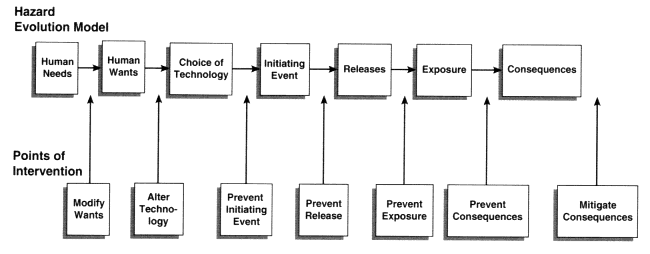
exposure can be prevented. As a last resort, intervention after exposure to the hazard may be able to mitigate the harm done.
In this manner, the flow diagram facilitates an examination of the changes needed and how they may be accomplished, by suggesting (1) the location of the required change within the social organization, (2) the costs of the change to society and how those costs are spread or concentrated, (3) the array of segments of society involved, and (4) ways to facilitate the change. Consideration of these four issues assists in determining how far the benefit(s) of a particular change or effort would go toward mitigating the targeted hazard.
ADAPTING THE MODEL TO VESSEL GARBAGE MANAGEMENT
The Kasperson and Pijawka model has considerable application to the problems of managing vessel garbage and facilitating the implementation of MARPOL Annex V. However, in adapting the model for its own analysis, the committee found it appropriate to make two modifications. First, the committee eliminated the first intervention option (''modifying human needs'') because, while this action may be possible, it is very difficult to accomplish and likely is not an intervention that marine user groups currently have the capacity to accomplish. It is important, however, to recognize the human needs that draw individuals to the marine environment: the need to cam a living, to engage in recreation, and to transport resources that enhance quality of life at the destination. It is also important to recognize that human needs might be modified, especially in the sense of altering perceptions about what needs and behaviors are regarded as appropriate in the marine environment. The committee's flow diagram, which identifies both the stages of hazard evolution and the possible interventions, is shown in Figure 3-2.
The second change made by the committee was to re-label the second box ("human wants") to focus on behavior. (This change is not reflected in Figure 3-2 due to the simplicity of the diagram but appears in matrixes presented later in this chapter and in Chapter 4.) Because Annex V establishes new performance standards, it is appropriate to focus here on the changes in behavior that must be achieved to accomplish the mandated level of performance. No change in "human wants" is required, although this might help, indirectly.
Interventions to Remedy the Hazard
The committee recognized that a comprehensive set of approaches to implementation of Annex V was essential, based on the durable nature of the hazard created by garbage thrown overboard, and the need for a broad-based effort to halt permanently many longstanding practices of all sectors of the maritime community. Therefore, in addition to modifying the Kasperson and Pijawka hazard evolution model to focus on vessel garbage, the committee further set the stage