Clean Ships, Clean Ports, Clean Oceans: Controlling Garbage and Plastic Wastes at Sea (1995)
Chapter: Shoreside Recycling
Guard boarding officer to examine a ship (J.M. Farley, U.S. Coast Guard, personal communication to Marine Board staff, September 1993). One way to help ensure sanitation would be to strengthen the federal program of vessel inspections in ports, through either the CDC or the Food and Drug Administration's existing Program on Interstate Travel Sanitation. The operations manual used to check sanitation on cruise ships (Centers for Disease Control, 1989) is an example of an approach that could be integrated into vessel inspection programs. The provision of standard guidelines for maritime sectors other than cruise ships could help assure that sanitation is not compromised in the pursuit of Annex V compliance. Some fleets also may need technical assistance in developing safe and efficient on-board storage procedures.
On-board garbage storage facilities can be designed to provide for quick and easy off-loading at ports while preventing unintended loss overboard. Facilities range from secured plastic bags for day trips to large dumpsters requiring mechanical off-loading (Mike Prince, marine superintendent, Moss Landing Oceanographic Laboratory, personal communication to Marine Board staff, February 4, 1994). Waste storage areas on vessels can be designed or modified to isolate certain types of wastes, minimize odors, and prevent vermin infestation. The Navy is experimenting with odor-barrier bags for storing food-contaminated plastics on board (Koss, 1994).
Shoreside Recycling
Assuming adequate on-board storage space is available, port waste disposal volumes can be reduced if recyclable materials are separated. Easily recycled materials include aluminum and steel cans, glass bottles, plastic bottles, newspapers, and cardboard packaging. Other materials that may be recycled include metal parts, fishing nets, ropes, and other gear.2
As noted earlier, sorting is best accomplished with standard, color-coded containers and simple, appropriate training programs (Princess Cruises, 1993). Each vessel operator tailors training to fit the circumstances. Short videotapes, followed by practice and demonstrations, greatly assist in crew training. Similar educational programs may be developed for passengers, emphasizing the need for their cooperation in improving the vessel's waste disposal practices. Obviously, recycling only makes sense if the port reception facility and the land-based ISWMS can accept the specific, separated recyclable materials.
A few pilot programs have demonstrated the feasibility of recycling vessel garbage, but few permanent arrangements are in place (Middleton et al., 1991; Kauffman, 1992).
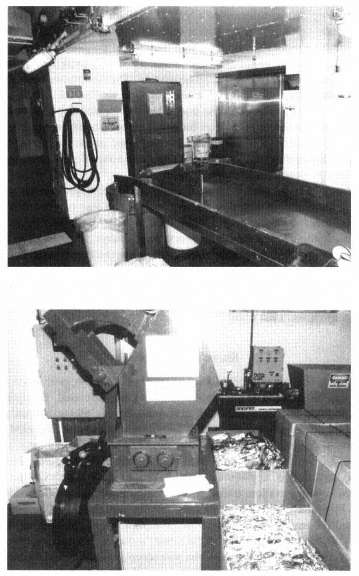
Some of the most advanced vessel garbage handling procedures and equipment can be found on cruise ships. The top photo shows a garbage sorting area. Sorting is essential both to ensure that plastics are held on board and to separate recyclable materials from other garbage. The bottom photo shows a commercially available compactor that reduces aluminum to 1/30th of its former volume and tin to 1/10th of its former volume. These materials then are baled and brought ashore for recycling. Credit: Princess Cruises

