Database Needs for Modeling and Simulation of Plasma Processing (1996)
Chapter: Particle Beams
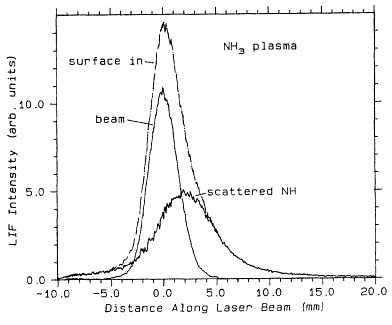
Figure 4.2 Spatial profile of measured fluorescence from an IRIS apparatus using NH radicals impacting and reflecting from a substrate. The "scattered NH" profile is the difference between the signal with the substrate in place ("surface in") and the signal with no substrate ("beam"). (Reprinted, by permission, from E.R. Fisher, P. Ho, W.G. Breiland, and R.J. Buss, J. Phys. Chem. 96:9855 (1992). Copyright © 1992 by the American Chemical Society.)
Most conventional surface science techniques cannot be employed because of the relatively high pressure of the glow discharge. However, several in situ real-time diagnostics have been employed in the study of surfaces in contact with glow discharges. These are listed in Chapter 3.
In many cases we do not know what the surface reactions are. We measure an overall reaction rate constant for an overall etching reaction. This may be all that is needed in etching. However, in deposition processes, rates of different reactions affect the film composition, and we may need more details on the reaction pathways and reaction rate coefficients for those pathways.
Technology
Additional diagnostics are needed to identify adsorbates, to describe their bonding to the surface, and to determine their concentrations—and to make similar measurements on resists and the sidewalls. The presence of other materials, such as photoresist in etching applications, is known to alter surface kinetics in some cases. Coupling between surface chemistry and chemical species transport in submicron features of complex three-dimensional shape may be important. For instance, sidewall passivation layers are often important for microelectronic applications. In many cases we do not know the composition of these layers or the mechanism of their formation. The formation rate of these films shows a strong temperature dependence. Examples of measurements on three-dimensional structures have been described.7
Ultrahigh-Vacuum Approach Using Mass and Energy Selected Reactive Beams
Winters and Coburn, and the FOM group, did excellent work using this approach8 by employing inert gas ion bombardment and chemical etchants like XeF2 and C12. In the future, the major emphasis should be on the ionic and neutral species that typically interact with surfaces under realistic plasma processing conditions.
Particle Beams
A common problem in surface studies with beams of neutral and/or ionic species is controlling and/or characterizing beam composition and energy. Development of well characterized and controllable sources that can produce pure radical and ion beams at the relevant energies for use in such studies is an important goal to pursue. A distinction must also be made between neutral and charged energetic species, and it will be interesting to examine the differences in their behavior.
It is important to distinguish between those processes that form the adlayer, which involve both neutral and ion species, and those that are important in desorbing the adlayer. There is also recent data in UHV
