Database Needs for Modeling and Simulation of Plasma Processing (1996)
Chapter: Condition of the Surface
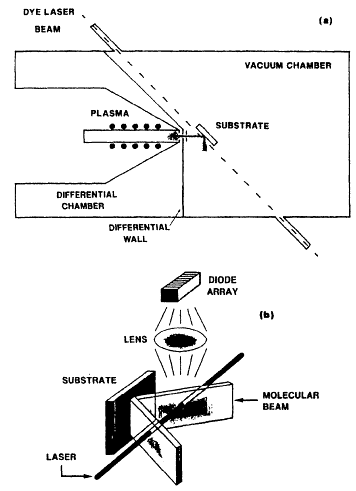
Figure 4.1 (a) Schematic illustration of the IRIS apparatus. Plasma species are directed into a high-vacuum chamber where they impact a surface. The dye laser beam illuminates both incident and reflected species; (b) illustration of the laser-induced fluorescence measurement of both incident and reflected species. (Reprinted, by permission, from E.R. Fisher, P. Ho, W.G. Breiland, and R.J. Buss, J. Phys. Chem. 96:9855 (1992). Copyright © 1992 by the American Chemical Society.)
For desorbing species, the issues are the identifies and energies of dominant etching products and other desorbing species; the importance of these species for the composition of the plasma, i.e. "recycling"; and the identity of species that redeposit on the surface or the walls of the reactor.
Techniques traditionally used for gas phase diagnostics have been adopted to characterize the interaction of radicals with specific surfaces. An example mentioned in Chapter 3 is the IRIS (imaging of radicals interacting with a surface) technique.6 The principle of the technique is shown in Figure 4.1. In Figure 4.1a, a plasma chamber is shown in contact with a high-vacuum chamber where the substrate is located. Figure 4.1b illustrates how the molecular beam is directed to the surface and is partly reflected. A dye laser is used to excite specific radicals in the incident and reflected beams and the resulting fluorescence is measured. An example of data obtained on the interaction of NH radicals from a NH3 plasma is shown in Figure 4.2. By performing the measurement with and without a surface and taking the difference of the fluorescence data, it is possible to measure the intensity of scattered NH and thus determine the reactivity of NH with that surface. Mass spectrometry, threshold ionization mass spectrometry, and Fourier transform infrared spectroscopy are other important tools for plasma sampling that are very helpful for incident flux analysis.
The products and product energy distributions for many of the systems of current interest, e.g. etching of Si3N4 in a downstream plasma, are still unknown. Work is needed to apply the above techniques to obtain information on the products that are evolved from the surfaces.
Condition of the Surface
The state, or condition, of the surface exposed to a plasma is crucial to a fundamental understanding of heterogeneous processes. Issues of importance include the identity and coverage of species adsorbed or absorbed at the surface; adsorption, diffusion, and reaction mechanisms; the identities of species incorporated into growing films; the role of ion bombardment; and the proper parameter dependence of these quantities, i.e. the dependence on substrate temperature, gas mixture, and so on.
