Database Needs for Modeling and Simulation of Plasma Processing (1996)
Chapter: PLASMA EQUIPMENT SUPPLIER PERSPECTIVES
manufacturers and users of plasma processing equipment. Plasma processes have been successful in meeting the processing needs of many aspects of the semiconductor manufacturing industry. However, to keep up with the projected acceleration in the industry, plasma equipment design, optimization, and control must become more efficient. Plasma equipment suppliers that are able to meet the accelerating demands will win market share over their competitors both domestically and abroad. Chip manufacturers better able to optimize, maintain, and control their plasma tools will enjoy an advantage in productivity and therefore profitability. This advantage will in turn translate into more capable and affordable electronics for the civilian and defense sectors. In the rest of this chapter the panel outlines the opportunities that modeling and simulation offer to chip manufacturers and to plasma equipment suppliers to meet these goals.
Plasma Equipment Supplier Perspectives
Equipment suppliers design plasma process chambers, with the associated pumping, gas handling, wafer handling, and control software and hardware. In addition, plasma equipment suppliers develop process chemistries to meet the needs of their chip manufacturing customers, often in a collaborative effort. As silicon technology evolves toward the gigabit era in the next millennium, the requirements listed in Table 1.1 will place increased demands on the design of both new chambers and process chemistries. The choice of plasma tool design, process gas chemistries, and operating conditions (the operating window) must satisfy these criteria over a reasonable range of conditions. A major concern is the rune it takes to design a new plasma process chamber and to select the appropriate process chemistries and operating conditions. Plasma-induced contamination and damage are always a concern and must be kept to an absolute minimum, if not eliminated altogether.
The major problems with plasma processing technology from the point of view of the tool supplier can be summarized as difficulties in tool design, tool optimization, and tool control. Historically, and currently, plasma process equipment has been designed and optimized largely empirically. Designers have relied on experience, intuition, and estimation to develop the next generation of tools. Process control strategies have lagged behind the standards seen in other industries. Mostly, control has focused on simply maintaining constant mass flow of reactants, constant pressure in the chamber, constant wafer temperature, and constant radio-frequency power to the discharge. The wafer-to-wafer and batch-to-batch drifts that are well known to all users of plasma process equipment have not been addressed, or they have been dealt with by more frequent (and costly) chamber cleaning and wall conditioning.
The general consensus is that the traditional method of meeting the requirements listed above, namely empirical trial and error, is encountering a point of diminishing returns. One view of the overlapping roles that modeling and simulation can play is illustrated in Figure 1.1. The "modeling design engine" includes virtual prototyping of equipment, real-time process control, and process design. Virtual prototyping is the use of modeling to determine the location and size of gas inlet and pumping ports, the design of the vacuum pumping layout, the electrode and electromagnetic power coupling configurations, and the wafer clamping mechanism, among other equipment components, before constructing a prototype chamber (that is, before " cutting metal"). Process design involves the selection of process chemistries and operating conditions (e.g. pressure, power, gas flow rate) that will provide the desired processing characteristics (e.g. uniformity, rate, anisotropy in etching, film properties in deposition). Real-time process control involves the ability to make appropriate measurements of the important processing variables (or to infer these quantifies from other, more convenient measurements) and to adjust operating conditions to remain within the desired set-points. Modeling and simulation can play an important role in process control in several ways. For example, it is not always clear what operating variables (or
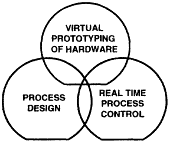
Figure 1.1
Overlapping functions of modeling: the "modeling design engine." (Courtesy of A. Voshchenkov, Lam Research Corporation.)
