Database Needs for Modeling and Simulation of Plasma Processing (1996)
Chapter: Ion-Molecule and Charge Exchange Reactions
Cross Sections and Rate Coefficients
Ion Processes
The needs for fundamental data on ion processes can be subdivided by energy range as indicated in Table 6.1. The division in energy range is based on two premises. First, the ion distribution in the bulk plasma for the majority of plasma processing reactors can be well described by a Maxwellian or moderately drifting Maxwellian. The temperatures are usually less than 0.1 eV. Transport coefficients and cross sections for processes in this range of energies are usually measured using a swarm or drift tube technique, and characterized by a "random" temperature. Ion energies greater than 0.1 eV are usually found only in the presheath or sheath regions of the plasma. Cross sections for collisional processes in the higher energy range are measured by beam techniques, and usually characterized by a directed energy.
TABLE 6.1 Categorization of Data Needs for Ion Processes
|
Process |
Thermal |
Superthermal |
|
|
(e < 0.1 eV) |
(0.1 < e < 1 keV) |
|
Momentum transfer |
• |
• |
|
Ion-molecule and charge exchange |
• |
• |
|
Ion-ion neutralization |
• |
|
|
Electron-ion recombination |
• |
|
|
Ion-neutral and neutral-neutral excitation |
|
• |
Momentum Transfer
Momentum transfer collisions are elastic and/or inelastic processes resulting in a change in momentum and in which the identity of the ion does not change.

Beam-measured cross sections should be resolved in energy and angle. Swarm-measured cross sections or rate coefficients should be temperature dependent.
The availability of ion swarm parameters (usually mobilities, diffusion coefficients, and characteristic energies vs. E/N) is good for ions of interest in atmospheric or combustion applications, and poor for ions of interest to plasma processing. These data are typically scattered in the literature. A compendium of ion transport coefficients dating to 1984 is available from Ellis et al.1
Ion-Molecule and Charge Exchange Reactions
Collisions resulting in transfer of positive or negative charge from the incident ion are ion-molecule or charge exchange reactions.

If the identity of the ion does not change, this process is known as a symmetric charge exchange and is sometimes difficult to distinguish from a momentum transfer collision. Beam-measured cross sections should be resolved in energy and angle. Swarm-measured cross sections or rate coefficients should be temperature dependent. Distribution of products from the target molecule should also be identified.
The availability of data for thermal ion-molecule and charge exchange reactions for molecules of atmospheric or combustion interest is relatively good. Many compendia are available, such as those of Sieck and Lias,2 Albritton,3 and Ikezoe et al.4
There are isolated instances of measurements of cross sections for these reactions in gases of interest to plasma processing. For example, Morris et al.5 have measured reaction rate coefficients for

Tsuji et al.6 have made measurements of charge exchange of rare gases with etching gases. For example,
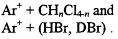
Bohme has measured and assembled a database for ion-molecule reactions for silicon-bearing ions.7 Mandich and Reents8 have performed measurements of ion-molecule cross sections in silane systems using Fourier transform mass spectrometry,

The latter work has shown that there are bottlenecks for silane ion association reactions that may be breached by the internal energy of the reactants or by the presence of impurities such as water. (See Figure 6.1.)
A subset of ion-molecule reactions are ion association reactions  The rate coefficients for these processes tend to be system specific even for rare gases. Scaling laws for their temperature dependence, however, have been developed by Johnsen9
Superthermal ion-molecule and charge-exchange collisions usually occur in the sheaths. These are processes that are not allowed at thermal energies in the bulk plasma but nevertheless should be addressed in the database for use in higher pressure systems where sheaths may be collisional.

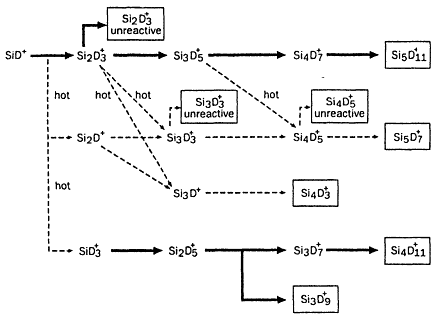
Figure 6.1 Reaction sequence for ion chemistry initiated by SiD+ in SiD4. (Reprinted, by permission, from M.L. Mandich and W.D. Reents, J Chem. Phys. 95:7360 (1991). Copyright © 1991 by the American Institute of Physics.)

