Database Needs for Modeling and Simulation of Plasma Processing (1996)
Chapter: Summary
TABLE 6.2 The Status of Neutral Chemistry Databases for Selected Chemistries
|
System |
Status |
Comments |
|
SiH4 / Si2H6 / H2 (Deposition of a-Si:H, p-Si) |
Good |
Database was initially compiled for silane combustion, CVD of p-Si, and PECVD of a-Si:H for photovoltaics. |
|
SinHm / O2 / N2O (Deposition of SiO2 oxynitrides) |
Fair to good |
Database was initially compiled for CVD of SiO2, silane combustion, and atmospheric chemistry |
|
SinHm / NH3 / N2 (Deposition of Si3N4 |
Fair to good |
Database was initially compiled for CVD of Si3N4 and atmospheric chemistry |
|
CnHm / H2 (Deposition of diamond, diamond-like carbon) |
Very good |
Database was initially compiled for combustion. |
|
CnFm / H2 / O2 (Etching of SiO2, Si) |
Fair to good |
The Plumb and Ryana mechanisms are ''standard'' but applicable to a limited parameter space. A new reaction mechanism and database developed by M. Zachariahb are now available |
|
SF6 (Etching of p-Si, W) |
Fair to poor |
Interest in modeling circuit breakers and spark gaps at high pressure Database with questionable application to low pressure |
|
CCl4 (Etching of p-Si) |
Fair |
Need for this database is minimal due to phaseout of the use of CCl4. |
|
BCl3 / HBr / C12 / NF3 (Etching of p-Si, metals) |
Poor |
These are examples of databases that are currently poor but are amenable to being addressed by calculations |
|
a I. Plumb and K. Ryan, Plasma Chern. Plasma Proc. 6:11 (1986); — 6:205 (1986); — 6:231 (1986). b D.R.F. Burgess, M.R. Zachariah, W. Tsang, and P.R. Westmoreland, NIST Technical Note 1412 (U.S. Department of Commerce, Technology Administration, July 1995). |
||
A subset of excited state chemistry is electronic quenching and Penning ionization. These reactions are collisions involving excited states of atoms or molecules and resulting in the deactivation of the excited state (quenching) and the transfer of energy to the collision partner. When the collision partner is ionized, the process is termed a "Penning ionization."
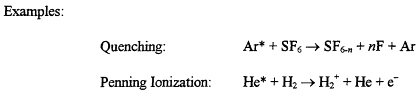
Quenching reactions are important because they can transfer energy to the collision partner producing dissociation, and they may remove intermediates for multistep ionization. Interest in the development of excimer and metal ion lasers in the 1970s and 1980s resulted in a large database for rare-gas metastable quenching. (See, for example, Velasco et al.26) In the 1980s and 1990s, interest in PECVD of a-Si:H and its alloys for photovoltaics has supplemented that database with reactions involving SiH4, Si2H6, CH4, C2H6, and GeH4.27 In many cases, these rate coefficients and cross sections are for quenching of the excited state on a particular gas, and little information is given on the identity and branching ratios of the products.
Summary
It is clear that a large resource for cross sections and rate coefficients is currently available in the literature. Unfortunately, this resource was developed largely for use in fields other than plasma processing, and therefore is scattered and difficult to assemble. A first and necessary task is to assemble, evaluate, and disseminate the existing data.
