Touch the Sun: A NASA Braille Book (2005)
Chapter: 16. Space Weather (Sun, Solar Wind, Earth)
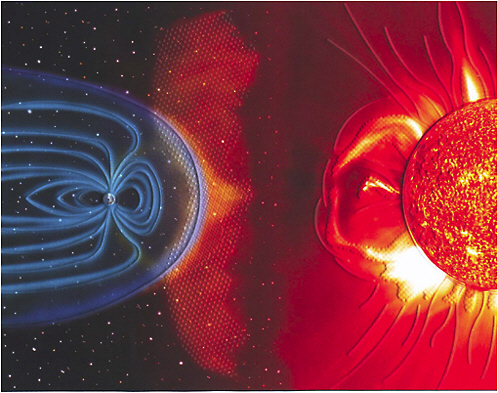
Figure 16.
Space Weather (Sun, Solar Wind, Earth)
Imagine that we could leave Earth and look back at both Earth and the Sun during a solar storm to see solar wind and coronal mass ejections. Some of the material reaches Earth in 24 to 48 hours.
While it is the Sun’s magnetic field that drives its activity, the Earth’s own magnetic field provides a barrier to protect the Earth from most of the harmful effects of that activity.
Turn the book so that you view this image horizontally, with the spine toward the top. This illustration depicts solar wind and coronal mass ejections, shown with a dotted texture, leaving the Sun. Half of the Sun is shown on the right side. The Earth is shown as a small hollow circle on the left side. Between the Earth and Sun is the solar material. Solid curved lines surrounding Earth show how the Earth’s magnetic field deflects most of the solar material away from Earth.
Solar storms can cause disruptions in communications on Earth. Some of the particles are also responsible for colorful displays of light called auroras, which resemble wavy curtains of light dancing in Earth’s night sky.
Credit: Steele Hill, SOHO/EIT and LASCO, NASA/ESA