Touch the Sun: A NASA Braille Book (2005)
Chapter: 2. The Full Sun
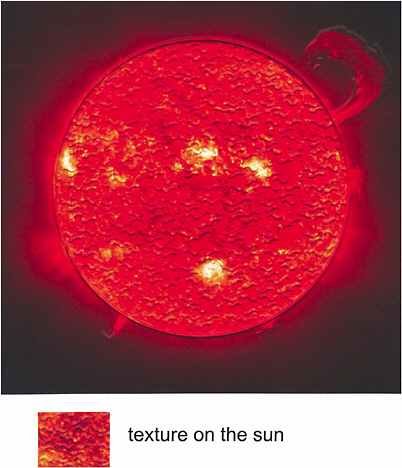
Figure 2.
The Full Sun
The Sun is basically a gigantic ball of gas made mostly of hydrogen and helium. The deepest part of the Sun’s atmosphere, visible directly with a special dark solar filter or indirectly with a pinhole projection system in a shoebox, is called the photosphere. In this layer, we observe rising and falling gas currents just like those in boiling water. The photosphere is very active and changes within minutes. Astronomers and physicists use special solar telescopes and solar satellites to observe the Sun’s activity.
The following photograph taken on Sept. 14, 1999 by the SOHO (Solar and Heliospheric Observatory) spacecraft, shows the full Sun surrounded by explosive areas along the edge of our view. Notice the very active “bubbly texture” on the Sun, caused by the up and down motion of convection currents that move magnetic fields around. The texture is called supergranulation, and each bumpy area is a supergranule. Along the edge of the Sun’s disk are arches and blobs of gases contained by magnetic fields; these are called prominences. Prominences are denser and cooler than their surroundings and sometimes erupt and escape from the Sun.
Credit: SOHO/EIT, NASA/ESA