Touch the Sun: A NASA Braille Book (2005)
Chapter: 9. Sunspots in Motion Over Time
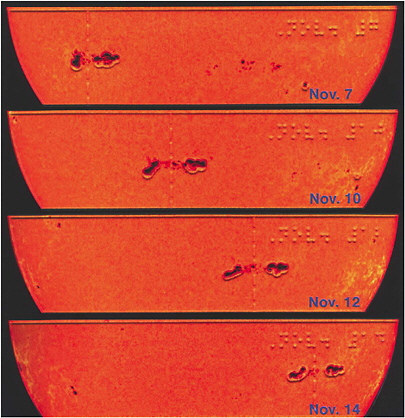
Figure 9.
Sunspots in Motion Over Time
Sunspots and groups of sunspots travel across the Sun as the Sun rotates. By observing the motion of sunspots, Galileo was able to deduce that the Sun itself takes about a month to complete a rotation.
In fact, the Sun’s surface rotates faster at the equator than at the poles, where the rotation period lasts around 35 days. Scientists learned about this “differential rotation” from studying sunspot motions too. The Earth, by contrast, does not experience differential rotation because it is solid and rotates rigidly.
The next image shows the Sun over a seven-day period. Imagine slicing the Sun into sections. You are looking at the same group of sunspots on the same section of the Sun every 2-3 days. A dotted reference line has been added between the two large sunspots, and the date of each observation is labeled. Notice how the sunspots move toward the right side. The original sunspot group is seen on the far left, but after four observations, the sunspot group has moved to the far right.
Credit: SOHO/MDI, NASA/ESA