Touch the Sun: A NASA Braille Book (2005)

Chapter: 8. The Sun with Sunspots

Previous Chapter: 7. The Sun as seen by the TRACE Satellite
Suggested Citation: "8. The Sun with Sunspots." Noreen Grice. 2005. Touch the Sun: A NASA Braille Book. Washington, DC: Joseph Henry Press. doi: 10.17226/11219.

Figure 8.
The Sun with Sunspots

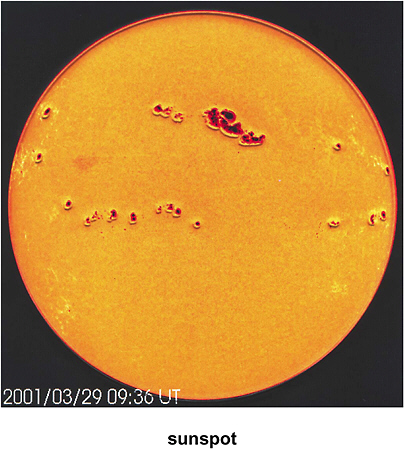
Magnetic field lines can also form loops that break out from the Sun’s photosphere. In these areas, the energy from convection is partially blocked. This means that those areas are slightly cooler than their surroundings. The cooler areas appear as dark spots against the bright Sun and are called sunspots.


Every 11 years, the Sun becomes very active and experiences a sunspot maximum, when numerous sunspots are visible.

Suggested Citation: "8. The Sun with Sunspots." Noreen Grice. 2005. Touch the Sun: A NASA Braille Book. Washington, DC: Joseph Henry Press. doi: 10.17226/11219.

The next image shows the Sun with sunspots, as seen on March 29, 2001 by SOHO. The large sunspot group near the top center is more than 13 times the size of Earth. The Sun’s surface is intentionally shown without any background texture so that the sunspots are easy to find.


Notice how the sunspots appear very small and irregularly shaped.


Credit: SOHO/MDI, NASA/ESA
Suggested Citation: "8. The Sun with Sunspots." Noreen Grice. 2005. Touch the Sun: A NASA Braille Book. Washington, DC: Joseph Henry Press. doi: 10.17226/11219.

The Sun with Sunspots


Suggested Citation: "8. The Sun with Sunspots." Noreen Grice. 2005. Touch the Sun: A NASA Braille Book. Washington, DC: Joseph Henry Press. doi: 10.17226/11219.

This page intentionally left blank.

Next Chapter: 9. Sunspots in Motion Over Time
Subscribe to Emails from the National Academies
Stay up to date on activities, publications, and events by subscribing to email updates.