Touch the Sun: A NASA Braille Book (2005)

Chapter: 1. Earth and Sun Size Comparison

Previous Chapter: Introduction
Suggested Citation: "1. Earth and Sun Size Comparison." Noreen Grice. 2005. Touch the Sun: A NASA Braille Book. Washington, DC: Joseph Henry Press. doi: 10.17226/11219.

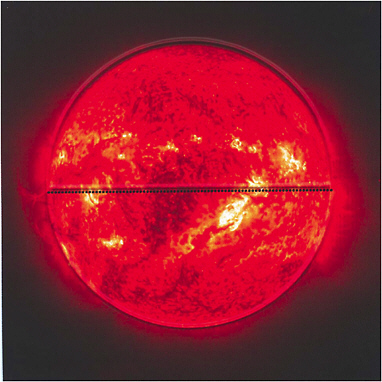
Figure 1.
Earth and Sun Size Comparison

At night, the distant stars appear as tiny points of light against the blackness of space. They look small because they are trillions upon trillions of miles away. Our Sun is the closest star to Earth. On average, it is about 93 million miles (150 million kilometers) away.


The Sun is a sphere about 865,000 miles (1.4 million kilometers) across. By contrast, our Earth is about 8,000 miles (12,756 kilometers) across.

Suggested Citation: "1. Earth and Sun Size Comparison." Noreen Grice. 2005. Touch the Sun: A NASA Braille Book. Washington, DC: Joseph Henry Press. doi: 10.17226/11219.

In the first illustration, the large circle represents the Sun and each tiny dot, on the dotted line in the middle of the Sun, represents an Earth. More than 100 Earths could easily fit across the Sun. The Sun is the largest object in our solar system, accounting for 99% of the solar system’s mass.


Credit: Steele Hill, SOHO/EIT, NASA/ESA
Suggested Citation: "1. Earth and Sun Size Comparison." Noreen Grice. 2005. Touch the Sun: A NASA Braille Book. Washington, DC: Joseph Henry Press. doi: 10.17226/11219.

Earth and Sun Size Comparison

Suggested Citation: "1. Earth and Sun Size Comparison." Noreen Grice. 2005. Touch the Sun: A NASA Braille Book. Washington, DC: Joseph Henry Press. doi: 10.17226/11219.

This page intentionally left blank.

Next Chapter: 2. The Full Sun
Subscribe to Emails from the National Academies
Stay up to date on activities, publications, and events by subscribing to email updates.