Touch the Sun: A NASA Braille Book (2005)
Chapter: 6. The Sun with Magnetic Field Lines
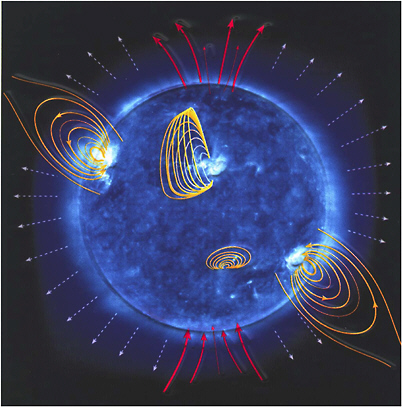
Figure 6.
The Sun with Magnetic Field Lines
An atom is composed of a nucleus of positively charged particles (protons) and particles without any charge (neutrons), except for hydrogen, which has a single proton for its nucleus. The nucleus of an atom is surrounded by much smaller negatively charged particles called electrons. Atoms are electrically neutral because the number of protons and electrons is the same.
The gas in the Sun’s upper atmosphere is very thin, but it is electrically charged (or ionized) because the temperature is so high that atoms frequently collide, resulting in the stripping off of electrons. Atoms that have lost electrons are called ions.
The motion of ionized gas is controlled by a magnetic field. Every feature we see in the Sun’s upper atmosphere is due to the shape of the magnetic field.
The next illustration shows how the Sun would look if we could actually see some of its magnetic field lines. The Sun has an overall magnetic field, but also places where smaller loops of magnetic fields break out from its surface.
Low solid lines represent the magnetic field loops. The pointed arrows, shown radiating above and below the Sun, represent magnetic field loops that reconnect a long way from the Sun.
Credit: Steele Hill, SOHO/EIT, NASA/ESA