Touch the Sun: A NASA Braille Book (2005)
Chapter: 11. Coronal Mass Ejection
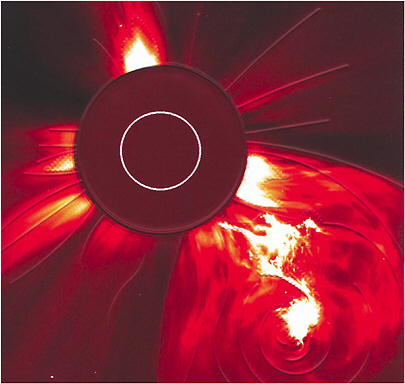
Figure 11.
Coronal Mass Ejection
The inner layer of the Sun’s atmosphere, where sunspots form, is the photosphere. The middle layer is the chromosphere, and the outermost layer of the Sun is the corona.
The corona and chromosphere are very faint but can be observed during a total solar eclipse, when the moon’s disk completely covers the disk of the Sun, or with a special kind of telescope that utilizes an instrument that uses an artificial moon, or disk, to cover the Sun.
In the next illustration, the large raised circle in the center represents the artificial eclipse disk in the telescope. The activity in the corona is shown as thin curved lines and textured areas, which represent coronal mass ejections: violent gusts of particles being ejected from the Sun. A coronal mass ejection can carry a billion tons of matter away from the Sun at speeds over 2 million miles per hour.
Credit: SOHO/LASCO, NASA/ESA