Touch the Sun: A NASA Braille Book (2005)
Chapter: 7. The Sun as seen by the TRACE Satellite
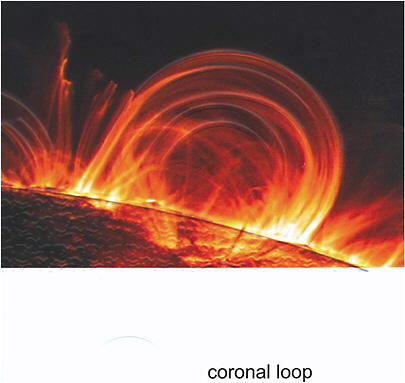
Figure 7.
The Sun as seen by the TRACE Satellite
Some of the magnetic loops in the outermost layer of the Sun’s atmosphere are filled with gas at temperatures of a million degrees or more.
Astronomers and solar physicists can observe these coronal loops in extreme ultraviolet light, which is invisible to human eyes but visible to certain satellites in space. Two of the most famous solar telescopes are SOHO, launched on December 2, 1995, and the TRACE satellite, launched on April 1, 1998.
TRACE images a close-up of part of the Sun, while SOHO images the whole Sun at once.
The next illustration shows coronal loops and hot gases trapped in magnetic arches, as seen by NASA’s TRACE solar telescope. Long curved lines, like yarn, represent hot gases moving along the curved magnetic field lines. This image is a close-up of a small area on the Sun’s edge.
Credit: TRACE, Lockheed Martin Solar and Astrophysics LAB, NASA