Third-Party Contracts for Fixed-Route Bus Operations and Maintenance: Performance Metrics (2023)
Chapter: Summary

SUMMARY
Third-Party Contracts for Fixed-Route Bus Operations and Maintenance: Performance Metrics
A transit agency can directly operate transit services using agency staff, contract out to a third party, or a mix of both. Transit agencies may contract out for a wide variety of reasons. However, whether the quality and cost efficiency of outsourced service will compare favorably to insourced service depends on many local, contractual, and managerial factors. One such factor is how the performance of the contractor is monitored and managed.
Transit Cooperative Research Program Synthesis Project J-07/Topic SG-20, “Performance Metrics in Third Party Contracts for Bus Operations and Maintenance,” was conducted to document current practices and metrics used to contract out fixed-route bus service in the United States of America (U.S.). This report will use the term bus service to refer to fixed route bus service reported to the National Transit Database under the motor bus (MB) mode. The focus of the report is on the following topics within the umbrella of contracting out bus service:
- The nature of current contractual arrangements
- Reasons, measures, and analyses used when deciding whether to outsource
- The measures and methods for monitoring contractors and holding them accountable for performance
This report documents the entire study effort, which included a literature review and industry scan, a survey of 37 U.S. transit agencies, and five case examples of agencies that currently or used to outsource their fixed route bus service. The case examples include Nassau Inter-County Express, MetroWest Regional Transit Authority, San Diego Metropolitan Transit System, the City of Tucson, and Escambia County Area Transit.
In 2020, 376 transit agencies contracted out at least some of their bus service, accounting for 20% of all bus service revenue hours operated. Most (70%) of the agencies that contracted out bus service in 2020 contracted out small bus operations (those with 25 or fewer buses operating at peak service); however, agencies with large bus operations (those with 76 or more buses at peak) accounted for the greatest amount of service contracted out, with outsourced bus service at large bus operations amounting to 6,416 buses operating at peak service.
The prevalence of contracting out bus service has been increasing, especially for small bus operations. Over the last 15 years (from 2006 to 2020), the number of transit agencies outsourcing bus service increased from 174 to 376, a 116% increase that was mainly driven by an increase in agencies with small bus operations—from 49 in 2006 to 265 in 2020. Although the number of individual agencies contracting out has increased significantly, the proportion of all bus revenue hours outsourced has increased more slowly, growing from 14% in 2006 to 20% in 2020.
The literature review and industry scan found that there are several potential reasons transit agencies may choose to contract out, including seeking improved cost efficiency, not having enough staff or resources to operate service in-house, wanting increased service flexibility, or for historical, political, or legal reasons. When asked about why outsourcing first started, survey respondents most frequently answered that historical, political, or legal reasons were at least part of the decision-making process. However, reducing costs or not having adequate staff capacity or capabilities were also frequently reported as reasons.
It has been previously found that, in some cases, transit agencies that contract out bus service achieve their desired benefits. On the other hand, not all transit agencies see positive outcomes, and the current evidence suggests that there are many local factors at play that determine the success of outsourcing bus service. Most of the survey respondents and all four of the case example agencies that currently outsource found their outsourcing to be cost-efficient and an overall positive way to provide transit service to their communities.
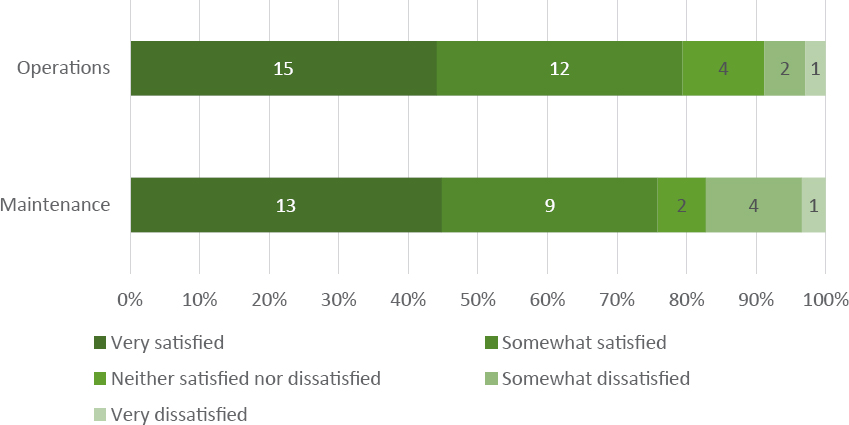
Most survey respondents indicated that, overall, they were satisfied with their outsourced bus operations and maintenance (see Figure 1).
However, outsourcing can come with certain challenges. In some cases, transit agencies felt like they lacked direct control over their service. Other agencies reported that monitoring the contractor and administering the contract was burdensome. Still others reported challenges associated with the contractor’s management team turning over too quickly—undermining service continuity and the relationships between the transit agency and the contractor. In addition, contractors are not exempt from the challenge of recruiting and retaining enough bus operators to run scheduled service, which negatively impacts service quality.
The literature review, survey, and case examples provided some notable practices that may help increase the chances of a positive outsourcing experience. First, building positive, collaborative relationships with the contractor through proactive two-way communication was mentioned as critical in several of the case examples. Keeping the contractor management team physically close to the agency’s contractor oversight staff can also help keep lines of communication open. Second, having dedicated oversight staff with clearly delineated responsibilities may also support positive outcomes, especially if those oversight staff and the contractor are judging performance using the same (and contractually defined) performance measures.
Typically used performance measures for monitoring revenue service included crash/accident rates, on-time performance (schedule adherence), missed trips or blocks, complaints, and pull-out adherence (i.e., pulling buses out of the garage on time). Typically used performance measures for monitoring maintenance included preventative maintenance on-time performance, distance between mechanical failures, road calls, fleet availability, and bus washing and cleaning. In most cases, transit agencies were calculating performance measures on their own (sometimes using contractor-provided data).
The case examples provided interesting details on contractual incentives and penalties tied to performance measures and those triggered by occurrences of target events (e.g., failing to complete a pre-trip inspection). The case examples and appendices E and F provide detailed information about incentives and penalties, including the performance measure or event, the standard (i.e., the minimum level of performance), and the value of the incentive or penalty. There were significant differences across case examples not only in what performance measures were tied to incentives and penalties but also in how those measures were operationally defined, what standards were set, and the monetary value of the incentive or penalty. In some cases, both incentives and penalties were scaled up or down depending on how much the contractor exceeded (or failed to meet) the standard.
The case example agencies that had incentives and penalties in their contracts felt that the incentives and penalties were beneficial and effective at helping to motivate the contractor to maintain or improve performance.
The literature review and industry scan found that information on performance measures, incentives, and penalties in bus service contracts was relatively sparse. There is little guidance on what performance measures are best and how to set incentives or penalties to maximize cost efficiency and contractor performance. Therefore, the team identified some potential topics for future study related to outsourcing fixed route bus service.
For example, more study is needed to quantify the effectiveness of incentives and penalties. Do they really improve performance? What are the best incentives and penalties, and under what conditions? More study is also needed to evaluate the cost-effectiveness of outsourced bus service and to determine what factors may make outsourcing cost-effective at one agency and not cost-effective elsewhere. International transit systems may also provide U.S. transit agencies with new and helpful outsourcing practices.
Finally, transit agencies may benefit from study projects that result in guidelines or guidebooks for defining contractor performance measures, setting performance standards, monitoring performance, and setting and executing performance incentives and penalties. Such guidelines or guidebooks may also need to consider changing transit technologies (e.g., automation and electrification) and how to allow for innovation and change in contracts without undermining the clarity of roles and responsibilities.
Contracting out is not the most common approach to delivering fixed route bus service in the United States. However, outsourcing is becoming more common—especially among transit agencies with small bus operations. The decision of whether to outsource or to operate and/or maintain service in-house is complex and involves many factors well beyond the scope of this report. However, for any outsourced service, performance measures are a critical component that helps to ensure the contractor is performing its work well and to achieve desired levels of service quality. Readers of this report will gain an understanding of the performance measures used in outsourced fixed route bus service and will also learn of the challenges, benefits, lessons learned, and notable practices experienced by outsourcing transit agencies.


