Incorporating Resilience into Transportation Networks (2024)
Chapter: Appendix C: Catalog of Recent, Relevant Frameworks and Methods

APPENDIX C
Catalog of Recent, Relevant Frameworks and Methods
Contents
C.2 Federal Resilience Frameworks
C.3 U.S. Pacific Region Resilience Frameworks
C.4 U.S. Rocky Mountain Region Resilience Frameworks
C.5 U.S. Southwest Region Resilience Framework
C.6 U.S. Midwest Region Resilience Frameworks
C.1 Introduction
Disasters and disruptions to transportation systems create barriers to the movement of people and goods and can cause knock-on effects on economic and social systems. Political pressure falls on political leaders and public agencies to ensure a return to normalcy as quickly as possible.
A resilient transportation system is one in which critical assets are not exposed to hazards or, if they are, there is sufficient capacity to mitigate the impacts of a shock. Current planning guidelines urge state DOTs and other transportation agencies to consider resilience, but they often do not provide specific guidance for incorporating it into the transportation-planning process.60 However, more can be done to make resilience a more deliberate part of transportation planning, asset management, and investment decision-making.61
Resilience is a framework that helps DOT leaders prepare for disruptions, including no-notice events like earthquakes and terrorist strikes, short-notice events like hurricanes, or inevitable long-term impacts like aging infrastructure, climate change, and sea level rise.
Resilience responses fall into three main typologies:
- Engineering resilience refers to the ability or rate at which a system can return to equilibrium after a disturbance.
- Ecological resilience refers to a system’s ability to cope with perturbations before shifting to a new state, regime, or stability domain.
- Evolutionary resilience, a third typology beyond engineering and ecological resilience, focuses on the ways the very nature of systems may change with or without an external disturbance with the potential for transformation to a new state.62
The following frameworks are examples of research on a national level that focus on resilience from specific perspectives in the transportation industry and are later disseminated at the state level. At the federal level, frameworks can summarize climate change as a combination of multiple threats, but at the state level, DOTs can emphasize specific hazards to their respective climates and the necessary guidelines needed to address them.
C.2 Federal Resilience Frameworks
Climate Resilience Pilot Program (2013–2015)63
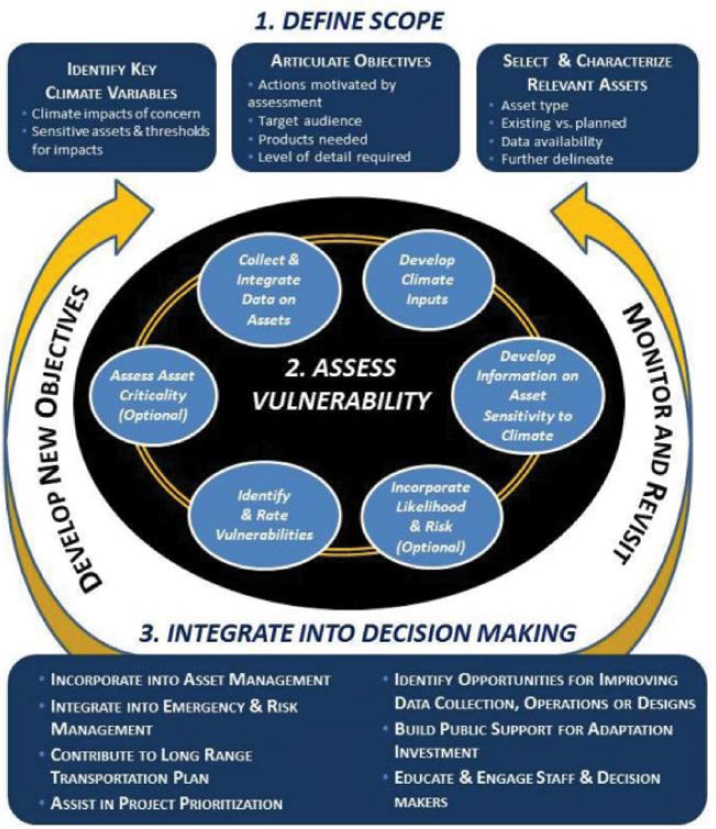
For this study, the FHWA worked with state DOTs and MPOs to prepare 19 case studies that linked climate change and extreme weather events to impacts on transportation systems. Using these case studies as a foundation, a framework was developed for transportation agencies to conduct vulnerability assessments (see Figure C.1).
FHWA Vulnerability Assessment and Adaptation Framework64
The purpose of this framework is to assess climate-change vulnerability and extreme weather impacts by following modules. Each of the modules comprises tools, key steps, videos, and links to specific case studies.
This framework is specifically geared toward state DOTs, MPOs, and agencies involved with transportation system operations. In particular, the use case of this framework includes ideas to integrate climate-adaptive responses and examples of assessments at each module level.
- Module 1: Articulate Objectives
- Module 2: Identify Key Climate Variables
- Module 3: Characterize and Select Assets
- Module 4: Assess Vulnerabilities
- Module 5: Integrate Vulnerabilities into Decision-Making
- Module 6: Monitor and Revisit
Investing in Transportation Resilience Framework65
The report examines resilience theory, promising analytic methods, and the potential for new ideas about resilience to be applied in the transportation-planning context. A review of transportation agencies’ current practices for evaluating resilience and analyzing investments aimed at restoring and adding resilience to transportation networks finds that many resilience measures are applied inconsistently. Findings from the literature review indicate that the process of measuring resilience will require continued investments in “multi-step, multi-hazard analytic frameworks.”
Resilience Pilots66
The FHWA partnered with multiple state DOTs and MPOs on a broad spectrum of pilot programs designed to adapt transportation infrastructure to current and future extreme weather events in a way that reduces maintenance costs for the full life cycle of transportation assets (see Figure C.2).

Some examples of relevant projects include the following:
- Wildfire and precipitation impacts to a culvert (Canyon Cove Lane, Colorado).
- Sea level rise and storm surge impacts on a coastal bridge (Mobile Bay, Alabama).
- Temperature and precipitation impacts on cold region pavement (Maine).
- Risk register development and asset deterioration rates from extreme weather events (Kentucky DOT).
- Flood-risk reduction vulnerability assessment (Washington State DOT).
Transportation System Resilience to Extreme Weather and Climate Change: Federal Highway Administration67
The framework provides an overview of how TSMO and maintenance managers can
- Define the scope of adaptation efforts.
- Assess vulnerabilities to inform the development of adaptation strategies.
- Integrate climate change into decision-making.
Action steps to increase resilience are shown in Figure C.3.
Incorporating Resilience into Transportation Planning and Assessment68
This framework defines how transportation systems respond to shocks. The four variables it describes include the following:
- Absorptive Capacity: the ability of a system to absorb shocks and maintain normal function.
- Restorative Capacity: the ability to recover quickly following a shock or stress and return to normal.
- Equitable Access: the ability to provide the opportunity for access across an entire community during shock or stress.

- Adaptive Capacity: the ability to change in response to shocks and stresses to maintain normal function.
Overall, these elements are meant to capture a transportation system’s performance in the face of risk.
Transportation Resilience Framework for Informed Choices69
This framework discusses climate-change threats pertinent to transportation systems and the economic costs associated with the reconstruction/rehabilitation of impacted infrastructure. The report reviews resilience theory and produces a list of recommendations for analytical, quantitative, and policy-based decision-making to establish robust transportation operations in the face of climate change (see Figure C.4).
Emergence of Resilience as a Framework for State Departments of Transportation (DOTs) in the United States70
This approach helps state DOTs conceptualize transportation planning policies within a resilience framework by examining infrastructure vulnerability. A focus on resilience can identify common themes among state DOTs that facilitate collaboration and bolster their capacity for responding to service disruptions, even in situations when transportation agencies use different metrics to quantify passenger and freight operations. A major takeaway is that resilience should not focus solely on climate change. Other significant threats listed in this framework include terrorism, cyberattacks, and aging infrastructure. Figure C.5 shows U.S. regions.


C.3 U.S. Pacific Region Resilience Frameworks
Transit Adaptation and Resilience Planning: Southern California Association of Governments71
The purpose of this framework is to expedite planning, consulting, and project development in the face of climate change by coordinating the collaborative effort of multiple agencies. A climate resilience toolbox lays out the following framework:
- Objective 1: Provide an actionable climate adaptation and resilience plan.
- Objective 2: Identify critical assets and routes.
- Objective 3: Integrate climate-change and forecast data.
- Objective 4: Increase regional transit system disaster recovery and resilience.
- Objective 5: Support local planning efforts.
Oregon Department of Transportation Resilience Framework72
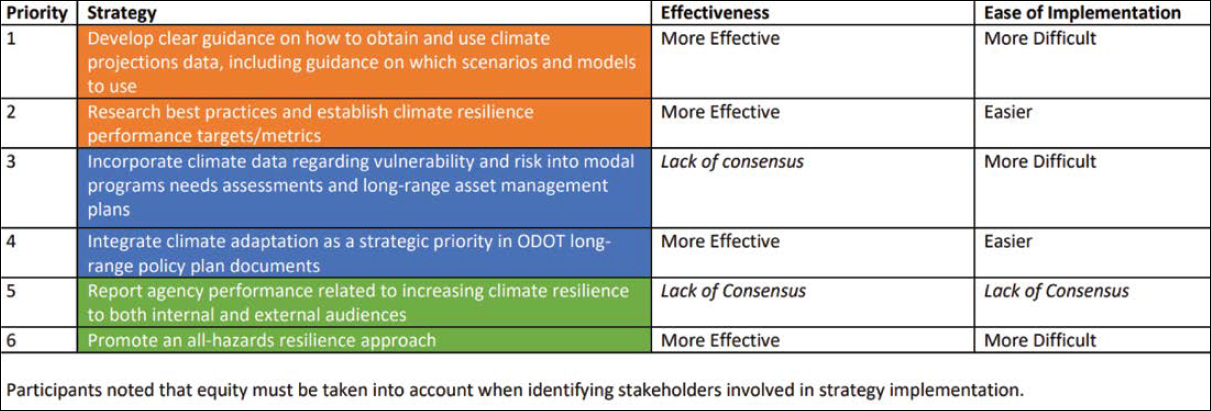
The Oregon Department of Transportation put together a robust framework diagram detailing a roadmap that delineates the key elements of resilience in the transportation sector. Similar to the one created by the Southern California Association of Governments, the purpose of this framework is to help an agency use an “operational plan with actionable strategies for implementation in the near term.” Figure C.6 shows the priorities of various strategies.
C.4 U.S. Rocky Mountain Region Resilience Frameworks
WYDOT 2018 Freight Resilience Plan73
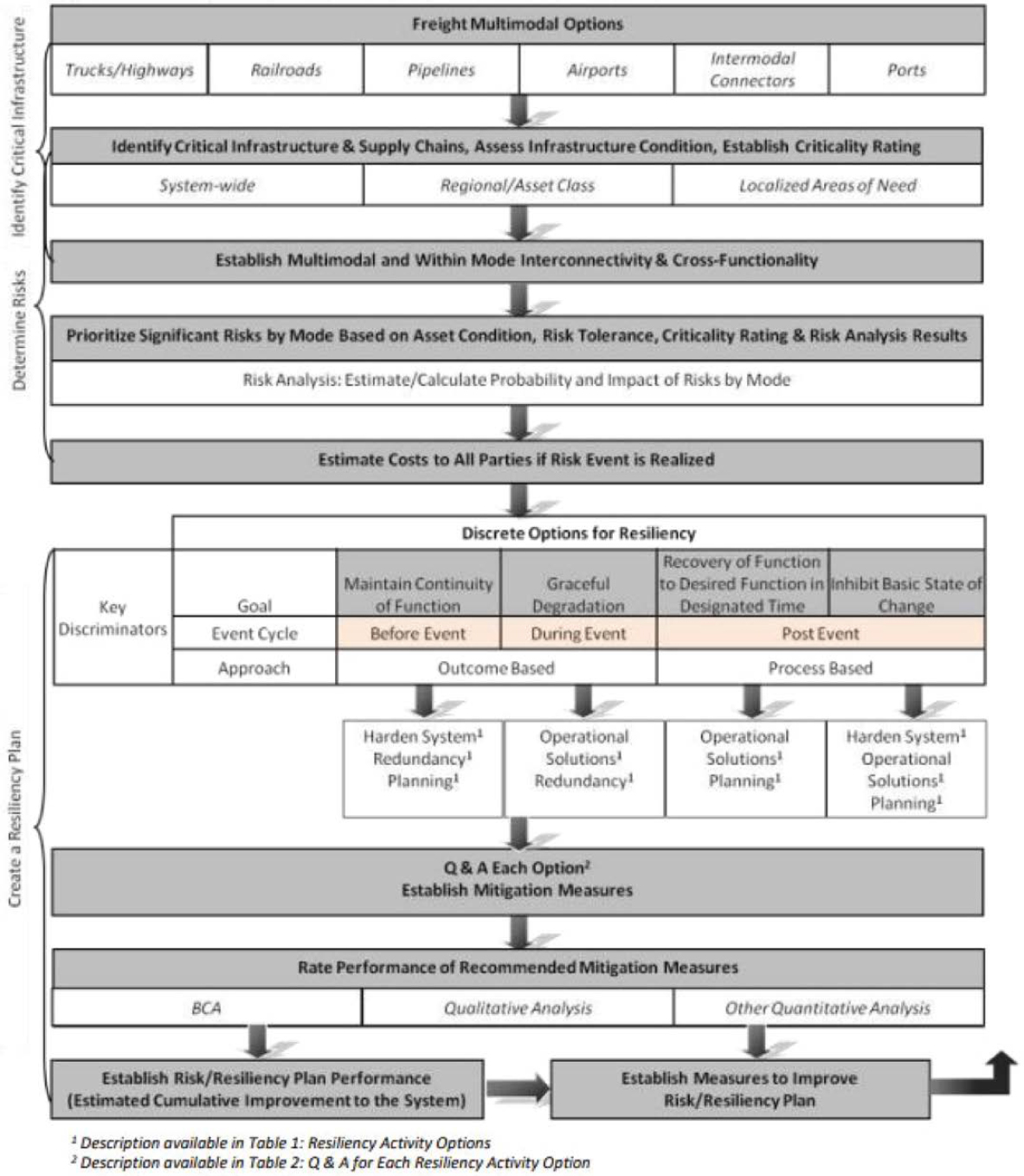
In Wyoming, the state DOT focused on freight-related assets when designing their risk and resilience framework (see Figure C.7). The framework considers the transportation network to be an interconnected system of highways, railroads, pipelines, airports, intermodal connectors, and ports.
Colorado Resiliency Framework—Colorado Resiliency Office74
Colorado’s framework aims to integrate social equity, investment planning, mitigation, and recovery efforts into its resilience framework. It also responds to the threat of wildfire and flooding events. The state endured several of these events in the last two decades. As a metric, the framework provides 29 strategies across six different priority focus areas that adapt to changing environmental, social, and economic conditions.
Colorado’s priorities when designing a framework toward advancing resilience considered six distinct priorities:
- Future-Ready Economy and Workforce
- Climate and Natural Hazard Resiliency
- Building and Infrastructure
- Agriculture and Food Security
- Housing Attainability
- Community Capacity
C.5 U.S. Southwest Region Resilience Framework
Statewide Freight Resiliency Plan—Texas Department of Transportation75
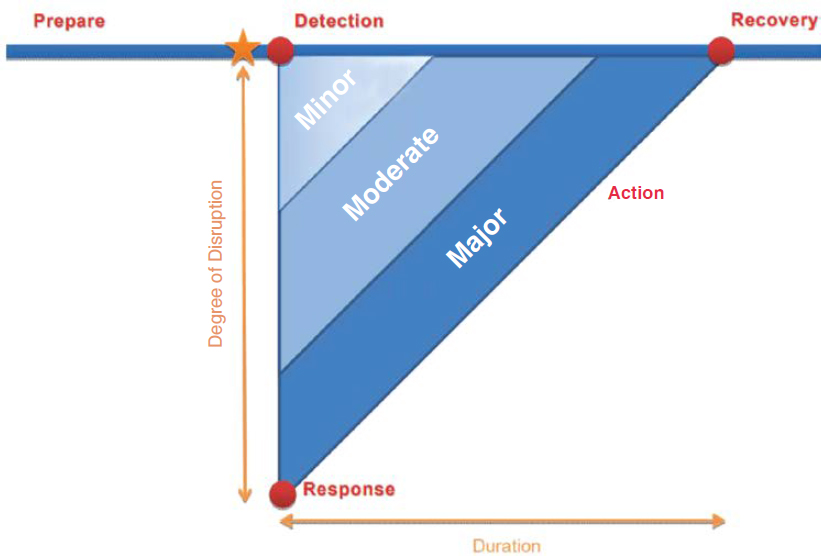
The State of Texas considered the economic ramifications of having inadequate transportation systems in the face of risk and resilience toward the impacts of climate change. Officially, “freight transportation system resilience is the ability for the system to absorb the consequences of disruptions, to reduce the impacts of disruptions, and maintain freight mobility.” However, Texas soon came to realize that “there is no specific framework available that clearly defines how a state DOT can measure or ensure a resilient transportation system.” The basis of their framework, depicted in Figure C.8, includes a triangle diagram displaying the linear relationship between the degree of disruption and the duration of disruption along a timeline of preparation, detection, and recovery.
Ultimately the Texas framework focused on four pillar strategies:
- Support planning for a resilient, well-maintained freight transportation network.
- Prioritize infrastructure enhancements to improve the freight resilience of Texas highways.
- Improve access to data, information, and people needed for effective resilience planning.
- Communicate before, during, and after events.
C.6 U.S. Midwest Region Resilience Frameworks
Transportation Resilience—Current Practices and Opportunities for MnDOT76
Minnesota was one of the selected pilot projects for climate resilience as part of the development of the FHWA VAST Tool. The framework MnDOT put forth emphasizes initiatives that assess infrastructure vulnerability and risk reduction, qualitative assessments to check storms and climate-change projections.
On the state DOT’s end, they pursued relevant climate-centric projects, including the following examples:
- Flash Flood Vulnerability and Adaptation Assessment Pilot Project (2014)
- Extreme Flood Vulnerability Analysis (2019–ongoing)
- Slope Vulnerability Assessment (2019–ongoing)
- Guide for Stream Connectivity and Aquatic Organism Passage through Culverts (2019)
- Sustainable Pavement
Transportation Climate Resilience77
Illinois states that transportation networks can be operated to “continue to provide seamless mobility even in the face of a changing climate.” To achieve this goal, the Chicago Metropolitan Agency for Planning (CMAP) looks to organize strategies and actions that support this ideal. The crux of CMAP’s efforts will go toward three main priorities:
- Adapt vulnerable transportation infrastructure to be responsive to weather events and climate change.
- Improve stormwater management in transportation projects.
- Improve the operational response to weather events to ensure mobility.
C.7 U.S. Southeast Region Resilience Frameworks
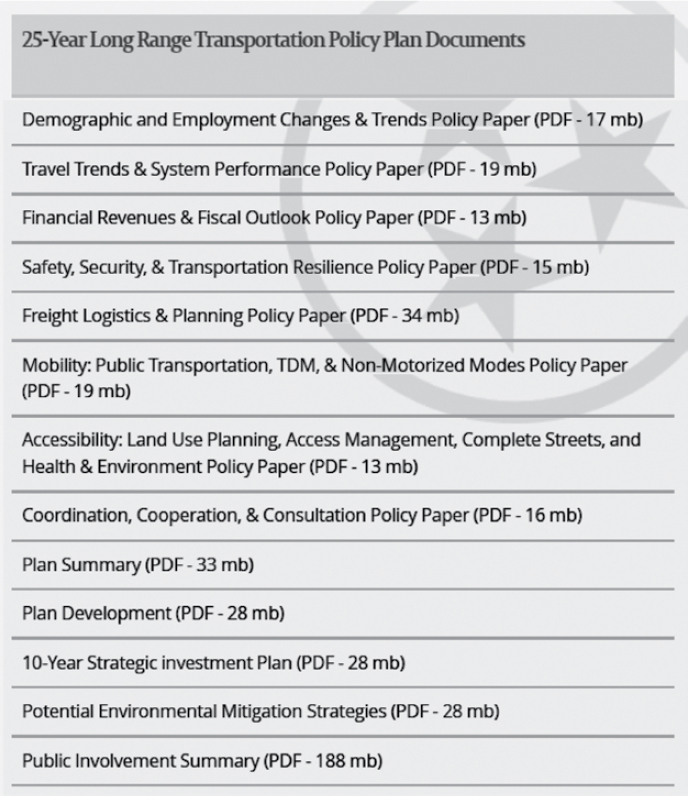
25-Year Transportation Policy Plan—Tennessee Department of Transportation78
Tennessee has adopted a 25-year Transportation Policy Plan dedicated toward a “long-term vision for transportation” in the state (see Figure C.9). The framework includes a compilation of documents written from multiple perspectives (policy, planning, land use, TDM, and system performance) of the transportation industry. The goal is for Tennessee to establish the nation’s best multimodal transportation system while considering climate change, other environmental factors, and the associated economic risks that have become pertinent in civil engineering today.
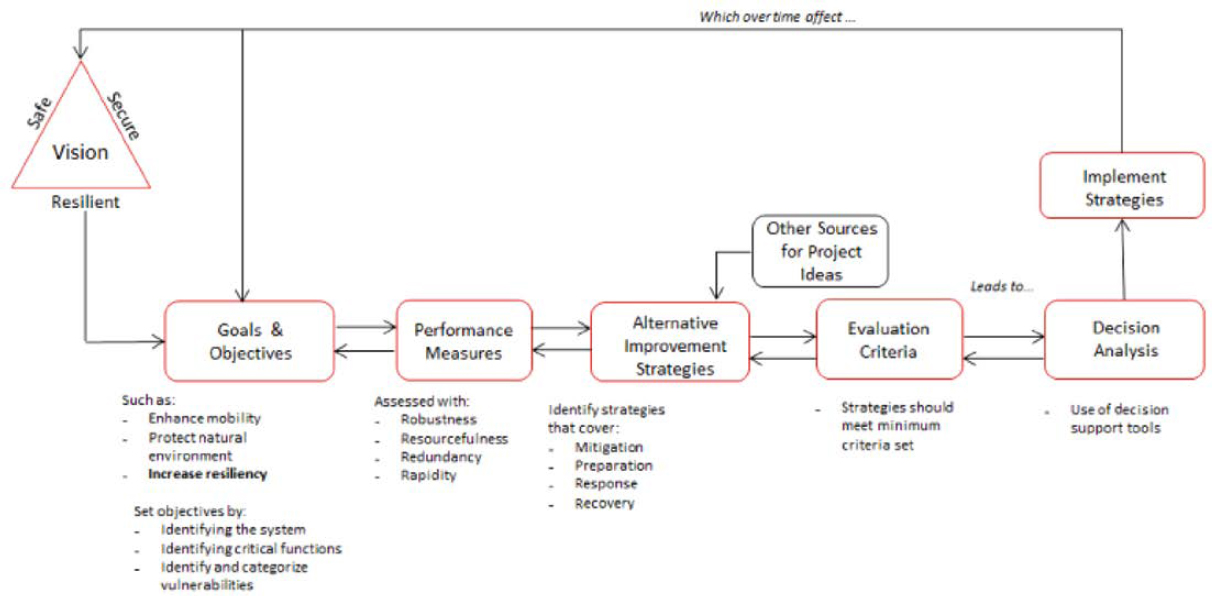
A Framework for Resiliency Planning in State Transportation Agencies79
Although this paper is a published thesis submitted as part of a graduate program at Georgia Tech, the content is relevant to resilience for transportation agencies. By defining these specific phases, the user can use strategies that retrofit existing infrastructure, change design standards, implement policies, or cross-train employees (see Figure C.10).
NCDOT Resilience Strategy Report – North Carolina Department of Transportation82
The framework was developed to address gaps in freight planning and standards quantifying redundancy, supply chain, data, and risk analysis. The objective of the plan is to enhance freight management and transportation resilience in the face of hurricanes and tropical systems that have brought previously unaccounted-for impacts on the state’s transportation systems.
The comprehensive study performs multiple analyses on the transportation operations in the state with advanced modeling of disaster data for risk-based freight routing through spatial-simulation-driven scenario analysis and supports web applications.
C.8 U.S. Northeast Region Resilience Frameworks
Sustainability Bond Framework—Massachusetts Bay Transportation Authority80
The Massachusetts Bay Transportation Authority (MBTA) recently enacted a plan that embedded sustainability risk policies into their business processes. The focus of their environmental considerations includes the built environment; carbon reduction, energy conservation, and climate resilience; ecological conservation; noise-pollution prevention; and resource management. The MBTA also hopes to engage in strategic social priorities with funding from sustainability bonds.
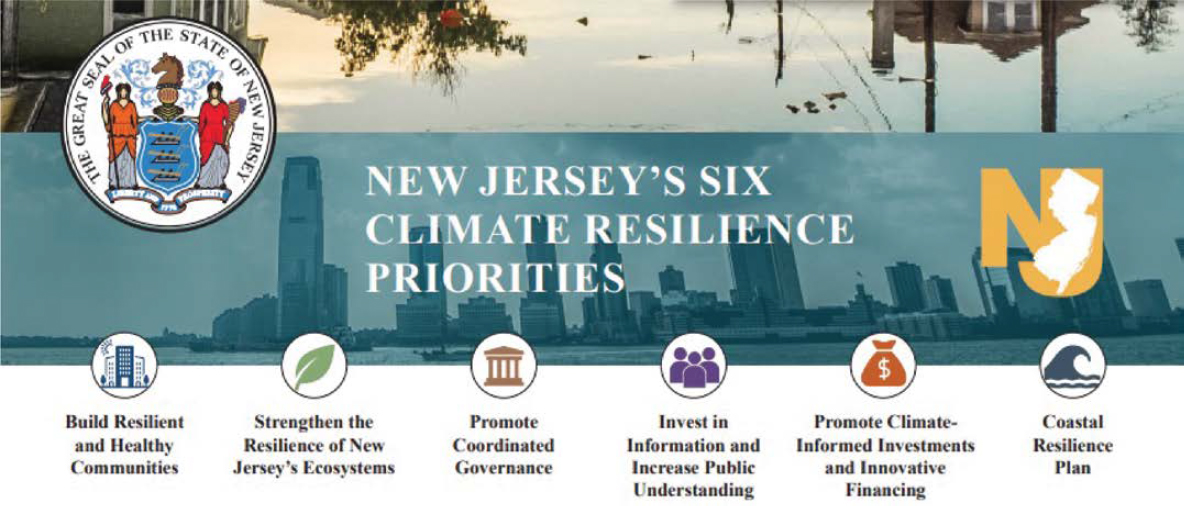
New Jersey Climate Change Resilience Strategy81
The New Jersey Department of Environmental Protection designed a climate-change resilience strategy that includes 125 recommended actions across six priority areas (see Figure C.11). The focus of this strategy is to promote the long-term mitigation, adaptation, and resilience of New Jersey’s economy, communities, infrastructure, and natural resources throughout the state.


