Incorporating Resilience into Transportation Networks (2024)
Chapter: Appendix D: Transportation Network Resilience Awareness Challenge Supply Chain and Institutional Readiness

D.1 Objectives and Applications of the Transportation Network Resilience Awareness Challenge
The research team developed the Transportation Network Resilience Awareness Challenge to help transportation agencies build capacity in resilience planning. The challenge aims to improve organizational capacity by introducing key information about different aspects of resilience planning. It also provides individuals with a common language as a starting point for discussion among various stakeholders in their economic sector or geographic region.
The goal of developing the challenge was to create a portable training application that could be customized to address a range of vulnerabilities without a significant investment. Based on earlier case studies and focus areas proposed by the NCHRP Project 20-125 panel, the team selected three module topics:
- Transportation Infrastructure Resilience
- Supply Chain Resilience
- Cybersecurity/Data Network Resilience
The traditional approach for climate-vulnerable communities to improve resilience has involved vulnerability assessments using climate modeling tools, investing in strengthening the most vulnerable critical infrastructure and documenting policies and procedures for disaster response and recovery. Agency-sponsored workshops and simulation exercises have also been popular to engage interdependent partners and develop instinctive reactions through practice about what to do when a disruption occurs. In short, most climate-focused resilience training is highly customized, in-person and on-site, and requires a significant investment of time and resources by the host agency.
In contrast, the U.S. Department of Defense (DOD) has been managing and addressing attacks on data networks since George Washington established the first spy network in colonial America. Today, anyone wishing to work with or for the DOD is required to complete data security training. The current version of this training is called Cyber Challenge 2022.83 The Transportation Network Resilience Awareness Challenge follows the DOD’s example in being portable and relevant to organizational missions.
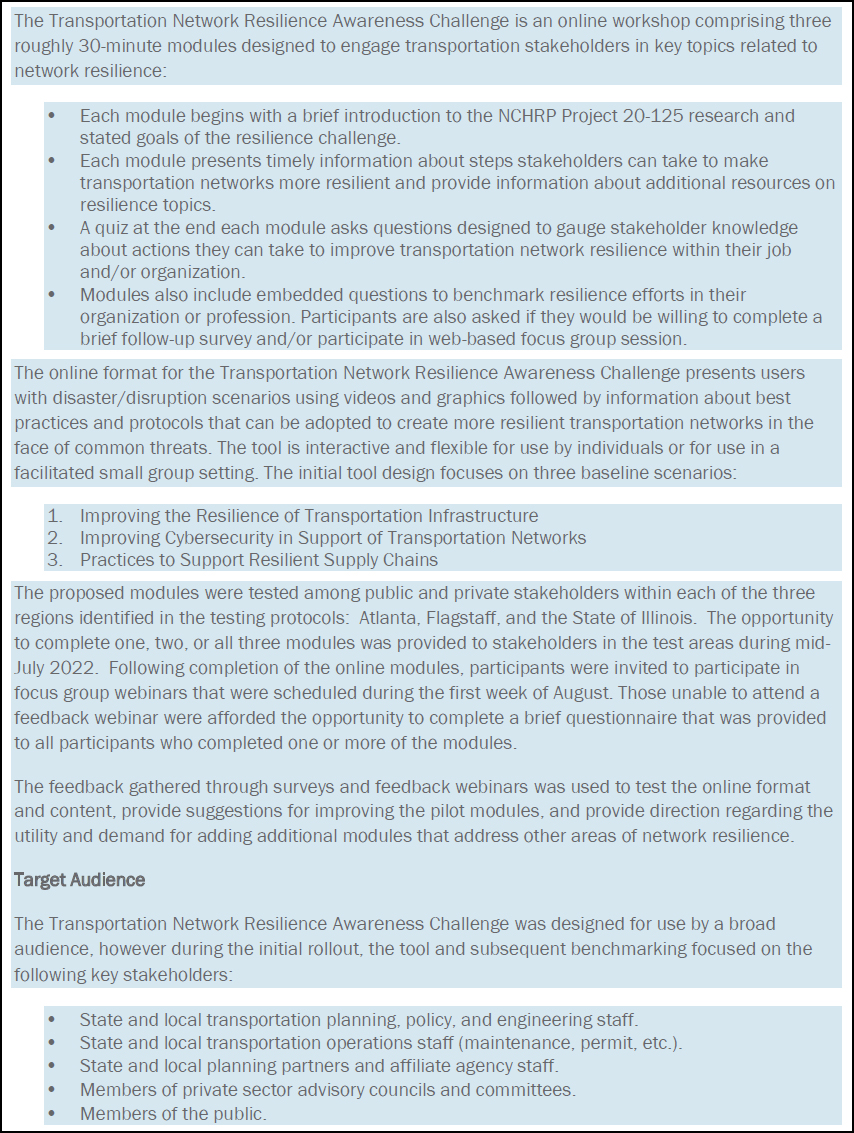
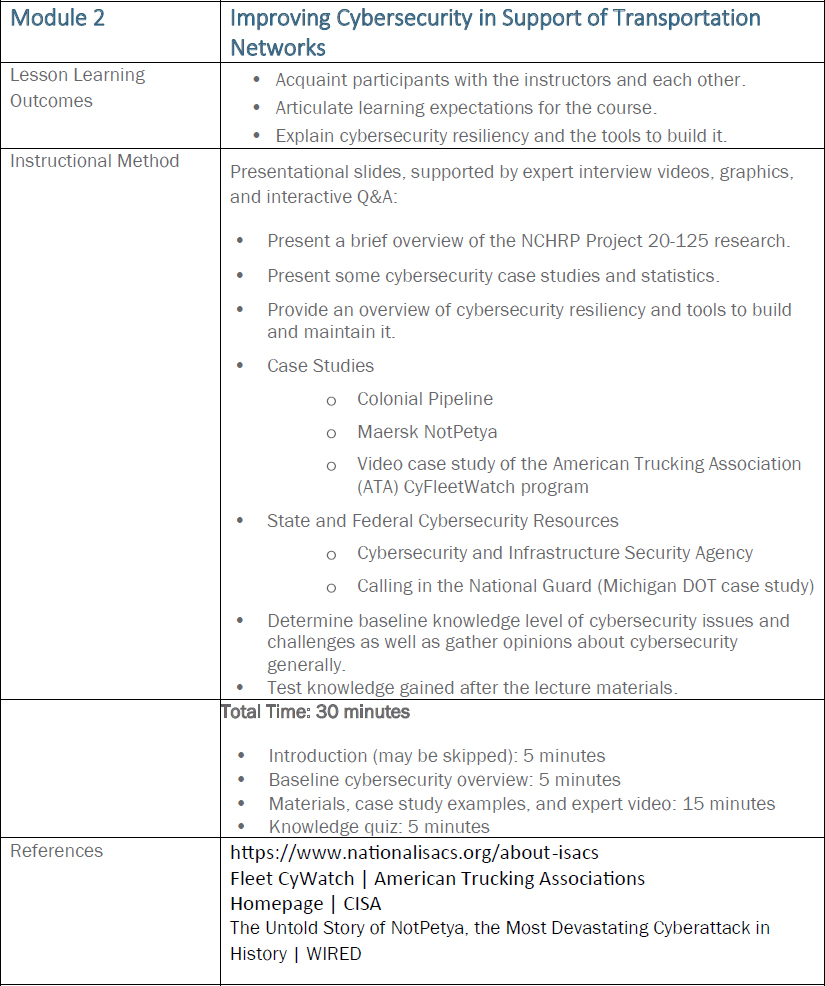
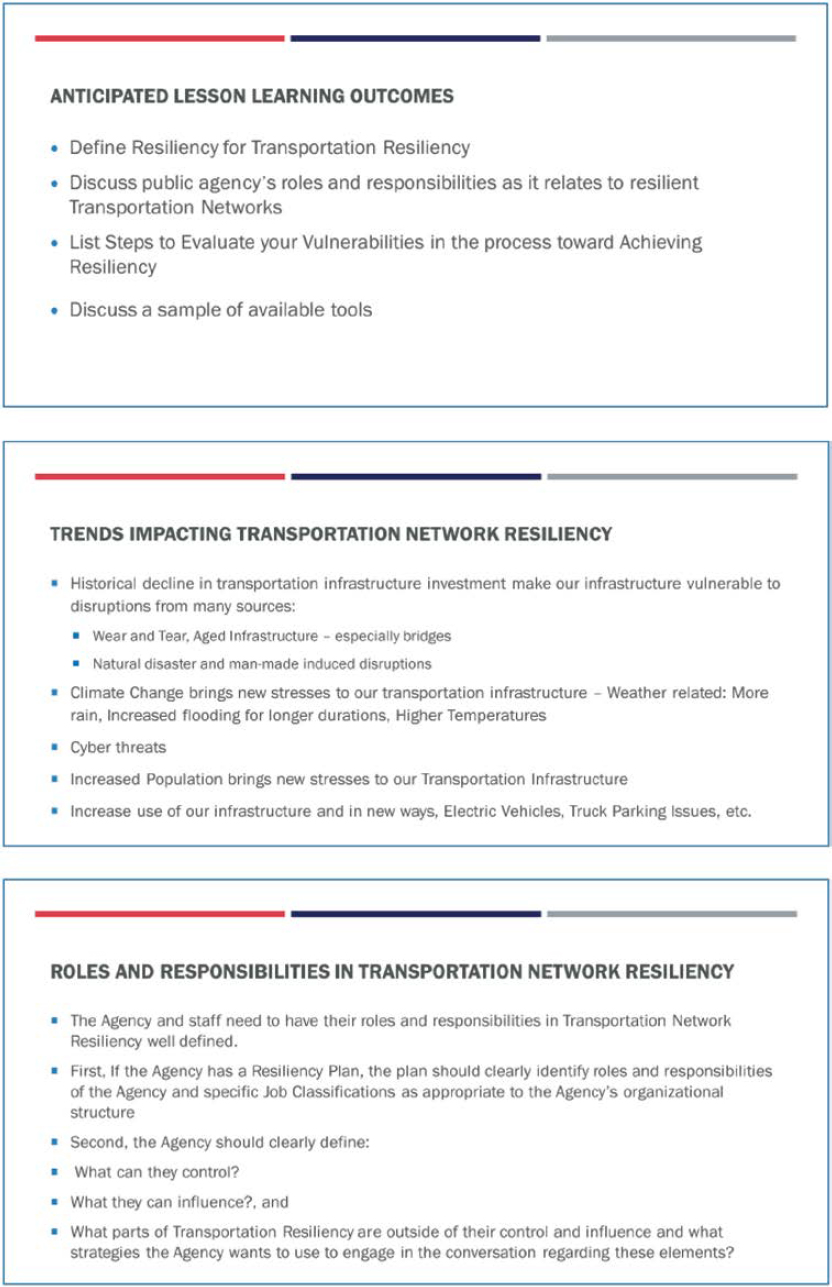
Packaged as the Transportation Network Resilience Awareness Challenge, each module was designed to introduce information about transportation network resiliency and provide resources to state and local agencies as well as their stakeholders. The development of the materials followed the process used by the National Highway Institute for developing instructor-led training courses. Before populating the three slide decks with content, an outline of each proposed module was presented in a preliminary lesson plan (PLP). The following text box and table provide examples from the PLPs presented to the project panel for approval.
The following figures and exhibits provide examples from the PLP assembled for each module and presented to the NCHRP Project 20-125 panel. Figure D.1 provides an example of the PLP introduction discussing the module learning objectives, methods, and target audience. Figure D.2 provides a one-page summary of the module content, timing, and presentation method. A storyboard using PowerPoint slides is presented in Figure D.3.
Once the PLP and proposed module storyboards were approved, the research team began to populate the PowerPoint slide decks with content.
When the draft modules were assembled, the team reached out to the following organizations and individuals for feedback on the draft content, requested consideration of recording expert video content, and solicited help in distributing the Transportation Network Resilience Awareness Challenge modules to potential pilot participants:
- ITS America/Cyber Security Working Group
- Kristin White, ITSA COO
- Nicole DuPuis, ITSA VP Innovate Mobility, and Emerging Technology
- Matt Leasure, ITSA VP Public Policy and Legislative Affairs
- Jess Baker, HNTB ITS Practice/Working Group Co-Chair
- AASHTO
- Patrick Zelinski, Associate Program Director
- David Peters, Program Specialist
- Robert White, Program Manager for Operations
- Specialized Carriers and Riggers Association (SCRA)
- Chris Smith, Vice President
- Commercial Vehicle Safety Alliance (CVSA)
- Chris J. Turner, Esq. Director of Enforcement and Judicial Outreach
- American Trucking Association (ATA)
- Kevin Grove, Director of Safety and Technology Policy
- MAASHO/Illinois Department of Transportation
- Geno Koehler, Permit Chief
With feedback from these organizations and individuals, the final content for each module was completed. Microsoft PowerPoint (MS PPT) was chosen as the primary software due to its widespread use and versatility.
It was decided each slide would be narrated to make the slide decks as user-friendly as possible. A self-narrated recording proved to be more challenging than initially assumed. Therefore, detailed notes for each slide were converted to an audible narration using an inexpensive voiceover software called Speechelo Videos from private industry. Other topical experts were recorded using another off-the-shelf video software called Vouch. With the embedded audio and video files, each MS PPT module file grew quite large, with some files approaching 200 MB.
To address the file size issue, the presentations, complete with audio and video files, were uploaded to a web-based training application called TalentLMS. TalentLMS allowed the MS PPT files to be broken into logical sub-elements and stitched the submodules into one video file. The TalentLMS environment also tracks users, tallies survey and quiz responses, and improves portability by eliminating the need to transfer or download large files resulting from embedded audio and video.
Organizations that wish to customize the modules can easily revise the base MS PPT slide deck content, modify the narration notes, and use the same or similar software packages to create custom training modules.
Once the three modules were posted on TalentLMS, the links to the modules were distributed to various organizations and mailing lists, including AASHTO’s resiliency committee and ITS America. A particular emphasis was put on soliciting input from the maritime sector through the American Association of Port Authorities’ facility and security committees and the TRB Ports and Channels Committee. Stakeholders from these groups were invited to take the Transportation Network Resilience Awareness Challenge through individual emails. This first email was followed up 10 days later with an email requesting their participation in this research.
Based on the NCHRP Project 20-125 panel’s input, direct contact was made with the Port of San Diego and Port of Bremerton to participate in the Transportation Network Resilience Awareness Challenge. In addition, an email distribution list was created from select members of the TRB resiliency committees.
Two of the three regional locations (Flagstaff and Atlanta) distributed the Transportation Network Resilience Awareness Challenge to their stakeholders.
All participants who completed at least one of the three modules were invited to participate in providing feedback either through a survey or a focus group. The summary of the focus groups can be found in Appendix D.2.
Videos of the modules are available at https://vimeo.com/showcase/10741790, or by searching the National Academies Press website (nap.nationalacademies.org) for NCHRP Research Report 1118: Incorporating Resilience into Transportation Networks.
D.2 Focus Groups and Demonstration Cases of the Transportation Network Resilience Awareness Challenge
D.2.1 Flagstaff Network Awareness Challenge Results in Context
Focus Group Name or Emphasis: Flagstaff, Arizona Region
Facilitator(s): Jeannie Beckett/David Proffitt
Recorder: David Proffitt
Participants: (This should be pre-populated if possible)
| Name | Organization |
|---|---|
| 1. David Wessel | Metro Plan (Flagstaff MPO) |
| 2. Elizabeth “Bizzie” Collins | Mountain Line Transit |
| 3. Barney H. | Flagstaff Pulliam Airport |
| 4. Jennifer O’Connor | Northern Arizona Council of Governments |
| 5. | |
| 6. | |
| 7. | |
| 8. | |
| 9. | |
| 10. |
Facilitators may distribute the participant handout via email prior to the virtual meeting. The purpose of the handout is to help participants record their thoughts, especially thoughts they may not get a chance to express verbally due to time limitations.
Ask participants to email their worksheets at the end of the session to: kate.beasley@quetica.com
Introduction and Initial Feedback
Approximate Timing (1 hour total)
Questions 1–3: 15 minutes total
Questions 3–6: 10 minutes each
5 minutes to wrap up and summarize the discussion
Recorders should help facilitators keep track of time and indicate when they have used up the time allotted for each question.
Facilitator: First, thank you for taking the time to try the resilience challenge, and meeting with us today. To begin, I would like to quickly go around the virtual room for brief introductions. Can you please state your name, organization, and a bit about your role?
Q 1: Ok great. To begin with, how many of you completed all three modules? Two?
One? Which modules did you complete? Indicate the number that completed each module.
 | Infrastructure Module |  | Cybersecurity Module |
 | Supply Chain Module |
David W had not completed any of the modules before the focus group. Jennifer and Elizabeth had both completed parts of the infrastructure and supply chain modules. Barney arrived late so was not asked the question formally, but he referred to the supply chain and cybersecurity modules in the conversation.
Q2: What was your impression? Did you like the online environment? Was it easy to use? Do you have any suggestions of how it could be better? And I know those are three questions, so you can take any of those in any order.
- “The introduction explaining why resilience is important. It seems redundant to people who already work in resilience and recognize how critical it is. It started with, ‘Why is resiliency important?’ And I just thought that was … a moot point. We live in a flood-prone, fire-prone place. We are living in the thick of resiliency. The target audience is already well versed in why resiliency is important, so that part I was just like, ‘Oh man, I get it.’”
- Two of the panelists did not like the automated voices in the modules. “I found the topics interesting, and I found them to be engaging. So, I thought that was good. A lot of the presenters’ voices were just automated, which was a little weird.”
- One of the panelists complained that it was difficult to restart the modules in the same location after pausing the recording [and possibly leaving or signing out of the software]. “I did pause it and went back to it and then it said complete. I actually had a really hard time resuming the video. It sent me all the way to the end of the survey, which I completely failed because I didn’t watch the rest of the video.”
- The quizzes at the end of each module did encourage people to pay attention, but one panelist thought the end-of-module survey questions were too detail-oriented and didn’t reflect the key takeaways. “I wasn’t a big fan of the survey questions. I thought they were just trying to be tricky instead of trying to assess whether you actually learned anything. … I’m sure I could have regurgitated more useful information in an open-ended question and done better than it did with this. I definitely failed the first quiz.”
Q3: Following up on the comment that resilience is already in your lifestyle or in your professional spectrum. Did you find that you learned anything new or was it all old stuff compared to your professional development level?
- The personal examples given in the practitioner videos were helpful and engaging. “In the second module that I did, the use of the videos with people giving their personal stories, I thought that was a good way to break it up. And I thought, just in terms of the format as well, I appreciated all the examples that were given.”
- For organizations that already consider resilience in their planning or management processes, the modules did not present much information; however, one panelist said it’s important to go over this perspective because not all organizations have the same level of familiarity with resilience. “Mountain Line [Transit] uses the Franklin Covey management process, and part of that is a risk assessment for all of our projects. There’s a matrix that gets into that. So, [with] a lot of the components, it was like, ‘OK, this is just a different style of the same things that I’m very familiar with, that we practice regularly.’ So, I wouldn’t say I learned anything new, but I think for other organizations that I’ve worked for where we never had the risk-management approach, that it would have been new for me, for sure.”
Q4: What kind of information would be most helpful in training like this? Regardless of whether you saw it or not in the current resilience challenge incarnation, was there something that you found yourself looking for that you didn’t see or something that you hope to see?
- Panelists would have liked to see and hear more examples of people going through the resilience process to arrive at their own decisions and plans. “I saw a framework for assessing what your resiliency is, and that’s pretty much what I expected. … It might have been nice to see people processing or going through that process to arrive at their resiliency plan.”
- More information and direction on how to approach resilience and produce resilience plans in a variety of environments would be helpful, too. “In the module that I watched, it wasn’t providing direction on how to do a resiliency plan. It was more of like why they’re important. … A little bit of information about the process or how you would go about doing one would be helpful. I mean, I would just say that the NACOG region is vast. It’s four counties of northern Arizona with 22 jurisdictions in it, along with large swaths of tribal land. So how NACOG would go about doing a resiliency plan would look very different from how Metro Plan would do one. Just given the resources within our communities, they’re struggling to stay on top of roadway maintenance, much less doing like bigger planning. And our job is to help them see the bigger picture but, I mean, that’s the challenge that we face. … I’d be certainly interested to learn more about how to do resiliency planning in that kind of environment.”
A question for the MPO and the COG: Do you see resiliency planning as part of your charter? Or because you don’t own assets, you are a planning organization, but you don’t own any assets. Are you more of an advocate or a champion for your agencies that are part of your membership to have their own resiliency plan, or would you see that a COG or an MPO would have one itself?
- David W: Metro Plan is about the simplest MPO structure you can have. There’s the city and part of the county. We coordinate with Mountain Line Transit and the university and the state, but it’s really about as simple as you can get. There’s a possibility that we would produce a resiliency plan and work with our partners to address those more operational issues as opposed to planning issues. That’s something that we could possibly take on—and might—but I don’t see NACOG trying to do that for all or even necessarily any one of their actual jurisdictions.
- Jennifer: I do see our COG role as definitely encouraging these types of efforts at a regional level because so many of our jurisdictions are small towns. They don’t have the capacity or the time and energy to focus on something like a resiliency plan. But if they are encouraged and guided in that process, you can actually get them to participate. And I think it could make a huge impact for the region. But we [the COG] can’t do the resiliency plan for them, in terms of the actual response to incidents. That’s something that they would have to handle. So, it would be if we were to pursue a resiliency plan, it would be something where we would take it to our TAC [transportation advisory committee] and our regional council to get their support. Obviously, we’d have to spend some time and energy and funding on that, so I definitely see value in it, but it’s not always easy to get all of our jurisdictions to participate.
We were just having a conversation basically for the MPO/COG participants on their opinions on whether they need a resiliency plan or whether they were more of a champion or advocate for their members to develop such a plan. So as an expert employee that had airport connections and clients that have airports, I’m pretty sure you have some kind of plan. It may not be called a resiliency plan. It may be called a continuation of operations. It may be business continuity, but I would be surprised if you said “No, we don’t have a plan.”
- Barney: We rely more on what we call our required airport emergency plan, which is similar [to a resiliency plan]. It provides detailed information on each event and what we would do.
- We are kind of building a mini COOP [continuity of operations plan] plan right now. But it will fall along the same lines as this resiliency.
Jeannie: So, when COVID hit, did your emergency plan have a section that you were able to use for COVID, or did you have to make that up on the fly?
- Barney: It’s an interesting subject because I’ve actually set up another panel with an ARS. We discussed the fact that all of us had emergency plans … based more on an individual aircraft or an individual group of people, not on a nationwide event. And nobody in our industry had set up something on this scale. Our industry shut down for almost three months, so we had plenty of time to think about it. But I’m looking back on it. I’m not sure that there was much we could have done differently because it was out of our control. If we have an individual aircraft coming in with SARS or something like that, we can isolate, we can contain and work with it and proceed from there. But this was beyond one individual airport.
Q5: What is the level of regional coordination about resilience? And how much recognition is there about some of the interdependencies between the airport, the transit system, and the transportation system in Flagstaff to some of the other areas outside the metro area up into NACOG territory, whether there are plans or not? How much do you all think you should talk to each other and what would you need to help build those conversations or build recognition of those interdependencies?
- Barney: We’re not like a larger metropolitan area where all of our transportation depends on each other. Our community is so small that we don’t have the interaction. Well, we don’t have rail. What rail we have is not for us domestically. It’s going across country. But our bus system and the airport aren’t as interdependent as we’d like them to be because our community hasn’t got to that size to make that demand there to support that interaction.
- Elizabeth: I’d say we [Mountain Line Transit] coordinate pretty well with the city and ADOT [Arizona DOT] to make sure that we understand road closures, road impacts, timelines, deadlines. We just have a point of contact with them and just reach out directly.
- I don’t think we necessarily have plans. We have flood detours at the ready that we implement when [the] city says, “This road is impacted, detour around.” We just know where those impacted areas are. We’re anticipating that. But I guess we don’t necessarily create plans with everybody else. We just understand that this is how we will receive that information. This is the plan that we will implement.
- Jennifer: From a NACOG perspective, I think we see how much we rely on each other the most when we look at public transit and where our transit-dependent folks are trying to get to. That comes up a lot because obviously, they’re trying to get to major shopping destinations and medical employments.
- I also think that for a lot of our region, the small town Main Street is also the state highway. Think Pinetop-Lakeside or other small towns. There is definitely coordination at that level, where the state and the town are working together, the state and the city, since they’re both trying to maintain and upgrade those roadways.
- David W: Because of some of the recent fires, I think it’s actually working fairly well within our region. I think Bizzie [Elizabeth Collins] alluded to it. There’s an emergency operations center. They get set up pretty quickly. Everybody knows their roles, who needs to attend. So, it handles emergency situations pretty well.
- One of the things that I’m not sure of, and maybe that I’m just ignorant of, is that now that you’ve won the war, how to handle the peace? The emergency is over, … we’ve stopped the flooding, there were the fires to put out. Now, how do we return to normal? Or we’re going through yet another construction season on I-17 and it’s going to have impacts on access to
- the airport or access to business. How are we managing the nonemergency aspects of this? And I’m not sure there’s a lot of coordination that happens after the emergency when we could maybe lessen the impact on people’s lives.
- The community passed a tax several years ago to do [tree] thinning [in] parts of the forest that were not commercially viable for logging. The purpose of that was to protect the watershed. They did some modeling—if it were to burn, what would happen?—and identified areas critical to protect. Beyond that example, there is a lot of thinning going on routinely to help prevent large forest fires that’s been successful in some places as far as flooding. But I think we’re always just playing catch up. It’s a resource issue and that’s it. The county’s doing a pretty incredible job—I think the city is too—throwing up berms, putting in detention basins. But that’s only catching up with the last fire. It’s not trying to put something in place ahead of the next fire.
Let’s explore this nonemergency aspect a little bit. Who are the people that you regularly talk to—or feel like you should regularly talk to—in terms of economic development or other kinds of social needs? Another way to think about that is, who are the stakeholders or audiences that your resilience planning really has to work for and benefit?
- Jennifer: I can just say quickly that at NACOG, we don’t just do the transportation planning. In fact, that’s a minuscule part of what NACOG does. We also have the area agency on aging. We have economic and workforce development, a Head Start community development. Community development on the CDBG [Community Development Block Grant] side, as well as social and human services we support on an individual basis. One nice thing about being at NACOG is that, as directors, we’re meeting on a monthly basis and connecting with each other’s programs and forwarding clients to each other as needs arise, so there’s a fair amount of connectivity there at the NACOG level.
- David W: Reflecting on the work that Gwyn Kash did in association with this [NCHRP Project 20-125] kind of opened my eyes to some of the communities that need to be more than a checklist for us, like the Title VI communities. And really understanding at a deeper level, what the provision of transportation services and access to transportation services means.
- The example of the lady who couldn’t get to two of the cities to clean the houses and so lost $700 that day was pretty telling, when 89 closed because of the fire. The onus for preventing fires in the first place so those consequences aren’t felt and reopening quickly is important. So is understanding those stories and those impacts.
- I think we’ll have an impact, but it does need to be institutionalized in terms of what we do on a regular basis. Baking those into our processes is tough.
- Jennifer said she appreciated some of the video stories, and I think being exposed to some of those. … Let’s face it, most of us who are in these positions to [help] … aren’t personally subject to Title VI situations … so it’s easy to get caught up in [the thought that], “95 percent or 90 percent of the public is doing this, and let’s just cater to that and forget that there’s more stories.”
- Social agencies, economic development agencies [need to think] in terms of how are they prepared to handle construction on the 17 and work with their businesses to weather that storm. Because there’s business owners, there’s employees, there’s people who need those services. Understanding that resiliency on a broader basis than just disaster recovery is really useful.
- Elizabeth: I would say transit is not often considered in many [planning] processes. So, we make a point of knocking on other people’s doors … to make sure we are considered and maybe get a seat at the table and involvement in development processes. Say a hospital is moving to a new location. We need to have transit access to a hospital for equity components,
- so making sure that we interject ourselves into those conversations and remind people that transit needs are a really big component of this. We would love to be involved more regularly.
- We are an essential service in serving essential jobs. [We serve] majority low-income workers. Those people depend on transit. I think the economic component [of transit] is often forgotten, that transit does contribute to the economy and, yeah, it’s not the big dollar spenders, but it’s the basis of our society. It’s the grocery store workers. It’s the gas station workers, et cetera. So … [it’s important] we go to various business groups and make sure that we do have economic representative on our transit advisory committee. Transportation needs touch a lot of avenues – healthcare and maybe to the airport. We definitely see airports not quite as the equity component for people who are flying, but maybe the workforce. We’ve heard from Barney, a lot of our employees would love to use transit. They could use it. They’re not on a transit line right now, so I think just employee workforce access.
- Barney: We [Flagstaff Pulliam Airport] provide a facility for commercial air service for freight. An aspect that is really critical in our community, and most people don’t think about, is medical flights. Our resiliency is based on bringing our airport back to a service level as quickly as possible for all those entities. … And the perfect storm is what I’d mentioned earlier, that winter storm. If we have a major snowfall, that’s going to impact operations for all those entities. We see five—sometimes more, sometimes less—events a year. Our goal is to bring that back to an operation level for those entities, for whatever there need be, whether it be a blood-transport flight or a commercial service flight to Dallas. All of our daily goals are to meet that level.
- Our partnerships are oftentimes with federal entities such as the FAA and TSA to ensure that all the rules that they’ve put in place to prevent us from failing are met and looking for assistance for long-range planning to reduce the impacts of those events.
Q6: Are there certain types of information or other kinds of tools that might help you and your organizations coordinate better or help you prepare for disruptions to the broader transportation network and how that might affect you?
- David W: Process mapping tools. … When we’re dealing with an emergency like a highway shutdown, do we have those playbooks in place where the team knows who all to contact and invite to the table, so people aren’t knocking on the doors or waiting to be called?
- Also knowing those commute patterns a little more thoroughly. So, when we do have any particular highway shut down, we have a good sense of who is being impacted. Then, back to that playbook, who do we need to reach out to and engage? Because some people are missing out on economic opportunity.
- Are we speaking the language? Does everybody see resiliency the same way? Are people in the economic world and social services world, are they all talking about resiliency in the same way that people in the emergency and transportation world are? And once we know everybody we need to be talking with and see how far these relationships branch out, can we work on a common language, so we are all moving in the same direction?
- Elizabeth: A cheat sheet showing suggested contacts or groups of contacts in an emergency. [With some organizations, people think] “Wow, I didn’t even consider that, but they’re on a list, so that makes sense to reach out to them.” It just kind of jogs the memory.
- And then, even a cheat sheet of resilience components to build your own resilience plan. Something like, “These are the six steps” or whatever—like really quick and easy. I feel like quick and easy is the key here.
- Barney: From an emergency operations center—I used to run one years ago—a plug-and-play map was great. The names can always change, but if you have the numbers and the positions, it helps those people who step into those emergency operation centers that don’t deal with it on a day-to-day basis.
D.2.2 National Awareness Challenge in Context (Including All Freight Modes and Regions)
Focus Group Name or Emphasis: Public-Private Cooperation
Summary of Observations/Discussion
A key takeaway from this focus group relates to the idea that resilience is a more mature capability for many firms in the private sector, especially for large firms dealing with complex supply chains or transportation operations. An emergency management professional noted that for Class 1 railroads, dealing with disruptions is an almost daily occurrence, and advanced planning and training gives them the ability to address almost any form of operational disruption. It was suggested that even though the private sector may be ahead of the public sector in their ability to plan for and adapt to disruptions, the public sector has different priorities. To make resilience of value to everyone, public transportation agencies must remain open and inclusive, establish lines of communication for when disruptions do occur, and provide relevant information of value to everyone in the community. It was described as a constant effort to normalize relationships and communications with partners and members of the community.
Participants of this focus group also noted several improvements that could be made to the resilience challenge modules to make them more useful and relevant, including a checklist at the end of each module covering actions that should be considered during each phase of the resilience cycle.
Facilitator(s): Mark Berndt/Jeannie Beckett
Recorder: Mark Berndt
Participants: (This should be pre-populated if possible)
| Name | Organization |
|---|---|
| 1. Ann Schneider | Ann Schneider Associates (Former DOT Secretary/former National Freight Advisory Committee Chair) |
| 2. Joaquin Mixco | Utah DOT Emergency Manager |
| 3. | |
| 4. | |
| 5. | |
| 6. | |
| 7. | |
| 8. | |
| 9. |
Facilitators may distribute the participant handout via email prior to the virtual meeting. The purpose of the handout is to help participants record their thoughts, especially thoughts they may not get a chance to express verbally due to time limitations.
Ask participants to email their worksheets at the end of the session to: kate.beasley@quetica.com
Introduction and Initial Feedback
Approximate Timing (1 hour total)
Questions 1–3: 15 minutes total
Questions 3–6: 10 minutes each
5 minutes to wrap up and summarize the discussion
Recorders should help facilitators keep track of time and indicate when they have used up the time allotted for each question.
Facilitator: First, thank you for taking the time to try the resilience challenge and meeting with us today. To begin, I would like to quickly go around the virtual room for brief introductions. Can you please state your name, organization, and a bit about your role?
Q1: Ok great. To begin with, how many of you completed all three modules? Two?
One? Which modules did you complete? Indicate the number that completed each module.
| Infrastructure Module | | Cybersecurity Module |
| Supply Chain Module |
Ann completed all three. Joaquin completed the infrastructure module.
Q2: To begin the discussion, what was your impression of the module format? Was the online environment easy to navigate?
(Note Ann S. was a little late joining the discussion and did not directly answer this first question).
- I had no problem navigating the modules. Going in, I tried to approach the takeaways as senior management would view it—what would they be looking for in this type of tool?
- Being in emergency management, one of the underlying concepts is the circular nature of the process so it never ends. Start by identifying vulnerabilities and plan for them, then “boom” an event happens: we react, we respond, recover, and then start planning again. Thought that point came across very well, “the information was very consumable.” The materials gave a very good overview of the circular resilience process. Felt it really resonated because it is all about what you do around the “boom.”
Q3: Regardless of the module or modules you completed, did you feel like the informational content provided you with new information? What information or resources were most memorable from your experience?
- I think just the fact that for those of us who live in the preparedness realm; we live in preparing for an event before it occurs. The more work that we do in the preparedness phase; on this side of the issue, the better we are. The more we prepare, the more capable we are of dealing with often very short response time and then potentially very long recovery time. So, the module discusses that cycle. It talked about climate and infrastructure and the need to make assessments.
Q4: Thinking about the module or modules you completed, if you could add or subtract any particular information what would it be?
- Nothing really jumped out. However, there are some suggested changes—more operational:
- An option for closed captioning—sometimes the narration was a little difficult to follow or understand.
- A progression bar to see where you are at in the module.
- Would like to see links to state or federal codes that designate authority to act or spend public funds.
- It would help to understand what my authority is to act or spend funds.
- Would also be nice to see what are the emergency management requirements at each level of government, e.g., in Utah, a cabinet member has certain requirements when something happens—one is to maintain a continuity of operations plans, must have a written plan.
- On the infrastructure module—it’s heavy on response and recovery, but a little light on how you prepare, and more emphasis on operations and less on infrastructure. A DOT executive likely wants to know how they can improve or make their infrastructure better. I would like to see more emphasis on that issue. What can I do to make my infrastructure better or make it recover more quickly?
Q5: One of the underlying pillars of building resilient communities and organizations is that they understand network dependencies. In other words, they understand that resilience requires communication and information exchange among partners in a network, be it a transportation network, supply chain, or data network. How could you see this type of tool assist or support communications among network partners?
- The example of supply chain for computer chips is a good example of how when the impact on one product is disrupted, it has far-ranging impacts on many finished and manufactured products and customers. So, after years of off-shoring, we are now trying to bring chip production back to the U.S. So, it’s a good example of a life cycle and how it can go full circle: disruption, then the response recovery review, and then the actions you have to take to make the supply chain more resilient. And I think examples like that really help illustrate the key points and will help people understand.
In some modules, we did use case studies to tell a story, but we didn’t really try and tell the whole life-cycle story.
- Thought the MAASTO case study was a good one; it told the story of how there were issues in the trucking industry when disruptions occurred. MAASTO responded by coming together, developing a plan to address the problem, and executing the plan by developing the MOU [memorandum of understanding]. Then they made it known to the trucking industry so the next time we have a situation, whether it’s manmade or Mother Nature, we’re in a better position to respond.
- The state emergency management division started a collaboration with the private sector. We kept asking, especially along the lines of transportation: If we have some cataclysmic event that will disrupt routes or lines of communication, can you identify some of those nodes that are critical? And we’re talking about critical infrastructure like natural gas, electricity, water waste, water, fuel supplies, petroleum. You know, the bulk petroleum, stuff like that. They have been very hesitant to answer that because it is proprietary. They don’t want everybody to know where their vulnerabilities are, basically. So that was a little bit of a trying process to cajole them by saying I don’t need to know what’s there, I just need to know that it’s important to you.
- I do have some experience with different private sector organizations like the Union Pacific, for example. They are on our emergency support function team but never show up to our meetings. UP is headquartered in Nebraska, so they view us as a backwater. And then on a day-to-day basis, they’re experiencing disruptions and incidents from a Type 5 to possibly a Type 3 or a Type 2 situation. Fires or derailments. I mean, those are serious things, every minute that those trains aren’t on the track running, they’re losing lots of money. They’re always busy and they really don’t need anything from anybody else. I did not realize that they are very self-sufficient. A few years back, I can’t remember how long ago, maybe it was 10 years
- now: a semi rolled over in one of our very precarious canyons and it ignited and blew up our road and damaged the railroad. It took us weeks to get back into operation. But the railroad, they came in, you know, from every single angle and they fixed their stuff post haste. It was no joke—they got it done.
- There is an example where the railroads cooperated. In Chicago, they have a shared operation center. We got six of the seven Class Ones sitting in the room with the commuter railroad, with the Amtrak, with the city of Chicago. And they’re making real-time decisions on operations. They have taken matters into their own hand[s], and it was a resiliency exercise. This resulted from a big snowstorm in Chicago that shut down the terminal and it took the railroads months to recover. They all got together and decided, we can’t have our operations impacted like this. So, they got together, and they all agreed that they would. They decided to work cooperatively to ensure that the Chicago terminal never shut down like that again. They did that because they needed each other.
You raise a good point: What is the self-interest that may bring the private sector to the table? So, for example, among the railroads, what might bring them to the table? And maybe that’s a point of research we probably can’t answer right now. But we could at least get them to take a few minutes and think about it.
- And it could be like you say, this is more of a research element, but the idea is how do you bring people together? We recently updated our FEMA Wasatch Earthquake response plan and we had everybody there, the entire spectrum. So, people could see how the plan would work out from the federal side of the house. And we had state and local requirements, but we got everyone in the room and used a big walking map to show nodes and issues, so everyone was involved in some aspect of developing the plan.
- These little private-public partner groups, P3 is what we called it, we have them so in the event of an emergency, they don’t have to queue up or wait in line for information. They are invited to our command center or a coordination center within the Division of Emergency Management at the state Emergency Operations Center. Then they can give us feedback on what is the most important thing at that moment. And they can see, OK, these are our priorities and it’s always going to be the same top three or four priorities:
- Fuel
- Medicine
- Water
- Food
- At least now they know where they can go to in an emergency and get information.
- Part of that is just socialization, a normalization of relationships. And that’s just a constant thing we also work on. For example, there’s an I-80 coalition and an I-15 coalition. We communicate very rapidly with our trucking association, a local trucking association that has its feelers out to the other organizations that subscribe to it. Every once in a while, you’ll get the mom-and-pop company. It’s the idea of normalizing it, having these groups and coalitions and then just being able to accept those people who are coming in from outside. “Oh, this is the first time I’ve heard of this. What’s going on here?” Well, this is where you come to get your information. This is where you come to tell us what you need so that we can be responsive to your requirements.
Have you ever been invited to discuss emergency operations at a freight advisory committee or group?
- No, but I do have someone at my emergency support function desk for the state who is from the state trucking association.
- In 2020, we had the post-Saint Patrick’s Day earthquake. I didn’t feel that we had enough time to talk to each other during our state meetings, so we created a separate group and I made
- sure that all of the people; anybody who had anything to do with transportation[,] the school board, the trucking association, partners from the state and the private sector so we could all meet weekly to talk about stuff. So, we have created that relationship with the private sector and other partners.
Q6: Ok, last question. What one thing would you suggest to make this more useful in creating a tool that would facilitate the broader understanding and adoption of practices to support resilient transportation networks?
- It would be helpful if, in conjunction with the tool, there was a checklist for each aspect of resiliency. So, at the end, there would be a checklist of things you should do for each phase of the resilience continuum and maybe a list of resources associated with each phase.
- Guidelines at the FEMA level for the five different phases, so those are the first three phases. So, if you wanted a checklist, FEMA might be a good start.
- A lot of times you are not going to prevent a disruption, but how can you protect? And there’s some nuanced ways to protect: you harden the pillars or make better rail systems or put in more cameras. Then it really comes down a lot to mitigation and you’ve got a lot of coordination that has to happen pre-contracting. Exercises and training on response and recovery, those kinds of things.
- Maybe you delineate those a little bit. Talk to your local emergency manager or sheriff or fire chief. You’re actually creating a relationship, which is considered a mitigating factor, right? It can help reduce the time that you are spending.
- Building on to what Ann said. Talk a little bit more about the pre-event phases.
- I also recommend that there be some kind of a static button or passive button that would link you to either the federal code or rules or regulations that govern your ability to create these relationships or fund projects.
- Example: Secretary Buttigieg came out and he talked about the PROTECT. I can’t remember what the acronym is, but it’s all about infrastructure resiliency. And there’s what is it, $70 billion or $7 billion?, that everybody’s going to be eligible for. When you put the dollars to the common sense it will make the modules more robust.
- Functionally, it was kind of hard from time to time to follow it because it sounded like you had some sort of automatic reader.
- So, one of the things you suggested is that we include closed caption.
Focus Group Name or Emphasis: Public/Private Viewpoints
Summary of Observations/Discussion
A major conclusion from this focus group is that it is difficult to get both public and private sector employees and stakeholders to integrate resiliency into their daily activities. Participants emphasized that resilience typically becomes a top priority at organizations they are familiar with only after a disruptive event affects their delivery of services. This lagging attention to resilience planning was described as something integral to the nature of a private company versus a public agency in that private firms are focused on serving their customer base and surviving a disruptive event. Thus, private companies are focused on returning to operations and, in many cases, have policies and plans that can be implemented quickly.
Currently, the private sector (shippers, carriers, etc.) will move to the recovery stage immediately following a disruption if the affected asset is an important link in their supply chain and they have control over it. In the following example, a landslide closed both a rail line and a highway, but the railroad completed repairs and got the line back into service quickly compared to the state agency in charge of the highway, which had to methodically work through their policies and procedures before the highway could be repaired.
Participants also pointed out the importance of champions at the top of the organization to drive resilience efforts. Private sector entities will participate in government-sponsored resilience efforts only when leadership within the organization sees a clear benefit to the company.
Facilitator(s): Mark Berndt/Jeannie Beckett
Recorder: Mark Berndt/Jeannie Beckett
Participants: (This should be pre-populated if possible)
| Name | Organization |
|---|---|
| 1. Bill Goins | Retired from FedEx |
| 2. Ed Hicks | Georgia DOT – Planning Office |
| 3. | |
| 4. | |
| 5. | |
| 6. | |
| 7. | |
| 8. | |
| 9. | |
| 10. |
Facilitators may distribute the participant handout via email prior to the virtual meeting. The purpose of the handout is to help participants record their thoughts, especially thoughts they may not get a chance to express verbally due to time limitations.
Ask participants to email their worksheets at the end of the session to: kate.beasley@quetica.com
Introduction and Initial Feedback
Approximate Timing (1 hour total)
Questions 1–3: 15 minutes total
Questions 3–6: 10 minutes each
5 minutes to wrap up and summarize the discussion
Recorders should help facilitators keep track of time and indicate when they have used up the time allotted for each question.
Facilitator: First, thank you for taking the time to try the resilience challenge, and meeting with us today. To begin, I would like to quickly go around the virtual room for brief introductions. Can you please state your name, organization, and a bit about your role?
Q1: Ok great. To begin with, how many of you completed all three modules? Two?
One? Which modules did you complete? Indicate the number that completed each module.
| Infrastructure Module | | Cybersecurity Module |
| Supply Chain Module |
Bill completed all three. Ed completed the infrastructure module.
Q2: To begin the discussion, what was your impression of the module format? Was the online environment easy to navigate?
- The modules did a great job of defining where we had been for about 30 years and where we are now.
- It did a nice job of offering an understanding of where we’ve come from, which has heavily been a supply chain orientation to just-in-time since the ‘80s to where we are today.
- The last two to three years (with COVID) has turned supply chain on its head.
- The transportation challenges put an emphasis on the mismatch of where inventory should be in this new environment. COVID played a large role in that and certainly, I don’t see anything going back the way it was.
- The material was very good. There may be a little too much emphasis on acronyms.
- Spelling out what the acronym means with a little bit of definition on some of them for the user community could be very, very helpful.
- The Supply Chain Module was particularly useful and helpful to me. I was impressed that it focused a lot on tracking changes, which to us is a critical piece.
- The information presented in the Supply Chain Module was particularly interesting. It was stuff I’d never heard of before. I’m always particularly interested in people showing how tracking change and conveying information about how change is affecting a particular field. That was the main takeaway I had from the module.
- So much has happened in the last two years and now it seems to be changing again. That would be very useful for GDOT to incorporate into its freight plan.
- We’re trying to get as granular details as we can for that sector of the freight plan, the supply chain issues.
- If there’s differentiation by industry class type, that would be helpful as well. That sort of ties into my work where I’m trying to build a tool to look at how to prioritize projects by various metrics and for freight. We’re waiting for the freight team to come up with theirs, but we also need things like different types of employment generators.
- I think hospitals, medical centers are the ones we picked out.
- As well as higher education and K through 12.
- Warehousing, freight distribution, logistics concentrations.
- We’re trying to find ways to look at all those. We understand that there are differences between them—employment generators and freight generators—and would just like to get more details on how we should measure those against each other or if we should keep them separate.
Q3: Regardless of the module or modules you completed, did you feel like the informational content provided you with new information? What information or resources were most memorable from your experience?
- Anytime you can apply key examples or stories is good. Specifically, any private sector-type examples of things that we read about every day that are going on: supply chain challenges, port issues, products being delayed for one reason or another.
- We know in most of those cases this is not just an individual public, private, or academic sector issue—it’s a combination. So, wherever examples or stories can be applied that’s helpful to the user of the module.
- The other thing I will add along with that point is the question about who you are trying to draw into the audience and thinking about the context of your audience: Is it the public sector? Is it the private sector? Who are you channeling this to?
- If it’s private sector, I think we’re going be back to the same old age-old question. We’ve talked a lot about how do you engage, how do you get them to take the time to engage, and in particular what’s in it for them. You almost have to sugarcoat a carrot, not just hold out a carrot, but a sugarcoated carrot to get them engaged. And we’ve all run into this many, many times because they’ll say, “What’s in it for me?” And unless you can define it in a way that they go “OK now it’s worth me taking an hour, 45 minutes, or three hours,” or whatever it is.
- Or else they’re not going [to] do it.
Q4: Thinking about the module or modules you completed, if you could add or subtract any particular information what would it be?
- Nothing really jumped out.
Q5: One of the underlying pillars of building resilient communities and organizations is that they understand network dependencies. In other words, they understand that resilience requires communication and information exchange among partners in a network, be it a transportation network, supply chain, or data network. How could you see this type of tool assist or support communications among network partners?
Mark Berndt: You know, one of the underlying pillars, when we talk about resilience, is interdependencies, and so supply chains is a really good example, but it’s true as well when you talk about infrastructure networks because there are private and public elements. It’s true when you talk about data networks because there are private and public elements.
And in supply chains, we’ve seen this.
A great example I think is what happened with computer chips in the last couple of years. You have one industry where there is a severe shortage, but it affects many types of manufacturing and many types of consumers. And so, one of the goals of this tool was to try and bring about some common understanding between public and private sectors.
I think in putting it together, we hope that maybe this was something that freight advisory committees could take and share with their members and say, “Can we create a conversation?”, kind of like we’re having. But to be quite honest, we have had a difficult time even though the project panel that’s overseeing this specifically asked us to engage the private sector. We’ve had a difficult time. Jeannie and I talked about, well, who could we get to take these in the railroad industry.
And we basically said, you know, they do their own thing. They have their own resources. They deal with emergencies all the time. We don’t think they’re going to take the Challenge. We’ve had difficulty in the port sector getting folks to take it. So, I’m curious to hear your thoughts or any insights you might have on.
What? How could this be made more valuable to the private sector?
Or how might it be used to understand those interdependencies with the private sector?
- That’s a good question. The bigger the companies, like in this market, Medtronics, General Mills, even on the carrier side, we got a great relationship from the past with FedEx members. They’re all going to point to their own training departments. These large companies have formal resources for training on subjects like those presented in the Challenge. And if they see something like a seminar or a webinar that they think is a personal interest, they’ll take the 30 or 45 minutes for that. We’re being bombarded with so much material today, you have to pick and choose.
- There is an opportunity with smaller companies to educate their teams. Whether it be a warehousing team, or whether it be someone in traffic, to be educated from these modules where the big companies already have internal formal training systems, they provide guides that are important for their staff to know.
- It’s the smaller firms that are going to have the greatest application for this type of material.
- There is an interest in all three modules that you put together. I would say at GDOT, we do have a lot of cybersecurity training on a quarterly basis, but it’s not focused on the transportation networks. It’s focused on our internal data basis and trying to protect our resources from hacking and sabotage.
- The cybersecurity module would be good to help refocus that discussion on how cybersecurity is going to be an issue going forward with the electrification of the fleet. GDOT and other state departments of transportation are being tasked with setting up the network of charging stations throughout their states. I don’t think we’ve really had a discussion yet about how to prevent vulnerabilities immediately as we set up those systems.
- And there is a great deal of interest in Georgia in deploying ITS and other automated technologies and communication systems with vehicle-to-vehicle, vehicle-to-everything kind of networks. GDOT has been asked to participate in expanding broadband access throughout the state. Georgia has large gaps in its broadband network and the rural areas. Probably the areas along the interstates and then the main state routes would be our first deployment zone. So, I think cybersecurity, particularly for those coming networks, would be a very important issue.
- GDOT has had the same problem that others have had getting the private sector to participate. We have to show that it’s in their interest. If you will share your data with us, we can include it in our project prioritization considerations. So, if you tell us where you are hitting bottlenecks and issues and logistic or infrastructure constraints, we can factor that into our decision-making and try to make sure we’re trying to focus on the worst pressure point first.
Mark Berndt: You make a good point. If you recall, there was an interview with the American Trucking Association and their person about their information sharing and analysis center. They set up their ISAC [information sharing and analysis centers] and he indicated that it was really to try and get trucking companies within the industry to share more information about cyber vulnerabilities. But he said, quite frankly, no one wants to admit that they have vulnerabilities. So, it’s been very difficult even though they try to set up a resource.
As an internal industry, you’re learning that it’s even been difficult within the industry to get individual companies to share more information. So that’s a hurdle we’ll have to give some more thought to and do a little more research on. I think it may be a very ripe area for follow-up research.
- For example: FedEx is a company that is very protective of data. Trying to get even a case study done through them and getting it approved through legal is like pulling teeth.
- It is a real challenge. On cybersecurity, what’s interesting is, and maybe some of you have heard [about it]. Shortly after FedEx bought TNT, there was a cyberattack on TNT particularly. It was through a portal in Ukraine that went from Russia to Ukraine. It fried their systems in a matter of about 30 minutes, almost the entire TNT network. Now, if there was a portal into the FedEx system, which there wasn’t at that time, what could that have done? I don’t think anybody will speculate on that. So, how are we going to get anybody at FedEx to talk about it? From googling “FedEx and cybersecurity in Europe,” there are articles that talk about that breach, so there is some publicly available information.
- Information like that, if it’s done right, could be utilized as an example or a case study of how cybersecurity can affect the company. And you’re right, most companies won’t talk about it. They don’t want to talk about their vulnerabilities. I know it from senior leadership at FedEx that went through this nightmare because it cost a tremendous amount of money to fix the problem. Quite honestly, if TNT hadn’t been owned by FedEx, TNT may not have survived that attack.
Mark Berndt: Yeah, we actually talked a little bit about case studies. One is the colonial pipeline attack and then the one you’re referring to, Bill, is the NotPetya malware attack in 2017. We did a case study on Maersk, which is the largest container shipping line and it cost them $200 to $300 million, took down their entire network. If not for one server that was off-line due to a power shortage, they would have not been able to rebuild their network as quickly as they did, but they were able to use that as a sort of blueprint of what they had.
- I thought that was very interesting too, that by a fluke having something down saved them. Basically, having something off-line kept it from being contaminated. And they used that to reconstruct their whole system.
Mark Berndt: The young man from the American Trucking Association, in talking about cybersecurity, said it used to be that before the pandemic we really looked at cybersecurity as potential attacks against a company that could cost them money.
But one of the things he noted is that the pandemic changed their mindset in the industry and that there may be actors out there that are going to try and cause disruption just for the sake of causing disruption. Kind of like the NotPetya attack, which was traced to the Russian army. And so, he said that in the industry, they’re kind of rethinking that supply chains are really critical infrastructure.
They’re not necessarily physical infrastructure, but they’re cyberinfrastructure. You’ve got infrastructure, you’ve got data networks and they’re all tied together in the supply chain. I thought that was an interesting observation. It may be a way to interest the state DOTs and other public agencies to think about this too; that the supply chain isn’t just a private sector activity. It’s tied into the public infrastructure, it’s dependent on the public infrastructure. I just thought that was a very interesting observation that he said the trucking industry is really rethinking how they view supply chains.
- Who would have thought before it happened that one ship accidentally turning sideways in the Suez Canal would cause as much of a problem as it did, you know?
- That had a little bit of everybody involved. Every company was evaluating, “Where’s my stuff? Is it on that ship or is it on a ship that’s stuck there right now?” And you have the public sector scrambling to try to figure out how to free the ship. That was an interesting case study of how one thing like that could disrupt basically global supply chains.
- I’ll tell you one situation that’s got me worried is Taiwan. You know this whole situation with Taiwan right now? If China decides they’re going to take Taiwan by force, what does that do to the semiconductor industry? It’s not set up today, but 90% of the semiconductors are coming out of Taiwan. We will be scrambling 17 ways from sunset to sunrise to figure that one out if something happens and we don’t address that right now.
Mark Berndt: I read something recently where even a lot of our military complexes depend on those semiconductors out of Taiwan. That’s a good point.
- Somewhere in your Supply Chain Module, you mentioned that companies are trying to hedge against that kind of a problem. They’re bringing or they’re dispersing production and they’re actually increasing warehousing and reserves. I thought that was an important point. And I was curious about that case for Georgia. The poorest areas don’t have good internet connectivity. Savannah is kind of expanding up I-16, which is an area that’s very low density, very rural. I mean, it’s not even rural, it’s more tree farms. It’s almost not developed at all.
- Logistics is seeking out those kinds of spots outside of the metros where they can have a big footprint and it’s economical to develop. And for the first time in Georgia’s history, we’re having a boom out in the areas that were previously under-invested and have struggled economically for decades. And now this kind of chain could bring jobs and money and investment to those areas.
- It’s what the whole goal of our developmental highway network program was decades ago, and it never paid off until recently. The port of Savannah is actually growing inland. Georgia is putting together some things called inland ports where you unload to trains to avoid the bottleneck at Savannah and Atlanta. You get up to Atlanta and then all of a sudden you hit another major hurdle before you can disperse to the rest of the southeast.
- That’s a great point. I salute your involvement and what you’re describing on this call. I mean, quite honestly, there should be 49 other states on this call doing the same thing because you’re strategically looking out just because you’re on the phone. I think what Atlanta and Georgia have been doing with even the growth in the air industry.
- And other things that Georgia is doing, you’re quite a leader in some of these things around the nation. So, you know, Mark, there should be opportunities there for 49 other states to be on this call.
Mark Berndt: We have had a good response among state devotees in terms of taking it because they’re one of the primary audiences for this tool. Many of them said they would do a follow-up survey, but we’ve gotten less response from them for these focus groups. But these discussions have been very helpful.
Jeannie Beckett: So, I have a question for the port of Savannah. Have you had any ability to get their attention and get them to participate in different activities?
- GDOT: We do. The Port Authority of Savannah is also a state agency, so that helps a lot. The office of planning, which is in GDOT, but it’s actually under the governor’s office. So, we’re the connection between the governor and the GDOT. The port of Savannah is definitely another state agency, but it’s strongly tied into the governor’s office as well. So, we have good cooperation there. It’s more from the private sector, the Amazons and whatnot, that we have trouble getting specific supply chain or logistic information. They will talk to us, but they will only share some information. They also said, “Please don’t release this.” They will say, “We’re just talking to you, but we don’t want you to put it in your report in any way. That’s parsable or trackable, just so you’re aware of what we’re doing but don’t know the specifics.”
Q6: Ok, last question. What one thing would you suggest to make this more useful in creating a tool that would facilitate the broader understanding and adoption of practices to support resilient transportation networks?
- Nothing that’s jumping out at me right at the moment here.
- I’m trying to think of how supply chain resilience can be tied into the larger discussion of resilience all throughout GDOT. For us, resilience right now mainly means stuff like weatherproofing infrastructure. Particularly in the coastal plains of Georgia. That’s where we’re getting more and more intense disruptions.
- We used to be more focused around metro Atlanta, where we had the disruptions that were manmade but now that’s starting to change.
- I’ll go back to what we’re describing here now, key stories or examples that bring the real-world perspective into this. I think we’ve all taken courses. One of my favorite instructors way, way back when was somebody that could talk about a theory for 20 minutes or something. Then he closed the book and said, “Now let me tell you how it’s done in the real world.” And I’ll never forget that he was great at that. That is something that could be added that would be very, very helpful.
Mark: In some modules, we did use case studies to tell a story, but we didn’t really try and tell the whole life-cycle story.
One of the things I should note is that you know when we put these together, as you notice, they’re based on PowerPoint. So, these are PowerPoint slide decks. We then wrote out the text for the narration, and we used a rather inexpensive voiceover software. It was about $100 and
converted the PowerPoint text to a narration. So, it was automated narration. Then we used another inexpensive training software where we could convert the PowerPoints into a video course with quizzes and assessments to (1) make sure that the participants were taking the course, (2) gather baseline data of the participants, and (3) get their feedback on the effectiveness of the presentation of the material in this format.
Are you aware that in some of the modules, there are expert interviews from a variety of folks? The software we used made it easy to collect the interviews. We sent them a message that asked them a question; they could look into their laptop camera, record the video, and send it back to us. And then finally, we uploaded everything once it was ready into this training software, which again, was fairly inexpensive. So, the idea was that these modules should be fairly portable.
The research team’s idea was that the case studies or examples could be changed by the local agency to make them more relevant. And so, if an agency, say, GDOT, wanted to make this change, they easily could. Say, use the port of Savannah or a local company that had experienced a disruptive event. The PowerPoint presentation could be revised to include the local priorities, examples, or events.
It should be relatively easy to do. It shouldn’t take a lot of outside resources for any agency or company to say, “We’d like to use this and modify it to make it more personable.” So that was one of the goals. We used fairly well-known software and inexpensive software to create these modules.
- One thing I would appreciate is that text you use. If there is some way I could get a copy of that because there was a lot of important information, but it came so fast at me, it was on to the next important sentence and I was like, “Wait that last sentence? There was something in there I need to remember.” And then it was followed up. There were so many good points, but I couldn’t keep up. I’d like to share that with my freight team because I think that’s exactly what they’re looking for. It’s like, what are we? What do we need to be paying attention to? What’s the big picture? Not just Georgia, but nationally and internationally.
- So, we don’t just have a narrow view of our freight plan but what are the big trends, what’s the context? And I would love it if y’all could share that with me. I know that might not be possible at this moment, but that stuff, there was just too much information for me to capture and process. But I was like, “Wow, I need to remember that.” There was just a lot of good stuff there that I would like to share.
Mark Berndt: So, when we do webinars, when we participate in webinars with USDOT, etcetera, lots of times you can download the PDF of the slides, and sometimes you can actually get a transcript. Would you like both? Would you like it in PowerPoint? Would providing the notes and pages, help?
- Yes. I think they’ll be very helpful because a lot of those notes there was just so much information packed in them. It’s more than I could write down and remember.
Mark Berndt: Yeah, that should be possible. We can check with TRB staff. We can certainly print it out as a PDF with the notes and see if they will post it to the project page and send you a link.
Jeannie Beckett: A comment that we got in another focus group is that it would be nice to have a closed caption. So, depending on your surroundings, whether it’s hard to understand what the narrator is saying or some of the abbreviations then that might help too.
Mark Berndt: That’s one thing about the software, there are times you have to spell out an acronym, phonetically for the automated voice to get it correct.


