Incorporating Resilience into Transportation Networks (2024)
Chapter: Introduction

Introduction
Transportation networks go beyond just physical assets. They are composed of infrastructure, institutions, and individuals in diverse roles. When networks are disrupted, relationships among these roles can determine the cost, duration, and extent of impact for the entire system. Resilience entails collaboration. Coordination among people, institutions, and the network assets they engage is essential to the success of any transportation resilience strategy. This playbook is for professionals and groups seeking to incorporate resilience into transportation networks. Plays provide an easy, digestible resource for understanding the components of network resilience, how to build and sustain resilience teams, and how to implement collaborative resilience strategies at the network level.
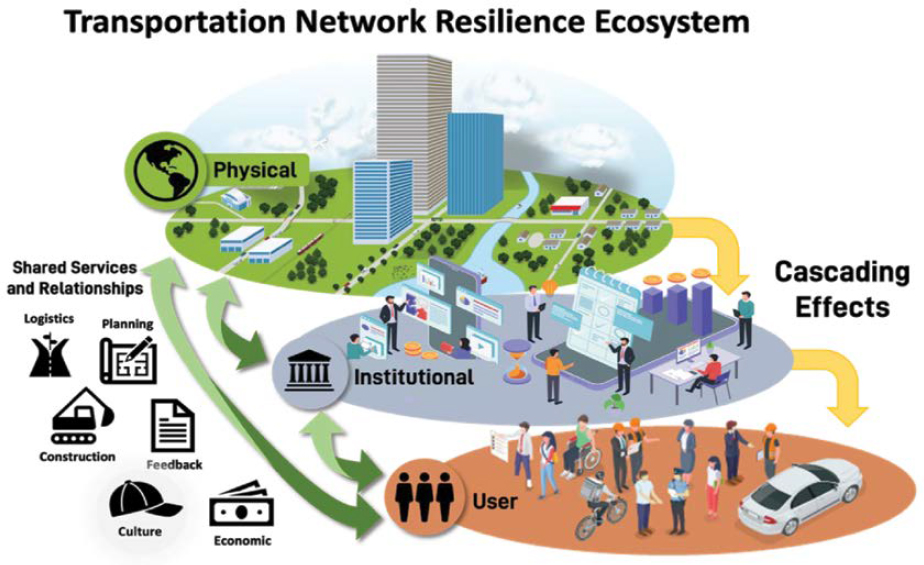
The principle of a resilience ecosystem has become a vital construct for resilience planning at the national level.1 Network resilience planning is aided by coordination between physical, institutional, and individual dimensions to build capacity to prepare for, manage, and recover from transportation network disruptions. Cascading effects are ways that a disruption in one dimension can affect the entire system. When seeking to enhance resilience at the network level, it is important to ask:
- What are the ingredients of the network ecosystem?
- Who are the players in a resilience strategy?
- What are their roles?
- What are the assets and threats facing the network?
- What solutions are available to enhance resilience?
- And what payoffs can be achieved by collaborating across a network?
This playbook is part of a comprehensive set of resources referenced in the plays and available to support their implementation. These resources include the following:
- The Playbook with its seven plays guides the incorporation of resilience into transportation networks.
- The Literature Review (Appendix A) details current research on network and supply-chain resilience.
- A Policy Guidance Document (Appendix B) contains inputs, steps, and considerations for establishing resilience policies.
- A Catalog of Recent, Relevant Frameworks and Methods (Appendix C) contains example frameworks and other resilience strategies.
- The Transportation Network Resilience Awareness Challenge (Appendix D) provides a resource for capacity building and a platform for collaboration in a network resilience team.
- “In Their Own Words” Social Equity Case Study (Flagstaff) (Appendix E) describes a social equity case from Flagstaff, Arizona.
- Resilience Case Studies (published as NCHRP Web-Only Document 391: Resilience in Transportation Networks, Volume 1: Resilience Case Studies) contains practical examples of how network resilience issues have been handled by agencies throughout the nation.
- The Resilience Toolkit (published as NCHRP Web-Only Document 391: Resilience in Transportation Networks, Volume 2: Network Resilience Toolkit and Techniques) provides a host of practical methods and network improvement strategies for use in a network resilience program. It includes new network resilience analysis methods, such as cascading-effects modeling and network-robustness modeling, as well as existing tools, frameworks, and methods.
What the Playbook Is About
Topics the Playbook Addresses
Public agencies and private firms have a growing choice of solutions available for identifying vulnerable assets and strengthening transportation resilience. This playbook addresses the larger question of how these solutions combine to provide a network-wide resilience strategy. The playbook addresses key aspects of such strategies, including the following:
Navigating the Play Field: Understanding Network Ecosystem and Components of Resilience (Play 1)
The components of network resilience support linkages between the physical, institutional, and individual user levels of the ecosystem. Defining measurable components of network resilience can guide planners to strategies for both diagnosing resilience needs and collaborating to enhance resilience. By integrating the business/supply-chain literature with transportation-planning principles, this playbook offers practical components of resilience that can be uniquely engaged at the network level.
Getting Players on the Team: Building and Sustaining a Network Resilience Team (Play 2)
Coalitions and partnerships have long been understood as essential to transportation planning. NCHRP Synthesis 337: Cooperative Agreements for Corridor Management (2004) describes how memoranda of understanding, joint powers agreements, and other arrangements can formalize coalitions in the corridor management context.2 Freight advisory committees, metropolitan planning organization (MPO) committees, and other existing groups serve as a starting place
for building a network resilience team. A specific challenge for building a resilience team is the inclusion of traditionally underserved populations and groups. Noninstitutional stakeholders may not be represented in the business and government institutions that often make decisions about a network during the urgent circumstances of a disruption. This playbook outlines success factors for identifying an inclusive resilience coalition, collaborating in a network-wide resilience strategy, sustaining partnerships over time, and supporting network resilience roles.
Scoring Points: Understanding Assets, Disruptions, and Solutions at the Network Level (Play 3 and Play 4)
There is a broad range of potential types of disruptions that can compromise a network. In some cases, a network disruption may be defined differently from the disruption of an individual asset. For example, in a hurricane, flooding may be the immediate source of compromise for a bridge, whereas a power outage may compromise emergency response, and a worker shortage may affect warehousing and supply availability. This playbook identifies stress factors affecting entire networks, which can lead to disruptions throughout the system. The playbook includes examples of tools, strategies, and technologies for both assessing vulnerability and strengthening transportation systems at the network level.
Investing and Playing to Win: Establishing and Sustaining Resilience Programs (Play 5 and Play 6)
Investing in a resilient network requires understanding the types of solutions likely to be effective. It also entails accounting for resilience within the wider context of infrastructure investment. Investments that enhance the resilience of a network may not satisfy the typical performance-based planning requirements that are often applied to individual projects in a transportation planning and programming context. Furthermore, when shippers, carriers, ports, and third-party-logistic (3PL) providers make investments in systems, locations, or other resources, public agencies need to complement these investments. This playbook explores (1) public and private investment in resilience, (2) how the payoffs can be framed, and (3) how both traditional and innovative techniques may be applied to make the business case for network resilience outlays.
Beyond Overtime: The Future of Network Resilience Strategies (Play 7)
There is an unprecedented amount of new research and data available on resilience that can be applied at the network level. Visualizing, projecting, and addressing value-chain relationships and cascading effects of potential disruptions pose new challenges for planners to pinpoint and articulate network-level solutions. New types of partnerships between the public and private sectors, between policy areas related to transportation, and between states and regions require direct application of this playbook and further development of new network solutions. This playbook offers priorities for future research and applications to enhance network resilience in the long term.
How to Use the Plays
The plays that follow provide helpful tips and guiding principles, not strict rules. Like any list of strategies, they are not all-inclusive, nor will they all be relevant to every location’s specific needs. While the steps in some plays may ideally be implemented in sequence, the plays themselves do not need to be implemented in a particular order and should add value to any resilience-planning effort, whether taken individually or together. The knowledge and expertise they provide can be used in part, in any combination, and in any order. The playbook represents many experiences, some shared from multiple locations across the country.
When using this playbook, feel free to change up the plays to suit local needs. The research offers best-practice techniques and innovative methods for incorporating resilience into transportation networks and using state-of-the-art measures and techniques observed in the research. However, it is not intended to address every problem in the process of network resilience planning. It is
offered to facilitate a new generation of network resilience planning efforts that address emerging issues of equity, public-private coordination, big data and analytics, and an increasingly collaborative resilience-planning environment. This playbook is a starting point for more innovative practices and tools to be developed from these basic plays.
As plays are executed and new ones are developed, practitioners are encouraged to share their success through collaboration with the AASHTO, TRB, and other associations. The final play on future-proofing and new research introduces innovative/exploratory elements with which resilience planners and implementors may experiment and subject areas for new research to complement this current playbook.
The seven plays are listed as follows and summarized in Figure 1.
PLAY 1 | Define the Transportation Resilience Ecosystem
PLAY 2 | Build and Prepare the Resilience Team

PLAY 3 | Define Disruptions, Risks, and Vulnerabilities
PLAY 4 | Identify Critical Hard and Soft Assets
PLAY 6 | Play to Win: Build a Resilience Program and Learn from Experience
PLAY 7 | The Future of Network Resilience
Making the Most of the Resilience Toolkit
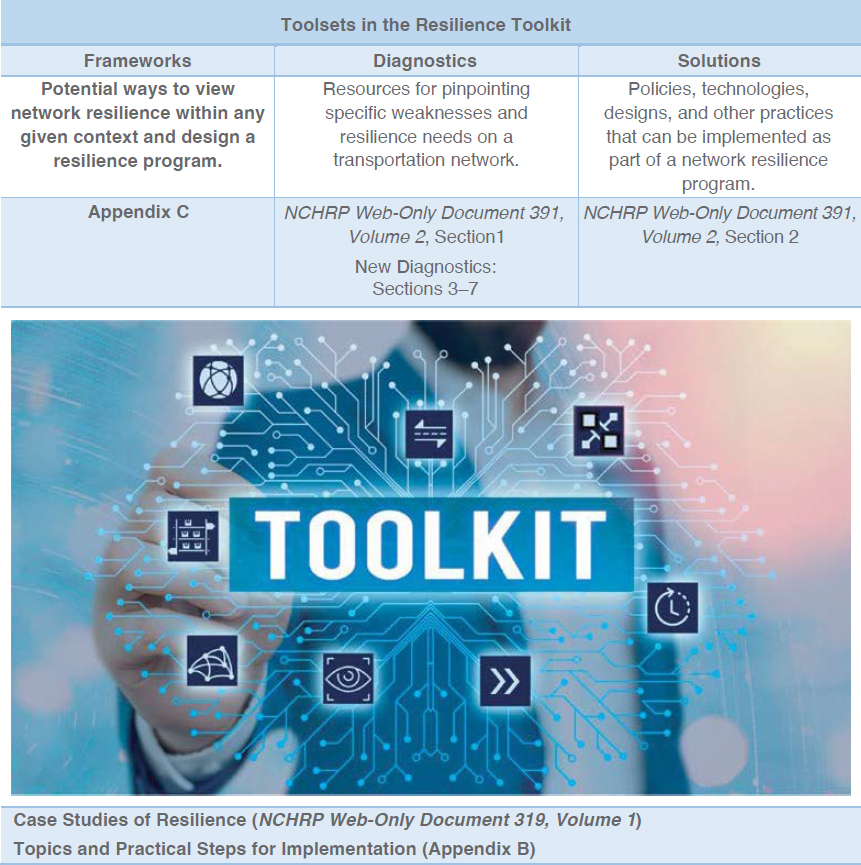
The playbook comes with a comprehensive resilience toolkit (published as NCHRP Web-Only Document 391, Volume 2), encapsulating a wide range of new and existing resources for designing network-level resilience programs, identifying resilience needs at the network level, and suggesting solutions to network resilience problems. The plays of this playbook offer context for understanding where and how to make the best use of network resilience tools, integrating these resources into a cohesive strategy. Each of the plays suggests practical considerations, guides, worksheets, and self-assessments for building and defining the scope of a resilience program, building a resilience team, identifying key disruption risks to be addressed, evaluating network assets, investing in resilience, and considering scenarios and choices as well as future innovations in network resilience planning. Figure 1 shows how the resilience toolkit is organized and referenced throughout this playbook along with practical case studies that have informed the content of the plays as well as uses of the toolkit.
NCHRP Objectives
The objective of this research was to develop a toolkit and supporting guidance to improve the resilience (as defined by the National Academies) of the multimodal freight transportation network at various geographical levels. This toolkit should incorporate strategies and applications to minimize and mitigate the impacts of disruptive events. It should support the development of transportation network policies and programs that enhance infrastructure, operations, resource management, institutional collaboration, and investment decision-making. Specific tools and techniques could include, but not be limited to, scenario planning, economic forecasting, institutional options, and analytical models. The supporting research includes the following:
- A review of known and anticipated issues and practices, including public and private sector risk management and business-continuity analysis.
- Surveys of case studies to illustrate current understanding of the issues as well as strategies and approaches to strengthening transportation network resilience.
- Supporting guidance for tools and analytical models and other innovative resources to develop effective multimodal freight transportation resilience programs.
- A discussion of strategic approaches to and risks associated with multimodal freight transportation network resilience in the context of disruptions affecting supply chains.
- A detailed plan on how to translate components of the toolkit into a broader multimodal freight transportation resilience program.
- Recommendations for disseminating the research results, including presentation materials to enhance decision-making.


