Review of the Long-Term Operations of the Central Valley Project and the State Water Project (2026)
Chapter: 1 Introduction
1
Introduction
The State of California has the fourth largest economy in the world, behind only the United States, China, and Germany (Rao, 2025). California’s economic success is heavily dependent on water, much of which comes from Northern California and flows through the Sacramento-San Joaquin Delta (the Bay-Delta or Delta), with a substantial portion diverted to the Central Valley and more heavily populated Southern California. Given California’s highly variable precipitation, both within and across years, managing the water that moves through the Delta is a critically important state and federal responsibility. The fundamental challenge in the Delta of how to provide and distribute water to human, agricultural, and ecosystem needs is keenly dependent on science, particularly adequate monitoring and modeling.
BACKGROUND
The Sacramento-San Joaquin Delta is formed by the confluence of two of California’s largest rivers: the Sacramento, flowing south from its headwaters near Mount Shasta, and the San Joaquin, flowing north from its origins in the southern Sierra Nevada mountains. These rivers and their tributaries carry about half of the state’s total annual runoff. Freshwater from the rivers mixes with saltwater from the San Francisco Bay and Pacific Ocean, forming one of the largest estuaries on the west coast of North America. The Delta, which spans about 738,000 acres in Northern California at the western edge of the Central Valley, is home to more than 627,000 people as well as 750 animal and plant species and 55 fish species.1 Indeed, Myers et al. (2000) highlighted the California Floristic Province, of which the Bay-Delta is a critical part, as one of the world’s 25 priority hotspots of ecological diversity.
Precipitation in California generally occurs between October and April, while municipal and industrial water demands are year-round, with agricultural demand peaking during the growing season from April through August (see Appendix A for a complete discussion of California climate). To support growing demands for water supply development in California in the 20th century, two massive and interconnected systems of reservoirs, dams, and levees were constructed in the Sacramento and San Joaquin river basins (Figure 1-1). These are the Central Valley Project (CVP), overseen by the U.S. Bureau of Reclamation (USBR), and the State Water Project (SWP), overseen by the California Department of Water Resources (CDWR). The region also contains many other smaller water systems owned and operated by water utilities, power companies, and water management agencies.
___________________
1 See https://deltacouncil.ca.gov/frequently-asked-questions.

The CVP can capture and store nearly 12 million acre-feet of water, and it delivers, on average, 7 million acre-feet of water a year from Northern California and the Sierra Nevada to about 3 million acres of farmland, about 2 million people in urban centers, and 19 wildlife refuges (Johnson, 2024), most of them in the Central Valley. In addition, the CVP provides hydropower for 650,000 people, as well as flood protection, navigation, and recreation benefits. The SWP can capture and store about 4.2 million acre-feet of water, and it delivers an average of 2.5 million acre-feet of water a year (CDWR, n.d.). The SWP extends more than 705 miles (two-thirds the length of California) and delivers water to 750,000 acres of farmland, most of it in the southern San Joaquin Valley, and to households (including 27 million Southern Californians) and businesses throughout much of the state.2 A recent study found that the SWP supports 8.7 million full-time jobs and 800,000 businesses, including 160,000 farmworkers, and provides water to 8.2 million people in disadvantaged communities (Sunding et al., 2023). The water supply commitments of the CVP and SWP (collectively referred to as “the Projects”) are outlined in hundreds of contracts (as described in Appendix B).
Operational Context
The Projects were originally proposed to send surplus freshwater to the Central Valley and Southern California and to help recharge groundwater, all while preventing salinity intrusion into the Delta and the water intakes. The operations of the CVP and SWP are coordinated by USBR and CDWR. The two agencies must account for climatic conditions; water supply commitments of the CVP and SWP contracts; infrastructure limits (e.g., reservoir capacities, pumping constraints); flood operations and preparations; multiple statutes including the Endangered Species Act (ESA), the Clean Water Act (CWA), the National Environmental Policy Act (NEPA), and state versions of these federal laws; water rights; and licensing requirements for dams. The coordination of CVP and SWP operations occurs in a framework established in a Coordinated Operating Agreement (COA), approved in 1986 and amended in 2018 by California and the United States (DOI and CA Resources Agency, 1986). The 2018 COA (USBR and CDWR, 2018) updates and formalizes earlier agreements dating back to 1960.
Daily calculations are made to determine whether the Delta is in so-called “balanced conditions,” which occur when releases from upstream reservoirs plus unregulated flow approximately equal the water supply needed to meet Sacramento Valley in-basin uses, plus exports (USBR and CDWR, 2018). Excess water conditions are periods when it is agreed that releases from upstream reservoirs plus unregulated flow exceed Sacramento Valley in-basin uses, plus exports. Whether the Delta is experiencing balanced or excess conditions determines how much water the CVP and SWP are responsible for releasing from reservoirs or are allowed to pump. The COA specifies how much of the water stored in CVP and SWP facilities must support Sacramento Valley in-basin water uses and how Delta export capacity is to be shared. The COA also specifies the flow and storage measurements and forecasts to be made for each project, as well as repayments for expenses when one project’s facilities are operated to benefit the other project.
To allocate water, USBR and CDWR use annual assessments of water availability. They adjust those assessments as each water year develops. They also convene periodic operational meetings to help coordinate and adjust operations, with adjustments informed by the COA, water supply and flood control needs, and various environmental requirements. Flood management is a shared responsibility of multiple federal, state, and local agencies, including the U.S. Army Corps of Engineers. Operators of both the CVP and SWP are housed at a joint operations center in Sacramento. Coordination meetings are held at daily to quarterly intervals, depending on the topic, and involve staff from key state and federal agencies (Table 1-1).
Both the CVP and the SWP draw water from heavily allocated river systems, and water supplies are often insufficient to meet all the demands of users that have contracts with the Projects for water deliveries. Factors that impact the ability of the Projects to deliver water for agricultural, municipal, and industrial uses include variability in precipitation, upstream diversions from the Delta’s tributary basins, and environmental mandates for such things as Delta outflows, water quality, fish migration pathways, and entrainment prevention at the pumps. Future climate conditions, characterized by warmer temperatures, more intense winter precipitation, prolonged
___________________
TABLE 1-1 CVP and SWP Operations Teams
| Meeting/Event | Frequency | Participants | Purpose |
|---|---|---|---|
| Daily Operations Coordination Meetings | Daily | USBR, CDWR, Joint Operations Center staff | Coordinate current reservoir releases, Delta pumping, and forecast-based adjustments. |
| Meeting of the Smelt Monitoring Team, Salmonid Monitoring Team, Delta Monitoring Workgroup | Weekly during OMR season (more frequent in critical periods) or as needed | CVP and SWP staff from CDWR and USBR, NMFS, USFWS, CDFW, SWRCB, stakeholders | Review real-time Delta conditions, fish presence, and water quality, and coordinate pumping/fish protections. |
| Meeting of the Sacramento River Group and JPE Subteam, American River Group, Stanislaus Watershed Team, Clear Creek Technical Team, Trinity River Temperature Task Group, Delta Coordination Group, DRY Team | Monthly or as needed | Same as above | Ensure operational endangered species protection and regulatory compliance. |
| Meeting of the Water Operations Management Team | Weekly during OMR season or as needed | Senior agency representatives from USBR, CDWR, NMFS, USFWS, CDFW, SWRCB | Make strategic decisions, resolve conflicts elevated from other teams. |
| Meeting of the Shasta Operations Team | Monthly or as needed | Senior agency representatives from USBR, CDWR, NMFS, USFWS, CDFW | Make strategic decisions, resolve conflicts elevated from other teams, manage assets for voluntary agreements. |
| Quarterly Outages, Operations and Maintenance Coordination Meeting | Quarterly | USBR, CDWR, WAPA, and SLDMWA | Plan for long-term maintenance, equipment outages, and infrastructure coordination. |
NOTES: SLDMWA = San Luis and Delta-Mendota Water Authority; WAPA = Western Area Power Administration.
droughts, reductions in snowpack, and increasing demand due to rising temperatures, are expected to exacerbate these challenges by further reducing water availability or altering the times when water is available.
Environmental Context
The construction and operation of the CVP and SWP have had major effects on fish native to the Bay-Delta watershed. Many of those fish species are now listed as threatened or endangered, by both state and federal agencies (Box 1-1; Appendix E). These listed species include the Sacramento River winter-run Chinook salmon, Central Valley spring-run Chinook salmon, Delta smelt, longfin smelt, California Central Valley steelhead trout, and the southern distinct population segment of North American green sturgeon. (White sturgeon has threatened status at the state level, pending a review in 2025.)
Dams and levees built around the rim of the Central Valley floor have prevented many fish species from reaching their historical habitats and spawning grounds, limiting their reproductive success (Hanak et al., 2011). Water diversions for agricultural, industrial, and municipal uses have also impaired passage for both returning adult fish and outmigrating juveniles, partly by altering the hydrodynamics of the Delta (Brown et al., 2024; Hassrick et al., 2022; Perry et al., 2015; Sturrock et al., 2020). Warm water conditions caused by the construction and operation of the Projects and exacerbated by a warming climate are less compatible with spawning, incubation, and rearing requirements of the listed fish species (Slater, 1963; Willis et al., 2021; see Appendix E).
BOX 1-1
Declines in Fish Abundance in the Bay-Delta
Six fish species in the Bay-Delta have seen dramatic declines in abundance in the last few decades and are listed as threatened or endangered under the ESA. Brief descriptions of these declines and relevant abundance data are presented below for three of the fish: Delta smelt, longfin smelt, and Sacramento River winter-run Chinook salmon. Appendix E provides a lengthier description of the life history of each listed fish, along with information on species monitoring, conceptual models and quantitative life-cycle models for the species, how the Projects and other major stressors affect the species, the role of hatcheries in maintaining the population, and key uncertainties.
Delta smelt (Hypomesus transpacificus) experienced a major decline during the early 1980s, followed by substantial fluctuations during the 1990s. This was followed by an abrupt decline in the early 2000s that was part of the pelagic organism decline (Sommer et al., 2007). In 2022, the Spring Kodiak Trawl abundance index was 1.7, which is the fourth lowest on record (USBR, 2024a). The 2023 actual abundance was estimated to be 4,656 adults (95% CI: 1,178–12,730), which is the lowest since that survey began in 2002 (Figure 1-2A).

SOURCE: USBR (2024a).
Longfin smelt (Spirinchus thaleichthys) were historically very abundant in the San Francisco Bay estuary. Over the past few decades, species abundance has progressively declined. Longfin smelt are also part of the pelagic organism decline in the Bay-Delta, having declined to about 1 percent of their former abundance, as shown in Figure 1-2B.

SOURCE: USBR (2024b).
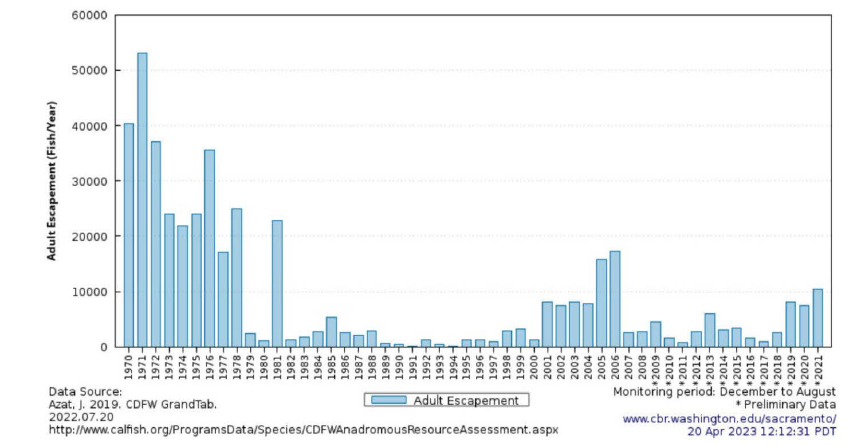
Sacramento River winter-run Chinook salmon (Oncorhynchus tshawytscha) populations have declined substantially since the early 1970s. According to the National Marine Fisheries Service (NMFS, 2024a), threats to the species have changed over the years, with disease and predation adding to problems created by poor spawning habitat and migratory corridor habitat. Figure 1-2C shows annual escapementa data for winter-run Chinook salmon from 1970 to 2021.
NOTE: These data include both natural and hatchery-origin Chinook.
SOURCE: USBR (2024c).
__________________
a Escapement refers to the number of salmon that “escape” fisheries (i.e., are not harvested) and return to freshwater to spawn (https://www.npafc.org/salmon-escapement/).
Beyond the significant effects stemming from the Projects, other stressors adversely affect fish, including contamination from terrestrial runoff in the watersheds draining into the Sacramento and San Joaquin rivers and the Delta (Hammock et al., 2015; Stillway et al., 2024), land use changes in the Delta region that have altered food webs and reduced vital energy pathways for fish (Moyle et al., 2011; SFEI, 2014; Whipple et al., 2012), an increase in non-native species that thrive in the degraded Delta habitat and compete with or prey on native species (DISB, 2024; Hagani et al., 2023; Sommer et al., 2007), and the loss of genetic integrity of some listed fish species (Bert et al., 2007; Brown and Moyle, 1991; Moyle et al., 2011; Quiñones et al., 2014).
The combination of all of these stressors has led to dramatic loss of listed fish populations over the last half century (Mount et al., 2012), with particularly significant declines since 2000 for pelagic fish (Sommer et al., 2007). Indeed, the term “pelagic organism decline” was coined to describe the reduction, primarily between 2000 and 2005, in fish abundance for the four major pelagic fishes of the upper estuary (i.e., Delta smelt, longfin smelt, striped bass, and threadfin shad). These fish vary widely in their life histories and estuary use, suggesting the presence of systemic ecological problems.
The environmental stressors outlined above have been exacerbated by hot and dry periods over the past few decades that are likely to intensify in the coming years. As discussed in greater detail in Appendix A, average annual precipitation varies greatly both interannually and spatially among California’s 11 climate regions. Although no long-term trend in California statewide precipitation is apparent (OEHHA, 2022), the interannual variability in precipitation amounts has increased, with a steep increase in variability occurring during the mid-1970s (Figure 1-3). Indeed, compared to the first half of the 20th century, many fewer years in the past 80 years reflect so-called average conditions. Along with sea level rise, warming of air temperature, and an increasing intensity of both droughts and atmospheric rivers, this rise in variability of precipitation is expected to further challenge efforts to maintain and enhance populations of listed fish species.
California’s generally dry, strongly seasonal hydrology, with frequent droughts and high and diverse water demands, brings perennial water management challenges and controversies. When and where water is naturally available in California’s Central Valley is poorly matched with when and where water is needed for agricultural and urban uses, as depicted in Table 1-2. That is, most precipitation and streamflow occur in winter, while the
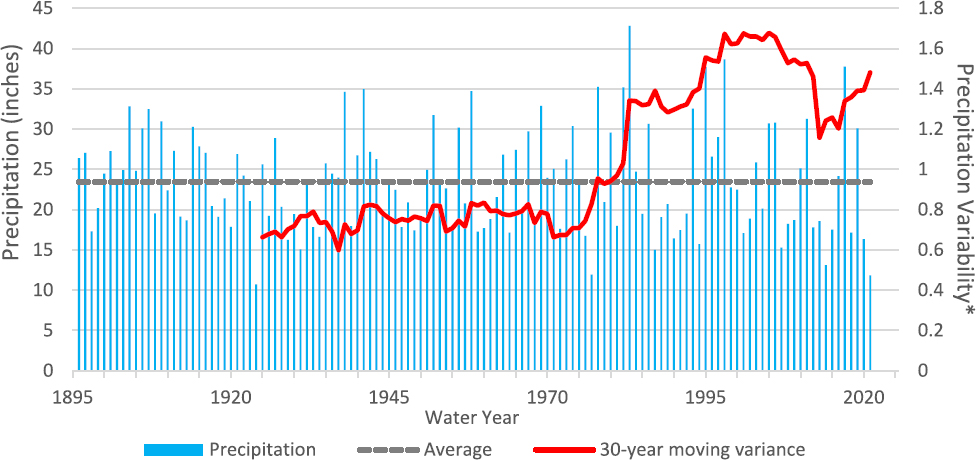
NOTE: Annual variability is the ratio of the variance for the 30-year period ending in that year to the variance over the entire period. A ratio above 1 means precipitation was more variable; below 1, less variable.
SOURCE: OEHHA (2022).
water demands of cities and agriculture are highest in the summer. This mismatch had led to the development and operation of major federal, state, and local water projects in California and throughout the American West.
Because California’s precipitation varies greatly from year to year, and within each water year, water operations, contractual deliveries, and other aspects of water supply also vary from year to year according to a coarse classification adopted by state and federal agencies. Each water year, which spans from October 1 to the following September 30, is classified by type: Wet (W), Above Normal (AN), Below Normal (BN), Dry (D), or Critically Dry (C) (CDWR, 1989, 1991). These classifications are assigned based on a water-year index, which is calculated using estimates of unimpaired streamflow for the year and sometimes unimpaired flow from the previous year.
The water-year-type classifications were originally developed for water allocation and environmental purposes relevant to CVP and SWP operations, and they affect each of the three actions reviewed in this report differently. The coarse classification of five water-year types does not reflect seasonal dynamics, regional and subbasin conditions, the availability of stored water, or other factors often important for both water allocation and environmental water management. More fine-grained or multidimensional classifications might be useful for implementing environmental protections (e.g., water-year types that also account for temperature, fish populations, tides, or other state variables) (Murdoch, 2024; Null and Viers, 2013), but the Committee did not consider alternative classifications in detail.
The ecosystems of the Delta, along with the operations of the water supply projects, are particularly complex because the Delta is a seasonally and tidally flushed network of rivers, sloughs, canals, and channels. Indeed, most internal Delta flows are driven by the 6-foot tides that occur twice daily. For most of the year and for most years, tidal flows are responsible for the mixing and transport of salts, nutrients, particulate matter, and many organisms within the Delta (Brown et al., 2024). Large seasonal, interannual, and operational fluxes in freshwater flows are important in modifying the effects of these underlying tidal flows.
Regulatory Context
The challenges of operating the Projects have grown since the 1960s, partly because of the promulgation of laws that require water quality protection and protection of native fish species, which evolved in extensive pre-development habitats and in the variable flows of the watershed’s natural hydrology. Growing water demands and water diversions from groundwater pumping also have made Project operations and how they respond to environmental regulations more complex over time. The current governing legal frameworks are discussed in Appendix C of this report in great depth. What follows is an initial and general overview.
General Administrative Law Principles
The CVP and SWP are managed by USBR and CDWR, respectively, both of which are administrative agencies. Under federal and state law, agencies obtain their authority through legislation, and that authority is also bounded by governing legislation. As the U.S. Supreme Court has stated, “[A]n agency literally has no power to act… unless and until Congress confers power upon it.”3 That general principle means that USBR and CDWR have management discretion only to the extent that it is conferred upon them by state and federal statutes. USBR and CDWR are also bound by both federal and state laws. Under Section 8 of the Reclamation Act of 1902, USBR obtains and exercises its water rights “in conformity” with state law,4 which means that the California State Water Resources Control Board (SWRCB) has regulatory authority over USBR’s water rights and that USBR operations
___________________
3 Louisiana Pub. Serv. Comm’n v. FCC, 476 U.S. 355 (1986).
4 See 43 USC §383,which states, “Nothing in this Act shall be construed as affecting or intended to affect or to in any way interfere with the laws of any State or Territory relating to the control, appropriation, use, or distribution of water used in irrigation, or any vested right acquired thereunder, and the Secretary of the Interior, in carrying out the provisions of this Act, shall proceed in conformity with such laws, and nothing herein shall in any way affect any right of any State or of the Federal Government or of any landowner, appropriator, or user of water in, to, or from any interstate stream or the waters thereof.”
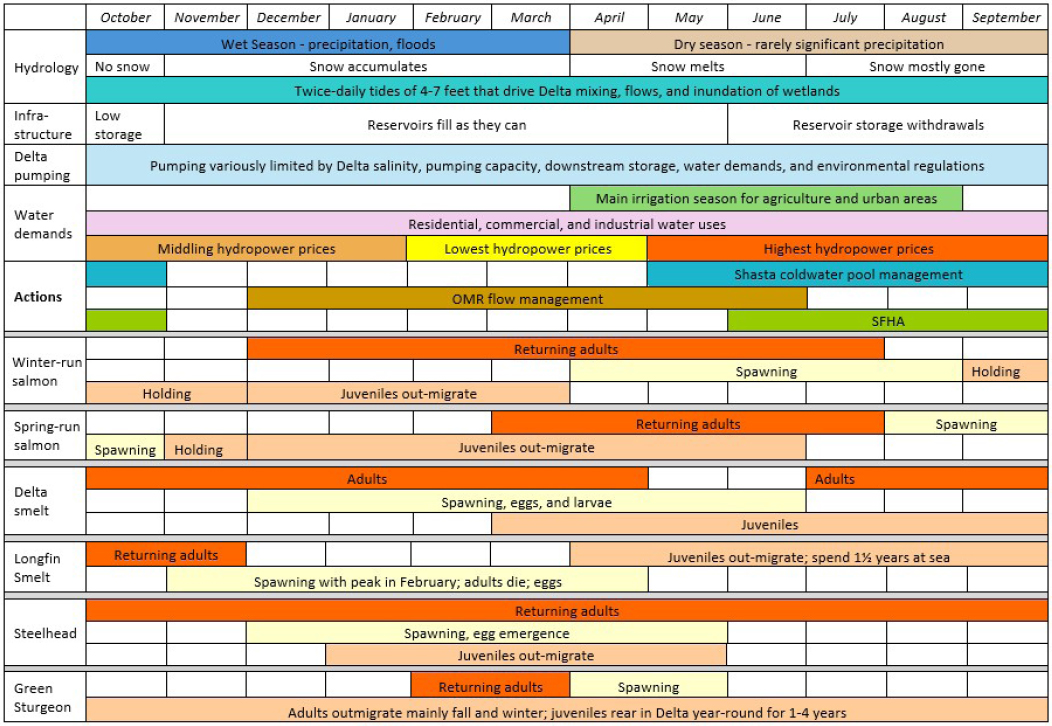
NOTES: OMR = Old and Middle River; SFHA = Summer-Fall Habitat Action.
are constrained by some state-law provisions.5 The Supremacy Clause of the U.S. Constitution gives the federal government regulatory authority over states, and while some key provisions of federal statutes apply only to federal agencies, others apply more generally.
Project management decisions are also based on water rights and contracts. USBR and CDWR obtain their water rights through California’s water-rights system, which is based partly on principles of “prior appropriation.” In a prior appropriation system, older or “senior” water rights receive their water before newer or “junior” rights do.6 Because irrigated agriculture was well established in the Central Valley before the CVP and SWP were built, each project’s water rights are relatively junior, and more senior water users’ rights must be satisfied before the Projects are allowed to divert water. The CVP and SWP serve several groups of contractors who had water rights before the Projects existed. As discussed in Appendix B, these Settlement and Exchange contractors have priority within the system. California’s water rights system also recognizes riparian rights, which allow water diversions by waterfront landowners, and project exports are generally subordinate to the water uses of the many riparian-right
___________________
5 See, e.g., California v. United States, 438 U.S. 645, 650, 678 (1978); Natural Resources Defense Council v. Patterson, 333 F.Supp.2d 906, 913-14 (E.D. Cal. 2004). Section 101(b) of Public Law 99-546, enacted in 1986, also requires USBR to manage the CVP consistently with state water quality standards.
6 See https://www.waterboards.ca.gov/waterrights/board_info/faqs.html.
holders in the Bay-Delta watershed.7 For these reasons, and also because “area of origin” laws have limited water exports,8 CVP and SWP operations are especially vulnerable to drought conditions, because earlier-established water users have priority when water is allocated.
The CVP and the SWP both deliver water to end users, and those end users have contracts for CVP and SWP water rather than hold the water rights themselves.9 The contracts are complex and include water shortage provisions. Both federal and state contracts specify maximum delivery amounts but do not require delivery of those amounts. Instead, USBR and CDWR deliver water to the extent that it is available, accounting for not only the limits of precipitation and storage and the needs of senior water users but also constraints imposed by environmental laws and the need to prepare for future dry years.10 Some of those laws, such as the Central Valley Project Improvement Act, are specific to the Projects; some, like California’s Delta Protection Act, apply regionally; and others, such as NEPA, apply nationally. A summary of these laws appears in Appendix C.
For the elements of CVP and SWP operations addressed in this report, two of the most important laws are the federal and state ESAs.11 Both ESAs are designed to prevent extinction12 and facilitate recovery of species, as described in Box 1-2. They require implementing agencies—the U.S. Fish and Wildlife Service (USFWS) and the National Marine Fisheries Service (NMFS or National Oceanic and Atmospheric Administration Fisheries), for the federal statute, and the California Department of Fish and Wildlife (CDFW), for the state statute—to list species that are in danger of going extinct. Once listed, those species receive several protections (Box 1-2). Most importantly, the federal ESA prohibits federal agencies from actions likely to jeopardize the continued existence of listed species or to adversely modify their critical habitat (16 USC §1536(a)(2)). It also prohibits unauthorized takes of endangered and some threatened species, and the definition of “take” includes acts that unintentionally kill, wound, or harm protected species (16 USC §1538)—a requirement echoed by California’s ESA (CA Fish & Game Code §2080). Many constraints on CVP and SWP operations stem from these legal prohibitions. The federal operating constraints are often contained in documents called biological opinions, to which the remainder of this report will often refer.
Although the ESAs are perhaps the most prominent environmental laws that apply to the Projects, many other laws are important. Under the federal CWA and California’s Porter-Cologne Water Quality Control Act, the State of California sets water quality standards, including requirements for salinity control (33 USC §1313; CA Water Code 13241). For much of a typical year, those standards are the primary controls on CVP and SWP pumping levels (Gartrell et al., 2017). The SWRCB’s Decision D-1641 is the rulebook for implementing the 1995 Water Quality Control Plan, and D-1641 assigns responsibility for meeting flow, salinity, and Delta outflow standards to USBR and CDWR. The Central Valley Project Improvement Act specifies environmental flow requirements and establishes goals for the recovery of salmonid populations.13 NEPA and, for state projects, the California Environmental Quality Act (CEQA) require analysis of discretionary new agency actions, and although many elements
___________________
7 An exception to this general principle arises if the freshwater that riparian-right holders hope to divert would not be present if not for project operations. This could happen in the late summer and fall or dry years, when releases of stored water from the projects are responsible for maintaining freshwater conditions in parts of the Delta.
8 See Craig M. Wilson, 2013, California’s Area of Origin Laws, https://www.waterboards.ca.gov/board_info/agendas/2013/oct/100813_7origin.pdf.
9 Some of the contractors have separate water rights to non-CVP and non-SWP water.
10 See O’Neill v. United States, 50 F.3d 677, 684 (9th Cir. 1995). (“We conclude that the contract’s liability limitation is unambiguous and that an unavailability of water resulting from the mandates of valid legislation constitutes a shortage by reason of ‘any other causes.’”)
11 The Committee acknowledges that salinity control drives most restrictions on exports. However, for the three actions that this report evaluates, the state and federal ESAs are critical, and hence this report focuses on the controls brought about by the ESA.
12 Biologists sometimes distinguish “extinction,” which involves the complete loss of a species (as a biologist would use the term “species”), and “extirpation,” which involves the loss of some distinct population of the species. In contrast, the federal ESA does not use the term “extirpation,” and it defines a species as being in danger of extinction if it might disappear in “all or a significant portion” of its range. Thus, the Act treats the term “extinction” as including situations where a biologist might use “extirpation.” This report uses the term “extinction” in the ESA sense because of the importance of the ESA to agency decision making for the three actions.
13 See San Luis & Delta Mendota Water Auth. v. U.S., 672 F.3d 676, 684-85 (9th Cir. 2012) (summarizing the act’s requirements).
BOX 1-2
ESA for Species Recovery Versus Prevention of Extinction
A question for agencies as they strive to comply with the ESA is whether the end goal is species recovery or merely prevention of extinction. The latter goal is obvious from the statute’s text, and sometimes commentators and implementing agencies can assume that extinction prevention is the statute’s sole focus—or, at least, is the sole focus of its regulatory provisions.
Nevertheless, the ESA is concerned with both survival and recovery. The Act opens with a statement of purpose, which refers to “conserving” and the “conservation” of species. The next section states that “[t]he terms ‘conserve’, ‘conserving’, and ‘conservation’ mean to use and the use of all methods and procedures which are necessary to bring any endangered species or threatened species to the point at which the measures provided pursuant to this chapter are no longer necessary.” In other words, the statute’s core goal is to recover species.
Multiple other sections of the statute specifically focus on recovery. Section 4 governs species listings and requires recovery plans. Sections 5 and 6 authorize federal land acquisitions and cooperation with state programs, respectively, and speak of the need to “conserve” species. Section 7(a)(1) states that “[a]ll … Federal agencies shall, in consultation with and with the assistance of the Secretary, utilize their authorities in furtherance of the purposes of this chapter by carrying out programs for the conservation of [listed] species.” Section 7 also requires federal agencies to avoid taking actions that adversely modify the critical habitat of listed species, defined as habitat that is “essential to the conservation of the species.”
of the CVP and SWP predate NEPA and CEQA, both statutes can apply to significant changes in the projects.14 California Fish and Game Code section 5937 requires operators of dams to maintain below-dam fish populations “in good condition.”15 Furthermore, all surface water rights in California are subject to the state’s public trust doctrine and to California’s constitutional requirement that limits water rights to reasonable uses.16 Both of these doctrines can be somewhat vague in their requirements, but they both apply to the CVP and SWP, and both can be the basis for environmentally motivated restrictions on project operations.
Recent Changes to the Biological Opinions
In late 2024, USFWS and NMFS issued new biological opinions for endangered and threatened fish in the Bay-Delta region (NMFS, 2024b; USFWS, 2024). Both agencies’ biological opinions also contained “incidental take statements,” which conditionally authorize takes of listed species, and CDFW also issued an incidental take permit (CDFW, 2024). These documents have substantial impacts on CVP and SWP operations because they limit the number of fish that can be taken as the Projects supply water to their contractors and specify a range of operating conditions designed to limit takes. Biological opinions for this system have been produced about every 10 years, although in the recent past reconsultation has become more frequent. In response to each biological opinion/incidental take permit, USBR and CDWR produce a revised plan of operations for the CVP and the SWP (e.g., USBR, 2024d). These operations have multiple components, most of which fall under the category of reservoir and system operational changes and flow-related actions, including altering reservoir storage, managing system flows, and managing temperature regimes to benefit listed species. Other components include habitat restoration
___________________
14 42 USC §4332(C); Cleveland Nat’l Forest Found. v. San Diego Ass’n of Gov’ts, 397 P.3d 989, 992 (Cal. 2017) (describing CEQA).
15 Natural Resources Defense Council v. Patterson, 333 F. Supp. 2d at 913-14.
16 See Northern Cal. Water Ass’n v. State Water Resources Control Bd., 230 Cal. Rptr. 3d 142, 166 (Cal. Ct. App. 2018). As the court explained, “[T]he USBR operates the CVP and allocates CVP water subject to a comprehensive scheme of environmental statutes and regulations, and various state and federal regulations. . . . Moreover, the CVP contractors take their interest in the USBR’s water rights subject to these legal obligations… and the USBR cannot give away more than it has.”
projects, facility improvements, use of hatcheries, and special scientific studies. These components are supported by real-time biological and physical monitoring and modeling of the Projects, the results of which are used in decision making.
SIZE AND SCOPE OF THE DELTA SCIENCE ENTERPRISE
Numerous parties in the Delta region have contributed to the overall science enterprise that informs management of the Projects, including USBR, CDWR, USFWS, NMFS, CDFW, SWRCB, the U.S. Geological Survey (USGS), the Delta Stewardship Council (including the Delta Science Program), electrical utilities, Native American tribes, environmental nongovernmental organizations, water contractors, researchers from many universities, consultants, and others. Table 1-3 lists many of the organizations that have a stake in Project operations and also conduct or fund research relevant to the Delta science enterprise, each with different missions and combinations of expertise. These organizations are often aided by a large number of specialized and general consulting firms that are important to maintaining scientific activities and disseminating ideas among agencies. Long-term success for managing such a complex and controversial system as the CVP and SWP will be more likely if the scientific activities of the many federal, state, local and regional, nongovernmental, and academic institutions are coordinated and organized. The effectiveness and improvement of this broad enterprise are addressed in Chapter 5.
The public meetings that informed this review underscored the strong scientific and engineering expertise of California state agencies’ and sister federal agencies’ staff. Furthermore, collaborative relationships exist among these entities, as evidenced by the Delta Plan Interagency Implementation Committee, the Interagency Ecological Program, the independent coordination and review role of the Delta Science Program, the Collaborative Science and Adaptive Management Program, and many other efforts. Innumerable scientific discoveries and technological advances have benefited the management of the Projects and informed understanding of the Delta ecosystem. Benefits of the agency commitment to the application of best science and collaboration, many of which are cited throughout this report, include the improved understanding of fish life cycles (Hendrix et al., 2014, 2019), the role of nutrients and contaminants in ecosystem health (Brown et al., 2024; Dahm et al., 2016; DISB, 2018), and the development and application of new modeling tools (Abrahamsson, 2023; MacWilliams et al., 2016; Wang et al., 2024). These and many other advances have informed laws and policies, guided water operations, protected human health, and led to a substantial knowledge base to guide the recovery of the Delta and its watershed. Sustaining and continuing this legacy of interagency science collaboration is essential to meeting the long-term goals of the Projects.
REQUEST FOR THE STUDY AND STATEMENT OF TASK
The previous sections have outlined the complexities of CVP and SWP operations. Inherent to the operation of large water projects with diverse demands in a dry and highly variable climate, the Projects rarely deliver their full contracted amount of water or completely fulfill all their mandated and contractual expectations. Furthermore, the Projects function within a complex regulatory environment of state and federal laws created to protect water quality and prevent fish species native to the Delta and estuary from going extinct. This task will become more challenging as rising temperatures and changing precipitation patterns complicate water quality protection and push the listed species closer to their thresholds of survivability. Presently, despite USBR and CDWR’s efforts to comply with the ESA and reduce take, the abundance of listed species continues to decline, with some nearing extinction (Box 1-1; Hobbs et al., 2017). There is disagreement about whether and how much to hold the Projects responsible for the observed fish population collapses, and what should be the future obligation of the action agencies to prevent further species decline and to recover fish populations.
It was in the midst of grappling with this complicated scientific, regulatory, and sociopolitical environment that USBR engaged in nearly two years of planning discussion to finally contract, in late 2023, with the National Academies of Sciences, Engineering, and Medicine to form an expert committee that could independently review the science supporting CVP and SWP operations. Similar to the National Academies’ review of the Greater Everglades Restoration Program (e.g., NASEM, 2021, 2023, 2024), this Committee was tasked to produce biennial reports that assess the progress of the Projects to meet various operational and other goals. This first report focuses
| California Agencies | |
| Water project action agencies | California Department of Water Resourcesa |
| Regulatory agencies | California Department of Fish and Wildlife,a State Water Resources Control Board,a Delta Stewardship Council,a Central Valley Regional Water Quality Board,a San Francisco Bay Regional Water Quality Board,a Delta Protection Commission, Delta Conservancy, Delta Watermaster |
| Federal Agencies | |
| Water project action agencies | U.S. Bureau of Reclamation,a U.S. Army Corps of Engineersa |
| Regulatory agencies | National Oceanic and Atmospheric Administration National Marine Fisheries Service,a U.S. Fish and Wildlife Service,a U.S. Environmental Protection Agency |
| Nonregulatory agencies | U.S. Geological Surveya,b |
| Local and Regional Agencies | |
| Water supply organizations | Metropolitan Water District of Southern California,a State Water Contractors,a Sacramento River Settlement Contractors, East Bay Municipal Utility District, Turlock Irrigation District, Modesto Irrigation District, Westlands Water District, Kern County Water Agency, Contra Costa Water District, Santa Clara Valley Water District, Central Delta Water Agency, Valley Water,a San Luis & Delta-Mendota Water Authority, San Joaquin River Exchange Contractors Water Authority, American River agencies |
| Flood control agencies | Sacramento Area Flood Control Agency, Reclamation districts, regional water authorities |
| Hydropower | Northern California Power Agency, Western Area Power Authority, Roseville Electric Utility, City of Palo Alto Electric Utility, Trinity Public Utilities District, Yuba County Water Agency |
| Wastewater dischargers | Sacramento Regional County Sanitation District |
| Tribes | Winnemem Wintu, Yurok, Karuk, Shingle Springs Rancheria, Hoopa, Miwok |
| Universities | University of California campuses,a California State University campuses,a Stanford University,a others |
| Nongovernmental Organizations | Coalition for a sustainable delta, pacific coast federation of fishermen’s associations, institute for fisheries resources, golden state salmon association, save california salmon, friends of the river, defenders of wildlife, california trout, the nature conservancy,a the bay institute, american rivers, center for california water resources policy and management |
| Non-advocacy Science Organizations | Public Policy Institute of California,a San Francisco Estuary Institutea |
NOTE: This table is not exhaustive.
a Groups with major science and technical staff.
b USGS provides the “gold standard” for generating water and ecological data as well as the field experience and logistics to advise other entities on supplemental studies or monitoring.
on the underlying science—as well as the monitoring, modeling, and decision making—relevant to three actions (out of about 27) that make up the long-term operations of the CVP and SWP: the Shasta Coldwater Pool Management Action, the Old and Middle River (OMR) Flow Management Action, and the Summer-Fall Delta smelt Habitat Action (SFHA). The National Academies Committee’s statement of task appears in Box 1-3.
The Shasta Coldwater Pool Management Action, the OMR Flow Management Action, and the SFHA for Delta smelt were chosen for consideration in Phase 1 of this study because they are consequential and controversial, for both scientific and nonscientific reasons (Mooney, 2024; USBR, 2024d). These three actions are described briefly below.
Shasta Coldwater Pool Management (Chapter 2)
USBR manages Shasta Reservoir to maintain flood conservation space and to meet downstream flow and water delivery requirements. Those downstream needs include meeting minimum instream flows, satisfying senior water rights on the Sacramento River, meeting Delta salinity and outflow requirements, providing for water
BOX 1-3
National Academies Committee’s Statement of Task
At the request of the U.S. Bureau of Reclamation, an ad hoc committee of the National Academies of Sciences, Engineering, and Medicine will conduct a biennial review of the monitoring, modeling, and other relevant scientific activities and initiatives that support the long-term operations of the Central Valley Project (CVP). Along with the State Water Project, the CVP consists of coordinated federal-state water operations that annually move millions of acre-feet of water via dams, canals, tunnels, pumps, power plants and transmission lines from Northern California to a wide variety of water users throughout the state, including municipalities, agriculture, industries and wildlife refuges. Operation of the CVP affects species protected under the ESA such as the southern distinct population segment of North American green sturgeon, California Central Valley steelhead trout, Central Valley spring-run Chinook salmon, Sacramento River winter-run Chinook salmon, and Delta smelt. In the first cycle of the study, the committee will:
- Assess the state of science for the following topics as they relate to long-term operations of the CVP:
- Old and Middle River (OMR) flow management
- − Salmonid route selection and survival
- − Delta smelt entrainment and recruitment
- Shasta cold-water pool management
- Summer–fall Delta smelt habitat
- Old and Middle River (OMR) flow management
- Provide recommendations on how modeling and monitoring strategies and decision-support tools can be changed, improved, or replaced to more accurately assess the impacts of the CVP operations described above.
service contract diversions at the Red Bluff Pumping Plant, and fulfilling contracts for exports from the Delta. USBR operates a Temperature Control Device (TCD) within Shasta Reservoir to maximize the use of available cold water to support Sacramento River winter-run Chinook salmon spawning and incubation just downstream of Keswick Dam over the summer months. The TCD is used when Shasta Reservoir is stratified (typically starting in late April or early May). It blends water from warmer and colder layers within Shasta Reservoir to preserve the lowest and colder water for later in the season; hence, the action extends from May through October. Because of a warming climate, meeting the required temperatures below Keswick will become increasingly difficult, as recent droughts have demonstrated.
OMR Flow Management (Chapter 3)
This action aims to maximize the export of water while minimizing pumping’s adverse effects on fish populations, particularly when fish are rearing in and migrating through the Delta. The strategy is to close the Delta Cross Channel and to limit exports from the state and federal pumping stations during the migration season (December through June), thus controlling the magnitude of OMR reverse flows, and then to further control such flows based on detections (in salvage) of winter-run and spring-run Chinook salmon and steelhead and on surrogate measures for Delta and longfin smelt. The OMR Flow Management Action is of interest because it curtails the amount of water pumped south, limiting the CVP’s and SWP’s ability to deliver water to their contractors, and because those limits on pumping are a core element of USBR’s strategy to minimize project impacts on species. Yet, disagreement exists about the effectiveness of both the triggers and the corresponding flow restrictions on protecting the listed fish populations.
SFHA for Delta Smelt (Chapter 4)
SFHA seeks to address a seasonal bottleneck for juvenile Delta smelt survival, which has been identified based on analysis and interpretation of historical monitoring data and life-cycle models. The action responds to this problem by providing more low-salinity habitat in the Suisun Marsh area during the summer. The underlying hypothesis is that improving Delta smelt habitat by optimizing salinity, turbidity, temperature, and prey conditions and by creating connectivity to food supplies will support Delta smelt recruitment and population growth. Some aspects of the action are costly in terms of water use. Furthermore, over the relatively short time period that the action has been implemented, evaluating its effectiveness for improving the population viability of Delta smelt has been challenging.
***
Subsequent cycles of this National Academies’ review will each address up to three new scientific topics selected after consultation with USBR (and with input from other agencies and stakeholders) that are timely for potentially improving Project operations. For each topic, the Committee will consider the best available science along with relevant monitoring and synthesis, modeling and decision support tools, and adaptive management strategies, and it will recommend the highest priorities for improvement. Subsequent reports will also evaluate progress toward meeting the Projects’ long-term operational goals and discuss significant accomplishments of the Projects during the biennial report period.
Previous Reviews of Science Relevant to Agency Actions in the Bay-Delta
This report is not the first time that the National Academies has reviewed science in the Bay-Delta region. In 2010, Congress and the Departments of the Interior and Commerce asked the National Academies to review the scientific basis of actions that have been taken and that could be taken for California to achieve an environmentally sustainable Bay-Delta ecosystem and a reliable water supply. Specifically, a committee was convened to do the following:
- Identify the factors that may be contributing to the decline of federally listed species and other significant at-risk species in the Delta.
- Identify future water-supply and water-delivery options that reflect a proper consideration of climate change and compatibility with the objectives of maintaining a sustainable Bay-Delta ecosystem.
- Identify gaps in available scientific information and uncertainties.
- Advise on the degree of restoration of the Delta system likely to be attainable, given adequate resources.
That Committee and the resulting reports (NRC, 2010, 2011, 2012) offered recommendations and identified a variety of ecosystem stressors, including those not directly related to operation of the CVP and SWP, that interact in different ways to influence at-risk and other species. That Committee also noted that meeting the two “co-equal goals” of providing a more reliable water supply for California and protecting, restoring, and enhancing the Delta ecosystem (from the Delta Reform Act of 2009) requires clarity on how the inevitable tradeoffs between the goals will be managed when water is in short supply.
Beyond consulting the past work of the National Academies, this Committee reviewed the extensive literature that supported the development of regulatory documents such as the 2024 biological opinions and incidental take permits for endangered and threatened fish in the Bay-Delta region (CDFW, 2024; NMFS, 2024b; USFWS, 2024). NMFS conducts five-year reviews that describe whether recovery is on track in the context of the recovery plan, explain what the most significant accomplishments have been over the previous five years, and identify the greatest immediate challenges for species recovery. A review of California coastal Chinook salmon was produced in 2024 (NMFS, 2024a). Many other agencies active in the Delta have also produced syntheses and reviews of recent work (e.g., Brown et al., 2024; DISB, 2015, 2022, 2024). Several relevant Delta Science Program reviews coincided with the timing of this study. Whenever possible, the Committee used these reports, many of which became available well after it began its work, for this review. The vast amount of material available, which grew even as this report was being drafted, posed a challenge for this and similar reviews.
REPORT ROADMAP
To be of immediate relevance to the study sponsors and other decision makers working in the Bay-Delta region, this report relegates substantial background material to five appendixes. The first three appendixes provide scientific, technical, and legal context for understanding the long-term operations of the CVP and SWP. Appendix A provides an overview of California climate and hydrology, including the impacts of recent and projected future climate change on several physical metrics such as precipitation, air and water temperature, streamflow, and sea level rise. Appendix B provides the history of California water resources development before outlining the major features of the CVP and SWP, including descriptions of the relevant infrastructure and the ways in which that infrastructure and its operations have altered flow paths in the upper Sacramento River and the Delta. Appendix B also describes the water users that rely on CVP and SWP water and their contracted allocations. Finally, Appendix C describes the regulatory framework under which the CVP and SWP operate, providing more detail than in Chapter 1.
Appendix D describes many of the monitoring networks and models used in CVP and SWP operations. This includes the monitoring of physical, chemical, and biological parameters conducted by various state and federal agencies, with a particular spotlight on the many fish surveys throughout both the Delta and the upper Sacramento River. Appendix D covers models of physical processes such as CalSim3 and the Delta Simulation Model II, along with many biological models, including quantitative life-cycle models for the listed fish species. Finally, Appendix E provides a general overview of the seven fish species in the Delta that are listed as threatened or endangered under the federal ESA. It discusses the species’ life histories, fish monitoring networks for these species, abundance data, available life-cycle models, and major stressors on the individual species.
Chapters 2 through 4 discuss the three specific actions that are the focus of this first report: the Shasta Coldwater Pool Management Action, the OMR Flow Management Action, and the SFHA for Delta smelt. Each chapter describes the action; evaluates monitoring, modeling, and decision support tools relevant to the action; and considers how certain climate impact drivers will affect the action. Each chapter also outlines science challenges for each action. Finally, Chapter 5 explores overarching issues such as the organization of the science enterprise in the Delta region, systemwide monitoring and modeling issues, and action agencies’ plans to account for the increasing variability in precipitation and intensity and frequency of droughts. Each chapter ends with conclusions and (when appropriate) recommendations, the most important of which are compiled in the report summary.
REFERENCES
Abrahamsson, D. 2023. “A Numerical Modeling Analysis of the San Francisco Bay and Sacramento-San Joaquin Delta: Riverine, Tidal, and Wind Processes.” Master’s thesis, California Polytechnic State University. https://digitalcommons.calpoly.edu/theses/2729.
Bert, T. M., C. R. Crawford, M. D. Tringali, S. S. Seyoum, J. Galvin, M Higham, and C. Lund. 2007. “Genetic Management of Hatchery-Based Stock Enhancement.” In Ecological and Genetic Implications of Aquaculture Activities, edited by T. M. Bert. Reviews: Methods and Technologies in Fish Biology and Fisheries, vol 6. Dordrecht: Springer. https://doi.org/10.1007/978-1-4020-6148-6_8.
Brown, L. R., D. E. Ayers, B. A. Bergamaschi, J. R. Burau, E. T. Dailey, B. D. Downing, M. A. Downing-Kunz, et al. 2024. Physics to Fish—Understanding the Factors That Create and Sustain Native Fish Habitat in the San Francisco Estuary. No. 2023-1087. U.S. Geological Survey.
Brown, L. R., and P. B. Moyle. 1991. Status of Coho Salmon in California: Report to the National Marine Fisheries Service. http://pavveor.krisweb.com/biblio/gen_nmfs_brownetal_1991.pdf.
CDFW (California Department of Fish and Wildlife). 2024. California Endangered Species Act Incidental Take Permit No. 2081-2023-054-00. Long-Term Operation of the State Water Project in the Sacramento-San Joaquin Delta. https://water.ca.gov/-/media/DWR-Website/Web-Pages/News/Files/PDF--2081-2023-054-00-SWP-ITP_Final_20241104.pdf.
CDWR (California Department of Water Resources). n.d. The State Water Project: More than Water. https://water.ca.gov/-/media/DWR-Website/Web-Pages/Programs/State-Water-Project/Files/SWP-Benefits-Brochure_Spreads_FINAL.pdf.
CDWR. 1989. Bay-Delta Estuary Proceedings Water Year Classification Workgroup, San Joaquin River Index, Summary of Workshop Activities, California Department of Water Resources.
CDWR. 1991. Bay-Delta Estuary Proceedings Water Year Classification Sub-Workgroup, Summary of Workshop Activities, California Department of Water Resources.
Dahm, C. N., A. E. Parker, A. E. Adelson, M. A. Christman, and B. A. Bergamaschi. 2016. “Nutrient Dynamics of the Delta: Effects on Primary Producers.” San Francisco Estuary and Watershed Science 14(4). https://doi.org/10.15447/sfews.2016v14iss4art4.
DISB (Delta Independent Science Board). 2015. Flows and Fishes in the Sacramento-San Joaquin Delta: Research Needs in Support of Adaptive Management: A Review by the Delta Independent Science Board. Delta Stewardship Council. https://deltacouncil.ca.gov/pdf/isb/products/2015-09-29-isb-final-fishes-and-flows-in-the-delta.pdf.
DISB. 2018. Water Quality Science in the Sacramento-San Joaquin Delta: Chemical Contaminants and Nutrients. Delta Stewardship Council. https://deltacouncil.ca.gov/pdf/isb/products/2018-07-26-isb-2018-water-quality-review.pdf.
DISB. 2022. Review of the Monitoring Enterprise of the Sacramento-San Joaquin Delta. Delta Stewardship Council. https://deltacouncil.ca.gov/pdf/isb/products/2022-03-22-isb-monitoring-enterprise-review.pdf.
DISB. 2024. Advancing Scientific Understanding and Management of the Delta Through a Food Web Perspective. Delta Stewardship Council. https://www.deltacouncil.ca.gov/pdf/isb/products/2024-10-02-isb-food-webs-review.pdf.
DOI and CA Resources Agency (U.S. Department of the Interior and California Resources Agency). 1986. Agreement Between the United States of America and the State of California for Coordinated Operation of The Central Valley Project and The State Water Project. https://cawaterlibrary.net/wp-content/uploads/2017/09/agreementbetween00wash_bw.pdf.
DSC (Delta Science Council). 2018. Chapter 3 of the Delta Plan as Amended in 2018. https://deltacouncil.ca.gov/pdf/delta-plan/2018-04-26-amended-chapter-3.pdf.
Gartrell, G., J. Mount, E. Hanak, and B. Gray. 2017. A New Approach to Accounting for Environmental Water Insights from the Sacramento–San Joaquin Delta. Public Policy Institute of California. https://www.ppic.org/wp-content/uploads/r_1117ggr.pdf.
Hagani, J. S., J. Y. Takekawa, S. C. Chappell, R. L. Tanner, A. R. Ernst, and K. M. Kettenring. 2023. “A Remote Sensing Approach to Assess the Historical Invasion of Phragmites australis in a Brackish Coastal Marsh.” Frontiers in Ecology and Evolution 11:1171245. https://doi.org/10.3389/fevo.2023.1171245.
Hammock, B. G., J. A. Hobbs, S. B. Slater, S. Acuña, and S. J. Teh. 2015. “Contaminant and Food Limitation Stress in an Endangered Estuarine Fish.” Science of the Total Environment 532:316–326.
Hanak, E., J. Lund, J. Mount, R. Howitt, P. Moyle, A. Dinar, B. Gray, and B. Thompson. 2011. Managing California’s Water: From Conflict to Reconciliation. Public Policy Institute of California. https://www.ppic.org/wp-content/uploads/content/pubs/report/R_211EHR.pdf.
Hassrick, J. L., A. J. Ammann, R. W. Perry, S. N. John, and M. E. Daniels. 2022. “Factors Affecting Spatiotemporal Variation in Survival of Endangered Winter-run Chinook Salmon Out-migrating from the Sacramento River.” North American Journal of Fisheries Management 42(2):375–395. https://doi.org/10.1002/nafm.10748.
Hendrix, N., A. Criss, E. Danner, C. M. Greene, H. Imaki, A. Pike, and S. T. Lindley. 2014. Life Cycle Modeling Framework for Sacramento River Winter-run Chinook Salmon. NOAA-TM-NMFS-30 SWFSC-530. https://repository.library.noaa.gov/view/noaa/4738/.
Hendrix, N., A. M. K. Osterback, E. Jennings, E. Danner, V. Sridharan, C. M. Greene, and S. T. Lindley. 2019. Model Description for the Sacramento River Winter-run Chinook Salmon Life Cycle Model. https://www.noaa.gov/sites/default/files/legacy/document/2020/Oct/0.7.115.5960-000001.pdf.
Hobbs, J., P. B. Moyle, N. Fangue, and R. E. Connon. 2017. “Is Extinction Inevitable for Delta Smelt and Longfin Smelt? An Opinion and Recommendations for Recovery.” San Francisco Estuary and Watershed Science 15(2). https://doi.org/10.15447/sfews.2017v15iss2art2.
Johnson, L. 2024. USBR Central Valley Project Operations Overview. Presentation to the NASEM Committee to Review the LTO of the CVP and SWP. Sacramento, CA, January 30, 2024.
Kershner, J. E. Williams, R. E. Gresswell, and J. Lobón-Cerviá. 2019. Trout and Char of the World. Bethesda, MD: American Fisheries Society.
MacWilliams, M. L., E. S. Ateljevich, S. G. Monismith, and C. Enright. 2016. “An Overview of Multi-Dimensional Models of the Sacramento–San Joaquin Delta. San Francisco Estuary and Watershed Science 14(4). https://doi.org/10.15447/sfews.2016v14iss4art2.
Mooney, D. 2024. Opening Remarks. Presentation to the NASEM Committee to Review the LTO of the CVP and SWP. Davis, CA, February 28, 2024.
Mount, J., W. Bennett, J. Durand, W. Fleenor, E. Hanak, J. Lund, and P. Moyle. 2012. Aquatic Ecosystem Stressors in the Sacramento–San Joaquin Delta. Public Policy Institute of California. https://www.ppic.org/wp-content/uploads/content/pubs/report/R_612JMR.pdf.
Moyle, P. B., J. V. E. Katz, and R. M. Quiñones. 2011. “Rapid Decline of California’s Native Inland Fishes: A Status Assessment.” Biological Conservation 144:2414–2423. https://citeseerx.ist.psu.edu/document?repid=rep1&type=pdf&doi=97a8817d3c037028df857f61f76ad375165acf17.
Murdoch, L. 2024. “Adaptively Operating a Fixed-percent Environmental Flow Budget with a Functional Flows Approach.” Master’s thesis, Department of Civil and Environmental Engineering, University of California, Davis. https://ucdavis.app.box.com/s/0xjbhcu3hhsbjhwf68fyf63j4xw9wuaq.
Myers, N., R. Mittermeier, C. Mittermeier, G. A. B. da Fonseca, and J. Kent. 2000. “Biodiversity Hotspots for Conservation Priorities.” Nature 403:853–858. https://doi.org/10.1038/35002501.
NASEM (National Academies of Sciences, Engineering, and Medicine). 2021. Progress Toward Restoring the Everglades: The Eighth Biennial Review—2020. Washington, DC: The National Academies Press. https://doi.org/10.17226/25853.
NASEM. 2023. Progress Toward Restoring the Everglades: The Ninth Biennial Review—2022. Washington, DC: The National Academies Press. https://doi.org/10.17226/26706.
NASEM. 2024. Progress Toward Restoring the Everglades: The Tenth Biennial Review—2024. Washington, DC: The National Academies Press. https://doi.org/10.17226/27875.
NMFS (National Marine Fisheries Service). 2024a. 2024 5-Year Review: Summary & Evaluation of Sacramento River Winter-Run Chinook Salmon. National Oceanic and Atmospheric Administration. https://doi.org/10.25923/4t2m-kt52.
NMFS. 2024b. Endangered Species Act Section 7(a)(2) Programmatic Biological Opinion for the Reinitiation of Consultation on the Long-Term Operation of the Central Valley Project and State Water Project. https://s3.amazonaws.com/media.fisheries.noaa.gov/2024-12/lto-biological-opinion-appendices-2024.pdf.
NRC (National Research Council). 2010. A Scientific Assessment of Alternatives for Reducing Water Management Effects on Threatened and Endangered Fishes in California’s Bay-Delta. Washington, DC: The National Academies Press. https://doi.org/10.17226/12881.
NRC. 2011. A Review of the Use of Science and Adaptive Management in California’s Draft Bay Delta Conservation Plan. Washington, DC: The National Academies Press. https://doi.org/10.17226/13148.
NRC. 2012. Sustainable Water and Environmental Management in the California Bay-Delta. Washington, DC: The National Academies Press. https://doi.org/10.17226/13394.
Null, S. E., and J. H. Viers. 2013. “In Bad Waters: Water Year Classification in Nonstationary Climates.” Water Resources Research 49(2):1137–1148. https://doi.org/10.1002/wrcr.20097.
OEHHA (Office of Environmental Health Hazard Assessment). 2022. Indicators of Climate Change in California: Precipitation, Fourth Edition. California Environmental Protection Agency. https://oehha.ca.gov/media/downloads/climate-change/document/2022caindicatorsreport.pdf.
Perry, R. W., P. L. Brandes, J. R. Burau, P. T. Sandstrom, and J. R. Skalski. 2015. “Effect of Tides, River Flow, and Gate Operations on Entrainment of Juvenile Salmon into the Interior Sacramento–San Joaquin River Delta.” Transactions of the American Fisheries Society 144(3):445–455. https://doi.org/10.1080/00028487.2014.1001038.
Quiñones, R. M., M. L. Johnson, and P. B. Moyle. 2014. “Hatchery Practices May Result in Replacement of Wild Salmonids: Adult Trends in the Klamath basin, California.” Environmental Biology of Fishes 97:233–246. https://doi.org/10.1007/s10641-013-0146-2.
Rao, P. 2025. “Mapped: The World’s Largest Economies, Including the United States.” Visual Capitalist. May 16, 2025. https://www.visualcapitalist.com/mapped-the-worlds-largest-economies-including-u-s-states/.
SFEI (San Francisco Estuary Institute). 2014. A Delta Transformed: Ecological Functions, Spatial Metrics, and Landscape Change in the Sacramento–San Joaquin Delta. SFEI Publication #729. Prepared for the California Department of Fish and Wildlife and Ecosystem Restoration Program. https://www.sfei.org/sites/default/files/biblio_files/DeltaTransformed_SFEI_110414.pdf.
Slater, D. W. 1963. Winter-run Chinook Salmon in the Sacramento River, California with Notes on Water Temperature Requirements at Spawning. Special Scientific Report—Fisheries No. 461. U.S. Department of the Interior, Bureau of Commercial Fisheries. https://www.noaa.gov/sites/default/files/legacy/document/2020/Oct/07354626630.pdf.
Sommer, T., C. Armor, R. Baxter, et al. 2007. “The Collapse of Pelagic Fishes in the Upper San Francisco Estuary: El Colapso de los Peces Pelagicos en La Cabecera Del Estuario San Francisco.” Fisheries 32(6):270–277. https://doi.org/10.1577/1548-8446(2007)32[270:TCOPFI]2.0.CO;2.
Stillway, M. E., B. G. Hammock, S. Acuña, et al. 2024. “Sub-Lethal Responses of Delta Smelt to Contaminants Under Different Flow Conditions.” San Francisco Estuary and Watershed Science 22(2). https://doi.org/10.15447/sfews.2024v22iss2art5.
Sturrock, A. M., S. M. Carlson, J. D. Wikert, T. Heyne, S. Nussle, J. E. Merz, H. J. W. Sturrock, and R. C. Johnson. 2020. “Unnatural Selection of Salmon Life Histories in a Modified Riverscape.” Global Change Biology 26(3):1235–1247. https://doi.org/10.1111/gcb.14896.
Sunding, D., O. Browne, and Z. J. Zhu. 2023. The Economy of the State Water Project. Berkeley Research Group and the California Department of Water Resources. https://water.ca.gov/-/media/DWR-Website/Web-Pages/News/Files/FINAL-12-14-2023---The-Economy-of-the-State-Water-Project.pdf.
USBR (U.S. Bureau of Reclamation). 2024a. “Appendix AB—Biological Assessment. Chapter 9—Delta Smelt.” Final Environmental Impact Statement. https://www.usbr.gov/mp/nepa/includes/documentShow.php?Doc_ID=55337.
USBR. 2024b. “Appendix AB—Biological Assessment. Chapter 10—Long-fin Smelt.” Final Environmental Impact Statement. https://www.usbr.gov/mp/nepa/includes/documentShow.php?Doc_ID=55336.
USBR. 2024c. “Appendix AB—Biological Assessment. Chapter 5—Winter-run Chinook Salmon.” Final Environmental Impact Statement. https://www.usbr.gov/mp/nepa/includes/documentShow.php?Doc_ID=55341.
USBR. 2024d. “Executive Summary.” In Final Environmental Impact Statement for the Long-Term Operation of the Central Valley Project and State Water Project. https://www.usbr.gov/mp/nepa/includes/documentShow.php?Doc_ID=55436.
USBR and CDWR. 2018. Addendum to the Agreement Between the United States of America and the Department of Water Resources of the State of California for Coordinated Operation of the Central Valley Project and the State Water Project, 4 pp., USBR, Denver CO and California DWR, Sacramento, CA. https://www.usbr.gov/mp/cvo/coa-addendum-2018-12-12.pdf.
USFWS (U.S. Fish and Wildlife Service). 2024. 2024 Biological Opinion for the Reinitiation of Consultation on the Coordinated Operations of the Central Valley Project and State Water Project. https://cawaterlibrary.net/document/2024-biological-opinion-reinitiation-of-consultation-on-the-coordinated-long-term-operation-of-the-central-valley-project-and-state-water-project/.
Wang, X., R. W. Perry, A. C. Pope, and D. Jackson. 2024. “Individual-Based Ecological Particle Tracking Model (ECO-PTM) for Simulating Juvenile Chinook Salmon Migration and Survival Through the Sacramento–San Joaquin Delta.” San Francisco Estuary and Watershed Science 22(4). https://doi.org/10.15447/sfews.2024v22iss4art4.
Whipple, A. A., R. M. Grossinger, D. Rankin, B. Stanford, and R. A. Askevold. 2012. Sacramento-San Joaquin Delta Historical Ecology Investigation: Exploring Pattern and Process. Prepared for the California Department of Fish and Game and Ecosystem Restoration Program. A Report of SFEI-ASC’s Historical Ecology Program, SFEI-ASC Publication #672. San Francisco Estuary Institute-Aquatic Science Center, Richmond, CA. https://www.sfei.org/sites/default/files/biblio_files/Delta_HistoricalEcologyStudy_SFEI_ASC_2012_medres.pdf.
Willis, A. D., R. A. Peek, and A. L. Rypel. 2021. “Classifying California’s Stream Thermal Regimes for Cold-Water Conservation.” PLoS ONE 16(8):e0256286. https://doi.org/10.1371/journal.pone.0256286.


