Review of the Long-Term Operations of the Central Valley Project and the State Water Project (2026)
Chapter: 4 Summer-Fall Habitat Action
4
Summer-Fall Habitat Action
The Committee’s statement of task calls for assessing the state of science for the Summer-Fall Habitat Action (SFHA) and providing recommendations about ways to change, improve, or replace modeling, monitoring, and decision support tools to more accurately assess the impacts of the SFHA. To that end, this chapter describes the components and evolution of the SFHA; describes the monitoring and modeling that support the action; outlines the structured decision-making (SDM) process and decision support tools that have been used to govern implementation of the action; highlights key science and engineering challenges of the action; and makes relevant conclusions and recommendations.
The ecological disruptions experienced by Delta smelt and other native fishes of the Delta and Central Valley have been extreme, especially in the summer and early fall, such that a management effort focusing on enhancing Delta smelt summer-fall habitat is scientifically reasonable. The SFHA attempts to address a variety of factors impacting habitat suitability and ultimately Delta smelt through manipulations of flow to influence salinity and food availability. The chapter concludes that the greatest uncertainty about the SFHA stems from the inability to detect a response to the action in fish populations because of their small numbers. Several targeted lines of research, including the development of a process-based Delta smelt model, could accelerate better implementation of the SFHA and increase understanding of the effectiveness of various SFHA components.
DESCRIPTION OF THE DELTA SMELT SUMMER-FALL HABITAT ACTION
The Delta smelt is a small, short-lived fish endemic to the upper Sacramento-San Joaquin Delta. It was considered an abundant species until it started to decline in the early 1980s (Moyle, 1992). Now, Delta smelt are extremely rare (zero caught in most catch indices in recent years; USBR, 2024, Figures 9-1 and 9-2) and listed as endangered under the California Endangered Species Act (CESA) and threatened under the federal Endangered Species Act (ESA). Delta smelt life history is described briefly in Box 4-1, with a more in-depth exploration provided in Appendix E.
The overall goal of the SFHA is to improve the growth, survival, and recruitment (i.e., fitness) of Delta smelt within Suisun Bay by improving critical habitat and food availability through coordinated water flow management actions aimed at mitigating human-driven habitat modifications (CDWR and USBR, 2023). The action focuses on the summer and fall seasons, because multiple lines of evidence indicate that decreases in habitat suitable for
BOX 4-1
Delta Smelt Life History and Stages
The Delta smelt (Hypomesus transpacificus) is a small (60–70 millimeter [mm]), translucent fish in the family Osmeridae. Delta smelt are endemic to the Sacramento–San Joaquin Delta, where they were historically found from the San Pablo Bay upstream into the Central Valley. They are adapted to a broad range of environmental conditions and use a wide variety of Delta habitats to complete their different life stages (reviewed in USBR, 2024). However, the conditions of the Delta ecosystem have been altered to such a degree that Delta smelt are no longer detected in routine monitoring surveys. They may be, locally, functionally extinct,a meaning that a few individuals may still be living, but the species is no longer able to produce healthy offspring because of low numbers and is no longer playing a significant role in the ecosystem (e.g., Jørgensen, 2002). In 1991, the U.S. Fish and Wildlife Service proposed to list the Delta smelt under the ESA as threatened with proposed critical habitat; the threatened listing occurred in 1993 (USFWS, 1993) and designated critical habitat listing for the species occurred in 1994 (USFWS, 1994). From 2004 until the present, the Delta smelt’s status has been reviewed multiple times. The species is now listed as endangered under CESA but still threatened under the ESA.
The Delta smelt is primarily an annual species that completes its life cycle in one year, beginning in approximately March to the following March, a window that varies by one to two months (Moyle et al., 2016). The Delta smelt has been described as a semi-anadromous species that relies on a range of habitat types during different stages of their relatively short lifespan, including tidal freshwater habitats within the Delta and brackish low-salinity (1–6 psub) habitats, although studies have also identified two additional life-history phenotypes: freshwater resident and brackish-water resident (Hobbs et al., 2019). Under the system’s current flow regime, the low-salinity zone occurs downstream of the confluence of the Sacramento and San Joaquin rivers. During the dry seasons (summer and fall, June to September/October), the location of the low-salinity zone and its overall size are strongly influenced by the Delta outflow (e.g., Dege and Brown, 2004). The zone has been changing in areal magnitude and physical characteristics (e.g., turbidity, salinity, food quantity and/or quality, and temperature) in ways that appear to be detrimental to Delta smelt (USBR, 2024).
Historically, most Delta smelt spawning was believed to occur in upstream freshwater areas that are tidally influenced backwater sloughs and low-velocity channel edgewaters. However, Hobbs (2010) suggests that the range of life histories includes freshwater spawning/freshwater rearing, freshwater spawning/brackish rearing, and brackish spawning/brackish rearing with multiple variations in the specific timing. The eggs are adhesive and are believed to be batch-released over firm substrates or sand. The adult fish generally migrate upstream to spawn in the winter, following the first flush of turbid freshwater from precipitation.
Delta smelt are primarily planktivores, feeding on small, free-floating (pelagic) crustaceans and also sporadically on insect larvae and even larval fish. Traditionally, the main prey of Delta smelt was a copepod (Eurytemora affinis) that was likely introduced from the mid- to late-19th century, as well as cladocerans and mysid shrimp (Neomysis mercedis; reviewed in USBR, 2023).
__________________
a See https://www.watereducation.org/western-water/delta-smelt-all-gone-wild-first-ever-hatch-and-release-effort-aims-save-them.
b One psu (practical salinity unit) is generally considered equal to 1 ppt or 1 gram per kilogram (g/kg) of salt.
juvenile and sub-adult Delta smelt during this window have resulted in these life stages becoming a bottleneck for Delta smelt (Moyle et al., 2016; Smith et al., 2021; USBR, 2023; Woo, 2024).
In its current form, the SFHA consists of three primary components: (1) management of the location of the 2 parts per thousand (ppt) bottom salinity isohaline in the fall (Fall X2) and thereby the areal extent of the low-salinity conditions that are considered to favor Delta smelt, (2) operation of the Suisun Marsh Salinity Control Gates (SMSCG) to adjust salinity in Suisun Marsh (and secondarily in Grizzly Bay) and possible food provision in the summer, and (3) an additional supplemental release of 100,000 acre-feet (100 TAF) of freshwater. In the past, the mix of specific components comprising the SFHA has varied. Components of the SFHA have been identified by the U.S Fish and Wildlife Service (USFWS) as a “reasonable and prudent action[s]” (i.e., necessary or appropriate to minimize the impacts of the incidental take on the species) or within the U.S. Bureau of Reclamation’s (USBR’s) Proposed Action for long-term operations of the Central Valley Project (CVP) for more than a decade. Figure 4-1 shows key SFHA locations within the San Francisco Bay Estuary, including Suisun Bay, SMSCG, and the Delta.
The SFHA aims to improve habitat conditions and food supply for Delta smelt by maintaining more low-salinity habitat in Suisun Marsh and Grizzly Bay when water temperatures are suitable, managing the low-salinity zone to overlap with turbid water and available food supplies, and establishing contiguous low-salinity habitat from the Cache Slough Complex to Suisun Bay. The target biotic and abiotic criteria to create Delta smelt habitat that maximizes recruitment include (Brown et al., 2014)
- low salinity (0–6 ppt);
- low temperature (< 24°C [75.2°F], although recent evidence suggests < 20°C [68°F]; Lewis et al., 2021);
- turbidity of at least 12 NTU; and
- high food availability in open water habitats.
Overall, the objective of the SFHA is to increase the spatial and temporal overlap of the distribution of Delta smelt with the low-salinity zone and high-quality habitat including turbidity and available food. Because the highest-quality habitat in the Bay-Delta are areas with complex bathymetry, in deep channels close to shoals and shallows, and in proximity to extensive tidal or freshwater marshlands and other wetlands (Bever et al., 2016; CDWR and USBR, 2023; Hammock et al., 2019), Suisun Bay and Marsh are the key focal areas of this action.
Rationale for the Action
The rationale for the SFHA’s design is that managing flows can help maintain adequate physical habitat while simultaneously ameliorating potential food limitation for Delta smelt. In trying to address the many factors affecting habitat suitability and the Delta smelt, this action takes an ecosystem-based approach (e.g., Link, 2002). The SFHA is supported conceptually by the match-mismatch hypothesis, which was originally developed specifically for larval (first-feeding) fish stages and has a firm grounding in fisheries science. For over a century, fishery scientists have attempted to predict populations of future year classes of fishes, largely for managing commercial fisheries (e.g., Ferreira et al., 2023; Hjort, 1914). Under this umbrella of recruitment theory, successful new populations are based on maximizing the overlap (match) between consumers and peaks in abundance of their prey, with a mismatch resulting in low new year-class populations. Several trophic levels can be involved (e.g., Kristiansen et al., 2011). Many of the fishes known to suffer from the match-mismatch hypothesis (e.g., cod, Kristiansen et al., 2011; herring, Ferreira et al., 2023) are those with life histories similar to Delta smelt or that are similar to Delta smelt during their larval stages with a reliance on zooplankton, which prey on phytoplankton, which in turn can demonstrate large boom and bust cycles.
For the SFHA, it is not unreasonable to suggest a current mismatch in the geography and timing of Delta smelt and their food resources (e.g., zooplankton) and other key abiotic factors (e.g., turbidity), given the dramatic anthropogenic changes to the hydrology, habitats, and biology of the Bay-Delta ecosystem and given the reliance of Delta smelt on pelagic zooplankton. As just one example of these changes, food limitation for Delta smelt has been strongly linked to the invasion of the overbite clam (Potamocorbula amurensis), as it greatly reduces bio-
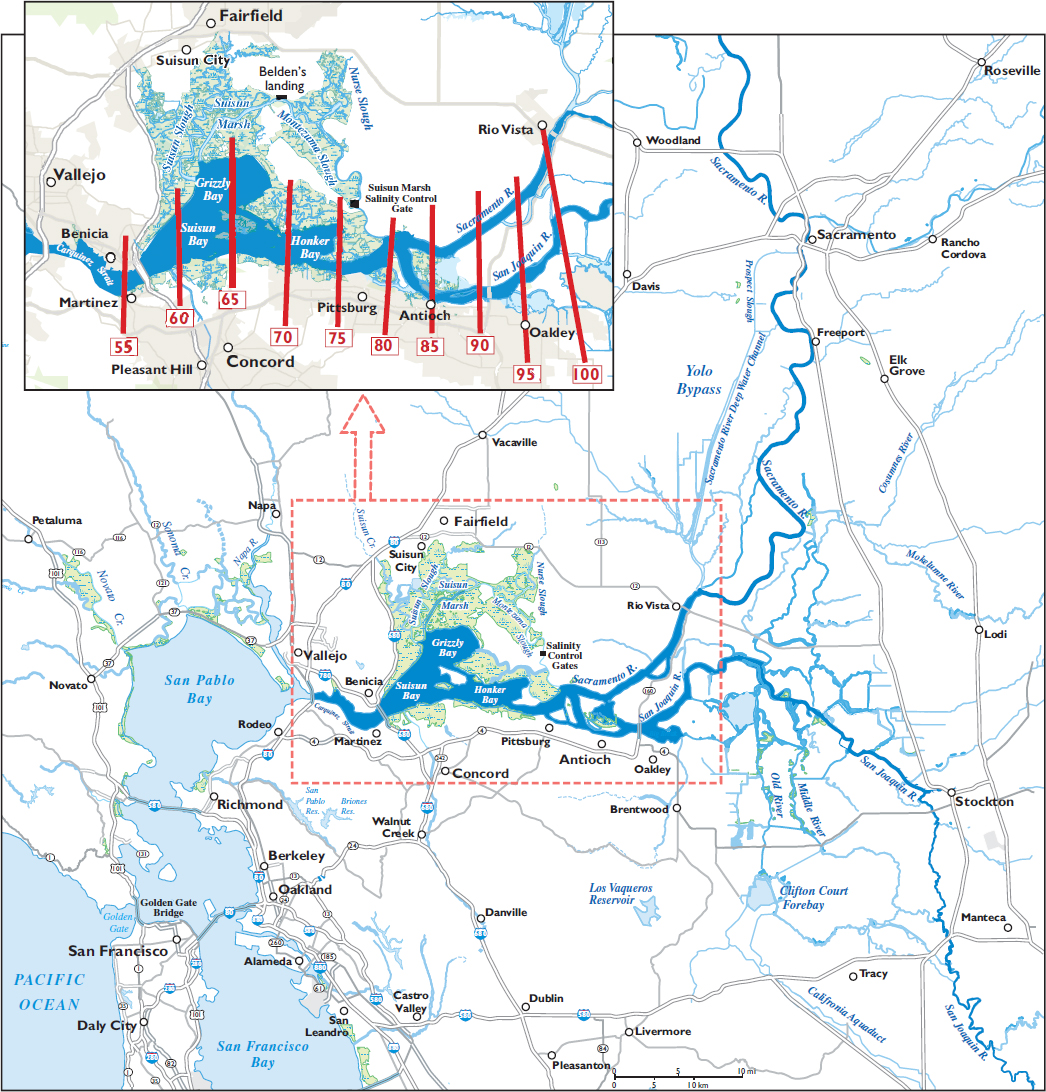
NOTES: The boxed area is the primary focus of the SFHA. The inset shows the distance in kilometers from the Golden Gate Bridge, which is used to measure the position of X2 (2 ppt bottom salinity isohaline).
SOURCE: Kevin Lear, International Mapping Associates.
mass of phytoplankton and zooplankton nauplii (Kimmerer et al., 1994; Moyle et al., 2016), sequestering much of the remaining primary production from the pelagic to the benthic part of the food web (Cloern and Jassby, 2012; Durand, 2015).
The SFHA aims to provide suitable habitat in the summer and fall so that sufficient numbers of juvenile fish will grow and survive through the winter (thereby increasing their recruitment success) and then successfully spawn in the early spring. Because of the substantial and diverse alterations to the upper Sacramento River system and the Delta resulting from a century of land use change and water resources project development (see Appendix B), it is not surprising that a misalignment exists of optimal habitat conditions for sustaining Delta smelt (including food availability) and their preference for the low-salinity zone during certain life stages. Although it is the goal of the SFHA to help mitigate some of those misalignments, the action is not designed or intended to restore pristine conditions. Rather, it is focused on what is thought to be one of the important bottlenecks (summer/fall food limitation) to Delta smelt survival. For this approach to be effective, there must not be other limiting factors that result in high mortality (e.g., predation or entrainment). Given the scale and complexity of the ecosystem and its natural variability, uncertainty remains regarding whether recruitment would actually increase because of the SFHA.
Components of the Action
The SFHA components included in the 2024 USFWS Biological Opinion (USFWS, 2024a, p. 133) and the 2024 California Department of Fish and Wildlife (CDFW) Incidental Take Permit (CDFW, 2024, p. 101) are summarized below, with key details captured in Box 4-2. Hence, implementation of the SFHA is a shared responsibility between the CVP and the State Water Project (SWP).
Fall X2
X2 is a metric developed to characterize the geographic distribution of fresh, brackish, and saline waters across the Delta and eastern San Francisco Bay (primarily Suisun and San Pablo bays). The numeric value of X2 identifies the location along the deep channel where the daily-averaged bottom salinity is 2 ppt, measured in kilometers (km) from the Golden Gate Bridge. X2’s position varies over time, primarily in response to freshwater flow from the Delta over the preceding days to weeks. Higher freshwater flows shift X2 west or seaward (decreasing X2). Although X2 is presented as a distance (see the inset in Figure 4-1), its location determines the spatial extent (area, volume) of low-salinity zone habitat, a critical seasonal habitat for juvenile Delta smelt in summer and fall as well as other biota.
The Fall X2 action calls for maintaining a 30-day average X2 ≤ 80 km from September 1 through October 31 in wet and above normal water years. Achieving freshwater flows into Suisun Bay to sustain X2 at ≤ 80 km during this time period usually requires sustained additional upstream reservoir releases and/or reductions in CVP and SWP exports (on the order of 200 TAF for the period).1
The Fall X2 action has occurred five times—in 2011, 2017, 2019, 2023, and 2024. There is some evidence that the increase in freshwater discharge required for X2 ≤ 80 km can result in increased fluxes of zooplankton from the Delta into Suisun Bay (e.g., Hassrick et al., 2023). Years with such flow augmentation (2017 and 2019) were shown to have higher total zooplankton abundance and altered community composition in Suisun Bay and Suisun Marsh compared to years without the flow augmentation (2018 and 2020) (Lee et al., 2023), suggesting that freshwater flows can influence foraging habitat and prey availability for Delta smelt.
Starting in 2025, the Fall X2 component is subject to reevaluation annually to biannually by technical teams according to the 2024 Biological Opinion Appendix 2: Proposed Action (USFWS, 2024b). This appendix assigns action into “bins” depending on the frequency with which data regarding performance are to be assessed and considered. Indeed, the Fall X2 action was curtailed in October 2024. There is no specific expectation that the Fall X2 component of the action will continue in the future.
___________________
14.3 x 10⁶ m3/day relative to X2 @ 85 km (Andrews et al., 2017) x 1 AF, 1233.5 m3 x 60 days = 209 TAF.
Suisun Marsh Salinity Control Gate Operation
Operation of the SMSCG is the second component of the SFHA and has some overlapping objectives with Fall X2, because both aim to expand low-salinity habitat. A key difference is that the gate operation focuses on Suisun Marsh and seasonally re-establishes low-salinity conditions in this area. This targeted freshening is achieved by operating flow control gates near the river confluence on Montezuma Slough to open the gates and allow freshwater to flow northwest directly into Suisun Marsh on the ebb tides and then close the gates on the flood tide to retain more freshwater in Suisun Marsh. The gate action has both low-salinity and food-supply objectives by creating the low-salinity habitat in the potentially food-rich Suisun Marsh (Colombano et al., 2021).
In above-normal and below-normal water years, and in dry years following wet or above-normal years, the SMSCG is operated for 60 days to maximize the number of days at Belden’s Landing with three-day average salinity ≤ 4 psu between June and October. In dry years following below-normal years, the gate is operated for 30 days to maximize the number of days at Belden’s Landing with three-day average salinity ≤ 6 psu between June and October. The SMSCG component of the SFHA has occurred four times, in 2018, 2023, 2024, and 2025.
According to the 2024 USFWS Biological Opinion Appendix B: Proposed Action (USFWS, 2024b), the SMSCG component of the SFHA has been assigned to Bin 3.2
Supplemental Water Release of 100,000 Acre-Feet
A third component of the SFHA is the supplemental release of 100,000 acre-feet (100 TAF) of additional freshwater to further enhance and enlarge the low-salinity zone. This release is achieved by adjusting CVP releases and export rates from the Delta and can be implemented in conjunction with the Suisun Marsh Salinity Control Gate Operation or as an independent supplemental outflow. In water year 2025, the 100,000 acre-ft release of stored water may be released to supplement Delta outflow from June to September, but is subject to spill from the Oroville Reservoir, according to an agreed plan (CDFW, 2024, p. 101). One hundred TAF of water is equivalent to increasing average Delta outflows by about 400 cubic feet per second (cfs) during this four-month period.3 (This is a small change in the average Delta outflow and would be difficult to detect in the field.) It is unclear if the supplemental 100 TAF component, which has historically been allowed only in above-normal or wet water years, will be part of the SFHA going forward.4
***
Box 4-2 outlines the history of the SFHA as implemented over two decades, including how the suite of SFHA components has changed over time. Formerly, the SFHA included a North Delta Food Subsidies component that involved either diverting water from the Sacramento River to the Yolo Bypass or releasing pulses of agricultural runoff within the Yolo Bypass/Cache Slough region. The augmented flow pulses during low-flow months would ideally transport productive water from upstream to food-limited habitats downstream. Similarly, the SFHA also included a Sacramento Ship Channel Special Study, which considered whether pulses from the highly productive Sacramento Deep Water Channel might serve as a food subsidy for Delta smelt habitats downstream. With this latter approach, fertilizers could be applied to further stimulate production, and a pilot study assessed this potential in 2019 (Loken et al., 2022). Finally, the concept of using managed wetlands as a source of productivity for Delta smelt has also been considered as a potential component of the SFHA. However, these three elements were not included in the 2024 SFHA. Rather they are included as special studies as described in the 2024 USFWS Biological Opinion (USFWS, 2024a).
___________________
2For items in Bin 3, evaluation and potential refinement occur less frequently, on the order of 10–15 years, and may inform the next ESA Section 7 consultation and development of a new incidental take permit.
3This is a unit conversion. 100 TAF = 50,000 cfs = 50,000 cfs in one day. Average additional cfs outflow = 50,000/(4*30) = 416 cfs averaged over four months.
4This paragraph was edited after release of the report to clarify the third component of SFHA.
BOX 4-2
Recent Consideration of the Summer-Fall Habitat Action
The concepts behind the SFHA developed over more than a decade, and details of these actions have evolved through various regulatory processes related to the CVP and SWP. Legal details about the biological opinions and incidental take permits cited below are provided in Appendix C.
2008 USFWS Biological Opinion
(USFWS, 2008) on the coordinated operations of the CVP and SWP included a Reasonable and Prudent Alternative (RPA) to “improve fall habitat for Delta smelt through increasing Delta outflow during fall. Increase in fall habitat quality and quantity will both benefit Delta smelt.” Under the action, subject to adaptive management, USBR and the California Department of Water Resources (CDWR) were to provide, during September and October in years when the preceding precipitation and runoff period was wet or above normal, sufficient Delta outflow to maintain monthly average X2 at 74 km from the Golden Gate in wet water years and at 81 km in above-normal years. The rationale was that Fall X2 had a measurable correlation with recruitment of juveniles the following summer since the introduction of the overbite clam (Potamocorbula amurensis) around 1987 (Cloern and Jassby, 2012). Although a broad relationship between the Fall Midwater Trawl Index (FMWT), which indicates relative Delta smelt abundance (Appendix D), and turbidity and salinity had been established, the relationship was not strong or simple (NRC, 2010). When the action occurred in 2011, an increase in the FMWT index occurred when September–October X2 was at 75 km, near the objective of X2 at 74 km identified in the RPA.
2016 Delta Smelt Resiliency Strategy
(CNRA, 2016) included an Outflow Augmentation action. Conceptual models suggested that seasonally augmented outflows could improve turbidity and hydrology to the benefit of Delta smelt. The strategy also identified North Delta Food Web Adaptive Management Projects, reoperation of the SMSCG, Roaring River Distribution System Food Production, and Coordination of Managed Wetland Flood and Drain Operations in Suisun Marsh as promising actions.
2019 USFWS Biological Opinion
(USFWS, 2019) includes, as part of the proposed action, “Summer-Fall Delta Smelt Habitat.” USBR and CDWR proposed to operate the SMSCG in the summer and fall to create habitat for Delta smelt in Suisun Marsh, in combination with various actions to generate food from the Colusa Basin Drain, Roaring River Distribution System, and Sacramento Deepwater Ship Channel. In addition, in years when the infrastructure operation was unable to create sufficient habitat, USBR and CDWR would operate to maintain X2 at 80 km from the Golden Gate Bridge, a location considered key for possible low-salinity habitat in Suisun Marsh. USBR also proposed a monthly average X2 of 80 km in September–October in above-normal and wet years as an operational backstop to provide a specific acreage of low-salinity habitat.
2020 CDFW Incidental Take Permit
(CDFW, 2020) for the long-term operation of the SWP also included a Delta smelt SFHA. It requires that each year CDWR and USBR develop an SFHA plan that considers actions to improve key aspects of Delta smelt habitat including turbidity and food availability and facilitation of downstream transport of phytoplankton and zooplankton in the North Delta and Suisun Marsh. It requires the establishment of the Delta Coordination Group and the use of SDM.
2024 CDFW Incidental Take Permit
(CDFW, 2024) calls for the annual development of a plan to implement and report on the SFHA for use in adaptive management. The SFHA spans June 1 to October 31. A 30-day average X2 ≤ 80 km is to be maintained from September 1 through October 31 in wet and above-normal years. The SMSCG will be operated to increase habitat and food access for Delta smelt in summer and fall (June through October) in Suisun Marsh and Grizzly Bay during above-normal and below-normal years, and dry years following wet or above-normal years. The duration of the operation and the target salinity are reduced in dry years. There is also a one-time water commitment of 100,000 acre-ft of water in year 2025 from Oroville.
2024 USFWS Biological Opinion
(USFWS, 2024a) includes Fall X2 and operating the SMSCG. Monitoring plans are to be based on a schedule determined by the Adaptive Management Steering Committee. Food subsidy measures, including Managed Wetland reoperation in Suisun Marsh and the Sacramento Deepwater Ship Channel Food Subsidy Action, are considered Special Studies to the SFHA.
The alterations to habitat and flow that result from the SFHA, while aiming to benefit Delta smelt, may affect other fish species’ use of habitat. The 2024 USFWS Biological Opinion evaluated the potential effects of the SFHA on several other species of concern (winter-run and spring-run Chinook salmon, steelhead, and green sturgeon). That evaluation identified straying or delayed migration as the primary potential stressors and estimated the magnitude of effect to be “low” (USFWS, 2024a). Similarly, CDWR (2023) discussed whether the redistribution of stored water to support the SFHA might affect stranding of juvenile spring-run Chinook salmon in the Feather River and egg mortality of winter-run Chinook salmon below Keswick Dam. Concern was expressed about the potential impact of ramping rates from release of 100 TAF from Oroville on spring-run Chinook salmon in the Feather River. However, there could also be benefits to imperiled juvenile fishes rearing in the area, such as more food and more suitable temperatures. Overall, the potential impacts of the SFHA on other fishes are generally assumed to be minor (USFWS, 2024a) and likely extremely difficult to detect.
The Role of Hatchery Fish in the SFHA
The SFHA can benefit from the hatchery-raised Delta smelt supplemented into portions of the river systems; such “supplementation” has been ongoing for a few years for a variety of purposes. The need for supplementation stems from the extremely low densities (mostly zero) of Delta smelt in the data from multiple monitoring programs including the Enhanced Delta Smelt Monitoring (EDSM, see Appendix D). USFWS (2024a) referred to the original supplementation efforts as “experimental releases” for two reasons: (1) whether fish grown at the University of California (UC) – Davis, Fish Conservation and Culture Laboratory would survive when released into the wild was unknown, and (2) the numbers initially released were too small to be considered a full-fledged supplementation program. There is now a Delta Smelt Supplementation Strategy for supplementation that includes production, tagging, transport, and release of cultured adult fish into the wild. The goal is to ramp up production numbers over the next few years to reach 200,000 in water year 2026. USBR and CDWR also expressed an ongoing commitment to helping USFWS and CDFW continue to plan for the construction of facilities that could produce 400,000 to 500,000 Delta smelt by 2030. Notably, cage deployments and tethering of fish have been attempted as part of monitoring for the SFHA, but these techniques introduce problems with fouling, artificial surroundings, and lack of exposure to real-world factors such as predation (Baerwald et al., 2023; Enos et al., 2022) that constrain interpretations and are not considered further.
Why the Action Is Controversial
Economic Cost
The SFHA is considered controversial because it can be costly in terms of water released to the estuary that could have otherwise been exported or stored for later use (including environmental uses). With prices for agricultural uses south of the Delta of roughly $300 per acre-foot, reductions of water exports of 100 TAF per year to support the SFHA would imply an economic loss of roughly $30 million/year for water export uses. Partly because of such considerations, in late 2024 the Fall X2 action was reduced in scope after petitioning from various stakeholders.
Lack of Evidence for Effectiveness
Another issue is the difficulty in measuring and attributing a fish response to the SFHA, which is caused by several factors. First, the ultimate endpoint of the action (Delta smelt) is difficult to detect because they are a short-lived, small-bodied fish in a large heterogeneous system; the habitat is complex and requires many gear types to sample exhaustively; and perhaps most importantly, they are now at such low abundances that any response is likely impossible to detect at this time, especially for wild Delta smelt. However, the use of specifically deployed
tagged or marked hatchery Delta smelt to enable detection of effects might overcome some of these challenges. Because deploying hatchery fish into warm summer waters may be stressful, their utility in relation to detecting a response to this action should be carefully considered.
Second, the system is highly variable in environmental conditions over diel, seasonal, and interannual scales, which makes detection of responses to discrete interventions more challenging. The targeted biotic and abiotic factors that are the focus of this action would have naturally fluctuated widely interannually, because of ocean influences and climate variability, as well as spatially within subregions of the estuary, due to extremely heterogenous hydrodynamics (Brown et al., 2024). Within a given year, phytoplankton and other carbon sources are typically higher in areas of the estuary where flood tides dominate ebb tides. This natural temporal and spatial variability in the interactions between physical processes and the landscape, which ultimately creates high-quality habitat for Delta smelt, is described in detail in Brown et al. (2024). As a consequence, for example, it could be difficult to detect an increase in zooplankton in the low-salinity zone, because the zone is large in spatial scale and very dynamic, zooplankton are notoriously patchy, and both the water and the zooplankton are moving with the tide.
Third, this action takes an ecosystem-based approach and seeks to affect a whole food web. Although this approach is scientifically robust and ambitious, food-web dynamics are often difficult to distinguish from individual species dynamics (e.g., DeAngelis et al., 1989; Polis and Strong, 1996). This could be particularly true in a food web that has been “rewired” by numerous invasions, including by indirect competitors such as the overbite clam (Potamocorbula amurensis), which appeared shortly before Delta smelt started to decline and is presumed to have reduced primary production five-fold (Cloern and Jassby, 2012). The fact that other planktivorous fishes also declined in abundance over this time frame (Colombano et al., 2022) further suggests that these indirect interactions may be important (Moyle et al., 2016) and could introduce uncertainty in the action by preventing increases in pelagic production from benefitting pelagic consumers such as the Delta smelt.
Fourth, it may be difficult to attribute any observed changes in phytoplankton or zooplankton density or other targeted abiotic conditions to a specific flow management action (and not to climatic variability, annual hydrology, or some other factor). Evidence is emerging that other stressors, such as temperature, can confound the success of actions such as Fall X2 (Hammock et al., 2022). In addition, although studies exposing Delta smelt to agricultural drainage water collected during SFHA-like actions found no acute toxicity, negative effects were found in the livers of Delta smelt exposed to agricultural water from the Toe Drain and Cache Slough during a 2019 pulse flow action, which coincided with higher detections and concentrations of organic pesticides (Hammock et al., 2015; Stillway et al., 2024). The lack of consistent response of Delta smelt to flow-related actions suggests a need to further understand the role of additional stressors, and their interaction with flow actions.
Finally, because the components of the SFHA are designated for implementation only in some water-year types and not repeatedly across years, conditions may change in the estuary from one implementation to the next, making it difficult to detect a consistent response.
MONITORING FOR THE SFHA
Although direct measures of Delta smelt abundance would be the ultimate metric for the SFHA, monitoring and analysis currently target the amount and quality of habitat that have been identified as critical for improved Delta smelt growth and survival (CDWR, 2023; CDWR and USBR, 2024a; USBR and CDWR, 2023). These variables serve as primary indicators of SFHA effects for two key reasons. First, improved Delta smelt growth and survival are the end-products of a multi-step set of ecological processes that would be difficult to detect under the best of circumstances because of natural variability. Second, it is unlikely that the response produced by a single favorable action would be readily detectable given the extremely low current populations of Delta smelt.
This section focuses on evaluating responses to two of the current components of the SFHA: Fall X2 and SMSCG operation. CDWR and USBR (2024a) summarize the approach to monitoring for SFHA responses as primarily utilizing monitoring data collected through long-term monitoring programs, which were not designed specifically to detect Delta smelt or Delta smelt response to management perturbations, and the EDSM program, and supplementing those efforts as needed. Table 4-1 summarizes the monitoring activities, environmental vari-
ables, and analyses used to test for and quantify ecosystem responses to the two components, with each row corresponding to a hypothesized response. Figures 4-2 to 4-4 provide the sampling locations for the monitoring.
The hypotheses set forth in the SFHA 2024 Comprehensive Monitoring Plan (CDWR and USBR, 2024a) include the following:
- Hypothesis #1: Decreasing X2 and/or operating the SMSCG during summer or fall will increase the area and duration of habitat with appropriate temperatures, turbidity, and salinity for Delta smelt.
- Hypothesis #2: Decreasing X2 and/or operating the SMSCG during summer or fall will increase biomass of calanoid copepods in the low-salinity zone, through their increased transport from upstream areas.
- Hypothesis #3: Operating the SMSCG will increase the area of appropriate Delta smelt habitat in Grizzly Bay.
- Hypothesis #4: Better habitat and increased food availability will improve Delta smelt growth and survival.
The first three hypotheses focus on measuring indicators of habitat. The 2023 Comprehensive Monitoring Plan (CDWR, 2023) calls for testing Hypotheses #1 and #3 using data from the existing networks of continuous sensors (15-minute data) that measure temperature, salinity, and turbidity. CDWR and USBR (2024a) also proposed using three-dimensional (3-D) hydrodynamic models in combination with (or calibrated using) mooring data to estimate the area that reached suitable conditions (i.e., salinity < 6 psu and temperature < 22°C), or to hindcast conditions during earlier time periods that predate establishment of the sensor network. The difference between Hypotheses #1 and #3 is that #1 considers conditions over a wide spatial extent (Suisun Bay and Marsh, Grizzly Bay, and the Sacramento River), while #3 focuses specifically on Grizzly Bay using data from a subset of locations.
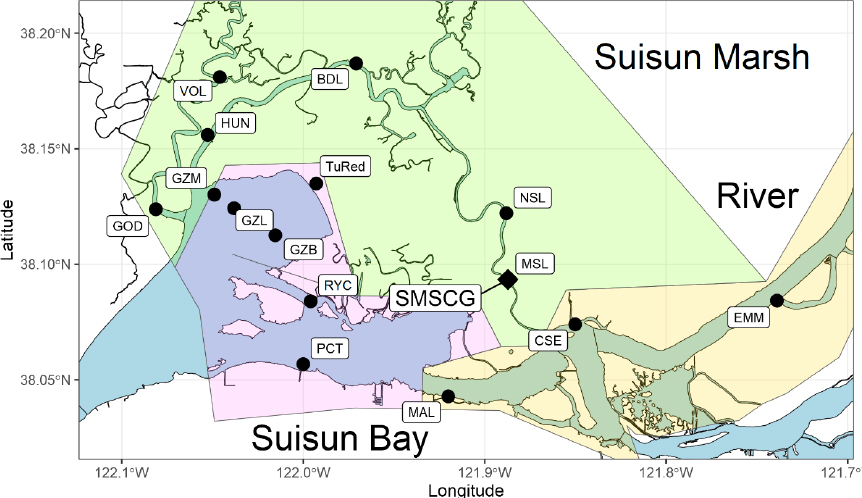
NOTES: Salinity, temperature, dissolved oxygen, and turbidity are measured at all locations. Sensors for additional parameters (pH; chlorophyl and phycocyanin fluorescence) are included at a subset of the stations (CSE, MSL, NSL, BDL, HUN, GZL, GZB, GZM, TRB); periodic discrete samples (biweekly or monthly) are also collected at these locations for measuring chlorophyll a and nutrient concentrations. The three regions used for major comparisons are shown in yellow (lower Sacramento River), green (Suisun Marsh), and pink (Suisun Bay).
SOURCE: CDWR (2023).
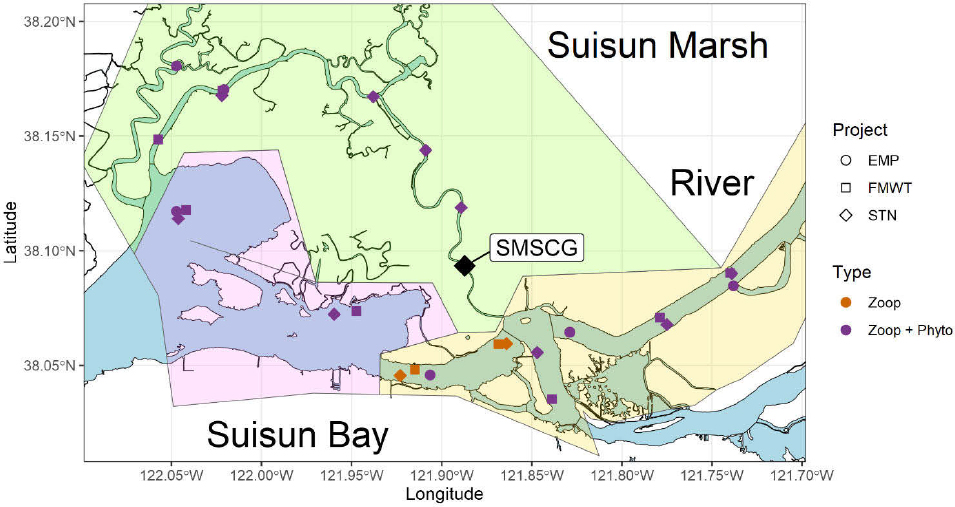
NOTES: The three regions used for major comparisons are shown in yellow (lower Sacramento River), green (Suisun Marsh), and pink (Suisun Bay). EMP = Environmental Monitoring Program; FMWT = Fall Midwater Trawl Index; STN = Summer Townet Survey (see Appendix D).
SOURCE: CDWR (2023).

NOTES: The three regions used for major comparisons are shown in yellow (lower Sacramento River), green (Suisun Marsh), and pink (Suisun Bay). FMWT = Fall Midwater Trawl Index; STN = Summer Townet Survey; Bay Study = CDFW San Francisco Bay Study; Suisun = UC Davis Suisun Marsh Fish Survey.
SOURCE: CDWR (2023).
Testing of Hypothesis #2 relies primarily on zooplankton data from three ongoing monitoring programs (Summer Townet Survey, FMWT, and the Environmental Monitoring Program—see Appendix D). The Environmental Monitoring Program conducts year-round monthly sampling, while the other two programs sample monthly within seasonal windows (Summer Townet Survey: June–August; FMWT: September–December). The study plan notes that additional sampling will also be performed related to these actions, to increase sampling spatial and temporal resolution. However, this hypothesis would be best tested by estimating zooplankton production rates (e.g., from exclosure experiments before and after the action, along a gradient of action influence) (Poff, 2018; Vanni, 1987). Zooplankton biomass or counts are an imperfect proxy for production (or actual “food availability”) because they only reflect the uneaten portion, and because production/biomass relationships may be affected by the action itself (e.g., as a consequence of changing water temperature and thus zooplankton growth rates).
Delta smelt responses to the SFHA (Hypothesis #4) are tested primarily through analyzing fish abundance data from existing surveys (Table 4-1 and Figure 4-4), with the science and monitoring plans highlighting two limitations to this approach. First, of the six fish monitoring surveys being used, only one, the EDSM, has been catching Delta smelt regularly. Second, multiple action years may be required (and results combined) before statistical analyses can be reliably performed to assess the effects of the SFHA. Because all of the existing monitoring programs extend over larger areas than the SFHA regions of interest, each survey has only a few relevant stations or limited seasonal sampling windows (CDWR, 2023).
None of the routine monitoring plans includes direct measurements of vital rates (e.g., growth, survival), which limits the ability to detect the effectiveness of the action on Delta smelt. While such measurements for wild Delta smelt are currently limited by low abundance, the lack of such information on key response variables further confounds understanding of the action.
The SFHA science and monitoring plans are described in more detail in two recent technical reports (CDWR, 2023; USBR and CDWR, 2023) that underwent technical review through a 2024 peer-review process led by the Delta Stewardship Council (DSC, 2024a). The SFHA science and monitoring plans are explored further in the section on Additional Science Topics.
SFHA MODELING
Several computer models of various physical, chemical, and biological processes are (or can be) employed in the SFHA (Table 4-2). The routinely used models rely mostly on operations, hydrodynamic, and water quality models that grew from modeling needs for Delta water supply operations and are discussed below. Table 4-2 also lists other research models that have been used infrequently and provide some innovations and insights into the SFHA. Several of these studies are mostly statistical estimations of Delta smelt habitat suitability indices (Bever et al., 2016; Hamilton and Murphy, 2020; Manly et al., 2015; Nobriga et al., 2008; Nobriga and Rosenfeld, 2016; Sommer et al., 2011).
The hydrology of the Central Valley and operations of its major water projects are simulated using CalSim3 (see Chapter 3 and Appendix D), which outputs monthly flows into the Delta and Delta pumping and outflow boundary conditions to be used in other Delta hydrodynamic and water quality models. Also discussed in Chapter 3, internal Delta hydrodynamics and salinity are routinely represented by the faster one dimensional (1-D) Delta Simulation Model II (DSM2) model. This model is used to manage most Delta water supply operations and regulations and serves as a foundation for the Delta smelt model IBMR, which can estimate effects on Delta smelt populations from flow, salinity, and broader habitat conditions.
The Semi-implicit Cross-scale Hydroscience Integrated System Model (SCHISM), a 3-D model of Delta hydrodynamics and salinity, is the main model used to assess the likely extent of suitable salinity habitat from the SFHA, using upstream freshwater inputs from CalSim3. SCHISM and UnTRIM (another 3-D Delta model) calculate water depths, flows, and salinities over small time scales and over a relatively fine 3-D grid of the Delta and San Francisco, extending outside the Golden Gate Bridge and upstream to the extent of tidal influence. Both models are computationally intensive, with much greater spatial resolution than both DSM2 and the fast, empirically trained artificial neural network models of salinity at specific locations (see Chapter 3). These 3-D models also display good skill in predicting water surface elevation, velocity, and salinity. Delta smelt habitat indices are estimated from 3-D model results, mostly using the habitat suitability method of Bever et al. (2016) (described in more detail below).
TABLE 4-1 Overview of Monitoring and Other Data Used for Assessing Responses to the SFHA
| Hypothesized Response | Long-Term Monitoring | Special Studies and/or Analyses to Quantify Response |
|---|---|---|
| Parameters, Region(s), # of stations, Sampling Frequency | ||
|
|
|
|
|
|
|
|
|
|
|
|
SOURCE: CDWR and USBR (2024a).
The water surface elevation, flow speed, and salinity predictions from these models (DSM2, SCHISM, and UnTRIM) are fairly accurate and reliable, based on well-known physics. Estimates of Delta smelt habitat suitability and populations are far less mature, less accurate, and calculated over coarser spatial scales. The prognosis for developing more accurate Delta smelt models is greatly hindered by the lack of wild Delta smelt available for improving these models. Yet, the precarious position of Delta smelt makes developing mechanistic life-cycle models for this species urgent, in order to help inform Delta environmental and water policies and operations.
The modeling summarized in Table 4-2 was an application of the information available when the SFHA was being planned for water year 2022. Ideally, annual planning would be supported by predictions of how the SFHA will affect the suitability of habitat, and ultimately Delta smelt, for different environmental conditions and management strategies. However, although a few of the models currently available contain components necessary for modeling the likely effects of the SFHA, none contain all the components. Life cycle-specific models for Delta smelt are described in Appendix E. Most of them, including Maunder and Deriso (2011) and Polansky et al. (2021), are based on statistical analysis, meaning they cannot be reliably applied to conditions not represented in the data used to build the statistical relationships. Those that are process based, such as Rose et al. (2013a,b), are driven in part by existing field data and therefore are limited in their application to future conditions for which representative data are unknown.
Models that could potentially be used to evaluate the environmental impacts of the CVP and SWP on listed fishes were reviewed in detail in the 2024 USFWS Biological Opinion (USFWS, 2024a), where the following criteria were used to consider model suitability: (1) models are accessible and model output can be reproduced by an independent party, (2) model structure is well documented including model assumptions, (3) model functions are responsive to changing operations such as flow, and (4) model output informs performance metrics. With regard to modeling Delta smelt habitat, food, and growth potential, USFWS (2024a) considered a common bioenergetics approach (e.g., Rose et al., 2013a,b; Smith et al., 2021) but determined that CalSim outputs were inappropriate as inputs into these models, a common issue with coupling CalSim with other models that operate on a finer time scale than one month (see Chapter 5). Regarding the evaluation of different water project alternatives, the Kimmerer Copepod Box Model (Hassrick et al., 2023; Kimmerer et al., 2019) requires empirical field data that are not available for planned management actions, limiting its application. The RMA Copepod BPUE Model5 remained under review at the time of the 2024 Biological Opinion and therefore was not considered in detail but was believed to be limited in scope.
The Bever et al. (2016) Habitat Suitability Index for Delta smelt is perhaps the most promising statistical approach for modeling the effects of the SFHA. The approach uses a 3-D hydrodynamic model in combination with long-term data from the FMWT, in order to develop a statistical relationship between Delta smelt catch and (1) salinity (percent of time < 6 psu), (2) velocity (maximum depth-averaged current speed over a four-month period), and (3) turbidity (0.5 meter Secchi depth threshold). Based on these relationships, Bever et al. (2016) predicted a catch station index (relative ranking of FMWT stations) based on Delta smelt catch. This index was also validated with Delta smelt data from the Bay Study survey, and general agreement throughout the Delta was determined. Bever et al. (2016) used the UnTRIM Bay-Delta Model, but the statistical relationships can be applied using SCHISM. Although informative, this modeling approach is not process based and cannot predict how the SFHA will operate mechanistically under different scenarios.
DECISION SUPPORT TOOLS
Decision support tools can enable the integration of field data, available model results, and technical, scientific, and management expertise to inform decision makers. Decision tools, data, and models co-evolve over time with decision concerns, options, and processes. Unlike the Shasta Coldwater Pool Management Action and the Old and Middle River Flow Management Action, the SFHA has used an SDM approach to determine how the SFHA will be implemented each year. This approach considers information about the state of the system during each
___________________
5Calanoid copepod analysis addendum; see https://dshm.rmanet.app/overview/rma_calibration_reports/USBR_LTO_copepod_addendum.pdf.
TABLE 4-2 Summary of Models/Tools Used in SFHA in Water Year 2022
| Model | Inputs | Outputs | Notes on Model Use for the SFHA |
|---|---|---|---|
| CalSim3 (2022) | Hydrology from and within watersheds; Delta flow requirements | Monthly inflows into the Delta, water exports from the Delta | Delta operations and Delta model boundary conditions (monthly inflows and outflows) affecting internal Delta flows and water quality |
|
SCHISM (3-D) a Ateljevich et al. (2021) | Flow boundary conditions from CalSim3 | Salinity distribution, temperatures, habitat metrics based on acreage/frequency | Used to assess extent of salinity habitat from SFHA. Generally good predictions, conditioned on wind and air temperature, salinity, and water temperature assumptions. Turbidity is less well predicted. a |
|
DSM2 (1-D) CDWR (2019) | Hydrology from CDWR studies and CalSim3 | Salinity, water export cost | Only simulations of salinity are used for the SFHA. The biggest limitation is the uncertainty in hydrologic forecasts. |
|
IBMR Rose et al. (2013a,b) Kimmerer and Rose (2018) | Hydrodynamics, prey density, Secchi depth, smelt distribution, temperature, turbidity | Simulated population growth rate; can also produce simulated individual growth rates, or growth potential | Individually based model for Delta smelt written in R. Includes reproduction, growth, mortality, and movement of individual Delta smelt and prey over their entire life cycle on a DSM2 grid. Field validation not possible. |
|
RMA Bay-Delta modelb (2-D), RMA San Francisco Estuary UnTRIM c (3-D) RMA (2021) | Wind velocity, air temperature, solar radiation, and cloudiness; salinity and water temperature from data and DSM2; Secchi depth data | Salinity, temperature, turbidity, water velocity for input to a habitat suitability index | Coupled hydrodynamic, water quality, and habitat suitability modeling. Did not include different implementation scenarios for the SMSCG action. Relies on historical conditions. |
| Various Habitat Suitability Index Estimation Studies | |||
| Bever et al. (2016)d | UnTRIM/SCHISM outputs and historical FMWT data | Habitat Suitability Index used in the 2022 Structured Decision Making | Uses UnTRIM/SCHISM hydrodynamic and water quality outputs and historical FMWT data to estimate Delta smelt preferences for different types of habitat |
| Nobriga et al.(2008)e | Temperature, turbidity, salinity | Habitat Suitability Index | Statistical analysis of water quality suitability for Delta smelt |
| Manly et al. (2015)f | Salinity and turbidity | Habitat Suitability Index | Low predictive accuracy for presence of Delta smelt |
| Hamilton and Murphy (2020) Smelt Habitat | Field data: depth, copepod biomass, temperature, turbidity, and prey | Habitat Suitability Index | Copepod biomass is only food source |
| Other Coupled 3-D Hydrodynamics, Water Quality, and Zooplankton Biomass | |||
| Kimmerer copepod box model; Kimmerer et al. (2019) g; Hassrick et al. (2023) h | 3-D hydrodynamic model for velocity, salinity, volume, and particles moving per day | 3-D temperature, salinity, turbidity, and zooplankton biomass | Assumes copepod densities and reproductive rates are similar to historical levels. Only models Pseudodiaptomus forbesi. |
a See https://data.cnra.ca.gov/dataset/methodology-for-flow-and-salinity-estimates-in-the-sacramento-san-joaquin-delta-and-suisun-marsh/resource/c64349eb-397a-47c1-b516-b3f522528c00.
b See https://dshm.rmanet.app/overview/.
c See https://dshm.rmanet.app/overview/rma_calibration_reports/USBR_LTO_Summer_Fall_Delta_Smelt_Habitat.pdf.
d See https://escholarship.org/uc/item/2x91q0fr.
e See https://escholarship.org/uc/item/5xd3q8tx.
f See https://link.springer.com/article/10.1007/s12237-014-9905-3.
g See https://escholarship.org/uc/item/4b1433j7.
h See https://link.springer.com/article/10.1007/s12237-022-01142-1.
water year and how it can be used to inform the planning and execution of either Fall X2 or the operation of the SMSCG, as described in greater detail below.
The Annual Decision Process for the SFHA
The Delta Coordination Group determines how the components of the SFHA are implemented each year. The determinations are based on available projections and information about the hydrologic conditions reflected in the water-year type and use an SDM tool. Documentation made available to the Committee to inform its understanding of the SDM approach for water years 2022 and 2023 (DSC, 2024b,c) had been previously compiled for a 2024 Delta Science Program review of the science and monitoring plans and decision approach for the SFHA (DSC, 2024a). No specific documentation of the SDM approach was available for water year 2024, but the 2024 Action Plan for the SFHA notes, “The 2024 recommendation was based on (1) previous SDM iterations developed by the Delta Coordination Group, (2) new analyses of low-salinity zone habitat, temperature, and food (i.e., Pseudodiaptomus forbesi) for scenarios, and (3) a series of collaborative discussions within the Delta Coordination Group of predicted benefits to Delta smelt” (CDWR and USBR, 2024b). Of note, the SFHA for water years 2022 and 2023 included actions that are no longer part of the SFHA in the 2024 Biological Opinion (e.g., North Delta Food Subsidy).
SDM was used in water year 2023 to answer the question, “What suite of actions should the Delta Coordination Group recommend for the SFHA period (June to October), given the likely water-year types?” This question encompasses not only whether the action involves Fall X2 or operation of the SMSCG but also how to implement the action. The SDM approach was designed to cover as many water-year types as feasible given time and data. Water-year types are initially set by first-of-month runoff forecasts beginning in February. The final determination is based on the May 1 forecast of conditions that have a greater than 50 percent chance of occurring. SDM meetings begin earlier in the year; hence, the Delta Coordination Group met in January and February 2022 to consider updates from the approach used in water year 2021 and therefore had to consider several water-year types to develop plans that could be implemented once the final water year was determined in May.
The stepwise SDM process considers the following:
- Decision objectives—the factors important enough for the Delta Coordination Group to consider when determining the nature of the SFHA in that year
- Performance measures for each decision objective—the metrics that will be used to characterize the Delta Coordination Group’s predictions of an alternative’s performance relative to a decision objective
- Alternatives—management actions as well as science actions or monitoring
- Consequences of each alternative for each decision objective—prediction of performance using methods agreed on by the Delta Coordination Group
Figure 4-5 presents an example of the influence diagram developed to support the SDM in water year 2022. At the far right-hand side of the diagram are fundamental objectives such as Delta smelt recruitment (in a white box)—the outcomes identified through the SDM process that Delta Coordination Group members care about and that can be affected by the decision. Increased Delta smelt recruitment is supported by increased Delta smelt growth and survival (DSC, 2024b). Because many efforts beyond those covered by the SFHA are geared toward increasing Delta smelt recruitment, and because the broader system is complex and poorly understood, Delta smelt recruitment is unlikely to be useful as a decision objective. Thus, Delta smelt growth and survival are shown as decision objectives (in blue boxes). The grey box on the left-hand side of the diagram contains the main categories of management actions that the Delta Coordination Group considered in the water year 2022 SDM process. The central part of the influence diagram shows how changes in management levers influence different aspects of the system that ultimately influence Delta smelt growth and survival. Of note, the SDM process includes documentation of how the relationships on the influence diagram are commonly understood by the Delta Coordination Group.
The consequences analysis, both quantitative and qualitative, determines the effects of the SFHA on the various decision objectives. Fact sheets are developed based on predictive models and expert elicitation. Some
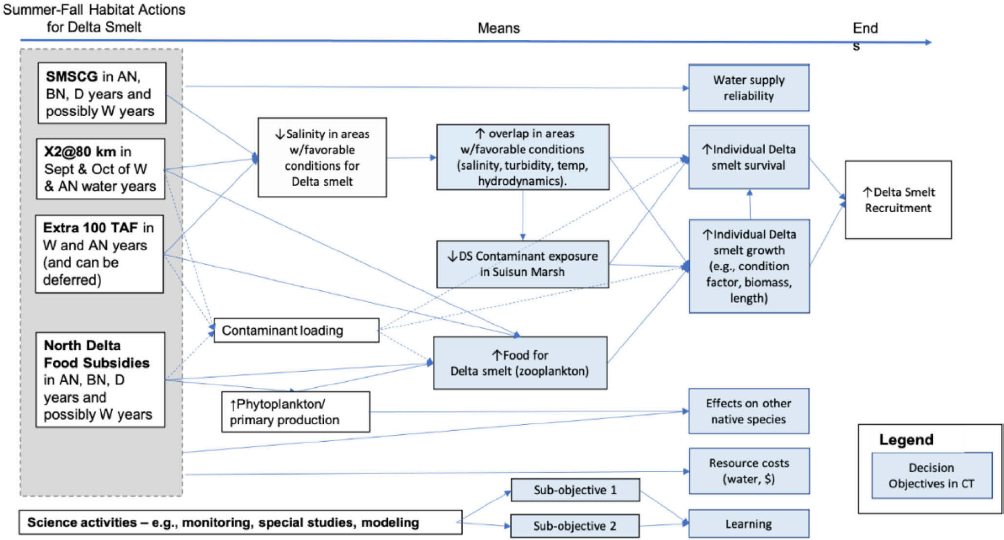
NOTE: The North Delta Food Subsidy is no longer part of the SFHA.
SOURCE: CDWR and USBR (2023).
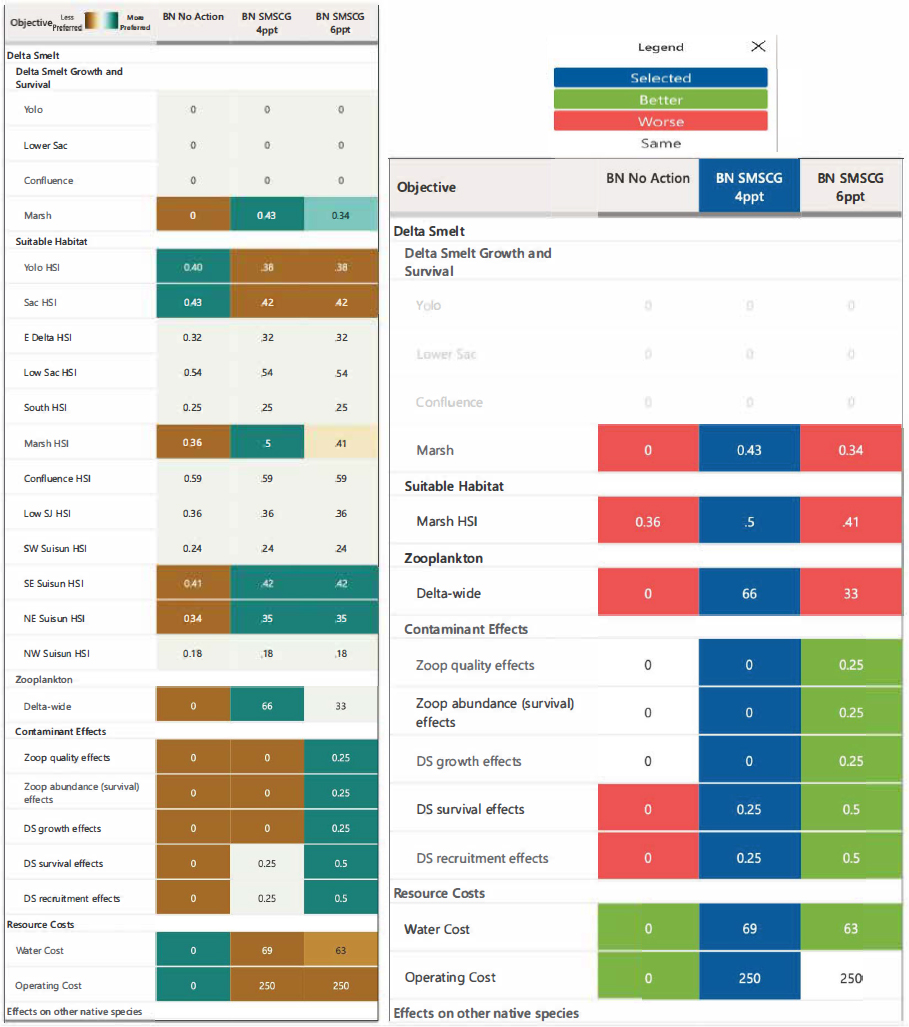
performance measures are assessed using models (e.g., a bioenergetics model) and habitat suitability indices, while others are assessed using expert elicitation, whereby experts rate alternatives relative to “No Action” using a predetermined scale (e.g., to assess exposure to contaminants). The consequences of each alternative action are then compared, and consequences and tradeoffs are explored by the Delta Coordination Group using Compass Resource Management’s online Altaviz tool.
Figure 4-6 shows an example of the display from Altaviz for a below normal (BN) water year. In the left panel, color coding (brown to green for less effect to more effect) is used for the outcomes that are impacted by two different options for SMSCG operation (i.e., achievement of either ≤ 4 psu or ≤ 6 psu at Belden’s Landing versus not undertaking the action). The table on the right of Figure 4-6 shows the details of the table on the left but displayed in a more simplified way. Here, performance is categorized as better or worse than a selected option.
In water year 2022, consensus on the selected approach for the SFHA was reached through negotiation. For water year 2023, the Delta Coordination Group used an optimization approach to tradeoffs. The selected optimization method, Simple Multi-Attribute Ranking Technique with Swings, worked as follows:
- Prior to meeting to decide on SFHA recommendations, each Delta Coordination Group member weighed growth, food, and contaminant subobjectives in terms of their relative importance to the overall Delta smelt objective, and then weighed the four top-level objectives (Delta Smelt, Effects to Other Species, Costs, and Learning) in terms of overall importance. Each member also directly ranked alternatives.
- Scores for each performance measure were normalized to a 0 to 1 scale.
- Normalized, weighted scores were summed for each alternative to create a single gross utility score for each Delta Coordination Group member.
These results were then used to facilitate the Delta Coordination Group’s discussion. This approach provides a way of depicting how close or far apart the different group members are in their thinking. However, as informa-
SOURCE: DSC (2024b).
tion is scored and normalized, some nuances of members’ individual preferences may be less obvious than if they were revealed through negotiation.
Suggestions for Improving the SFHA Decision Process
Because the SDM process was reviewed in detail by the Delta Science Program (DSC, 2024a), this Committee did not repeat that review. DSC (2024a) expressed concerns about ambiguity in the definition of objectives and a lack of clear framing of the process, including the scope. Regarding participants, the review noted “that group members from state and federal resource management agencies and the state and federal water contractors,
who have had long involvement in the water projects, can introduce a status quo bias and discourage insightful questions and the development of new alternatives.” Finally, the review noted a lack of focus on uncertainties, tradeoffs, and priorities:
SDM is decision-based and thus requires simplification: when an Objectives by Alternatives consequence matrix grows large, it no longer provides an easy path to insights for making better management decisions. An SDM process achieves simplification by highlighting uncertainties (with respect to the consequences of actions), tradeoffs (with respect to the achievement of objectives), and priorities (in terms of what is most important to the decision at hand). These reports describe the modeling results and provide convincing documentation that reducing extinction risks to Delta Smelt is a complex task.
Presently, whether the Fall X2 component of the SFHA will occur is based on water-year type. However, water-year type may not be an appropriate way to characterize the conditions under which X2 will be most successful. For example, even in “wet” years, spring conditions (such as temperatures) could be so unfavorable that they would preclude success of the X2 component. Furthermore, planning for the SFHA occurs early in the year so that agencies and water users can plan for and coordinate water needs. However, water-year type may not be clear until early May. Although water users should have reasonable expectations of how water deliveries may change, a set of triggers for moving forward with various components of the SFHA could be established based on expectations developed early in the year. For example, this might include information on antecedent conditions, temperature, and availability of food resources, with the goal of identifying under what conditions the action’s components would proceed and how. Closer to the time of the action, monitoring data could be used to adjust SFHA implementation based on the triggers. There is sufficient flexibility in how the SFHA is described in regulatory documents to allow for year-to-year adjustments. Taking advantage of this within-year flexibility could achieve a more efficient and effective use of water, staff, and field data collection resources.
If implemented collaboratively including a range of stakeholders, SDM should improve the transparency, efficiency, and hopefully the effectiveness of regulated operations (e.g., Peterson et al., 2024). The 2024 biological opinions and incidental take permit do not require the use of SDM for annual planning of the SFHA. However, the adaptive management approach described in Appendix 2 of the USFWS 2024 Biological Opinion (USFWS, 2024b) states that adaptive management teams will use “decision-analytic tools or a structured decision-making process to define relevant uncertainty, develop action alternatives, estimate expected consequences of the alternatives, and evaluate trade-offs and preferences when making choices between alternative courses of action.”
ADDITIONAL SCIENCE TOPICS
The SFHA is complex and ambitious in the changes it seeks, and by its nature it will be difficult to unambiguously trace response variables back to the SFHA. The complexity of the system and confounding factors make it difficult to isolate the impacts of the action from those attributed to other system dynamics. Furthermore, the relationships among the action, food availability, and Delta smelt recruitment are not fully understood. Low Delta smelt abundance poses additional challenges, and questions remain about the potential role of experimental releases of cultured fish. Finally, opportunities exist to explore the potential role of tidal modifications in the system to support the delivery of food for Delta smelt. These multiple challenges facing the SFHA could be addressed with new science as discussed below.
Isolating the Action from Other System Dynamics
As mentioned previously, a major challenge to implementing the SFHA is the extreme difficulty in isolating the effects of the action from the other system dynamics to identify direct effects the availability of spawning habitat. It is necessary to rule out the effects of other stressors on either Delta smelt individuals or their food resources. Factors that may be important are predation (either of Delta smelt or their prey) and other food-web interactions, the effects of contaminants, the availability of spawning habitat, and warming water temperatures.
Predation and Food-Web Interactions
Several studies have examined the potential effects of predation on Delta smelt in general (Nobriga and Smith, 2020), and Mississippi silversides have been identified as predators, especially in clearer water (Schreier et al., 2016), with less evidence of a clear role for striped bass (Brandl et al., 2021). Genetic analysis (e.g., eDNA) of potential predators in the areas where Delta smelt are proposed to benefit from the SFHA could help to identify the potential for predation to counter expected benefits.
The Delta Independent Science Board recently released a report (DISB, 2024) with a goal of advancing food-web science to better inform a broad range of management decisions, including the SFHA. If food-web models were updated and improved, they could support planning of the SFHA by predicting and understanding the effects of the SFHA on (1) other fishes (e.g., longfin smelt and salmonids), (2) non-native competitors of Delta smelt, and (3) predators of Delta smelt.
Contaminants
Some components of the SFHA increase flows in areas or at times of the year when they would otherwise be low. This increase in flows has the potential to mobilize and transport contaminants to the areas where the Delta smelt are expected to benefit from the action. Hammock et al. (2015) demonstrated that Delta smelt from the Suisun Marsh region had better morphometric and histopathological condition and higher short-term nutrition and growth indices. In contrast Delta smelt from the freshwater regions of the estuary, particularly Cache Slough, demonstrated the greatest histopathological signs of contaminant exposure.
Stillway et al. (2024) similarly conducted laboratory experiments with Delta smelt exposing them to field water from six sites in the estuary that encompass the freshwater and low-salinity habitat of Delta smelt. No acute toxicity was observed during any exposure, but negative effects were observed in the livers of Delta smelt exposed to agricultural water from the Toe Drain and Cache Slough during the 2019 pulse flow action, which coincided with elevated detections and concentrations of organic pesticides. Clearly, understanding whether potentially toxic contaminants are mobilized by the components of the SFHA needs to be monitored. Changing the patterns of exposure to contaminants as a result of the SFHA could be a potential stressor confounding the response of Delta smelt to the action.
Spawning Habitat
Availability of suitable spawning habitat for Delta smelt is another potentially important constraint on their recovery. Dense invasive submersed aquatic vegetation (SAV) can physically block access to shallow channel margins, alter local flow and dissolved oxygen conditions, and reduce the availability of suitable substrate for egg deposition. Monitoring programs and recent syntheses have documented rapid expansion of invasive SAV over the past two decades, particularly during drought years when water clarity increases (Christman et al., 2023; Smits et al., 2025). In tidal freshwater sloughs of the northern Delta, vegetation cover increased dramatically—by factors of six (e.g., Lindsey Slough) to nearly 1,000 (e.g., Cache Slough) over the last decade (Smits et al., 2025), coincident with large increases in water clarity. These vegetation-driven changes not only obstruct spawning access but also modify light regimes, decrease turbidity, and create habitat for non-native predators, compounding other stressors on Delta smelt (Moyle et al., 2016).
Temperature
High temperature is a well-established stressor for Delta smelt (e.g., Davis et al., 2019), and therefore high temperatures in some years could negate potential positive effects of the Fall X2 action. For example, although 2017 was one of the wettest years on record, the Delta smelt population did not demonstrate a corresponding increase with the Fall X2 action during the fall or the following spring (2018), in comparison to the action in 2011 (Brown et al., 2014). Although the specific reason is unclear (Schultz et al., 2019), the 2017 Delta smelt year class
began with poor recruitment in spring 2017 and below average survival for spring to summer and summer to fall. Thus, low production and low survival led to low abundance of all life stages. One reason could have been water temperature, which in 2017 approached or passed levels (≥ 22–23°C or 71.6–73.4°F) where physiological stress for Delta smelt has been shown to occur (FLOAT-MAST, 2020), especially in the more landward regions of the study area. As discussed previously, adjusting the decision process for the SFHA so that information about within-year conditions can be considered may enable better tuning of the action to the conditions at hand, or a decision that the action is unlikely to be effective in a given year.
***
When they reach certain levels, each of these stressors individually could limit the ability to detect a response of Delta smelt to the SFHA. Their interactions may produce even more complex results. The use of laboratory experiments has advanced our understanding of Delta smelt response, such that continued studies of interacting effects, such as the Davis et al. (2019) study of temperature and predation, could provide insight, especially if the potential beneficial effects of the SFHA such as food and turbidity are also interactively examined. Otolith analyses (Lewis et al., 2021) of wild fishes captured between 2011 and 2019 have been insightful and have shown how growth of Delta smelt varies with environmental conditions. In the future, if Delta smelt were to increase in abundance and/or supplemented fish were used, additional studies of this type may provide greater insight into environmental conditions that should be targeted. This information would be complementary to statistical analysis of Delta smelt catches in long-term monitoring programs (such as the data relied on in Feyrer et al., 2007).
Will Increasing Food Supply Help Delta Smelt Persist?
This chapter began by stating that the SFHA was a way of better aligning Delta smelt distribution, their preferred low-salinity habitat, and available food. Several aspects of the SFHA seek to increase the availability of food resources in the low-salinity zone, but the links between these actions and Delta smelt abundance are not fully understood. Although zooplankton growth rate and reproductive output is positively related to chlorophyll concentration (Gearty et al., 2021; Owens et al., 2019), the link to zooplankton biomass is sometimes weak because of highly variable mortality. In addition, most analyses of zooplankton as food for Delta smelt have examined a limited number of taxa that may individually compose a large proportion of Delta smelt prey but may not be important locally or under specific conditions. Detailed species-specific data on zooplankton distributions and abundance are available (Bashevkin et al., 2022). The importance of species-specific feeding could be revealed by a more thorough analysis of species consumed by Delta smelt in relation to prey availability—for example, through laboratory studies.
Studies have shown that Delta smelt caught in the vicinity of tidal wetlands have greater stomach fullness than those more remote from wetlands (Hammock et al., 2019). Therefore, it may be difficult to detect the impact of new food advected to the low-salinity zone, as many of the SFHA components are close to wetlands. Opportunities to identify the food sources of Delta smelt could be found by using stable isotopes during deployment of cultured Delta smelt in association with SFHA operations. Carbon (δ13C) and nitrogen (δ15N) have been used in studies in the Delta examining the use of various food sources by fish (e.g., Grimaldo et al., 2009; Schroeter et al., 2015). Identifying which food sources are utilized by cultured Delta smelt (e.g., those tethered before, during, and after the SFHA) may enable verification of the utilization of food brought to the low-salinity zone from the Central Delta via flow releases.
The original food-supply goals of the SFHA were not to increase food supply along pelagic pathways (i.e., phytoplankton to zooplankton and zooplankton to Delta smelt) while bypassing benthic grazing but rather to move the zooplankton to where the Delta smelt are. Two invasive clam species are dominant primary consumers in Delta-Suisun freshwater (Corbicula) and saline/low-salinity (Potamocorbula) habitats (see Appendix E), with the latter being a particularly strong food-web disruptor. It is reasonable to hypothesize that both species are food limited in their respective ranges; thus, their densities and spatial distributions could increase in response to food availability. The Committee is not aware of studies conducted to test this hypothesis. This basic uncertainty about
clam responses to food availability remains but may be irrelevant. If more food is available for fish and clams, then fish may still benefit.
If there is agreement that the provision of food in turbid waters of an appropriate salinity will benefit Delta smelt, then the question of “how much is enough” still remains. Some SFHA components require large amounts of water, but how much and how often is needed to achieve a meaningful response in the Delta smelt population is unclear. An additional unexplored complication is that as additional flows and the gate action freshen Suisun Marsh, the pelagic food supply might be advected out of the marsh at approximately the same rate.
A number of statistically based approaches to fish modeling are available, and there have been efforts to simulate vital rates—that is, growth, mortality, movement, and reproduction (e.g., Rose et al., 2013a,b). However, tests of how much flow is needed and how often, and when/where SFHA components need to be conducted in concert, will require a process-based model of Delta smelt that incorporates changing physical conditions in the system, the dynamics of food resources, and vital rates for the fish (e.g., as proposed in Reed et al., 2021). Ideally, this modeling would incorporate complex hydrodynamics and operations that reflect tidal dynamics over a range of hourly, weekly, seasonal, and longer time scales. Extensive developments in Delta smelt science in recent years (Baerwald et al., 2023; Huntsman et al., 2024; Korman et al., 2021; Lewis et al., 2025) provide an increasingly solid platform for developing such a model. Such a model might also enable exploration of fundamental constraints on the provision of habitat conditions. For example, can a less turbid Delta (Hestir et al., 2016) even support Delta smelt, and does this fundamentally constrain efforts to benefit the species? Furthermore, biological and ecological process-based modeling, including food-web models, will need to become more compatible with the impressive 3-D hydrodynamic modeling capabilities for the Delta.
There may be opportunities to learn more about the relationship between food availability and fish abundance by extending the Bever et al. (2016) habitat suitability approach and completing a retrospective statistical analysis of previous annual estimates of zooplankton abundance and catch of Delta smelt and longfin smelt (the Committee is not aware of such an analysis).
Tidal Modifications to Enhance Food Supply
The intent of the SFHA is to improve the production, transport, and accumulation of food for native fish species in the western Delta and Suisun Marsh. Before development, the Delta’s extensive and diverse tidally dominated wetlands and internal flows provided many opportunities for higher levels of production, with tidal transport moving this larger production throughout the Delta where it was available to support fishes. Suitable conditions existed somewhere in the Delta for all its fishes under the historical range of extremes (Moyle et al., 2012).
Because most freshwater and brackish Delta flows that distribute and circulate water, salt, nutrients, and organisms are caused by tides, varying tidal flows and elevations could be key to (1) inundating wetlands to improve their productivity and provide fish habitat, (2) moving flows through wetlands to make biological productivity available outside wetlands, (3) transporting fish food to other locations in the Delta with native fishes, and (4) sometimes retaining and accumulating (rather than dispersing) food at these locations (Brown et al., 2024).
Tidal elevations, flows, and mixing might be altered through a combination of levee elevation and coverage changes, changes in channel geometries and lengths, tide gates, modification of island drainage discharges, and changes in Delta inflows and pumping. These ideas could be explored through a series of focused modeling studies, combined with field studies needed to improve model representations of these processes.
Ramifications of Low Delta Smelt Abundance
A fundamental uncertainty with the SFHA is that low abundance makes it extremely difficult to quantify the actual direct benefits of the SFHA to Delta smelt. Therefore, the effectiveness of the action should be first assessed based on whether or not desired physical habitat conditions (in terms of temperature, turbidity, and salinity) and food availability levels (i.e., zooplankton biomass or production) were achieved, regardless of whether a fish response is observed. Temperature, turbidity, and salinity are the three dimensions that, when combined, constitute suitable habitat (Bever et al., 2016).
If a process-based model (as described above) were developed using a hydrodynamic model to predict how flow releases affect physical habitat conditions (such as temperature, turbidity, and salinity), and how those conditions affect zooplankton production and Delta smelt survival and growth, then planning for the SFHA could greatly improve. Such a model could be used for sensitivity analyses of the mechanisms and assumptions influencing the abiotic and biotic endpoints of the action (i.e., physical habitat, zooplankton production, and Delta smelt fitness). A sensitivity analysis would help to inform understanding of which responses are robust versus which are sensitive to context, as well as the size of the response that could be reasonably expected. This exercise could help to elucidate which responses are associated with more uncertainty and the extent to which a lack of detected response may reflect low sample size (i.e., a type II error) as opposed to true unresponsiveness. It could also determine the numbers of “deployed” juvenile fishes needed to assess success of the action (see below) and support refinement of the action.
Given the current extremely low Delta smelt abundances, even if the SFHA improves Delta smelt growth or survival, increased abundance may not be detectable in the near term. This argues not only for having realistic expectations about assessing the action but also for implementing the SFHA over multiple years and conducting special studies (including process-based model development) that will eventually enable detection of a response.
The Potential Role of Hatchery Delta Smelt in Evaluating the Likely Effectiveness of the Action
The growing numbers of hatchery Delta smelt being raised for supplementation offer the opportunity to deploy small numbers of these fish to aid in detecting the effects of SFHA. If possible, released fish should be tagged or marked in some way, with extensive attempts to recapture the fish using high-frequency local sampling or acoustic surveying. Although hatchery Delta smelt may not grow and reproduce exactly as do wild Delta smelt (Chase et al., 2024; Finger et al., 2018), they are the most appropriate available surrogate for wild Delta smelt. Given their limited time reared in captivity, both within and across generations, it is fair to assume a considerable component of their wild genome is still present (reviewed in Fraser, 2008). Captured fish would enable evaluation of their food sources, recent growth, and any adverse effects resulting from components of the action.
Climate Change Impacts to the SFHA
Climate change will directly affect the Delta ecosystem through rising sea levels, increasing temperatures, and altered freshwater inflows. Over the next half century, sea level rise has the potential to reshape the Delta, by increasing open water and wetland habitats through flooding and perhaps promoting upstream salinity migration and levee failures. According to Fleenor et al. (2008), maintaining salinity controls will require additional Delta outflows, potentially up to half a million acre-feet per year. Nonetheless, although sea level rise poses long-term challenges to the Bay-Delta and the SFHA, temperature increases and reduced inflows due to drought will likely have greater short-term impacts on the SFHA.
Temperature trends in the Bay-Delta region show warming and drying over 30-year averages, alongside increasing extremes that prolong dry spells (see Appendix A). Delta smelt populations, which thrive in cooler, wetter years, are particularly vulnerable to these shifts because of their restricted geographic range and specialized ecological requirements (Moyle et al., 2016). Their thermal tolerance lies between 15–20°C (59–68°F) (Komoroske et al., 2014), below projected temperature increases for the region. Komoroske et al. (2014) identified juvenile smelt as the most susceptible life stage to warming, noting that higher maximum temperatures could render otherwise suitable habitats uninhabitable. Likewise, Brown et al. (2016) projected that under severe climate scenarios, suitable habitat availability for Delta smelt (particularly considering temperatures for all life stages) could resemble conditions seen during the worst recorded droughts.
The severity of extreme precipitation events and droughts is also increasing, amplifying California’s already high hydrologic variability (Figure 1-3 and Appendix A). In the Delta, drier years will reduce freshwater inflows, while wetter years will bring short-term surges in inflows, concentrated over periods of weeks and not over the entire wet season. These events will bring greater swings in Delta pumping and internal Delta flows, especially in upstream areas with less tidal influence. Climate model projections of temperature and precipitation conditions
consistent with drought in California (Diffenbaugh et al., 2015) suggest that future drought incidence could reduce freshwater flows and increase salinity intrusion, pushing the low-salinity zone critical for Delta smelt reproduction and early life stage development east (Brown et al., 2013, 2016). This eastward shift of the low-salinity zone, combined with higher temperatures found in the eastern Delta, could further degrade habitat conditions for Delta smelt if they encounter warmer waters, compounding the challenges for their reproduction and early development.
Additional climate-related stressors compound challenges for Delta smelt. Altered precipitation regimes are modifying seasonal flow patterns crucial for spawning cues (Hobbs et al., 2017), while reduced turbidity resulting from changing sediment transport dynamics decreases the protective cover that historically shielded Delta smelt from predation (Hasenbein et al., 2013).
When the SFHA was conceived, it assumed that a small population of Delta smelt existed in the targeted areas and could benefit from habitat improvements. However, current catch data suggest that Delta smelt are no longer reliably detectable in these locations during the summer and fall. If conditions become increasingly inhospitable due to higher water temperatures and degraded habitat quality, then they may limit the benefits of continuing the action in its original form. Process-based modeling could provide insights for preparing for and managing such conditions.
CONCLUSIONS AND RECOMMENDATIONS
The ecological disruptions experienced by Delta smelt and other native fishes of the Delta and Central Valley have been extreme, especially in the summer and early fall, such that a management effort focusing on Delta smelt summer-fall habitat is scientifically reasonable. The SFHA attempts to address a variety of factors impacting habitat suitability and ultimately Delta smelt through manipulations to flow and food availability. The following conclusions and recommendations offer feedback and suggest improvements to the action. However, as with the other two actions reviewed by the Committee, it is unlikely that the SFHA will be sufficient to lead to Delta smelt persistence and recovery. Many more components of the SFHA, and other actions systemwide, will be needed to prevent extinction of this endemic Delta fish.
Conclusion 4-1: USBR and CDWR are to be commended for embracing an ecosystem-based approach for protecting Delta smelt that attempts to overlay Delta smelt distribution with food supplies and the favorable habitat conditions of the low-salinity zone.
However, over time some components of the SFHA believed to be necessary to generate food for resident native Delta fishes have been stopped. The action agencies are encouraged to pursue the identified special studies related to food and to commit to implementing the SMSCG component of the SFHA over multiple years in sequence.
Conclusion 4-2: The greatest uncertainty of the SFHA is the inability to detect a response in fish populations.
Evaluation of SFHA effectiveness is hampered by natural variability and variability in anthropogenic stressors, the size and complexity of the ecosystem, the dynamics of trophic interactions including those potentially affected by the action, and perhaps most importantly the current low abundance of Delta smelt. In addition to evaluating the effectiveness of the action based on achievement of a suite of abiotic and biotic conditions, which is already done, the health of any targeted fishes collected in monitoring could be systematically assessed. Indices such as condition, gut fullness, isotopic position, and diet can be informative with a much smaller sample size relative to the large numbers necessary for estimating true vital rates (e.g., growth, survival) or population-level metrics (e.g., population growth rate). Finally, opportunities for field experimentation exist, including tightly monitored experiments involving large-scale releases of tagged, cultured fish. A sensitivity analysis could be completed to help guide this experimentation by asking how many fish, where, and when. Only if Delta smelt populations start to recover, or if sufficient quantities of hatchery fish are used, will SFHA effectiveness be measurable via fish vital rates and population-level viability metrics.
Recommendation 4-1: Development of a process-based Delta smelt model in a spatial food-web context could greatly accelerate better implementation of the SFHA and increase understanding of the effectiveness of various SFHA components.
Ideally, this process-based model for Delta smelt and its prey would be linked to existing models on estuarine hydrodynamics and water quality, which would enable evaluation of how the SFHA ultimately affects Delta smelt reproduction, growth, mortality, and seasonal movement. To achieve this level of prediction and analysis, monitoring may need to include the measurement of rates (e.g., zooplankton production) and not just static variables (e.g., standing crop) and should also examine zooplankton responses to action-mediated changes in water residence time. The Committee acknowledges that acquiring this modeling capacity will require targeted data collection and experimentation and possibly multi-year development horizons and investment across agencies.
Recommendation 4-2: Exploring new scientific research areas (through special studies) would enhance understanding of factors limiting Delta smelt and support the implementation of the SFHA.
These research areas include genetic analyses (e.g., eDNA, DNA of predator guts), which could offer insight into the role of predators in determining the effectiveness of the SFHA. Using cultured Delta smelt, laboratory and field studies could be completed to analyze the species of zooplankton consumed by smelt (short-term diet), and stable isotopes could be used to understand long-term diet and trophic position. This information in combination with other critical information (e.g., bioenergetics) could be used to update food-web models in order to better predict and understand the effects of the SFHA on other lower trophic levels, on other imperiled fishes (e.g., longfin smelt and salmonids), and on non-native competitors and predators. Finally, mark-recapture technology and the tags specifically are advancing rapidly and may offer opportunities for much stronger monitoring and the ability to tag smaller fishes such as Delta smelt.
Conclusion 4-3: Climate change, in particular future drought, may reduce the number of years in which the SFHA can be implemented.
It may also reduce the efficacy of the SFHA when it does occur, given the sensitivities of Delta smelt to warm temperatures and increased salinity. Eastward shifts of the low-salinity zone, combined with higher temperatures, could further degrade habitat conditions for Delta smelt. As a consequence, the mixture and magnitude of components that compose the action and the targeted regions may require adjustment over time.
Recommendation 4-3: An annual decision process for the SFHA founded on a series of environmental triggers that encompass more than the water-year type should be considered.
Lessons learned from previous implementation of the SFHA, including the 2017 Fall X2 action, have shown that the response of Delta smelt may be determined by environmental conditions that are unrelated to water-year type, including water temperature and antecedent conditions. The success of Fall X2 in a wet or above normal year may be dependent on the conditions in the previous year. A set of triggers (e.g., related to temperature and food resources) for the SMSCG could be established based on expectations developed early in the year, identifying under what conditions the action would proceed and how. Closer to the time of the action, monitoring data based on the triggers could be used to adjust SFHA implementation.
Recommendation 4-4: The SFHA should be developed and adapted using a more coherent and transparent longer-term science program, where a broader range of experts explore, develop, and preliminarily evaluate integrated actions, and agency managers and scientists adapt these more comprehensively considered actions for regulatory and operational implementation.
A successful combination of SFHA components is unlikely to be developed by the current method of internal agency professional judgement and partial consensus alone.
REFERENCES
Andrews, S. W., E. S. Gross, and P. H. Hutton. 2017. “Modeling Salt Intrusion in the San Francisco Estuary Prior to Anthropogenic Influence. Continental Shelf Research 146:58–81. https://doi.org/10.1016/j.csr.2017.07.010.
Ateljevich, E., Z. Zhang, J. Frantzich, et al. 2021. SCHISM 3D Hydrodynamic and Water Quality Modeling Work Plan. Department of Water Resources, Modeling Support Branch. https://resources.ca.gov/-/media/DWR-Website/Web-Pages/Programs/State-Water-Project/Operations-And-Maintenance/Files/Bay-Delta/Monitoring-Special-Study/MSS-Plan/Attachment-3---SCHISM-3D-Hydrodynamic-and-Water-Quality-Modeling-Work-Plan.pdf.
Baerwald, M. R., N. Kwan, C. Pien, et al. 2023. “Captive-reared Delta Smelt (Hypomesus transpacificus) Exhibit High Survival in Natural Conditions Using In Situ Enclosures.” PLOS One. https://journals.plos.org/plosone/article?id=10.1371/journal.pone.0286027.
Bashevkin, S. M., R. Hartman, M. Thomas, et al. 2022. “Five Decades (1972–2020) of Zooplankton Monitoring in the Upper San Francisco Estuary.” PLOS One 17(3):e0265402. https://doi.org/10.1371/journal.pone.0265402.
Bever, A. J., M. L. MacWilliams, B. Herbold, L. R. Brown, and F. V. Feyrer. 2016. “Linking Hydrodynamic Complexity to Delta Smelt (Hypomesus transpacificus) Distribution in the San Francisco Estuary, USA.” San Francisco Estuary and Watershed Science 14(1). https://doi.org/10.15447/sfews.2016v14iss1art3.
Brandl, S., B. Schreier, J. L. Conrad, B. May, and M. Baerwald, M. 2021. “Enumerating Predation on Chinook Salmon, Delta Smelt, and Other San Francisco Estuary Fishes Using Genetics.” North American Journal of Fisheries Management 41(4):1053–1065. https://doi.org/10.1002/nafm.10582.
Brown, L. R., D. E. Ayers, B. Bergamaschi, et al. 2024. Physics to Fish—Understanding the Factors That Create and Sustain Native Fish Habitat in the San Francisco Estuary. U.S. Geological Survey Open-File Report 2023–1087. https://doi.org/10.3133/ofr20231087.
Brown, L. R., R. Baxter, G. Castillo, et al. 2014. Synthesis of Studies in the Fall Low-Salinity Zone of the San Francisco Estuary, September-December 2011 (No. 2014-5041). U.S. Geological Survey. https://doi.org/10.3133/sir20145041.
Brown, L. R., W. A. Bennett, R. W. Wagner, et al. 2013. “Implications for Future Survival of Delta Smelt from Four Climate Change Scenarios for the Sacramento–San Joaquin Delta, California.” Estuaries and Coasts 36(4):754–774. https://doi.org/10.1007/s12237-013-9585-4.
Brown, L. R., L. M. Komoroske, R. W. Wagner, et al. 2016. “Coupled Downscaled Climate Models and Ecophysiological Metrics Forecast Habitat Compression for an Endangered Estuarine Fish.” PLOS One 11(1):e0146724. https://doi.org/10.1371/journal.pone.0146724.
CalSim3. 2022. “California Simulation Model 3.” https://water.ca.gov/Library/Modeling-and-Analysis/Central-Valley-models-and-tools/CalSim-3.
CDFW (California Department of Fish and Wildlife). 2020. California Endangered Species Act Incidental Take Permit for Long-Term Operation of the State Water Project in the Sacramento-San Joaquin Delta (2081-2019-066-00). https://water.ca.gov/-/media/DWR-Website/Web-Pages/Programs/State-Water-Project/Files/ITP-for-Long-Term-SWP-Operations.pdf.
CDFW. 2024. California Endangered Species Act Incidental Take Permit No. 2081-2023-054-00, Long-Term Operation of the State Water Project in the Sacramento-San Joaquin Delta, Sacramento, CA. https://water.ca.gov/News/News-Releases/2024/Nov-24/New-Operating-Permit-Issued-for-Californias-State-Water-Project.
CDWR (California Department of Water Resources). 2019. “DSM2: Delta Simulation Model II.” California Department of Water Resources. Accessed October 6, 2025. https://water.ca.gov/Library/Modeling-and-Analysis/Bay-Delta-Region-models-and-tools/Delta-Simulation-Model-II.
CDWR. 2023. Summer-Fall Habitat Action: Comprehensive Monitoring Plan for 2023. https://www.deltacouncil.ca.gov/pdf/science-program/review-documents/2024-02-28-sfha-comprehensive-monitoring-plan-for-2023.pdf.
CDWR and USBR (U.S. Bureau of Reclamation). 2023. Summer Fall Habitat Action Plan (SFHA Plan). https://deltacouncil.ca.gov/pdf/science-program/background-documents/2024-02-28-2023-summer-fall-habitat-action-plan.pdf.
CDWR and USBR. 2024a. Summer-Fall Habitat Action 2024 Comprehensive Monitoring Plan. May 14, 2024.
CDWR and USBR. 2024b. Delta Smelt Summer-Fall Habitat Action 2024 Action Plan. May 2024.
Chase, S. N., B. E. Davis, E. W. Carson, L. Ellison, A. J. Finger, M. R. Baerwald, and T-C Hung. 2024. “Evaluating the Impact of Captive Ancestry on the Growth and Survival of Delta Smelt in a Captive Environment.” Aquaculture Reports 36:102169. https://doi.org/10.1016/j.aqrep.2024.102169.
Christman, M. A., S. Khanna, J. Z. Drexler, and M. J. Young. 2023. “Ecology and Ecosystem Effects of Submerged and Floating Aquatic Vegetation in the Sacramento–San Joaquin Delta.” San Francisco Estuary and Watershed Science 20(4):0–32. https://doi.org/10.15447/sfews.2023v20iss4art3.
Cloern, J. E., and A. D. Jassby. 2012. “Drivers of Change in Estuarine-Coastal Ecosystems: Discoveries from Four Decades of Study in San Francisco Bay.” Reviews of Geophysics 50(4). https://doi.org/10.1029/2012RG000397.
CNRA (California Natural Resources Agency). 2016. The 2016 Delta Smelt Resiliency Strategy. July 16. https://resources.ca.gov/CNRALegacyFiles/docs/Delta-Smelt-Resiliency-Strategy-FINAL070816.pdf.
Colombano, D. D., S. M. Carlson, J. A. Hobbs, and A. Ruhi. 2022. “Four Decades of Climatic Fluctuations and Fish Recruitment Stability Across a Marine-Freshwater Gradient.” Global Change Biology 28(17):5104–5120. https://doi.org/10.1111/gcb.16266.
Colombano, D. D., T. B. Handley, T. A. O’Rear, J. R. Durand, and P. B. Moyle. 2021. “Complex Tidal Marsh Dynamics Structure Fish Foraging Patterns in the San Francisco Estuary.” Estuaries and Coasts 44:1604–1618. https://doi.org/10.1007/s12237-021-00896-4.
Davis, B. E., M. J. Hansen, D. E. Cocherell, et al. 2019. “Consequences of Temperature and Temperature Variability on Swimming Activity, Group Structure, and Predation of Endangered Delta Smelt.” Freshwater Biology 64(12):2156–2175. https://doi.org/10.1111/fwb.13403.
DeAngelis, D. L., P. J. Mulholland, A. V. Palumbo, A. D. Steinman, M. A. Huston, and J. W. Elwood. 1989. “Nutrient Dynamics and Food-Web Stability.” Annual Review of Ecology and Systematics 20:71–95. https://jstor.org/stable/2097085.
Dege, M., and L. R. Brown. 2004. “Effect of Outflow on Spring and Summertime Distribution and Abundance of Larval and Juvenile Fishes in the Upper San Francisco Estuary.” Pp. 49–66 in American Fisheries Society Symposium. American Fisheries Society.
Diffenbaugh, N. S., D. L. Swain, and D. Touma. 2015. “Anthropogenic Warming Has Increased Drought Risk in California.” Proceedings of the National Academy of Sciences 112(13):3931–3936. https://doi.org/10.1073/pnas.1422385112.
DISB (Delta Independent Science Board). 2024. Advancing Scientific Understanding and Management of the Delta Through a Food Web Perspective. Delta Stewardship Council.
DSC (Delta Science Council). 2024a. Summer-Fall Habitat Action (SFHA) Monitoring and Science Plans and Structured Decision Making (SDM) Approach Peer Review Letters to the Delta Science Program. https://www.deltacouncil.ca.gov/pdf/science-program/panel-letters/2024-06-20-sfha-monitoring-and-science-plans-peer-review-panel-final-letters.pdf.
DSC. 2024b. 2022 Delta Coordination Group SDM Process Document (DRAFT) WY 2022. https://deltacouncil.ca.gov/pdf/science-program/review-documents/2024-02-28-2022-draft-dcg-sdm-process-document-and-supporting-appendices.pdf.
DSC. 2024c. DRAFT Delta Coordination Group SDM Process Document WY 2023. https://deltacouncil.ca.gov/pdf/science-program/review-documents/2024-02-28-2023-draft-dcg-sdm-process-document-and-supporting-appendices.pdf.
Durand, J. R. 2015. “A Conceptual Model of the Aquatic Food Web of the Upper San Francisco Estuary.” San Francisco Estuary & Watershed Science 13(3). https://doi.org/10.15447/sfews.2015v13iss3art5.
Enos, E., O. Patton, and F. V. Feyrer. 2022. Underwater Videographic Observations of Domesticated Delta Smelt in Field Enclosures. U.S. Geological Survey open file report. https://doi.org/10.3133/ofr20221028.
Ferreira, A. S. A., A. B. Neuheimer, and J. M. Durant. 2023. “Impacts of the Match-Mismatch Hypothesis Across Three Trophic Levels: A Case Study in the North Sea.” ICES Journal of Marine Science 80:308–316. https://doi.org/10.1093/icesjms/fsac237.
Feyrer, F., M. L. Nobriga, and T. R. Sommer. 2007. “Multidecadal Trends for Three Declining Fish Species: Habitat Patterns and Mechanisms in the San Francisco Estuary, California, USA.” Canadian Journal of Fisheries and Aquatic Sciences 64(4):723–734.
Finger, A. J., B. Mahardja, K. M. Fisch, A. Benjamin, J. Lindberg, L. Ellison, T. Ghebremariam, T-C Hung, and B. May. 2018. “A Conservation Hatchery Population of Delta Smelt Shows Evidence of Genetic Adaptation to Captivity After 9 Generations.” Journal of Heredity 109(6):689–699. https://doi.org/10.1093/jhered/esy035.
Fleenor, W., E. Hanak, J. R. Lund, and J. Mount. 2008. “Delta Hydrodynamics and Water Quality in Future Conditions.” In Comparing Futures for the Sacramento San Joaquin Delta, edited by J. Lund, E. Hanak, W. Fleenor, et al. San Francisco, CA: Public Policy Institute of California. http://www.ppic.org/content/pubs/other/708EHR_appendixC.pdf.
FLOAT-MAST (Flow Alteration - Management, Analysis, and Synthesis Team). 2020. Synthesis of Data and Studies Relating to Delta Smelt Biology in the San Francisco Estuary, Emphasizing Water Year 2017. IEP Technical Report 95. Interagency Ecological Program, Sacramento, CA.
Fraser, D. J. 2008. “How Well Can Captive Breeding Programs Conserve Biodiversity? A Review of Salmonids.” Evolutionary Applications 4:535–586. https://doi.org/10.1111/j.1752-4571.2008.00036.x.
Gearty, A. J., T. R. Ignoffo, A. M. Slaughter, and W. J. Kimmerer. 2021. “Growth and Reproductive Rates of the Dominant Copepod Pseudodiaptomus Forbesi in Response to Environmental Factors and Habitat Type in the Northern San Francisco Estuary.” Aquatic Ecology 55(3):825–848.
Grimaldo, L. F., A. R. Stewart, and W. Kimmerer. 2009. “Dietary Segregation of Pelagic and Littoral Fish Assemblages in a Highly Modified Tidal Freshwater Estuary.” Marine and Coastal Fisheries 1(1):200–217. https://doi.org/10.1577/C08-013.1.
Hamilton, S. A., and D. D. Murphy. 2020. “Use of Affinity Analysis to Guide Habitat Restoration and Enhancement for the Imperiled Delta Smelt.” Endangered Species Research 43:103–120. https://doi.org/10.3354/esr01057.
Hammock, B. G., R. Hartman, R. Dahlgren, et al. 2022. “Patterns and Predictors of Condition Indices in a Critically Endangered Fish.” Hydrobiologia 849(3):675–695.
Hammock, B. G., R. Hartman, S. B. Slater, A. Hennessy, and S. J. Teh. 2019. “Tidal Wetlands Associated with Foraging Success of Delta Smelt.” Estuaries and Coasts 42:857–867. https://doi.org/10.1007/s12237-019-00521-5.
Hammock, B. G., J. A. Hobbs, S. B. Slater, S. Acuña, and S. J. Teh. 2015. “Contaminant and Food Limitation Stress in an Endangered Estuarine Fish.” Science of the Total Environment 532:316–326. https://doi.org/10.1016/j.scitotenv.2015.06.018.
Hasenbein, M., L. M. Komoroske, R. E. Connon, J. Geist, and N. A. Fangue. 2013. “Turbidity and Salinity Affect Feeding Performance and Physiological Stress in the Endangered Delta Smelt.” Integrative and Comparative Biology 53(4):620–634. https://doi.org/10.1093/icb/ict082.
Hassrick, J. L., J. Korman, W. J. Kimmerer, et al. 2023. “Freshwater Flow Affects Subsidies of a Copepod (Pseudodiaptomus forbesi) to Low-Salinity Food Webs in the Upper San Francisco Estuary.” Estuaries and Coasts 46:450–462. https://doi.org/10.1007/s12237-022-01142-1.
Hestir, E. L., D. H. Schoellhamer, J. Greenberg, T. Morgan-King, and S. L. Ustin. 2016. “The Effect of Submerged Aquatic Vegetation Expansion on a Declining Turbidity Trend in the Sacramento-San Joaquin River Delta.” Estuaries and Coasts 39(4):1100–1112. https://doi.org/10.1007/s12237-015-0055-z.
Hjort, J. 1914. “Fluctuations in the Great Fisheries of Northern Europe Viewed in the Light of Biological Research.” Journal du Conseil Permanent.
Hobbs, J. A. 2010. Otolith Growth and Microchemistry to Determine Variability in Recruitment Success of Delta Smelt. Research summaries. California Sea Grant College Program, University of California, San Diego.
Hobbs, J. A., P. B. Moyle, N. Fangue, and R. E. Connon. 2017. “Is Extinction Inevitable for Delta Smelt and Longfin Smelt? An Opinion and Recommendations for Recovery.” San Francisco Estuary & Watershed Science 15(2). https://doi.org/10.15447/sfews.2017v15iss2art2.
Hobbs, J. A., L. S. Lewis, M. Willmes, C. Denney, and E. Bush. 2019. “Complex Life Histories Discovered in a Critically Endangered Fish.” Scientific Reports 9(1):16772. https://doi.org/10.1038/s41598-019-52273-8.
Huntsman, B., L. R. Brown, M. Wulff, et al. 2024. “Climate Change Scenarios for Air and Water Temperatures in the Upper San Francisco Estuary: Implications for Thermal Regimes and Delta Smelt.” San Francisco Estuary & Watershed Science 22(2). https://doi.org/10.15447/sfews.2024v22iss2art1.
Jørgensen, D. 2002. “Extinction and the End of Futures.” History & Theory: Studies in the Philosophy of History. https://doi.org/10.1111/hith.12258.
Kimmerer, W. J., E. Gartside, and J. J. Orsi. 1994. “Predation by an Introduced Clam as the Likely Cause of Substantial Declines in Zooplankton of San Francisco Bay.” Marine Ecology Progress Series 113:81–93. https://www.int-res.com/articles/meps/113/m113p081.pdf.
Kimmerer, W. J., E. S. Gross, A. M. Slaughter, et al. 2019. “Spatial Subsidies and Mortality of an Estuarine Copepod Revealed Using a Box Model.” Estuaries and Coasts 42:218–236. https://doi.org/10.1007/s12237-018-0436-1.
Kimmerer, W. J., and K. A. Rose. 2018. “Individual-Based Modeling of Delta Smelt Population Dynamics in the Upper San Francisco Estuary III. Effects of Entrainment Mortality and Changes in Prey.” Transactions of the American Fisheries Society 147(1):223–243. https://doi.org/10.1002/tafs.10015.
Komoroske, L. M., R. E. Connon, R. E., J. Lindberg, et al. 2014. “Ontogeny Influences Sensitivity to Climate Change Stressors in an Endangered Fish.” Conservation Physiology 2(1):cou008. https://doi.org/10.1093/conphys/cou008.
Korman, J., E. S. Gross, and L. F. Grimaldo. 2021. “Statistical Evaluation of Behavior and Population Dynamics Models Predicting Movement and Proportional Entrainment Loss of Adult Delta Smelt in the Sacramento–San Joaquin River Delta.” San Francisco Estuary & Watershed Science 19(1). https://doi.org/10.15447/sfews.2021v19iss1art1.
Kristiansen, T., K. F. Drinkwater, R. G. Lough, and S. Sundby. 2011. “Recruitment Variability in North Atlantic Cod and Match-Mismatch Dynamics.” PloS One 6:e17456. https://doi.org/10.1371/journal.pone.0017456.
Lee, C. Y., A. G. Smith, J. L. Hassrick, et al. 2023. “Flow Augmentations Modify an Estuarine Prey Field.” San Francisco Estuary and Watershed Science 21(2). https://doi.org/10.15447/sfews.2023v21iss2art1.
Lewis, L., M. Willmes, C. Denney, et al. 2025. “Validating Estuarine Movements from Otoliths for an Imperiled Fish.” Aquatic Biology 34:1–13. https://www.int-res.com/abstracts/ab/v34/ab00773.
Lewis, L. S., C. Denney, M. Willmes, et al. 2021. “Otolith-based Approaches Indicate Strong Effects of Environmental Variation on Growth of a Critically Endangered Estuarine Fish.” Marine Ecology Progress Series 676:37–56. https://doi.org/10.3354/meps13848.
Link, J. 2002. “What Does Ecosystem-Based Fisheries Management Mean?” Fisheries 27:18–21.
Loken, L. C., S. Sadro, L. E. Lenoch, et al. 2022. “Whole-Ecosystem Experiment Illustrates Short Timescale Hydrodynamic, Light, and Nutrient Control of Primary Production in a Terminal Slough.” Estuaries and Coasts 45(8):2428–2449. https://doi.org/10.1007/s12237-022-01111-8.
Manly, B. F. J., D. Fullerton, A. N. Hendrix, and K. P. Burnham. 2015. “Comments on Feyrer et al. ‘Modeling the Effects of Future Outflow on the Abiotic Habitat of an Imperiled Estuarine Fish.’ Estuaries and Coasts 38(5):1815–1820. https://doi.org/10.1007/s12237-014-9905-3.
Maunder, M. N., and R. B. Deriso. 2011. “A State–Space Multistage Life Cycle Model to Evaluate Population Impacts in the Presence of Density Dependence: Illustrated with Application to Delta Smelt (Hyposmesus transpacificus).” Canadian Journal of Fisheries and Aquatic Sciences 68(7):1285–1306. https://doi.org/10.1139/f2011-071.
Moyle, P. 1992. Inland Fishes of California. University of California Press. https://books.google.com/books?hl=en&lr=&id=93ElDQAAQBAJ&oi=fnd&pg=PR9&dq=Moyle+1992+fish+california&ots=t_VELSj6DT&sig=btUKO2iXVYFgYtLvI4xolrZHlHs.
Moyle, P., W. Bennett, J. Durand, et al. 2012. Where the Wild Things Aren’t Making the Delta a Better Place for Native Species. PPIC. https://www.ppic.org/wp-content/uploads/rs_archive/pubs/report/R_612PMR.pdf.
Moyle, P. B., L. R. Brown, J. R. Durand, and J. A. Hobbs. 2016. “Delta Smelt: Life History and Decline of a Once-Abundant Species in the San Francisco Estuary.” San Francisco Estuary & Watershed Science 14(2). https://doi.org/10.15447/sfews.2016v14iss2art6.
Nobriga, M., and W. E. Smith. 2020. “Did a Shifting Ecological Baseline Mask the Predatory Effect of Striped Bass on Delta Smelt?” San Francisco Estuary and Watershed Science 18(1). https://doi.org/10.15447/sfews.2020v18iss1art1.
Nobriga, M. L., and J. A. Rosenfield. 2016. “Population Dynamics of an Estuarine Forage Fish: Disaggregating Forces Driving Long-Term Decline of Longfin Smelt in California’s San Francisco Estuary.” Transactions of the American Fisheries Society 145(1):44–58. https://doi.org/10.1080/00028487.2015.1100136.
Nobriga, M. L., T. R. Sommer, F. Feyrer, and K. Fleming. 2008. “Long-Term Trends in Summertime Habitat Suitability for Delta Smelt, Hypomesus transpacificus.” San Francisco Estuary & Watershed Science 6(1). https://doi.org/10.15447/sfews.2008v6iss1art1.
NRC (National Research Council). 2010. A Scientific Assessment of Alternatives for Reducing Water Management Effects on Threatened and Endangered Fishes in California’s Bay-Delta. Washington, DC: The National Academies Press. https://doi.org/10.17226/12881.
Owens, S., T. R. Ignoffo, J. Frantzich, A. Slaughter, and W. Kimmerer. 2019. “High Growth Rates of a Dominant Calanoid Copepod in the Northern San Francisco Estuary.” Journal of Plankton Research 41(6):939–954. https://doi.org/10.1093/plankt/fbz064.
Peterson, J. T., E. McCreless, A. Duarte, P. Wohner, S. Hamilton, J. Medellín-Azuara, and A. Escriva-Bou. 2024. “Prototyping Structured Decision Making for Water Resource Management in the San Francisco Bay-Delta.” Environmental Science & Policy 157:103775. https://doi.org/10.1016/j.envsci.2024.103775.
Poff, N. L. 2018. “Beyond the Natural Flow Regime? Broadening the Hydro-Ecological Foundation to Meet Environmental Flows Challenges in a Non-Stationary World.” Freshwater Biology 63(8):1011–1021. https://doi.org/10.1111/fwb.13038.
Polansky, L., K. B. Newman, and L. Mitchell. 2021. “Improving Inference for Nonlinear State-Space Models of Animal Population Dynamics Given Biased Sequential Life Stage Data.” Biometrics 77(1):352–361. https://doi.org/10.1111/biom.13267.
Polis, G. A., and D. R. Strong. 1996. “Food Web Complexity and Community Dynamics.” American Naturalist 147:813–846. https://doi.org/10.1086/285880.
Reed, D., S. Acuña, E. Ateljevich, et al. 2021. Toward Improved Decision-Support Tools for Delta Smelt Management Actions. A report prepared for the Collaborative Adaptive Management Team.
RMA (Resource Management Associates). 2021. RMA UnTRIM San Francisco Estuary Model 2018 Calibration Report. Prepared for U.S. Bureau of Reclamation. February 2021. calReport_2018_UnTRIM_CalibrationReport.pdf.
Rose, K. A., W. J. Kimmerer, K. P. Edwards, and W. A. Bennett. 2013a. “Individual-Based Modeling of Delta Smelt Population Dynamics in the Upper San Francisco Estuary: I. Model Description and Baseline Results.” Transactions of the American Fisheries Society 142(5):1238–1259. https://doi.org/10.1080/00028487.2013.799518.
Rose, K. A., W. J. Kimmerer, K. P. Edwards, and W. A. Bennett. 2013b. “Individual-Based Modeling of Delta Smelt Population Dynamics in the Upper San Francisco Estuary: II. Alternative Baselines and Good Versus Bad Years.” Transactions of the American Fisheries Society 142(5):1260–1272. https://doi.org/10.1080/00028487.2013.799519.
Schreier, B. M., M. R. Baerwald, J. L. Conrad, G. Schumer, and B. May. 2016. “Examination of Predation on Early Life Stage Delta Smelt in the San Francisco Estuary Using DNA Diet Analysis.” Transactions of the American Fisheries Society 145(4):723–733. https://doi.org/10.1080/00028487.2016.1152299.
Schroeter, R. E., T. A. O’Rear, M. J. Young, and P. B. Moyle. 2015. “The Aquatic Trophic Ecology of Suisun Marsh, San Francisco Estuary, California, During Autumn in a Wet Year.” San Francisco Estuary and Watershed Science 13(3). https://doi.org/10.15447/sfews.2015v13iss3art6.
Schultz, A. A., L. Grimaldo, J. Hassrick, et al. 2019. “Effect of Isohaline (X2) and Region on Delta Smelt Habitat, Prey and Distribution During the Summer and Fall: Insights into Managed Flow Actions in a Highly Modified Estuary.” Pp. 237–285 in Directed Outflow Project: Technical Report 1, edited by A. A. Schultz. U.S. Bureau of Reclamation, Bay-Delta Office, Mid-Pacific Region, Sacramento, CA.
Smith, W. E., L. Polansky, and M. L. Nobriga. 2021. “Disentangling Risks to an Endangered Fish: Using a State-Space Life Cycle Model to Separate Natural Mortality from Anthropogenic Losses.” Canadian Journal of Fisheries and Aquatic Sciences 78(8):1008–1029. https://doi.org/10.1139/cjfas-2020-0251.
Smits, A.P., J.R. Durand, B.O. Williamshen, K. Luke, and T. O’Rear. 2025. “Drought and Aquatic Vegetation Alter Water Clarity and Fish Assemblages in Freshwater Tidal Ecosystems of the SacramentoSan Joaquin River Delta.” Estuaries and Coasts 48:120. https://doi.org/10.1007/s12237-025-01556-7.
Sommer, T., F. H. Mejia, M. L. Nobriga, F. Feyrer, and L. Grimaldo. 2011. “The Spawning Migration of Delta Smelt in the Upper San Francisco Estuary.” San Francisco Estuary & Watershed Science 9(2). https://doi.org/10.15447/sfews.2011v9iss2art2.
Stillway, M. E., B. G. Hammock, S. Acuña, et al. 2024. “Sub-Lethal Responses of Delta Smelt to Contaminants Under Different Flow Conditions.” San Francisco Estuary & Watershed Science 22(2). https://doi.org/10.15447/sfews.2024v22iss2art5.
USBR (U.S. Bureau of Reclamation). 2023. Draft EIS. Appendix K, Summer and Fall Delta Outflow and Habitat. https://deltacouncil.ca.gov/pdf/science-program/background-documents/2024-01-19-appendix-k-summer-and-fall-delta-outflow-and-habitat.pdf.
USBR. 2024. Final EIS - Appendix AB - Biological Assessment - Chapter 9: Delta Smelt. https://www.usbr.gov/mp/nepa/includes/documentShow.php?Doc_ID=55337.
USBR and CDWR. 2023. Delta Smelt Summer-Fall Habitat Action Monitoring and Science Plan. https://www.deltacouncil.ca.gov/pdf/science-program/review-documents/2024-02-28-2023-sfha-monitoring-and-science-plan.pdf.
USFWS (U.S. Fish and Wildlife Service). 1993. “Delta Smelt Threatened Listing.” Federal Register 58(42).
USFWS. 1994. “Delta Smelt Designated Critical Habitat Listing.” Federal Register 59(242).
USFWS. 2008. 2008 Biological Opinion on the Coordinated Operations of the Central Valley Project and State Water Project.
USFWS. 2019. 2019 Biological Opinion on the Coordinated Operations of the Central Valley Project and State Water Project.
USFWS. 2024a. 2024 Biological Opinion for the Reinitiation of Consultation on the Coordinated Operations of the Central Valley Project and State Water Project. https://cawaterlibrary.net/document/2024-biological-opinion-reinitiation-of-consultation-on-the-coordinated-long-term-operation-of-the-central-valley-project-and-state-water-project.
USFWS. 2024b. 2024 Biological Opinion for the Reinitiation of Consultation on the Coordinated Long-Term Operation of the Central Valley Project and State Water Project. Appendix 2: Proposed Action. https://www.usbr.gov/mp/bdo/docs/Appendix-2-Proposed-Action-and-AMP.pdf.
Vanni, M. J. 1987. “Effects of Food Availability and Fish Predation on a Zooplankton Community.” Ecological Monographs 57(1):61–88. https://doi.org/10.2307/1942639.
Woo, I. 2024. Summer-Fall Habitat Action (SFHA) Monitoring and Science Plans and Structured Decision Review of the Delta Smelt SFHA Monitoring and Science Plans. Individual letter review for the Delta Science Program. https://deltacouncil.ca.gov/pdf/science-program/panel-letters/2024-06-20-sfha-monitoring-and-science-plans-peer-review-panel-final-letters.pdf.


