Strengthening Alcohol Policies and Supporting Safety and Health in the Maritime Industry (2026)
Chapter: Appendix C: Survey
Appendix C
Survey
The Committee on Alcohol at Sea developed questions to be adapted and used by others as a starting point to gather information on the topics discussed in this report.
Researchers and all other investigators planning to use these questions should follow all appropriate procedures for ethical conduct and review prior to the administration of this survey.
The committee suggests that the following pieces of information be included in the Instruction & Informed Consent section of a survey utilizing some or all of these questions:
- Origins and Intention of the Survey, such as the intention is to gather information about topics, including sexual misconduct experiences, ship environment, stressors, alcohol and other substance misuse, and mental health. The survey may ask for input on potential solutions to challenges in the unique work environment.
- Institutional Review Board Information, as appropriate.
- Instructions for taking the survey, such as having secure internet access.
- Efforts to protect confidentiality and security of participants, such as noting participants do not have to answer any question they do not want to, listing methods of how responses will be captured, the anonymization of data, data storage and analysis practices to uphold privacy and security, etc.
- A point of contact for any questions or concerns pertaining to this study.
- Information for informed consent, such as language stating that participants are voluntarily choosing to participate in the study, it may pose a risk related to discomfort in answering questions, participants can skip questions or exit the study at any time without consequence, an understanding that the study was designed with the highest available protections to maintain participant confidentiality and to prevent answers from being linked back to the individual participant, their ship, or their company.
- Resources, such as how to access 24/7 emotional support by calling or texting 988 or calling the Substance Abuse and Mental Health Services Administration’s National Helpline at 1-800-662-4357.
Basic demographic questions
Q1. What is your gender?
- Man (1)
- Woman (2)
- My gender is not listed (3)
Q2. What is your age?
- 18–20 (1)
- 21–24 (2)
- 25–29 (3)
- 30–34 (4)
- 35–39 (5)
- 40–44 (6)
- 45–49 (7)
- 50–54 (8)
- 55–59 (9)
- 60–64 (10)
- 65–69 (11)
- 70–74 (12)
- 75–79 (13)
- 80+ (14)
Q3. Were you born in the United States?
- No (1)
- Yes (2)
Q4. What is your race/ethnicity? (Select all that apply.)
- American Indian or Alaska Native (1)
- Asian (2)
- Black or African American (3)
- Hispanic or Latino/a/x/e (4)
- Middle Eastern or North African (5)
- Native Hawaiian or Pacific Islander (6)
- White (7)
I identify another way (please specify): __________ (8)
Ship Type Questions
Q5. Do you work on a US flag ship?
- No (1)
- Yes (2)
- Unsure (3)
Q6. What type of ship do you work on?
- Container ship (1)
- Bulk carrier (2)
- RO-RO (3)
- Reefer (4)
- Dry cargo (5)
- Passenger ship/Ferry (6)
- Oil tanker (7)
- Chemical and product tanker (8)
- Gas (LNG) tanker (9)
- Other tanker (10)
- Supply ship (11)
- Inland barge (12)
- Deck barge (13)
- Crane barge (14)
- Hopper barge (15)
- Shale barge (16)
- Liquid mud barge (17)
- Ocean barge (18)
- Tanker barge (19)
- Towboat (20)
- Tugboat (21)
- Other: __________ (22)
Q7. Where does your ship operate?
- Blue Water (1)
- Brown Water (2)
- Green Water/Coastal Water (3)
Q8. Does your ship/company participate in EMBARC?
- No (1)
- Yes (2)
- Unsure (3)
Q9. How many crew members are on your ship?
- 1 to 2 (1)
- 3 to 5 (2)
- 6 to 10 (3)
- 11 to 20 (4)
- 21 or more (5)
Q10. How long have you worked as a mariner?
- Less than 12 months (1)
- 1 to 5 years (2)
- 6 to 10 years (3)
- 11 to 15 years (4)
- 16 or more years (5)
Q11. In what department do you work on your ship?
- Deck (1)
- Engine (2)
- Electro-technical (3)
- Steward/Gallery (4)
- Other (please describe): __________ (5)
Q12. What is your role on the ship?
- Officer (1)
- Rating (2)
- Unlicensed (3)
- Cadet (4)
Q13. Does your work as a mariner require voyages lasting multiple days at sea or on the water?
- No (1)
- Yes (2)
[Display Question Logic: If answered “Yes” to the previous question]
Q14. How many days were you away from home on your current or most recent voyage?
______________________________________________________
Q15. What is your normal duty schedule while on ship?
- 4 hours on, 8 hours off (1)
- 6 hours on, 6 hours off (2)
- 8 hours on, 8 hours off (3)
- Other (please specify): __________ (4)
Q16. Please briefly describe a typical duty shift. To help ensure that your responses remain anonymous, please do not include any identifying information (e.g., the name of you, your ship, co-workers, or company).
______________________________________________________
______________________________________________________
______________________________________________________
______________________________________________________
Q17. How many women are on your ship?
- 0 (1)
- 1 (2)
- 2 (3)
- 3 or more (4)
Ship Environment Questions
Q18. How comfortable do you feel talking to coworkers when you feel distressed?
- Extremely uncomfortable (1)
- Somewhat uncomfortable (2)
- Neither comfortable nor uncomfortable (3)
- Somewhat comfortable (4)
- Extremely comfortable (5)
Q19. In general, how supported do you feel by the other mariners on your ship?
- 1 – Not supported at all (1)
- 2 (2)
- 3 – Somewhat supported (3)
- 4 (4)
- 5 – Very supported (5)
Q20. What would make you feel more supported by your colleagues? As you feel it applies, please consider differences based on the gender of the mariners on your ship. To help ensure your responses remain anonymous, please do not include any identifying information (e.g., the name of you, your ship, co-workers, or company).
______________________________________________________
______________________________________________________
______________________________________________________
______________________________________________________
Q21. Please indicate how often you experience the following at work.
| 1 – Hardly Ever (1) | 2 – Some of the Time (2) | 3 – Often (3) | |
|---|---|---|---|
| How often do you feel that you lack companionship at work? | □ | □ | □ |
| How often do you feel left out at work? | □ | □ | □ |
| How often do you feel isolated from others at work? | □ | □ | □ |
Q22. Please indicate how often you experience the following in general.
| 1 – Hardly Ever (1) | 2 – Some of the Time (2) | 3 – Often (3) | |
|---|---|---|---|
| How often do you feel that you lack companionship in general? | □ | □ | □ |
| How often do you feel left out in general? | □ | □ | □ |
| How often do you feel isolated from others in general? | □ | □ | □ |
Q23. What percentage of the time that you are on your ship are you able to reliably communicate with people off the ship (e.g., internet, cell phone, text, satellite phone)?
Please use the slider to indicate the percentage of time (0% = never, 100% = always).
| 0 | 10 | 20 | 30 | 40 | 50 | 60 | 70 | 80 | 90 | 100 | |
|---|---|---|---|---|---|---|---|---|---|---|---|
| Percentage of Time (%) |  |
||||||||||
Q24. When you feel distressed on the ship, who do you go to for help? (Select all that apply)
- Friend (1)
- Coworker (2)
- Family member (3)
- Medical provider (doctor, nurse practitioner, etc.) (4)
- Mental health provider (therapist, counselor, psychologist, social worker, etc.) (5)
- Religious advisor/chaplain (6)
- Other (please list): __________ (7)
- I do not go to anyone (8)
- I never feel distressed on the ship (9)
Q25. When you feel distressed on the ship, who do you wish you could reach out to? (Select all that apply)
- Friend (1)
- Coworker (2)
- Family member (3)
- Medical provider (doctor, nurse practitioner, etc.) (4)
- Mental health provider (therapist, counselor, psychologist, social worker, etc.) (5)
- Religious advisor/chaplain (6)
- Other (please list): __________ (7)
- I do not want to reach out to anyone (8)
- I never feel distressed on the ship (9)
Q26. Which of the following barriers do you experience to obtaining support when distressed on the ship? (Select all that apply)
- Unavailable or unreliable internet (1)
- Schedule or time challenges (2)
- Fear of being judged for needing help (3)
- Fear of other crew members finding out (4)
- I can’t contact my supports at the times I need them (5)
- Other (please describe): __________ (6)
- I don’t experience any barriers to obtaining support (7)
Q27. What would improve your ability to cope with stress while on your ship? To help ensure that your responses remain anonymous, please do not include any identifying information (e.g., the name of you, your ship, coworkers, or company).
______________________________________________________
______________________________________________________
______________________________________________________
______________________________________________________
Substance Use Environment Questions
Q28. Is smoking allowed on your ship?
- Yes (1)
- No (2)
- No, but it occurs (3)
[Display Question Logic: If answered “Yes” or “No, but it occurs” to the previous question]
Q29. Where does smoking occur on board?
- Anywhere on the ship (1)
- Anywhere indoors on the ship (2)
- Anywhere outdoors on the ship (3)
- Only in a designated indoor space (4)
- Only in a designated outdoor space (5)
- On in designated indoor and outdoor spaces (7)
- Other (please describe): __________ (6)
Q30. Does your ship have a no alcohol policy?
- No (1)
- Yes (2)
Q31. How acceptable is the consumption of alcohol on your ship?
- 1 – Not at all acceptable (1)
- 2 (2)
- 3 (3)
- 4 – Completely acceptable (4)
Q32. Have you ever observed a colleague performing work duties when you believe they were impaired due to substance use?
- No (1)
- Yes (2)
Q33. How do you feel about ships having an alcohol free policy?
- 1 – I am strongly AGAINST alcohol being prohibited on the ship (1)
- 2 (2)
- 3 – I am indifferent/don’t have a strong opinion (3)
- 4 (4)
- 5 – I am strongly in SUPPORT of alcohol being prohibited on the ship (5)
Q34. How do you feel about ships having a tobacco/nicotine/vape free policy?
- 1 – I am strongly AGAINST tobacco/nicotine/vapes being prohibited on the ship (1)
- 2 (2)
- 3 – I am indifferent/don’t have a strong opinion (3)
- 4 (4)
- 5 – I am strongly in SUPPORT of tobacco/nicotine/vapes being prohibited on the ship (5)
Q35. How do you feel about ships having a completely substance free (e.g., no alcohol, nicotine/tobacco/vape, drugs, etc.) policy?
- 1 – I am strongly AGAINST all substances being prohibited on the ship (1)
- 2 (2)
- 3 – I am indifferent/don’t have a strong opinion (3)
- 4 (4)
- 5 – I am strongly in SUPPORT of all substances being prohibited on the ship (5)
Q36. What strategies would you suggest for safe use of substances (e.g., alcohol, nicotine/tobacco/vape, other drugs) on your ship? To help ensure that your responses remain anonymous, please do not include any identifying information (e.g., the name of you, your ship, co-workers, or company).
______________________________________________________
______________________________________________________
______________________________________________________
______________________________________________________
Q37. What strategies would you suggest for the safe use of substances (e.g., alcohol, nicotine/tobacco/vape, other drugs) on port leave? To help ensure that your responses remain anonymous, please do not include any identifying information (e.g., the name of you, your ship, co-workers, or company).
______________________________________________________
______________________________________________________
______________________________________________________
______________________________________________________
Q38. If a ship has an alcohol-free policy and a mariner is identified as having alcohol on board, what would be the appropriate response to address this policy? Please rank the following options in order from most appropriate (1) to least appropriate (9).
- ______ Write up (1)
- ______ Termination (2)
- ______ Report to authorities (3)
- ______ Support mariner in getting help (4)
- ______ Do nothing (5)
- ______ Other (6)
- ______ Other (7)
- ______ Connect mariner with substance abuse specialist (8)
- ______ Other (9)
Substance Use Questions
Q39. This next section asks about experiences with medications and other substances. Please answer each question as openly and honestly as possible. There are no right or wrong answers, only what is true to your experience.
Q40. What substances have you used in the past year? Please include prescribed and over-the-counter medications as well as non-prescribed substances. (Select all that apply.)
- Alcohol (1)
- Amphetamines/Stimulants (e.g., cocaine, crack, crank, Dexedrine, Ritalin, Adderall) (2)
- Antidepressant medication (e.g., Prozac, Zoloft, Lexapro, Wellbutrin) (3)
- Antipsychotic medication (e.g., Seroquel, Zyprexa, risperdone, clozapine, chlorpromazine, haloperidol, perphenazine) (4)
- Caffeine (5)
- Cannabis (e.g., weed, THC, hashish, cannabis vape products, hash oil, live resin, shatter, wax, edibles) (6)
- Hallucinogens/Psychedelics (e.g., LSD, acid, mescaline, mushrooms, psilocybin, peyote, PCP, angel dust, ecstasy, molly, MDMA, ayahuasca, ketamine) (7)
- Inhalants (e.g., nitrous oxide, whippits, poppers, glue, solvents, gasoline, toluene) (8)
- Nicotine (e.g., cigarettes, cigars, clove cigars, bidis, waterpipe/hooka/huka, pipes, chewing tobacco, wet snuff, dry snuff, snus, dissolvable tobacco, heat-not burn, electronic nicotine devices (ENDs), nicotine pouches [ZYN, Lyft, On!], lozenges, gum, patches) (9)
- Opioids/Narcotics/Pain Relievers (e.g., Vicodin, Percocet, Oxycontin, morphine, Dilaudid, Demerol, codeine, Robitussin, heroin, fetanyl, methadone, Suboxone, Sublicade, Kratom) (10)
- Sedatives/Hypnotics/Tranquilizers (e.g., Valium, Librium, Ativan, Serax, tranxene, Xanax, miltown, quaaludes, halcion, benzodiazepines) (11)
- Sleep Aids (e.g., Ambien, Lunesta, Sonata, ZzzQuil) (12)
- Steroids (13)
- Other (please list): __________ (14)
- None – I have not used any substances, prescribed, over-the-counter, or non-prescribed, in the past year (15)
[Display Section Logic: If answered anything other than “None” to the previous question]
Q41. What substances have you used or been under the influence of while on duty in the past year? Please include prescribed and over-the-counter medications as well as non-prescribed substances. (Select all that apply.)
[Display Choice Logic: If “Alcohol” selected in the previous question]
- Alcohol (1)
[Display Choice Logic: If “Amphetamines/Stimulants” selected in the previous question]
- Amphetamines/Stimulants (e.g., cocaine, crack, crank, Dexedrine, Ritalin, Adderall) (2)
[Display Choice Logic: If “Antidepressant medication” selected in the previous question]
- Antidepressant medication (e.g., Prozac, Zoloft, Lexapro, Well-butrin) (3)
[Display Choice Logic: If “Antipsychotic medication” selected in the previous question]
- Antipsychotic medication (e.g., Seroquel, Zyprexa, risperdone, clozapine, chlorpromazine, haloperidol, perphenazine) (4)
[Display Choice Logic: If “Caffeine” selected in the previous question]
- Caffeine (5)
[Display Choice Logic: If “Cannabis” selected in the previous question]
- Cannabis (e.g., weed, THC, hashish, cannabis vape products, hash oil, live resin, shatter, wax, edibles) (6)
[Display Choice Logic: If “Hallucinogens/Psychedelics” selected in the previous question]
- Hallucinogens/Psychedelics (e.g., LSD, acid, mescaline, mushrooms, psilocybin, peyote, PCP, angel dust, ecstasy, molly, MDMA, ayahuasca, ketamine) (7)
[Display Choice Logic: If “Inhalants” selected in the previous question]
- Inhalants (e.g., nitrous oxide, whippits, poppers, glue, solvents, gasoline, toluene) (8)
[Display Choice Logic: If “Nicotine” selected in the previous question]
- Nicotine (e.g., cigarettes, cigars, clove cigars, bidis, waterpipe/hooka/huka, pipes, chewing tobacco, wet snuff, dry snuff, snus, dissolvable tobacco, heat-not burn, electronic nicotine devices (ENDs), nicotine pouches [ZYN, Lyft, On!], lozenges, gum, patches) (9)
-
[Display Choice Logic: If “Opioids/Narcotics/Pain Reliever” selected in the previous question]
- Opioids/Narcotics/Pain Relievers (e.g., Vicodin, Percocet, Oxycontin, morphine, Dilaudid, Demerol, codeine, Robitussin, heroin, fen-tanyl, methadone, Suboxone, Sublicade, Kratom) (10)
[Display Choice Logic: If “Sedatives/Hypnotics/Tranquilizers” selected in the previous question]
- Sedatives/Hypnotics/Tranquilizers (e.g., Valium, Librium, Ativan, Serax, tranxene, Xanax, miltown, quaaludes, halcion, benzodiazepines) (11)
[Display Choice Logic: If “Sleep Aids” selected in the previous question]
- Sleep Aids (e.g., Ambien, Lunesta, Sonata, ZzzQuil) (12)
[Display Choice Logic: If “Steroids” selected in the previous question]
- Steroids (13)
[Display Choice Logic: If “Other” selected in the previous question]
- Other (please list): __________ (14)
- None – I have not used any substances, prescribed, over-the-counter, or non-prescribed, while on duty in the past year (15)
[Display Question Logic: If answered anything other than “None” to the previous two questions]
Q42. How often has your work performance been negatively impacted by your use of substances in the past year?
- 0 – Never (1)
- 1 (2)
- 2 – Half of the Time (4)
- 3 (5)
- 4 – Most of the Time (6)
Alcohol Use Questions
[Display Section Logic: If “Alcohol” selected in the past-year substance use question]
Q43. Please answer the following questions regarding your use of alcohol. Please answer each question as openly and honestly as possible. There are no right or wrong answers, only what is true to your experience.
Q44. How often do you have a drink containing alcohol?
- Never (1)
- Monthly or less (2)
- 2–4 times a month (3)
- 2–3 times a week (4)
- 4 or more times a week (5)
[Skip Logic: If answered “Never” to the previous question, skip to next section]
Q45. How many standard drinks (see Figure C-1) containing alcohol do you have on a typical day when you are drinking?
- 1 or 2 (1)
- 3 or 4 (2)
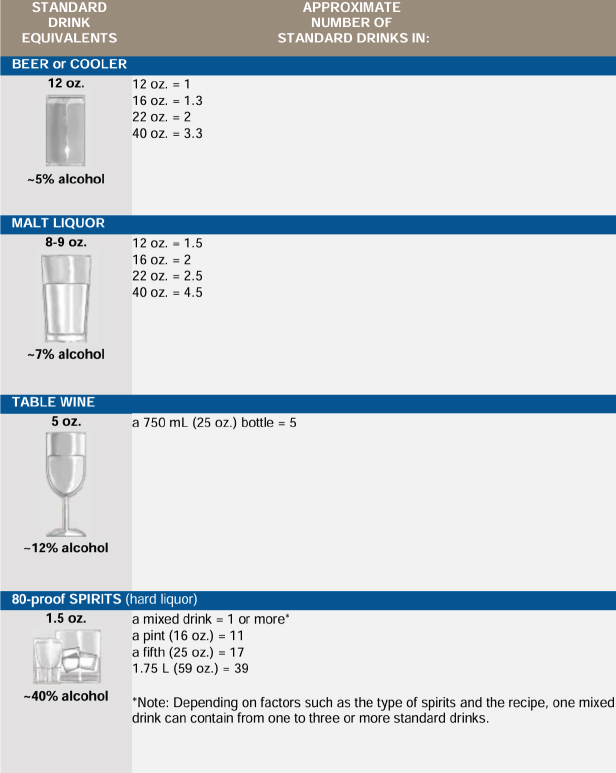
SOURCE: National Institute on Drug Abuse (NIDA). Alcohol Use Disorders Identification Test (AUDIT). https://nida.nih.gov/sites/default/files/files/AUDIT.pdf
- 5 or 6 (3)
- 7 to 9 (4)
- 10 or more (5)
Q46. How often do you have six or more drinks containing alcohol on one occasion?
- Never (1)
- Less than monthly (2)
- Monthly (3)
- Weekly (4)
- Daily or almost daily (5)
Q47. How often during the last year have you found that you were not able to stop drinking alcohol once you had started?
- Never (1)
- Less than monthly (2)
- Monthly (3)
- Weekly (4)
- Daily or almost daily (5)
Q48. How often during the last year have you failed to do what was normally expected of you because of drinking alcohol?
- Never (1)
- Less than monthly (2)
- Monthly (3)
- Weekly (4)
- Daily or almost daily (5)
Q49. How often during the last year have you needed a first drink containing alcohol in the morning to get yourself going after a heavy alcohol drinking session?
- Never (1)
- Less than monthly (2)
- Monthly (3)
- Weekly (4)
- Daily or almost daily (5)
Q50. How often during the past year have you had a feeling of guilt or remorse after drinking alcohol?
- Never (1)
- Less than monthly (2)
- Monthly (3)
- Weekly (4)
- Daily or almost daily (5)
Q51. How often during the last year have you been unable to remember what happened the night before because of drinking alcohol?
- Never (1)
- Less than monthly (2)
- Monthly (3)
- Weekly (4)
- Daily or almost daily (5)
Q52. Have you or someone else been injured as a result of your alcohol drinking?
- No (1)
- Yes, but not in the past year (2)
- Yes, during the past year (3)
Q53. Has a relative, friend, doctor, or other health care worker been concerned about your alcohol consumption or suggested you cut down?
- No (1)
- Yes, but not in the past year (2)
- Yes, during the past year (3)
Nicotine Use Questions (Modified Fagerstrom)
[Display Section Logic: If “Nicotine” selected in the past-year substance use question]
Q54. Directions: The following questions ask additional information about your experience with nicotine. Nicotine refers to the following: cigarettes, cigars, clove cigars, bidis, waterpipe/hooka/huka, pipes, chewing tobacco, wet snuff, dry snuff, snus, dissolvable tobacco, heat-not burn, electronic nicotine devices (ENDs), vapes, nicotine pouches (ZYN, Lyft, On!), lozenges, gum, and patches.
Q55. Do you smoke?
- No (1)
- Yes (2)
Q56. How soon after you wake up do you first use any nicotine product?
- Within 5 minutes (1)
- Within 6 to 30 minutes (2)
- Within 31 to 60 minutes (3)
- After 60 minutes (4)
Q57. Do you find it difficult to refrain from using nicotine in places where it is forbidden (e.g., in church, on transportation, at work, in cinema)?
- No (1)
- Yes (2)
Q58. Which time of day would be the hardest to refrain from nicotine?
- First thing in the morning (1)
- Any other time (2)
Q59. Do you use nicotine more frequently during the first hours after waking than during the rest of the day?
- No (1)
- Yes (2)
Q60. Do you use nicotine when you are so ill that you are in bed most of the day?
- No (1)
- Yes (2)
Cannabis Use Questions (from CUDIT-R)
[Display Section Logic: If “Cannabis” selected in the past-year substance use question]
Q61. Instructions: Please answer the following questions about your cannabis/marijuana/THC use. Choose the response that is most correct for you in relation to your cannabis use over the past six months. Please answer each question as openly and honestly as possible. There are no right or wrong answers, only what is true to your experience.
Q62. How often do you use cannabis/marijuana/THC?
- Never (1)
- Monthly or less (2)
- 2–4 times a month (3)
- 2–3 times a week (4)
- 4+ times a week (5)
Q63. How many hours were you “stoned” on a typical day when you had been using cannabis/marijuana/THC?
- Less than 1 (1)
- 1 or 2 (2)
- 3 or 4 (3)
- 5 or 6 (4)
- 7 or more (5)
Q64. How often during the past 6 months did you find that you were not able to stop using cannabis/marijuana/THC once you had started?
- Never (1)
- Less than monthly (2)
- Monthly (3)
- Weekly (4)
- Daily or almost daily (5)
Q65. How often during the past 6 months did you fail to do what was normally expected from you because of using cannabis/marijuana/THC?
- Never (1)
- Less than monthly (2)
- Monthly (3)
- Weekly (4)
- Daily or almost daily (5)
Q66. How often in the past 6 months have you devoted a great deal of your time to getting, using, or recovering from cannabis/marijuana/THC?
- Never (1)
- Less than monthly (2)
- Monthly (3)
- Weekly (4)
- Daily or almost daily (5)
Q67. How often in the past 6 months have you had a problem with your memory or concentration after using cannabis/marijuana/THC?
- Never (1)
- Less than monthly (2)
- Monthly (3)
- Weekly (4)
- Daily or almost daily (5)
Q68. How often do you use cannabis/marijuana/THC in situations that could be physically hazardous, such as driving, operating machinery, or caring for children?
- Never (1)
- Less than monthly (2)
- Monthly (3)
- Weekly (4)
- Daily or almost daily (5)
Q69. Have you ever thought about cutting down, or stopping, your use of cannabis/marijuana/THC?
- Never (1)
- Yes, but not in the past 6 months (2)
- Yes, during the past 6 months (3)
Other Drug Questions (DAST-10)
[Display Section Logic: If any of the following selected in the past-year substance use question: “Amphetamines/Stimulants” or “Hallucinogens/Psychedelics” or “Inhalants” or “Opioids/Narcotics/Pain Relievers” or “Sedatives/Hypnotics/Tranquilizers” or “Sleep Aids” or “Steroids”]
Q70. Please answer each question as openly and honestly as possible. There are no right or wrong answers, only what is true to your experience. Instructions: “Drug use” refers to (1) the use of prescribed or over‐the‐counter drugs in excess of the directions, and (2) any nonmedical use of drugs. The various classes of drugs may include solvents (e.g., paint thinner), tranquilizers (e.g., Valium), barbiturates, cocaine, stimulants (e.g., speed), hallucinogens (e.g., LSD) or narcotics (e.g., heroin). The questions do not include alcoholic beverages, nicotine, or cannabis. Please answer every question. If you have difficulty with a statement, then choose the response that is mostly right. These questions refer to drug use in the past 12 months. Please choose No or Yes.
| No (1) | Yes (2) | |
|---|---|---|
| Have you used drugs other than those required for medical reasons? (1) | □ | □ |
| Do you use more than one drug at a time? (2) | □ | □ |
| Are you always able to stop using drugs when you want to? (3) | □ | □ |
| Have you had “blackouts” or “flashbacks” as a result of drug use? (4) | □ | □ |
| Do you ever feel bad or guilty about your drug use? (5) | □ | □ |
| Does your spouse (or parents) ever complain about your involvement with drugs? (6) | □ | □ |
| Have you neglected your family because of your use of drugs? (7) | □ | □ |
| Have you engaged in illegal activities in order to obtain drugs? (8) | □ | □ |
| Have you ever experienced withdrawal symptoms (felt sick) when you stopped taking drugs? (9) | □ | □ |
| Have you had medical problems as a result of your drug use (e.g., memory loss, hepatitis, convulsions, bleeding, etc.)? (10) | □ | □ |
Health-related Questions (including GAD-7 AND PHQ-9)
Q71. Over the last 2 weeks, how often have you been bothered by the following problems?
| Not at all (1) | Several days (2) | More than half the days (3) | Nearly every day (4) | |
|---|---|---|---|---|
| Feeling nervous, anxious, or on edge? (1) | □ | □ | □ | □ |
| Not being able to stop or control worrying? (2) | □ | □ | □ | □ |
| Worrying too much about different things? (3) | □ | □ | □ | □ |
| Trouble relaxing? (4) | □ | □ | □ | □ |
| Being so restless that it is hard to sit still? (5) | □ | □ | □ | □ |
| Becoming easily annoyed or irritable? (6) | □ | □ | □ | □ |
| Feeling afraid, as if something awful might happen? (7) | □ | □ | □ | □ |
[Display Question Logic: If “Several days” or “More than half the days” or “Nearly every day” selected for at least one item in the previous question]
Q72. How difficult have these problems made it for you to do your work, take care of things at home, or get along with other people?
- Not at all difficult (1)
- Somewhat difficult (2)
- Very difficult (3)
- Extremely difficult (4)
Q73. Over the last 2 weeks, how often have you been bothered by any of the following problems?
| Not at all (1) | Several days (2) | More than half the days (3) | Nearly every day (4) | |
|---|---|---|---|---|
| Little interest or pleasure in doing things? (1) | □ | □ | □ | □ |
| Feeling down, depressed, or hopeless? (2) | □ | □ | □ | □ |
| Trouble falling or staying asleep, or sleeping too much? (3) | □ | □ | □ | □ |
| Feeling tired or having little energy? (4) | □ | □ | □ | □ |
| Poor appetite or overeating? (5) | □ | □ | □ | □ |
| Not at all (1) | Several days (2) | More than half the days (3) | Nearly every day (4) | |
|---|---|---|---|---|
| Feeling bad about yourself or that you are a failure or have let yourself or your family down? (6) | □ | □ | □ | □ |
| Trouble concentrating on things, such as reading the newspaper or watching television? (7) | □ | □ | □ | □ |
| Moving or speaking so slowly that other people could have noticed? Or the opposite - being so fidgety or restless that you have been moving around a lot more than usual? (8) | □ | □ | □ | □ |
| Thought that you would be better off dead or hurting yourself in some way? (9) | □ | □ | □ | □ |
[Display Question Logic: If “Several days” or “More than half the days” or “Nearly every day” selected for at least one item in the previous question]
Q74. How difficult have these problems made it for you to do your work, take care of things at home, or get along with other people?
- Not difficult at all (1)
- Somewhat difficult (2)
- Very difficult (3)
- Extremely difficult (4)
Q75. In general, how would you describe your physical health?
- Excellent (1)
- Very good (2)
- Good (3)
- Fair (4)
- Poor (5)
Q76. During the past 7 days, how much have you been bothered by any of the following problems?
| Not bothered at all (1) | Bothered a little (2) | Bothered a lot (3) | |
|---|---|---|---|
| Stomach pain (1) | □ | □ | □ |
| Back pain (2) | □ | □ | □ |
| Pain in your arms, legs, or joints (knees, hips, etc.) (3) | □ | □ | □ |
| Not bothered at all (1) | Bothered a little (2) | Bothered a lot (3) | |
|---|---|---|---|
| [Display Choice Logic: If “Woman” selected in gender question] | |||
| Menstrual cramps or other problems with your periods (4) | □ | □ | □ |
| Headaches (5) | □ | □ | □ |
| Chest pain (6) | □ | □ | □ |
| Dizziness (7) | □ | □ | □ |
| Fainting spells (8) | □ | □ | □ |
| Feeling your heart pound or race (9) | □ | □ | □ |
| Shortness of breath (10) | □ | □ | □ |
| Pain or problems during sexual intercourse (11) | □ | □ | □ |
| Constipation, loose bowels, or diarrhea (12) | □ | □ | □ |
| Nausea, gas, or indigestion (13) | □ | □ | □ |
| Feeling tired or having low energy (14) | □ | □ | □ |
| Trouble sleeping (15) | □ | □ | □ |
Q77. What medical diagnoses do you have? (If you don’t have any medical diagnoses, please write, “None.” To help ensure that your responses remain anonymous, please do not include any identifying information (e.g., the name of you, your ship, co-workers, or company).
______________________________________________________
Q78. During the past month, how many hours of actual sleep did you get a night (this may be different than the hours you spent in bed)?
______________________________________________________
Q79. During the past month, how often have you taken something to help you fall asleep (e.g., prescription medication, over-the-counter medication)?
- Not during the past month (1)
- Less than once a week (2)
- Once or twice a week (3)
- Three to six times a week (4)
- Daily (5)
Q80. During the past month, how often have you had a drink or used cannabis to help you fall asleep?
- Not during the past month (1)
- Less than once a week (2)
- Once or twice a week (3)
- Three to six times a week (4)
- Daily (5)
Q81. During the past month, how would you rate your sleep quality overall?
- Very good (1)
- Fairly good (2)
- Fairly bad (3)
- Very bad (4)
Q82. In the past month, how much has your sleep interfered with your ability to perform your duties at work?
- Not at all (1)
- A little (2)
- A moderate amount (3)
- A lot (4)
- A great deal (5)
Trauma Questions
Q83. Sometimes things happen to people that are unusually or especially frightening, horrible, or traumatic. For example: a serious accident or fire; a physical or sexual assault or abuse; an earthquake or flood; a war; seeing someone be killed or seriously injured; having a loved one die through homicide or suicide.
Q84. Have you ever experienced this kind of event?
- No (1)
- Yes (2)
[Display Choice Logic: If “Yes” selected in previous question]
Q85. Please answer the five questions below based on the frightening, horrible, or traumatic event(s) you indicated experiencing on the previous page. In the past month, have you...
| No (1) | Yes (2) | |
|---|---|---|
| had nightmares about the event(s) or thought about the event(s) when you did not want to? (1) | □ | □ |
| tried hard not to think about the event(s) or went out of your way to avoid situations that reminded you of the event(s)? (2) | □ | □ |
| been constantly on guard, watchful, or easily startled? (3) | □ | □ |
| felt numb or detached from people, activities, or your surroundings? (4) | □ | □ |
| felt guilty or unable to stop blaming yourself or others for the event(s) or any problems the event(s) may have caused? (5) | □ | □ |
Stress and Coping Questions
Q86. In general, how often do you feel overly stressed?
Please use the slider to indicate the percentage of time (0% = never, 100% = always).
| 0 | 10 | 20 | 30 | 40 | 50 | 60 | 70 | 80 | 90 | 100 | |
|---|---|---|---|---|---|---|---|---|---|---|---|
 |
|||||||||||
| When on the ship? (%) | □ | □ | □ | □ | □ | □ | □ | □ | □ | □ | □ |
| When off the ship? (%) | □ | □ | □ | □ | □ | □ | □ | □ | □ | □ | □ |
Q87. We are interested in how people respond when they confront difficult or stressful events in their lives. There are lots of ways to deal with stress. This questionnaire asks you to indicate what you generally do and feel, when you experience stressful events. Obviously, different events can bring out different responses, so think about what you usually do when you are distressed. There are no right or wrong answers, only what is true to your experience.
| I usually don’t do this at all (1) | I usually do this a little bit (2) | I usually do this a medium amount (3) | I usually do this a lot (4) | |
|---|---|---|---|---|
| I concentrate my efforts on doing something about the problem (1) | □ | □ | □ | □ |
| I take action to try to make the problem better (2) | □ | □ | □ | □ |
| I try to come up with a strategy about what to do (3) | □ | □ | □ | □ |
| I think hard about what steps to take (4) | □ | □ | □ | □ |
| I usually don’t do this at all (1) | I usually do this a little bit (2) | I usually do this a medium amount (3) | I usually do this a lot (4) | |
|---|---|---|---|---|
| I try to see it in a different light, to make it seem more positive (5) | □ | □ | □ | □ |
| I look for something good in what is happening (6) | □ | □ | □ | □ |
| I accept the reality of the fact that this has happened and that it can’t be changed (7) | □ | □ | □ | □ |
| I learn to live with it (8) | □ | □ | □ | □ |
| I make jokes about it (9) | □ | □ | □ | □ |
| I make fun of the situation (10) | □ | □ | □ | □ |
| I try to find comfort in my religion or spiritual beliefs (11) | □ | □ | □ | □ |
| I pray or meditate (12) | □ | □ | □ | □ |
| I get emotional support from others (13) | □ | □ | □ | □ |
| I get comfort and understanding from someone (14) | □ | □ | □ | □ |
| I try to get advice or help form other people about what to do (15) | □ | □ | □ | □ |
| I get help and advice from other people (16) | □ | □ | □ | □ |
| I turn to work or other activities to take my mind off things (17) | □ | □ | □ | □ |
| I do something to think about it less, such as going to movies, watching TV, reading, daydreaming, sleeping, or shopping (18) | □ | □ | □ | □ |
| I say to myself, “This isn’t real” (19) | □ | □ | □ | □ |
| I refuse to believe that it has happened (20) | □ | □ | □ | □ |
| I say things to let my unpleasant feelings escape (21) | □ | □ | □ | □ |
| I express my negative feelings (22) | □ | □ | □ | □ |
| I use alcohol or other drugs to make myself feel better (23) | □ | □ | □ | □ |
| I usually don’t do this at all (1) | I usually do this a little bit (2) | I usually do this a medium amount (3) | I usually do this a lot (4) | |
|---|---|---|---|---|
| I use alcohol or other drugs to help me get through it (24) | □ | □ | □ | □ |
| I give up trying to deal with it (25) | □ | □ | □ | □ |
| I give up the attempt to cope (26) | □ | □ | □ | □ |
| I criticize myself (27) | □ | □ | □ | □ |
| I blame myself for things that happened (28) | □ | □ | □ | □ |
| I try to exercise regularly to make myself feel better (29) | □ | □ | □ | □ |
| I build more physical activity into my day such as walking, working out, taking the stairs (30) | □ | □ | □ | □ |
Sexual Misconduct Questions
Q88. The following questions ask about behaviors that you may have observed or experienced during your career as a mariner. Please answer each question as openly and honestly as possible. There are no right or wrong answers, only what is true to your experience. Excluding any behaviors you were told about by someone else, please indicate whether you have personally witnessed (i.e., seen or heard directly) or personally experienced each of the following behaviors in your current work setting.
| Witnessed (1) | Experienced (2) | Did not witness or experience (3) | Uncomfortable Responding (4) | |
|---|---|---|---|---|
| Sexual jokes (1) | □ | □ | □ | □ |
| Unwanted sexual attention, such as whistles, calls, suggestive looks, gestures, or body language (2) | □ | □ | □ | □ |
| Inappropriate sexual comments about someone’s appearance or body (3) | □ | □ | □ | □ |
| Witnessed (1) | Experienced (2) | Did not witness or experience (3) | Uncomfortable Responding (4) | |
|---|---|---|---|---|
| Inappropriate discussion about their sex life, your sex life, or someone else’s sex life (4) | □ | □ | □ | □ |
| Displaying, showing, or sending sexually explicit messages or materials like photos or videos or directing others to view sexually explicit material online (5) | □ | □ | □ | □ |
| Taking or posting in appropriate or sexually suggestive photos or videos of another person without consent (6) | □ | □ | □ | □ |
| Indecent exposure or inappropriate display of body parts (7) | □ | □ | □ | □ |
| Repeated pressure from the same person for dates or sexual relationship (8) | □ | □ | □ | □ |
| Unwelcome physical contact, such as hugs or shoulder rubs, or getting too close (9) | □ | □ | □ | □ |
| Offering workplace benefit for engaging in sexual activity or being mistreated for not engaging in sexual activity (10) | □ | □ | □ | □ |
| Suggesting that a man doesn’t act like a man is supposed to act or that a woman doesn’t act like a woman is supposed to act (11) | □ | □ | □ | □ |
| Someone being insulted, mistreated, ignored, or excluded because they are a man or a woman (12) | □ | □ | □ | □ |
| Witnessed (1) | Experienced (2) | Did not witness or experience (3) | Uncomfortable Responding (4) | |
|---|---|---|---|---|
| Comments that people are either not good at a particular job or should be prevented from having a particular job because they are a man or woman (13) | □ | □ | □ | □ |
| Someone being insulted, mistreated, ignored, or excluded because of their sexual orientation (14) | □ | □ | □ | □ |
| Someone being insulted, mistreated, ignored, or excluded because they are (or are assumed to be) a transgender person (15) | □ | □ | □ | □ |
| Someone was made to have sexual intercourse without their consent (16) | □ | □ | □ | □ |
| Someone was made to perform or receive oral sex, anal sex, or penetration by a finger or object without their consent (17) | □ | □ | □ | □ |
| Someone attempted to make another person have sexual intercourse without consent but was not successful (18) | □ | □ | □ | □ |
| Someone attempted to make another person perform or receive oral sex, anal sex, or penetration by a finger or object without consent but was not successful (19) | □ | □ | □ | □ |
| Someone sexually touched another person (for example, intentional touching of genitalia, breasts, or buttocks) or made another person sexually touch them without consent (20) | □ | □ | □ | □ |
[Display Question Logic: If “Witnessed” or “Experienced” selected for at least one item in the previous question]
Q89. Thinking of the events you noted on the previous page, in what circumstances and locations did these behaviors take place? Select all that apply.
- On ship, while on duty (1)
- On ship, while off duty (2)
- While on shore leave (3)
- While on port stay (4)
- During a work-sanctioned event (5)
- While at sea or on the water (6)
- While in port (7)
- Other (please describe): __________ (8)
[Display Section Logic: If “Witnessed” selected for at least one item in the list of sexual misconduct behaviors]
Q90. For this next set of questions, please think about all of the events that you indicated you witnessed on the previous page. Please answer each question as openly and honestly as possible. There are no right or wrong answers, only what is true to your experience.
Q91. Think only about behaviors that you witnessed. Please exclude behaviors directed at you. How much of a role do you believe alcohol played in these behaviors occurring?
- 1 – Not at All (1)
- 2 (2)
- 3 – Somewhat (3)
- 4 (4)
- 5 – Very Much (5)
Q92. Think only about behaviors that you witnessed. Please exclude behaviors directed at you. Select the actions you took regarding the behaviors you witnessed. (Select all that apply.)
- I talked to the person(s) responsible for the behavior (include talking in person, over the phone, and messaging or writing via text, social media, or email) (1)
- I talked to those targeted by the behavior (including talking in person, over the phone, and messaging or writing via text, social media, or email) (2)
- I reported the behavior to someone in authority on the ship (3)
- I stepped in and separated the people involved in the situation (4)
- I created a distraction to stop the situation (5)
- I asked others to step in as a group and stop the situation (6)
- I sought advice from someone (7)
- I reported the behavior to the US Coast Guard (8)
- I contacted the police (9)
- I sought help from people not associated with the ship (10)
- Other (please describe): __________ (11)
- I did not take any action (12)
- N/A – I only experienced events and did not witness any events (13)
Q93. There are many reasons why people do not take action or do not take certain actions when they witness these behaviors. Please select which ones apply to the behaviors you witnessed. (Select all that apply.)
- I didn’t think the behavior was serious enough to take action (1)
- I was afraid of negative consequences for those targeted by the behavior (2)
- I didn’t think it was my responsibility (3)
- Those responsible were at a higher rank than me (4)
- I was afraid of negative consequences for myself (e.g., personal harm, retaliation or revenge, career implications, being labeled) (5)
- I knew other people were taking action (6)
- Those targeted by the behavior asked me not to take any action (7)
- I didn’t know what to do (8)
- Other reason (please describe): __________ (9)
- N/A – I took all the actions necessary for these situations (10)
- N/A – I only experienced events and did not witness any events (11)
[Display Section Logic: If “Experienced” selected for at least one item in the list of sexual misconduct behaviors]
Q94. Think only about behaviors that you experienced. Please exclude behaviors that you witnessed. How much of a role do you believe alcohol played in these behaviors occurring?
- 1 – Not at All (1)
- 2 (2)
- 3 – Somewhat (3)
- 4 (4)
- 5 – Very Much (5)
Q95. Think only about behaviors that you experienced. Please exclude behaviors that you witnessed. Select the actions you took regarding the behaviors you experienced. (Select all that apply.)
- I talked to the person(s) responsible for the behavior (include talking in person, over the phone, and messaging or writing via text, social media, or email) (1)
- I reported the behavior to someone in authority on the ship (2)
- I created a distraction to stop the situation (3)
- I asked others to step in as a group and stop the situation (4)
- I sought advice from someone (5)
- I reported the behavior to the US Coast Guard (6)
- I contacted the police (7)
- I sought help from people not associated with the ship (8)
- Other (please describe): __________ (9)
- I did not take any action (10)
- N/A – I only witnessed events and did not experience any events (11)
Q96. There are many reasons why people do not take action or do not take certain actions when they experience these behaviors. Please select which ones apply to the behaviors you experienced. (Select all that apply.)
- I didn’t think the behavior was serious enough to take action (1)
- I didn’t think it was my responsibility (2)
- Those responsible were at a higher rank than me (3)
- I was afraid of negative consequences for myself (e.g., personal harm, retaliation or revenge, career implications, being labeled) (4)
- I knew other people were taking action (5)
- I didn’t know what to do (6)
- Other reason (please describe): __________ (7)
- N/A – I took all the actions necessary for these situations (8)
- N/A – I only witnessed events and did not experience any events (9)
Q97. Please indicate your agreement with the statements below.
| 1 – Strongly Disagree (1) | 2 (2) | 3 (3) | 4 (4) | 5 – Strongly Agree (5) | |
|---|---|---|---|---|---|
| It would be risky for me to file a sexual harassment complaint (1) | □ | □ | □ | □ | □ |
| A sexual harassment complaint would not be taken seriously (2) | □ | □ | □ | □ | □ |
| Individuals who sexually harass others get away with it (3) | □ | □ | □ | □ | □ |
Q98. What strategies would you suggest to decrease sexual harassment and sexual assault within the maritime industry? To help ensure that your responses remain anonymous, please do not include any identifying information (e.g., the name of you, your ship, co-workers, or company).
______________________________________________________
______________________________________________________
______________________________________________________
______________________________________________________
This page intentionally left blank.


