Strengthening Alcohol Policies and Supporting Safety and Health in the Maritime Industry (2026)
Chapter: 1 Introduction
1
Introduction
In 2021, an anonymous student at the U.S. Merchant Marine Academy (USMMA) published an account of being raped during her training year at sea. In her report—published under the pseudonym “Midshipman X”—she described her experience becoming intoxicated and then experiencing an assault. She also stated that she knew of “at least” nine other current USMMA students who had also been raped during their training (Ellis & Hicken, 2021; The Maritime Executive, 2023).
The story of a brutal crime against a student at the USMMA shocked the nation about the dangers of adverse workplace conditions, alcohol misuse, and risk of sexual misconduct on U.S. commercial shipping vessels (Duncan, 2022; Jankowicz, 2022; Shepardson & Trotta, 2021). The account led to a Congressional investigation and eventually to multiple changes in policy and practice. In December 2023, Congress passed the provisions of the Safer Seas Act, enacted in 2022 as part of the Don Young Coast Guard Authorization Act of 2022 and James M. Inhofe National Defense Authorization Act (NDAA) for the Fiscal Year (FY) 2023 (Pub. L. No. 117-263, § 11608).1 Among other provisions, this law required the U.S. Coast Guard to bar individuals convicted of sexual assault from the maritime industry, established mandatory reporting of sexual misconduct aboard commercial vessels, and created a series of provisions known as the Every Mariner Builds a Respectful Culture (EMBARC) requirements for certain ships, including video monitoring and key controls, to protect against sexual misconduct and then implemented the requirements. Section
___________________
1 Throughout the report, NDAA FY 2023 is used interchangeably with the Safer Seas Act.
11606 of the law also requires the U.S. Coast Guard to commission a National Academies of Sciences, Engineering, and Medicine (National Academies) study “to determine safe levels of alcohol consumption and possession by crew members aboard vessels of the United States engaged in commercial service, except when such possession is associated with the commercial sale to individuals aboard the vessel who are not crew members.”
This is the report of that study, which was conducted by an independent expert committee convened to fulfill the Statement of Task presented in Box 1-1. The 12 committee members have expertise from the fields of public health, psychology (clinical, industrial/organizational), alcohol and substance misuse prevention, treatment, and policy in safety-sensitive industries, sexual misconduct prevention, and the maritime industry. The
BOX 1-1
Study Statement of Task
The National Academies will convene an ad hoc committee to prepare an assessment that will inform public policies concerning the possession and consumption of alcohol by crew members and other personnel aboard commercial vessels of the United States. The assessment will consider the personal security, welfare, and safety interests of all individuals aboard the vessel as well as the use of other intoxicants in conjunction with alcohol. As part of the assessment, the committee will also consider:
- Operational and workplace factors that may contribute to the misuse of alcohol by crewmembers and other onboard personnel in different segments (types of service/vessels) of the maritime industry;
- The contributing role of alcohol and other intoxicants to abusive and dangerous behaviors in the maritime workplace;
- Effectiveness of federal regulations and vessel operator policies to detect and deter misuse of alcohol by crew members and other personnel, both on-duty and off duty;
- The state of the science on best practices for regulating workplace alcohol use, intoxication, and the prevention of sexual assault and sexual harassment and other dangerous and abusive behaviors. This includes practices for education, training, reporting, and accountability, as well as the development and implementation of a culture of safety.
- The extent to which federal regulations and vessel operator policies, as implemented, conform to identified best practices.
As appropriate, the committee will make recommendations for changes in federal regulations and other policies that govern alcohol possession and consumption by personnel aboard U.S. commercial vessels and that support best practices to ensure a safe and secure workplace free of alcohol misuse.
Statement of Task, or committee charge, starts with direction to “prepare an assessment that will inform public policies concerning the possession and consumption of alcohol by crew members and other personnel aboard commercial vessels of the United States” and, after considering a series of factors, make recommendations to support “a safe and secure workplace free from alcohol misuse” (see Box 1-1). The factors to be considered include the operational and workplace factors that may contribute to the misuse of alcohol, the effectiveness of federal regulations and vessel operator policies to detect and deter alcohol and other substance misuse, and the extent to which federal regulations and vessel operator policies conform to best practices for the prevention of sexual misconduct and other dangerous and abusive behaviors.
This report focuses on the intersection of alcohol and other substance misuse and sexual misconduct in the U.S. commercial maritime industry. As this report articulates, the industry is both unique and complex. The U.S. maritime industry operates within an intricate framework of international standards, federal regulations, company policies, and union negotiations. Deepsea routes as well as inland passages must be considered, in addition to a wide range of vessel types—such as research ships, passenger vessels, and commercial ships. These factors set the stage for an uneven policy landscape regarding alcohol and other drug possession and consumption, with implications for sexual misconduct alongside other abusive and dangerous behaviors.
Of course, the challenges of alcohol and other substance misuse and sexual misconduct exist far beyond the U.S. commercial maritime industry. The majority of adults in the United States (aged 18+) report drinking alcohol within the past year (67.1%; National Institute on Alcohol Abuse and Alcoholism [NIAAA], 2025b), with nearly 11% meeting diagnostic criteria for an alcohol use disorder (NIAAA, 2025a). Excessive drinking is associated with alcohol poisoning, violence, injuries, and other adverse effects (U.S. Centers for Disease Control and Prevention [CDC], 2025).
According to the National Institute on Drug Abuse (NIDA), addiction is the moderate to severe end of the substance use disorder spectrum “characterized by compulsive drug seeking and use despite adverse consequences” and is associated with “functional changes to brain circuits involved in reward, stress, and self-control.” This condition is also treatable, with many people achieving a sustained recovery. NIDA explains, “Addiction is a lot like other diseases, such as heart disease. Both disrupt the normal, healthy functioning of an organ in the body, both have serious harmful effects, and both are, in many cases, preventable and treatable. If left untreated, they can last a lifetime and may lead to death” (NIDA, 2020).
Sexual misconduct, a form of interpersonal mistreatment that is inclusive of sexual harassment and sexual assault (Koss et al., 2014), encompasses
a range of conduct, including verbal and nonverbal behaviors that can convey hostility, as well as physical acts committed against a person’s will (Koss et al., 2014). A widespread problem across various industries, sexual misconduct is prevalent on college campuses (Holland & Cortina, 2017; National Academies, 2018) and in the military (Buchanan et al., 2014), medicine and health care (Vargas et al., 2020), the retail, hospitality, and entertainment industries, and sports media (Madera et al., 2019). While the specific definition and interpretation of sexual misconduct laws and policies may vary across industries, the harms associated with experiencing misconduct are well documented, and have significant impacts on career, physical, and mental health (National Academies, 2018).
The link between alcohol misuse and sexual misconduct is well established (Maryland Collaborative, 2016). It is estimated that approximately half of all sexual assaults involve the perpetrator, survivor, or both using alcohol (Lorenz & Ullman, 2016). For perpetrators, alcohol can suppress inhibition, moral reasoning, and empathy for others, while elevating sexual desire, risk taking, and aggression (Abbey, 2011). For survivors, alcohol can impair threat recognition and self-protection (Lorenz & Ullman, 2016). In recent years, increasing attention has been given to the risks associated with alcohol and other substance use concerning sexual misconduct across various sectors (Caamano-Isorna et al., 2018; Lund et al., 2023; Miggantz et al., 2023).
While this report focuses on the commercial maritime industry, it draws on a large body of research, experience, and knowledge concerning alcohol and other substance misuse and sexual misconduct in the workplace as well as society at large.
PROCESS AND SCOPE
The study committee incorporated several sources of evidence to inform the development of this report. The committee reviewed the existing scientific literature and examined best practices within the U.S. commercial maritime industry, as well as those from a wider variety of industries with similar characteristics domestically and globally. Beyond the scientific literature, the committee determined that additional evidence was needed to address the Statement of Task, which included relevant websites, publicly available government documents, policy documents, white papers, and other sources not traditionally included in the peer-reviewed scientific literature. The committee commissioned a resource paper on the U.S. Commercial Maritime Industry Context and Regulatory and Oversight Framework (St. Amand & St. Amand, 2025), which is integrated and cited throughout the report. The committee also made several requests for information between October 2024 and May 2025 and the following information was provided:
- 2024 Alcohol Offenses and Sanctions2
- Framing and Info 101 Questions for National Academies Study3
- MISLE Vessel Population Information (vessel type, total crew positions, total credentialed, total not credentialed)4
- Sexual Misconduct on U.S. Vessels (2024)5
To obtain perspectives from the U.S. commercial maritime industry (e.g., vessel operator companies and associations, unions, service providers), the committee convened a series of panel discussions. Panelists included regulators from the U.S. Coast Guard, leadership of the merchant marine academies, representatives from the maritime training academies and institutes, leadership of major shipping companies, crew of commercial shipping vessels, union leadership, and other individual mariners and legal counsel on the problem of alcohol use and its relation to sexual misconduct, other abusive behaviors, mental health, and well-being. During one of its seven meetings, the committee also visited a U.S. commercial vessel, speaking with the operator and its crew in Jacksonville, Florida.
The open, publicly available panel sessions included conversations on company policies, maritime education institute policies, the maritime work environment, the Cadet training environment, incident reporting, responsibility and accountability for mariner safety and security, as well as broad policy context considerations.
These panel discussions included a variety of differing views on the nature of the problem and its solutions. Some panelists saw alcohol and sexual misconduct as deeply embedded in maritime experiences, requiring major changes to policy and process to remedy. Others saw the concerns as more sporadic and the solution less in regulation, but rather in encouraging greater cohesion and trust between crew members. Themes that emerged from these discussions were top of mind when the committee deliberated and drafted its report. In instances where there were differing perspectives among presenters, the committee reflected on the points made and looked at evidence alongside the committee’s own experience and expertise to draw conclusions and make recommendations. The committee determined best practices based on its judgment about whether the implementation of
___________________
2 U.S. Coast Guard, Personal Communication, February 25, 2025. https://www.nationalacademies.org/projects/DBASSE-BBCSS-23-02/past-events
3 U.S. Coast Guard, Personal Communication, April 8, 2025. https://www.nationalacademies.org/projects/DBASSE-BBCSS-23-02/past-events
4 U.S. Coast Guard, Personal Communication, April 28, 2025. https://www.nationalacademies.org/projects/DBASSE-BBCSS-23-02/past-events
5 U.S. Coast Guard, Personal Communication, April 4, 2025. https://www.nationalacademies.org/projects/DBASSE-BBCSS-23-02/past-events
programs or policies was working as intended, as supported by evidence and experience shared during the study process.
The committee recognizes that current policies and programs are subject to change at any time; those mentioned in this report may continue to evolve after publication. Nevertheless, the committee believes the report’s discussion of best practices, grounded in empirical support, should remain valid.
Context and Terminology
In consulting with the U.S. Coast Guard at the outset of the study, one of the key takeaways was the U.S. Coast Guard’s desire for the study to have maximal impact in the field.
To accomplish this goal, the committee had to maintain a practical focus. The report’s coverage of U.S.-flag commercial vessels, therefore, does not include small vessels that represent the vast majority of the vessels in the maritime industry, but for whom there is limited data about the scope of alcohol and other drug use, and even less regulatory coverage. Examples are small fishing vessels, passenger vessels, and towboats. References to such vessels, therefore, are limited to where relevant information was available. It should be noted that where the report focuses on oversight of credentialed mariners, recommendations would have impact wherever they work, including the smaller vessels.
The committee also focused on the populations of greatest interest. The scope calls for the committee to “consider the personal security, welfare, and safety interests of all individuals aboard the ship,” while making recommendations related to alcohol only for the mariners and other personnel on a vessel’s staff. The committee accordingly focused on the health and safety of mariners and staff, with the understanding that enhancing their health and well-being would translate to that of others on board, such as passengers. The Statement of Task also asks the committee to address both on-duty and off-duty behavior. To avoid being too expansive, the committee focused primarily on on-duty behavior, with some specific exceptions, including on-boarding activities and time in port.
The Statement of Task defines the scope of the substances of interest for the committee as alcohol and “other intoxicants.” During consultations, the U.S. Coast Guard emphasized that the study’s primary interest should be on alcohol and its related policies, consistent with the legislative mandate. The report refers to “alcohol and other substance misuse,” and there are other substance use disorders, including opioid use disorder, that affect the
merchant marine and other workplace environments. This report primarily focuses on alcohol, but there is discussion of the use of other substances in sections related to testing, treatment, and other supports, as well as recognition that addiction is a chronic illness. The report refers more specifically to “drugs,” “drug use,” and “drug testing” when these terms are defined and used in current statutes or regulations or in research or surveys with Cadets and mariners. Throughout this report, the committee intentionally used person-first, non-stigmatizing language that aligns with the best available science on addiction (National Institute on Drug Abuse, 2023).
An important component in the Statement of Task pertains to interpersonal mistreatment, including “sexual assault and sexual harassment and other dangerous and abusive behaviors.” The report uses the broader term “sexual misconduct” to refer to sexual harassment and sexual assault. Given the recent challenges with sexual misconduct in the maritime industry, the committee chose to focus on this specific behavior. At the same time, the report’s focus on preventing alcohol misuse, advancing mariner wellbeing generally, and promoting a culture of safety are relevant to multiple other types of dangerous behaviors. Workplace misconduct encompasses a spectrum of harmful interpersonal behaviors—including non-sexualized behaviors such as incivility, bullying, and abusive supervision, as well as sexualized behaviors such as sexual harassment and sexual assault—that differ in intensity, intent, and power dynamics but share overlapping antecedents and outcomes (Hershcovis, 2011). These behaviors collectively reflect failures in organizational systems that permit disrespect and aggression to persist. Moreover, as the report notes, many of the best practices aimed at preventing sexual misconduct can also help prevent and mitigate these forms of mistreatment.
The report focuses on the U.S. maritime industry and the role of U.S. agencies in overseeing it. The broader world of global maritime regulation is mentioned only as context in different sections of the report, not for the purpose of making recommendations to the global community. The committee also faced the challenge of where to direct recommendations, given the complexity of oversight among multiple federal agencies. Our approach was to identify the most appropriate entity to serve as the lead and identify other actors to consult with to adequately address the recommendation.
In short, the study scope and approach had to be bound so that the committee was able to concentrate on matters that could inform larger policy changes.
Safety Culture and Leadership
The committee observed that the Statement of Task calls for an assessment of best practices in the development and implementation of a workplace, or organizational, culture of safety. This language struck the committee as being a highly important consideration because organizational culture influences decision-making, resource allocation, acceptable behavior, as well as practices and norms within an entity (i.e., company, agency; Canada Energy Regulator, 2021; National Academies, 2022; Stroeve et al., 2022).
Safety culture, a subset of an organization’s broader culture, refers to the attitudes, values, norms, and beliefs that members of a group share with respect to risk and safety (Mearns et al., 1998). In high hazard industries, such as commercial shipping, these attitudes, values, norms, and beliefs collectively influence safety performance and outcomes (Canada Energy Regulator, 2021). Well-designed and implemented safety management systems provide supporting structures, policies, processes, and procedures that facilitate the development and advancement of a robust culture of safety (Canada Energy Regulator, 2021; Jazayeri & Dadi, 2017).
It is well understood that leaders play a central role in establishing an organizations safety culture and demonstrating a commitment to preventing harm (Blair, 2003). Research has demonstrated that effective and committed leaders at all organizational levels should also exhibit respect, integrity, self-awareness, compassion, and courage—factors that this report will also cover. They should communicate the vision for the organization in terms that the audience understands and collaborate effectively with all stakeholders (Center for Creative Leadership, 2025). A priority for the committee, therefore, was translating the best practices, programs, and policies for the maritime industry into steps that leaders can take to establish and maintain an effective organizational culture that supports safety.
Mariner Well-Being
In its consultations, the committee repeatedly heard that challenges to mental health and well-being, as well as limited access to mental health services, are major drivers of alcohol and other substance misuse and their harms. The committee came to recognize that mariners experience unique working conditions that shape their daily lives and well-being. These include prolonged periods of social isolation, fatigue, the demands of overnight voyages in close quarters, limited access to internet and cell phone services, and substantial gender imbalance in the workplace, among others.
Figure 1-1 reflects the committee’s view that there are connections between mariners’ well-being, alcohol and other substance misuse, and sexual
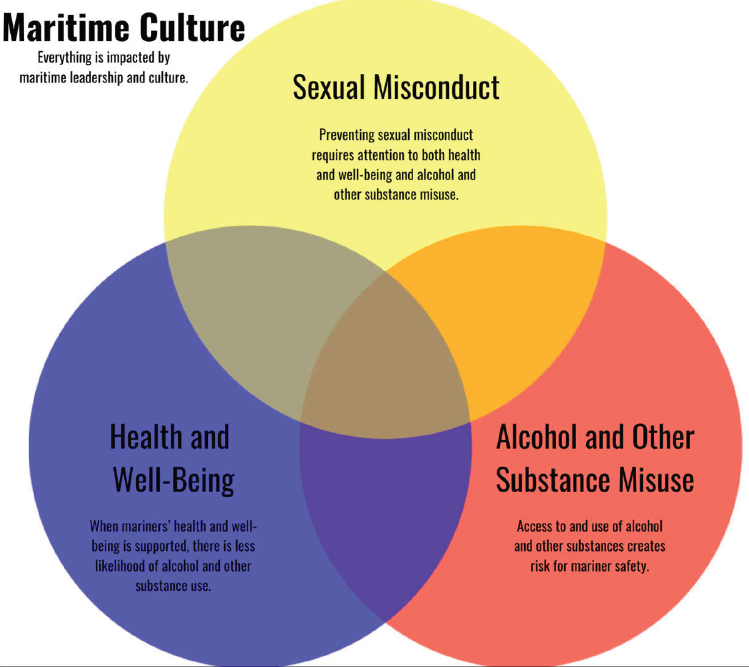
misconduct—as well as critical issues for these topics on their own. The recommendations in this report are made with these interrelationships in mind.
ORGANIZATION OF THE REPORT
The report is organized into seven chapters. In Chapter 2, the committee describes the U.S. commercial shipping industry, and policies related to alcohol and other substance use as well as sexual misconduct.
In Chapter 3, available data on the extent of the problem of alcohol misuse and its relation to misconduct are summarized in the context of U.S. commercial shipping as evidence.
In Chapter 4, the committee focuses on steps to be taken before setting sail to prevent alcohol and substance misuse as well as sexual misconduct.
This chapter includes attention to the training academies and institutes, screening and eligibility assessment, and other factors.
Chapter 5 addresses policies and programs aboard the ship to reduce alcohol and other substance use as well as sexual misconduct. These include the appropriate standard for permissible blood alcohol concentration, structural changes to the ships (including locks and cameras), and attention to mariner well-being.
Chapter 6 focuses on policies related to response to incidents of alcohol and other substance misuse as well as sexual misconduct. These include reporting systems, investigation, accountability, support, and others.
In Chapter 7, the committee turns to the bigger picture of leadership and culture needed to support progress on alcohol and other substance use, sexual misconduct, and employee well-being together.
The committee bios are available for review in Appendix A. The committee also developed sets of questions that could inform the development of a survey for mariners, as discussed in Chapter 3; these are provided in Appendix B.
GLOSSARY
- Cadet is a student in a merchant marine academy, also referred to as a Midshipman.
-
Credential is a term used to refer to any or all of the following (46 C.F.R. § 10.107, 2013):
- merchant mariner’s document;
- merchant mariner’s license;
- Standards of Training, Certification, and Watchkeeping endorsement;
- certificate of registry; and/or
- merchant mariner credential (MMC).
- Credentialed mariner is a mariner with an MMC issued by the U.S. Coast Guard (46 C.F.R. § 10.107, 2013).
-
Crewmember means an individual who is (46 C.F.R. § 16.105, 1988):
- onboard a vessel acting under the authority of a credential issued under this subchapter, whether or not the individual is a member of the vessel’s crew; or
- engaged or employed onboard a vessel owned in the United States that is required by law or regulation to engage, employ, or be operated by an individual holding a credential issued under this subchapter, except for the following:
-
-
- — individuals on fish processing vessels who are primarily employed in the preparation of fish or fish products, or in a support position, and who have no duties that directly affect the safe operation of the vessel;
- — scientific personnel on an oceanographic research vessel;
- — individuals on industrial vessels who are industrial personnel, as defined in this chapter; and
- — individuals not required under part 156 of this subchapter who have no duties that directly affect the safe operation of the vessel.
-
- Culture refers to basic assumptions, which are invented, discovered, or developed by a group as it seeks to resolve issues related to external adaptation and internal integration. These assumptions are shared with new members as the acceptable way to see the world, think, and feel in relation to relevant internal and external problems (Schein, 1985). This organizational sensemaking drives values, priorities, decisions, and behaviors (Isabella, 1990; Weick et al., 2005).
- Dangerous drug means a narcotic drug, a controlled substance, or a controlled-substance analog (46 C.F.R. § 10.107, 2013).
- Drug test means a chemical test of an individual’s urine for evidence of dangerous drug use (46 C.F.R. § 16.105, 1988).
-
Drug Testing Definitions
- 46 Code of Federal Regulations (C.F.R.) outlines the basic requirements for mariner drug testing in Part 16 (46 C.F.R. § 16, 2024). Definitions as outlined within the Federal Regulations are key to understanding the various responsibilities and involved parties within these requirements.
- Chemical test means a scientifically recognized test which analyzes an individual’s breath, blood, urine, saliva, bodily fluids, or tissues for evidence of dangerous drug or alcohol use (46 C.F.R. § 16.105, 1988).
___________________
6 From Chapter 2: “Credentialed mariners are required aboard vessels in international waters, 1507 Great Lakes, and some domestic trades and vessels 100 gross registered tonnage (GRT) or more 1508 such as freight ships including bulk carriers, tankers, large passenger vessels, towing vessels, 1509 OSVs, or research vessels. Exceptions to the need for an MMC include mariners sailing on 1510 vessels less than 100 GRT and carrying six or fewer passengers, including barges, fishing 1511 vessels, fish tenders, whaling vessels, yachts, instructors and students on sailing school vessels; 1512 and scientific personnel aboard oceanographic research vessels, certain fish processing vessels, 1513 mobile offshore drilling units, and passenger vessels not engaged in a foreign voyage (in respect to certain entertainers; 46 C.F.R. § 15.401, 2013).”
-
- Consortium/third party administrator (C/TPA) means a service agent who provides or coordinates the provision of a variety of alcohol and drug testing services to employers. C/TPAs typically perform administrative tasks concerning the operation of the employers’ alcohol and drug testing programs. This term includes, but is not limited to, groups of employers who join to administer, as a single entity, the U.S. Department of Transportation (DOT) alcohol and drug testing programs of its members (46 C.F.R. § 16.105, 1988).
- Employer means a marine employer or sponsoring organization (46 C.F.R. § 16.105, 1988).
- Fails a chemical test for dangerous drugs means that the result of a chemical test conducted was reported as “positive” by a Medical Review Officer (MRO) because the chemical test indicated the presence of a dangerous drug at a level equal to or exceeding the levels (46 C.F.R. § 10.107, 2013).
- Gender harassment includes a range of behaviors, including verbal or non-verbal, that treat individuals of a certain gender with hostility, as an object, as an outsider, or as “less than” (Vargas et al., 2020).
- Mariner (or Seafarer) is an individual whose role is essential to the operation of the ship: operates or assists in the operation of ships, including merchant ships and other types of watercraft; responsible for the various operations aboard ships, including navigation, maintenance, cargo handling, and compliance with maritime laws and safety regulations; ensures the crew’s sustenance and wellbeing (onboard cook); may be a crewmember employed by a vessel operator or contracted personnel, including those that contribute to the overall operation and mission of a cruise ship or other passenger vessels such as hospitality workers (33 U.S.C. § 3079(b)(c), 2023; Maritime Labour Convention, 2006).
- Marine employer means the owner, managing operator, charterer, agent, master, or person in charge of a vessel, other than a recreational vessel (46 C.F.R. § 16.105, 1988).
- Maritime institute provides “professional and recreational mariners with high quality, affordable, practical training in all subjects related to vessel operations, while meeting or exceeding US Coast Guard standards for training where applicable, and delivering the knowledge mariners need to be safe out on the water” (Maritime Institute, 2025).
- Medical Review Officer (MRO) means a person who is a licensed physician and who is responsible for receiving and reviewing laboratory results generated by an employer’s drug testing program and
- evaluating medical explanations for certain drug test results (46 C.F.R. § 16.105, 1988).
- Merchant mariner is an employee of the U.S. Merchant Marine, which consists of privately-owned, U.S.-registered (flag) merchant ships and vessels that provide waterborne transportation for passengers and cargo moving in domestic and international commerce (U.S. Department of Transportation Maritime Administration, 2025).7
- Midshipman is a student at the U.S. Merchant Marine Academy, also referred to as Cadet.
- Mitigation is a harm reduction approach that focuses on minimizing the negative consequences of substance use while promoting safety in the workplace. It acknowledges that some individuals may use substances and emphasizes managing associated risks effectively (CDC, 2022).
-
Operation means to navigate, steer, direct, manage, or sail a vessel, or to control, monitor, or maintain the vessel’s main or auxiliary equipment or systems (46 C.F.R. § 16.105, 1988). Operation includes:
- determining the vessel’s position, piloting, directing the vessel along a desired trackline, keeping account of the vessel’s progress through the water, ordering or executing changes in course, rudder position, or speed, and maintaining a lookout;
- controlling, operating, monitoring, maintaining, or testing: the vessel’s propulsion and steering systems; electric power generators; bilge, ballast, fire, and cargo pumps; deck machinery including winches, windlasses, and lifting equipment; lifesaving equipment and appliances; firefighting systems and equipment; and navigation and communication equipment; and
- mooring, anchoring, and line handling; loading or discharging of cargo or fuel; assembling or disassembling of tows; and maintaining the vessel’s stability and watertight integrity.
- Passes a chemical test for dangerous drugs means the result of a chemical test conducted in accordance with 49 C.F.R. § 40 (2000) is reported as “negative” by an MRO in accordance with that part (46 C.F.R. § 16.105, 1988).
- Policies set the strategic direction in which practices and procedures can occur. Organizations set alcohol and substance use policies to meet regulatory, safety and societal requirements and expectations (The University of Texas at Dallas, 2025).
___________________
7 From this point forward, the U.S. Department of Transportation’s Maritime Administration will be referred to as the U.S. Maritime Administration or MARAD.
- Positive rate for random drug testing means the number of verified positive results for random drug tests conducted under this part plus the number of refusals of random drug tests required by this part, divided by the total number of random drug test results (i.e., positives, negatives, and refusals) under this part (46 C.F.R. § 16.105, 1988).
- Prevention refers to strategies and initiatives designed to stop substance use before it begins or to delay the onset of use, particularly in workplace or safety-sensitive environments (U.S. Department of Health and Human Services, 2016).
- Procedures are the operational steps taken by individuals and units in the organization to meet standards and establish performance consistent with policies (The University of Texas at Dallas, 2025).
- Response refers to actions and protocols that address acute substance-related issues and substance use disorders and facilitate a safe return to work. This often includes the expectation of total abstinence as a condition for resuming safety-sensitive duties (Frone et al., 2022).
- Service agent means any person or entity that provides services specified under or to employers and/or crewmembers in connection with DOT drug and alcohol testing requirements. This includes, but is not limited to, collectors, Breath Alcohol Technicians (BATs) and Screening Test Technicians (STTs), laboratories, MROs, substance abuse professionals, and C/TPAs. To act as service agents, persons and organizations must meet the qualifications set forth in applicable sections of 49 C.F.R. § 40 (2023). Service agents are not employers for purposes of this part (46 C.F.R. § 16.105, 1988).
- Sexual misconduct includes incidents of sexual assault as well as sexual harassment.8 Within this, sexual assault refers to “any form of abuse or contact as defined in chapter 109A of title 18, or a substantially similar offense under State, local, or Tribal law” (CongressGov, 2022).
- Sponsoring organization is any company, consortium, corporation, association, union, or other organization with which individuals serving in the marine industry, or their employers, are associated (46 C.F.R. § 16.105, 1988).
- Standards establish the guidelines and metrics against which performance in the organization or system is measured, consistent with the overall guidance provided in policies (The University of Texas at Dallas, 2025).
___________________
8 U.S. Coast Guard, Personal Communication, April 04, 2025. https://www8.nationalacademies.org/pa/managerequest.aspx?key=DBASSE-BBCSS-23-02
- Stand-down means the practice of temporarily removing a crewmember from the performance of safety-sensitive functions based only on a report from a laboratory to the MRO of a confirmed positive test for a drug or drug metabolite, an adulterated test, or a substituted test, before the MRO has completed verification of the test result (46 C.F.R. § 16.105, 1988).
- Substance Abuse Professional (SAP) means a person who has completed the DOT credentialing process to evaluate employees who have violated a DOT drug and alcohol regulation and make recommendations concerning education, treatment, follow-up testing, and aftercare (46 C.F.R. § 16.105, 1988).
- Substance use disorder is a medical condition characterized by the uncontrolled use of a substance despite harmful consequences. It involves a pattern of symptoms such as cravings, loss of control, tolerance, withdrawal, and continued use despite problems at work, home, or in relationships. Substance use disorder can range from mild to severe and is treatable with appropriate support and interventions (American Psychiatric Association, 2022; Cleveland Clinic, 2024).
- Substance misuse is the inappropriate or harmful use of alcohol or other substances.
- Vessel owned in the United States means any vessel documented or numbered under the laws of the United States; and any vessel owned by a citizen of the United States that is not documented or numbered by any nation (46 C.F.R. § 16.105, 1988).
REFERENCES
33 U.S.C. § 3079(b)(c). (2023). Student pre-commissioning education assistance program. https://www.govinfo.gov/app/details/USCODE-2023-title33/USCODE-2023-title33-chap43-subchapV-sec3079/summary
46 C.F.R. § 10.107. (2013, amended 2024). Definitions in Subchapter B. https://www.ecfr.gov/current/title-46/section-10.107
46 C.F.R. § 15.401. (2013, amended 2022). Employment and service within restrictions of credential. https://www.ecfr.gov/current/title-46/part-15/section-15.401
46 C.F.R. § 16.105. (1988, amended 2025). Definitions of terms used in this part. https://www.ecfr.gov/current/title-46/part-16/section-16.105
49 C.F.R. Part 40. (2000). Procedures for transportation workplace drug and alcohol testing programs. https://www.ecfr.gov/current/title-49/subtitle-A/part-40
Abbey, A. (2011). Alcohol’s role in sexual violence perpetration: Theoretical explanations, existing evidence, and future directions. Drug and Alcohol Review, 30(5), 481–489. https://doi.org/10.1111/j.1465-3362.2011.00296.x
American Psychiatric Association. (2022). Diagnostic and Statistical Manual of Mental Disorders, Text Revision (DSM-5-TR) (5th ed.). American Psychiatric Association Publishing. https://doi.org/10.1176/appi.books.9780890425787
Blair, E. (2003). Culture and leadership: Seven key points for improved safety performance. Professional Safety, 48(6), 18–22. https://aeasseincludes.assp.org/professionalsafety/pastissues/048/06/010603as.pdf
Buchanan, N. T., Settles, I. H., Hall, A. T., & O’Connor, R. C. (2014). A review of organizational strategies for reducing sexual harassment: Insights from the U.S. military. Journal of Social Issues, 70(4), 687–702. https://doi.org/10.1111/josi.12086
Caamano-Isorna, F., Adkins, A., Moure-Rodríguez, L., Conley, A. H., & Dick, D. (2018). Alcohol use and sexual and physical assault victimization among university students: Three years of follow-up. Journal of Interpersonal Violence, 36(7–8), NP3574–NP3595. https://doi.org/10.1177/0886260518780413
Canada Energy Regulator. (2021). Advancing safety in the oil and gas industry: Statement on safety culture. https://www.cer-rec.gc.ca/en/safety-environment/safety-culture/statement-safety-culture/advancing-safety-in-the-oil-and-gas-industry-statement-on-safety-culture-2021.pdf
Center for Creative Leadership. (2025). 12 essential qualities of effective leadership. https://www.ccl.org/articles/leading-effectively-articles/characteristics-good-leader/
Cleveland Clinic. (2024). Substance Use Disorder (SUD). https://my.clevelandclinic.org/health/diseases/16652-drug-addiction-substance-use-disorder-sud
CongressGov. (2022). H.R.7776 - James M. Inhofe National Defense Authorization Act for Fiscal Year 2023. 117th Congress (2021–2022). https://www.congress.gov/bill/117th-congress/house-bill/7776/text
Duncan, I. (2022, November 18). Shipping line Maersk, federal cadet resolves sex assault lawsuit. The Washington Post. https://www.washingtonpost.com/transportation/2022/11/18/maersk-sea-year-sexual-assault/
Ellis, B., & Hicken, M. (2021, October 12). ‘I was trapped’: Shipping giant investigates alleged rape of 19-year-old during federal training program. CNN. https://www.cnn.com/2021/10/11/business/maersk-rape-investigation-merchant-marine
Frone, M. R., Chosewood, L. C., Osborne, J. C., & Howard, J. J. (2022). Workplace supported recovery from substance use disorders: Defining the construct, developing a model, and proposing an agenda for future research. Occupational Health Science, 6(4), 475–511. https://doi.org/10.1007/s41542-022-00123-x
Hershcovis, M. S. (2011). “Incivility, social undermining, bullying…oh my!”: A call for reconciling constructs within workplace aggression research. Journal of Organizational Behavior, 32(3), 499–519. https://doi.org/10.1002/job.689
Holland, K. J., & Cortina, L. M. (2017). “It happens to girls all the time”: Examining sexual assault survivors’ reasons for not using campus supports. American Journal of Community Psychology, 59(1-2), 50–64. https://doi.org/10.1002/ajcp.12126
Isabella, L. A. (1990). Evolving interpretations as a change unfolds: How managers construe key organizational events. Academy of Management Journal, 33(1), 7–41. https://www.researchgate.net/publication/248744369_Evolving_interpretations_as_a_change_unfolds_How_managers_construe_key_organizational_events
Jankowicz, M. (2022). A merchant navy cadet is suing Maersk, saying the company failed to protect her from rape and sexual harassment on board one of its ships. Business Insider. https://www.businessinsider.com/cadet-whose-rape-claim-shook-up-shipping-industry-sues-maersk-2022-6
Jazayeri, E., & Dadi, G. B. (2017). Construction safety management systems and methods of safety performance measurement: A review. Journal of Safety Engineering, 6(2), 15–28. http://article.sapub.org/10.5923.j.safety.20170602.01.html
Koss, M. P., Wilgus, J. K., & Williamsen, K. M. (2014). Campus sexual misconduct: Restorative justice approaches to enhance compliance with Title IX guidance. Trauma, Violence, & Abuse, 15(3), 242–257. https://doi.org/10.1177/1524838014521500
Lorenz, K., & Ullman, S. E. (2016). Alcohol and sexual assault victimization: Research findings and future directions. Aggression and Violent Behavior, 31, 82–94. https://doi.org/10.1016/j.avb.2016.08.001
Lund, I., Moan, I. S., & Halkjelsvik, T. (2023). Alcohol‐related sexual harassment in the workplace: A between and within industry analysis. Drug and Alcohol Review, 42(7), 1764–1772. https://doi.org/10.1111/dar.13736
Madera, J. M., Lee, L., & Dawson, M. (2019). Sexual harassment and sexual assault training: Consider the industry. Industrial and Organizational Psychology, 12(1), 96–99. https://doi.org/10.1017/iop.2019.17
Maritime Institute. (2025, January 5). About us. https://maritimeinstitute.com/about/
Maritime Labour Convention. (2006). International Labour Organization Conference. https://www.ilo.org/sites/default/files/2024-10/NORMES_MLC%20Amendments-EN_2022_Web_1.pdf
Maryland Collaborative to Reduce College Drinking and Related Problems. (2016). Sexual assault and alcohol: What the research evidence tells us. Center on Young Adult Health and Development. https://nida.nih.gov/sites/default/files/sexualassault.pdf
Mearns, K., Rhona, F., Rachale, G., & Fleming, M. (1998). Measuring safety climate on offshore installations. Work & Stress, 12(3), 238–254. https://doi.org/10.1080/02678379808256864
Miggantz, E. L., Orchowski, L. M., Beltran, J. L., Walker, K. H., Hollingsworth, J. C., Davis, K. C., Zong, Z. Y., Meza-Lopez, R., Hutchkins, A., & Gilmore, A. K. (2023). Alcohol-involved sexual assault in the US military: A scoping review. European Journal of Psychotraumatology, 14(2). https://doi.org/10.1080/20008066.2023.2282020
National Academies of Sciences, Engineering, and Medicine (National Academies). (2018). Sexual harassment of women: Climate, culture, and consequences in academic sciences, engineering, and medicine. The National Academies Press.
___. (2022). Use of safety management systems in managing highway maintenance worker safety. The National Academies Press.
National Institute on Alcohol Abuse and Alcoholism (NIAAA). (2025a). Alcohol Use Disorder (AUD) in the United States: Age groups and demographic characteristics. https://www.niaaa.nih.gov/alcohols-effects-health/alcohol-topics/alcohol-facts-and-statistics/alcohol-use-disorder-aud-united-states-age-groups-and-demographic-characteristics
___. (2025b). Alcohol use in the United States: Age groups and demographic characteristics. https://www.niaaa.nih.gov/alcohols-effects-health/alcohol-topics-z/alcohol-facts-and-statistics/alcohol-use-united-states-age-groups-and-demographic-characteristics
National Institute on Drug Abuse (NIDA). (2020, July 6). Drugs, brains, and behavior: The science of addiction. Drug misuse and addiction. https://nida.nih.gov/publications/drugs-brains-behavior-science-addiction/drug-misuse-addiction
___. (2021, June 23). Words matter: Preferred language for talking about addiction. National Institutes of Health. https://nida.nih.gov/research-topics/addiction-science/words-matter-preferred-language-talking-about-addiction
Schein, E. H. (1985) Organizational culture and leadership: A dynamic view. Jossey-Bass. https://psycnet.apa.org/record/1990-98917-000
Shepardson, D., & Trotta, D. (2021, October 13). U.S. lawmakers press for action on maritime sexual assault allegations. Reuters. https://www.reuters.com/world/us/us-lawmakers-press-action-maritime-sexual-assault-allegations-2021-10-13/
St. Amand, D., & St. Amand., B. (2025). [U.S. commercial maritime industry context and regulatory and oversight framework.] Paper commissioned by the Committee on Alcohol at Sea, National Academies of Sciences, Engineering, and Medicine.
Stroeve, S., Smeltink, J., & Kirwan, B. (2022). Assessing and advancing safety management in aviation. Safety, 8(2), 20. https://doi.org/10.3390/safety8020020
The Maritime Executive. (2023, August 24). Engineer in midshipman-X case voluntarily surrenders license to USCG. https://maritime-executive.com/article/engineer-in-midshipman-x-case-voluntarily-surrenders-license-to-uscg
The University of Texas at Dallas. (2025). Policies, standards, procedures, and guidelines. https://infosecurity.utdallas.edu/information-hub/policies-standards-procedures-and-guidelines/
U.S. Centers for Disease Control and Prevention (CDC). (2022). Overdose data to action case studies: Harm reduction. National Center for Injury Prevention and Control, U.S. Department of Health and Human Services. https://www.cdc.gov/overdose-prevention/media/pdfs/OD2A-Case-Studies-Harm-Reduction-508.pdf
___. (2025, January 14). Alcohol use and your health. U.S. Department of Health and Human Services. https://www.cdc.gov/alcohol/about-alcohol-use/index.html
U.S. Department of Health and Human Services. (2016). Facing addiction in America: The Surgeon General’s report on alcohol, drugs, and health. U.S. Department of Health and Human Services. https://www.hhs.gov/sites/default/files/facing-addiction-in-america-surgeon-generals-report.pdf
U.S. Department of Transportation Maritime Administration. (2025). What is the military to mariner program? https://www.maritime.dot.gov/outreach/military-mariner
Vargas, E. A., Brassel, S. T., Cortina, L. M., Settles, I. H., Johnson, T. R. B., & Jagsi, R. (2020). #MedToo: A large-scale examination of the incidence and impact of sexual harassment of physicians and other faculty at an academic medical center. Journal of Women’s Health, 29(1), 13–20. https://doi.org/10.1089/jwh.2019.7766
Weick, K. E., Sutcliffe, K. M., & Obstfeld, D. (2005). Organizing and the process of sensemaking. Organization Science, 16(4), 409–421. https://psycnet.apa.org/doi/10.1287/orsc.1050.0133


