Strengthening Alcohol Policies and Supporting Safety and Health in the Maritime Industry (2026)
Chapter: 3 Mariner Alcohol and Other Substance Use, Sexual Misconduct, and Well-Being
3
Mariner Alcohol and Other Substance Use, Sexual Misconduct, and Well-Being
Alcohol and other substance misuse by mariners has long been a concern due to its impact on health, safety, and operational readiness, but available evidence about the extent and consequences of these behaviors for sexual misconduct has been limited. This chapter reviews evidence from four sources: the published research literature; findings of surveys from Cadets and Midshipmen who train on onboard U.S. ships; reports and actions collected by the U.S. Coast Guard; and reports from a survey of U.S. Merchant Marine Academy (USMMA) Cadets.
The review reveals that much remains unknown. There are major gaps in available information on alcohol and other substance use, sexual misconduct, and well-being among mariners. Most of the sources of information including for U.S.-flagged vessels have a singular focus, giving little attention to the interrelations between these topics. The final section of the chapter summarizes the committee’s key findings and conclusions from the review, followed by the committee’s recommendations for better data collection, analysis, and use.
PUBLISHED LITERATURE
The published literature, while limited, identifies challenges in the U.S. Merchant Marine with alcohol and other substance use, sexual misconduct, and mariner well-being. These studies have limitations common to this type of research, including that respondents may not accurately report their experiences and that those who are most affected may be more likely to respond.
Alcohol and Other Substance Use
As noted by observers of the maritime industry, alcohol is “being seen as a way to relieve from stress, overcome loneliness and boost confidence for the introverts who wish to be more involved in recreation activities on board” (Safety4Sea Editorial Team, 2025). There are no comprehensive studies, however, of alcohol and other substance use by mariners in the U.S. maritime sector. The literature that does exist indicates that binge drinking is a particular concern. A study of the fishing industry in Washington State, which included maritime workers in the industry, found higher rates of alcohol use, binge drinking, and marijuana use than in the general population and the population of workers in the natural resource industry (Speir et al., 2020). A survey of 233 vessel captains and pilots at two training centers found that 68% drank alcohol, with 12% reporting the experience of forgetting after drinking binges (Lefkowitz et al., 2020). Published research based on the Centers for Disease Control and Prevention national behavior surveillance data from 2014 to 2018 from 38 states found that of a sample of 1,417 maritime workers (representing a population of 272,720 maritime workers), 32.8% reported binge drinking, compared to 21.5% in the general population (Evoy & Case, 2022).
The global literature adds little evidence on prevalence of alcohol use due to the wide range of results. A review of the studies around the world from 1993 to 2013 found that 8.8% to 75% of mariners drank alcohol on board their vessels (Pougnet et al., 2014). Another review of global studies published between 2014 and 2019 found a range of 11.5% to 89.5% of mariners using alcohol (Stoll et al., 2020).
Sexual Misconduct
Interest in researching sexual misconduct in the maritime industry is largely a recent phenomenon, prompted by changes in social norms, criminal laws, and the growing presence of women in the seafaring workforce. Published studies specific to U.S. mariners are not available.
In global studies, the prevalence of sexual misconduct is typically over 20% of all mariners and even higher for women mariners. For instance, according to a study conducted in 2023 study that involved surveys and face-to-face interviews of 783 French mariners arriving for fitness-for-duty physical exams, 24.5% of the study participants recounted being a victim of verbal aggression in a work-related context (21.1% for men and 41% for women) and 20% reported sexual harassment in the last 12 months. In addition, 65.5% of women and 38.2% of men reported experiencing sexual harassment at some time during their maritime career (Sanz-Trepiana et al., 2024).
Similar high percentages were found in an earlier study of French mariners (686 men and 55 women; Grövel et al., 2017, reported in Sanz-Trepiana et al., 2024). In this study, 30.2% of women and 35.7% of men reported being exposed to verbal aggression onboard, while 35.5% of women and 10% of men reported experiencing sexual assaults. Psychological violence was declared by 11.5% of men and 21.6% of women. These findings are consistent with a recent global survey on violence and harassment at work carried out by the International Labor Organization, Lloyd’s Register Foundation, and Gallup, that found 22.8% of maritime workers (not only mariners) have experienced some form of violence or harassment at work in their lifetime (International Labor Organization, 2022).
Mariner Well-Being
In contrast to the paucity of studies on mariner alcohol and other substance use and sexual misconduct, a fair amount of research documents challenges to mariner well-being and mental health. The 2018-2019 Seafarer Mental Health Study (Lefkowitz & Slade, 2019) surveyed 1,572 mariners who represented many world regions and vessel types, and thus provided a global perspective on the mental health issues experienced by mariners and the factors that influence their mental health. Although the study included mariners from North America, the study did not separately analyze mariners from the United States. Based on responses to standard health and mental health questionnaires, 25% of surveyed mariners had scores indicating depression; 17% had scores indicating generalized anxiety; and 19.5% had scores indicating suicidal ideation, for either several days (12.5%), more than half the days (5%), or nearly every day (2%) during the two weeks prior to taking the survey (Lefkowitz & Slade, 2019).
When each respondent’s demographic, occupational, and work environmental factors were examined, the researchers found that determinants of depression, anxiety, and suicidal ideation included aspects of the work environment (non-caring company culture, violence at work), job satisfaction, and self-rated health (the strongest predictor of anxiety and depression). Depression, anxiety, and suicidal ideation were associated with increased likelihood of injury and illness while working on board the vessel. The survey provides a global perspective on the mental health issues experienced by mariners and influences on mariners’ health; however, because of the difficulty finding a comparable control sample taking a similar survey in a similar manner, it is not possible to compare these results with those outside the industry. Additional research is needed to better understand the wellbeing of mariners in the United States.
A systematic review of 63 studies published between 2012 and 2021 that, again, included hundreds of mariners from various countries showed
that risk factors for poor mental health1 among mariners appear to be “younger age; being single; poor physical health; exposure to noise/vibration; feeling unsafe; high job demands; long working hours; night/irregular shifts; poor sleep; poor team cohesion; poor perception of management; poor social support; lack of autonomy; scheduling uncertainties; long duration at sea; and over-commitment” (Brooks & Greenberg, 2022).
A review of information on the mental health of mariners worldwide from years 1960 to 2009 showed that 1,011 of the 17,026 mariners who died during this period died by suicide (5.9%). In the same study, a second compilation of 12 reports of deaths due to illness from 1992 to 2007 demonstrated that 590 died by suicide out of 4,487 mariners dying due to illness. This estimate yields an even higher estimate of deaths by suicide at approximately 13.1% (Iversen, 2012). The author of the review surmises “these percentages would be higher if 50% of deaths due to mariners disappearing at sea were included,” and that contributors to suicide are likely to include loneliness, separation from spouses and families, stress due to job demands, lack of shore leave, short ship-turnaround times that do not allow time on shore, and fatigue. This reasoning aligns with findings of researchers who interviewed 198 crew members on board 11 container ships and found that mariners reported experiencing stress associated with few opportunities for shore leave, irregular working hours, long assignments, job-related dangers such as accidents or piracy, separation from family, and challenges of living within a crew consisting of members with different languages and cultures (Oldenburg & Jenson, 2019).
More recent data is mixed. The study, cited above, demonstrated higher rates of binge drinking among mariners in 38 states from 2014 to 2018 but did not demonstrate higher rates of depression than the general population (Evoy & Case, 2022). However, a 2021 study (Baker, 2021) indicated that U.S. mariners experienced significant mental health challenges during the COVID-19 pandemic. Researchers in this 2021 study surveyed more than 1,500 U.S. credentialed mariners during the period of the pandemic (including more than 1,300 of whom sailed during the period) and found that about 20% were likely to have had major depressive disorder, 20% were likely to have had generalized anxiety disorder, 9% were likely to have had suicidal ideation, 38% were likely to have elevated stress, and 18% were likely to have had post-traumatic stress disorder. All told, the scores from the survey results suggested that 50% of the surveyed mariners appeared to have experienced one or more of these conditions.
The Baker study found that mariners with depression more frequently experienced scenarios such as being denied shore leave, having limited
___________________
1 The studies included a focus on mental health, well-being, depression, anxiety, stress, resilience, alcohol misuse, alcoholism, and hazardous or problematic drinking.
access to internet or phone, being denied the ability to join their families, having feelings of isolations, and having worries about family members contracting COVID-19. Remote communications facilitated during the COVID-19 pandemic between remote shipboard workers and shoreside groups and activities had measurable impact on mariner well-being and health (Baker, 2021; Radic et al., 2020).2 While the results from the 2020 and 2021 studies present only a snapshot view during a time when the pandemic posed unique challenges, they are nevertheless informative of the stresses mariners can face, including restrictions on getting off the vessel, cancelled shore leave, and limited port calls.3
Results from the published literature are consistent with the judgement by the National Merchant mariner Medical Advisory Committee (U.S. Coast Guard, n.d.)4 that mariners are likely to have increased susceptibility to depression and substance use disorders, which are often associated with the risk factor of social isolation. The report, prepared at the request of the U.S. Coast Guard, recommends more information gathering to better understand the specific mental health issues mariners experience, aspects of the work requirements and environment that can contribute to deterioration in mariners’ mental health, and supports that industry (e.g., companies, unions) could provide drawing on knowledge of factors that are protective of mental health in similar conditions.
SURVEYS OF USMMA CADETS
The USMMA surveys Cadets during training and before and after Midshipmen go to sea (or their Sea Year) as part of their shipboard training experiences. The surveys are designed to be anonymous and voluntary. Results
___________________
2 Although it is recognized that internet use for individual consumption can exacerbate isolation and loneliness (Office of the Surgeon General, 2023).
3 The survey was developed and deployed in collaboration with the interagency U.S. Committee on the Marine Transportation System COVID-19 Working Group, the U.S. Department of Transportation (DOT) Maritime Administration, and the non-profit Ship Operations Cooperative Program.
4 NMEDMAC “Summary-Task Statement 18-27”; “The NMEDMAC was established on December 4, 2018, by § 601 of the Frank LoBiondo U.S. Coast Guard Authorization Act of Fiscal Year 2018 (Pub. L. No. 115-282, 132 Stat. 4192), and codified in 46 U.S.C. § 15104. The Committee operates under the provisions of the Federal Advisory Committee Act (5 U.S.C. chapter 10) and 46 U.S.C. § 15109. The function of the Committee is to provide advice to the Secretary of Homeland Security through the Commandant of the U.S. Coast Guard on matters relating to (1) medical certification determinations for the issuance of licenses, certification of registry, and merchant mariners› documents with respect to merchant mariners; (2) medical standards and guidelines for the physical qualifications of operators of commercial vessels; (3) medical examiner education; and (4) medical research.” U.S. Coast Guard (n.d.). Federal advisory committees. https://www.uscg.mil/Federal-Advisory-Committees/
are used by the USMMA, maritime industry leaders, and government officials to continually improve Cadet training. These surveys provide data relevant to assessing the prevalence of both alcohol use and sexual misconduct, but they cannot address the relative prevalence compared to other settings.
The USMMA Sea Year Survey, which was conducted from 2018 through 2024, assessed USMMA Cadet experiences during training on commercial ocean-going vessels to identify safety, harassment, and health concerns. Among other questions, the survey asks whether while on the Sea Year assignment the Cadet experienced any “unwanted pressure to drink alcohol or use drugs” or other unwanted behaviors including “inappropriate sexual advances or pressure to engage in sexual activity.”5 These surveys (Figure 3-1 and Figure 3-2) demonstrate between 2 and 10% of Cadets experienced unwanted pressure to drink or use other substances or experienced inappropriate sexual advances or pressure to engage in sexual activity, with the general trend declining somewhat from July 2018 to March 2024.6
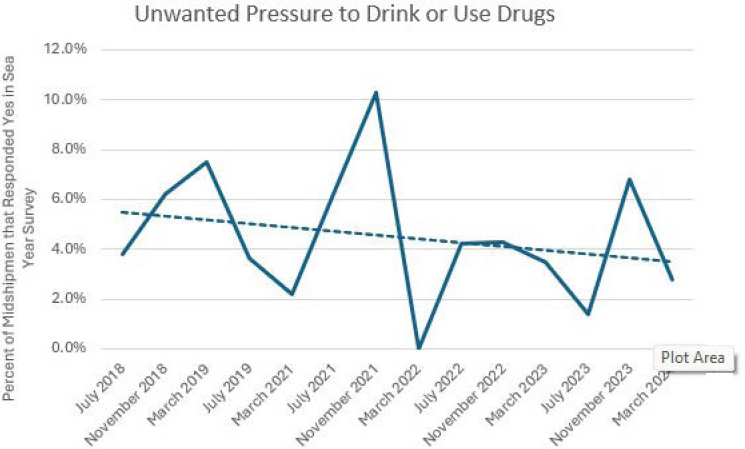
SOURCE: Committee generated from data provided from the USMMA (USMMA, Personal Communication, July 18, 2024. https://www8.nationalacademies.org/pa/managerequest.aspx?key=DBASSE-BBCSS-23-02
___________________
5 USMMA, Personal Communication, July 18, 2024. https://www8.nationalacademies.org/pa/managerequest.aspx?key=DBASSE-BBCSS-23-02
6 Yearly sample sizes for the data in Figures 3-1 and 3-2 ranged from 82 to 133; response rates to the surveys ranged from 51.7% to 85.7%, with an average response rate of 72%.
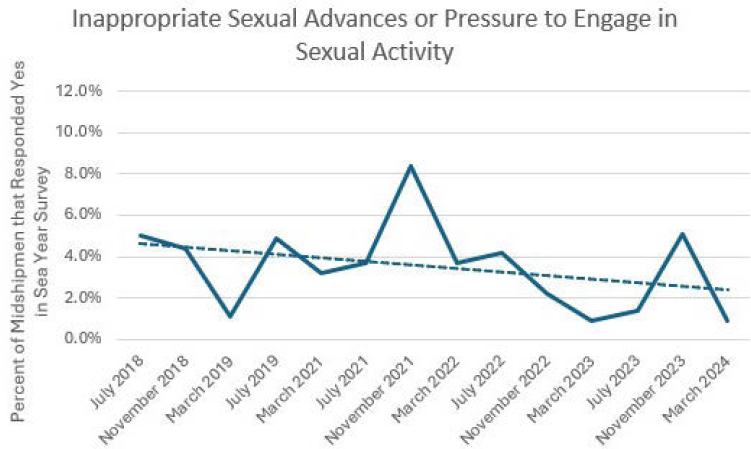
SOURCE: Committee generated from data provided from the USMMA (USMMA, Personal Communication, July 18, 2024. https://www8.nationalacademies.org/pa/managerequest.aspx?key=DBASSE-BBCSS-23-02
An understanding of student experiences on campus can also provide insight into the maritime industry’s culture and climate in as much as the maritime academies (both SMAs and the USMMA) and institutes establish expectations for students as they graduate and pursue careers in the commercial maritime industry.
In this regard, the USMMA has participated in the Office of People Analytics, Department of Defense’s (DOD) Service Academy Gender Relations (SAGR) Survey (2024), which has been issued about every two years, since 2012. The SAGR survey guides planning, assessment, programming and continuous learning to reduce the incidence of sexual misconduct. USMMA results from the SAGR 2022 survey showed that 26.2% of surveyed women (55) and 2.8% of USMMA men (21) experienced unwanted sexual contact in the previous academic year. These rates were notably higher than the results from the 2018 SAGR survey when the rate was 11% for women and 1.4% for men (Office of People Analytics, 2023). The rates of reported unwanted sexual contact at the USMMA are somewhat higher for women and lower for men compared to rates in the military academies, which reported that 21.4% of women and 4.4% of men reported unwanted sexual contact in 2022 (Davis et al., 2023). When considering questions related to sexual harassment, the SAGR 2022 survey found that 60% of
women (126) and 11% of men (81) experienced sexual harassment in the past academic year, compared to 2018 when the rate was 41% for women and 4% for men (Office of People Analytics, 2023). These results suggest that the prevalence of sexual misconduct at the USMMA may have been increasing during this period.
According to the SAGR survey, unwanted sexual contact remained underreported at the USMMA. The 2022 survey indicated that 20% of women who experienced unwanted sexual contact filed an official report and said they did so because someone encouraged them to file the report or to stop the alleged offender(s) from hurting others. Over two-fifths of USMMA women who filed an official report said they experienced retaliation from reporting their unwanted sexual contact event. Of those who did not report the experience, the majority said they did not report because they managed the problem themselves by avoiding the alleged offender, did not want more people to know, or felt uncomfortable making a report (Office of People Analytics, 2023).7
The USMMA was required to issue surveys to Cadets and Midshipmen, in response to a Fiscal Year (FY) 2024 James M. Inhofe National Defense Authorization Act (NDAA) mandate to (a) assess the extent that USMMA’s honor and conduct systems are similar to each other and to Uniform Code of Military Justice processes, including punishments given and whether any honor or misconduct issues are included on military records upon commissioning; (b) the extent that military academy honor and conduct systems provide common due process protections; (c) the extent that military academy honor and conduct systems enable the academies to measure student conduct and performance trends; and (d) perceptions and attitudes of Cadets and Midshipmen toward their academy’s honor and conduct system. The committee learned in its communications with the USMMA that these results are expected to be released several months after March 2025.8
U.S. COAST GUARD REPORTS AND ACTIONS
In addition to the published literature and maritime institute surveys, available data includes reports of incidents and enforcement action from the U.S. Coast Guard. These reports, of course, only reflect those cases of which the U.S. Coast Guard is aware. Nonetheless, the data does provide a window into these challenges.
___________________
7 USMMA Midshipmen and students from the other four federal service academies participated in the latest DOD SAGR survey in March 2024; Midshipmen who were at sea in March 2024 participated in November 2024.
8 USMMA, Personal Communication, March 31, 2025. https://www8.nationalacademies.org/pa/managerequest.aspx?key=DBASSE-BBCSS-23-02
Data Sources for Alcohol and Other Substance Misuse Reports
Reports on alcohol and other substance misuse on commercial vessels come from the U.S. Coast Guard Marine Information Safety and Law Enforcement System (MISLE) database. MISLE is an information system that supports and centralizes the information needs and business processes of the U.S. Coast Guard’s marine safety, security, environmental protection, and law enforcement programs. MISLE data is collected and stored by authorized U.S. Coast Guard’s personnel using a database operated and maintained by the U.S. Coast Guard.
Although certain information is available to the public, MISLE contains privileged information about vessel owners, operators, charterers, managers, agents, crewmembers, or passengers; facility owners, operators, or employees; individuals who own, operate, or represent marine transportation companies; and other individuals who came into contact with the U.S. Coast Guard through its Maritime Law Enforcement, Investigation, Marine Safety, Maritime Security, Marine Environmental Protection, Search and Rescue, and Bridge Administration activities. The information system has recognized limitations related to data quality (e.g., data errors, inconsistent data entries) and other shortcomings (U.S. Government Accountability Office [GAO], 2020, 2025). Nevertheless, it remains the most reliable source of reports about safety incidents in the commercial maritime industry.
MISLE houses information that companies are required by law to report about safety and security events, including the results of the required post-casualty tests for alcohol and drugs submitted as part of the Report of Marine Casualty and its Report of Mandatory Chemical Testing (see Chapter 2). MISLE also houses other violations of federal alcohol regulations, such as reports of positive reasonable cause tests for crew members arriving for duty intoxicated. MISLE also includes Management Information System (MIS) reports that companies in the maritime industry file with the U.S. Coast Guard to enable tracking and analysis of safety data to ensure compliance with maritime regulations.
However, because periodic and random testing is required only for dangerous drugs, not alcohol, as described in Chapter 2, MIS reports do not include any such tests for alcohol conducted only according to company policy.9 According to the U.S. Coast Guard, about 500 to 1,200 MIS reports
___________________
9 H.R. 6 Sec. 8103, signed into law in 2018, required DOT to establish and make publicly available on its website a database MIS drug and alcohol testing data reported by employers for each mode of transportation, and to update the database annually (DOT Agency MIS Data. (n.d.). DOT. https://www.transportation.gov/odapc/DOT_Agency_MIS_Data). Data is reported at the level of mode with indication of the number of reporting companies and number of safety-sensitive employees represented. The U.S. Coast Guard, having moved from DOT to the U.S. Department of Homeland Security in 2003, is not mandated to make the MIS data it collects publicly available on the DOT Agency MIS data system.
are received yearly; however, the vast majority are from smaller operations such as a small fishing boat or dive boat that may carry up to six paying passengers plus a crew member or other uninspected vessels (up to 100 gross registered tonnage) that do not require a credentialed mariner.10 In addition, MISLE includes the results of Safety Management System audits, which are used to track alcohol and other substance incident investigations and enforcement actions against individual mariners and commercial maritime entities, including shipping companies.
Another source of information on alcohol misuse is U.S. Coast Guard Merchant Mariner Licensing and Documentation (MMLD) data. As part of the U.S. Coast Guard’s merchant mariner credentialing and licensing process, mariners are required to disclose all convictions, including those for alcohol, drug, or sexual crimes, which is tracked in MMLD data.11 However, according to the U.S. Coast Guard, the number and percentage of current merchant mariners having an existing conviction cannot be easily determined by a search of MMLD data.12
MMLD data also includes medical certification applications; however, the relevant form, CG-719K, asks only about the “evaluation, treatment, or hospitalization for alcohol or substance use, abuse, addiction, or dependence” and does not require specifying the substance. The form also does not require disclosing recreational alcohol or other substance use. Entry-level mariners do not have to disclose alcohol or other substance use in the medical certificate application because, according to the U.S. Coast Guard, the service “has limited statutory authority to require medical examinations for entry-level mariners. At present, that authority does not require a full physical examination for entry-level mariners.”13
Maritime Events
According to MISLE data, for the time period covering January 2015 to December 2023, 244 reports were received for maritime events on U.S.-flagged vessels that involved alcohol or other substances and credentialed or non-credentialed mariners (see Appendix B). An incident is an occurrence
___________________
10 Patrick Mannion, Presentation to the Committee, May 28, 2024. https://www8.nationalacademies.org/pa/managerequest.aspx?key=DBASSE-BBCSS-23-02
11 See Form CG-719C, https://media.defense.gov/2018/May/22/2001920378/-1/-1/0/CG_719C.PDF
12 According to the U.S. Coast Guard, CG-719C data describing conviction type are held in a free-form data field that is difficult to search, and every result turned up in a search would have to be verified by hand (U.S. Coast Guard, Personal Communication, April 8, 2025. https://www8.nationalacademies.org/pa/managerequest.aspx?key=DBASSE-BBCSS-23-02).
13 U.S. Coast Guard, Personal Communication, April 8, 2025. https://www8.nationalacademies.org/pa/managerequest.aspx?key=DBASSE-BBCSS-23-02
that causes or requires the U.S. Coast Guard Captain of the Port or Officer in Charge of Marine Inspection to take an action such as inspection, investigation, mitigation, recovery, or enforcement; an event is a component of the incident. The overall trend in the number of reported incidents involving alcohol and other substance incidents is decreasing: 2024 is less than half of 2015. However, there is considerable variability, and the number of reports are limited, so it is difficult to draw definitive conclusions.
Enforcement Actions for Alcohol Incidents
Additional information comes from data on enforcement actions related to incidents involving alcohol. This data depends on decisions to report a problem and then on decisions to move forward with enforcement; as a result, it cannot be relied upon for the prevalence of specific events. For credentialed mariners, the U.S. Coast Guard may take enforcement action against a mariner’s credentials for alcohol incidents under several applicable regulations. The U.S. Coast Guard provided data on alcohol
TABLE 3-1 Alcohol Incidents Leading to a Merchant Mariner Credential Enforcement Action, 2019–2024
| Calendar Year | 2019 | 2020 | 2021 | 2022 | 2023 | 2024 | Total |
|---|---|---|---|---|---|---|---|
| Enforcement Cases | 91 | 46 | 20 | 53 | 63 | 87 | 360 |
NOTE: Each case is a separate incident and individual.
SOURCES: Jason Neubauer, Presentation to Committee, May 28, 2024, and U.S. Coast Guard, Personal Communication, February 25, 2025 (for FY 2024 totals). https://www8.nationalacademies.org/pa/managerequest.aspx?key=DBASSE-BBCSS-23-02
| Regulations | Number of Cases |
|---|---|
| 46 C.F.R. § 5.27 Misconduct | 233 |
| 46 C.F.R. § 5.29 Negligence | 4 |
| 46 C.F.R. § 5.31 Incompetence | 1 |
| 46 C.F.R. § 5.33 Violation of Law or Regulation | 100 |
| 46 C.F.R. § 5.35 Prior Substance Abuse Conviction | 3 |
| 46 U.S.C. § Sec. 7702 Temporary Suspension | 1 |
| 46 U.S.C. § Sec 7703 Negligence Contributing to Death | 1 |
SOURCE: Jason Neubauer, Presentation to Committee, May 28, 2024. https://www8.nationalacademies.org/pa/managerequest.aspx?key=DBASSE-BBCSS-23-02
incidents involving credentialed mariners over a six-year period leading to an enforcement action (Table 3-1), and number of cases associated with applicable regulations (Table 3-2). Note that an enforcement action for an alcohol incident may or may not be related to a reported casualty event.
Misconduct14 is the violation category with the most alcohol-related cases (233), followed by violation of law or regulation (100). The U.S. Coast Guard characterized the alcohol misconduct cases as follows:15
- In “many” cases, alcohol was detected due to mandatory testing required after a marine casualty.
- A “majority” of alcohol cases involved junior crew members who return from liberty or report for duty intoxicated.
- A “small percentage” of the cases involved alcohol being smuggled aboard the vessel or misuse of a liquor locker on a vessel engaged on international voyages.
The number of alcohol misconduct cases varies with ship type (see Table 3-3). Almost half of cases occurring during 2019–2024 took place on one passenger ship.
According to the U.S. Coast Guard, fishing vessels is an example of a “blind spot” for alcohol misuse: anecdotally “a lot” of alcohol and other substance use occurs, but without required alcohol and other drug testing, due to their small size.
The number of distinct counts of enforcement actions and sanctions for January 1, 2024, to January 14, 2025, the only time period available for the committee’s review, are shown in Table 3-4 and Table 3-5. Because an individual may be sanctioned for more than one “count,” total counts exceed total cases.16
Reports of Sexual Misconduct
Since 2019, the U.S. Coast Guard has received reports of sexual misconduct incidents through the CG-TIPS App or email address, with
___________________
14 46 C.F.R. § 5.27 defines misconduct as “human behavior which violates some formal, duly established rule. Such rules are found in, among other places, statutes, regulations, the common law, the general maritime law, a ship’s regulation or order, or shipping articles and similar sources. It is an act which is forbidden or a failure to do that which is required.”
15 Jason Neubauer, Presentation to Committee, May 28, 2024. https://www8.nationalacademies.org/pa/managerequest.aspx?key=DBASSE-BBCSS-23-02; and U.S. Coast Guard, Personal Communication, February 25, 2025 (for FY 2024 totals).
16 Not included in the data are administrative actions the U.S. Coast Guard may have taken for an alcohol offense not under the authority of the merchant mariner credential (MMC), such as driving while intoxicated or other non-maritime offenses.
TABLE 3-3 Number and Percentage of Alcohol Misconduct Cases by Ship Type, Calendar Years 2019–2024
| Type of Vessel | 2019 | 2020 | 2021 | 2022 | 2023 | 2024 | Total | Percent |
|---|---|---|---|---|---|---|---|---|
| Passenger Ship | 53 | 22 | 2 | 18 | 30 | 23 | 148 | 48.7% |
| Towing Vessel | 15 | 5 | 5 | 8 | 3 | 7 | 43 | 14.1% |
| General Dry Cargo Ship | 9 | 5 | 1 | 7 | 8 | 1 | 31 | 10.2% |
| Tank Ship | 5 | 4 | 4 | 4 | 5 | 5 | 27 | 8.9% |
| Roll On/Roll Off Cargo Ship | 4 | 3 | 3 | 1 | 3 | 2 | 16 | 5.3% |
| Miscellaneous Vessel | 1 | 1 | 4 | 3 | 3 | 1 | 13 | 4.3% |
| Bulk Carrier | 3 | 3 | 1 | 1 | 2 | 10 | 3.3% | |
| Barge | 4 | 1 | 2 | 1 | 8 | 2.6% | ||
| School Ship | 4 | 4 | 1.3% | |||||
| Recreational (Charter) | 2 | 2 | 0.7% | |||||
| Offshore | 1 | 1 | 0.3% | |||||
| Research Ship | 1 | 1 | 0.3% | |||||
| Total (listed) | 96 | 45 | 21 | 48 | 53 | 41 | 304 | 100.0% |
NOTES: Almost half of the alcohol misconduct cases occurred on one vessel—the single cruise ship that operates in U.S. waters. The Pride of America, with a crew of ~1,500 and a capacity for 3,236 passengers, sails exclusively between Hawaii ports. This vessel is responsible for nearly half of the alcohol incidents on U.S.-flagged vessels. According to the U.S. Coast Guard’s presentation, most cases on the Pride of America were young crew members coming on duty having consumed alcohol when off-duty that violated the alcohol regulations.
SOURCE: Jason Neubauer, Presentation to Committee, May 28, 2024. https://www8.nationalacademies.org/pa/managerequest.aspx?key=DBASSE-BBCSS-23-02
guidance provided in Marine Safety Information Bulletin No. 1-23 (U.S. Coast Guard, 2023). The U.S. Coast Guard also maintains a 24/7 watch, which can field reports of sexual misconduct via the National Command Center with 24/7 phone number.17 The committee requested historic data from the U.S. Coast Guard on the numbers and types of sexual assault and harassment incidents that have been reported by type of vessel, location of the incident, type of credential held by parties involved (survivor,
___________________
17 Data or reports are available from the CG-TIPS App in 23 different categories: Assault, Concern of Self-Harm, Drugs, Environmental Crimes/Pollution, Fraud, Harassment, Homicide, Human Trafficking, Illegal Charter Operations, Improper Profiling or Bias, Insider Threat, Merchant Mariner Credential (MMC) Fraud, Port Safety and Security Violations, Robbery, Search and Rescue Hoax, Sexual Assault, Sexual Harassment, Terrorism, Theft or Loss of Government Property, TWIC Fraud, UCMJ Violation, and Other.
| Citation Code | Enforcement | Sanction | Distinct Counts |
|---|---|---|---|
| Misconduct (46 C.F.R. § 5.27) | Letter of Warning – Suspension and Revocation | 23 | |
| Suspension and | 1–3 months | 19 | |
| Revocation (#33) | 4–6 months | 18 | |
| 12+ months | 1 | ||
| Unspecified | 2 | ||
| Voluntary Surrender | 2 | ||
| Pending/With Judge, In Process | 7 | ||
| Closed Cases | 32 | ||
| Open Cases | 40 | ||
| Total 46 C.F.R. § 5.27 Cases | 72 | ||
| Misconduct (46 C.F.R. § 5.33) | Letter of Warning – Suspension and Revocation | 1 | |
| Suspension and | 1–3 months | 4 | |
| Revocation | 4–6 months | 3 | |
| 12+ months | 1 | ||
| Unspecified | 1 | ||
| Pending/With Judge | 2 | ||
| Closed Cases | 3 | ||
| Open Cases | 9 | ||
| Total 46 C.F.R. § 5. | 3 Cases | 12 | |
| Violation of Law or Regulation Related to Drugs or Alcohol While Acting Under Authority of Credential (46 U.S.C. § 7702(d)(1)(B)(i)) | Suspension and Revocation | 12+ months | 1 |
| Open Cases | 1 | ||
| Total 46 U.S.C. § 7702(d)(1)(B)(i) Cases | 1 | ||
| Conviction of Operating a Motor Vehicle Under the Influence of Alcohol or Drugs (46 U.S.C. § 7703(3)) | Suspension and Revocation | 1–3 months | 2 |
| Unspecified | 1 | ||
| Voluntary Surrender | 1 | ||
| Closed Cases | 2 | ||
| Open Cases | 2 | ||
| Total 46 U.S.C. § 7703(3) Cases | 4 | ||
NOTES: Counts are not equal to number of mariners because an individual mariner may have one or more distinct counts. Number of open and closed cases as of January 14, 2025.
SOURCE: Committee generated from data provided from the U.S. Coast Guard (U.S. Coast Guard, Personal Communication, February 25, 2025. https://www8.nationalacademies.org/pa/managerequest.aspx?key=DBASSE-BBCSS-23-02)
TABLE 3-5 Summary of Distinct Merchant Mariner Credential Sanction Counts by Enforcement Type
| Enforcement Type | Total Counts |
|---|---|
| Warning - Suspension and Revocation | 24 |
| Suspension and Revocation | 53 |
| Voluntary Surrender | 3 |
| Pending | 9 |
| Total | 89 |
NOTE: Counts are not equal to number of mariners because a single individual may have one or more distinct counts.
SOURCE: Committee generated from data provided from the U.S. Coast Guard (U.S. Coast Guard, Personal Communication, February 25, 2025. https://www8.nationalacademies.org/pa/managerequest.aspx?key=DBASSE-BBCSS-23-02)
perpetrator) and whether alcohol and/or other harmful substances was deemed a cause or involved. The U.S. Coast Guard reported this data is not “readily available.”18
Section 10105 of Title 46, U.S. Code (2023) requires the U.S. Coast Guard to report to Congress annually statistics on sexual misconduct or related offenses (Sexual Misconduct on U.S. Vessels (FY 2024) Report to Congress, April 4, 202519). In FY 2024, the U.S. Coast Guard received 287 reports of sexual misconduct or harassment (see Table 3-6), a 91% increase of such reports from FY 2023. Of the 18 criminal investigations for sexual assault, eight were referred to the Department of Justice, which did not accept or pursue any criminal referrals; five were referred to other law enforcement authorities, two were moved into administrative proceedings, and three remained open investigations. The U.S. Coast Guard reported that sexual misconduct cases have been challenging to prove criminally: the five sexual assault cases from 2019 to 2024 that resulted in criminal charges include incidents of rape and two Cadets being drugged by a senior officer and alcohol smuggled onboard in violation of company policy (U.S. Coast Guard, 2024).
The U.S. Coast Guard also reports to Congress administrative investigations as part of MMC enforcement, also called Suspension and Revocation proceedings. The administrative investigations in Table 3-7, totaling 442 investigations, include those completed in as well as those still open in FY 2024. Table 3-7 also includes credential enforcement because of
___________________
18 U.S. Coast Guard, Personal Communication, April 8, 2025. https://www8.nationalacademies.org/pa/managerequest.aspx?key=DBASSE-BBCSS-23-02
19 U.S. Coast Guard, Personal Communication, April 4, 2025. https://www8.nationalacademies.org/pa/managerequest.aspx?key=DBASSE-BBCSS-23-02
TABLE 3-6 Reports of Sexual Misconduct and Assault to the U.S. Coast Guard, FY 2024
| Offense Type | Amount |
|---|---|
| Sexual Assault | 18 |
| Assault | 15 |
| Sexual Harassment | 107 |
| Harassment | 147 |
| Total | 287 |
SOURCE: U.S. Coast Guard, Personal Communication, April 4, 2025. https://www8.nationalacademies.org/pa/managerequest.aspx?key=DBASSE-BBCSS-23-02
TABLE 3-7 Administrative Investigations for Merchant Mariner Credential Enforcement, FY 2024
| Offense Type | Open | Completed |
|---|---|---|
| Sexual Assault | 42 | 9 |
| Assault | 17 | 4 |
| Sexual Harassment | 86 | 64 |
| Harassment | 48 | 103 |
| TWIC Revocation - Sex Offenses | 43 | 1 |
| Prior Conviction of Sex Offense | 16 | 2 |
| Pending Assessment | 6 | |
| Total | 258 | 183 |
SOURCE: U.S. Coast Guard, Personal Communication, April 4, 2025. https://www8.nationalacademies.org/pa/managerequest.aspx?key=DBASSE-BBCSS-23-02
Transportation Worker Identification Credential (TWIC) revocation for or prior conviction of sex offenses, which are not covered under the reporting required for Table 3-6. Most of the completed administrative investigations resulted in the finding that the U.S. Coast Guard did not have MMC enforcement jurisdiction, either because the mariner never had a credential or because the credential had expired before the investigation began. For sexual misconduct offences, seven of nine completed sexual assault investigations and 52 of 64 completed sexual harassment investigations concluded because of a lack of jurisdiction, indicating the limited reach of MMC enforcement.
Although the U.S. Coast Guard report to Congress does not include the portion of sexual misconduct cases that involve alcohol, the U.S. Coast Guard provided the committee data on what portion of MMC enforcement
cases for alcohol misconduct also included sexual misconduct. Over a six-year period (calendar years 2019–2024), the U.S. Coast Guard reported that 3% of alcohol misconduct cases also included sexual misconduct (see Table 3-8). Underreporting is likely during this six-year period, because many of the reported incidents occurred before the maritime academies implemented their amnesty policy for alcohol infractions if reporting a sexual misconduct incident and before mandatory sexual misconduct reporting. According to the U.S. Coast Guard, the sexual misconduct cases involving alcohol “often” included senior-level mariners, and these reported incidents were prior to the Every Mariner Builds a Respectful Culture policy that prohibited Cadets and crewmembers from entering each other’s state rooms.20 The U.S. Coast Guard indicated that social events onboard have led to “the worst” incidents. Table 3-9 reviews MMC enforcement actions for sexual misconduct, January 1, 2024–January 14, 2025.
Table 3-9 shows administrative actions for sexual misconduct cases over a one-year period.
U.S. Coast Guard and Sexual Misconduct
For additional insight into the maritime industry’s safety culture, the committee reviewed sexual misconduct reports in the U.S. Coast Guard, given the parallels in merchant and U.S. Coast Guard sea service experience, culture and sexual misconduct experience.
The U.S. Coast Guard has experienced increased scrutiny, particularly around sexual misconduct accountability, transparency and reporting in Operation Fouled Anchor (GAO, 2022; Hicken et al., 2023; U.S. Coast Guard, 2020) and at the U.S. Coast Guard Academy (National Academy of Public Administration, 2022). Similarly, State MariAcademies have received calls for enhanced sexual misconduct policies, procedures, and working environment improvements (e.g., Cal Maritime News, 2021).
| 2019 | 2020 | 2021 | 2022 | 2023 | 2024 | Total | |
|---|---|---|---|---|---|---|---|
| Alcohol Misconduct Cases | 91 | 46 | 20 | 53 | 63 | 87 | 360 |
| Alcohol Plus Sexual Misconduct | 3 | 2 | 1 | 0 | 4 | 1 | 11 |
SOURCES: Jason Neubauer, Presentation to Committee, May 28, 2024, and U.S. Coast Guard, Personal Communication, February 25, 2025 (for FY 2024 totals). https://www8.nationalacademies.org/pa/managerequest.aspx?key=DBASSE-BBCSS-23-02
___________________
20 Jason Neubauer, Presentation to Committee, May 28, 2024. https://www8.nationalacademies.org/pa/managerequest.aspx?key=DBASSE-BBCSS-23-02
| Citation Code | Enforcement | Distinct Counts |
|---|---|---|
| 46 U.S.C. § 7704a(a) Sexual Harassment | Letter of Warning – Suspension and Revocation | 1 |
| Suspension and Revocation | 13 | |
| Voluntary Surrender | 1 | |
| 46 U.S.C. § 7704a(b) Sexual Assault | Letter of Warning – Suspension and Revocation | 0 |
| Suspension and Revocation | 17 | |
| Voluntary Surrender | 1 | |
| Total | 31 |
SOURCE: Committee generated using data provided by the U.S. Coast Guard (U.S. Coast Guard, Personal Communication, February 25, 2025. https://www8.nationalacademies.org/pa/managerequest.aspx?key=DBASSE-BBCSS-23-02
In its annual report on FY 2022 mandated by Congress,21 the U.S. Coast Guard reported 88 allegations of sexual harassment and 40 substantiated cases (U.S. Coast Guard, 2024). Reported allegations of sexual harassment decreased from 122 in FY 2021 to 88 in FY 2022, a 28% decrease that the U.S. Coast Guard attributes to implementation of “harassment policies, complaint processes, and procedures” that “hold appropriately accountable any personnel in substantiated cases” (U.S. Coast Guard, 2024). The U.S. Coast Guard reported 226 sexual assault reports in the U.S. Coast Guard in FY 2022. Of the 176 reports that did not involve a formal investigation, involvement of alcohol or other substances in sexual assault was described as suspected in 61 and unknown for 6322 (U.S. Coast Guard, 2024).
Affirmation of underreporting of sexual misconduct and of the role of alcohol comes from the U.S. Senate Permanent Subcommittee on Investigations (2024) report A Pervasive Problem: Voices of Coast Guard Sexual Assault and Harassment Survivors, which notes “approximately half of the instances of sexual misconduct disclosed to the Subcommittee were never reported to the Coast Guard or the Academy” (U.S. Senate Permanent Subcommittee on Investigations, 2024, p. 15). The report points to the role of “a hostile culture” that was “deeply harmful to the whistleblowers
___________________
21 Section 217 of the U.S. Coast Guard Authorization Act of 2010 (Pub. L. No. 111-281), as amended by the John S. McCain National Defense Authorization Act for Fiscal Year 2019 (Pub. L. No. 115-232).
22 These were restricted reports. An unrestricted report triggers a formal investigation and command notification, whereas a restricted report allows a survivor to confidentially access support services without notifying command or law enforcement.
who reported their abuse and also deterred many from reporting.” Among the primary policies alleged to have fostered a culture tolerant of sexual misconduct at the U.S. Coast Guard Academy were regulations around punishment for collateral misconduct including under-age drinking (U.S. Senate Permanent Subcommittee on Investigations, 2024, p. 21).
ANNUAL REPORTS FROM THE MARITIME ACADEMIES AND AUDITS
Sexual Misconduct
In addition to the USMMA’s surveys, the USMMA’s 2022-2023 Annual Report on Sexual Assault and Sexual Harassment at USMMA provides a yearly overview of reported incidents of sexual harassment and assault and the academy’s response efforts (USMMA, 2024). In academic year 2022–2023, 31 incidents of sexual misconduct, including gender-based harassment, relationship violence, and stalking incidents, were reported. The 31 total reported incidents represented an increase from 21 in 2021–2022, and 15 in 2020–2021. Reported Incidents in 2022–2023 included Sexual Assault (12 incidents), Sexual Harassment, including Gender-Based Harassment, and Retaliation (16), Stalking (1) and Relationship Violence (2).
It merits noting that the USMMA will participate in the DOD On Site Installation and Evaluation (OSIE) program to audit the military misconduct process at the USMMA. OSIE focuses on a military installation’s undesirable behavior prevention capabilities and the installation’s ability to effectively address risk for sexual assault, harassment, and suicide (DOD, 2023a,b). The results of the USMMA’s OSIE are expected to be available in late 2025 and used for guiding planning, assessment, programming, and continuous learning to improve campus safety climate.23
CONCLUSIONS AND RECOMMENDATIONS
Because of significant limitations in available data, it is not possible to fully characterize the prevalence of mariner alcohol and other substance use and sexual misconduct. There is no single source of data, and what data does exist varies in terms of design, limitations, and reach. At the same time, there is sufficient data suggesting that mariners face challenges with binge drinking and other mental health issues. Surveys of USMMA Cadets suggest that between 2% and 10% experience challenges with alcohol and unwanted sexual attention during their year training at sea and
___________________
23 USMMA, Personal Communication, April 29, 2025. https://www8.nationalacademies.org/pa/managerequest.aspx?key=DBASSE-BBCSS-23-02
reported incidents of sexual misconduct at the academy were increasing as of 2022–2023.24
U.S. Coast Guard reporting suggests an ongoing challenge with alcohol misuse and sexual misconduct at sea, but the scope and scale of the challenge is not possible to ascertain, especially given the likelihood of underreporting and lack of information for smaller vessels. In short, the information available is incomplete and inaccessible in ways that prevent full assessment of the effectiveness of government, industry, and institutional interventions.
To address these gaps, the committee developed sets of questions to inform the development of surveys for mariners. The questions address well-being, alcohol and other substance use, and sexual misconduct and could be used to provide a more comprehensive assessment and measure progress over time.
Conclusion 3-1: To design and evaluate the effectiveness of policies related to alcohol and other substance use and sexual misconduct for U.S. commercial vessels and maritime academies and institutions, more comprehensive, integrated, and accurate data are needed on the occurrence of mariner misuse of alcohol and other substances in connection with sexual misconduct and other harmful behaviors.
Recommendation 3-1: The U.S. Coast Guard should initiate a data collection and maintenance effort for the entire U.S. maritime industry, including the maritime academies, that can be used to assess mariner alcohol and other substance use and misuse, well-being, and sexual misconduct.
The goal should be to bring together results from Cadet surveys, alcohol and other drug testing, and disciplinary actions for sexual misconduct and use and misuse of alcohol and other substances, and to supplement this information with regularly conducted mariner surveys. The surveys should be designed to assess the population-level prevalence of risky behaviors by U.S. mariners, trends over time, and the degree to which they are reported. A sample set of questions that might be included in a mariner survey is offered in this report.
___________________
24 USMMA, Personal Communication. https://www8.nationalacademies.org/pa/managerequest.aspx?key=DBASSE-BBCSS-23-02
REFERENCES
46 U.S.C. § 5.27. (1985). https://www.ecfr.gov/current/title-46/chapter-I/subchapter-A/part-5/subpart-B/section-5.27
46 U.S.C. § 10105. (2023). https://www.govinfo.gov/app/details/USCODE-2023-title46/USCODE-2023-title46-subtitleII-partG-chap101-sec10105
46 U.S.C. § 15109. (2023). https://uscode.house.gov/view.xhtml?req=granuleid:USC-prelim-title46-section15109&num=0&edition=prelim
Baker, M. G. (2021). U.S. Mariner mental health & wellbeing during COVID-19 and beyond. University of Washington School of Public Health. https://deohs.washington.edu/sites/default/files/2021-11/Mariner%20final%20report%2011192021.pdf
Brooks, S. K., & Greenberg, N. (2022). Mental health and psychological wellbeing of maritime personnel: a systematic review. BMC Psychology, 10(1), 139. https://doi.org/10.1186/s40359-022-00850-4
Cal Maritime News. (2021). State maritime academies urge action on sexual assault in the maritime industry. California State University Maritime Academy. https://web.archive.org/web/20240710114004/https://www.csum.edu/campus-news/2021/sash-letter.html
Davis, L., Klahr, A., Klauberg, W. X., Alukal, D., Wakefield, E., Puckett, G., Clark, B., Salomone, D., Elvey, K., & Lane, B. (2023). 2022 service academy gender relations survey overview report. Office of People Analytics. https://dpac.defense.gov/Portals/131/Documents/2022SAGR_OverviewReport_FINAL_DTIC-SF298.pdf?ver=bZ3QbX3qHOQR4924gLqUzQ%3D%3D
Evoy, R., & Case, S. (2022). Prevalence of adverse health behaviors and conditions among maritime workers, BRFSS 2014 to 2018, 38 states. Journal of Occupational and Environmental Medicine, 64(4), 350–355. https://doi.org/10.1097/jom.0000000000002430
Grövel, A., Stevanovic, J., & Maruani, M. (2017). Travailler à bord des navires de la Marine marchande: Étude sociologique des risques et des violences physiques, psychologiques ou à caractère sexuel. Institute Research Économiques Et Sociales.
Hicken, M., Ellis, B., Ash, A., Brown, P., & Devine, C. (2023). CNN uncovered a damning, secret investigation into sexual assault at the US Coast Guard Academy. This woman’s case triggered that probe. CNN. https://www.cnn.com/2023/07/12/politics/coast-guard-academy-investigation-invs
International Labor Organization. (2022). Experiences of violence and harassment at work: A global first survey. https://doi.org/10.54394/IOAX8567
Iversen, R. T. (2012). The mental health of Seafarers. International Maritime Health, 63(2), 78–89. https://pubmed.ncbi.nlm.nih.gov/22972547/
Lefkowitz, R. Y., Null, D. B., Slade, M. D., & Redlich, C. A. (2020). Injury, illness, and mental health risks in United States domestic mariners. Journal of Occupational and Environmental Medicine, 62(10), 839–841. https://doi.org/10.1097/jom.0000000000001968
Lefkowitz, R. Y., & Slade, M. D. (2019). Seafarer mental health study. ITF Seafarers’ Trust & Yale University. https://www.seafarerstrust.org/sites/default/files/node/publications/files/ST_MentalHealthReport_Final_Digital-1.pdf
National Academy of Public Administration. (2022). An assessment of cultural competence at the United States Coast Guard Academy. https://napawash.org/academy-studies/u-s-coast-guard-academy-cultural-competence-assessment
Office of People Analytics. (2023). 2022 U.S. Merchant Marine Academy Service Academy gender relations survey (Report No. 2023-026). U.S. Department of Defense. https://www.opa.mil/research-analysis/health-well-being/sexual-assault-prevention-and-response/2022-service-academy-gender-relations-survey/2022-u-s-merchant-marine-academy-usmma-gender-relations-survey-overview-report
Office of the Surgeon General. (2023). Our epidemic of loneliness and isolation: The U.S. Surgeon General’s advisory on the healing effects of social connection and community. U.S. Department of Health and Human Services. https://www.hhs.gov/sites/default/files/surgeon-general-social-connection-advisory.pdf
Oldenburg, M., & Jensen, H. J. (2019). Stress and strain among Seafarers related to the occupational groups. International Journal of Environmental Research and Public Health, 16(7), 1153. https://doi.org/10.3390/ijerph16071153
Pougnet, R., Pougnet, L., Loddé, B., Canals, L., Bell, S., Lucas, D., & Dewitte, J. D. (2014). Consumption of addictive substances in mariners. International Maritime Health, 65(4), 199204. https://doi.org/10.5603/IMH.2014.0038
Radic, A., Ariza-Montes, A., Hernández-Perlines, F., & Giorgi, G. (2020). Connected at sea: The influence of the internet and online communication on the well-being and life satisfaction of cruise ship employees. International Journal of Environmental Research and Public Health, 17(8), 2840. https://doi.org/10.3390/ijerph17082840
Safety4Sea Editorial Team. (2025). Alcohol onboard: Striking a balance is crucial. Safety4Sea. https://safety4sea.com/cm-alcohol-onboard-striking-a-balance-is-crucial/
Sanz-Trepiana, L., Bost, E., Jégo, C., Lucas, D., & Fort, E. (2024). Aggression, psychological violence and sexual harassment in Seafarers in France. International Maritime Health, 75(2), 121–134. https://doi.org/10.5603/imh.99382
Speir, C., Ridings, C., Marcum, J., Drexler, M., & Norman, K. (2020). Measuring health conditions and behaviours in fishing industry participants and fishing communities using the Behavioral Risk Factor Surveillance Survey (BRFSS). ICES Journal of Marine Science, 77(5), 1830–1840. https://doi.org/10.1093/icesjms/fsaa032
Stoll, E., Püschel, K., Harth, V., & Oldenburg, M. (2020). Prevalence of alcohol consumption among Seafarers and fishermen. International Maritime Health, 71(4), 265–274. https://doi.org/10.5603/IMH.2020.0045
U.S. Coast Guard. (n.d.). Federal advisory committees. https://www.uscg.mil/Federal-Advisory-Committees/
___. (2020). “Fouled anchor” investigation final report. https://www.uscg.mil/Portals/0/documents/FOULED_ANCHOR_INVESTIGATION_FINAL_REPORT_AND_ENCLOSURE-508Compliant.pdf
___. (2023). Reporting sexual misconduct on U.S. vessels (MSIB No. 1-23). M. S. I. Bulletin. https://www.dco.uscg.mil/Portals/9/DCO%20Documents/5p/MSIB/2023/MSIB-01-23_Sexual_Misconduct_Reporting_Requirements.pdf?ver=9ToC1vbjw8tMGln9FpjdZg%3d%3d
___. (2024). Sexual assault in the U.S. Coast Guard (FY 2022): Report to Congress. https://www.dcms.uscg.mil/Portals/10/CG-1/cg114/docs/2024_01_03_Sexual%20Assaults%20in%20the%20Coast%20Guard%20(FY%202022).pdf?ver=5QWxg62BoOM7JmFUVmzGpw%3D%3D
U.S. Department of Defense (DOD). (2023a). 2023 military service academies on-site installation evaluation report. https://www.prevention.mil/Portals/130/Documents/2023_MILITARY_SERVICE_ACADEMIES_ON_SITE_INSTALLATION_EVALUATION_REPORT.pdf?ver=YBoBd0kEZPOpINbn0-Au9Q%3d%3d
___. (2023b). Department actions to transform the climate and help prevent harmful behaviors at the U.S. military service academies. https://media.defense.gov/2023/Aug/17/2003282612/-1/-1/1/SECRETARY_OF_DEFENSE_MEMORANDUM_ON_DEPARTMENT_ACTIONS_TO_TRANSFORM_THE_CLIMATE_AND_HELP_PREVENT_HARMFUL_BEHAVIORS_AT_THE_US_MILITARY_SERVICE_ACADEMIES.PDF
U.S. Department of Transportation (DOT). (2025). DOT agency MIS data. https://www.transportation.gov/odapc/DOT_Agency_MIS_Data
U.S. Government Accountability Office (GAO). (2020). Coast Guard: Actions needed to ensure investments in key data system meet mission and user needs (GAO-20-562). https://www.gao.gov/products/gao-20-562
___. (2022). Sexual assault: DOD and Coast Guard should ensure laws are implemented to improve oversight of key prevention and response efforts. (GAO-22-103973). https://www.gao.gov/products/gao-22-103973
___. (2025). Coast Guard: Actions needed to improve oversight of third-party organizations that help certify U.S.-flagged vessels (GAO-25-107139). https://www.gao.gov/products/gao-25-107139
U.S. Merchant Marine Academy (USMMA). (2024). 2022-2023 Sexual assault and sexual harassment report to Congress. https://www.usmma.edu/academy-life/sexual-assault-prevention/2022-2023-sexual-assault-and-sexual-harassment-report
U.S. Senate Permanent Subcommittee on Investigations. (2024). A pervasive problem: Voices of Coast Guard sexual assault and harassment survivors. Majority Staff Report. https://www.hsgac.senate.gov/wp-content/uploads/2024.08.07-PSI-Majority-Staff-Report-Voices-of-Coast-Guard-Sexual-Assault-and-Harassment-Survivors.pdf
This page intentionally left blank.


