Strengthening Alcohol Policies and Supporting Safety and Health in the Maritime Industry (2026)
Chapter: 2 Overview of the U.S. Commercial Maritime Industry and the Policy Context for Alcohol and Other Substance Misuse and Sexual Misconduct
2
Overview of the U.S. Commercial Maritime Industry and the Policy Context for Alcohol and Other Substance Misuse and Sexual Misconduct
Alcohol consumption and sexual misconduct on U.S. commercial vessels occurs in a context shaped by the commercial maritime industry and federal policy—a combination of law and regulation alongside implementation and enforcement. This chapter provides an overview of this context in order to set the stage for evidence, analysis, and recommendations in the ensuing parts of the report.
The first section provides a general description of the industry, including its various segments and scopes of operation as well as the commercial maritime workforce. This description covers the role of the U.S. Maritime Administration (MARAD) in developing and supporting the workforce to meet the nation’s economic and security needs primarily through its oversight and support for post-secondary maritime education, including at the U.S. Merchant Marine Academy (USMMA) and state maritime academies (SMAs).
The second section focuses on working on board commercial vessels including life at sea, to encompass the diversity of vessels and number of mariners whose work requires overnight voyages. A mariner living aboard a towing vessel on the Mississippi River will have different working and living conditions compared to a mariner aboard a tanker ship traversing the ocean.
The third section focuses on the general U.S. regulatory environment for vessels and maritime transportation, describing the overall international framework and the U.S. Coast Guard’s role in regulating vessels, vessel operators, and mariners.
The fourth section then turns to specific policies related to the subject matter of this report, including alcohol and other substance misuse and
sexual misconduct. Federal regulations do not prohibit alcohol consumption, but there are strict standards for its use. These strict standards play out in a diverse and complex system made up of different industry segments, geographic sectors, and vessel types.
U.S. COMMERCIAL MARITIME INDUSTRY AND WORKFORCE
On June 12, 2025, MARAD celebrated 250 years since civilian mariners took up arms against the British during the Revolutionary War.1 Today, the U.S. Maritime Transportation System (MTS) is a vast and complex network comprising ports, waterways, vessels, and intermodal connections that facilitate waterborne commerce and other marine activities. When in U.S. waters, vessels engaged in waterborne shipping and passenger service are overseen for the most part by the U.S. Coast Guard. Key components of the MTS include
- Deep sea or blue water sector: seaports, harbors, coastal waterways, and ocean-going vessels that primarily handle long-distance international cargo.
- Inland waterways: the Mississippi, Ohio, and Columbia-Snake River systems, known as “brown water” sector, and
- the Great Lakes and intracoastal waterways (National Academies, 2004).
Voyages for deep sea vessels and on the Great Lakes usually involve multiple days and nights, while those for inland and intracoastal waters are usually daily and may not require overnight voyages, although inland river towboats will have multiday or multiweek trips.
Industry Segments and Scopes of Operation
Understanding the basic organization of the U.S. commercial maritime industry is necessary to understanding the challenges of substance misuse and sexual misconduct. The U.S. commercial maritime industry is broadly segmented into international shipping and domestic waterways transport. International shipping includes container shipping, freighters and roll on/roll off (RO/RO) vessels; dry bulk shipping (e.g., coal, grain, and ore); tanker shipping (e.g., liquid cargo, including crude oil, refined petroleum products, and chemicals); passenger vessels; and specialty shipping (e.g., heavy lift ships and cable laying ships). The domestic segment includes
___________________
coastal tankers and freighters including bulk carriers; barges propelled by tugboats or towboats transporting freight, liquid, and bulk cargoes on inland waterways; dredges; ship assist and commercial fishing vessels; offshore energy exploration, production, and supply vessels; ships supporting port terminal operations; and passenger ferries or other passenger vessels.
Section 27 of the Merchant Marine Act of 1920, colloquially known as “The Jones Act,” continues to shape the U.S. commercial fleet and the scope of waterborne trade. The Jones Act requires ships carrying cargo between two U.S. coastwise ports to be U.S. owned, built, and manned by U.S. citizens as well as registered under the laws of the United States (i.e., under the U.S. flag; 46 U.S.C. § 55102, 2023). Commercial waterborne transportation requiring Jones Act-compliant vessels are known as the “Jones Act trades.” Box 2-1 provides a more detailed description of the scope of operations and industry segments for Jones Act trades. The Passenger Vessel Services Act places similar restrictions on moving passengers between U.S. ports (46 U.S.C. § 55103, 2023). Passenger service is predominantly local or regional ferry service such as those operating in the New York harbor, Puget Sound, San Francisco Bay, and other ports, and excursion or touring services. Of 15 U.S.-flag cruise ships, there is only one large cruise ship, Pride of America,2 which has capacity for 3,236 passengers and a crew of approximately 1,500, and which sails exclusively between Hawaii ports.
Vessel Types and Uses
The U.S. flag maritime workforce environment is shaped by type and use of the vessel. The types of commercial vessels that typically require the crew and other personnel to live on board include ocean-going deep draft vessels, towing vessels, offshore supply vessels (OSVs), research vessels, school ships, and certain passenger vessels and commercial fishing vessels3 (Haugen & Kristiansen, 2022; National Research Council, 1990).
The U.S. Army Corps of Engineers (USACE), MARAD, and the U.S. Coast Guard track the number and types of U.S. flag commercial vessels, although they use different criteria. Table 2-1 is the U.S.-flag fleet according to the USACE’s publication Waterborne Transportation Lines of the United States (U.S. Army Corps of Engineers, 2025).4 This publication states that there are currently 10,507 self-propelled vessels in the U.S. fleet that may include living quarters; the majority of self-propelled vessels (57%) are
___________________
2 U.S. Coast Guard, Personal Communication, May 6, 2025. https://www8.nationalacademies.org/pa/managerequest.aspx?key=DBASSE-BBCSS-23-02
3 U.S. Coast Guard, Personal Communication, April 21, 2025. https://www8.nationalacademies.org/pa/managerequest.aspx?key=DBASSE-BBCSS-23-02
4 This publication focuses on freight and passenger transportation and so does not include fishing vessels.
BOX 2-1
Scope of Operations and Industry Segments in U.S. Waterborne Trades
The Jones Act covers all U.S. waterborne carriage of cargo between any two U.S. ports. The major Jones Act trades include the following:
- Oil and chemical transportation; the major segments of this trade include
- Alaskan Crude Oil to the U.S. West Coast;
- petroleum products across the U.S. Gulf, primarily to Florida;
- crude oil from Texas and other U.S. Gulf ports to refineries along the U.S. Gulf and the U.S. Northeast;
- chemicals and specialty products (e.g., lubes, caustic) along U.S. Atlantic and Gulf Coasts, U.S. Navy’s Military Sealift Command (MSC), and the West Coast petroleum trade; and
- regional petroleum trades (e.g., New York Harbor to New England) using tank barges.
- Container and RO/RO transportation, dry consumer goods transported in shipping containers or tractor trailers, almost entirely on the following three non-contiguous routes:
- Hawaii - U.S. West Coast to/from Hawaii;
- Puerto Rico - U.S. Atlantic/Gulf Coasts; and
- Alaska - U.S. West Coast.
- Great Lakes dry bulk trades: the dominant segment is iron ore moving from Superior/Duluth to steel mills on the Lower Lakes. Coal, limestone, and cement also move in this trade.
- Gulf of Mexico offshore services transporting crews and supplies to oil platforms and other production units, including the offshore wind industry.
- Inland waterways trade moving dry bulk (e.g., grain and coal) and liquid bulk (e.g., petroleum and chemicals) along the inland river system, Gulf and Intracoastal Waterways, Columbia River, and other rivers with limited drafts requiring barge vessels.
- Ship assist in all ports with large commercial vessel calls (i.e., tugboats that help ocean-going vessels dock).
- Commercial fishing along all three major U.S. coasts.
- Dredging U.S. harbors and channels is done by Jones Act dredging companies.
- Shipyards building the vessels for the Jones Act trade.
SOURCE: 46 U.S.C. § 55102 (2023). https://www.govinfo.gov/app/details/USCODE-2023-title46/USCODE-2023-title46-subtitleV-partD-chap551-sec55102/summary
TABLE 2-1 U.S.-Flag Fleet of Ocean, Coastal, Harbor, and Inland Vessels for 2023
| Vessel Type | Number | Atlantic, Gulf, and Pacific Coasts | Mississippi River System and the Gulf Intracoastal Waterway | Great Lakes System |
|---|---|---|---|---|
| Self-Propelled, Total | 10,507 | 4,126 | 5,993 | 388 |
| Dry Cargo (not Container) | 144 | 78 | 26 | 40 |
| Container | 78 | 77 | 1 | 0 |
| Offshore Supply | 1,841 | 474 | 1,364 | 3 |
| Ferries & Passenger | 1,872 | 1,459 | 237 | 176 |
| Tankers | 80 | 75 | 3 | 2 |
| Towboats | 6,492 | 1,963 | 4,362 | 167 |
| Non-Self-Propelled, Total | 35,233 | 4,830 | 30,201 | 202 |
| Dry Barges | 21,565 | 1,787 | 19,695 | 83 |
| Tank Barges | 5,812 | 554 | 5,243 | 15 |
| Deck Barges | 7,856 | 2,489 | 5,263 | 104 |
| Total, All | 45,470 | 8,956 | 36,194 | 590 |
NOTE: The data excludes floating equipment used in construction work, such as dredges, pile drivers, and flats; fishing vessels; and recreational crafts. Vessels classified by region may not equal total vessels as some vessels’ regional status is unknown.
SOURCE: U.S. Army Corps of Engineers, 2025.
deployed in the Mississippi River System and the Gulf Intracoastal Waterway, with most of the rest traveling along the Atlantic, Gulf, and Pacific Coasts. Large cargo ships and ferries are most numerous in the Atlantic, Gulf, and Pacific Coasts while towboats dominate the Mississippi River System and the Gulf Intracoastal Waterway. Of the vessels tracked by the USACE, 77% are barges; crew living areas would be on the associated towboats (U.S. Army Corps of Engineers, 2025).
In the U.S. flag fleet, deep-draft ocean-going vessels have the largest crews, and their voyages require them to live onboard for the longest periods of time. According to MARAD’s inventory (Table 2-2), there were 188 such vessels in 2025, with tankers and container ships making up 39% and 31% of these vessels, respectively.
Another perspective on the makeup of U.S. flag vessels is the U.S. Coast Guard’s records of inspected vessels, which also includes commercial passenger vessels with the capacity to carry more than six passengers. According to the U.S. Coast Guard’s records, there were 17,225 vessels
TABLE 2-2 U.S.-Flaggred Deep-Draft Ocean-going Vessels for January 2025
| Vessel Type | Number |
|---|---|
| Containership | 59 |
| Containership/RO/RO (ConRo) | 6 |
| Dry Bulk | 4 |
| General Cargo | 17 |
| RO/RO | 6 |
| Tanker | 74 |
| Vehicles Carrier | 22 |
| Total | 188 |
NOTE: Of the total vessels shown, 92 are Jones Act Eligible. RO/RO = roll on/roll off.
SOURCE: MARAD, 2024e.
with a valid Certificate of Inspection (COI) and in service as of November 2024.5 Inspected vessels in service require at least one credentialed mariner, as discussed later in this chapter. Table 2-3 shows the number of vessels by vessel type (class) and vessel service. For vessels by service, passenger vessels (38%) and towing vessels (27%) are the most numerous. This U.S. Coast Guard data does not cover uninspected vessels, which include most commercial fishing vessels, certain towing vessels, and passenger vessels with six or fewer passengers.
The vast majority of fishing vessels are registered by their respective state governments. Although there is no federal agency that tracks all commercial fishing vessels, the U.S. Coast Guard estimates there are roughly 51,000 active commercial fishing vessels (U.S. Government Accountability Office, 2022).
Overnight Voyages
At the request of the committee, the U.S. Coast Guard provided data from its Maritime Information for Safety and Law Enforcement database covering the number and type of vessels that typically travel for more than one day, the size of their crew, and total crew positions credentialed and not credentialed for vessels (Table 2-4). Roughly 77,000 mariners serve on vessels with overnight voyages. Although the ratio of credentialed to not credentialed mariner varies by vessel type, credentialed mariners make up just over half of total crew positions on vessels that travel overnight. Data
___________________
5 U.S. Coast Guard, Personal Communication, April 8, 2025. https://www8.nationalacademies.org/pa/managerequest.aspx?key=DBASSE-BBCSS-23-02
| Vessel Type | Number | Vessel Service | Number |
|---|---|---|---|
| Bulk Liquid Cargo (Tank) Barge | 4,492 | Passenger (Inspected) | 6,530 |
| Excursion/Tour Vessel | 2,626 | Towing Vessel | 4,731 |
| General | 2,532 | Tank Barge | 4,582 |
| Pushing Ahead (Towboat) | 1,185 | Offshore Supply Vessel | 389 |
| Charter Fishing Vessel | 923 | Freight Ship | 233 |
| Pushing Ahead/Hauling Alongside | 896 | Industrial Vessel | 201 |
| Ferry | 601 | Freight Barge | 196 |
| Water Taxi | 446 | Tank Ship | 109 |
| Crew Boat | 445 | Oil Recovery | 62 |
| Offshore Supply Vessel | 330 | Passenger Barge | 49 |
| Other | 2,749 | Other | 143 |
| Total | 17,225 | Total | 17,225 |
NOTE: Some barges are self-propelled (on coastal and intercoastal waters) and have crew on board; some are towed (shallow-draft) and have crews on associated towing vessels.
SOURCE: Committee generated from data provided from U.S. Coast Guard (U.S. Coast Guard, Personal Communication, April 8, 2025. https://www8.nationalacademies.org/pa/managerequest.aspx?key=DBASSE-BBCSS-23-02).
for tugboats, dredges, small passenger vessels, OSVs, and other small vessels that comprise the largest percentage of the U.S. maritime fleet, however, were unavailable in the U.S. Coast Guard Maritime Information for Safety and Law Enforcement (MISLE) database and in other sources.
Credentials and Roles
A critical aspect of the safety of the maritime environment is who is chosen to work there. The U.S. Coast Guard establishes manning or crew requirements for inspected vessels. Manning will identify not only how many crew members must serve on board but also what type of Merchant Mariner Credentials (MMC) or licenses that those individuals must hold. The agency also regulates the issuance of MMCs, establishing all application requirements for training, educational, physical fitness and safety and suitability requirements for mariners to serve on commercial vessels. Credenmariners are required aboard vessels in international waters, on the Great Lakes, and on some domestic trades and vessels weighing 100 gross
TABLE 2-4 U.S. Vessel Population Statistics Associated with Overnight Voyages
| Vessel Class | Vessels | Credentialed Mariners | Not Credentialed Mariners |
|---|---|---|---|
| Towing Vessels | 4,784 | 24,933 | 18,237 |
| Fishing Vessels | 4,557 | 1,378 | 9,499 |
| Offshore Vessels | 362 | 3,245 | 1,561 |
| Passenger Ships | 286 | 930 | 2,706 |
| General Dry Cargo Ships | 137 | 2,798 | 2,546 |
| Tank Ships | 109 | 2,714 | 1,502 |
| RO/RO Cargo Ships | 62 | 1,607 | 1,648 |
| Research Ships | 29 | 845 | 196 |
| School Ships | 8 | 23 | 52 |
| Miscellaneous Vessels | 5 | 208 | 32 |
| Recreational Vessels | 1 | 4 | 9 |
| Total | 10,340 | 38,685 | 37,988 |
NOTES: Fishing vessels, as the only uninspected class of vessel are included if the vessel route category was “Oceans, Coastwise, Lakes, Bays” or “Sounds, Lakes, Bays” or “Sounds plus Limited Coastwise.” The number of fishing vessels outnumber the credentialed mariners due to the lack of documentation in the MISLE database. Lack of documentation includes the number of Masters, Mates, Engineers, and Crew. Vessels over 200 tons should have a crew suitable for the voyage being undertaken. Fishing vessels under 200 gross tons are not required to have credentialed mariners. RO/RO = roll on/roll off.
SOURCE: Committee generated from data provided from U.S. Coast Guard (U.S. Coast Guard, Personal Communication, May 6, 2025. https://www8.nationalacademies.org/pa/managerequest.aspx?key=DBASSE-BBCSS-23-02).
registered tonnage (GRT) or more (e.g., freight ships, bulk carriers, tankers, large passenger vessels, towing vessels, OSVs, and research vessels).6
As an indicator of the size of the workforce, the U.S. Coast Guard reports 203,328 individuals with unexpired MMCs in effect at the end of 2024, with about 64,948 receiving credentials in 2024.7 Of these, about
___________________
6 Exceptions to the need for an MMC include mariners sailing on vessels less than 100 GRT and carrying six or fewer passengers, including barges, fishing vessels, fish tenders, whaling vessels, yachts, instructors and students on sailing school vessels; and scientific personnel aboard oceanographic research vessels, certain fish processing vessels, mobile offshore drilling units, and passenger vessels not engaged in a foreign voyage (in respect to certain entertainers; 46 C.F.R. § 15.401, 2013; U.S. Coast Guard, Personal Communication, April 8, 2025). https://www8.nationalacademies.org/pa/managerequest.aspx?key=DBASSE-BBCSS-23-02
7 U.S. Coast Guard, Personal Communication, April 8, 2025. https://www8.nationalacademies.org/pa/managerequest.aspx?key=DBASSE-BBCSS-23-02
33,000 hold unlimited credentials (MARAD, 2020a, p. 11), meaning that the holder is authorized to serve on vessels without restrictions on tonnage (for deck officers) or horsepower (for engineering officers). The U.S. Coast Guard also issues the Standards of Training, Certification, and Watchkeeping (STCW) credentials that are required for mariners on U.S. flag vessels in international trade; 69,916 of these mariners were reported active in 2024.8 Further information about the merchant marine workforce is provided in Table 2-5. Certain vessels may operate only if at least 65% of the deck crew
TABLE 2-5 Number of Mariners Holding Merchant Mariner Credentials by Credential Type, as of April 2025a
| Vessel Type | Male | Female |
|---|---|---|
| Ocean/Deep Sea | ||
| Licensed Officersb | 24,877 | 1,231 |
| Licensed Ship’s Pilots | 3,730 | 160 |
| Unlicensed Crewmembers | 25,128 | 1,410 |
| Great Lakes & Inland Waterways | ||
| Licensed Officers | 7,322 | 84 |
| Unlicensed Inland Crewmembers | 4,469 | 391 |
| Inland Masters (officers)c | 38,447 | 1,676 |
| Inland Mates (officers)d | 6,199 | 189 |
NOTES: Because a mariner may hold more than one active credential, the table reflects the number of mariners who hold a credential in each of the categories shown and does not equate to the total number of credentialed mariners (55,052 mariners). The committee generated this table from data provided by the U.S. Coast Guard from the Merchant Mariner Licensing and Documentation (MMLD) database. The MMLD stores information about U.S. merchant mariners, including their credentials, medical certificates, and background check information and supports the Mariner Credentialing Program in ensuring mariners are properly qualified for their duties.
a Unlicensed mariners hold certifications.
b Positions include 2nd Mate Unlimited, 3rd Mate Unlimited, Chief Mate Unlimited, Master & Mate, Master Unlimited.
c Includes Masters positions on vessels of 100 gross tons to 500 gross tons, offshore vessels, and towing vessels.
d Includes Inland Mates positions on vessels of 200 to 500 gross tons, offshore vessels, and pilot towing vessels.
SOURCE: Committee generated from data provided from U.S. Coast Guard (U.S. Coast Guard, Personal Communication, February 7, 2025. https://www8.nationalacademies.org/pa/managerequest.aspx?key=DBASSE-BBCSS-23-02).
___________________
8 U.S. Coast Guard, Personal Communication, April 8, 2025. https://www8.nationalacademies.org/pa/managerequest.aspx?key=DBASSE-BBCSS-23-02
have merchant mariners’ documents endorsed for a rating of at least able seaman (46 U.S.C. § 8702, 2023).
The size of crews aboard U.S. flag vessels varies by ship type and trade, employer, and the presence of a union or union affiliation, among other factors; for inspected vessels, the minimum crew is dictated by the vessel’s COI, which is determined by the U.S. Coast Guard (46 C.F.R. § 15.501, 1987) in consultation with the ship owner/operator. Large ocean-going commercial cargo ships may have a crew of about 20 members, with ocean-going tugs and OSVs having smaller crews of about 10 members, and inland river towboats having a crew of 5 to 10 members. These numbers will vary by vessel trade, ship type, operations, and crewing contracts and agreements. The duration of time spent at sea and off duty varies by the type of vessel, the nature of its work, and other considerations. Shifts on smaller inland vessels may allow mariners to return home each night, while larger vessels may keep crews at sea for more than two months at a time (NRC, 1984, 1990).
The largest employer of U.S. merchant mariners in the United States is the MSC (U.S. Navy, 2025a), the maritime logistics provider for the U.S. Department of Defense (DOD) on over 140 government-owned or chartered commercial vessels. Of its 9,714 total personnel, it employs 6,093 civilian mariners and 1,400 commercial mariners (U.S. Navy, 2025a, p. 10). Civilian mariners serve on government-owned ships and are DOD employees, while commercial mariners serve on ships operated by contractors. MSC mariners must carry U.S. Coast Guard credentials in line with their safety-related duties, MSC policies, and their vessel’s type, trade, and operations. MSC mariners typically spend extensive time deployed at sea, earning shore leave for time at sea in addition to federal annual leave (U.S. Navy, 2025b).
The U.S. Maritime Administration
The governmental organizations that set policy for the maritime industry are central to the response to substance misuse and sexual misconduct. Housed within the U.S. Department of Transportation (DOT), MARAD’s mission is to foster, promote, and develop the U.S. maritime industry to meet the nation’s economic and security needs (MARAD, 2025a). Historically, MARAD has conducted policy analysis and makes recommendations regarding improvements to the maritime system, including operational safety and readiness. MARAD participates in rulemaking and may issue final rules as part of the rulemaking process to carry out its statutory mandate. MARAD does not have direct regulatory or enforcement authorities over commercial vessel operations, but MARAD has provided oversight and support for the USMMA, SMAs, and other maritime training
institutes.9,10 For example, MARAD has authority over commercial vessels, particularly those that are U.S.-flagged, through financial programs, national security mandates, and regulatory oversight. For U.S.-documented vessels over 1,000 gross tons, MARAD must approve any transfer to foreign ownership or registry.
MARAD works with the MSC, the broader industry, and maritime academies (both SMAs and the USMMA) to ensure a viable U.S. Merchant Marine workforce. In addition, MARAD works with international and national standard organizations to develop safety and environmental standards and guidelines for the maritime industry, including for maritime operations and credentialing for deep sea and other vessels.11 MARAD also influences industry standards and culture through outreach to government agencies and stakeholders and oversight and support for maritime education and training. It verifies that maritime academies and any U.S. Coast Guard-approved educational institutions providing international STCW educational programs meet requirements and maintain U.S. Coast Guard approval for training and producing mariners with International Maritime Organization (IMO) STCW certificates.12
MARAD maintains the active National Defense Reserve Fleet and its subset, the Reserve Ready Force, a fleet of inactive, government-owned vessels ready for deployment in the event of national emergencies. MARAD oversees the leasing of these vessels to other government agencies, their maintenance and disposal, and their use in merchant marine training. MARAD administers the related Maritime Security Program (MSP), first established in 1996 and authorized through September 30, 2035. This is the fleet of “militarily useful” U.S.-flagged, privately owned, commercially operated, internationally trading vessels with access to preferred cargoes under the U.S. Cargo Preference program that can be mobilized to support DOD during times of conflict or national emergency. A Tanker Security Program (TSP) also was established in 2022 with 10 U.S.-flagged tankers.13 Following National Defense Authorization Act (NDAA), fiscal year (FY) 2024 funds were appropriated for up to 20 of such vessels. Vessels enrolled in the MSP and TSP receive payments from MARAD and are required by law to host
___________________
9 https://www.maritime.dot.gov/maritime-workforce/maritime-education
10 Updated information presented to the committee in the form of a personal communication indicates that other offices in DOT are also involved in USMMA oversight (DOT, Anne Byrd, July 17, 2025. https://www8.nationalacademies.org/pa/managerequest.aspx?key=DBASSE-BBCSS-23-02).
11 Matthew Mueller, Presentation to the Committee, July 17, 2024. https://www8.nationalacademies.org/pa/managerequest.aspx?key=DBASSE-BBCSS-23-02
12 Matthew Mueller, Presentation to the Committee, July 17, 2024. https://www8.nationalacademies.org/pa/managerequest.aspx?key=DBASSE-BBCSS-23-02
13 These fleets are distinct from DOD’s MSC, a fleet of government-owned transport and supply vessels crewed by civilian mariners.
USMMA Cadets during their Sea Year training programs as part of their MSP, TSP, or CSP (Cable Security Program) participation.
Maritime Academies
Central to the challenge of substance misuse and sexual misconduct are the Cadets rising in the profession, who are both at risk and represent the next generation of leaders. Historically, MARAD funds and oversees the USMMA in Kings Point, New York, and plays a crucial role in supporting and overseeing the six SMAs, which are located in California, Michigan, Maine, Massachusetts, New York, and Texas. For more than 80 years, the USMMA has placed licensed mariners in the U.S. Merchant Marine, maritime industry, and the armed forces; it, along with SMAs, provides the nation with qualified Strategic Sealift Officers (SSOs), who provide the capability for emergency crewing and shoreside support of MARAD’s Surge Sealift Fleet and qualified mariners to the U.S. Flag Fleet, Military Sealift Command, ready reserve fleet (RRF), national defense reserve fleet (NDRF), and other U.S.-flagged vessels operating internationally and in coastwise trade (USMMA, 2023, p.5).
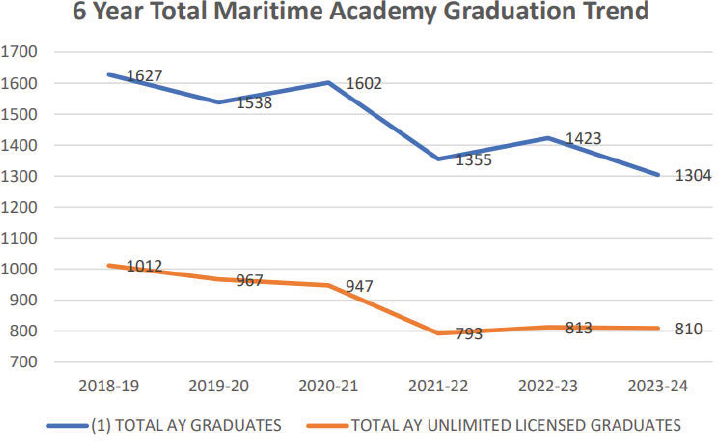
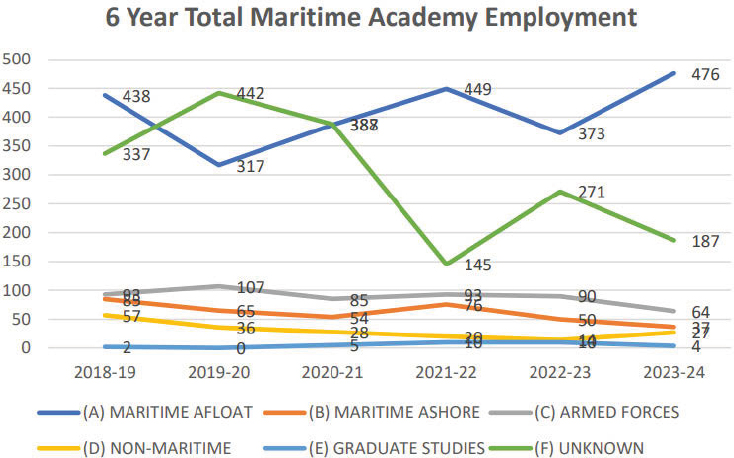
The USMMA is dedicated to preparing graduates for unlimited seagoing licenses; the SMAs provide some seagoing licensed graduates but also offer non-seagoing programs. Although more students graduate from the SMAs (596 of 810 graduates in academic year 2023–2024; Figure 2-1), the USMMA produces the largest number of mariners with unlimited licenses (214 of 810 graduates in academic year 2023–2024), as the USMMA is dedicated to producing graduates with seagoing licenses and SSOs for U.S. Navy sealift capability. Although in aggregate the SMAs produce a larger number of seagoing officers, many SMA graduates pursue employment other than deep sea sailing (Figure 2-2). Figure 2-1 shows the decline in the number of maritime academy graduates and in the number of total licensed mariner graduates over the past six years; this decline occurs in a period of heightened need for deep sea unlicensed mariners and as the MSC laid up vessels it could not crew (DOT, 2024; Schuler, 2024; Shelbourne, 2024). For the period 2013 through 2022, 87% of students enrolled at the USMMA were male and 13% were female; from 2015 to 2022, 77% of students enrolled were White; 9% Hispanic/Latino; 4% Asian; 2% African American; 1% American Indian or Alaskan Native; 4% two or more races; 0% Native Hawaiian or Pacific Islander; and 4% unknown (MARAD, 2024c).
For many years, MARAD has worked with maritime academies to ensure they have the resources and infrastructure needed to educate and train a steady supply of licensed mariners. MARAD’s funding programs
support USMMA seagoing Cadet billets (46 C.F.R. § 310.60)14, provide assistance to midshipmen who cannot find placement for their mandatory time aboard a U.S. flag vessel (obligated by their USMMA education), and provide training ships for the SMAs.15 Box 2-2 provides an overview of MARAD’s statutory areas of oversight and support for the SMAs. MARAD can influence industry actions, including policies for training to ensure alcohol is not misused at sea.16 USMMA Cadets sail on commercial maritime vessels during their training periods and thus do not utilize training ships, as described in the next section.
BOX 2-2
MARAD’s Statutory Areas of Oversight and Support for the SMAs
MARAD exercises influence over the maritime industry in part through its oversight of and funding support for the SMAs. Types of support include the following:
Direct Financial Assistance: MARAD provides annual funding to the SMAs to ensure the education and training of future U.S. merchant mariners. This includes funding for workforce development, maintenance, and special projects such as the National Security Multi-Mission Vessel (NSMV) program.
Training Vessels: MARAD supplies federally owned training ships from the NDRF to the SMAs for at-sea training and as shoreside laboratories. It also funds the maintenance and repair of these vessels. In addition, MARAD oversees the NSMV program that replaces aging training ships with modern vessels designed for both training and emergency response missions.
Student Incentive Program (SIP): MARAD administers the SIP, which provides financial support to SMA students who commit to post-graduation service obligations, such as serving as officers in the U.S. Merchant Marine or armed forces.
Direct and Vessel Operations Revolving Fund Payments: MARAD allocates funds from the sale of obsolete vessels in the NDRF to support SMA operations.
SOURCE: MARAD, 2020b.
___________________
14 All operators of subsidized merchant vessels, in accordance with contractual arrangements, are required to employ for training at least two midshipmen, as assigned by the Superintendent of the Academy, which employment shall be in accordance with the following provisions.
15 It is uncertain at the time of this writing whether Executive Order, April 9, 2025 “Restoring America’s Maritime Dominance” may influence these activities.
16 Matthew Mueller, Presentation to the Committee, July 17, 2024. https://www8.nationalacademies.org/pa/managerequest.aspx?key=DBASSE-BBCSS-23-02
Training at Sea
The USMMA and the SMAs offer educational programs on training vessels and commercial vessels that meet the U.S. Coast Guard requirement for a specified number of training days at sea to establish eligibility for the MMC officer license exams. The USMMA’s Sea Year program is a cooperative educational program designed to give Cadets practical knowledge of the performance and operating characteristics of various classes of vessels, the operating requirements for different trade routes, and labor relations in the ocean shipping industry. Sea Year training typically consists of a sailing period of 120 days during a Cadet’s 2nd Class year and 300 days for Engine Cadets and 335 days for Deck Cadets during a Cadet’s 3rd Class Year (USMMA, 2025, p. 5). Similar to an internship, Cadets serve aboard commercial vessels and are paid as mariners by the companies on whose vessels they sail (USMMA, 2025, p. 33). The SMAs also provide training at sea, primarily on school training ships, although limited opportunities to sail aboard commercial vessels are offered (Texas A&M Maritime Academy, 2025).
Maritime Training Institutes, K–12 Education, and Centers of Excellence
In addition to the maritime academies, maritime training institutes provide training and education across a wide spectrum: middle school and high school maritime training institutes; pre-college, apprenticeship and community college programs (Cunningham, 2015); online programs (Northeast Maritime Institute, 2021); and union-run and/or independent maritime training facilities (Maritime Institute of Technology and Graduate Studies, 2025;17 Seafarers International Union, 2025b; The Seamen’s Church Institute, 202518). Maritime training institutes prepare students for entry-level employment in the maritime industry and provide certification and recertification for professional qualifications, such as radar observer, first aid and CPR, engine horsepower certification, and IMO-required qualifications such as STCW. In addition, the U.S. Coast Guard approves a number of individual maritime courses, both in person and online, which, taken together, can lead to an MMC (Mariner Skills, 2025; Seven Seas Preparatory Academy, 2025; U.S. Coast Guard, 2025a). A list of U.S. Coast Guard-approved courses and license and certification programs is updated biweekly by the U.S. Coast Guard (U.S. Coast Guard, 2025a).
MARAD supports K–12 programs to provide students with maritime skills that may lead directly to employment in the maritime industry or enable them to further their education. These programs develop students’
___________________
knowledge and expectations for working in the maritime industry, including lifestyle and broader onboard culture. Maritime elementary schools and high schools in the United States aim to provide students with maritime skills and knowledge that can lead to employment in the maritime industry or prepare them for further education at maritime-oriented colleges or vocational schools. Some programs offer Career and Technical Education courses that position students to acquire credentials such as the MMC and the Transportation Workers Identification Credential that are assets for those considering entry into a vocational or collegiate-level program, including one of the SMAs or the USMMA.
MARAD-designated Centers of Excellence for Domestic Maritime Workforce Training and Education are another mechanism that MARAD can use to influence the training of future and current mariners. MARAD’s Centers of Excellence designations serve to assist the maritime industry in obtaining and maintaining the highest quality workforce, and contribute to the growth, sustainability, and competitiveness of the maritime sector in the United States. Educational institutions must apply to MARAD for the designation, which is awarded according to published standards and valid for five years (MARAD, 2024a). As of 2024, there were 50 designated Centers of Excellence (MARAD, 2024b).
Curricular content at the USMMA and the SMAs is established by the faculty and administration of the maritime academies and is accredited by regional accrediting authorities. Engineering curricular content is also accredited by national engineering accreditation. Course work and training experiences required for licensed deck and engineering officer credentialing are established by the U.S. Coast Guard, and Academy coursework and instructors supporting these portions of study are also U.S. Coast Guard approved (USMMA, 2023, pp. 6–7). This includes any content leading to the issuance of STCW certificates. Licensure program approvals at the merchant marine academies are generally issued at five-year intervals and subject to periodic certification and re-certification requirements (USMMA, 2023, pp. 6–7).
LIFE ON BOARD VESSELS
The working lives of mariners—and their challenges—are shaped by vessel types, operations, and associated trade routes; the frequency of port calls; proximity to land and access to the internet and cell service; and shipboard culture. Mariners on deep-draft ocean-going vessels go ashore only when off-duty in port. Increased ship and shoreside automation on U.S. commercial ships have dramatically reduced the time ships stay in port. These changes in vessel operations and quick turnaround times greatly reduce the time that the crew gets to spend off the vessel.
Mariners on inland tows are in constant proximity to shore but stops to drop barges may not be long enough to allow leave while on duty. Tugboats (ship assist) are crewed by a mixture of shore-based mariners and vessel-based mariners who live and sleep on board. Crews on ocean-towing tugs also live and sleep onboard. Requirements for OSVs vary with service. OSVs serving longer supply and crew change runs to oil platforms will have bunks and meals provided, whereas crews on shorter OSV runs may live on shore. However, many mariners serving on U.S. flag passenger vessels will live on shore.
U.S. Coast Guard-inspected vessels are crewed by licensed officers and unlicensed crew members. Workload and hours worked vary by job requirements and voyage circumstances. On ocean-going vessels, watchstanding by a deck officer, perhaps with an unlicensed crewmember for steering or lookout responsibilities, is required on the bridge. Watchstanding by an engineering officer, perhaps with an unlicensed crewmember, is required in engineering spaces. Periodically unattended engine rooms, which are authorized on many U.S. deep-draft vessels, as well as automated engine rooms with Coast Guard- and Class-approved Automation Procedures, require watchstanding personnel. Personnel not assigned to watches are assigned to day work, usually eight-hour shifts over the course of the working day. Typical deep sea vessel watches (i.e., shifts) are four hours on and eight hours off (a three-watch system), although variations of 12 hours on and 12 hours off and other arrangements are utilized in specialized operations, such as liquefied natural gas and integrated tug-barge operations. Although mariners usually habituate to their watch schedules, changes in these watch schedules during a voyage have significant impact on human performance, attention, and situation awareness (van Leeuwen et al., 2021).
Tow and similar vessels are allowed to operate with a two-watch system—six hours on and six hours off, which is most common—this can mean no crew member is allowed more than six hours for uninterrupted sleep. Mariners on other watch schedules may work 12 hours on and 12 hours off.
For unlicensed watchstanders and day workers working day shifts, any time working outside of watch hours is considered “overtime” with increased pay for crew; however, licensed officers are typically considered management and, depending on union agreement, do not receive overtime pay. Working overtime is expected with most mariner union agreements specifying the minimum overtime a crew member will receive to ensure their earnings. Mariner work and rest hours aboard vessels are governed by 46 C.F.R. § 15.1111 (1987). Mariner rest hours can be shortened for operational reasons, such as delays or changes in cargo or fuel loading, in weather, administrative paperwork requirements or port transit maneuvering and berthing shifts in port; however, shortened rest periods can have detrimental impacts on mariner fatigue and stress (Strauch, 2015).
Living conditions and associated spaces affording privacy vary (International Labor Organization, 2006).19 On deep-draft ocean-going vessels, most crew members have private staterooms with bathrooms, except on very small vessels. On large vessels (e.g., tankers and containerships), staterooms for unlicensed crew and licensed officers will usually be on different decks. The Master (Captain)’s stateroom and office is closest in proximity to the bridge and may be on a different deck from the other officers. Accommodation varies on other types of vessels and may require some crewmembers to share sleeping quarters, bathrooms, and washrooms. Meal areas and lounges are traditionally segregated by officers and crew for large vessels, depending on vessel type. Smaller commercial vessels may have only a single galley and small area for meals and common lounges. Crews are typically provided with a break room with television and entertainment access. Large vessels may have spaces dedicated to exercise.
The presence and reliability of on-board communication technology is important to shipboard morale and mariner well-being. Access to satellite television, voice and video communication, internet connectivity, and WiFi access on board vessels provide important links to shoreside communities, leisure, family, spiritual and/or health and well-being groups and activities. Most U.S.-flagged deep-draft ocean-going vessels have satellite access to phone and internet service, but crew availability may be limited due to expense or vessel location relative to satellites. Inland and harbor service vessels spend most of their time within areas with cell service.
OVERVIEW OF THE MARITIME REGULATORY AND OVERSIGHT FRAMEWORK
Efforts to address substance misuse and sexual misconduct take place in the existing context of regulation and oversight. Maritime laws and regulations are enforced through a combination of Flag State and Port State control. Flag State refers to the country in which the vessel is registered, and Port State refers to the country in which the vessel is calling. The Flag State is responsible for vessel certification, registration, and inspections and for addressing issues that take place on the high seas (i.e., outside of one of its own or another country’s territorial waters), as well as incident and accident investigation. The Port State may conduct documentation reviews and inspections on vessels calling at ports or involved in accidents within territorial waters. The rules that Flag States and Port States operate under are agreed to by international conventions.
___________________
19 Specifically, see Crew Accommodation Convention Requirements 92 vs 133 vs MLC 2006, https://normlex.ilo.org/dyn/nrmlx_en/f?p=1000:53::::53:P53_FILE_ID:3152915. See also NRC (1990).
U.S. REGULATORY ENFORCEMENT
The U.S. Coast Guard oversees and regulates operations in the MTS, including enforcing all regulations concerning vessel operations and equipment, mariner credentialing, and occupational health and safety.20 The U.S. Coast Guard is a multi-mission service that has both military and civilian functions.21
There are two statutory provisions granted to the U.S. Coast Guard to enforce domestic and international requirements for U.S.-flagged vessels and foreign-flagged vessels calling within U.S. territorial waters. These law enforcement capabilities are exercised in 37 distinct geographic regions known as Coast Guard Sectors. Each Sector Commander exercises both Officer in Charge, Marine Inspection (OCMI) and Captain of the Port (COTP) authority.
An OCMI may inspect a commercial vessel in their Sector at any time for any reason, but most inspections are scheduled in advance. During an inspection, designated personnel will board the vessel and review vessel documentation, certificates, crew licenses, and navigational, mechanical, auxiliary, and safety systems required under U.S. regulations or international conventions. Inspection procedures are maintained by the Commandant in the Marine Safety Manual, Marine Inspection Administration (U.S. Coast Guard, 2021). The U.S. Coast Guard’s Marine Inspection Administration instructs inspectors “to observe crew performance and witness the operation of a vessel’s machinery and other equipment […] to determine its reasonable, probable compliance with published minimum safety standards over a projected period of time” (U.S. Coast Guard, 2021, p. A1–14). This manual also includes distinct guidance for foreign-flagged vessels exams or Port State Control Exams.
In the event an OCMI discovers a regulatory discrepancy, the U.S. Coast Guard will take corrective actions of increasing consequence depending on the severity of the problem. Actions can range from a simple equipment fix to the levy of fines, or even a detention of a vessel. In the case of restricting vessel movements, the U.S. Coast Guard can use OCMI authority, but it can also use COTP authorities. This authority is broader than OCMI authority,
___________________
20 The Department of Labor Office of Safety and Occupational Health does not regulate vessels, although it does regulate some shoreside personnel, e.g., workers at shipyards and marine terminals.
21 Founded in 1790 within the U.S. Department of the Treasury, today’s U.S. Coast Guard was formed through the merging of multiple forerunner agencies having maritime-related functions. Along with being one of the country’s six armed forces, the U.S. Coast Guard is an emergency responder, law enforcement agency, member of the intelligence community, manager of the navigable waterways, protector of maritime safety and security, and steward of the marine environment. The U.S. Coast Guard moved to the DOT in 1967 and became part of the Department of Homeland Security in 2003.
as it covers the entire waterfront and provides unique control over the port, vessels, facilities, cargo operations, and waterways. Certain violations may be referred to other federal agencies who have oversight.
In addition to inspected vessels, there are also uninspected vessels, such as most commercial fishing vessels which are not by law required to be inspected by the U.S. Coast Guard. These vessels must still meet certain safety regulations, can participate in voluntary inspection programs, and may be boarded at sea when subject to U.S. jurisdiction, e.g., when engaged in commercial fishing in U.S. waters. (U.S. Coast Guard, 2020).
International Regulatory Framework and Process
Because most maritime shipping is international, stakeholders in shipping have developed a global regulatory framework. The main international bodies overseeing the regulation of the commercial maritime industry are the IMO and the International Labor Organization (ILO). The IMO and the ILO work together where their areas of concern overlap; for instance, they have established joint guidelines for the rights of mariners in the event of maritime accidents that address issues of liability and compensation. These bodies act as forums for Member States to develop international regulatory conventions, but they do not have enforcement capacities. Member States conduct enforcement. The United States is a Member State of both the IMO and the ILO, and is a party to some, but not all, of the IMO and ILO conventions.22 However, since most U.S. commercial vessels do not sail internationally, IMO and ILO rules are often not applicable.
International Maritime Organization
The IMO, established in 1948, is a specialized agency of the United Nations (UN) responsible for shipping safety and security and the prevention of marine and atmospheric pollution by ships. The IMO creates a regulatory framework and standards or conventions for the shipping industry, which it does by providing a forum for developing maritime rules through a multilateral process involving specialized committees. Enforcement authority falls to the Member States through their adoption of the standard or convention. The IMO covers all aspects of international shipping including
___________________
22 The United States has ratified key IMO and ILO conventions, including those described in subsequent sections of this chapter, but there are exceptions (see IMO. 2025a. Status of IMO treaties. https://wwwcdn.imo.org/localresources/en/About/Conventions/StatusOfConventions/Status%202025.pdf; ILO. n.d. Up-to-date conventions and protocols not ratified by United States of America. https://normlex.ilo.org/dyn/nrmlx_en/f?p=NORMLEXPUB:11210:0::NO::P11210_COUNTRY_ID:102871)
ship manning,23 design, construction, equipment, operations, and disposal. The IMO’s specialized committees and sub-committees update existing regulations and/or develop and adopt new regulations. Maritime experts from Member States, as well as interested intergovernmental and non-governmental organizations attend meetings. Committee-approved instruments are submitted to a conference of UN members for finalization and approval and then to individual Member States. Member States complete individual ratification by adding them to the Member States’ regulations.24 In the United States, this process requires adoption by Congress and the signature of the President. After the designated (required) number of Member States have ratified the instrument, it is codified and can be enforced by Flag or Port States, as applicable, meaning U.S. -flagged vessels and mariners sailing internationally would be subject to these rules.
The U.S. Coast Guard is a key agency representing U.S. interests at the IMO. In that role, the U.S. Coast Guard coordinates U.S. participation and involvement at various levels in assembly and council and is the lead agency for the Maritime Safety and Marine Environmental Protection Committees. The agency coordinates with the Departments of State, Homeland Security, Justice, and Transportation, the Environmental Protection Agency, and the National Oceanic and Atmospheric Administration, as well as with maritime industry experts and non-governmental organizations.25
Safety of Life at Sea and Safety Management Systems
The IMO’s Maritime Safety Committee is responsible for regulations overseeing vessel manning and safety, which includes maritime safety procedures and requirements, marine casualty investigation, salvage and rescue, and all matters that could directly affect safety of the maritime workforce. The Maritime Safety Committee’s key instrument concerning maritime workforce safety is the International Convention for Safety of Life at Sea (SOLAS), which sets minimum international safety standards for the construction, equipment, and operation of ships. Originally approved in 1974, subsequent amendments have encompassed emerging improvements in safety culture. The International Safety Management (ISM) Code was adopted by the IMO in 1993 following a string of deadly international maritime accidents in the 1980s. The ISM Code was made mandatory in 1998, as the inclusion of a new Chapter IX to SOLAS, and provides an
___________________
23 “Manning” generally refers to the number of crewmembers, their qualifications, and their conditions of employment.
24 IMO. (n.d.). Conventions. https://www.imo.org/en/About/Conventions/Pages/default.aspx
25 U.S. Coast Guard. (2024, February 6). USCG International Maritime Organization. https://www.dco.uscg.mil/IMO/#:~:text=The%20International%20Maritime%20Organization%20(IMO,various%20government%20and%20industry%20advisors
international standard for the safe management and operation of ships and for pollution prevention.26
According to the ISM Code, each vessel operator should develop, implement, and maintain a Safety Management System (SMS) that is to include functional requirements that focus on mariner training and safety; environmental protection; accident prevention and risk reduction; communications between ships and shore-based operating companies; audits and inspections; and the fostering of a safety culture. The vessel operator (i.e., the “marine employer”) develops its SMS for the company, and the SMS applies to all ships in a company’s fleet. The United States has ratified SOLAS, with its provisions codified in 46 U.S.C. § 3201 et seq. (2023) and 33 C.F.R. § 96 (1997)—Rules for the Safe Operation of Vessels and Safety Management Systems.
The U.S. Coast Guard issues guidance on implementing the ISM Code, although shipping companies may use alternative approaches if those satisfy the requirements of applicable statues and regulations (U.S. Coast Guard, 2023c). A company submits an SMS to the U.S. Coast Guard, who then reviews it for compliance and audits the company and its vessels to confirm that operations are being conducted as described in the SMS. The U.S. Coast Guard also verifies SMS compliance during its overall vessel compliance activities, such as its annual inspections of applicable U.S.-flagged vessels. The U.S. Coast Guard may delegate the conduct of SMS audits and issuance of certificates to third parties, designated as a Recognized Organization (RO) or Authorized Organization Acting on behalf of the United States. The U.S. Coast Guard has authorized several ROs to conduct SMS audits and issue applicable certificates, including the American Bureau of Shipping27 and other classification societies (National Academies, 2021).
An SMS is an important tool to promote safety, but the regulations requiring them for U.S.-flagged vessels have limited reach. For U.S.-flagged vessels, SMSs are required only for vessels engaged in foreign voyages (defined as departing from and/or arriving at a place not under the jurisdiction of the United States) and transporting more than 12 passengers or being of the following type: “A tanker, a bulk freight vessel, a freight vessel or a self-propelled mobile offshore drilling unit (MODU) of 500 gross tons or more.” In addition, vessels operating solely on the Great Lakes are excluded, as are public vessels not in commercial service (33 C.F.R. § 96.120, 1997; 96.210, 1997). Although U.S.-flagged vessels engaged in domestic or Great
___________________
26 IMO. (2018). ISM code. https://www.imo.org/en/ourwork/humanelement/pages/ISMCode.aspx
27 The American Bureau of Shipping is a ship classification society. Classification societies were developed in the late 1800s to ensure that ships were designed, built, and maintained to safety standards for purposes of ship and cargo insurance.
Lakes travel are excluded from the SMS mandate, owners or operators of these vessels may voluntarily submit their SMS for certification.
Standards of Training, Certification and Watchkeeping (STCW)
The IMO International Convention on STCW sets qualification standards for certain personnel on seagoing merchant ships, which are incorporated into U.S. regulation and policy. Adopted in 1978, coming into force in 1985, and amended many times since, this Convention maintains the STCW Code, which sets minimum international training standards for professional mariners. The STCW also allow for international recognition of Member States’ certificates that are used for service on ships flying their flag. STCW IMO verifies STCW certificates, maintains a list of certificate-issuing authorities, and publishes IMO model courses to assist Member States in maritime training. The IMO does not approve any training courses or institutes, which is solely the responsibility of individual states. Working through the STCW, the IMO’s Sub-Committee on Human Element, Training, and Watchkeeping is responsible for regulations concerning the maritime workforce’s well-being, focusing on “the human side of shipping, including training and certification; the review, updating and revision of IMO model courses; and guidance addressing issues such as fatigue” (IMO, 2025b).
For U.S. flag vessels, the STCW requirements apply to seagoing vessels. 46 C.F.R. § 15.1103 (1987) designates by type of seagoing vessel which crew positions must hold an STCW endorsement. Exceptions to STCW requirements comprise the vast majority of U.S.-flagged vessels and include specified fishing vessels, barges, pilot vessels, and small passenger and freight vessels on domestic, near coastal voyages as well as vessels solely operating in inland waters, the Great Lakes, the Straits of Juan de Fuca, and the Inside Passage between Puget Sound and Cape Spencer, Alaska (46 C.F.R. § 15.1101, 2013).28
International Labor Organization
The ILO is a UN agency responsible for maintaining and developing a set of international labor standards for all industries. Established in 1919 and headquartered in Geneva, the ILO has 187 Member States and a unique “tripartite structure” intended to give equal representation to workers, employers, and governments. Similar to the IMO, the ILO has no regulatory powers of its own: it sets international labor standards through
___________________
28 Other types of U.S.-flagged vessels, such as ships of war, are subject to other requirements but are not subject to the STCW (46 C.F.R. § 42.03-5, 1968).
international agreements, and Member States are responsible for enforcement. In February 2006, the ILO adopted the Maritime Labor Convention (MLC), which establishes “the minimum standards to ensure satisfactory conditions of employment for the world’s Seafarers.” The MLC consolidated and updated over 65 ILO maritime labor instruments and introduced a system of certifications and inspections (ILO, 2006). The MLC sets standards for working and related living conditions “including minimum age, employment agreements, hours of work and rest, payment of wages, paid annual leave, repatriation, on board medical care, the use of recruitment and placement services, accommodation, food and catering, health and safety protection and accident prevention, and complaint procedures for Seafarers” (ILO, 2006). However, the United States has not ratified the MLC, and as a result, the U.S. Coast Guard does not enforce its standards on U.S.-flagged vessels or foreign vessels calling at U.S. ports or entering U.S. territorial waters.
The ILO and IMO have formed a Joint ILO/IMO Tripartite Working Group (JTWG) to address mariners’ issues and the human element. The JTWG’s recommendations on combatting sexual assault and harassment are discussed later in this chapter.
Office of Merchant Mariner Credentialing
The U.S. Coast Guard’s Office of Merchant Mariner Credentialing (CG-MMC) develops regulations and sets policies governing U.S. merchant mariner credentialing and maritime labor issues. Within the CG-MMC are divisions that ensure compliance with domestic and international standards and that develop and maintain policy and guidance regarding personnel qualifications, licensing, certification, and manning for the maritime industry. The CG-MMC’s National Maritime Center issues MMCs and ensures compliance with U.S. Coast Guard regulations and international standards. The National Maritime Center is also responsible for the Merchant Mariner Medical Manual, which provides consolidated guidance for the medical evaluation required for the mariner credential. The manual is designed to assist medical practitioners, the maritime industry, individual mariners, and U.S. Coast Guard personnel in evaluating a mariner applicant’s medical and physical status to meet the merchant mariner medical certificate requirements; it includes alcohol misuse or dependence in its discussion of “psychiatric or mental health conditions.”
FEDERAL AND INDUSTRY POLICIES RELATED TO ALCOHOL AND SEXUAL MISCONDUCT
Alcohol Policies
Alcohol consumption on U.S.-flagged vessels is regulated by federal law (refer to Box 2-3 for relevant regulations in 33 C.F.R. § 95, 1987). Federal regulations generally allow crewmembers to possess and consume alcohol on board vessels but prohibit operating the vessel while under the influence of alcohol, defined for commercial vessels as at or above a .04% blood alcohol concentration (BAC). This BAC is lower than that for operators of recreational vessels, which is .08% BAC.
While other transportation modes have established requirements for action when BAC levels are between .02% and .039%, the U.S. Coast Guard does not currently have specific guidance or requirements for mariners who test positive for alcohol below the .04% threshold. In such cases, the U.S. Coast Guard may defer to a company’s policy and can pursue misconduct charges if the company enforces a zero-tolerance policy for alcohol use aboard its vessels. Sanctions in these cases can range from a Letter of Warning to suspension of the mariner’s MMC. Additionally, administrative suspension and revocation sanctions may include provisions consistent with those applied by other modes for low-level positive alcohol results.
Federal law divides U.S.-flagged vessels into inspected and uninspected vessels, with stricter alcohol consumption standards for inspected vessels. Crew members of inspected vessels are not to consume alcohol while on duty, be intoxicated at any time while on board, or perform scheduled duties within four hours of consuming alcohol. The U.S. Coast Guard has safety and enforcement authorities for violations of federal alcohol regulations for both inspected and uninspected vessels.
Beyond the standards set by federal law, U.S. vessel owners or operators may set stricter standards, prohibit alcohol consumption or possession while on board, and adopt “zero tolerance” policies for crew members in their employ (see 33 C.F.R. § 95.001(b), 1987).
U.S. regulations require a vessel’s SMS to include “instructions and procedures” to ensure compliance with U.S. law and regulation, of which alcohol is a part (see Box 2-3). U.S.-flagged vessel operators subject to the SMS requirement must also include their alcohol and other drug policies in the SMS (46 U.S.C. § 3203, 2023; U.S. Coast Guard, 2023c). Of note, U.S. regulations related to alcohol use while on watch are stricter than those found in the ISM Code, as amended 2011 (STCW Code), which recommend a limit for under the influence at .05% BAC for duty officers and .08% for others on watchkeeping duties and requires a vessel’s SMS to include clear policies on alcohol use.
BOX 2-3
Federal Regulations for Operating a Commercial Vessel Under the Influence of or After Consuming Alcohol
33 C.F.R. § 95.020 (1987) Standard for under the influence of alcohol or another dangerous drug. An individual is under the influence of alcohol or a dangerous drug when:
(b) The individual is operating a vessel other than a recreational vessel and has a BAC of .04% by weight or more in their blood; or,
(c) The individual is operating any vessel and the effect of the intoxicant(s) consumed by the individual on the person’s manner, disposition, speech, muscular movement, general appearance or behavior is apparent by observation.
33 C.F.R. § 95.015 (1987) Operating a vessel. For purposes of this part, an individual is considered to be operating a vessel when:
(b) The individual is a crewmember (including an officer), pilot, or watch-stander not a regular member of the crew, of a vessel other than a recreational vessel.
33 C.F.R. § 95.045 (1987) General operating rules for vessels inspected, or subject to inspection, under Chapter 33 of Title 46 United States Code. While on board a vessel inspected, or subject to inspection, under Chapter 33 of Title 46 United States Code, a crewmember (including an officer), pilot, or watch-stander not a regular member of the crew:
(a) Shall not perform or attempt to perform any scheduled duties within four hours of consuming any alcohol;
(b) Shall not be intoxicated at any time;
(c) Shall not consume any intoxicant while on watch or duty.
a Subsections “(a)” for 33 C.F.R. § 95.020 and 33 C.F.R. § 95.017 are not shown because they cover recreational vessels, which are not part of the committee charge.
SOURCE: 33 C.F.R. § 95 (1987) et seq. https://www.ecfr.gov/current/title-33/part-95
The U.S. Coast Guard’s Role in Alcohol and Other Drug Testing
The U.S. Coast Guard requires mariners to participate in alcohol and other drug testing and establishes penalties for positive results through a set of unique authorities.29 U.S. Coast Guard regulations on alcohol and other drug testing (see Box 2-4) require the marine employer to ensure
___________________
29 Relevant Coast Authorities derive from 33 U.S.C. § 2071 (2023) Inland navigation rules; 46 U.S.C. § 2103 (2023) Superintendence of the merchant marine; 46 U.S.C. § 2302 (2023) Penalties for negligent operations and interfering with safe operation; 46 U.S.C. § 3306 (2023) Regulations for inspection generally; 46 U.S.C. § 7101 (2023) Issuing and classifying licenses and certificates of registry; 46 U.S.C. § 7301 (2023) Merchant Mariners’ Documents; and 46 U.S.C. § 7701 (2023) Suspension and Revocation.
BOX 2-4
The U.S. Coast Guard Drug and Alcohol Testing Program Applicable Regulations
46 C.F.R. § 16 (1999) U.S. Coast Guard - Chemical Testing. This regulation covers the periodic, random, reasonable cause, and post-casualty testing for dangerous drugs and post-casualty testing for alcohol, and procedures for the marine employer (when and who to test).
33 C.F.R. § 95.035 (1987) U.S. Coast Guard - Reasonable Cause for Directing a Chemical Test. This regulation covers the authority and procedures for law enforcement or an employer to conduct reasonable cause testing for alcohol (when and who to test).
46 C.F.R. § 4.06 (1988) U.S. Coast Guard - Mandatory Chemical Testing Following Serious Marine Incidents Involving Vessels in Commercial Service. This regulation covers testing for alcohol or drugs after serious marine incidents defined in 46 C.F.R. 4.03-2 as including those resulting in death, serious injury, damage to property in excess of $200,000, loss of a vessel subject to inspection, loss of specified vessels not subject to inspection, and the release of specified pollutants or hazardous substances.
49 C.F.R. § 40 (2000) U.S. DOT - Procedures for Transportation Workplace Drug Testing Programs. This regulation establishes procedures for all DOT-regulated drug testing, including technical regulations for collection and testing (how to test).
SOURCES: 46 C.F.R. § 16 (1999) (amended 2024). https://www.ecfr.gov/current/title-46/part-16; 33 C.F.R. § 95 (1987) et seq. https://www.ecfr.gov/current/title-33/part-95; 46 C.F.R. § 4.06 (1988). https://www.ecfr.gov/current/title-46/chapter-I/subchapter-A/part-4/subpart-4.06; 49 C.F.R. § 40 (2000). https://www.ecfr.gov/current/title-49/part-40
testing is taking place. In 1995, the U.S. Coast Guard established a Drug and Alcohol Program Inspector (DAPI) position in each of its districts to ensure compliance with the regulations and to educate and assist employers in setting up a compliant program (U.S. Coast Guard, 2025b). Primarily, the DAPI is responsible for assessing the chemical testing programs established by employers for merchant mariners involved in commercial vessel operations. DAPIs not only educate the industry on the requirements but also are a valued resource for local U.S. Coast Guard units that receive positive
reports of drug use by mariners or who needed to ensure post-incident testing for alcohol and other drugs was carried out in the required timelines.30
An employer’s testing program must include pre-employment, periodic, random, reasonable cause, and post-casualty testing for drugs, but only reasonable cause and post-casualty testing apply to alcohol. Penalties on a marine employer for failure to comply can include pulling a vessel’s COI, issuing a COTP Order preventing an uninspected vessel from operating, and other civil penalties. Persons in violation and holding MMC or licenses may be subject to the U.S. Coast Guard’s suspension and revocation process.
Most of the testing requirements under 46 C.F.R. § 16 (1999) apply only to dangerous drugs, defined in 46 C.F.R. § 16.105 (1988) as “a narcotic drug, a controlled substance, or a controlled-substance analog (as defined in section 102 of the Comprehensive Drug Abuse and Control Act of 1970).”31 In practice, employers must test for five drug types: marijuana, cocaine, opiates, amphetamines, and phencyclidine PCP (U.S. Coast Guard, 2024b). For dangerous drugs, pre-employment testing applies to all crew members. Periodic testing occurs upon applying for or upgrading a credential and unlike other testing, it is the responsibility of the mariner. Reasonable cause testing is mandated to occur for alcohol (33 C.F.R. § 95.035, 1987) when the effect of alcohol is observed in the “person’s manner,
___________________
30 In practice, the DAPI also serves as a resource for U.S. Coast Guard units involved with various law enforcement or accident investigations. While companies are ultimately responsible to ensure that their employees are tested in accordance with the regulations, during an incident investigation, it is the U.S. Coast Guard that needs to ensure these are done on time. Over the years there are examples of companies failing to do required post-accident testing in a timely manner. The National Transportation Safety Board (NTSB) report about the allision of the Liberian tanker Julie in Portland, Maine, and the Cosco Busan incident in the San Francisco Bay are examples where post-accident testing was not done timely or where there was confusion as to the proper tests being done.
31 Controlled substance is defined as “a drug or other substance, or immediate precursor, included in schedule I, II, III, IV, or V of part B of this subchapter. The term does not include distilled spirits, wine, malt beverages, or tobacco, as those terms are defined or used in subtitle E of the Internal Revenue Code of 1986.” Narcotic drug is defined as “any of the following whether produced directly or indirectly by extraction from substances of vegetable origin, or independently by means of chemical synthesis, or by a combination of extraction and chemical synthesis.” Controlled-substance analog is defined as “a substance (i) the chemical structure of which is substantially similar to the chemical structure of a controlled substance in schedule I or II; (ii) which has a stimulant, depressant, or hallucinogenic effect on the central nervous system that is substantially similar to or greater than the stimulant, depressant, or hallucinogenic effect on the central nervous system of a controlled substance in schedule I or II; or (iii) with respect to a particular person, which such person represents or intends to have a stimulant, depressant, or hallucinogenic effect on the central nervous system that is substantially similar to or greater than the stimulant, depressant, or hallucinogenic effect on the central nervous system of a controlled substance in schedule I or II. The designation of gamma butyrolactone or any other chemical as a listed chemical pursuant to paragraph (34) or (35) does not preclude a finding pursuant to subparagraph (A) of this paragraph that the chemical is a controlled substance analogue.”
BOX 2-5
46 C.F.R. § 16.230 (1991). Random Testing Requirements
- Marine employers must establish programs for the chemical testing for dangerous drugs on a random basis of crewmembers on inspected vessels who:
- Occupy a position, or perform the duties and functions of a position, required by the vessel’s COI;
- Perform the duties and functions of patrolmen or watchmen required by this chapter; or,
- Are specifically assigned the duties of warning, mustering, assembling, assisting, or controlling the movement of passengers during emergencies.
- Marine employers must establish programs for the chemical testing for dangerous drugs on a random basis of crewmembers on uninspected vessels who:
- Are required by law or regulation to hold a credential issued by the U.S. Coast Guard in order to perform their duties on the vessel;
- Perform duties and functions directly related to the safe operation of the vessel;
- Perform the duties and functions of patrolmen or watchmen required by this chapter; or,
- Are specifically assigned the duties of warning, mustering, assembling, assisting, or controlling the movement of passengers during emergencies.
SOURCE: 46 C.F.R. § 16.230 (1991) (amended 2024). https://www.ecfr.gov/current/title-46/part-16/section-16.230
disposition, speech, muscular movement, general appearance or behavior” and for dangerous drugs (46 C.F.R. § 16.250, 1988) “based on direct observation of specific, contemporaneous physical, behavioral, or performance indicators of probable use.”
Random testing is mandated for dangerous drugs for certain crewmembers as specified in Box 2-5. Unlike employees in the aviation, railroad, motor carrier, and mass transit industries, covered by the Omnibus Transportation Employees Testing Act of 1991,32 marine employers and employees are not required to participate in random testing for alcohol. Random testing for dangerous drugs must include at a minimum 50% of mandated employees unless positive rates from random drug tests are less than 1% for the industry for two consecutive years, in which case the U.S. Coast Guard
___________________
32 For more information, see https://www.transportation.gov/odapc/omnibus-transportation-employee-testing-act-1991
may decrease the minimum to 25% of mandated employees. The minimum must go back up to 50% if in any year the industry-wide positive rate in random drug tests equals or exceeds 1%. Data to determine the industry-wide positive rate is drawn from the required drug management information system (MIS) reports (see Box 2-6). The random testing protocol must use an employee selection method that is statistically random.
Post-casualty testing for alcohol and drug (46 C.F.R. § 4.06, 1988) must occur after a serious maritime incident, as defined by 46 C.F.R. § 4.03-2 (1988). Post-casualty testing applies to credentialed and non-credentialed personnel involved in the incident. If a mariner fails or refuses an alcohol or other drug test, the mariner will be denied employment as a crewmember or removed from duties that directly affect the safe operation of the vessel (46 C.F.R. § 16.201, 1988). The U.S. Coast Guard’s Report of Marine Casualty (CG 2692) includes a Report of Mandatory Chemical Testing for crew or other individuals who were directly involved in the serious marine incident.
BOX 2-6
Mandatory Drug and Alcohol Data Reporting
The marine employer must collect drug and alcohol testing program data for input to the MIS. The following drug and alcohol and other substance data is required to be submitted:
- Number of covered employees.
- Number of covered employees subject to testing under the anti-drug rules of more than one DOT agency because of the nature of their assigned duties, identified by each agency.
- Number of drug and alcohol tests by test type.
- Number of positive drug test results verified by a Medical Review Officer (MRO) by test type and type of drug(s), and number of alcohol tests resulting in a BAC of .04% by weight or more by test type.
- Number of negatives reported by an MRO by type of test.
- Number of applicants denied employment based on a positive drug test result verified by an MRO.
- Number of marine employees with a positive drug test result verified by an MRO, who were returned to duty in a covered position, having met the requirements of 46 C.F.R. § 16.370(d) and 46 C.F.R. § 5 (1985).
- Number of marine employee drug test results that MROs verify positive for more than one drug or combination of drugs.
- Number of covered employees who refused to submit to a U.S. Coast Guard required drug test.
- Marine employee training and education information.
SOURCE: U.S. Coast Guard, 2025b.
Testing must occur within the time parameters specified: for alcohol, within two hours of when the incident occurred, and for other drugs, within 32 hours of when the incident occurred.
Investigation and Administrative Action
According to 46 C.F.R. § 16.201 (1988), if a mariner has a positive test for dangerous drugs during pre-employment testing, the person may not be hired. If a positive test for dangerous drugs occurs during any type of testing while employed, the person “must be removed from duties which directly affect the safe operation of the vessel as soon as practicable.” If they are a credentialed mariner, the person is also subject to suspension and revocation proceedings described below. A mariner with a positive alcohol test after a reasonable cause test or post-casualty test is covered by similar procedures.
For credentialed mariners, positive chemical test results must be reported to the nearest U.S. Coast Guard OCMI for suspension and revocation proceedings. If evidence indicates a mariner has inappropriately used alcohol, the investigating officer may issue a complaint with a recommended sanction, accept voluntary surrender of a credential or endorsement, accept voluntary deposit of a credential or endorsement until the case is adjudicated, or refer the case to others for further action.33 According to the U.S. Coast Guard, a gap of several months is not unusual between the report and the completion of the investigation, and “most” companies in the interim remove the mariner from service and restrict ability to work until U.S. Coast Guard adjudicates the matter.34
The U.S. Coast Guard has “delegated to administrative law judges the authority to admonish, suspend, with or without probation, or revoke a credential or endorsement issued to a person by the Coast Guard under any navigation or shipping law” (46 C.F.R. § 5.19, 1985). 46 C.F.R. § 5 (1985) “Marine Investigation Regulations – Personnel action” establishes policies for administrative actions that include suspension or revocation against the mariner credential or endorsement by the U.S. Coast Guard. The regulations specify conditions for deposit or surrender and return or issuance of a credential or endorsement (e.g., “Successfully completes a bona fide alcohol abuse rehabilitation program; is actively participating in a bona fide alcohol abuse monitoring program” [46 C.F.R. § 5.205, 1987]). Regulations also provide information and guidance to administrative law
___________________
33 During a voluntary deposit, the credential mariner under investigation voluntarily gives (i.e., deposits) their credential to the U.S. Coast Guard, which holds the credential until the administrative proceeding has concluded. While the credential is under deposit, the mariner may not act under the credential’s authority. https://media.defense.gov/2020/Mar/19/2002267283/-1/-1/0/CG_2639I.PDF
34 Patrick Mannion, Presentation to the Committee, May 28, 2024.
judges on selection of an appropriate order to promote uniformity in orders rendered (46 C.F.R. § 5.569, 1985). According to the U.S. Coast Guard,35 typical enforcement actions are as follows:
- Misconduct First Offense, not involving a marine incident: 3–4 months suspension;
- Post-Marine Incident, with major damage but no death: 9–12 months suspension; and
- Post-Marine Incident, especially if involved a death: permanent suspension.
During the adjudication process, the mariner enters into a settlement agreement with the U.S. Coast Guard and must abide by standards set in the agreement by the administrative law judge. One outcome may be that the mariner undergo an assessment by a DOT-certified Substance Abuse Professional (SAP) to determine whether intervention is needed and to make recommendations concerning education, treatment, follow-up testing, and aftercare. When the treatment period ends and the SAP determines that the mariner is fit to return to practice, the mariner may reapply for license.
If a mariner on a commercial vessel is suspected of breaking U.S. criminal law, 14 U.S.C. § 525 authorizes U.S. Coast Guard investigators from the U.S. Coast Guard Investigative Service, a federal law enforcement agency, to investigate, and, if warranted, arrest the mariner and refer the matter to the U.S. Attorney’s Office. Crimes committed at sea are prosecuted in federal district court.
Alcohol Policies at the Maritime Academies
For students entering a maritime academy immediately after graduating high school, many will spend time at sea as Cadets on training vessels or as an employee on commercial vessels before they are of legal drinking age.36 The USMMA and the six SMAs establish their own alcohol policies. The policies generally prohibit student alcohol possession and consumption on campus, but some academies (e.g., Texas A&M University at Galveston) allow students to consume alcohol on campus if of legal drinking age and under specific conditions (USMMA, 2012).
___________________
35 Jason Neubauer, Presentation to the Committee, May 28, 2024.
36 Since passage of the National Minimum Drinking Age Act of 1984 that withholds a percentage of federal highway funds from states that do not raise their minimal legal drinking age to 21, all 50 states have set the legal drinking age at 21, although some states allow underage drinking in specific circumstances. In Puerto Rico and the U.S. Virgin Islands the legal drinking age is 18.
The USMMA and some SMAs have established amnesty provisions to facilitate reporting of sexual misconduct incidents that involve alcohol,37 including while on training ships as discussed later in this chapter (Box 2-7). Whereas educational institution policies, including for alcohol, are typically set from the perspective of supporting development of young adult Cadets and may provide for amnesty, company policies consider Cadets as employees and may hold Cadets to the same standards that govern behavior for all crew members.38
Vessel Operator Policies
Operators and owners of certain categories of vessels described in preceding sections are responsible for implementation of alcohol and other drug testing to meet federal minimum requirements, and provision of employee assistance programs to support crew who misuse substances. According to the U.S. Coast Guard, numerous companies have “zero tolerance” policies that are stricter than the federal requirements for a BAC level of .04% and include more testing events that trigger a test.39 The
BOX 2-7
USMMA’s Amnesty Policy
“Survivors who report sexual assault, sexual or sex-based harassment, relationship violence, or stalking (collectively called wrongdoing), as well as bystanders intervening to prevent such wrongdoing and witnesses to such wrongdoing, are covered under the Academy’s amnesty policy. This means a Midshipman reporting wrongdoing against themselves, and witnesses and bystanders, will not be subject to discipline under the Midshipman Regulations for misconduct occurring at or near the time of the commission of the sexual assault, sexual or sex-based harassment, relationship violence, or stalking, whether such wrongdoing occurred on campus, at sea, or off campus. The most important thing is the survivor getting the help that is needed. Similarly, if you intervened to prevent such wrongdoing, or were a witness to such wrongdoing, you also will not be disciplined for the policy violation” (p. 18).
SOURCE: USMMA, 2025.
___________________
37 For example, under its Title IX Sexual Harassment Policy, the Massachusetts Maritime Academy “may elect not to pursue discipline against a student who, in good faith, reports, witnesses or possesses personal knowledge of sexual violence, stalking or retaliation” (Massachusetts Maritime Academy, 2025; see also for example, SUNY Maritime College, 2025)
38 Matthew Mueller, Presentation to the Committee, July 17, 2024.
39 Patrick Mannion, Presentation to the Committee, May 28, 2024.
companies are most often larger or mid-size companies that have tailored policies, dedicated human resources or other staff for development, implementation and enforcement of policies, and resources for alcohol and other drug testing beyond the federal requirement. Companies that are smaller or with smaller budgets may use boiler plate policies and join a drug testing consortium that provides standardized policies and procedures for alcohol and other drug testing to comply with federal law.
Companies may also voluntarily adhere to industry standards with respect to alcohol and other drug policies, such as those recommended by the International Chamber of Shipping (2025).40 Tanker owners and operators may follow the guidelines of the Oil Companies International Marine Forum (2024); inland vessel operators are provided guidance from The American Waterways Operators (2021) and Byrne (2023); and passenger vessel operators have similar guidance from the Passenger Vessel Association (2015).41 Companies who class their vessels with classification societies such as American Bureau of Shipping, Det Norske Veritas, and Lloyds Register may also align their alcohol and other drug policies with classification society guidance notes, and those of marine insurance protection and indemnity clubs for business42 as well as mariner mental health reasons (Britannia P&I Club, 2023; Maritime Mutual Insurance Association (NZ) Ltd., 2024). Maritime industry participation in federal advisory groups advising the U.S. Coast Guard on merchant marine personnel, such as the National Merchant Marine Personnel Advisory Committee, and medical issues, such as the National Merchant Marine Medical Advisory Committee, develop recommendations for the U.S. Coast Guard as input to U.S. Coast Guard regulatory processes regarding alcohol and other substance use and misuse and sexual misconduct behavior (U.S. Coast Guard, 2018, 2023b). Mariners sailing with companies with licensed or unlicensed unions must also follow the alcohol and other drug and sexual misconduct policies of their unions, such as the International Order of Masters, Mates, & Pilots (IOMM&P, 2023); the Seamen’s International Union; the Sailors’ Union of the Pacific (2024); and the Marine Engineers’ Beneficial Association (2021). Through such organizations mariners may receive access to treatment for alcohol and other substance misuse (Marine Engineers’ Beneficial Association, 2021; Seafarers International Union, 2025a), legal representation, or penalties for repeated violations within specified time periods (Marine Engineers Beneficial Association, 2021, p. 36).
Zero-tolerance policies, described to the committee as widespread in the shipping industry, prohibit use of alcohol on vessels but may permit
___________________
40 Sean Kline, Presentation to the Committee, May 29, 2024.
41 John Lake, Presentation to the Committee, September 12, 2024.
42 Molly McCafferty and William Moore, Presentation to the Committee, December 9, 2024.
consumption during shore leave.43 For example, Crowley maintains a zero-tolerance policy for alcohol and other substances on its ships (The Crowley Company, 2017, 2021). This policy began in the 1990s after the Exxon Valdez oil spill in 1989, which was attributed to intoxication of the Captain amid other factors and led to stricter alcohol policies throughout the maritime industry. The policy prohibits use of alcohol during an assignment to the vessel whether on board or ashore but allows alcohol use during shore leave with the requirement that crew members must test below .04% BAC to board the ship and at .0% to assume watch. As another example, the Hornblower Group conducts pre-employment, random, reasonable suspicion and post-incident alcohol and other substance testing, above those required by the U.S. Coast Guard.44
46 C.F.R. § 16.401 (1988) requires that employers provide an employee assistance program for all crewmembers that covers alcohol and other substance misuse. The program must display and distribute the employer’s drug and alcohol policy as well as a community service “hot-line” phone number for assistance. The program must also provide training on “the effects and consequences of drug and alcohol use on personal health, safety, and work environment; the manifestations and behavioral cues that may indicate drug and alcohol use and misuse” and document that such training was given.
Sexual Misconduct
The Safer Seas Act, enacted in 2022 as part of the Don Young Coast Guard Authorization Act of 2022 and NDAA for the Fiscal Year 2023 (10 U.S.C. § 101, § 11608; hereafter NDAA FY 2023), strengthened federal law addressing sexual misconduct. NDAA FY 2023 tied sexual misconduct to the merchant mariner credential process and required sexual misconduct prevention and response to be part of an SMS. NDAA FY 2023 also codified MARAD’s Every Mariner Builds a Respectful Culture (EMBARC) Standards Program (MARAD, 2025b), as described in a later section “EMBARC Standards Program.” Although the Safer Seas Act focused on EMBARC-applicable vessels, many U.S. commercial vessels do not have an SMS and are not part of EMBARC programs.
The international maritime agencies are also developing policies and procedures to prevent and address sexual misconduct. In February 2024, JTWG met to address “violence and harassment, including sexual harassment, bullying and sexual assault, in the maritime sector” and produced recommendations (IMO, 2024a). At MSC 108 in May 2024, the STCW Code was amended to combat sexual misconduct with new minimum
___________________
43 Sean Kline, Presentation to the Committee, May 29, 2024.
44 John Lake, Presentation to the Committee, September 12, 2024.
requirements for training beginning January 1, 2026. MSC 108 also approved other recommendations from the JTWG, including the launch of awareness campaigns and other measures to address violence and harassment, including sexual harassment, bullying, and sexual assault (IMO, 2024b). As the United States has not ratified these STCW amendments, this section focuses on the sexual misconduct policies of the U.S. Coast Guard and MARAD.
Recent Policy Changes
NDAA FY 2023 amended federal law to require that a MMC “shall be denied to an individual who has been convicted” of specified sexual offenses (46 U.S.C. § 7511(a), 2023). The MMC may also be denied to an individual convicted of sexual contact within five years of application (46 U.S.C. § 7511(b), 2023). To receive or renew the MMC and any endorsements, mariners are required to disclose all felony and misdemeanor convictions, which includes sexual assault-related convictions (U.S. Coast Guard, 2024b). The U.S. Coast Guard reviews each credential application for safety and suitability, in accordance with this change in law45 (U.S. Coast Guard, 2023a). The review extends to current mariners who had previously been approved for a credential under previous evaluation standards. In addition, the NDAA FY 2023 added 46 U.S.C. § 7704(a) (2023) authorizing the U.S. Coast Guard to take suspension and revocation administrative action against a mariner’s credential after an official finding of sexual misconduct. The new statute expanded the jurisdiction to any holder of a credential; no longer did the mariner need to be acting under the authority of their credential at the time of the incident to be charged with a sexual offense. 46 U.S.C. § 7704(a) (2023) has also been retroactively applied to incidents that occurred prior to the passage of the law.
NDAA FY 2023 requires mandatory reporting of harassment and sexual misconduct, with civil penalties for a vessel’s owner, operator, or master who knowingly fails to make a report to the U.S. Coast Guard (46 U.S.C. § 10104, 2023). The U.S. Coast Guard’s National Command Center has a 24/7 watch to field such reports, which can be made via the CG-TIPS app, phone number, or email address (U.S. Coast Guard, 2023a). Within 10 days of making such a report, the entity responsible is also required to submit a report documenting the results of their investigation and any actions taken. The U.S. Coast Guard has subpoena and audit authorities to oversee and enforce the mandatory reporting requirement. Box 2-8 provides an overview of the process for investigation and administrative and judicial action.
___________________
45 U.S. Coast Guard, Personal Communication, April 8, 2025.
BOX 2-8
Overview of Process for Investigation and Administrative and Judicial Actions Related to Reported Incidents of Sexual Misconduct
Each report of sexual misconduct is directed to the U.S. Coast Guard Investigative Services (CGIS), which then notifies the Suspension and Revocation National Center of Expertise (S&R NCOE) to start a file. CGIS investigates every report, including evaluating it to determine whether any criminal charges are implicated. If crimes are implicated, CGIS will conduct an investigation and refer the case to the U.S. Department of Justice (DOJ) for potential prosecution. CGIS’s investigative authority extends to both credentialed and non-credentialed mariners. The Federal Bureau of Investigations or local law enforcement authorities can also pursue criminal charges for any sexual offenses committed by non-credentialed mariners.
The employer may also take action against credentialed and non-credentialed mariners accused of a sexual misconduct offence. For lower-level sexual harassment incidents, the company typically conducts an internal investigation and follows up with appropriate employment actions.
For accused credentialed mariners, if there are no crimes implicated or the DOJ declines to prosecute, CGIS forwards the case file to the S&R NCOE to begin the administrative investigation. If the offense is sexual assault or a complex sexual harassment or harassment case, the S&R NCOE conducts the investigation. For all other sexual misconduct cases, the case is forwarded to the cognizant field unit for investigation. Regardless of who conducts the investigation, if there is sufficient evidence to make an official finding that a credentialed mariner committed a sexual misconduct offense, an S&R administrative proceeding will be initiated. If the accused contests the allegations in the U.S. Coast Guard complaint, an administrative law judge will be assigned to the case. The rules of practice and procedure for S&R administrative proceedings and investigations are found in 33 C.F.R. § 20 (1999) and 46 C.F.R. § 5 (1985).
SOURCE: U.S. Coast Guard, Personal Communication, April 8, 2025.
In addition, NDAA FY 2023 requires that information on reporting and preventing sexual misconduct be posted in crew berthing and washing areas (46 U.S.C. § 11101, 2023) and that certain vessels install surveillance equipment in hallways that record each door to a stateroom (46 U.S.C. § 4901, 2023; U.S. Coast Guard, 2024a). As of April 2025, the U.S. Coast Guard was still analyzing how many vessels are directly affected by this requirement.46
NDAA FY 2023 also included sexual misconduct procedures and training in the list of components of a required SMS (46 U.S.C. § 3203, 2023). Procedures and training are to cover prevention, bystander intervention,
___________________
46 U.S. Coast Guard, Personal Communication, April 8, 2025.
reporting, response, and investigation. However, this requirement only applies to vessels required to have an SMS.
EMBARC Standards Program
In 2021, MARAD set standards meant to prevent sexual misconduct on commercial vessels hosting USMMA Sea Year Cadets and on MARAD-owned SMA training vessels through its EMBARC standards program. Launched in 2021 and mandated by NDAA FY 2023,47 EMBARC standards (see Box 2-9) aim to prevent sexual misconduct in the maritime sector by promoting a culture of respect, inclusivity, and accountability. EMBARC promotes a zero-tolerance policy for sexual misconduct, hostile work environments, and retaliation and sets standards for security procedures such as prohibiting Cadets and crewmembers from entering each other’s staterooms, ensuring staterooms have functional locks, and controlling access to master keys (MARAD, 2021). Although MARAD does not set standards for company alcohol policies within EMBARC, the posting of alcohol policies is covered under auditable standards. In addition to the standards, EMBARC offers vessel operators a self-assessment tool to be conducted and requires participants to sign a statement of compliance annually that certifies meeting current standards and willingness to meet future changes to these standards.
As of July 3, 2025, 23 commercial carriers were enrolled in EMBARC (Box 2-10), “representing nearly all U.S. commercial operators of vessels” to which SOLAS applies, and all operators required to carry Cadets as a condition of their participation in MSP, TSP, or CSP (MARAD, 2025b). NDAA FY 2023 authorized MARAD to withhold payments from companies participating in the MSP, TSP, and CSP if they do not comply with EMBARC requirements. In addition, all ship managers for MARAD’s RRF and all MARAD-assigned General Agents participate in EMBARC (MARAD, 2025b). EMBARC standards do not apply to government vessels (e.g., U.S. Coast Guard, MSC, USACE, National Oceanic and Atmospheric Administration vessels), which fall under different sets of rules and guidelines.
MARAD is responsible for reviewing and approving a vessel operator’s EMBARC policy. The Office of Cadet Training At-Sea Safety conducts vessel checks to audit conformity with the EMBARC standards in accordance with 46 U.S.C. § 51322 (2023). In cases of non-compliance, MARAD notifies the ship’s owner with a specified time for correction.48 If not corrected, MARAD can ban the ship from carrying Cadets. As of July 2024, MARAD
___________________
47 46 U.S.C. § 51322 (2023). Protection of Cadets from sexual assault onboard vessels.
48 Matthew Mueller, Presentation to the Committee, July 17, 2024.
BOX 2-9
EMBARC Sexual Misconduct Standards for Vessel Operator Participation in the USMMA Sea Year Program (December 15, 2021, revised April 9, 2025)
Core Tenets of EMBARC:
- Build and maintain a shipboard culture of inclusion and respect.
- Establish zero tolerance policies for sexual misconduct, harassment, and hostile work environment, zero tolerance for retaliation against anyone who reports assault or harassment, and proportionate responses to policy infractions.
- Eliminate the barriers that survivors, witnesses, and bystanders face in reporting sexual misconduct incidents.
- Support survivors, witnesses, and bystanders who report sexual misconduct incidents.
- Promptly address any report of behavior that is inconsistent with EMBARC Standards, using every available resource.
- Review all company and vessel policies and procedures to ensure such policies fully support a work environment in which assault, harassment, and retaliation against those who report assault or harassment is not tolerated.
- Implement sexual misconduct best practices and commit to adopting updates when such practices are promulgated by MARAD.
- Incorporate sexual misconduct prevention, response, and reporting procedures into the Company and Vessel Safety Management Systems.
Each vessel operator participating in EMBARC is required to take a number of immediate actions before accepting Cadets on board in each of these areas:
- Safety Management System
- Designated Sexual Misconduct Contact
- Meetings Between the Sexual Misconduct Contact and Cadet
- Communication Measures
- Safety Practices
- Crew-Cadet Interaction
- Vessel Operator Training Requirements
- Reporting
- Best Practices
- Compliance Review
The standards include intermediate actions to be taken by vessel operators within specified time frames ranging from one to two years, and long-term actions to be developed by vessel operators in coordination with MARAD and other government and maritime industry participants.
SOURCE: MARAD, 2021.
BOX 2-10
U.S. Commercial Vessel Operators Enrolled in EMBARC
Alaska Marine Highway System
American Roll-On Roll-Off Carrier
APL Maritime LTD
Central Marine Logistics
Chevron Shipping Company, LLC
Crowley
Fairwater Vessel Management, LLC
Keystone Shipping Company
Liberty Maritime Corporation
Maersk Line, Limited
Matson Navigation Co., Inc.
Ocean Shipholdings, Inc.
OSG Ship Management, Inc.
Pacific-Gulf Marine, Inc.
Pasha Hawaii Holdings, LLC
Patriot Contract Services, LLC
Polar Tankers, Inc.
Savage Marine Management, LLC
Schuyler Line Navigation Company
TOTE Services, LLC
Transoceanic Cable Ship Co., LLC
U.S. Marine Management, Inc.
U.S. Ocean Fleet Management
SOURCE: MARAD, 2025b.
had boarded 51 ships in 22 companies, exceeding the Congressional mandate to audit 5% of the EMBARC-enrolled fleet.49 Audit results are not available to the public.
NDAA FY 2023 codified standards for the protection of Cadets from sexual assault on board vessels. EMBARC standards for commercial vessels participating in the EMBARC program also have as a general core tenant “Eliminate the barriers that survivors, witnesses, and bystanders face in reporting [sexual misconduct] incidents” (MARAD, 2021). These policies have encouraged amnesty provisions at the USMMA (Box 2-7) and other maritime academies to facilitate reporting of sexual misconduct incidents that involve alcohol, including while on training ships.
Although EMBARC only applies to vessels carrying USMMA Cadets and those who voluntarily agree to participate, the EMBARC program and
___________________
49 Matthew Mueller, Presentation to the Committee, July 17, 2024.
its associated provisions and requirements represent a sea change for the maritime industry, and a major effort to encourage an industry culture that supports mariners and provides safe workplaces for all employees, in line with international maritime conventions.
Industry Sexual Misconduct Prevention Efforts
In addition to companies required to comply with EMBARC requirements, shipping companies and unions have enacted policies and procedures for compliance with U.S. Coast Guard policies and requirements. Unions have publicized regulatory and policy changes, clarified expectations and procedures for reporting and handling sexual misconduct incidents (IOMM&P, 2023; Marine Engineers Beneficial Association, 2021), and publicized and developed in-person and online support resources (IOMM&P, 2025). The maritime industry has also strengthened and developed maritime resources and support groups, conferences, podcasts, and other events in response to changes in industry expectations for alcohol and other substance use and misuse and to sexual misconduct policies, procedures, and requirements.50
Maritime industry personnel requirements and expectations for behavior including alcohol and other substance use and sexual misconduct are framed and established through multiple organizations and from various industry perspectives. The U.S. Coast Guard promulgates regulations and provides guidance to the industry; the maritime industry provides recommendations to the U.S. Coast Guard for alcohol and other substance use and sexual misconduct regulations and establishes company policies and procedures. In addition, because shipping is a global enterprise, practices on non-U.S. flagged ships and other fleets create expectations for mariners globally, particularly as mariners communicate online, while vessels are in the same port or moored alongside each other, as well as when mariners move from one global shipping company to another, carrying their ship culture’s expectations for alcohol and other substance use and sexual misconduct with them.
REFERENCES
10 U.S.C. § 101 (2022). James M. Inhofe National Defense Authorization Act for Fiscal Year 2023, Pub. L. No. 117-263. https://www.govinfo.gov/app/details/PLAW-117publ263/summary
14 U.S.C. 525. (2019, amended 2024). Special agents of the Coast Guard Investigative Service law enforcement authority. https://www.govinfo.gov/app/details/USCODE-2019-title14/USCODE-2019-title14-subtitleI-chap5-subchapII-sec525
___________________
50 https://womenoffshore.org/ and https://wistainternational.com/
33 C.F.R. § 20. (1999). Rules of practice, procedure, and evidence for formal administrative proceedings of the Coast Guard. https://www.ecfr.gov/current/title-33/chapter-I/subchapter-A/part-20
33 C.F.R. § 95. (1987). Operating a vessel while under the influence of alcohol or a dangerous drug. https://www.ecfr.gov/current/title-33/chapter-I/subchapter-F/part-95
33 C.F.R. § 95.001(b). (1987). Operating a vessel. https://www.ecfr.gov/current/title-33/chapter-I/subchapter-F/part-95
33 C.F.R. § 95.015. (1987). Operating a vessel while under the influence of alcohol or a dangerous drug. https://www.ecfr.gov/current/title-33/chapter-I/subchapter-F/part-95
33 C.F.R. § 95.020. (1987). Standard for under the influence of alcohol or a dangerous drug. https://www.ecfr.gov/current/title-33/chapter-I/subchapter-F/part-95/section-95.020
33 C.F.R. § 95.035. (1987). Reasonable cause for directing a chemical test. https://www.ecfr.gov/current/title-33/chapter-I/subchapter-F/part-95/section-95.035
33 C.F.R. § 95.045. (1987). General operating rules for vessels inspected, or subject to inspection, under Chapter 33 of Title 46 United States Code. https://www.ecfr.gov/current/title-33/chapter-I/subchapter-F/part-95
33 C.F.R. § 96. (1997). Rules for the safe operation of vessels and safety management systems. https://www.ecfr.gov/current/title-33/chapter-I/subchapter-F/part-96
33 C.F.R. § 96.120. (1997). Definitions. https://www.ecfr.gov/current/title-33/part-96/section-96.120
33 C.F.R. § 96.210. (1997). Who does this subpart apply to? https://www.ecfr.gov/current/title-33/part-96/section-96.210
33 U.S.C. § 2071. (2023). Inland navigation rules. https://www.govinfo.gov/app/details/USCODE-2023-title33/USCODE-2023-title33-chap34-subchapII-sec2071
46 C.F.R. § 4.03-2. (1988, amended 2018). Series marine incident. https://www.ecfr.gov/current/title-46/part-4/section-4.03-2
46 C.F.R. § 4.06. (1988). Mandatory chemical testing following serious marine incidents involving vessels in ncommercial service. https://www.ecfr.gov/current/title-46/chapter-I/subchapter-A/part-4/subpart-4.06
46 C.F.R. § 5. (1985). Marine investigation regulations—Personnel action. https://www.ecfr.gov/current/title-46/part-5
46 C.F.R. § 5.19. (1985, amended 2009). Administrative law judge. https://www.ecfr.gov/current/title-46/part-5/section-5.19
46 C.F.R. § 5.205. (1987, amended 2009). Return or issuance of a credential or endorsement. https://www.ecfr.gov/current/title-46/part-5/section-5.205
46 C.F.R. § 5.569. (1985, amended 2001). Selection of an appropriate order. https://www.ecfr.gov/current/title-46/part-5/section-5.569
46 C.F.R. § 15.401. (2013, amended 2022). Employment and service within restrictions of credential. https://www.ecfr.gov/current/title-46/part-15/section-15.401
46 C.F.R. § 15.501. (1987, amended 2016). Certificate of inspection. https://www.ecfr.gov/current/title-46/chapter-I/subchapter-B/part-15/subpart-E/section-15.501
46 C.F.R. § 15.1101. (2013, amended 2019). General. https://www.ecfr.gov/current/title-46/part-15/section-15.1101
46 C.F.R. § 15.1103. (1987, amended 2024). Employment and service within the restrictions of an STCW endorsement or of a certificate of training. https://www.ecfr.gov/current/title-46/part-15/section-15.1103
46 C.F.R. § 15.1111. (1987, amended 2024). Work hours and rest periods. https://www.ecfr.gov/current/title-46/section-15.1111
46 C.F.R. § 16. (1999, amended 2024). Chemical testing. https://www.ecfr.gov/current/title-46/part-16
46 C.F.R. § 16.105. (1988, amended 2024). Definitions of terms used in this part. https://www.ecfr.gov/current/title-46/part-16/section-16.105
46 C.F.R. § 16.201. (1988, amended 2009). Application. https://www.ecfr.gov/current/title-46/part-16/section-16.201
46 C.F.R. § 16.230. (1991, amended 2024). Random testing requirements. https://www.ecfr.gov/current/title-46/part-16/section-16.230
46 C.F.R. § 16.250. (1988, amended 2009). Reasonable cause testing environments. https://www.ecfr.gov/current/title-46/part-16/section-16.250
46 C.F.R. § 16.310.60. (1981. amended 1983). Entrance requirements. https://www.ecfr.gov/current/title-46/part-16/section-16.401
46 C.F.R. § 16.370(d). (1988). Chemical testing. https://www.govinfo.gov/content/pkg/CFR1996-title46-vol1/pdf/CFR-1996-title46-vol1-part16-toc-id700.pdf
46 C.F.R. § 16.401. (1988). Employee Assistance Program (EAP). https://www.ecfr.gov/current/title-46/part-16/section-16.401
46 C.F.R. § 42.03-5. (1968, amended 1997). U.S.-flag vessels subject to the requirements of this subchapter. https://www.ecfr.gov/current/title-46/part-42/section-42.03-5
46 U.S.C. § 2103. (2023). Superintendence of the merchant marine. https://www.govinfo.gov/app/details/USCODE-2023-title46/USCODE-2023-title46-subtitleII-partA-chap21-sec2103
46 U.S.C. § 2302. (2023). Penalties for negligent operations and interfering with safe operation. https://www.govinfo.gov/app/details/USCODE-2023-title46/USCODE-2023-title46-subtitleII-partA-chap23-sec2302
46 U.S.C § 3201. (2023). Management of vessels. https://www.govinfo.gov/app/details/USCODE-2023-title46/USCODE-2023-title46-subtitleII-partB-chap32
46 U.S.C. § 3203. (2023). Safety management system. https://www.govinfo.gov/app/details/USCODE-2023-title46/USCODE-2023-title46-subtitleII-partB-chap32-sec3203
46 U.S.C. § 3306. (2023). Regulations. https://www.govinfo.gov/app/details/USCODE-2023-title46/USCODE-2023-title46-subtitleII-partB-chap33-sec3306
46 U.S.C. § 4901. (2023). Surveillance requirements. https://www.govinfo.gov/app/details/USCODE-2023-title46/USCODE-2023-title46-subtitleII-partB-chap49-sec4901
46 U.S.C. § 7511(a)(b). (2023). Convicted sex offender as grounds for denial. https://www.govinfo.gov/app/details/USCODE-2023-title46/USCODE-2023-title46-subtitleII-partE-chap75-sec7511/summary
46 U.S.C. § 7704(a). (2023). Dangerous drugs as grounds for revocation. https://www.govinfo.gov/app/details/USCODE-2023-title46/USCODE-2023-title46-subtitleII-partE-chap77-sec7704
46 U.S.C. § 8702. (2023). Certain crew requirements. https://www.govinfo.gov/app/details/USCODE-2023-title46/USCODE-2023-title46-subtitleII-partF-chap87-sec8702
46 U.S.C. § 10104. (2023). Requirement to report sexual offences. https://www.govinfo.gov/app/details/USCODE-2023-title46/USCODE-2023-title46-subtitleII-partG-chap101-sec10104
46 U.S.C. § 11101. (2023). Accommodations for seamen. https://www.govinfo.gov/app/details/USCODE-2023-title46/USCODE-2023-title46-subtitleII-partG-chap111-sec11101
46 U.S.C. § 51322. (2023). Protection of cadets from sexual assault onboard vessels. https://www.govinfo.gov/app/details/USCODE-2023-title46/USCODE-2023-title46-subtitleV-partB-chap513-sec51322
46 U.S.C. § 55102. (2023). Transportation of merchandise. https://www.govinfo.gov/app/details/USCODE-2023-title46/USCODE-2023-title46-subtitleV-partD-chap551-sec55102/summary
46 U.S.C. § 55103. (2023). Transportation of passengers. https://www.govinfo.gov/app/details/USCODE-2023-title46/USCODE-2023-title46-subtitleV-partD-chap551-sec55103
46 U.S.C. § 7101. (2023). Issuing and classifying licenses and certificates of registry. https://www.govinfo.gov/app/details/USCODE-2023-title46/USCODE-2023-title46-subtitleII-partE-chap71-sec7101
46 U.S.C. § 7301. (2023). General. https://www.govinfo.gov/app/details/USCODE-2023-title46/USCODE-2023-title46-subtitleII-partE-chap73-sec7301
46 U.S.C. § 7701. (2023). General. https://www.govinfo.gov/app/details/USCODE-2023-title46/USCODE-2023-title46-subtitleII-partE-chap77-sec7701
49 C.F.R. § 40. (2000). Procedures for transportation workplace drug and alcohol testing programs. https://www.ecfr.gov/current/title-49/part-40
Britannia P&I Club. (2023, July 6). Drug and alcohol related incidents: Advice for seafarers. https://britanniapandi.com/2023/07/drug-and-alcohol-related-incidents
Byrne, S. (2023, April 14). AWO advocates for saliva drug testing option. The Waterways Journal. https://www.waterwaysjournal.net/2023/04/14/awo-advocates-for-saliva-drug-testing-option/
Cunningham, S. B. (2015). The relevance of maritime education and training at the secondary level. Master of Science in Maritime Affairs Dissertation, World Maritime University. https://commons.wmu.se/all_dissertations/499/
Haugen, S., & Kristiansen, S. (2022). Maritime transportation: Safety management and risk analysis (2nd ed.). Routledge.
International Chamber of Shipping. (2025). Drug trafficking and drug abuse on board ship: Guidelines for owners and masters on preparation, prevention, protection, and response (2025–2026 ed.). Witherby Publishing Group.
International Labor Organization (ILO). (2006). Maritime labour convention. https://www.ilo.org/international-labour-standards/maritime-labour-convention-2006
International Maritime Organization (IMO). (2024a). Joint ILO/IMO Tripartite Working Group (JTWG), February 27–29, 2024. London, United Kingdom. https://www.imo.org/en/MediaCentre/MeetingSummaries/Pages/Joint-ILOIMO-Tripartite-Working-Group-%28JTWG%29%2C-27-to-29-February-2024.aspx
___. (2024b). Maritime safety committee - 108th session (MSC 108), May 15–24, 2024. London, United Kingdom. https://www.imo.org/en/mediacentre/meetingsummaries/pages/msc-108th-session.aspx
___. (2025a). Status of IMO treaties. https://wwwcdn.imo.org/localresources/en/About/Conventions/StatusOfConventions/Status%202025.pdf
___. (2025b). Sub-Committee on Human Element, Training, and Watchkeeping (HTW). London, United Kingdom. https://www.imo.org/en/MediaCentre/MeetingSummaries/Pages/HTW-Default.aspx
International Organization of Masters, Mates, & Pilots (IOMM&P). (2023). Omnibus law addresses sexual assault/sexual harassment in maritime. The Master, Mate, & Pilot, 59(1), 8. https://bridgedeck.org/wp-content/uploads/2023/03/MMP_Spring_2023WEB.pdf
___. (2025). MM&P women’s caucus: Resource Guide. https://bridgedeck.org/womens-caucus/
Marine Engineers’ Beneficial Association. (2021). Rules and regulations providing benefits of the MEBA medical and benefits plan (amended and consolidated through amendment no. 21-5). https://mebaplans.org/media/1476/meba-medical-rules-regulations.pdf
Mariner Skills. (2025). Welcome page. https://marinerskills.com/
Maritime Institute of Technology and Graduate Studies. (2025). Welcome to MITAGS. https://www.mitags.org/
Maritime Mutual Insurance Association (NZ) Ltd. (2024). Shipboard drug & alcohol abuse: STCW regulation and risk management guidelines. Maritime Mutual Risk Bulletin No. 82. https://maritime-mutual.com/wp-content/uploads/2024/06/MMIA-bulletin-082.pdf
Massachusetts Maritime Academy (2025). Title IX. https://www.maritime.edu/title-ix
Mueller, M. (2024, July 17). Presentation to Alcohol at Sea Committee. The National Academies, Washington, DC.
National Academies of Sciences, Engineering, and Medicine. (2004). The marine transportation system and the federal role: Measuring performance, targeting improvement—Special report 279. The National Academies Press.
___. (2021). Strengthening U.S. Coast Guard oversight and support of recognized organizations: The case of the alternate compliance program. The National Academies Press.
National Research Council (NRC). (1984). Effective manning of the U.S. Merchant fleet. Committee on Effective Manning, National Research Council. The National Academies Press. https://doi.org/10.17226/686
___. (1990). Crew size and maritime safety. Committee on the Effect of Smaller Crews on Maritime Safety, National Research Council. The National Academies Press. https://doi.org/10.17226/1620
Northeast Maritime Institute. (2021). Northeast Maritime Online - NEMO. Massachusetts. https://nmi.edu/maritime-training/nemo-online-courses/
Oil Companies International Marine Forum. (2024. March). Guidelines for the control of drugs and alcohol in the maritime industry (3rd ed.). https://www.ocimf.org/publications/information-papers/guidelines-for-the-control-of-drugs-and-alcohol-in-the-maritime-industry
Passenger Vessel Association. (2015). Crisis communication plan. https://www.pvfoundation.com/
Sailors’ Union of the Pacific. (2024). Sexual abuse and sexual harassment prevention best practices, policy, and procedure. https://www.sailors.org/eap-sash-and-substance-abuse
Schuler, M. (2024). Report: U.S. navy’s military sealift command could sideline ships amid Mariner shortage. gCaptain. https://gcaptain.com/report-u-s-navys-military-sealift-command-could-sideline-ships-amid-mariner-shortage/
Seafarers International Union. (2025a, March 1). SARC - Celebrating 50 years of helping Mariners. Seafarers Logs. https://www.seafarers.org/seafarerslogs/2025/03/sarc-celebrating-50-years-of-helping-mariners/
___.(2025b, September 27).The seafarers Harry Lundeberg school of seamanship. https://www.seafarers.org/training-and-careers/jobs/the-seafarers-harry-lundeberg-school-of-seamanship/
Seven Seas Preparatory Academy. (2025). STCW maritime safety - Online USCG approved courses. https://www.sevenseasprep.com/stcw-online-courses
Shelbourne, M. (2024, November 21). Navy will sideline 17 support vessels to ease strain on civilian mariners. USNI News. https://news.usni.org/2024/11/21/navy-will-sideline-17-support-vessels-to-ease-strain-on-civilian-mariners#:~:text=Military%20Sealift%20Command%20will%20sideline,in%20a%20call%20Thursday%20morning
Strauch, B. (2015). Investigating fatigue in marine accident investigations. Procedia Manufacturing, 3, 3115–3122. https://doi.org/10.1016/j.promfg.2015.07.859
SUNY Maritime College. (2025). Title IX: Prevention of sex and gender discrimination. https://www.sunymaritime.edu/student-life/titleix
Texas A&M Maritime Academy. (2025). Training at sea. Texas A&M University at Galveston. https://www.tamug.edu/corps/pages/Summer-at-Sea/training-at-sea.html
The American Waterways Operators. (2021, January 1). Responsible carrier program. https://www.americanwaterways.com/sites/default/files/2021-01-01%20REVISED%20AWO%20Responsible%20Carrier%20Program.pdf
The Crowley Company. (2017). The Crowley company employee handbook. https://www.thecrowleycompany.com/wp-content/uploads/2019/01/Crowley-Handbook-2017.pdf
___. (2021). Code of conduct for contractors and suppliers. https://www.crowley.com/code-of-conduct/
The Seamen’s Church Institute. (2025). Welcome page. https://seamenschurch.org/
The White House. (2025, April 9). Restoring America’s maritime dominance. Executive Orders. https://www.whitehouse.gov/presidential-actions/2025/04/restoring-americas-maritime-dominance/
U.S. Army Corps of Engineers. (2025). Waterborne transportation lines of the United States: Calendar year 2023. Volumes 1–3 Consolidated. https://publibrary.sec.usace.army.mil/api/download?id=12e55bf1-9abe-42ab-a513-ae3962741d86&filename=WTLUS2023.pdf&token=&preview=true
U.S. Coast Guard. (2018). National Merchant Mariner Medical Advisory Committee (NMEDMAC). https://www.dco.uscg.mil/Our-Organization/Assistant-Commandant-for-Prevention-Policy-CG-5P/Commercial-Regulations-Standards-CG-5PS/Office-of-Merchant-Mariner-Credentialing-CG-MMC/MEDMAC/
___. (2020). Fishing vessel safety: Federal requirements for commercial fishing industry vessels. https://www.dco.uscg.mil/Portals/9/Fed_Regs.pdf
___. (2021). Marine safety: Marine inspection administration (COMDTINST No. 16000.70). https://www.dco.uscg.mil/Portals/9/OCSNCOE/References/COMDTINSTs/CI-16000.70-Marine-Insp-Admin.PDF?ver=TStUMNrR8ZiIcG0aK27XUw%3D%3D
___. (2023a). Evaluation of suitability for applicants with convictions for sexual assault (CG-MMC Policy Letter No. 03-23). https://www.dco.uscg.mil/Portals/9/DCO%20Documents/5p/5ps/MMC/CG-MMC-2%20Policies/CG-MMC%20PL%2003-23%20Convictions%20for%20Sex%20Offenses%2020230523%20(002).pdf?ver=39eD7emVQNfetZOPbbs8QQ%3D%3D
___. (2023b). Guidance on statutory information requirements within accommodation spaces on merchant vessels (Policy Letter 23-04, 16711/Serial No. 2048). https://www.dco.uscg.mil/Portals/9/DCO%20Documents/5p/CG-5PC/CG-CVC/Policy%20Letters/2023/CVC-PL-23-04%20SASH%20Signage.pdf
___. (2023c). U.S. flag interpretations on the ISM code (CVC-WI-004[3]). https://www.dco.uscg.mil/Portals/9/DCO%20Documents/5p/CG-5PC/CG-CVC/CVC_MMS/CVC-WI-004(3).pdf
___. (2024a). Coast Guard policies to address sexual assault and sexual harassment prevention and response on vessels (MSIB No. 13-23, CH. 2). https://www.dco.uscg.mil/Portals/9/DCO%20Documents/5p/MSIB/2023/MSIB-13-23-CH02_SASH_Policies.pdf?ver=ZHdBiqEmaswKrCA0XXAFWw%3D%3D
___. (2024b). Disclosure statement for narcotics, DWI/DUI, and/or other convictions (Optional Form CG-719C). (OMB. No. 1625-0040). https://media.defense.gov/2018/May/22/2001920378/-1/-1/0/CG_719C.PDF
___. (2024c). USCG IMO homepage. https://www.dco.uscg.mil/IMO/#:~:text=The%20International%20Maritime%20Organization%20(IMO,various%20government%20and%20industry%20advisors
___. (2025a). Course approvals. https://www.dco.uscg.mil/Portals/9/NMC/pdfs/courses/courses.pdf
___. (2025b). History of DAPI program. https://www.dco.uscg.mil/Our-Organization/Assistant-Commandant-for-Prevention-Policy-CG-5P/Inspections-Compliance-CG-5PC-/Office-of-Investigations-Casualty-Analysis/Drug-and-Alcohol-Program/History-of-DAPI-Program/
U.S. Department of Transportation (DOT). (1991). Omnibus Transportation Employee Testing Act of 1991. https://www.transportation.gov/odapc/omnibus-transportation-employee-testing-act-1991
___. (2024). Development of a Mariner workforce strategic plan. https://www.volpe.dot.gov/news/development-mariner-workforce-strategic-plan
U.S. Department of Transportation Maritime Administration (MARAD). (2020a). Opportunities and challenges to increasing the number of United States Coast Guard credentialed Mariners. Report to Congress. https://www.maritime.dot.gov/sites/marad.dot.gov/files/2020-07/Mariner%20Opportunities%20and%20Challenges%20Report%20%28002%29.pdf
___. (2020b). State maritime academy support program. https://www.maritime.dot.gov/education/maritime-academies/state-maritime-academy-support-program
___. (2021). Every Mariner Builds a Respectful Culture (EMBARC): Sexual Assault and Sexual Harassment (SASH) prevention standards for vessel operator participation in the USMMA sea year program (Rev. 2—04/09/25). https://www.maritime.dot.gov/sites/marad.dot.gov/files/2025-04/EMBARC_Standards_4.9.25.pdf
___. (2024a). 2024 CoE interactive map. https://maps.dot.gov/portal/apps/dashboards/b6fae78ce08043ffa189cc986b305a49
___. (2024b). Centers of excellence for domestic maritime workforce training and education: Notice of opportunity to apply for designation (Docket No. MARAD-2018-0088). https://www.federalregister.gov/d/2024-20677
___. (2024c). Diverse mariner workforce recruitment strategy. https://www.maritime.dot.gov/sites/marad.dot.gov/files/2024-12/Diverse%20Mariner%20Workforce%20Recruitment%20Strategy%20December%202024.pdf
___. (2024d). Fiscal year 2024 publication of information about students and recent graduates of Maritime Academies. https://www.maritime.dot.gov/sites/marad.dot.gov/files/2024-12/NDAA%202024_1.pdf
___. (2024e). United States flag privately-owned merchant fleet report (version U.S.-flagged fleet list for January 2024) [data set]). https://www.maritime.dot.gov/data-reports/us-flag-fleet-CY-2024
___. (2025a). About us. https://www.maritime.dot.gov/about-us
___. (2025b). Every Mariner Builds A Respectful Culture (EMBARC) standards program. https://www.maritime.dot.gov/embarc
U.S. Government Accountability Office. (2022). Coast Guard: Additional actions needed to improve commercial fishing vessel safety efforts (GAO-23-105289). https://www.gao.gov/products/gao-23-105289
U.S. Merchant Marine Academy (USMMA). (2012). Policy on alcohol consumption on Academy grounds (Superintendent Instructions No. 2012-11). https://www.usmma.edu/sites/usmma.dot.gov/files/docs/about/leadership/superintendent/10941/alcohol-policyscrivenor-amendment.pdf
___. (2023, July). Third report to the Secretary of Transportation. https://www.usmma.edu/sites/usmma.dot.gov/files/2023-12/Third%20USMMA%20Advisory%20Board%20Report%2013%20July%202023.pdf
___. (2025, April). USMMA sea year handbook (revision 18). https://www.usmma.edu/academics/sea-year-guide
U.S. Navy. (2025a). Leave programs. https://civmar.sealiftcommand.com/benefits/leave-programs
___. (2025b). The U.S. Navy’s military sealift command 2025 handbook. https://www.msc.usff.navy.mil/Portals/43/Publications/Handbook/MSCHandbook2025.pdf
van Leeuwen, W. M. A., Pekcan, C., Barnett, M., & Kecklund, G. (2021). Mathematical modelling of sleep and sleepiness under various watch keeping schedules in the maritime industry. Marine Policy, 130, 104277. https://doi.org/10.1016/j.marpol.2020.104277
This page intentionally left blank.


