Strengthening Alcohol Policies and Supporting Safety and Health in the Maritime Industry (2026)
Chapter: 4 Before Setting Sail
4
Before Setting Sail
Reducing the risk of alcohol and other substance misuse, avoiding sexual misconduct and other abusive and dangerous behaviors, and promoting mariner well-being at sea requires action well before a vessel leaves port. The early training, screening and assessment, and socialization of mariners are ingredients of a healthy workplace. This chapter examines each of these four elements of preparation in turn. Each section provides evidence and best practices, current status, analysis with conclusions, and recommendations for change.
MARITIME TRAINING INSTITUTES/PROVIDERS AND MERCHANT MARINE ACADEMIES
Maritime training institutes and academies play a critical role in developing the knowledge and skills of mariners. This section focuses on three areas of relevance to alcohol and other substance use, sexual misconduct, and well-being at sea: building community, affinity, and norms for healthy behavior on campus and between campus and the maritime industry; curricula, meaning the core education given to future mariners about both alcohol and other substance use and sexual misconduct; and alcohol policies on campus at the training academies.
Evidence and Best Practices
Building Community, Affinity, and Norms
Maritime training institutes play an important role in socializing new entrants to the maritime industry, in setting expectations for workplace conduct and behavior, and in connecting new entrants to the maritime community. Cadets are introduced to seafaring norms and behavioral expectations before joining a ship, including those around alcohol and other substance use and misuse and sexual misconduct. This process occurs through both formal programs and informal experiences at maritime training institutes. Important experiences include:
- Cadet Sea Year and union pre-employment training and education programs and seminars (Seafarers International Union, 2025; U.S. Marine Merchant Academy [USMMA], 2025);
- Exposure to allyship and affinity (A&A) groups, which host podcasts, conferences, and outreach. Examples include Women Offshore,1 who offer an annual mentoring program for mariners called MentorSHIP, and the Women’s International Shipping and Trading Association.2 A&A groups can help to build a sense of community (Muraki et al., 2024); however, the extent of influence these groups may have in terms of connecting new mariners to the maritime community, their impact on mariners’ attitudes toward alcohol and other substance use and misuse and unwanted behavior at sea, requires further study (Baygi et al., 2020; Brooks & Greenberg, 2022);
- Outreach from Seafarer ministries (Seaman’s Church Institute, 2025), denominational groups,3 and employee resource groups during recruiting processes; and
- Participation in maritime professional mentoring programs offered at maritime training institutes and during Sea Year).4
With a small proportion of students who are women or from minority populations, a best practice for maritime academies (both SMAs and the USMMA) and institutes and affiliated organizations is to provide resources that support their sense of belonging. The U.S. Merchant Marine Academy (USMMA) Advisory Board is a statutorily mandated Advisory Board to both the Secretary of Transportation and the USMMA Superintendent. In
___________________
2023, the Board recommended that women and minority students at the Academy have dedicated spaces to promote diversity, foster a sense of belonging, encourage networking and mentorship, address unique challenges, and celebrate achievements (USMMA, 2023). The Board found that creating designated spaces demonstrates a commitment to providing an environment where individuals from all backgrounds feel welcome, supported, and represented. The Board also noted that dedicated spaces for women and minorities at the USMMA can serve as a hub for networking opportunities and mentorship programs and can facilitate connections with alumni, professionals, and organizations in related fields, providing valuable resources, guidance, and career development opportunities (USMMA, 2023).
In December 2024, the U.S. Maritime Administration (MARAD) published a Diverse Mariner Workforce Recruitment Strategy, noting that diversifying the academies and the field would likely reduce interpersonal friction at sea.5 In January 2025, President Trump’s executive order to end diversity, equity, and inclusion programs across the federal government led to the disbanding of these initiatives (The White House, 2025).
To promote Cadet well-being more broadly, institutes, academies, and affiliated organizations can foster whole person development, engaging student body, mind, and spirit as essential elements of holistic, healthy, and lifelong learning and practices (Otto et al., 2024; Zhao & Watterston, 2021).
Education and Curricula on Alcohol and Other Substance Use
Educational interventions show promise in reducing alcohol use among college students generally, but effects appear limited, and specific model curricula have not been identified for Cadet’s training in maritime institutes and academies.
Educational interventions can show positive effects when provided individually or in groups and in-person or via computer (hereafter referred to as e-interventions; Scott-Sheldon et al., 2014). While these programs do appear to reduce alcohol use, the effects may not be enduring, particularly for e-interventions (Prosser et al., 2018), which suggests a possible need for refresher training on a regular basis (e.g., annually) as well as the need to reinforce education with broader environmental management strategies including policies that restrict alcohol use (Jernigan et al., 2019; Paschall et al., 2011). A meta-analysis examining the effectiveness of e-interventions revealed a small effect of these interventions in reducing alcohol use among college students (Prosser et al., 2018). Specific intervention components that appear to increase efficacy are “providing individuals with personalized feedback on consumption, problems, or risks; strategies to moderate
___________________
5The report was subsequently removed from the MARAD website (see Glass, 2025).
their drinking behavior; challenges to alcohol expectancies and encouraging students to set alcohol-related goals” (Scott-Sheldon et al., 2014, p. 185). Paschall and colleagues (2011) evaluated an e-intervention that covered the definition of a standard drink, physiologic effects of alcohol and the monitoring of blood alcohol level, social influences on individual alcohol use and misuse, personalized normative feedback, and alcohol-related harm-reduction strategies. The study found the course had beneficial, albeit short-term, effects on hazardous drinking among first-year students (Paschall et al., 2011).
With respect to training Cadets and Seafarers, researchers have studied alcohol education, cognitive restructuring, and social skills training for Irish Navy Cadets. McCarthy and O’Sullivan (2010) found that the trainings that focused on establishing ethical boundaries, understanding behaviors, and reviewing beliefs related to drinking were influential in an increased readiness to change drinking behavior and a reduction in the binge drinking frequency score and in risky drinking behavior.
While a gold standard educational program has not been established yet, the National Institute on Alcohol Abuse and Alcoholism (NIAAA, 2025) offers evidence-based information and advice for course design and development.
Education and Curricula on Sexual Misconduct
Curricula can be effective in reducing sexual misconduct, but more evidence is needed to identify specific types of programs most appropriate for maritime institutes and academies.
Four primary approaches to educational programs aim to decrease sexual misconduct—“prevention programs with men, risk-reduction programs with women, mixed-gender programs, and community-level programs (such as bystander-prevention/social-norms campaigns)” (Newlands & O’Donohue, 2016, p. 3).6 Programs targeting a single gender are typically more effective (Vladutiu et al., 2011), and by separating men and women, differential aims for these programs can be addressed (Newlands & O’Donohue, 2016). Regarding prevention programs, there is empirical evidence for the effectiveness of The Men’s Program, The Men’s Project, and RealConsent. While more research is needed, addressing the concept of consent may be an important component of prevention programs (Newlands
___________________
6Current recommendations indicate that programs that target perpetration of sexual misconduct should be referred to as prevention programs, whereas programs that target sexual misconduct victimization should be referred to as risk-reduction programs because no strategies for mitigating victimization will be completely effective and the responsibility for sexual misconduct always falls on the perpetrator, not the victim (Berkowitz, 2005).
& O’Donohue, 2016). Risk-reduction programs appear to be more effective when they target specific types of victimization and specific risk factors (Newlands & O’Donohue, 2016). This finding suggests that programs ought to focus on the most common types of victimization and the risk factors involved. One program, the Enhanced Assess, Acknowledge, Act Sexual Assault Resistance program (Senn et al., 2015), has been shown to reduce risk of sexual misconduct victimization even up to two years post-intervention, and it focuses on helping women identify dangerous situations and act in those situations (Bonar et al., 2022).
With respect to Seafarers in training, Rau et al. (2010) found that lectures, group discussions, and audio and video dramatizations increased Navy male Seafarers’ rape knowledge, reduced their endorsement of rape myths, and increased their empathy for rape victims.
Alcohol Policies on Campus
A seminal NIAAA Task Force study, Changing the Culture of Drinking at U.S. College (2002), concluded that effective prevention on college campuses requires a multi-prong approach, with prevention targeted toward individuals (i.e., students who are at risk or already engaged in alcohol misuse), toward the broader student body, and toward the entire campus and college community. This approach reflects that “health-related behaviors are affected through multiple levels of influence: intrapersonal (individual) factors, interpersonal (group) processes, institutional factors, community factors and public policy” (DeJong & Langford, 2002, p. 140).
Campus alcohol policies can play an important role in affecting college drinking (Jernigan et al., 2019; Ringwalt et al., 2010). Experts ranked policies that restricted public alcohol use, sales in stadiums, and alcohol delivery on campus, as well as strict rules on alcohol for campus events and consequences for off-campus drinking as “most effective” (Jernigan et al., 2019). One policy approach is to limit or possibly prohibit alcohol sales and consumption on campus property and during school-sponsored events. Wechsler et al. (2001) found that on dry campuses, approximately 30% of students were less likely to engage in binge drinking and there were reduced incidents of second-hand effects of alcohol misuse, including assault. However, Taylor et al. (2006) found that “drinking and alcohol related problems found on dry campuses were similar to national trends on college campuses” (p. 35).
Current Policy and Practice
Building Community, Affinity, and Norms
Many activities at maritime training institutes and academies aim to build community and establish healthy norms for behavior. Introduction and socialization activities for new mariners occur through outreach, recruiting, and social events with maritime training institutes from shipping companies and unions, as well as with networking with maritime professional organizations on campus. MARAD has sponsored community-building conferences such as Women on the Water, attended by all state maritime academies (SMAs) and the USMMA (Devaney, 2024) and supported maritime industry-related and affinity group spaces on campus (Cal Poly Maritime Academy, 2024).
Outreach and socialization also occurs with allyship and affinity groups and employee resource groups in companies before Cadets and mariners join companies, as well as through mental health and professional support groups such as Alcoholics Anonymous and Narcotics Anonymous, all of whom host remote meetings, community meet-ups, and opportunities for socialization (Cape Atlantic Integroup, 2025), creating support networks and venues for mental health resources, particularly in the wake of the COVID-19 pandemic (U.S. Committee on the Marine Transportation System, 2020). Students also have access to vlogs on social media, including YouTube and TikTok7 describing Cadet life at sea (Wu, 2024).
There have been recent changes in some community-building opportunities. At the USMMA, a website previously encouraged students to join affinity groups. The site listed the Cultural Diversity Club, the KP Ladies’ Club, and the Asian and Pacific Islanders Club. It also included the KP Open Seas Club, whose goal was to “educate midshipmen about LGBTQIA+ related issues”—a reference to lesbian, gay, bisexual, transgender, queer, intersex, asexual, and other gender identities and sexual orientations. However, these websites were deleted in January 2025 following Executive Order 14168 (Martin, 2025). Similar groups have existed at California Maritime Academy (Cal Poly Maritime Academy, 2025), and other state maritime academies.
Other efforts to support development of a healthy maritime community at the USMMA include renewed emphasis on whole person development, with the Academy’s Office of Student Activities increasing programming beginning in academic year 2023–2024. Efforts to accomplish this goal include formal and informal company programs, programs on campus on weekends, and team movements for groups as diverse as the Midshipman
___________________
Concert Club, Cyber Defense Club, Yoga Club, and Rock Climbing Club, as well as for religious groups and affinity groups. Leadership opportunities beyond regimental or club officer roles, including Midshipman Morale Officers and Petty Officers focus on peer support systems designed to focus on the development of the whole student through internal and external programming.
Expectations for mariner behavior and experiences at sea are established during Sea Year preparatory classes and seminars at USMMA (2025) and at the SMAs (Maine Maritime Academy, 2025), as well as during training and education sessions at other maritime institutes. Another important factor setting expectations for Cadets is the publicity from recent episodes of sexual misconduct at sea, and the resulting Every Mariner Builds A Respectful Culture (EMBARC) program (MARAD, 2021), as described in Chapter 2.
Education and Curricula
The USMMA and the six state maritime academies, as well as at the more than 20 community and technical colleges offer programs intended to educate mariners. However, other than the EMBARC program, described in Chapter 2, standards have not been established with respect to education on alcohol and other substance use or sexual misconduct, leading to wide variation in implementation. These curricula are not regularly reviewed during accreditation processes, nor are they aligned with each institute’s leadership education and training programs. This variation stands in contrast to the expected implementation of EMBARC for shipping companies carrying USMMA Cadets, on state maritime academy training ships, and aboard other complying vessels.8
Alcohol Policies on Campus
A consistent alcohol policy across U.S. maritime training institutes and academies has not been established. Some schools prohibit the possession, use, sale, or distribution of alcohol on campus or at any school-sponsored activity located off campus. Others have policies that permit on-campus, school-sanctioned, and regulated establishments that serve alcohol, such as the Midshipman pub at the USMMA. Senior Midshipmen serve as
___________________
8MARAD works with 60 K–12 grade schools in the United States that introduce students to maritime careers (MARAD, 2020). These schools attract the attention and interest of youth to the maritime industry and serve as entry points and socialization venues for industry norms, behavioral expectations, and cultural values.
bartenders under staff supervision, following New York State bartending licensing requirements, and serve students 21 years or older. The campus’s isolated location influenced the decision to provide this on-campus option rather than have students travel off-campus, where driving and safety concerns would be greater.9
Analysis
Maritime institutes and academies share a common goal of developing Cadets into healthy mariners. With respect to alcohol and other substance use and sexual misconduct, aside from the EMBARC program, there is no consistency and coordination of policies, curricula, training, and other efforts to build a healthy culture. Moreover, evaluations of existing programs designed to protect Cadets—including the EMBARC program—have generally not been undertaken until directed by Congress. It is thus not possible for the committee to assess either their alignment with best practices or their success in influencing mariner attitudes, knowledge, skills, and capabilities.
Conclusion 4-1: The U.S. Merchant Marine Academy and state maritime academies lack a consistent approach to education and training, campus policies, and the availability of campus affinity groups. There is also a corresponding lack of monitoring and research on the impact of these interventions, leading to lost opportunities to enhance preparation of Cadets to avoid alcohol and other substance use and sexual misconduct at sea. The U.S. Department of Transportation—including the U.S. Maritime Administration—is best positioned to improve this situation.
Recommendation 4-1: The U.S. Maritime Administration should provide the maritime academies and training institutes with guidance based on best practices for curricula, campus policies, and educational and training materials that address the use and misuse of alcohol and other substances, sexual misconduct prevention, and development of healthy maritime safety cultures. Adherence to the guidance should be assessed as part of each institution’s accreditation activities, evaluated for positive impacts, and included in each institution’s leadership training and educational objectives.
Recommendation 4-2: The U.S. Maritime Administration should lead an evidence-based study of the effectiveness of the Every Mariner Builds A Respectful Culture Program in helping to prevent and respond to
___________________
9Anton Tripolskii and David Wulf, Presentation to the Committee, December 9, 2024. https://www8.nationalacademies.org/pa/managerequest.aspx?key=DBASSE-BBCSS-23-02
sexual misconduct and other forms of prohibited behaviors on commercial vessels at sea.
SCREENING AND ASSESSMENT
Screening for employment in the maritime industry is an early point of engagement for issues related to alcohol and other substance use. Screening tools can be part of the selection process for Cadets into the maritime academies, integrated into the licensing and credentialing process, and standardized for hiring mariners into employed positions. It is important for screening not to dissuade mariners from disclosing issues that can be managed in the workplace. Rather than serve primarily to exclude people from consideration, effective screening can facilitate referral to health resources, support the foundation of a long career, and help the industry better understand their workforce and its needs.
Evidence and Best Practices
Best practices for screening the risk of alcohol and other substance use start with a validated tool that asks a series of questions, with the answers scored to determine a positive or negative result. These questionnaires are validated by being tested in large populations and found reliable as predictors of the condition in question. Tools exist for problematic alcohol and other substance use, and others. For example, the Alcohol Use Disorders Identification Test;10 the Cannabis Use Disorder Identification Test-Revised;11 the Fagerstrom Test for Nicotine Dependence;12 the Tobacco, Alcohol, Prescription medication and other Substance use Tool;13 and the Drug Abuse Screening Test14 are free and used in a wide variety of settings.
It is best practice in the workplace to follow screening, for those who screen positive, with a brief intervention and referral to treatment. This approach known by the acronym screening, brief intervention, and referral to treatment (SBIRT)—is a comprehensive prevention model designed to provide “universal screening,” “early intervention,” and “timely referral and treatment” (Substance Abuse and Mental Health Services Administration, 2013). It is commonly used in primary care, emergency department,
___________________
10https://nida.nih.gov/sites/default/files/files/AUDIT.pdf
11https://wellness.caltech.edu/documents/18162/CUDIT.pdf
12https://www.aarc.org/wp-content/uploads/2014/08/Fagerstrom_test.pdf
13https://www.providerservices.iehp.org/content/dam/provider-services-rd/en/documents/providers/provider-resources/facility-site-review1/medical-record-review/adult-preventive/20241219%20-%20TAPS%20Tool%20English.pdf
14https://gwep.usc.edu/wp-content/uploads/2019/11/DAST-10-drug-abuse-screening-test.pdf
and trauma center settings (McPherson et al., 2009; National Academies, 2023; Substance Abuse and Mental Health Services Administration, 2013). The implementation of SBIRT standardizes screening that helps remove bias from the determination of who receives substance use screening and referral, and effectiveness in non-medical work-related settings warrants additional study (McPhearson et al., 2009). Screening for other active mental health conditions, including anxiety and depression, is also common in the workplace, but, again, is not an intervention in itself; screening is best when paired with referral to treatment options when an employee screens positive (Strudwick et al., 2023).
Some safety-sensitive industries require more comprehensive screening and assessment for entry into the field; however, these industries do not always follow best practices. To obtain and maintain their license, pilots, for example, must undergo a medical examination every six months to five years based on their licensure classification and age. In the United States, this examination includes an assessment of whether the pilot meets criteria for disqualifying diagnoses including psychosis, bipolar disorder, personality disorders, or problematic substance use and a review of criminal history. This assessment, however, is based on self-report of the pilot applicant and the discretion of the Aviation Medical Examiner (AME). No standardized, evidence-based screeners are required to be used by the AME as part of these medical examinations (National Academies, 2023).
Professionals in health care and law also are screened for mental health conditions and alcohol and other substance misuse at the time of licensure and renewal. Applicants are required to answer questions about criminal and psychiatric history, with a positive response leading to further review. Applicants therefore have three choices related to their mental health needs: (a) seek needed treatment and disclose it; (b) avoid seeking needed treatment so it does not have to be disclosed and does not complicate the licensure process; and (c) seek needed treatment and lie on the application. Due to the stigma on mental health and addiction, many may choose to avoid disclosure and treatment (American Medical Association, 2023; Federation of State Physician Health Programs, 2024; The Joint Commission, 2021).
It is not uncommon in professional fields for licensure questions to ask applicants about past psychiatric illnesses. Such questions are not a best practice; they may increase fear of licensure complication as they do not focus on current impairment that would interfere with the individual’s ability to perform safety-sensitive responsibilities, which many professional organizations argue ought to be the focal point. These questions may also be legally questionable. A 2014 Supreme Court Settlement Agreement in Louisiana was the impetus for bringing some licensure applicant questions into compliance with the Americans with Disabilities Act (Jones et al., 2018).
An additional dimension of screening is for criminal history. In many industries, disclosure of criminal convictions, including those related to alcohol and other substance use, is required. In some states, it is at the time of license renewal; however, in many, it is within 30 days of conviction, even if the professional is not up for license renewal. These rules vary by state and license type; failure to comply with these reporting requirements can result in disciplinary action.
For professionals in other safety-sensitive positions, a reported conviction often leads to a more thorough assessment by their licensing board or professional health program to determine whether the individual is fit to perform safety-sensitive responsibilities or needs intervention to safely work. Many criminal cases do not result in conviction, so cases that do may be indicative of more serious offenses, patterns, or concerns particularly relevant for the safety of the ship environment.
Current Policy and Practice
The screening and eligibility process occurs in two settings. Foundationally, the U.S. Coast Guard performs a review prior to providing credentialing and at the time of renewal. Companies then also may provide screening and make eligibility decisions prior to hiring.
Credentialing by the U.S. Coast Guard
Alcohol and other substance use screenings are carried out in two ways during the credential application process. Section III on the merchant mariner application form (CG-719B; Figure 4-1) contains a safety and suitability review (U.S. Coast Guard, 2017b). This section is where an applicant attests to substance use, dangerous drug convictions, criminal convictions, traffic infractions involving alcohol or other substance use, failure of a drug test, and revocation of a driver’s license due to failing to submit to an alcohol or other drug test.
While the mariner provides this information, the U.S. Coast Guard also reviews conviction records and the National Driver Registry to verify the information provided. Mariners may face an assessment penalty (time-out) depending on the nature of the conviction, where they must wait a certain length of time before submitting another application. Failure to disclose an alcohol or other substance incident or conviction will likely result in an application denial or in the case of a currently licensed mariner, possible suspension or revocation following an investigation. When a mariner is forthcoming with this history, they will have the opportunity to provide any
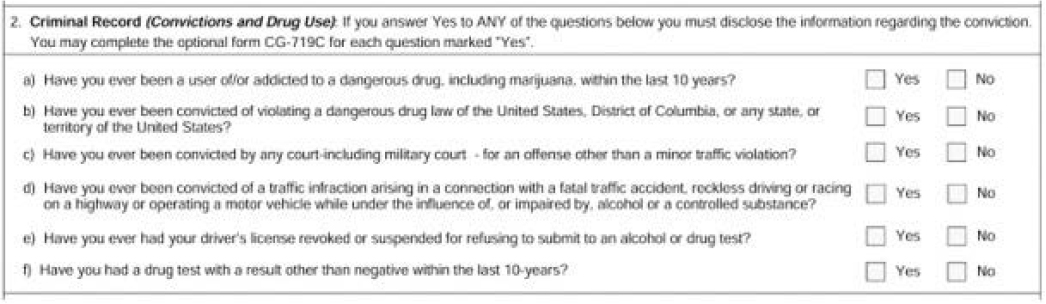
follow-on information to the U.S. Coast Guard that discusses convictions or alcohol and other substance use to help their situation. This may include documentation of successful substance use disorder treatment or attendance in alcohol and other substance use support groups.
Another occurrence of screening is during the merchant mariner medical certificate application review (U.S. Coast Guard, 2017a). Every mariner is screened for medical purposes. For mariners who are going to work in positions that do not require a U.S. Coast Guard credential, or those requiring minimal training, there are no specific questions about alcohol use. The medical practitioner filling out the CG-719K/E, which is given to entry-level merchant mariners, must only attest to the mariner’s ability to complete tasks related to the maritime environment. For mariners filling positions of higher authority and responsibility, they must attest if they ever required treatment for or currently present with a wide range of medical conditions via the CG-719/K form. One such condition is “evaluation, treatment, or hospitalization for alcohol or substance use, abuse, addiction or dependence to include illegal drugs, prescription medications, or other substances.”
Mariners who have motor vehicle convictions that resulted in loss of a state-issued driver’s license due to alcohol or other substance use, or in reckless driving or a fatal accident as defined in 46 C.F.R. § 10.107 (2009), will be subjected to an assessment period. Assessment periods as explained in Table 4-1 are a time-out period of up to three years, wherein the mariner will have to wait prior to resubmitting an application. Depending on the number and severity of alcohol, drug, and criminal convictions, the U.S. Coast Guard may require further proof that a mariner is suitable to hold a credential.
In its report U.S. Coast Guard: Magnitude of Alcohol Problems and Related Maritime Accidents Unknown, the U.S. Government Accountability Office examined the U.S. Coast Guard’s actions related to limiting alcohol use on commercial vessels (U.S. Government Accountability Office, 1990). The report recommended the U.S. Coast Guard improve procedures for identifying alcohol misuse during merchant mariner application screening and improve management information and program effectiveness by collecting data on applications denied because of alcohol misuse, among other factors. Since the report’s release in 1990, the U.S. Coast Guard has revised its serious marine incident alcohol and drug testing requirement.
In addition to questions about alcohol and other substance use, mariners are screened for their medication use. Per the Merchant Mariner Medical Manual, antidepressant medications may be approved without need for a waiver (U.S. Coast Guard, 2019). Medications requiring further review include antipsychotics, anti-convulsives, anti-epileptic drugs, barbiturates, stimulants, muscle relaxers, prescribed opiates (including methadone and buprenorphine, which are medications used to treat opioid use disorders),
TABLE 4-1 Table 1 to §10.213(c)—Guidelines for Evaluating Applicants for Merchant Mariner Credentials Who Have National Driver Register (NDR) Motor Vehicle Convictions Involving Alcohol or Dangerous Drugsa
| Number of convictions | Date of Conviction | Assessment Period |
|---|---|---|
| 1 | Less than 1 year | 1 year from date of conviction. |
| 1 | More than 1, less than 3 years | Application will be processed, unless suspension, or revocationb is still in effect. Applicant will be advised that additional conviction(s) may jeopardize merchant mariner credentials. |
| 1 | More than 3 years old | Application will be processed. |
| 2 or more | Any less than 3 years old | 1 year since last conviction and at least 3 years from 2nd most recent conviction, unless suspension or revocation is still in effect. |
| 2 or more | All more than 3 years old | Application will be processed unless suspension or revocation is still in effect. |
a Any applicant who has ever been the user of, or addicted to the use of, a dangerous drug must meet the requirements of paragraph (f) of this section, which states, “If an applicant has one or more alcohol or dangerous drug-related criminal or NDR-listed convictions, if the applicant has ever been the user of, or addicted to the use of, a dangerous drug, or if the applicant applies before the minimum assessment period for their conviction has elapsed, the Coast Guard may consider the following factors, as applicable, in assessing the applicant’s suitability to hold an MMC. This list is intended as a guide for the Coast Guard. The Coast Guard may consider other factors which it judges appropriate to a particular applicant, such as—(1) Proof of completion of an accredited alcohol or drug abuse rehabilitation program; (2) Active membership in a rehabilitation or counseling group, such as Alcoholics Anonymous or Narcotics Anonymous; (3) Character references from persons who can attest to the applicant’s sobriety, reliability, and suitability for employment in the merchant marine, including parole or probation officers; (4) Steady employment; and (5) Successful completion of all conditions of parole or probation.”
b Suspension or revocation, when referred to in table 1, means a state suspension or revocation of a motor vehicle operator’s license.
SOURCE: 46 C.F.R. § 10.213, 2013.
benzodiazepines, and prescription sleep medications. The use of hallucinogens, including cannabis—including in the form of topical creams—is disqualifying; waivers are not available under any circumstances.
Related to psychoactive medication use, diagnoses of psychotic disorders and alcohol and other substance use disorders that are not in remission are disqualifying; mood disorders, anxiety disorders, and attention deficit hyperactivity disorder diagnoses are also subject to more in-depth review as part of the application process. In part, these diagnoses require further review due to the medications used to treat them.
It is the committee’s understanding that mariners are not required to update the U.S. Coast Guard with changes in their answers to screening
questions—including changes related to criminal convictions—until their renewal application is due.
Hiring by Maritime Companies
Companies also complete their own screening process. For non-credentialed mariners, this is particularly important. Screening for alcohol and other substance misuse at this point in the hiring process is not standardized across the industry.
Pre-employment Drug Testing
For a company to hire an individual for employment on a vessel required to be crewed by a licensed mariner or in a safety-sensitive position, they must meet the drug testing requirements. Per the pre-employment requirements identified in 49 C.F.R. § 40 (2000), the U.S. Coast Guard directs mariners to take a 5+ drug panel test (see Chapter 5 for more).
Analysis
Screening for alcohol and other substance use problems is standard practice across safety-sensitive industries; however, U.S. Coast Guard protocols do not use evidence-based screening tools, do not focus on current impairment, and are not generally connected to brief intervention and referral to treatment. The process may encourage minimization to avoid rejection.
Conclusion 4-2: The U.S. Coast Guard’s screening for alcohol and other substance-related problems as part of the credentialing process does not follow best practices of using validated tools and linking individuals with brief interventions and treatment.
Conclusion 4-3: The U.S. Coast Guard does not require updating of answers to screening questions prior to license renewal; thus, a mariner could be convicted of an alcohol-related sexual assault shortly after obtaining their new credential and not have to report it for more than four years.
RECOMMENDATIONS
Recommendation 4-3: The U.S. Coast Guard should update the Application for Merchant Mariner Credential (Form CG-719B) to incorporate validated alcohol and other substance use screening tools that will help identify applicants at risk of impairment. When applicants screen
positive, they should be encouraged to meet with a Substance Abuse Professional who can perform a more thorough assessment and, when appropriate, guide applicants to appropriate interventions that could improve the chances of success when they reapply.
Recommendation 4-4: To support mariner safety, the U.S. Coast Guard should require credentialed mariners to disclose new convictions or administrative actions promptly (such as within 30 days of the judgment) or face disciplinary actions ranging from a warning to credential suspension. This legal and administrative history should be reviewed by the U.S. Coast Guard prior to credential renewal periods to determine whether it is appropriate for the mariner to remain at sea.
TRAINING
Training that occurs once a mariner has been hired sets the company or vessel expectations for behaviors and consequences related to alcohol and other substance use and misuse and sexual misconduct and other dangerous behaviors. Training on issues and impacts associated with alcohol and other substance misuse and sexual misconduct is a core component of prevention efforts.
Evidence and Best Practices
Non-Technical Skill Competence and Training
In the maritime industry, the relationship between crew interactions and accident causation has been long recognized (Pyne & Koester, 2005). Teamwork, which includes communication, coordination, and decision-making is fundamental to a vessel’s safe operation (Hetherington et al., 2006). For this reason, non-technical skills training is becoming increasingly prevalent in maritime safety improvement efforts; this reflects the known intersection between technical proficiency and human performance (Praetorius et al., 2020).
Best practices from other high hazard industries, such as commercial aviation, emphasize the importance of non-technical skills competence—sometimes referred to as Human Factors or Crew Resource Management (CRM). Non-technical skills are defined as “the cognitive, social, and personal resource skills that complement technical skills, and contribute to safe and efficient task performance” (Flin & O’Connor, 2008, p. 68). Human factors initiatives and CRM are intended to optimize individual and team performance in safety-sensitive work environments. Today, CRM is considered a key contributor to aviation safety performance as it serves to
reduce the frequency and severity of crew-based errors that may contribute to commercial aviation incidents and accidents (Federal Register, 2011).
The Federal Aviation Administration (FAA) notes technical proficiency alone cannot guarantee safe operations in the absence of effective crew coordination (Federal Aviation Administration, 2004). The FAA describes CRM as a comprehensive system of applying human factors concepts to improve crew (i.e., operational personnel) performance; it focuses on attitudes and behaviors with consideration of impacts on safety outcomes (Federal Aviation Administration, 2004). In the North American commercial aviation industry, CRM principles and concepts are shared through recurrent training, practice, evaluation, and feedback and further embedded and reinforced within safety management systems and organizational culture (Federal Aviation Administration, 2004; Transport Canada, 2020). See Box 4-1 for components of a typical aviation CRM training curriculum. CRM has the greatest impact when its components are tailored to the size, nature, and scope of the organization’s unique operational context (Transport Canada, 2020).
CRM was initially developed to supplement the technical competence of airmen following several aviation catastrophes that were attributed to human factors (Kaps et al., 1999). The enhanced safety benefit of bringing dissimilar groups (i.e., across operational departments) together in CRM training was soon realized—the objective of which was to “improve the effectiveness and safety of the entire operations team as a working system” (Federal Aviation Administration, 2004, p. 14). As a result, CRM in aviation has evolved to include broader groups, such as flight attendants,
BOX 4-1
Typical Aviation CRM Training Curriculum with Individual and Team Focus
- Threat and error management;
- Communication and coordination;
- Situational awareness;
- Workload and fatigue management;
- Pressure and stress management (chronic and acute);
- Leadership and team building conflict resolution;
- Decision-making; and
- Automation and technology management
SOURCE: Transport Canada, 2020, Table 2 — New CRM Training Standard. https://tc.canada.ca/en/aviation/reference-centre/advisory-circulars/advisory-circular-ac-no-700-042
maintenance personnel, flight dispatchers, and air traffic controllers. In the United States, recurrent CRM training is mandated for both pilots and flight attendants, and uniform standards for academic CRM training content have been promulgated to strengthen the aviation safety system (Federal Register, 2011).
Training Related to Alcohol and Other Substance Use and Misuse in Aviation
Aviation represents a mature safety system, and some regulators have offered guidance on how to effectively address the impacts of use and misuse of alcohol and other substances. The United Kingdom Civil Aviation Authority (2015) as of 2015, advised all air operators to provide awareness and education related to alcohol and other substance use and misuse as part of their respective safety management systems. Such a crew training program could cover:
- the potential effects of alcohol and other substances (on performance); and
- medication use (both prescription and over-the-counter drugs) to ensure the safe exercise of license (i.e., accreditation) privileges.
The FAA, per statute 14 C.F.R. § 120.115 (2009), requires that all employers provide an employee assistance program (EAP) for employees. The EAPs “must include education and training on drug use for employees and training for supervisors making determinations for testing of employees based on reasonable cause.” The education programs provided by the EAP must include the following at a minimum:
- “The effects and consequences of drug use on individual health, safety, and work environment;” and
- “The manifestations and behavioral cues that may indicate drug use and abuse.”
The training for supervisors making reasonable cause determinations must have a minimum of 60 minutes of training, and their training must be recurrent in future years.
Training Related to Sexual Misconduct Prevention
In recent years, researchers studying the U.S. military have observed that instances of sexual misconduct degrade individual, team/unit, and organizational performance (Klein & Gallus, 2018). Klein and Gallus (2018)
posit that these multi-level impacts threaten operational readiness to meet the mission and assert that non-technical skills training can play an important role in addressing this threat. They posit that interpersonal skills are essential, and their development (via awareness and education) must make explicit connections to operational performance, noting:
When possible, helping service members make connections between a broad range of negative behaviors (e.g., substance abuse, hazing, suicide) can provide greater clarity on the negative readiness impact that often results from sexual assault. […] When it comes to sexual harassment and assault, training and policy need to be reflective of not only the specific behaviors that are prohibited but on the broader connection between positive command climate and individual and unit readiness. (Klein & Gallus, 2018, p. 268)
Current Policy and Practice
The maritime industry began considering non-technical skills training in the 1990s; its genesis followed several accidents in which human performance issues (i.e., fatigue, stress, health, situation awareness, teamwork, decision-making, and communication) were identified as causal or contributory (Grech et al., 2008; Hetherington et al., 2006). The current International Maritime Organization’s (IMO’s) Seafarers’ Training, Certification and Watchkeeping (STCW) sets competency requirements for mariners, including the ability to:
- establish and maintain effective communications on board the ship;
- contribute to effective human relationship on board ship; and
- possess knowledge, understanding, and proficiency in “basic team-working principles and practice, including conflict resolution” and “dangers of drug and alcohol abuse.”
Demonstration of this competence is simply noted as “assessment of evidence obtained from approved instruction or during attendance at an approved course” (The Maritime Safety Committee, 2024). The specific curriculum is at the discretion of each training provider. As discussed in Chapter 5 in greater detail, the U.S. Coast Guard requires companies to have EAPs that provide alcohol and other substance misuse training. Those companies that participate in the EMBARC also are required to provide regular training on sexual misconduct policies.
At present, most non-technical skills training in the maritime industry is limited by a specific task or function approach rather than considering a systems view (Wahl & Kongsvik, 2018). Current training efforts tend to focus on bridge and engine room personnel reflecting the IMO’s requirement
for ship officers to complete leadership and teamwork training. This mandated competency requirement includes demonstration of competence in bridge resource management (BRM) and engine room resource management (ERRM) principles, which are derived from CRM principles in the aviation industry. The current IMO STCW mandates this training for the Chief Mate or Master on ships of 500 gross registered tonnage or more and for the second engineer officer or chief engineer officer on ships powered by main propulsion machinery of 750 kW propulsion power or more (49 C.F.R. § 11.311, 2024).
Some organizations now deliver maritime resource management (MRM) or vessel resource management (VRM) training, but the committee was unable to assess whether these monikers reflect training requirements and content that extend beyond the minimum STCW convention requirements. Nor was the committee able to assess whether these programs embrace contemporary CRM principles, such as designing and delivering training that recognizes the complexity of operational activities and the interactions that occur across functional teams, departments, and ranks.
MARAD’s Ship Operations Cooperative Program (SOCP) provides the maritime community—including employers, unions, and professional associations—with access to educational information and materials created by the SOCP, including guidance on how to recognize abusive behaviors and the maritime industry’s best practices for addressing such action. “The SOCP Best Practices Guide addresses several issues involving sexual assault, sexual harassment, retaliation, bystander intervention, bullying, hazing, coercion, stalking, and other prohibited behaviors in the U.S. Merchant Marines” (MARAD, 2025). The goal is to educate mariners about being able to “recognize these behaviors and become familiar with the appropriate practices for prevention and response to these prohibited behaviors. The tactics and practices in this guide are utilized by maritime companies of all sizes and compiled specifically for members of the U.S. maritime community” (MARAD, 2025).
Pending Changes
In May 2024, amendments to the STCW Code were adopted to “prevent and respond to violence and harassment in the maritime sector, including sexual harassment, bullying, and sexual assault. They outline new mandatory minimum requirements for basic training and instruction for all Seafarers to equip them with knowledge and understanding of violence and harassment—including sexual harassment, bullying, and sexual assault—and information on how to prevent and respond to incidents. The amendments to the STCW Code are expected to enter into force on January 1, 2026” (IMO, 2025). These amendments were reviewed by a
joint International Labor Organization/IMO Tripartite Working Group to Identify and Address Seafarers’ Issues and the Human Element (JTWG) in February 2024. The U.S. Navy’s Military Sealift Command 108 also “approved other recommendations from the JTWG, including the launch of awareness campaigns and other further measures to address violence and harassment—including sexual harassment, bullying and sexual assault—applicable to shipping companies, social partners and United Nations agencies” (IMO, 2025). Credentialed mariners will likely need to complete specific training modules (Lloyd’s Register, 2024).
Analysis
Regardless of what term is used to describe non-technical skills training (i.e., BRM, ERRM, VRM, MRM) in the maritime industry, it is evident that non-technical skills competence (or lack thereof) can influence interpersonal interactions, team coordination, and operational performance. Though the origins of non-technical skills training may be found in the aviation industry, it is important to customize broad CRM concepts within the maritime environment, emphasizing the actual work context and crew-specific needs (Wahl & Kongsvik, 2018). Because the commercial maritime industry has unique operational and interpersonal demands and pressures based on its very nature, non-technical skills training ought to be designed to address these specific workplace attributes.
In the U.S. maritime industry, however, there is no common standard or best practice associated with non-technical skills training that connects corporate policies to operational safety outcomes. Often, it is the responsibility of Human Resources departments to ensure that adequate training is offered to new mariners and that they are educated on all corporate policies (including those related to alcohol and other substance use and misuse and sexual misconduct) prior to joining a vessel, as part of the onboarding process. As a result, the focus of training content may be more administrative in nature, thus the operational and safety relevance of such policies is diminished. Moreover, required training through the EMBARC program only reaches those mariners whose companies participate.
Non-technical skills training, if expanded to include all mariners regardless of function, department, rank, or accreditation, would provide an effective frame for connecting operational performance and outcomes to alcohol and other substance use and misuse, a culture of care and concern, and prevention of sexual misconduct and other dangerous as well as abusive behaviors. Non-technical skills training provides a natural context for mariners to contemplate topics related to various forms of impairment and sexual misconduct with the aim of improving individual and team performance. The inclusion of sexual misconduct prevention course
content within non-technical skills training would effectively highlight the relationship between fostering respectful workplace behavior and achieving operational performance.
The incorporation of training content related to the use and misuse of alcohol and other substances within non-technical skills training would also foster mariners’ awareness of the relationship between various types of impairment on human performance and the achievement of operational performance. Peer awareness and intervention strategies need to also be included in this education, as studies have noted that spotting intoxication and impairment is often difficult for supervisors and co-workers (Howland et al., 2000). This finding underscores the need for training to recognize behavioral cues that may suggest intoxication to determine whether a test of fitness-for-duty is needed to avoid adverse events and accidents.
Conclusion 4-4: Research in the commercial aviation industry has established that supplementing technical competence with non-technical skills training (based on crew resource management concepts and principles) facilitates improvements to crew coordination and effectiveness. To be most effective, non-technical skills training should be designed for and delivered to joint training sessions across functional teams and departments to reflect the realities of the operational work system.
Conclusion 4-5: Non-technical skills competence development and training programs in the maritime industry can be strengthened by mandating competence and training for all mariners, customizing course curricula to the unique maritime workplace system, emphasizing the relationship between interpersonal skills and task performance, and designing and delivering training to multi-function, multi-department, and multi-rank audiences.
Conclusion 4-6: Non-technical skills training provides an appropriate setting for contemplating topics related to alcohol and other substance use and misuse and sexual misconduct prevention in the context of human performance (i.e., individual and team) and allows clear connections to be made to operational readiness, performance, and safety outcomes.
Recommendation 4-5: The U.S. Maritime Administration should engage with experts in human factors, career management, and addiction to develop best practice guidance on enhanced non-technical skills competence for mariners. The guidance should:
- Cover training curricula and delivery mechanisms for all mariners that is suited to role and rank, applicable to initial and recurrent training, and informed by contemporary programs in other high hazard industries;
- Include curricula with enhanced content that raises awareness about the impacts of alcohol and other substance use and misuse on individual, crew, and operational performance; and
- Include content regarding impacts of sexual misconduct, and the intersection with alcohol and other substance use and misuse, on operational readiness and performance.
Topics suggested by the committee for curricula are in Box 4-2 and Box 4-3. The U.S. Coast Guard should consider proposing adoption of best practices for non-technical skills training by the IMO. Maritime companies should adopt them as a minimum standard, while enhancing and customizing the training materials to reflect the unique nature of their operation, mission, and crew context and embed the concepts and principles within their respective safety management systems for the greatest effect.
SOCIALIZATION
A final step before setting sail is socialization, the process through which newcomers make the transition from being outsiders to becoming insiders by learning and adapting to the values, expected behaviors, and
BOX 4-2
Topics for Curricula to Supplement Non-Technical Skills Training: Respectful Workplace and Operational Performance
Respectful Workplace and Operational Performance
- Vessel resiliency and operational readiness as a function of teambuilding and respect in the workplace (including how crew communication, coordination, and cohesion are impaired by negative behaviors in the operational setting)
- Definitions of terms (harassment, bullying, hazing, sexual misconduct, etc.) including explicit articulation of types of inappropriate behaviors
- Role that the use and misuse of alcohol or other substances may play in enabling inappropriate conduct including an overview of low-risk drinking
- Formal and transparent consequences for infractions defined and articulated (should include criminal referral as appropriate)
- Conflict resolution and bystander actions to diffuse escalation
- Response from/by various parties
BOX 4-3
Topics for Curricula to Supplement Non-Technical Skills Training: Use and Misuse of Alcohol and Other Substances
Use and misuse of alcohol and other substances
- Impacts on individual and team performance (cognitive, psychosocial, physiological, and physical impacts of acute and chronic use/misuse and withdrawal)
- Clear articulation of relationship to operational safety/readiness
- Overview of low-risk drinking principles
- Peer awareness and interventions strategies (including identification of signs of impairment)
- Resources for assistance, supports, etc. that can be shared for those who may self-identify as in need following session
social knowledge of the organization. This process can be formal (e.g., structured onboarding programs) or informal (e.g., learning through daily interactions). Socialization plays a crucial role in employee adjustment, retention, and performance. In this section, we discuss alcohol-related signals during the socialization process.
Evidence and Best Practices
Alcohol can play a significant role in employee onboarding and socialization, particularly in organizations where social bonding is encouraged through informal gatherings, team dinners, or after-hours events. These occasions are often seen as opportunities to build camaraderie and to ease new employees into the company culture. Newcomers are especially sensitive to social cues during the onboarding period, including implicit messages about drinking norms (Liu et al., 2015). When alcohol is present at work or social events early in an employee’s tenure, it can signal that drinking is a valued or an expected part of fitting in or surviving a particular occupation.
Accordingly, the same socialization processes that supposedly foster learning and inclusion can also encourage problematic alcohol and other substance use. When new employees perceived heavy drinking as normative or tied to social acceptance, they were more likely to increase their own alcohol consumption to match perceived expectations (Liu et al., 2015). Over time, this can lead to unhealthy patterns of use, as new employees who are often eager to gain approval or reduce feelings of uncertainty increase their level of drinking after organizational entry (Liu et al., 2020).
Thus, early exposure to permissive drinking norms can create a trajectory where alcohol becomes intertwined with professional networking and team cohesion—blurring the boundaries between personal choice and cultural pressure.
To counter this, organizations can design onboarding processes that promote inclusion without relying on alcohol-centered events. Research suggests that certain onboarding experiences, such as job empowerment and supportive peer relationships, may expedite “maturing out” of risky drinking behaviors among at-risk college recruits (Bamberger et al., 2024, p. 3208). Accordingly, creating an alcohol-free, or at the minimum low-risk drinking culture, among the maritime workforce starts with intentional onboarding and socialization strategies. Best practices include clearly communicating company expectations around alcohol and other substance use, offering diverse, alcohol-free social opportunities, and training managers to model appropriate behavior. Specifically, during onboarding, companies could communicate their stance on alcohol use in the workplace, for example by explaining zero-alcohol policies during newcomer orientation.
Establishing a substance use policy and making it part of the onboarding process can help set the tone. In addition, company social events may provide engaging, alcohol-free alternatives. Instead of happy hours, organizations can plan coffee meet-ups, wellness activities, or game nights that promote connection without alcohol. Furthermore, leadership plays a key role in setting workplace norms. If leaders regularly opt for alcohol-free gatherings and respect boundaries, employees are more likely to follow suit.
Current Policy and Practice
Formal policies may strictly forbid alcohol use on board shipping vessels, but the reality for many Seafarers may be more nuanced. Given the normative influence of peer alcohol consumption, it is conceivable that when newcomers of the maritime industry observe occasional alcohol use by their more experienced coworkers, they may interpret such behaviors as implicitly allowed and even emulate such behaviors themselves.
Media reports over the last decade have highlighted the serious consequences of alcohol misuse in the maritime sector, though they often focus on the aftermath of accidents rather than the specific social events that may have preceded them. A notable 2022 incident involved P&O Ferries, which fired seven agency crewmembers for breaching the company’s zero-tolerance alcohol policy. While the report did not detail a specific company event, it underscored the strict enforcement of alcohol rules in a professional maritime setting (BBC, 2022).
Analysis
Studies and reports on the role of alcohol in the socialization of maritime workers remain limited. While there is some documentation that alcohol consumption occurs both at sea and during shore leave, the nature and context of such use are poorly understood. For instance, it is unclear whether drinking tends to be solitary or social, whether it happens during company-sponsored events or in informal gatherings, and what the typical quantity and frequency of alcohol use looks like. These gaps in the literature make it difficult to assess how alcohol functions within the broader work-nonwork rhythm and social dynamics of Seafarers’ life, particularly in an industry where isolation, stress, and rigid hierarchies may shape social behaviors in unique ways.
Moreover, the committee is not aware of any intervention studies that directly target problematic socialization practices that might implicitly or explicitly encourage alcohol use, whether in the general workforce or specifically within the maritime sector. In industries with safety-critical work like shipping, the absence of such research is particularly striking. Without targeted interventions or even a clear understanding of where and how these cultural norms around drinking are formed and maintained, efforts to reduce alcohol-related risks may be undermined. Further research to map out these dynamics and test practical interventions would be a valuable step forward in improving both safety and well-being.
Despite these gaps, existing research in occupational health suggests that when social signals around alcohol use conflict with formal policies (a policy-practice gap), negative outcomes often follow (Maternová & Svabova, 2024). For example, if a shipping company enforces a zero-tolerance alcohol policy but allows—or turns a blind eye to—team bonding rituals that involve drinking during shore leave, employees may receive mixed messages about acceptable behavior. This misalignment can not only compromise safety but also weaken trust in organizational leadership and rules. As such, it is crucial to design onboarding and socialization practices that clearly and consistently reinforce company norms around alcohol and other substance use. Doing so would help ensure that formal policies are supported, not undermined, by the everyday social environment aboard ships.
Conclusion 4-7: Socialization may be an unappreciated contributor to alcohol misuse in the maritime industry, but further research is needed to assess its role.
REFERENCES
14 C.F.R. § 120.115. (2009) (amended 2010). https://www.ecfr.gov/current/title-14/part-120/section-120.15
46 C.F.R. § 10.107. (2009). https://www.ecfr.gov/current/title-46/section-10.107
46 C.F.R. § 10.213. (2013) (amended 2024). https://www.ecfr.gov/current/title-46/chapter-I/subchapter-B/part-10/subpart-B/section-10.213
49 C.F.R. § 11.311. (amended 2024). https://www.ecfr.gov/current/title-46/chapter-I/subchapter-B/part-11/subpart-C/section-11.311
49 C.F.R. § 40. (2000). https://www.ecfr.gov/current/title-49/part-40
American Medical Association. (2023). Licensing and credentialing bodies’ inquiry of physician mental health. https://www.ama-assn.org/system/files/regulatory-myths-mental-health.pdf
Bamberger, P. A., Wang, M., Bacharach, S. B., Larimer, M., & Nahum-Shani, I. (2024). Organizational on-boarding practices and shifts in alcohol misuse among at-risk college recruits. The International Journal of Human Resource Management, 35(19), 3207–3241. https://doi.org/10.1080/09585192.2024.2401580
Baygi, F., Djalalinia, S., Qorbani, M., Dejman, M., & Nielsen, J. B. (2020). Lifestyle interventions in the maritime settings: A systematic review. Environmental Health and Preventive Medicine, 25(1), 1–10. https://doi.org/10.1186/s12199-020-00848-7
BBC. (2022, April 19). P&O Ferries: Agency staff sacked after breaching alcohol guidelines. https://www.bbc.com/news/uk-england-kent-61153167
Berkowitz, A. D. (2005). Critical elements of sexual-assault prevention and risk-reduction programs for men and women. In C. Kilmartin & A. D. Berkowitz, Sexual assault in context (pp. 75–96). Psychology Press.
Bonar, E. E., DeGue, S., Abbey, A., Coker, A. L., Lindquist, C. H., McCauley, H. L., Miller, E., Senn, C. Y., Thompson, M. P., Ngo, Q. M., Cunningham, R. M., & Walton, M. A. (2022). Prevention of sexual violence among college students: Current challenges and future directions. Journal of American College Health, 70(2), 575–588. https://doi.org/10.1080/07448481.2020.1757681
Brooks, S. K., & Greenberg, N. (2022). Mental health and psychological wellbeing of maritime personnel: A systematic review. BMC Psychology, 10(1), 139. https://doi.org/10.1186/s40359-022-00850-4
Cal Poly Maritime Academy. (2024). Inclusion Center. https://www.csum.edu/diversity/inclusion-center.html
DeJong, W., & Langford, L. M. (2002). A typology for campus-based alcohol prevention: Moving toward environmental management strategies. Journal of Studies on Alcohol, (Suppl. 14), 140–147. https://doi.org/10.15288/jsas.2002.s14.140
Devaney, R. (2024, March 2). ‘The only woman in the room.’ Female mariners, leaders bond at Cape maritime school event. Cape Cod Times. https://www.capecodtimes.com/story/news/education/2024/03/02/support-connections-women-mariners-massachusetts-mari-time-ann-phillips/72761343007/
Federal Aviation Administration. (2004). Crew resource management training (AC No. 120-51E). Advisory Circular. https://www.faa.gov/documentLibrary/media/Advisory_Circular/AC120-51e.pdf
Federal Register. (2011). Crew resource management training for crewmembers in Part 135 Operations. https://www.federalregister.gov/documents/2011/01/21/2011-1211/crew-resource-management-training-for-crewmembers-in-part-135-operations
Federation of State Physician Health Programs. (2024). FAQs. https://www.fsphp.org/faqs
Flin, R., & O’Connor, P. (2008). Safety at the sharp end: A guide to non-technical skills. CRC Press. https://doi.org/10.1201/9781315607467
Glass, P. (2025, January 22). Maritime Administration says maritime academies need more diversity. WorkBoat. https://www.workboat.com/maritime-administration-says-maritime-academies-need-more-diversity
Grech, M. R., Horberry, T., & Kester, T. (2008). Human factors in the maritime domain. CRC Press. https://doi.org/10.1201/9780429355417
Hetherington, C., Flin, R., & Mearns, K. (2006). Safety in shipping: The human element. Journal of Safety Research, 37(4), 401–411. http://dx.doi.org/10.1016/j.jsr.2006.04.007
Howland, J., Rohsenow, D. J., Cote, J., Siegel, M., & Mangione, T. W. (2000). Effects of low‐dose alcohol exposure on simulated merchant ship handling power plant operation by maritime Cadets. Addiction, 95(5), 719–726. https://doi.org/10.1046/j.1360-0443.2000.9557197.x
Inland Empire Health Plan (IEHP). (n.d.). TAPS Tool (Tobacco, Alcohol, Prescription medications, and other Substance use) – English. https://www.providerservices.iehp.org/content/dam/provider-services-rd/en/documents/providers/provider-resources/facility-site-review1/medical-record-review/adult-preventive/20241219%20-%20TAPS%20Tool%20English.pdf
International Marine Organization (IMO) (n.d.) IMO/ILO work on Seafarer issues. https://www.imo.org/en/ourwork/legal/pages/jointimoiloworkinggroupsonseafarerissues.aspx
___. (2010). STCW Code Table A-VI/1-4. https://www.edumaritime.net/stcw-code/stcw-vi-1-safety-familiarization-and-basic-training
Jernigan, D. H., Shields, K., Mitchell, M., & Arria, A. M. (2019). Assessing campus alcohol policies: Measuring accessibility, clarity, and effectiveness. Alcoholism: Clinical and Experimental Research, 43(5), 1007–1015. https://doi.org/10.1111/acer.14017
Jones, J. T. R., North, C. S., Vogel-Scibilia, S., Myers, M. F., & Owen, R. R. (2018). Medical licensure questions about mental illness and compliance with the Americans with Disabilities Act. Journal of the American Academy of Psychiatry and the Law, 46(4), 458–471. https://doi.org/10.29158/jaapl.003789-18
Kaps, R. W., Keren-Zvi, R., & Ruiz, J. R. (1999). Crew resource management: A literature review. Journal of Aviation/Aerospace Education & Research, 8(3), 2. https://doi.org/10.15394/jaaer.1999.1219
Klein, M., & Gallus, J. A. (2018). The readiness imperative for reducing sexual violence in the US armed forces: Respect and professionalism as the foundation for change. Military Psychology, 30(3), 264–269. https://psycnet.apa.org/doi/10.1080/08995605.2017.1422949
Liu, S., Bamberger, P., Wang, M., Shi, J., & Bacharach, S. B. (2020). When onboarding becomes risky: Extending social learning theory to explain newcomers’ adoption of heavy drinking with clients. Human Relations, 73(5), 682–710. https://doi.org/10.1177/0018726719842653
Liu, S., Wang, M., Bamberger, P., Shi, J., & Bacharach, S. B. (2015). The dark side of socialization: A longitudinal investigation of newcomer alcohol use. Academy of Management Journal, 58(2), 334–355. https://doi.org/10.5465/amj.2013.0239
Lloyd’s Register. (2024). IMO Maritime Safety Committee (MSC 108) summary report. https://www.lr.org/en/knowledge/regulatory-updates/imo-meetings-and-future-legislation/msc-108-summary-report/
Maine Maritime Academy. (2025, April 9). Summer sea term 2025 (SST 2025). Maine Maritime Academy & Texas A&M Maritime Academy Joint Sea Term Information Brief. https://mainemaritime.edu/tssom-training-cruise-blog/wp-content/uploads/sites/19/2025/05/Summer-Sea-Term-2025_Information-Brief.pdf
Martin, E. P. (2025, March 5). US Seafarer diversity effort ends in deletions and dead links after Trump order. TradeWinds. https://www.tradewindsnews.com/sustainability/us-seafarer-diversity-effort-ends-in-deletions-and-dead-links-after-trump-order/2-1-1786585
Maternová, A., & Svabova, L. (2024). Assessing fatality risks in maritime accidents: The influence of key contributing factors. Applied Sciences, 14(19), 9153. https://doi.org/10.3390/app14199153
McCarthy, P. M., & O’Sullivan, D. (2010). Efficacy of a brief cognitive behavioral therapy program to reduce excessive drinking behavior among new recruits entering the Irish Navy: A pilot evaluation. Military Medicine, 175(11), 841–846. https://doi.org/10.7205/milmed-d-09-00251
McPherson, T. L., Eric, G., Delia, O.-S., Laura, J.-K., A., L.-T. K., & Walsh, T. (2009). Workplace alcohol screening, brief intervention, and referral to treatment (SBIRT): A survey of employer and vendor practices. Journal of Workplace Behavioral Health, 24(3), 285–306. https://doi.org/10.1080/15555240903188372
Muraki, E. J., Atay, E. J., Chadwick, L., van der Wijk, G., Mori, C. M., Murry, A. T., & Exner-Cortens, D. (2024). Affinity and allyship groups to advance inclusion in postsecondary institutions: A systematic scoping review. Journal of Diversity in Higher Education. https://doi.org/10.1037/dhe0000543
National Academies of Sciences, Engineering, and Medicine. (2023). Substance misuse programs in commercial aviation: Safety first. The National Academies Press. https://doi.org/10.17226/27025
National Institute on Alcohol Abuse and Alcoholism (NIAAA). (2025). Rethinking drinking. https://rethinkingdrinking.niaaa.nih.gov/
___. (2002). A call to action: Changing the culture of drinking at U.S. college (NIH Publication No. 02-5010). https://www.collegedrinkingprevention.gov/niaaa-college-materials/reports/niaaa-college-task-force-materials/call-action-changing-culture
Newlands, R., & O’Donohue, W. (2016). A critical review of sexual violence prevention on college campuses. Acta Psychopathologica, 02(02). https://doi.org/10.4172/2469-6676.100040
Otto, S., Bertel, L. B., Lyngdorf, N. E. R., Markman, A. O., Andersen, T., & Ryberg, T. (2024). Emerging digital practices supporting student-centered learning environments in higher education: A review of literature and lessons learned from the Covid-19 pandemic. Education and Information Technologies, 29(2), 1673–1696. https://doi.org/10.1007/s10639-023-11789-3
Paschall, M. J., Antin, T., Ringwalt, C. L., & Saltz, R. F. (2011). Evaluation of an internet-based alcohol misuse prevention course for college freshmen: Findings of a randomized multi-campus trial. American Journal of Preventive Medicine, 41(3), 300–308. https://doi.org/10.1016/j.amepre.2011.03.021
Praetorius, G., Hult, C., & Österman, C. (2020). Maritime resource management: Current training approaches and potential improvements. TransNav, International Journal on Marine Navigation and Safety of Sea Transportation, 14(3), 573–584. https://doi.org/10.12716/1001.14.03.08
Prosser, T., Ann, G. K., & Jones, F. (2018). A meta-analysis of effectiveness of e-interventions to reduce alcohol consumption in college and university students. Journal of American College Health, 66(4), 292–301. https://doi.org/10.1080/07448481.2018.1440579
Pyne, R., & Koester, T. (2005). Methods and means for analysis of crew communication in the maritime domain. The Archives of Transport, 17(3-4), 193–208. https://www.nautinst.org/static/224adb8d-e8e0-4595-af8aedbfd7f50dd8/HE00640-Methods-and-Means-for-Analysis-of-Crew-Communication-in-the-Maritime-Domain.pdf
Rau, T. J., Merrill, L. L., McWhorter, S. K., Stander, V. A., Thomsen, C. J., Dyslin, C. W., Crouch, J. L., Rabenhorst, M. M., & Milner, J. S. (2010). Evaluation of a sexual assault education/prevention program for male US Navy personnel. Military Medicine, 175(6), 429–434. https://doi.org/10.7205/milmed-d-09-00218
Ringwalt, C. L., Paschall, M. J., & Gitelman, A. M. (2010). Alcohol prevention strategies on college campuses and student alcohol abuse and related problems. Journal of Drug Education, 41(1), 99–118. https://doi.org/10.2190/DE.41.1.f
Scott-Sheldon, L. A. J., Carey, K. B., Elliott, J. C., Garey, L., & Carey, M. P. (2014). Efficacy of alcohol interventions for first-year college students: A meta-analytic review of randomized controlled trials. Journal of Consulting and Clinical Psychology, 82(2), 177–188. https://doi.org/10.1037/a0035192
Seafarers International Union. (2025). Seafarers Addition Rehabilitation Center (SARC). https://www.seafarers.org/about/partners-and-programs/sarc/
Seamen’s Church Institute. (2025). Our history. https://seamenschurch.org/who-we-are/ourhistory/
Senn, C. Y., Eliasziw, M., Barata, P. C., Thurston, W. E., Newby-Clark, I. R., Radtke, H. L., & Hobden, K. L. (2015). Efficacy of a sexual assault resistance program for university women. New England Journal of Medicine, 372(24), 2326–2335. https://doi.org/10.1056/nejmsa1411131
Strudwick, J., Gayed, A., Deady, M., Haffar, S., Mobbs, S., Malik, A., Akhtar, A., Braund, T., Bryant, R. A., & Harvey, S. B. (2023). Workplace mental health screening: A systematic review and meta-analysis. Occupational and Environmental Medicine, 80(8), 469–484. https://doi.org/10.1136/oemed-2022-108608
Substance Abuse and Mental Health Services Administration. (2013). TAP 33: Systems-level implementation of screening, brief intervention, and referral to treatment (SBIRT). https://library.samhsa.gov/product/tap-33-systems-level-implementation-screening-brief-intervention-and-referral-treatment
Taylor, D. M., Johnson, M. B., Voas, R. B., & Turrisi, R. (2006). Demographic and academic trends in drinking patterns and alcohol-related problems on dry college campuses. Journal of Alcohol and Drug Education, 35–54. https://www.jstor.org/stable/45091745
The Joint Commission. (n.d.). Worker well-being resources. https://www.jointcommission.org/en-us/knowledge-library/workforce-safety-and-well-being-resource-center/workerwell-being
The Maritime Safety Committee (2024). Resolution Msc.560(108) (Adopted on 23 May 2024) - Amendments to Part A of the Seafarers’ Training, Certification and Watchkeeping (STCW) Code. https://wwwcdn.imo.org/localresources/en/KnowledgeCentre/Indexo-fIMOResolutions/MSCResolutions/MSC.560(108).pdf
The White House. (2025, January 21). Ending radical and wasteful government DEI programs and preferencing. https://www.whitehouse.gov/presidential-actions/2025/01/ending-radical-and-wasteful-government-dei-programs-and-preferencing/
Transport Canada. (2020). Crew resource management (CRM) (AC No. 700-042). https://tc.canada.ca/en/aviation/reference-centre/advisory-circulars/advisory-circular-ac-no-700-042
United Kingdom Civil Aviation Authority. (2015, February 20). Drugs and alcohol policies for air operator certificate holders and air navigation service providers (Information Notice IN-2015/012).
U.S. Coast Guard. (2017a). Application for a medical certificate (Form CG-719K/E) (OMB No. 1625-0040). https://www.dco.uscg.mil/Portals/9/NMC/pdfs/forms/CG_719KE.pdf
___. (2017b). Application for merchant mariner credential (Form CG-719B) (OMB No. 1625-0040). https://www.dco.uscg.mil/portals/9/nmc/pdfs/forms/cg_719b.pdf
___. (2019). Merchant mariner medical manual (COMDTINST M16721.48). https://media.defense.gov/2019/Sep/11/2002181050/-1/-1/0/CIM_16721_48.PDF
U.S. Committee on the Marine Transportation System. (2020). Mental health resources for U.S. merchant mariners and critical workforce in the MTS. https://www.american-club.com/files/files/CMTS-Catalog-of-Mental-Health-Resources-for-US-Merchant-Mariners-MTS.pdf
U.S. Government Accountability Office. (1990). Coast Guard: Magnitude of alcohol problems and related maritime accidents unknown (RCED-90-150). https://www.gao.gov/products/rced-90-150
U.S. Maritime Administration (MARAD). (2025). Every Mariner Builds A Respectful Culture (EMBARC) training. https://www.maritime.dot.gov/EMBARC/Training
___. (2020). Report to Congress: Opportunities and challenges to increasing the number of United States Coast Guard credentialed Mariners. https://www.maritime.dot.gov/sites/marad.dot.gov/files/2020-07/Mariner%20Opportunities%20and%20Challenges%20Report%20%28002%29.pdf
___. (2021). Every Mariner Builds A Respectful Culture (EMBARC): Sexual Assault and Sexual Harassment (SASH) prevention standards for vessel operator participation in the USMMA sea year program (Rev. 2—04/09/25). https://www.maritime.dot.gov/sites/marad.dot.gov/files/2025-04/EMBARC_Standards_4.9.25.pdf
U.S. Merchant Marine Academy (USMMA). (2023). Third report to the Secretary of Transportation. https://www.usmma.edu/sites/usmma.dot.gov/files/2023-12/Third%20USMMA%20Advisory%20Board%20Report%2013%20July%202023.pdf
___. (2025). USMMA sea year handbook (Revision 18). https://www.usmma.edu/academics/sea-year-guide
Vladutiu, C. J., Martin, S. L., & Macy, R. J. (2011). College- or university-based sexual assault prevention programs: A review of program outcomes, characteristics, and recommendations. Trauma, Violence, & Abuse, 12(2), 67–86. https://doi.org/10.1177/1524838010390708
Wahl, A. M., & Kongsvik, T. (2018). Crew resource management training in the maritime industry: A literature review. WMU Journal of Maritime Affairs, 17(3), 377–396. https://doi.org/10.1007/s13437-018-0150-7
Wechsler, H., Lee, J. E., Gledhill-Hoyt, J., & Nelson, T. F. (2001). Alcohol use and problems at colleges banning alcohol: Results of a national survey. Journal of Studies on Alcohol, 62(2), 133–141. https://doi.org/10.15288/jsa.2001.62.133
Wu, L. (2024). Containerization of Seafarers in the International Shipping Industry: Contemporary seamanship, maritime social infrastructures, and mobility politics of global logistics [Doctoral dissertation, City University of New York]. https://academicworks.cuny.edu/gc_etds/5649
Zhao, Y., & Watterston, J. (2021). The changes we need: Education post COVID-19. Journal of Educational Change, 22(1), 3–12. https://doi.org/10.1007/s10833-021-09417-3
This page intentionally left blank.


