Strengthening Alcohol Policies and Supporting Safety and Health in the Maritime Industry (2026)
Chapter: 7 Organizational Culture and Leadership
7
Organizational Culture and Leadership
Programs and policies that protect against alcohol and other substance misuse and sexual misconduct are integral to establishing cultures of safety and personal well-being within the maritime industry. These foundational concepts and their supporting values, beliefs, attitudes, and norms serve to generate both the appetite and aptitude to effectively implement the recommendations identified throughout this report. The role of leadership is critical to building and maintaining cultures of safety and personal wellbeing; it is the industry’s leaders that shape the values and behaviors of current and future mariners. This final chapter focuses on these important topics and makes recommendations for strengthening the culture of the U.S. maritime industry.
ORGANIZATIONAL CULTURE
Organizational culture consists of basic assumptions, espoused core values, and observed artifacts (e.g., structure, systems, policies, programs), and determines how we do things around here (Schein, 2010). An organization’s cultural attributes (as expressed through these assumptions, values, and artifacts) provides members with an unwritten social contract to survive and possibly thrive in the workplace. Research has shown that organizational culture influences decisions, priorities, resourcing, and the behavior of people in an organization; it can have a significant impact on all aspects of performance, including outcomes related to operational safety and personal well-being—the performance effects can be positive or negative. For example, in a proposed framework, Dextras-Gauthier and
colleagues (2012) note that improved mental health outcomes for many types of workers are related to a healthy workplace culture, which is defined by pleasant social connections, encouraging leadership, and appreciation of employees’ achievements. In contrast, negative workplace cultures, characterized by low-quality relationships, a lack of support, and low recognition, were associated with higher levels of stress, absenteeism, burnout, and turnover among workers (Bayot et al., 2024). Similarly, recent literature has demonstrated that organizational culture has the potential to either help or hinder substance use disorder recovery in the workplace (Frone et al., 2022). Frone and colleagues discussed that substance use disorder recovery is a dynamic, complex, heterogeneous process that unfolds over time and overlaps with employment. They define workplace supported recovery as an integrated set of evidence-based interventions and policies that together aim to reduce workplace hazards, increase workplace support, help employees maintain or regain employment during recovery, and promote the overall growth and well-being of employees (Frone et al., 2022). This is a similar concept to “recovery ready workplace,” as put forward by the Substance Abuse and Mental Health Services Administration (see Chapter 6).
A CULTURE OF PERSONAL WELL-BEING
There are a number of “just cultures” or “safety cultures” that are proactive (i.e., preventive) approaches taken by the shipping industry and regulators, using regulations from the International Maritime Organization (IMO; International Chamber of Shipping, 2013). “Just cultures” promote an atmosphere of responsible behavior and trust, where people are encouraged to provide essential safety-related information without fear of punishment while unacceptable behavior is identified and addressed. IMO guidelines stress that it is essential that companies clearly define the circumstances under which they will guarantee a non-disciplinary outcome and confidentiality, along with providing training and information about their approach to adopting a “just culture” for sea staff, as well as for shore management and superintendents (International Chamber of Shipping, 2013).
Harmonizing substance misuse expectations has long been of interest to maritime organizations, particularly in the wake of significant accidents, such as the Exxon Valdez grounding in 1989, in which alcohol use played a role (Williams & Olaniran, 1994); the collision of the Staten Island Ferry Andrew J. Barberi in 2003, in which underlying mariner health was a contributor (Chan, 2005); and the collision of the Cosco Busan with the Golden Gate Bridge in 2007, in which the ship’s pilot’s use of prescription drugs played a contributing role (Kurtz, 2011). Alcohol use has also played a role in global shipping accidents (for examples, see Japan Safety
Transportation Board, 2023; Maternová & Svabova, 2024; Oil Companies International Marine Forum, 2024; Safety4Sea Editorial Team, 2024).
Research in the prevention of alcohol use and misuse and sexual misconduct in the maritime industry has referenced findings related to resilience, safety impacts, and the role of human factors and human error (Chauvin et al., 2013; Whybrow et al., 2016) in distributed maritime operations (Grabowski & Roberts, 2019). This research has centered on individual, team, and vessel performance, with few research efforts undertaken at the organizational and system level (Dominguez-Péry et al., 2021).
Cultural norms related to alcohol in the workplace have been the subject of research focused on the role of two types of workplace norms. The first type of norms includes Descriptive norms, which in the context of substance use disorder, may represent the extent to which members of a workplace social network use or are impaired by alcohol at work. The second type of norms are injunctive norms. These norms represent the extent to which the use of alcohol or being under the influence of alcohol at work is supported by other members of a workplace social network (Park et al., 2009). There are several studies supporting significant relationships between both types of norms and involvement in workplace alcohol use. (e.g., Ames & Grube, 1999; Bacharach et al., 2002; Frone, 2003; Frone & Brown, 2010; MacDonald & Shields, 2001). For example, Frone and Brown found that injunctive workplace alcohol norms were associated with more frequent alcohol intoxication and use (Frone & Brown, 2010).
A CULTURE OF SAFETY
Inquiry, communication, data interpretation, and learning are considered by scholars to be central to a healthy culture of safety (Reason, 1997; Westrum, 1993). By contrast, a pathological or unhealthy culture of safety is generally characterized by a lack of accountability, hoarding of information, concealment, and/or whitewashing with actions taken based upon individual self-interest (Westrum, 2004).
A healthy culture of safety in a high hazard industry is comprised of several cultural attributes (e.g., see Figure 7-1) designed to promote meaningful and timely information sharing (Jilcha et al., 2016; Reason, 1997). Scholars have noted that together, these components result in a culture of trust. Trust helps the organization maintain adequate reporting to management when necessary (Jilcha et al., 2016).
A reporting culture, just culture, and learning culture serve to generate a culture of support and psychological safety for workers to raise concerns and report safety-critical information with confidence that appropriate response efforts will be taken, and openness rewarded.
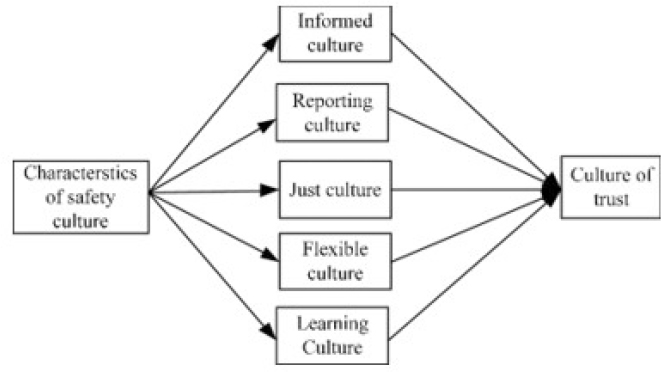
SOURCE: Jilcha & Kitaw (2016) licensed as a Creative Commons Attribution.
A reporting culture is one in which workers are willing and invested in the reporting of safety-critical information. This may include information such as hazards, errors, near-misses, and incidents. Personnel are not only empowered but also expressly encouraged by leaders (supported by Safety Management System [SMS] policies, processes, and practices) to share information to illuminate organizational and operational vulnerabilities (Canada Energy Regulator, 2021; Reason, 1997).
A just culture is one in which an atmosphere of trust and openness exists, and responsible behavior and trust is promoted, which further facilitates information sharing and event reporting (Reason, 1997). Workers know that the information shared will be acted upon to maintain or enhance safety and that it will be treated with the appropriate level of confidentiality (based on its sensitivity). The advancement of a just culture is reliant upon a clear articulation of what is deemed to be acceptable or unacceptable behavior in the workplace (often in the form of a code of conduct supplemented with a non-punitive reporting policy within the SMS), so that accountability is ensured when egregious acts occur (Jilcha et al., 2016; Reason, 1997).
A learning culture is one in which the organization possesses the willingness, competence, and means to collect and interpret information, data, and intelligence—in essence, to be informed, so leaders can identify and implement effective remedies to prevent recurrence and ensure continual improvement (Reason, 1997). Lessons learned and actions taken are then shared with those who report and others who may be impacted as part of a formalized feedback loop in alignment with leadership’s unwavering
commitment to transparency; this encourages further trust, openness, and information sharing within the safety system.
Finally, a flexible culture is one that permits adaptability in the face of an emergency or crisis event. Reason (1997) states that flexibility can take on a number of forms, such as shifting from a hierarchical to a flatter organizational structure. In a flatter structure, control is passed to experts on the spot. After an emergency or a crisis has passed, they suggest returning to a traditional hierarchical structure (Reason, 1997).
The Role of Leadership
Leaders in the maritime industry are said to be “instrumental in establishing team spirit and creating harmony on a vessel by setting high standards and clear goals, encouraging safe work practice, and addressing unwanted behaviour or conflicts in a direct and proactive manner” (Wahl & Kongsvik, 2018, p. 12). Committed safety leadership is essential for the creation and maintenance of a healthy culture of safety and personal wellbeing. Maritime leaders operate in multiple independent, but closely interrelated, contexts, including at the Merchant Marine Academies (MMAs), companies, unions, and aboard individual ships. For this reason, their influence to affect cultural change and improvement is considerable.
Merchant Marine Academies
The MMAs place special emphasis on the development of maritime leaders and their ability to foster safety cultures. Safety culture leadership and ethics training is intrinsic to education at the federal and state maritime academies (both SMAs and the USMMA). At the U.S. Merchant Marine Academy (USMMA), leadership training includes Naval Science courses in leadership and ethics, as well as the Academy’s “Leadership Development Program, Honor Board, various Regimental leadership and ethics trainings and Academic classes, the J. Smith Lanier ‘50 Distinguished Speaker Series, and team movements and special events” (USMMA, 2022). The Academy has a Director of Leadership and Ethics Development, who is responsible for all leadership and ethics training in the Regiment and synchronizing the same across the Academy. Two classes educate explicitly on ethics: a Plebe (freshman) class, BUSN101, Principles of Leadership; and a junior/senior class, NASC400, Naval Ethics and Leadership. Additionally, Regimental training periods, conducted at least once a week rely heavily on case studies on leadership and ethics, with exercises requiring ethical decision-making on the part of midshipmen. Ethics, integrity, and honor are intrinsic qualities and are critical to the USMMA mission (USMMA, 2025).
In addition to ethics training and education in classes, midshipmen are given additional ethics training before going out to sea in compliance with the Every Mariner Builds A Respectful Culture requirements. Ethics training and education as it relates to sexual misconduct and relationship violence is also taught as part of annual program(s) through the Sexual Assault Prevention and Response Office (USMMA, 2025).
Company Leadership
Shipping companies have a central role in establishing a culture of safety and well-being for their members. This culture is reflected in multiple ways, from initial recruitment efforts, onboarding, at-sea mariner support programs, and implementation of policies that address alcohol and other substance use, sexual misconduct, and mariner well-being. How companies manage issues such as workload, mental health support, recreational facilities, healthy alternatives, and social connectivity could affect whether employees turn to alcohol or more healthy coping mechanisms (U.S. Marine Management, LLC, 2024), which, in turn, can impact operational performance.
A key issue for leadership and culture is whether and how companies assess and reward captains for building and maintaining a positive culture of operational safety and personal well-being on board their ships. Companies that evaluate mariner experience and identify positive and negative outcomes related to ship leadership may use these organizational assessments to guide interventions, with a goal of improving personal well-being and operational safety performance over time.
Union Leadership
Unions have an important role in setting expectations for mariners to look out for one another on board a ship. For companies with challenges in workplace well-being, unions can represent mariners in seeking changes to policies. Unions can also provide support for those needing help through employee assistance programs that supplement employer health and safety resources (Schooley, 2025).
Onboard Ship Leadership
A ship’s Captain and senior officers can play a decisive role in the shipboard drinking culture. Their influence may manifest in several ways. First, the Captain and other officers determine how strictly alcohol policies are enforced (see Chapters 2 and 3). A lax attitude toward drinking may lead to informal allowances, even on a “dry” ship, whereas a strict Captain may
implement regular checks and maintain firm discipline. Second, the leaders serve as a role model for those under their command. If senior officers drink or bring alcohol onboard, it may signal to the crew that alcohol consumption is acceptable or even encouraged. Conversely, a Captain who abstains and discourages drinking may foster a more restrained culture. Third, officers who turn a blind eye to violations contribute to a permissive drinking culture, whereas those who swiftly discipline infractions reinforce the company’s standards. Finally, beyond official leadership, the onboard social environment also plays a role. Crewmembers may develop their drinking norms based on past experiences, cultural backgrounds, and peer behavior. However, leadership remains key in setting the tone—if officers tolerate or engage in excessive drinking, it can normalize the behavior among the crew.
The Captain and senior officers determine how alcohol policies play out on board. Their leadership can either reinforce a healthy environment or create conditions where alcohol misuse thrives. Specifically, a Captain and—in many cases—company management, who prioritizes balanced workloads and fair rotations can help to reduce crew stress and burnout; while a poor leader, who overburdens crewmembers or plays favorites, can create frustration and resentment, factors that could lead to increased drinking. In addition, officers can enforce quiet hours and minimize disturbances to improve sleep quality, helping to reduce the need to turn to alcohol to “wind down.” In addition, ships with sports tournaments, movie nights, or cultural celebrations provide non-alcoholic ways for the crew to relax. By contrast, ships with no structured activities could see higher rates of alcohol use due to boredom and lack of alternatives.
CONCLUSIONS
Conclusion 7-1: Organizational culture and leadership are critical in shaping the work environment and for the prevention and mitigation of alcohol misuse and personal safety and security problems.
Conclusion 7-2: Research in prevention of alcohol use and misuse and sexual misconduct in the maritime industry has largely been centered on individual, team, and vessel performance, with little research undertaken at the organizational and system level.
RECOMMENDATIONS
Recommendation 7-1: The U.S. Coast Guard should develop and recommend for implementation across the maritime industry a best practice guide, including a suite of assessment tools, for identifying and understanding leadership and cultural vulnerabilities at the level of
companies, ships, and senior shipboard and shoreside leaders. These guidance and assessment tools would support learning and continual improvement at each level and they should be updated as the evidence evolves.
Recommendation 7-2: The U.S. Maritime Administration should support research in the building and maintenance of healthy cultures of safety aboard ship and ashore, and the impact of leadership and organizational- and system-level influences on alcohol and other substance use or misuse and sexual misconduct.
REFERENCES
Ames, G. M., & Grube, J. W. (1999). Alcohol availability and workplace drinking: Mixed method analyses. Journal of Studies on Alcohol, 60(3), 383–393. https://doi.org/10.15288/jsa.1999.60.383
Bacharach, S. B., Bamberger, P. A., & Sonnenstuhl, W. J. (2002). Driven to drink: Managerial control, work-related risk factors, and employee problem drinking. Academy of Management Journal, 45(4), 637–658. https://doi.org/10.5465/3069302
Bayot, M. L., Tadi, P., & Vaqar, S. (2024). Work culture. StatPearls Publishing.
Canada Energy Regulator. (2021). Advancing safety in the oil and gas industry: Statement on safety culture. https://www.cer-rec.gc.ca/en/safety-environment/safety-culture/statement-safety-culture/advancing-safety-in-the-oil-and-gas-industry-statement-on-safety-culture-2021.pdf
Chan, S. (2005, January 19). Ferry director described procedures to inquiry as informal. The New York Times. https://go.gale.com/ps/i.do?p=AONE&u=nysl_oweb&id=GALE%7CA127245933&v=2.1&it=r&sid=googleScholar&asid=04837e17
Chauvin, C., Lardjane, S., Morel, G., Clostermann, J.-P., & Langard, B. (2013). Human and organisational factors in maritime accidents: Analysis of collisions at sea using the HFACS. Accident Analysis & Prevention, 59, 26–37. https://doi.org/10.1016/j.aap.2013.05.006
Dextras-Gauthier, J., Marchand, A., & Haines, III, V. (2012). Organizational culture, work organization conditions, and mental health: A proposed integration. International Journal of Stress Management, 19(2), 81–104. https://doi.org/10.1037/a0028164
Dominguez-Péry, C., Vuddaraju, L. N. R., Corbett-Etchevers, I., & Tassabehji, R. (2021). Reducing maritime accidents in ships by tackling human error: A bibliometric review and research agenda. Journal of Shipping and Trade, 6(20), 1–32. https://doi.org/10.1186/s41072-021-00098-y
Frone, M. R. (2003). Predictors of overall and on-the-job substance use among young workers. Journal of Occupational Health Psychology, 8(1), 39–54. https://doi.org/10.1037/1076-8998.8.1.39
Frone, M. R., & Brown, A. L. (2010). Workplace substance-use norms as predictors of employee substance use and impairment: A survey of U.S. workers. Journal of Studies on Alcohol and Drugs, 71(4), 526–534. https://doi.org/10.15288/jsad.2010.71.526
Frone, M. R., Chosewood, L. C., Osborne, J. C., & Howard, J. J. (2022). Workplace supported recovery from substance use disorders: Defining the construct, developing a model, and proposing an agenda for future research. Occupational Health Science, 6(4), 475–511. https://doi.org/10.1007/s41542-022-00123-x
Grabowski, M., & Roberts, K. H. (2019). Reliability seeking virtual organizations: Challenges for high reliability organizations and resilience engineering. Safety Science, 117, 512–522. https://doi.org/10.1016/j.ssci.2016.02.016
International Chamber of Shipping. (2013). Implementing an effective safety culture: Basic advice for shipping companies and Seafarers. https://www.ics-shipping.org/wp-content/uploads/2013/06/implementing-an-effective-safety-culture.pdf
Japan Safety Transportation Board. (2023, September 28). Marine accident investigation report. MA2023-10. https://jtsb.mlit.go.jp/eng-mar_report/2023/2020tk0010e.pdf
Jilcha, K., & Kitaw, D. (2016). A literature review on global occupational safety and health practice & accidents severity. International Journal for Quality Research, 10(2), 279–310. https://ijqr.net/journal/v10-n2/4.pdf
Jilcha, K., Kitaw, D., & Beshah, B. (2016). Workplace innovation influence on occupational safety and health. African Journal of Science, Technology, Innovation, and Development, 8(1), 33–42. https://doi.org/10.1080/20421338.2015.1128044
Kurtz, R. S. (2011). New public management and crisis mitigation: The 2007 M/V Cosco Busan incident. International Journal of Public Administration, 34(1–2), 26–31. https://doi.org/10.1080/01900692.2010.524072
MacDonald, Z., & Shields, M. A. (2001). The impact of alcohol consumption on occupational attainment in England. Economica, 68(271), 427–453. https://www.jstor.org/stable/pdf/3548969.pdf
Maternová, A., & Svabova, L. (2024). Assessing fatality risks in maritime accidents: The influence of key contributing factors. Applied Sciences, 14(19), 9153. https://doi.org/10.3390/app14199153
Oil Companies International Marine Forum. (2024, March 4). Guidelines for the control of drugs and alcohol in the maritime industry (3rd ed.). https://www.ocimf.org/publications/information-papers/guidelines-for-the-control-of-drugs-and-alcohol-in-the-maritime-industry
Park, H. S., Klein, K. A., Smith, S., & Martell, D. (2009). Separating subjective norms, university descriptive and injunctive norms, and U.S. descriptive and injunctive norms for drinking behavior intentions. Health Communication, 24(8), 746–751. https://doi.org/10.1080/10410230903265912
Reason, J. (1997). Managing the risks of organizational accidents (1st ed.). Routledge.
Safety4Sea Editorial Team. (2024, September 3). Intoxicated captain gets fined in the Canary Islands. Safety4Sea. https://safety4sea.com/intoxicated-captain-gets-fined-in-the-canary-islands/
Schein, E. H. (2010). Organizational culture and leadership (4th ed.). Jossey-Bass.
Schooley, S. (2025, April 14). Benefits of an employee assistance program. business.com. https://www.business.com/hr-software/eap-benefits/
U.S. Marine Management, LLC. (2024, December 9). National Academies studies – Alcohol at Sea – Open session – December 9, 2024. Testimony to National Academies of Sciences, Engineering, and Medicine’s Alcohol at Sea Committee. https://www.nationalacademies.org/event/docs/DF5A858CA91C673E6FE87255E9F398FB72A3B11635E1?noSaveAs=1
U.S. Merchant Marine Academy (USMMA). (2022). Leadership and ethics. https://www.usmma.edu/academy-life/leadership-and-ethics
___. (2025). Sea year guide: Final report. https://www.usmma.edu/academics/sea-year-guide
Wahl, A. M., & Kongsvik, T. (2018). Crew resource management training in the maritime industry: A literature review. WMU Journal of Maritime Affairs, 17(3), 377–396. http://dx.doi.org/10.1007/s13437-018-0150-7
Westrum, R. (1993). Cultures with requisite imagination. In J. A. Wise, V. D. Hopkin, & P. Stager (Eds.), Verification and validation of complex systems: Human factors issues (NATO ASI Series, Vol 110). Springer.
___. (2004). A typology of organisational cultures. BMJ Quality & Safety, 13(2), 22–27. https://doi.org/10.1136/qshc.2003.009522
Whybrow, D., Jones, N., Evans, C., Minshall, D., Smith, D., & Greenberg, N. (2016). The mental health of deployed UK maritime forces. Occupational and Environmental Medicine, 73(2), 75–82. https://doi.org/10.1136/oemed-2015-102961
Williams, D. E., & Olaniran, B. A. (1994). Exxon’s decision-making flaws: The hypervigilant response to the Valdez grounding. Public Relations Review, 20(1), 5–18. https://doi.org/10.1016/0363-8111(94)90110-4


