Effects of Past Global Change on Life (1995)
Chapter: Stable Isotopic Records

FIGURE 12.2 Oxygen isotopic records from analyses of Globigerinoides ruber (white variety) for EN32-PC4 (left, after Broecker et al., 1989) and EN32-PC6 (right, after Leventer et al., 1982), plotted against depth in core as d18O relative to the PDB standard. The cores show the late glacial to early Holocene interval, with the meltwater spike and the Younger Dryas chronozone labeled. Ages in thousands of years are accelerator radiocarbon dates, corrected for the 14C/12C difference between atmospheric CO2 and surface water SCO2, revised after Broecker et al. (1990).
Mississippi outlet, the Gulf of Mexico was particularly sensitive to circulation changes in the North Atlantic and to meltwater runoff from the Laurentide ice sheet (Prest et al., 1968; 1970; Kennett and Shackleton, 1975). We have examined undisturbed sequences marked by high sedimentation rates from the Orca Basin with abundant planktonic microfossils, thus providing a high-resolution record. Located on the continental rise 290 km south of the Mississippi Delta (Figure 12.2 ), with a maximum depth of 2400 m and a sill depth of 1800 m, the Orca Basin is filled with a hypersaline brine to a depth of 2230 m. Resulting anoxic conditions in the bottom waters provide excellent preservation, eliminate dissolution, and exclude benthic organisms that mix the sediments. These conditions preserve a pristine sedimentary sequence with undisturbed laminae, allow a high-resolution stratigraphy with a sampling interval of 100 yr, and provide a clear picture of dynamic changes in faunal assemblages unaffected by dissolution or bioturbation.
14C Chronology
Accelerator radiocarbon dates from two Orca Basin cores (EN32-PC4 and EN32-PC6), recently revised by Broecker et al. (1990a), provide excellent age control over the last deglaciation (Figure 12.3). Although calibration of the 14C time scale has shown that 14C dates correspond to somewhat older U-Th ages (Bard et al., 1990), the 14C time scale is adopted here for ease of comparison with previously published chronologies. The 14C ages show no stratigraphic inversions, although recent work has shown that the radiocarbon time scale remains constant at about 10 ka for a few hundred years (Oeschger et al., 1980; Andrée et al., 1986; Becker and Kromer, 1986; Lowe et al., 1988; Bard et al., 1990). All data presented here are plotted against 14C age by extrapolation between dated samples.
Stable Isotopic Records
High-resolution stable isotopic records have also been generated for these two Orca Basin samples (EN32-PC4, Broecker et al., 1989; Flower and Kennett, 1990, and EN32-PC6, Leventer et al., 1982; Kennett et al., 1985). The two oxygen isotopic records are similar, measured on Gs. ruber and plotted as d18O (%o relative to the PDB belemnite standard) against depth in Figure 12.2. The main feature is the pronounced negative spike in d18O, indicating major freshwater flooding into the Gulf of Mexico. Because the isotopic composition of Laurentide glacial ice
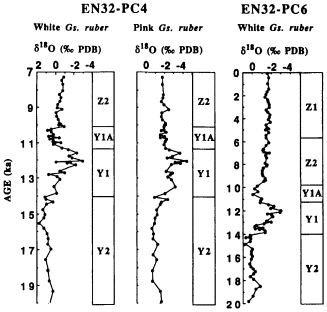
FIGURE 12.3 Plots of d18O records from analyses of Globigerinoides ruber plotted versus age for EN32-PC4 and EN32-PC6 from the Orca Basin. White and pink varieties of Globigerinoides ruber are plotted for EN32-PC4 against 14C age, as discussed in text. Note the different age scale for EN32-PC6.
