Effects of Past Global Change on Life (1995)
Chapter: Evidence for Climatic Variability
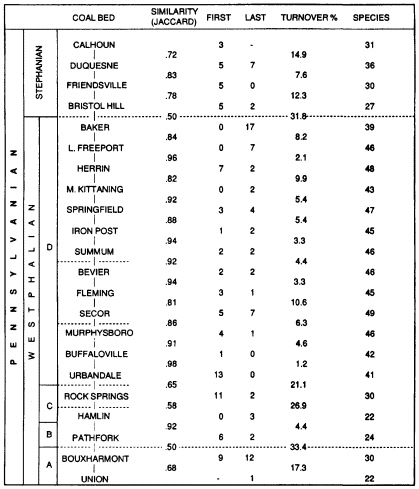
FIGURE 8.9 Patterns of turnover of species between coal swamps; first occurrences and last occurrences of species, and total species refer to individual coals. Similarity (Jaccard) and turnover percentage are comparisons between successive coals.
though species turnover tends to occur in greatest numbers at the breakpoints, where landscape patterns also change, the replacements that occur at these times are on ecomorphic themes, except at the Westphalian-Stephanian boundary.
At the Westphalian-Stephanian boundary the basic pattern changes. Many of the dominant tree ecomorphs are eliminated in the swamp extinctions. As a consequence, the dynamics of species interactions alone appear to dictate the initial patterns of swamp reorganization in the early Stephanian. Great variation in the suite of dominant species is detected palynologically (Phillips et al., 1974, 1985) among the coals that occur successively after the extinction. Ultimately, the system appears to reequilibrate, with fern dominance and pteridosperm subdominance becoming the rule for the remainder of the Stephanian. These patterns suggest that following the disruption of Westphalian ecosystem structure, coal-swamp dynamics became more stochastic for a relatively short period, until a new system of interactions was established.
CLIMATE CHANGE AND CAUSATION
Evidence for Climatic Variability
The morphological characteristics of tropical Euramerican floras indicate a humid, warm climate, lacking seasonality for much of the time: large, evergreen leaves; trunks and leaves with only minor armoring; woods lacking growth rings; trees and shrubs with structure suggesting rapid growth. The characteristics of Late Carboniferous plants are magnified as climate indicators by plants of the younger Permian Period in Euramerica, many of which are much more xeromorphic in character and suggest growth under periodic moisture limitation. One of the most extreme examples of xeromorphy in the Permian is the Hermit Shale flora of Arizona (White, 1929), which contains only seed plants, many of which are armored with spines and have thick, highly sclerotic leaves; the flora is associated with clear sedimentological indicators of seasonal rainfall, and may have inhabited a dry coastal area on the margin of
