Effects of Past Global Change on Life (1995)
Chapter: Albian-Cenomanian and Early Angiosperms
Campanian-Maastrichtian
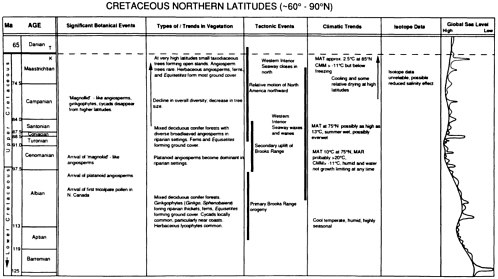
The North Slope of Alaska was at 85°N, and overall diversity had dropped in the megafloral record. Woody angiosperm diversity was much reduced, and conifers were represented by only two foliage and five wood taxa (Spicer and Parrish, 1990a). Equisetites and ferns continued as the main ground cover, and Ginkgo and cycads had disappeared. Fires were common.
The palynomorph record is extensive and indicates angiosperm predominance in the Maastrichtian, with a high turnover and spatial heterogeneity of taxa (Frederiksen et al., 1988; Frederiksen, 1989). Plants that produced the pollen are believed to be mostly herbaceous and probably annuals. A ''weedy" strategy would have been favored by short growing seasons and fire disturbance. Some woody Betulaceae/Ulmaceae may have been present (Parrish et al., 1987; Frederiksen, 1989); however tree taxa were dominated by the limited variety of conifers.
Tree rings reflect lower productivity and more inter-and intra-annual variation. Latewood to earlywood ratios are higher, suggesting thermal limitations on spring or summer growth rather than sudden dark-induced dormancy (Spicer and Parrish, 1990b). By the Maastrichtian, vegetation was more open, with smaller trees. The environment was not as wet, with periodic drying. Vegetational physiognomy suggests MAT of 2.5 to 5°C and long, cold, dark winters with CMM probably no lower than -11°C (Parrish et al., 1987). Large wood tracheid cross sections, and lack of periglacial sediments, imply no severe drought or freezing (Spicer and Parrish, 1990b).
On the Alaskan Peninsula, conditions were much warmer than on the North Slope. Leaf forms were more advanced, migration from the south continued, and Nilssonia (cycad) and diminuitive Ginkgo dawsonii survived into the Maastrichtian (Hollick, 1930; Spicer, 1983).
Floras in both the northern (Spicer, 1989b) and the southern (Askin, 1988b, 1990a; Raine, 1988) high latitudes apparently did not suffer any major ecological trauma at the Cretaceous-Tertiary boundary.
Southern Cretaceous
Albian-Cenomanian and Early Angiosperms
By the middle Cretaceous, angiosperms were well established in the southern high latitudes. At least 8 an
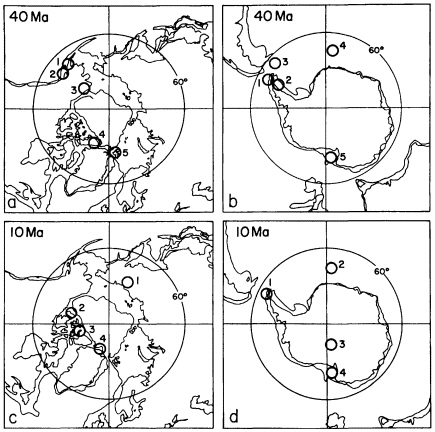
FIGURE 9.2 Cenozoic high latitude plant fossil localities on 40 and 10 Ma paleocontinental reconstructions (polar Lambert equalarea projections) of Smith et al. (1981):
(a) Northern Paleocene-Eocene localities, 1: Wolfe (1980); 2: Wolfe (1966), Wolfe and Poore (1982); 3:Hickey et al. (1983), Parrish et al. (1987), Frederiksen et al. (1988), Spicer and Parrish (1990a); 4: Francis and McMillan (1987); 5: Schweitzer (1974).
(b) Southern Paleocene-Eocene localities, 1: Stuchlik (1981), Lyra (1986), Torres and LeMoigne (1988), Birkenmajer and Zastawniak (1989), Torres and Meon (1990); 2: Dusen (1908), Fleming and Askin (1982), Zamaloa et al. (1987), Askin (1988a,b, 1990b), Case (1988), Askin et al. (1991); 3. Mohr, 1990; 4:Kennett and Barker (1990), Mohr (1990); 5: Truswell (1983).
(c) Northern Oligocene to Pliocene localities, 1: Sher et al. (1979); 2: Hills et al. (1974); 3: Hills and Matthews (1974), Kuc et al. (1983); 4: Funder et al. (1985).
(d) Southern Oligocene to Pliocene localities, 1: Palma-Heldt (1987), Birkenmajer and Zastawniak (1989); 2:Mohr (1990); 3: Askin and Markgraf (1986), Carlquist (1987), Webb etal. (1987), Harwood (1988); 4:Kemp (1975), Kemp and Barrett (1975), Truswell (1983, 1990), Hill (1989), Mildenhall (1989).