Effects of Past Global Change on Life (1995)
Chapter: DEVELOPMENT IN APES, HUMANS, AND AUSTRALOPITHECINES
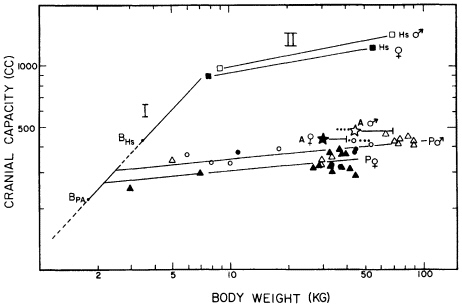
FIGURE 14.1 Differences in brain growth between apes and humans, and similarities between apes and australopithecines. Solid symbols represent males; hollow symbols, females. Circles represent chimpanzees; triangles, orangutans. The Phase I slope is shared by all taxa. Range for present estimates of gracile australopithecine cranial capacities is shown by dotted lines; the estimated male mean is placed near the upper level, and the estimated female mean near the lower level (stars); horizontal bars show ranges of body sizes estimated by less favored methods. BHs: mean birth size for the two species of apes, and also for gracile australopithecines (estimated from pelvic dimensions; Tague and Lovejoy, 1986). The postnatal segment of the Phase I slope for australopithecines was short, like that of apes, not long, like that of humans in which it is associated with a long interval of physical helplessness. (See Stanley, 1992, for details.)
orangutans, which are mature enough to cling to their semiarboreal mothers soon after birth, infants of early Homo had to be carried. It follows that, because a mother cannot climb while carrying an infant, a totally terrestrial life was a prerequisite for the evolution of Homo.
As it turns out, we can infer from fossil evidence the body and brain sizes of newborn and adult australopithecines. From these data, we can show that gracile australopithecines were apelike in their pattern of development: their infants were not physically helpless and should therefore have been able to cling to climbing mothers. Figure 14.1 illustrates how the pattern for gracile australopithecines resembles that for modern apes. On the other hand, comparable data for early Homo indicate a modern human pattern: infants were helpless (Stanley, 1992).
There is extensive evidence that at about 2.5 Ma, African forests shrank at the expense of grasslands, which are adapted to drier conditions. It has been suggested that these major vegetational changes that swept across Africa caused evolutionary turnover within the human family (Vrba, 1975, 1988, inter alia). In fact, the changes were precisely the kind that could be expected to have forced australopithecines to abandon habitual arboreal activities (Stanley, 1992). The result would have been extermination of many populations at the hands of large predators, but also provision of the opportunity for evolution of a large brain because physically helpless infants were now tolerable. The environmental changes should also have engendered strong selection pressures for brain expansion, given the need of hominids to cope with predation without escaping into trees and to replace tree-borne food materials.
DEVELOPMENT IN APES, HUMANS, AND AUSTRALOPITHECINES
Estimates of brain volumes, body weights, and pelvic dimensions lead to the conclusion that the infants of early Homo were physically helpless, like those of modern humans (Stanley, 1992). A key fact underlies calculations leading to this conclusion: all primates adhere to the same general curve when their brain weights are plotted against their body weights for the fetal interval: brain weight constitutes roughly 10% of body weight (Holt et al., 1975). Figure 14.1 shows how brain growth in humans departs from that of apes in the postnatal interval. In apes, the fetal (Phase I) slope gives way to a much lower (Phase II) slope soon after birth, so that there is only modest postnatal encephalization. In humans, the inflection is delayed to an age of about one year, so that an infant this age still has a brain that constitutes nearly one-tenth of its body weight. The remarkable fact is that the brain of a one-year-old human is more than twice as large as that of an adult chimpanzee or orangutan.
Several observations indicate that a general retardation of development produced the delay in the Phase I-Phase II transition that yielded the large brain of modern humans. Overall retardation is evident in the physical helplessness
