Effects of Past Global Change on Life (1995)
Chapter: Hierarchical Organization
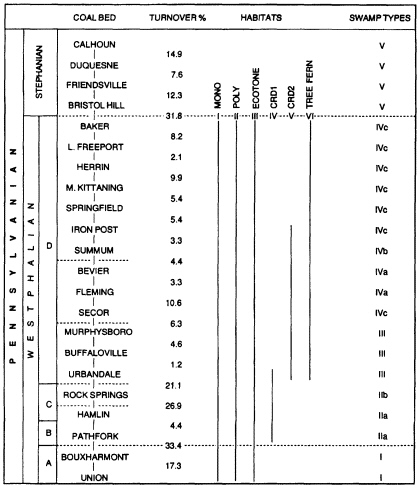
FIGURE 8.11 Comparison of species-, habitat-, and landscape-level changes in coal swamps during the upper Carboniferous. Habitat distributions are listed in a "range-through" fashion, based on first and last occurrence. Swamp type is a typological characterization of average quantitative landscape composition on a coal bed average basis.
cies replacement patterns, followed by ecosystem reorganization along different lines. During the Pennsylvanian, such major periods of extinction were rare, permitting the biotic-abiotic linkage to persist for millions of years.
Hierarchical Organization
These patterns are consistent with an interpretation of coal-swamp plant communities as hierarchically organized. Species have characteristic ecological amplitudes, which are more likely to be shared with closely related than distantly related species, at least in the less diverse, pre-angiosperm world. In a given habitat, the entire plexus of species defines a biotic network of evolved interactions. Loss of a few species from this network (extinction or extirpation) can be accommodated because the system has sufficient biotic linkages to be buffered; this notion runs counter to the findings of ecosystem models, where the greater the number of linkages, the lower is the stability of the system. Released resources and severed patterns of interaction are most likely to be utilized by species with similar morphological attributes. Particularly during the Carboniferous, in which ecosystems are strongly partitioned taxonomically, this means by a species related closely to the earlier occupant, and with similar growth form and life history. Thus, the ecomorphic-biotic structure of a habitat, given sufficient time to evolve, may strongly constrain the nature and dynamics of species replacement.
Breakdown of the biotic habitat structure will occur during catastrophic extinction, as near the Westphalian-Stephanian boundary. The result is that the biotic fabric collapses and no longer can constrain the selection of replacement species. At such times the system may go into a lottery-like period of species interactions, perhaps controlled largely by interspecific competition (admittedly, this is almost impossible to document in the fossil record). The new system may reequilibrate and establish a new set of biotic limits to species replacement dynamics.
The coal-swamp floras of the Stephanian bear close resemblance to Westphalian floras of the clastic wetlands (e.g., Pfefferkorn and Thomson, 1982). This suggests that many of the species or clades in Stephanian coal swamps
