Effects of Past Global Change on Life (1995)
Chapter: Turonian-Coniacian-Santonian
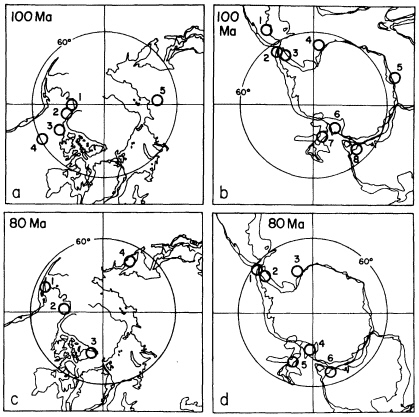
FIGURE 9.1 Cretaceous high latitude plant fossil localities on 100 and 80 Ma paleocontinental reconstructions (polar Lambert equal-area projections) of Smith et al. (1981):
(a) Northern Albian-Cenomanian localities, 1: Smiley (1966, 1967, 1969a,b), Scott and Smiley (1979); 2: May and Shane (1985), Spicer and Parrish (1986, 1990a,b), Spicer (1987), Parrish and Spicer (1988a,b), Grant et al. (1988), Youtcheffetal. (1987); 3: Jarzen and Norris (1975); 4: Singh (1975); 5: Samylina (1973, 1974), Lebedev (1978).
(b) Southern Aptian, Albian-Cenomanian localities, 1: Volkheimer and Salas (1975), Archangelsky (1980), Romero and Archangelsky (1986); 2:Rees and Smellie (1989), Rees (1990), Chapman and Smellie (1992); 3: Dettmann and Thomson (1987), Baldoni and Medina (1989); 4:Truswell (1983), Truswell and Anderson (1985); 5: Truswell (1990); 6: Truswell (1983); 7: Couper (1960), Raine (1984); 8: Douglas and Williams (1982), Dettmann (1986a), Taylor and Hickey (1990), Parrish et al. (1991), Dettmann et al. (1992).
(c) Northern Turonian to Maastrichtian localities, 1: Hollick (1930), Spicer(1983); 2: Parrish et al. (1987), Frederiksen et al. (1988), Parrish and Spicer (1988a), Frederiksen (1989), Spicer and Parrish (1990a,b); 3: Hickey et al. (1983); 4: Krassilov (1979).
(d) Southern Turonian to Maastrichtian localities, 1: Birkenmajer and Zastawniak (1989); 2: Cranwell (1969), Baldoni and Barreda (1986), Francis (1986), Dettmann and Thomson (1987), Askin (1988a,b, 1989, 1990a,b), Dettmann and Jarzen (1988), Baldoni and Medina (1989), Dettmann (1989), Jarzen and Dettmann (1990), Askin et al. (1991); 3: Truswell (1983), Truswell and Anderson (1985); 4: Truswell (1983); 5: Couper (1960), Mildenhall (1980), Raine (1984, 1988), Daniel et al. (1990); 6: Stover and Partridge (1973), Martin (1977), Dettmann and Jarzen (1988), Dettmann (1989), Dettmann et al. (1992).
Pseudoaspidiophyllum, Crednaria) locally dominated riparian habitats, where they successfully replaced Ginkgo and Ginkgo-like plants.
By the late Cenomanian, angiosperm diversity had risen to more than 60 leaf forms in Alaska (Spicer and Parrish, 1990a). Pollen diversity in Alaska has yet to be fully evaluated. The vegetation was still conifer dominated, but needle-leaved conifers were less common. Angiosperm leaf sizes were large, and leaf physiognomy suggests a wet regime with MATs of 10°C (Parrish and Spicer, 1988a). Tree rings show little intra-annual variation (few false rings). There is some inter-annual variation, possibly a result of fluctuations in water availability (Parrish and Spicer, 1988b), although overall water stress was lacking, based on the high productivity and large cell size. Latewood was very limited, suggesting rapid onset of dark induced dormancy (Spicer and Parrish, 1990b). There are no periglacial sediments known, or any features indicative of sea ice.
Turonian-Coniacian-Santonian
The Turonian was characterized by a major global sea-level highstand, reducing the nonmarine sedimentary record.
By the Coniacian, needle-leaved conifers and Podozamites had disappeared and taxodiaceous foliage was common. Platanoid angiosperms were still dominant along river and lake margins, and had begun to penetrate forests. Cycads were rare or absent, Ginkgo diversity was much reduced, and Equisetites and ferns formed the main ground cover. Leaf margin analysis of a small number of specimens imply an MAT of 13°C at about 78°N (Parrish and Spicer, 1988a), and conditions were still wet although coals are thinner and less numerous. Angiosperm diversity was high, but possibly less than in the Cenomanian. All taxa were deciduous or capable of winter dormancy.
Santonian nonmarine sediments are rare and not yet sampled for plant fossils.
