Effects of Past Global Change on Life (1995)
Chapter: CAUSE OF MASS EXTINCTION IN DEEP SEA
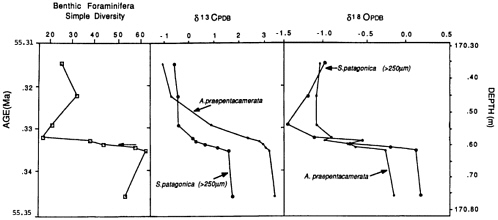
FIGURE 5.3 Changes in oxygen and carbon isotope composition of the planktonic foraminifers A. praepentacamerata and Subbotina patagonica, and in simple diversity of benthic foraminiferal assemblages at high stratigraphic resolution over the latest Paleocene mass extinction. The abrupt decrease in diversity reflects the mass extinction. Arrow at left indicates the last appearance of Stensioina beccariiformis, a distinctive foraminifer of the Paleocene. (Figure modified after Kennett and Stott, 1991.)
about 35% of the Late Paleocene species at Site 690B became completely extinct.
CAUSE OF MASS EXTINCTION IN DEEP SEA
It is clear that the mass extinction was restricted to the deep-sea biota deeper than the continental shelf or the thermocline. The lack of major extinctions in the oceanic planktonic and shallow water benthic communities strongly suggests that the extinctions were not caused by an extraterrestrial impact with the Earth, as has been implicated for the terminal Cretaceous extinctions (Alvarez et al., 1980). An intrinsic oceanic cause is considered more likely (Kennett and Stott, 1991). The process that caused the mass extinction must have had the capacity to strongly affect the vast volume of the deep ocean in an interval of less than 3000 yr. Indeed, the extinctions may well have taken place at the rate of replacement time of the oceans, currently about 1000 yr, although this was possibly slightly slower during the early Paleogene.
The superposition of the abrupt, negative d13C and d18O shifts upon similar, more gradual trends during the Late Paleocene (-60 Ma) to Early Eocene (-55 Ma) (Figure 5.1) suggests the involvement of a climatic threshold event similar to the oxygen isotopic shift near the Eocene-Oligocene boundary, although in an opposite sense (Kennett and Shackleton, 1976). The speed and magnitude of the associated temperature increase imply global warming with strong positive feedback mechanisms, not just warming restricted to the oceans. Indeed, isotopic fluctuations in the marine carbonate record are closely tracked by the terrestrial records provided by paleosol carbonates and mammalian tooth enamel (Koch et al., 1992).
Three main hypotheses have been proposed to account for this mass extinction. These are (1) the rapid warming of deep waters (Miller et al., 1987); (2) an oxygen deficiency in deep waters resulting from the sudden warming and change in deep-sea circulation (Kennett and Barker, 1990; Kennett and Stott, 1990a; Thomas, 1990, 1992; Katz and Miller, 1991); and (3) a sharp drop in surface ocean biological productivity that reduced the supply of organic matter, the food source of deep-sea benthic organisms, initiating a cascading trend of food chain collapse (Shackleton et al., 1985; Shackleton, 1986; Rea et al., 1990; Stott, 1992). If this had occurred, significant changes in oceanic plankton would be expected as well. There is no suggestion that this happened in the carbonate groups. It is also likely that reductions in abundance would have occurred in the infaunal deep-sea benthic foraminiferal assemblages. Indeed, Thomas (1990) showed that during the mass extinction, an increase occurred in the abundance of small infaunal species. Apparently these types of benthic foraminifera occur where there is availability of sedimentary organic carbon. Therefore, it is more likely that a greater
