Active Traffic Management Strategies: A Planning and Evaluation Guide (2024)
Chapter: Appendix B: ATM Strategy Fact Sheets

APPENDIX B
ATM Strategy Fact Sheets

ATM Strategy Fact Sheets Tips for Use
Each strategy fact sheet includes information to help the user understand each ATM strategy, how it can be applied, how it works, and what is needed for successful development and implementation. The fact sheets are intended to be a starting point for understanding different ATM strategies and provide links to additional resources for more information.
Table B-1. Information contained on ATM Strategy Fact Sheets and tips for use.
| Information on Fact Sheet | Explanation | Tips for Using This Information |
|---|---|---|
| Definition | A brief description of the strategy. | Not applicable |
| Application Scenarios | A description of different ways in which the strategy may be implemented. | A strategy may be implemented at various levels of sophistication or with different features, depending on existing local conditions and context. If an existing strategy is already being implemented, there may be more advanced applications that could also be considered. |
| Time to Implementation | The relative time associated with implementing in relation to other ATM strategies. | A general guide to implementation that will depend on existing infrastructure, technologies, and institutional relationships, which may vary considerably. Time estimates assume some existing technologies or infrastructure in place and reflect the time to deploy a strategy. |
| Scale | An indicator of whether the strategy may be applied at the following geographic levels: state, region, local, corridor, facility, or spot location. | A problem or issue may benefit from strategies applied at multiple scales. Problems at a lower scale can be addressed by strategies that might also apply more broadly. |
| Context | An indicator of the possible areas of application within a jurisdiction. | A strategy may be implemented to address a challenge in one or more locations and can be adapted based on the development and operational nature of the facility or area. |
| Support of Priority/Multimodal Operations | A description of how a strategy can be implemented to support priority or multimodal operations. | ATM strategies have the potential to improve operational performance for specific modes of transportation and/or to manage overall travel demand. They can also be implemented in combination across multiple modes and facility types. |
| Information on Fact Sheet | Explanation | Tips for Using This Information |
|---|---|---|
| Potential Benefits | The types of issues the ATM strategy addresses and what types of benefits are likely to be achieved. | Outcomes identified are those that are typically a primary motivator for a strategy. If a certain outcome is not identified, it does not mean that the strategy is not supportive of that outcome; for instance, some ATM strategies support safety, but safety is not a primary focus of all strategies. |
| Application Geography | Specific locations where the ATM strategy can be deployed. | Most ATM strategies can be deployed in a variety of locations based on the operational problem in question. This list is not exhaustive but serves as a starting point for application locations. |
| Strategy Variations | Common variations of an ATM strategy. | ATM strategies can be a starting point for other applications that agencies might adapt for a specific location. |
| Supporting Physical or Technology Elements | The types of infrastructure and technology systems (including intelligent transportation systems [ITS] or ITS technologies) needed to support strategy implementation. | The physical and technology elements needed will often depend on the strategies implemented. Agencies can consider what existing physical and technology elements they have in place and how they can build on existing capabilities. |
| Cost Considerations | The relative cost of implementing the strategy in relation to other ATM or transportation systems management and operations (TSMO) strategies. Account for initial strategy deployment (including capital costs associated with new technology and/or infrastructure changes) and ongoing operations, and impacts on transportation revenues (for pricing-related strategies). | This is a general guide; implementation costs may vary considerably and depend upon the existing infrastructure and technologies already in place. Estimates assume some existing technologies are in place. Costs also include considerations related to changes in revenue generation, if appropriate. |
| Organizations and Partners | Primary organizations or stakeholder groups that are involved in strategy implementation. | Lists of organizations and partners include those frequently involved in strategy implementation; the lists are not exhaustive. The types of engagement may include coordination, planning, implementation, and support of ongoing operations. In addition, many different stakeholders (e.g., commuters and local businesses) are often affected by strategy implementation and may be important for public involvement. |
| Compatible ATM Strategies | Strategies that are often implemented in combination or that complement each other to improve transportation system performance. | The strategies listed are those that practitioners may also want to consider since they are often implemented in combination. Other strategies may be applicable as well, and the list of related strategies is not exhaustive. |
| Implementation Considerations | Highlights needs related to successful deployment, operations, and maintenance of any individual strategy or combination thereof to optimize benefits. | Information may be needed regarding physical characteristics, operating characteristics, user information, and societal impacts of deployments. |
| Evaluation Considerations | Highlights needs related to a methodical approach to determining the benefit of any individual strategy or combination of strategies. | FHWA crash modification factors can be used to determine possible impacts of ATM strategies (FHWA 2023a). Make sure to identify appropriate performance measures, data needs, and methodologies for before-and-after studies. |
SOURCE: Adapted from FHWA 2023b.
Active Traffic Management Operational Strategy
ADAPTIVE RAMP METERING
Definition
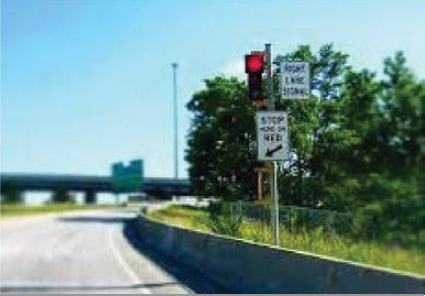
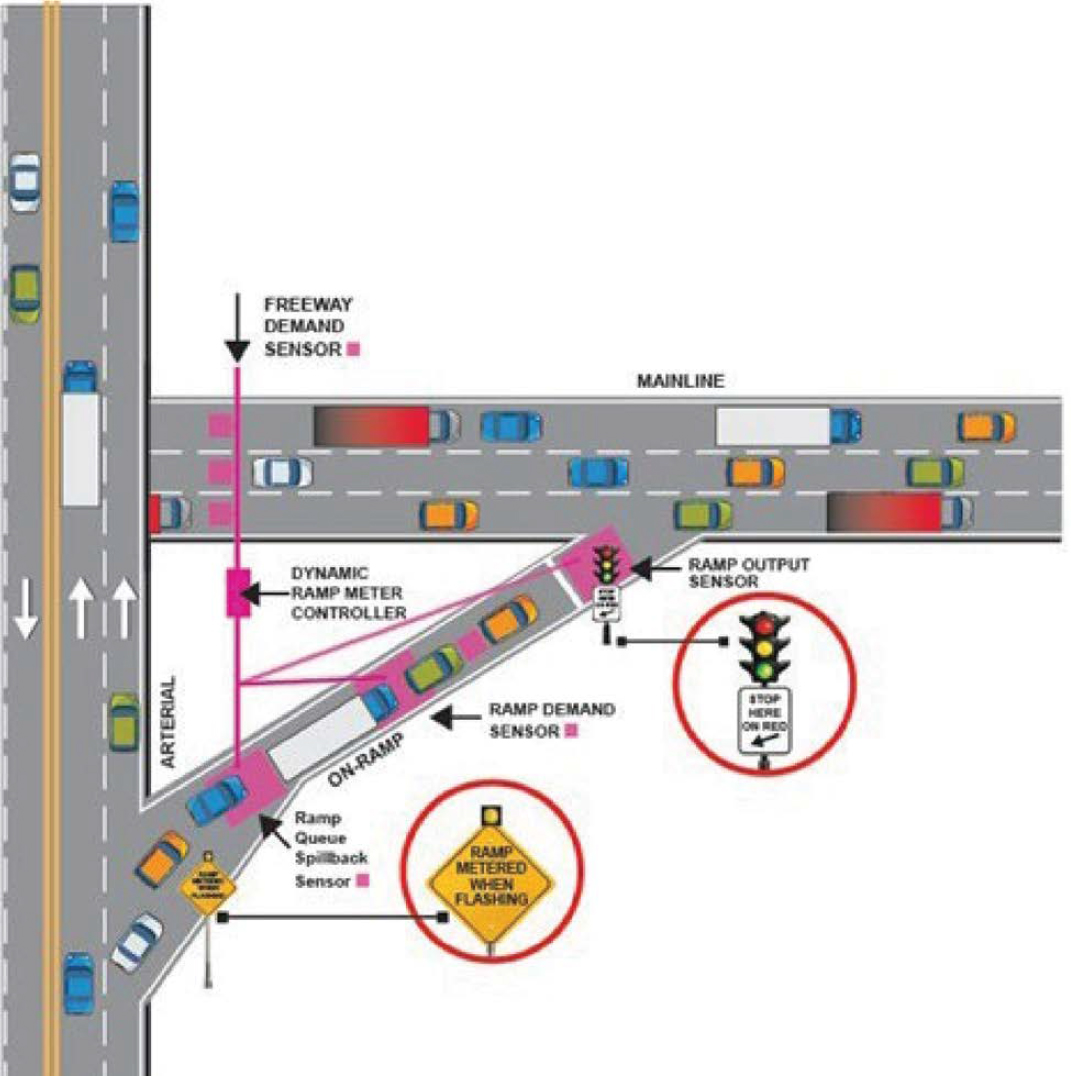
Adaptive ramp metering, or adaptive ramp control as it may also be called, addresses freeway congestion by smoothing the entrance of vehicles from a ramp into the main lane flow. The strategy operates using signals at entrance ramps to control the number of vehicles based on the available gaps in the traffic stream. This strategy utilizes traffic-responsive or adaptive algorithms (as opposed to pretimed or fixed-time rates) that can optimize either local or system-wide conditions. Overall, this strategy can reduce crashes, increase throughput and speed, and address congestion issues in areas that meet the parameters for use. Adaptive ramp metering is illustrated in Figure B-1.
Application Scenarios
As noted previously, an adaptive ramp control system changes the merge flow rate based on traffic volumes. Ramp meters can be operated as an isolated instance or as part of a network of ramp meters along a facility. Applications of this strategy include:
- Freeway entrance ramps with one or more issues such as safety in the merge area, regular congestion near the ramp, major weaving, and/or a downstream bottleneck.
- Ramps upstream of a work zone that can be metered or closed to better control traffic entering the work zone.
TIME TO IMPLEMENTATION
LOW MED HIGH
SCALE
STATE
REGION
LOCAL
CORRIDOR
FACILITY
SPOT
CONTEXT
URBAN
SUBURBAN
RURAL
SUPPORT OF PRIORITY/MULTIMODAL OPERATIONS
Provide priority to high-occupancy vehicles (HOVs)/high-occupancy toll (HOT), transit, or other modal applications at ramps by having a separate lane or bypass lane for special users (e.g., carpools, autonomous vehicles, freight, etc.).
POTENTIAL BENEFITS
- Delayed onset of main lane breakdown.
- Reduced main lane travel delay.
- Reduced ramp delay as freeway demands subside.
- Ramps near event venues that can be metered or closed to manage congestion during planned special events.
- Reduced vehicle-hours traveled.
- Reduced crash rates.
Application Geography
- Limited-access facilities.
- Bottlenecks.
- Spot locations with high crash rates.
Strategy Variations
- Bypass lanes (which allow a bus or special user to bypass a ramp meter or queue).
Supporting Physical or Technology Elements
- Connected signals at ramps.
- Real-time traffic information (unless fixed-time).
- Field sensors and/or third-party data.
- Static signage alerting drivers that the ramp is metered.
- A transportation management center (TMC) for data collection, monitoring, analysis, archiving, and strategy management.
Cost Considerations
- Capital costs: signal heads, controllers, detectors, signage, and ramp metering software; controller upgrades necessary to handle the adaptive ramp metering strategy.
- Operational costs: daily operations similar to regular traffic signal operations (e.g., electricity, communications, software updates, firmware updates, programming changes, etc.); no specific training required.
- Maintenance costs: similar to regular traffic signal systems (e.g., signal head replacement, detector replacement, equipment upgrades, etc.); pole-mounted signal heads may be prone to knockdown by vehicles, requiring additional repair; construction can affect detection systems.
Organizations and Partners
- Local jurisdictions.
- Local transportation agencies.
- Third-party data providers (if applicable).
- Law enforcement.
- Local venues if plans are changed to accommodate events.
Compatible ATM Strategies
- Dynamic junction control.
- Part-time shoulder use.
- Queue warning.
- Variable speed limits.
Implementation Considerations
- The geometry and volumes of the location need to support the strategy.
- Ongoing costs for operation and maintenance.
- Public education and outreach.
- Potential queue spill-back of ramps onto surface streets.
- Staff (in-house or outsourced) to manage and monitor the strategy.
- Equity concerns of benefiting freeway users over local residents.
Evaluation Considerations
When considering an ATM strategy to realize safety benefits, agencies can refer to the CMF Clearinghouse to determine which strategy could help meet those objectives and how to apply the related CMF in analyses (FHWA 2023a). The clearinghouse has specific countermeasures for ramp metering under the category of “Advanced Technology and ITS” that include the following:
- Install ramp meter.
- Coordinated ramp metering.
The clearinghouse also includes the overarching countermeasures for implementing ATM strategies (FHWA 2023a).
Active Traffic Management Operational Strategy
ADAPTIVE TRAFFIC SIGNAL CONTROL
Definition
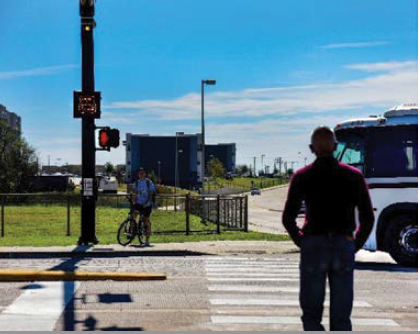
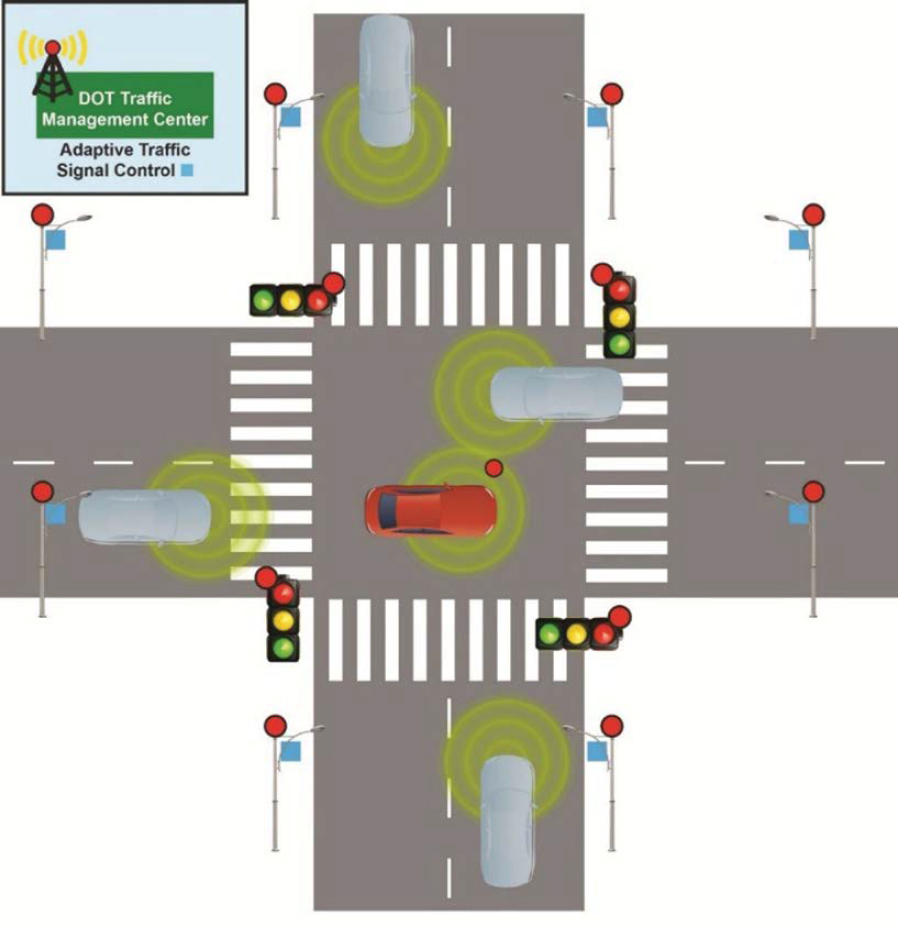
Adaptive traffic signal control continuously monitors arterial traffic conditions and the queuing at intersections, and dynamically adjusts the signal timing to optimize one or more operational objectives. Control can be coordinated with freeway operations as part of an integrated corridor management strategy and can include pedestrian, transit, and freight signal timing strategies. Adaptive traffic signal control is illustrated in Figure B-2.
Application Scenarios
Traffic signal improvements include updating signal timing plans and/or upgrading signals using approaches such as:
- Adaptive signals collect real-time data from detectors, adjust coordinated signal timings per cycle using parameters defined by predetermined timing plans, and make timing changes to signals in response to traffic conditions with each cycle using algorithms.
- Emergency vehicle preemption allows emergency vehicles to transmit a signal to the traffic signal controller, which then provides a green signal in the direction of travel.
- Pedestrian signal timing prioritizes the safety of the pedestrian through pedestrian-focused phasing.
- Freight signal priority involves modifying traffic signals to extend the timing of a green signal to allow an approaching truck to make it through an intersection without stopping.
TIME TO IMPLEMENTATION
LOW MED HIGH
SCALE
STATE
REGION
LOCAL
CORRIDOR
FACILITY
SPOT
CONTEXT
URBAN
SUBURBAN
RURAL
SUPPORT OF PRIORITY/MULTIMODAL OPERATIONS
Provide priority to HOVs/HOT, transit, or other modal applications at intersections.
POTENTIAL BENEFITS
- Reduced arterial travel time.
- Reduced arterial travel delay.
- Improved arterial reliability.
- Reduced number of stops.
- Reduced intersection delay.
- Reduced queue lengths.
- Increased arterial speeds.
Application Geography
- Congested corridors/arterials with traffic signals.
- Urbanized areas where buses are frequently delayed in traffic.
- Corridors with high volumes of trucks and/or crash rates involving freight vehicles.
Strategy Variations
- Dynamic signal retiming.
- Queue jump for priority users.
- Specialized signal timing plans for special events.
- Schedule-based preferential treatment to support pedestrians and bicyclists.
- Transit signal priority.
- Emergency vehicle preemption.
Supporting Physical or Technology Elements
- Traffic signals and related field equipment.
- Regional traffic signal system.
- Communication connectivity.
- Central software for operation.
- Bicycle and pedestrian detection and signals.
- Transit signal priority technology.
- TMC for data collection, monitoring, analysis, archiving, and strategy management.
Cost Considerations
- Capital costs: hardware platform costs; communications; detection.
- Operational costs: licensing; warranty; training and support; not a hands-off system; requires a commitment of operations staff who need time to become proficient in the system.
- Maintenance costs: construction and other utility work can impact detection; communications and hardware/software maintenance also have to be accounted for.
Organizations and Partners
- Local governments.
- Law enforcement.
- Emergency services/first responders.
- Local transportation agencies.
- Transit operators.
- Active transportation advocacy groups.
- Freight operators.
Compatible ATM Strategies
- Adaptive ramp metering.
- Dynamic lane-use control.
Implementation Considerations
- Staff to continuously monitor and adjust traffic signals, maintain proper signal timing, ensure functionality of sensors, and maintain detectors and other equipment.
- Regional traffic signal operations program and related institutional agreements.
- Funding support for improvement and regular retiming of signal systems.
- Reduced congestion may bring more people to the corridor, which could have a positive economic benefit.
Evaluation Considerations
When considering an ATM strategy to realize safety benefits, agencies can refer to the CMF Clearinghouse to determine which strategy could help meet those objectives and how to apply the related CMF in analyses (FHWA 2023a). The clearinghouse has specific countermeasures for adaptive traffic signal control under the category “Intersection Traffic Control” and the subcategory “Signal Phasing and Timing.” The clearinghouse also includes the overarching countermeasures for implementing ATM strategies under “Advanced Technology and ITS” (FHWA 2023a).
Active Traffic Management Operational Strategy
DYNAMIC JUNCTION CONTROL
Definition
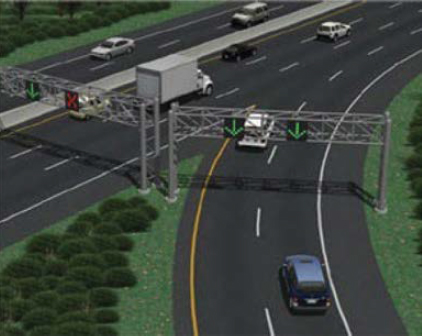
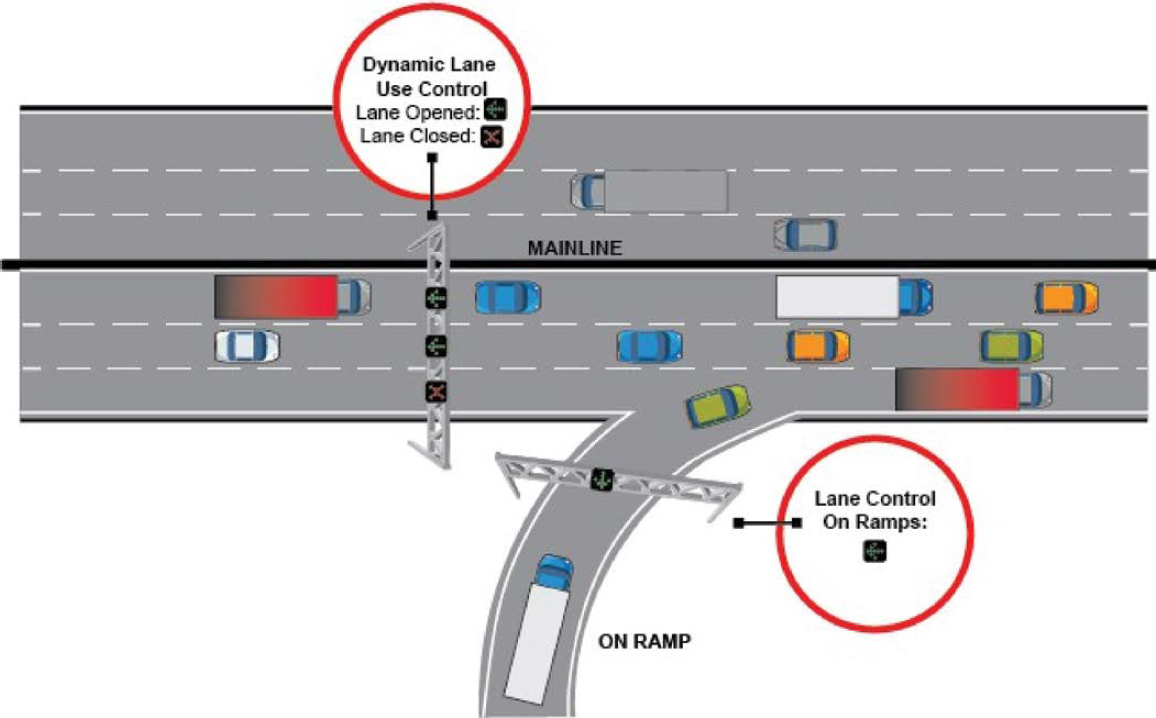
Dynamic junction control, which is also known as dynamic merge control, manages the flow of vehicles into merge areas. The strategy compares ramp volumes to mainline volumes to determine which movement should get additional capacity. Lanes and/or shoulders are open or closed with dynamic signage based on traffic demand. This strategy is shown to reduce delay and congestion, improve safety, and increase throughput. This strategy is also a potential solution for known bottlenecks and/or in combination with special events. A time-of-day operation can also provide benefits if the demand is more consistent during specific times of the day. Dynamic junction control is illustrated in Figure B-3.
Application Scenarios
Applications of this strategy where changing the amount of access based on traffic demand can improve operations include:
- General purpose lane closure closest to an upstream two-lane entrance ramp provides dedicated access to ramp traffic for either a known bottleneck or a special event.
- Emergency evacuation where merging traffic is given a priority.
- Work zone merging where directions can change from early merge to late or zipper merge based on traffic conditions.
TIME TO IMPLEMENTATION
LOW MED HIGH
SCALE
STATE
REGION
LOCAL
CORRIDOR
FACILITY
SPOT
CONTEXT
URBAN
SUBURBAN
RURAL
SUPPORT OF PRIORITY/ MULTIMODAL OPERATIONS
Provide dedicated merge access for HOVs/HOT or transit applications.
POTENTIAL BENEFITS
- Reduced travel time.
- Reduced travel delay.
- Reduced ramp delay.
- Increased travel speeds.
Application Geography
- Interchanges.
- On- and off-ramps.
- Heavy weaving/merge areas that can benefit from additional capacity on a dynamic basis.
- Work zones.
- Designated evacuation routes during emergency use.
Strategy Variations
- Dynamic turn restrictions (arterial).
Supporting Physical or Technology Elements
- Dynamic message signs.
- Dynamic lane control signals.
- Real-time traffic information.
- Field sensors and/or third-party data.
- Static signage.
- TMC for data collection, monitoring, analysis, archiving, and strategy management.
Cost Considerations
- Capital costs: lane control signs mounted on gantries or otherwise on the mainline and the ramps.
- Operational costs: additional incident response might be necessary during operations; automated monitoring of ramp and mainline volumes and activation is optimal.
- Maintenance costs: no significant maintenance challenges beyond other lane control issues unless in-pavement lighting is used to support merge applications.
Organizations and Partners
- Local jurisdictions.
- Local transportation agencies.
- Third-party data providers (if appropriate).
- Emergency services/first responders.
Compatible ATM Strategies
- Adaptive ramp metering.
- Dynamic junction control.
- Dynamic lane-use control.
- Dynamic lane reversal.
- Queue warning.
- Variable speed limits.
Implementation Considerations
- The geometry of the location needs to support the strategy (e.g., adequate right-of-way for signage and equipment, presence of a wide shoulder or auxiliary lane, etc.).
- Ongoing costs for operation and maintenance.
- Public education and outreach.
- Additional incident response might be necessary during operation if a shoulder is used to provide the additional capacity.
- Staff (in-house or outsourced) to manage and monitor the strategy.
Evaluation Considerations
When considering an ATM strategy to realize safety benefits, agencies can refer to the CMF Clearinghouse to determine which strategy could help meet those objectives and how to apply the related CMF in analyses (FHWA 2023a). The clearinghouse does not currently have specific countermeasures for dynamic junction control but does include the overarching countermeasures for implementing ATM strategies under the category of “Advanced Technology and ITS” (FHWA 2023a).
Active Traffic Management Operational Strategy
DYNAMIC LANE REVERSAL
Definition
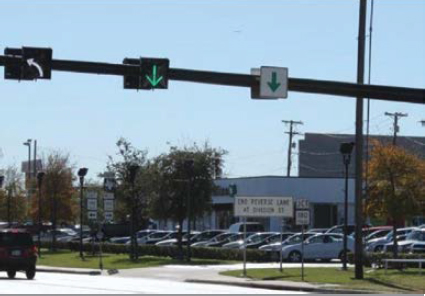
Reversible traffic lanes are a type of traffic management that allows arterial lanes to change direction based on peak congestion times. This strategy consists of the reversal of one or all lanes to dynamically allocate the capacity of congested roads, thereby allowing capacity to better match traffic demand throughout the day. Lane reversal could include changing the number of available lanes per direction by physically moving barriers or by signage. Implementing this strategy can help reduce congestion during commute times, a lane-blocking crash, special events, and construction. Reversible traffic lanes borrow lanes that typically serve traffic flowing in the opposite direction and are shown through changeable message signs and/or arrows. Dynamic lane reversal is illustrated in Figure B-4.
Application Scenarios
Applications of this strategy include:
- Roadways, bridges, and tunnels with a directional peak-period imbalance that can allow for additional capacity in the peak direction.
- Special event venues by increasing incoming and outgoing capacity to decrease arrival and departure times.
- Emergency evacuation during weather events or other natural disasters.
TIME TO IMPLEMENTATION
LOW MED HIGH
SCALE
STATE
REGION
LOCAL
CORRIDOR
FACILITY
SPOT
CONTEXT
URBAN
SUBURBAN
RURAL
SUPPORT OF PRIORITY/ MULTIMODAL OPERATIONS
Provide dedicated lanes for HOVs/HOT or transit applications.
POTENTIAL BENEFITS
- Increased throughput during lane reversal operations.
- Decreased travel times.
- Decreased crash rates.
- Improved level of service.
Application Geography
- Locations with significant directional peaking of traffic, typically for commuter traffic.
- Locations with long durations of peak flows and/or capacity limitations.
Strategy Variations
- Arterial reversible lanes.
Supporting Physical or Technology Elements
- Movable barriers or other forms of traffic separation (high-speed facilities).
- Dynamic lane control signals to show directional flow to travelers.
- Static signage; appropriate traffic signal infrastructure and timing (arterials).
- Communication connectivity.
- TMC for monitoring conditions.
Cost Considerations
- Capital costs: for freeway systems, it could include access control systems, wrong-way marking and intrusion detection systems, static signage, and improvements to various interchanges and junctions; arterial applications may include a combination of static signage, overhead beacons, lane control signs, and control software.
- Operational costs: enable emergency personnel to respond to incidents on a facility with limited access; provide for enforcement and tolling if required.
- Maintenance costs: maintenance of pylons and lane separators is always a challenge when they are used to separate reversible lanes; maintenance of core elements; maintenance of any ITS equipment and electronic signage and/or software can be significant.
Organizations and Partners
- Local governments.
- Law enforcement.
- Emergency services/first responders.
- Local transportation agencies.
Compatible ATM Strategies
- Dynamic junction control.
- Dynamic lane reversal.
- Dynamic lane-use control.
- Queue warning.
- Variable speed limits.
Implementation Considerations
- Coordination across jurisdictional boundaries (in some cases).
- Procedures for checking lanes prior to deployment.
- Procedures for reaching and addressing incidents.
- Might reduce traffic on parallel or alternate routes.
- Might be confusing to motorists.
- Costs associated with adjustable separation of lanes.
- Ongoing maintenance of equipment.
- May have impacts on parking lane.
- Might have adverse effects on bicycle/pedestrian crossings.
- Might cause changes to crash causes and metrics.
Evaluation Considerations
When considering an ATM strategy to realize safety benefits, agencies can refer to the CMF Clearinghouse to determine which strategy could help meet those objectives and how to apply the related CMF in analyses (FHWA 2023a). The clearinghouse does not currently have specific countermeasures for dynamic lane reversal but does include the overarching countermeasures for implementing ATM strategies under the category of “Advanced Technology and ITS” (FHWA 2023a).

Active Traffic Management Operational Strategy
DYNAMIC LANE USE CONTROL
Definition
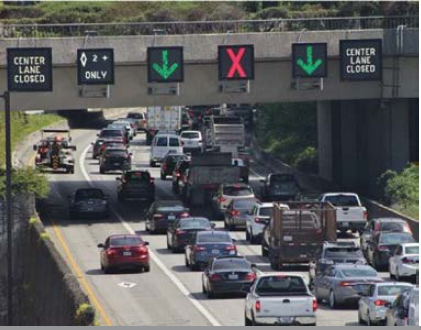
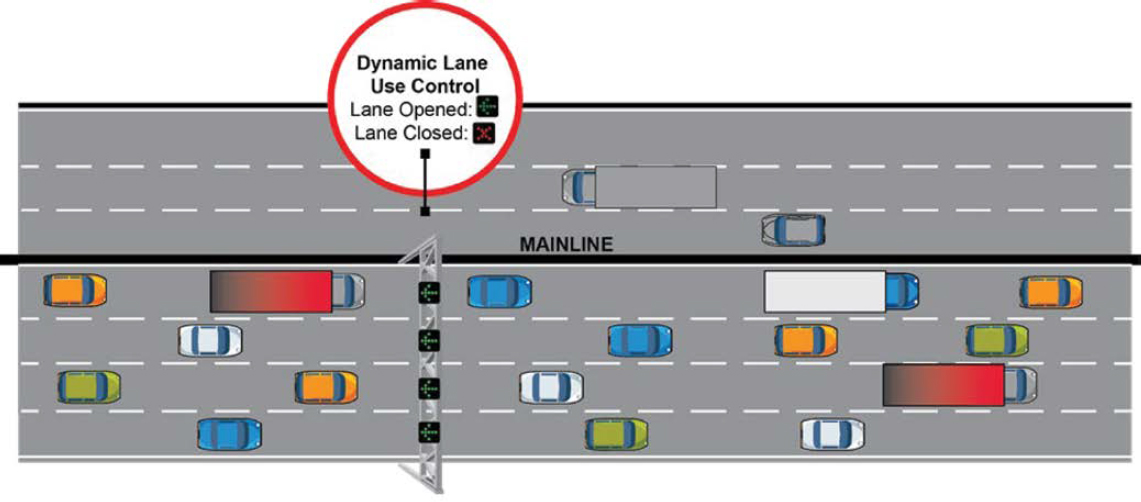
Variable or dynamic lane-use control uses variable message signs to indicate information about specific lanes that may be opened or closed. The lanes may be opened during specific times of the day based on preset arrangements, such as during peak periods. Alternatively, they may be dynamic based on specific needs. After traffic incidents, lanes can be closed to avoid secondary and end-of-queue crashes. During peak periods, highway shoulders can be temporarily open to traffic. Implementing this strategy can help maximize existing capacity and help prevent secondary crashes. Dynamic lane use control is often installed in conjunction with variable speed limits and may use the same signs. Dynamic lane use control is illustrated in Figure B-5.
Application Scenarios
Applications of this strategy include:
- Variable lane-use control, in which lanes are opened or closed during specific time periods based on preset arrangements, such as opening an additional lane during typical peak-travel hours.
- Dynamic lane-use control, in which lanes are opened or closed based on real-time conditions related to incidents and congestion.
- Reversible lanes, in which the direction of one or more lanes is changed based on time of day or demand.
- Part-time shoulder use, in which freeway shoulders are temporarily opened to transit vehicles or all traffic.
TIME TO IMPLEMENTATION
LOW MED HIGH
SCALE
STATE
REGION
LOCAL
CORRIDOR
FACILITY
SPOT
CONTEXT
URBAN
SUBURBAN
RURAL
SUPPORT OF PRIORITY/MULTIMODAL OPERATIONS
Provide dedicated lanes for HOVs/HOT or transit applications.
POTENTIAL BENEFITS
- Increased capacity when used with dynamic shoulder use.
- Increased lane density/volume.
- Reduced secondary crashes.
- Compliance with posted signage during different flow conditions.
- Improved responder safety.
Application Geography
- Urban and suburban freeway and arterial corridors that frequently experience congestion and/or incidents.
- Freeways with wide shoulders that can be used as temporary lanes.
- Arterials where reversible lanes can be implemented to respond to special events (e.g., located near stadiums).
Strategy Variations
- Dynamic lane assignment (arterial).
Supporting Physical or Technology Elements
- Dynamic message signs.
- Dynamic lane-use control signals.
- Field sensors and/or third-party data.
- Static signage.
- TMC for data collection, monitoring, analysis, archiving, and strategy management.
- Decision support systems and other traffic management tools.
Cost Considerations
- Capital costs: lane control signs and gantries; spacing of these signs influences the cost significantly and may depend on the physical geometry.
- Operational costs: dynamic lane-use control is typically not an automated activity within a TMC and imposes a significant resource burden on the TMC operators during incidents; adequate resources to monitor and change signage approaches are needed; when used with shoulder lane applications, the ability to monitor the facility for potential obstructions is needed.
- Maintenance costs: the health of the signs needs to be consistently monitored because of their importance; replacement signs need to be available and need to be swapped as efficiently as possible.
Organizations and Partners
- Highway operating agencies, including state departments of transportation and toll road authorities.
- Third-party data providers (if utilized to support real-time data collection).
- Law enforcement.
Compatible ATM Strategies
- Dynamic junction control.
- Queue warning.
- Part-time shoulder use.
- Variable speed limits.
- Queue warning.
Implementation Considerations
- Staff (in-house or outsourced) to manage and monitor the strategy.
- Policies and procedures to determine when to activate lane changes.
- Appropriate placement of signs to ensure enough advance notification of changes in lane configuration.
- Ongoing cost for operation and maintenance of dynamic lane control signs.
- Development of expert systems or rules to recommend changes in lane use for automatic posting or operator approval.
- Public education and outreach to ensure drivers understand the lane control indicators.
- Manual on Uniform Traffic Control Devices standards that specify the allowable signal indication symbols and messages.
Evaluation Considerations
When considering an ATM strategy to realize safety benefits, agencies can refer to the CMF Clearinghouse to determine which strategy could help meet those objectives and how to apply the related CMF in analyses (FHWA 2023a). The clearinghouse does not currently have specific countermeasures for dynamic lane use.
Active Traffic Management Operational Strategy
PART-TIME SHOULDER USE
Definition
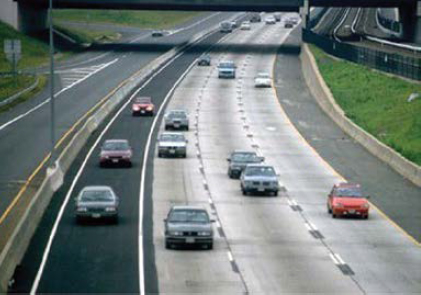
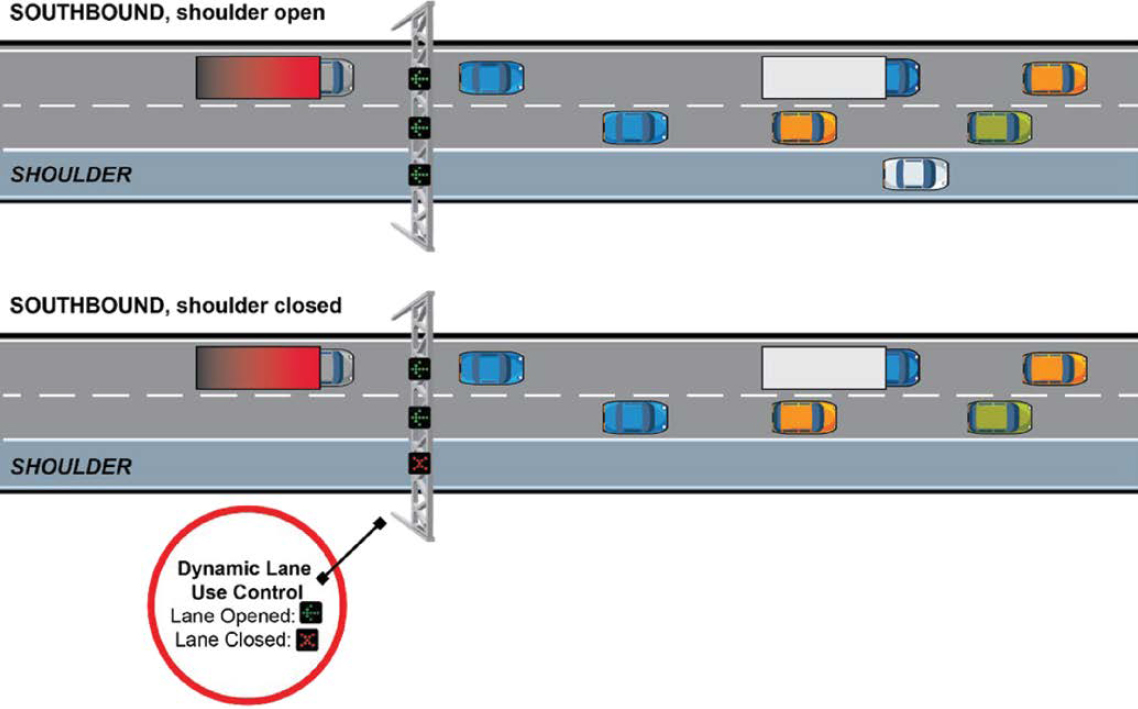
This strategy enables the use of the shoulder as a travel lane(s) based on congestion levels during peak periods and in response to incidents or other conditions as warranted during nonpeak periods. Shoulder use may be restricted to certain types of vehicles or occupants. For ATM, part-time shoulder use implies the ability to dynamically alter the usage of the shoulder. Static, time-of-day approaches are not generally included in the definition. However, they may serve as precursors to true dynamic use. Part-time shoulder use is illustrated in Figure B-6.
Application Scenarios
Applications of part-time shoulder use include:
- Shoulder use for all vehicles allows all vehicles on the roadway to use the designated shoulder when open. Traffic control devices over or adjacent to the shoulder instruct drivers when driving on the shoulder is permitted.
- Transit-only shoulder use (also known as a bus bypass shoulder or bus-on-shoulder) allows buses to use the designated shoulder in specific conditions and driving regulations. The bus drivers are instructed to use the shoulder under specific circumstances to ensure the safety of the operation and all the freeway users.
TIME TO IMPLEMENTATION
LOW MED HIGH
SCALE
STATE
REGION
LOCAL
CORRIDOR
FACILITY
SPOT
CONTEXT
URBAN
SUBURBAN
RURAL
SUPPORT OF PRIORITY/MULTIMODAL OPERATIONS
Provide dedicated shoulders for HOVs/HOT or transit applications.
POTENTIAL BENEFITS
- Improved level of service when shoulders are in operation.
- Reduced travel time.
- Increased travel time reliability.
- Reduced crash rates of some types resulting from added capacity.
- Reduced crash severity.
Application Geography
- Frequently congested freeways and arterials.
- Freeways with multiple bus routes that experience travel time delays.
- Roadways designated as emergency evacuation routes.
Strategy Variations
- None.
Supporting Physical or Technology Elements
- Dynamic message signs.
- Dynamic lane-use control signals.
- Field sensors and/or third-party data.
- Closed-circuit television.
- Static signage.
- TMC for data collection, monitoring, analysis, archiving, and strategy management.
Cost Considerations
- Capital costs: lane control signs and gantries; the spacing of these signs influences the cost significantly and may depend on the nature of use.
- Operational costs: dynamic lane-use control is typically not an automated activity within a TMC and imposes a significant resource burden on the TMC operators during incidents; adequate resources to monitor and change signage approaches are needed; when used with shoulder lane applications, the ability to monitor the facility for potential obstructions is needed.
- Maintenance costs: the health of the signs needs to be consistently monitored because of their importance; replacement signs need to be available and need to be swapped as efficiently as possible.
Organizations and Partners
- Local jurisdictions.
- Local transportation agencies.
- Law enforcement.
- Third-party data providers (operational information such as disabled vehicles, debris, etc.).
Compatible ATM Strategies
- Dynamic junction control.
- Dynamic lane reversal.
- Dynamic lane-use control.
- Queue warning.
- Variable speed limits.
Implementation Considerations
- Concerns with drivers using the shoulder during unauthorized times and speeding.
- Handling ramp merging when part-time shoulder use is operational.
- Sequencing gantries/signs to transition from fully open to fully closed lane(s).
- Loss of shoulder for emergency stops.
- Additional work area protection for maintenance.
- Possible need to consider modified on- and off-ramp design.
- Ongoing cost for operation and maintenance.
- Public education, outreach, and support.
- Potential need for geometric design exceptions (horizontal clearance, sight distance, etc.).
- Possible need for drainage modifications.
- Signs and markings to indicate operations.
- Possible need for shoulder reinforcement and removal of rumble strips.
- Potential shift of bottleneck downstream.
- Potential noise and air quality concerns.
- Potential need for enhanced incident response on facility.
- Staff (in-house or outsourced) to manage and monitor the strategy.
- Procedure for checking shoulder for disabled vehicles, debris, or obstruction prior to deployment (and related removal).
Evaluation Considerations
When considering an ATM strategy to realize safety benefits, agencies can refer to the CMF Clearinghouse to determine which strategy could help meet those objectives and how to apply the related CMF in analyses (FHWA 2023a). The clearinghouse has specific countermeasures for “Implement Active Traffic Management Strategies with Hard Shoulder Running” under the category of “Advanced Technology and ITS.” The clearinghouse also includes the overarching countermeasures for implementing ATM strategies (FHWA 2023a).
Active Traffic Management Operational Strategy
QUEUE WARNING
Definition
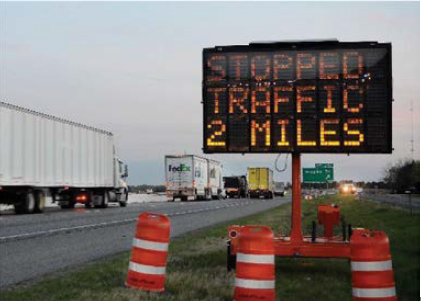
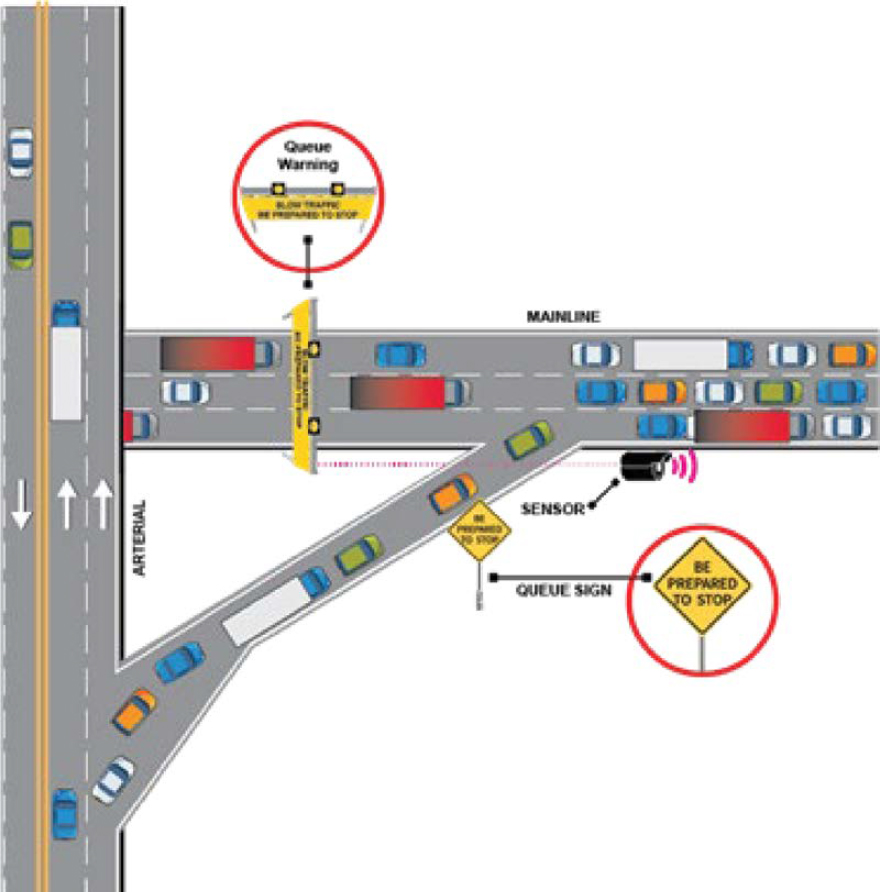
A queue warning strategy utilizes sensors and/or third-party data to detect slow or stopped traffic and issues alerts to drivers upstream of the queue. The availability of this information encourages drivers to reduce speed to avoid running into the end of the queue. These systems can operate autonomously in the field using set algorithms or be controlled by a traffic management center. Overall, this strategy helps to reduce crashes, the severity of crashes that do occur, congestion, delay, and emissions. Queue warning is illustrated in Figure B-7.
Application Scenarios
Development of a queue warning strategy involves:
- Location analysis, where locations of recurring congestion are known or temporary congestion (e.g., work zones) is anticipated.
- Queue prediction, where the extent of queue formation is predicted based on current or recent traffic parameters.
- Queue analysis, where post-activity analyses are conducted to ensure the actual queue did not overrun the predicted queue.
- Programmatic support, where items such as specifications, bidding procedures, and deployment contracts are developed for efficient implementation.
TIME TO IMPLEMENTATION
LOW MED HIGH
SCALE
STATE
REGION
LOCAL
CORRIDOR
FACILITY
SPOT
CONTEXT
URBAN
SUBURBAN
RURAL
SUPPORT OF PRIORITY/MULTIMODAL OPERATIONS
No specific support.
POTENTIAL BENEFITS
- Reduced rear-end crashes where the warning is in effect.
- Reduced severity of crashes.
- Increased lane utilization.
- Reduced speed differential.
Application Geography
- Areas with recurring congestion.
- Areas with high congestion.
- Areas with frequent events.
- Freeway with work zones.
- Locations prone to abrupt slowdowns where speeds need to drop very quickly.
Supporting Physical or Technology Elements
- Portable changeable message signs or dynamic message signs.
- Field sensors and/or third-party data.
- Control software and back-office capability for data collection, monitoring, analysis, archiving, and strategy management.
Cost Considerations
- Capital costs: costs are minimal if existing field infrastructure like dynamic message signs and detection are located at the right locations along the bottleneck; for work zone and other temporary queue warning applications, cost elements include temporary detection, portable signage, and control systems to monitor, detect, and report on the end of queue.
- Operational costs: signs with queue warning messages and/or supplemental flashing lights need to be visible to all vehicles; during normal operation, any dynamic message signs should be blank; the signage should also be consistent and uniform to clearly indicate congestion ahead.
- Maintenance costs: if portable detection or messaging is used, care must be taken to ensure communications and operations during work zone activity.
Organizations and Partners
- Local and state jurisdictions and agencies.
- Construction contractors and system providers.
- Third-party data providers.
- Law enforcement.
- Emergency services/first responders.
Compatible ATM Strategies
- Variable speed limits.
Implementation Considerations
- System specifications including items such as setup, teardown, data archiving, real-time analysis cycles, and contractor coordination responsibilities.
- Placement and length of system components based on analysis of estimated queue length.
- After-action procedures for analyzing results and considering adjustments to procedures as necessary.
- Education/outreach to inform drivers how to navigate the system.
- Law enforcement coordination related to move-over laws.
- Decision tools based on location, traffic, expected length, and nearby events.
- Contractor awareness and familiarity with equipment and specifications.
- Decision tools based on location, traffic, expected length, and nearby events.
- Contractor awareness and familiarity.
Evaluation Considerations
When considering an ATM strategy to realize safety benefits, agencies can refer to the CMF Clearinghouse to determine which strategy could help meet those objectives and how to apply the related CMF in analyses (FHWA 2023a). The clearinghouse has specific countermeasures for “Install Changeable ‘Queue Ahead’ Warning Signs” under the category of “Advanced Technology and ITS.” The clearinghouse also includes the overarching countermeasures for implementing ATM strategies (FHWA 2023a).
Active Traffic Management Operational Strategy
TRANSIT SIGNAL PRIORITY
Definition
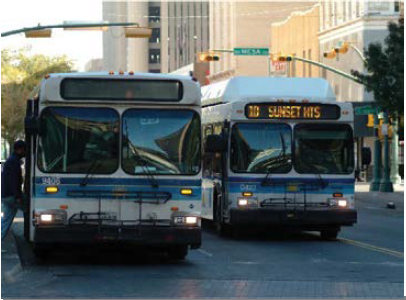
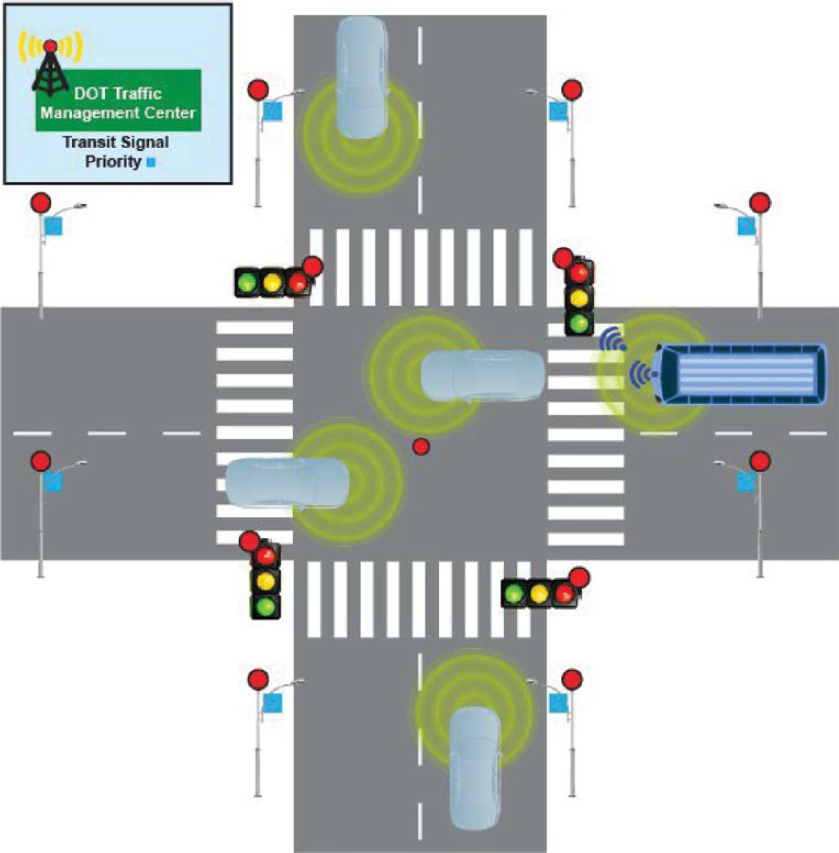
Transit signal priority (TSP) is a technology-based approach to improve the efficiency and reliability of bus operations, particularly along congested corridors. TSP alters signal timing to provide priority to transit operations. This utilizes technologies such as global positioning systems (GPS), automatic vehicle location (AVL), radio, traffic signal modifications, and in-ground or camera-based vehicle detection systems to limit how long buses wait at red traffic signals. Transit signal priority is illustrated in Figure B-8.
Application Scenarios
Applications of this strategy include:
- Passive priority strategies, which favor transit vehicles without requiring vehicle detection technology. These strategies include modifying the areawide traffic signal timing plan to favor transit-heavy corridors and altering signal timing to match the average bus speed rather than the average vehicle speed.
- Active priority strategies, which involve detecting the presence of a transit vehicle and, depending on the system logic and the prevailing traffic conditions, give the transit vehicle priority in proceeding through an intersection. The system can display an early green interval or hold a current green interval. Adaptive systems can change a signal timing plan based on real-time conditions, such as bus occupancy rates, traffic volumes, and bus schedule adherence.
TIME TO IMPLEMENTATION
LOW MED HIGH
SCALE
STATE
REGION
LOCAL
CORRIDOR
FACILITY
SPOT
CONTEXT
URBAN
SUBURBAN
RURAL
SUPPORT OF PRIORITY/MULTIMODAL OPERATIONS
The technology can support bicycle/pedestrian traffic signals and signal timing; transit queue jump lanes at signalized intersections; and transit-only lanes/shared bus-bike lanes.
POTENTIAL BENEFITS
- Improved transit schedule reliability.
- Reduced transit travel times.
- Decreased emissions.
- Increased rider satisfaction.
- Fewer transit stops.
Application Geography
- Urbanized areas where buses are frequently delayed in traffic.
- Roadway networks with significant traffic signal-controlled intersections.
Strategy Variations
- None.
Supporting Physical or Technology Elements
- Transit signal priority technology.
- Control software for operations.
- Transportation management center (virtual or physical location) for data collection, monitoring, analysis, archiving, and managing the strategy.
Cost Considerations
- Capital costs: common elements include vehicle detection, communications, hardware platform, and control software systems costs.
- Operational costs: licensing; warranty; training and support; not a hands-off system; requires a commitment of operations staff who need time to become proficient in the system.
- Maintenance costs: construction and other utility work can impact detection; communications and hardware/software maintenance also have to be accounted for.
Organizations and Partners
- Local and state jurisdictions and agencies.
- Local transportation agencies.
- Transit operators.
Compatible ATM Strategies
- Part-time shoulder use.
- Adaptive traffic signal control.
- Dynamic lane-use control.
Implementation Considerations
- Costs of changing signal timing plans and coordinating signals throughout a system.
- Education, outreach, and coordination with transit operators.
- Periodic analysis and adjustment of signals.
- Staff to continuously monitor and adjust traffic signals, operate the strategy, and maintain proper signal timing.
- Regional traffic signal operations program and related institutional agreements.
Evaluation Considerations
When considering an ATM strategy to realize safety benefits, agencies can refer to the CMF Clearinghouse to determine which strategy could help meet those objectives and how to apply the related CMF in analyses (FHWA 2023a). The clearinghouse has specific countermeasures for transit signal priority under the category of “Transit” that include the following:
- Implement transit signal and lane priority (at transit-serviced locations).
- Implement transit signal priority.
- Install transit signal priority (TSP) technology (at transit-serviced locations).
- Install transit signal priority (TSP) technology (transit-related crashes).
The clearinghouse also includes the overarching countermeasures for implementing ATM strategies under the category of “Advanced Technology and ITS” (FHWA 2023a).
Active Traffic Management Operational Strategy
VARIABLE SPEED LIMITS
Definition
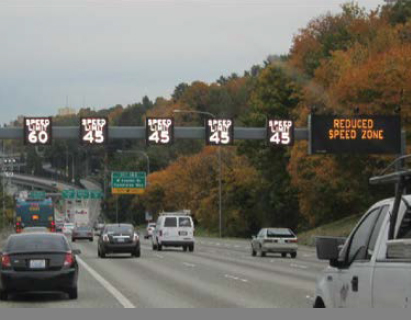
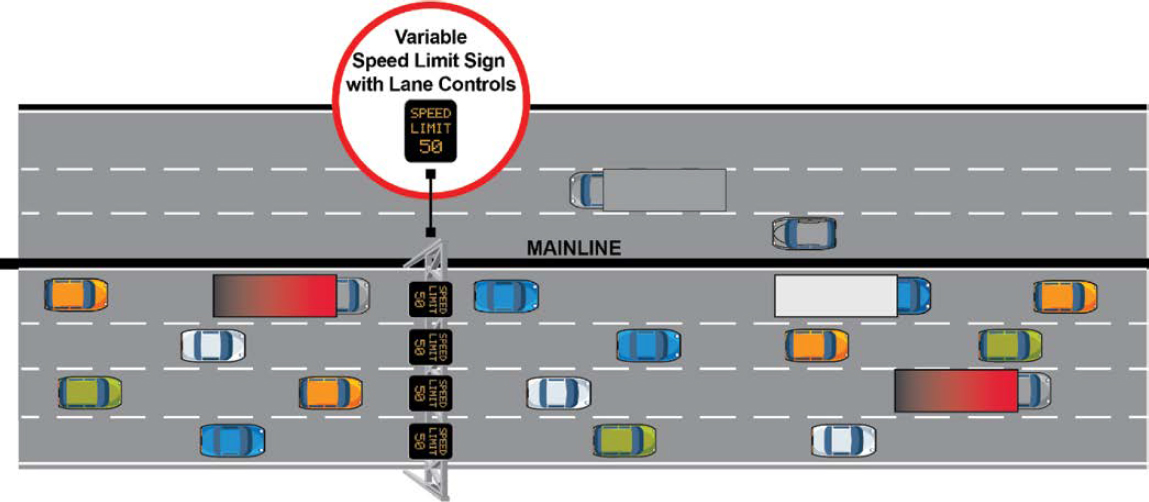
Variable speed limits (VSLs) (also called speed harmonization or dynamic speed limits [DSLs]) use dynamic signage in combination with roadway sensors to detect congestion or other conditions warranting a lower speed, such as weather. When conditions are detected, algorithms lower the speed limit in a stepwise fashion to slow traffic evenly, thereby reducing the onset of congestion. Overall, this strategy seeks to obtain more consistent traffic flow, reduce stop-and-go situations, and reduce crashes. VSLs are a Federal Highway Administration Office of Safety Proven Safety Countermeasure that can provide significant safety benefits (FHWA 2021). Variable speed limits are illustrated in Figure B-9.
Application Scenarios
Applications of this strategy include:
- A work-zone-related VSL/DSL can be used as a queue management tool for work zone activities.
- An incident-related VSL/DSL can be used to slow vehicles to support incident management and reduce secondary crashes.
- For significant congestion, when downstream speed drops below a certain threshold, the reduced speeds are activated.
- A weather-related VSL/DSL is used on roads where fog, ice, rain, or other factors often affect safety. When downstream traffic slows because of weather conditions, the system displays lower speeds to reduce the chance of collisions.
- Implemented as part of a full ATM system where speeds may be stepped down over a series of gantries.
TIME TO IMPLEMENTATION
LOW MED HIGH
SCALE
STATE
REGION
LOCAL
CORRIDOR
FACILITY
SPOT
CONTEXT
URBAN
SUBURBAN
RURAL
SUPPORT OF PRIORITY/ MULTIMODAL OPERATIONS
Provide higher speed limits for preferential vehicles, such as HOVs/HOT or transit applications.
POTENTIAL BENEFITS
- Reduced difference between the posted speed and actual speed.
- Reduced speed variability.
- Reduced spatial extent of congestion.
- Reduced temporal extent of congestion.
- Reduced crash rates.
- Reduced crash severity.
Application Geography
- Congested freeways.
- High-speed arterials with posted speed limits greater than 40 mph.
- Roadways with road weather issues.
Strategy Variations
- Regulatory VSLs.
- Advisory VSLs.
Supporting Physical or Technology Elements
- Dynamic message signs.
- Dynamic lane-use control signals.
- Field sensors and/or third-party data (including those for weather-related conditions that might trigger deployment).
- Control software.
- Closed-circuit television.
- TMC for data collection, monitoring, analysis, archiving, and strategy management.
Cost Considerations
- Capital costs: common elements include roadside signage, vehicle detection, and control software systems; additional detection systems may be required (e.g., road weather information systems); cost considerations are greatly influenced by the number of VSL signs involved and the type of installation.
- Operational costs: an enforcement strategy needs to be developed if the signs are regulatory; for weather-based and other safety-based VSLs, activation criteria should be developed as well as a deactivation protocol.
- Maintenance costs: greatly increases the amount of field equipment to be maintained at a higher level than before; maintenance considerations for overhead signs have to be factored into the design stage.
Organizations and Partners
- Local and state jurisdictions and agencies.
- Construction contractors and system providers.
- Third-party data providers.
- Law enforcement.
- Emergency services/first responders.
Compatible ATM Strategies
- Dynamic lane-use control.
- Queue warning.
- Part-time shoulder use.
Implementation Considerations
- Existing enabling legislation that allows VSLs.
- Determination of whether speeds will be regulatory or advisory.
- Staff (in-house or outsourced) to manage and monitor the strategy.
- Policies and procedures for activation based on specific conditions.
- Enforcement of regulatory speeds.
- Ongoing cost for operation and maintenance.
- Public education and outreach.
Evaluation Considerations
When considering an ATM strategy to realize safety benefits, agencies can refer to the CMF Clearinghouse to determine which strategy could help meet those objectives and how to apply the related CMF in analyses (FHWA 2023a). The clearinghouse has specific countermeasures for variable speed limits under the category of “Advanced Technology and ITS” and the category of “Speed Management.” The clearinghouse also includes the overarching countermeasures for implementing ATM strategies (FHWA 2023a).
Appendix B References and Bibliography
American Association of State Highway and Transportation Officials (AASHTO). (2023). Transportation Operations Manual, 1st ed. Publication Code: TOM-1.
Federal Highway Administration (FHWA). (2023a). “Crash Modification Factors Clearinghouse.” U.S. Department of Transportation. https://www.cmfclearinghouse.org/. Accessed October 3, 2023.
Federal Highway Administration (FHWA). (2023b). TSMO Strategy Toolkit—Getting Started: Tips and Frequently Asked Questions. U.S. Department of Transportation. Publication FHWA-HOP-23-XXX. Publication pending.
Federal Highway Administration (FHWA). (2021). Proven Safety Countermeasures: Variable Speed Limits. U.S. Department of Transportation. Publication FHWA-SA-21-054. https://highways.dot.gov/sites/fhwa.dot.gov/files/Variable%20Speed%20Limits_508.pdf. Accessed September 2023.
This page intentionally left blank.


