Prevention and Mitigation of Bridge and Tunnel Strikes (2025)
Chapter: 4 Knowledge Gaps Related to BrTS Data Management
CHAPTER 4
Knowledge Gaps Related to BrTS Data Management
Introduction
Built upon the literature review which summarize the current state of BrTS research and existing practices (Chapter 2), and the data needs data sources related to BrTS (Chapter 3), The purpose of this chapter is to synthesize the key findings of Chapter 2 and 3, identify the knowledge gaps related to BrTS, vehicle permitting processes, prevention and mitigation strategies, technologies, and data availability and quality. The synthesis focuses on the following three areas: 1) communication; 2) BrTS data collection and management; and 3) BrTS applicable technologies.
Communication
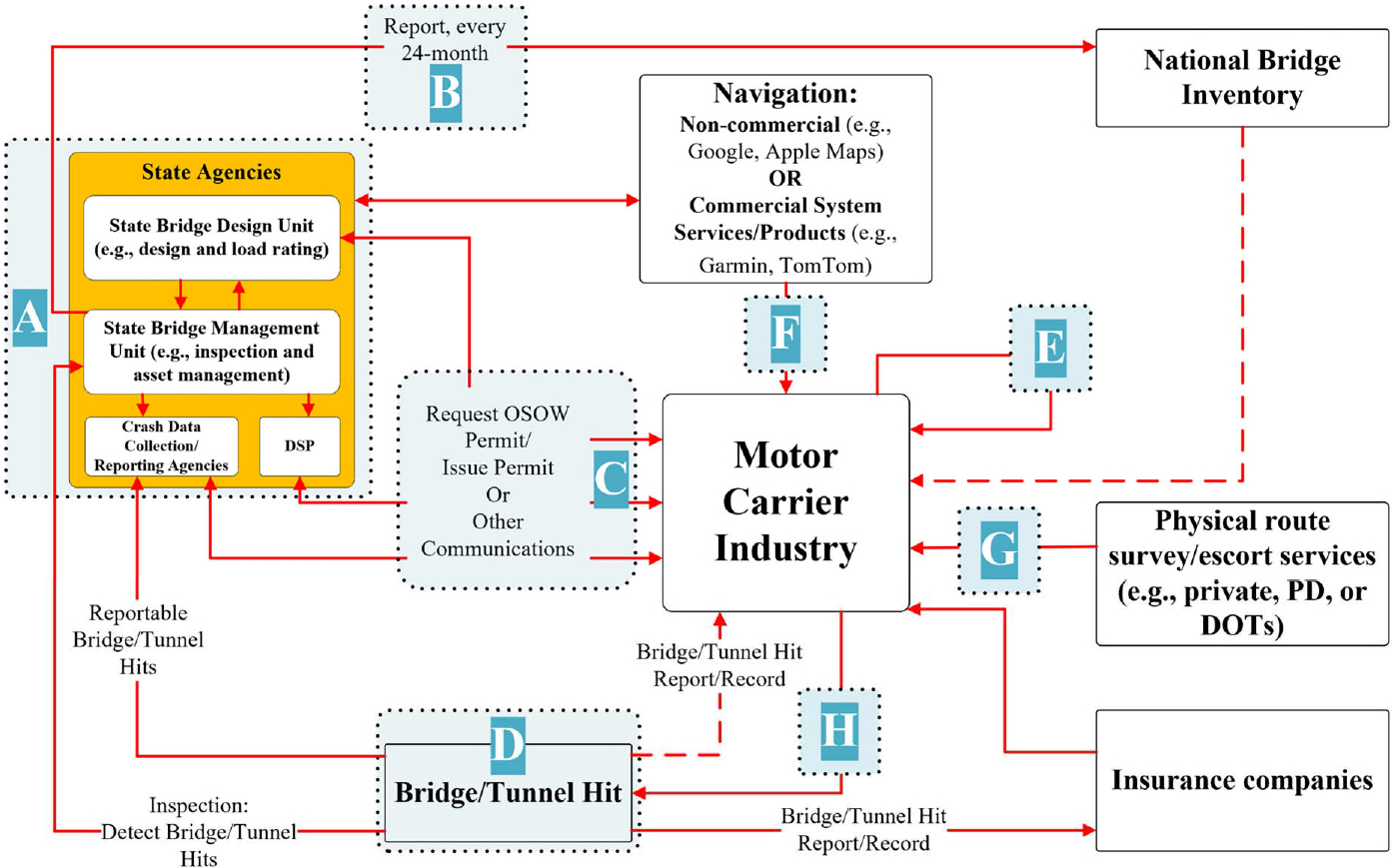
Mitigating and avoiding BrTS requires the participation of many stakeholders, including state/federal agencies, motor carriers, and private service providers. Hence, effective communication and information exchange among different parties and agencies are essential. The bridge/tunnel information (including BrTS data) flow chart is conceptualized in Figure 1 to illustrate how critical BrTS information circulates among different entities. The flow chart identifies possible information gaps and errors (e.g., vehicle permitting process), as well as data availability and quality. Any issues and/or knowledge gaps are categorized into the following eight aspects, corresponding to the letters in Figure 1:
- Inter/Intra-agency Communication
- State-Federal Communication
- Communication between OSOW Permit Issuing Authorities and Motor Carriers
- BrTS Strike Data Exchanges
- Motor Carrier’s Internal Communication
- Motor Carriers (esp. Non-permitted) and Navigation Systems
- Motor Carriers and Physical Route Survey/Escort Services
- Traffic Control (Bridge/Tunnel Signages)
Detailed gap analyses on each aspect associated with communications can be referred to Appendix C: Technical Memorandum: Identify Knowledge Gaps Related to BrTS Data Management.
BrTS Data Collection and Management
This section focuses on the discussion of gaps and limitations with respect to BrTS strike data, bridge/tunnel inventory data, and BrTS data management. Detailed discussions on each aspect related to BrTS data collection and management can be found in Appendix C: Technical Memorandum: Identify Knowledge Gaps Related to BrTS Data Management.
BrTS Strike Data
BrTS can be identified in reportable crashes through appropriate data fields, including the specific bridge component hit. Challenges include inconsistent state compliance with voluntary MMUCC guidelines, affecting data extraction and the detailed identification of affected bridge parts. Underreporting is a significant issue, influenced by variable state reportability criteria and subjective damage assessments, compounded by hit-and-run incidents. Accurately linking crash data to bridge inventory is complicated by non-uniform identification numbers, with a Wisconsin study demonstrating only a 53% accuracy rate. While additional data sources like incident reports and inspections can supplement BrTS data, they may lack detail and accuracy. Tunnel strike data, harder to identify, often require manual narrative reviews to determine strike locations. Overall, significant data gaps include reportability standards, data format uniformity, and the precise linkage and description of BrTS incidents within the infrastructure inventory.
Bridge/Tunnel Inventory Data
Chapter 3 discusses how state DOTs are required to collect bridge clearance data for federal reporting and oversize/overweight permitting. While most state DOTs provide public access to this data, often through GIS maps, methods and accuracy of data collection vary. Techniques range from manual to lidar measurements, and signage practices differ by state, with some states providing more detailed clearance information than others.
However, challenges with the NBI include missing, outdated, or inaccurate data, especially regarding lane-specific clearances. Quality control and assurance practices vary, affecting data reliability. Experimental comparisons between state and NBI data revealed discrepancies, particularly in Indiana’s data, showing higher clearance measurements than NBI. This analysis also highlights the variance in clearance measurement and signage practices between state and local systems, suggesting potential accuracy issues for trucks navigating final mile routes on local systems.
BrTS Data Management
Many states lack formal tracking of BrTS, leading to unreliable BrTS statistics. A 2004 survey (Fu, Burhouse, and Chang 2004) found that only 17 out of 29 states recorded overheight collisions, with specific states unnamed and the data possibly outdated due to changes in crash data management practices.
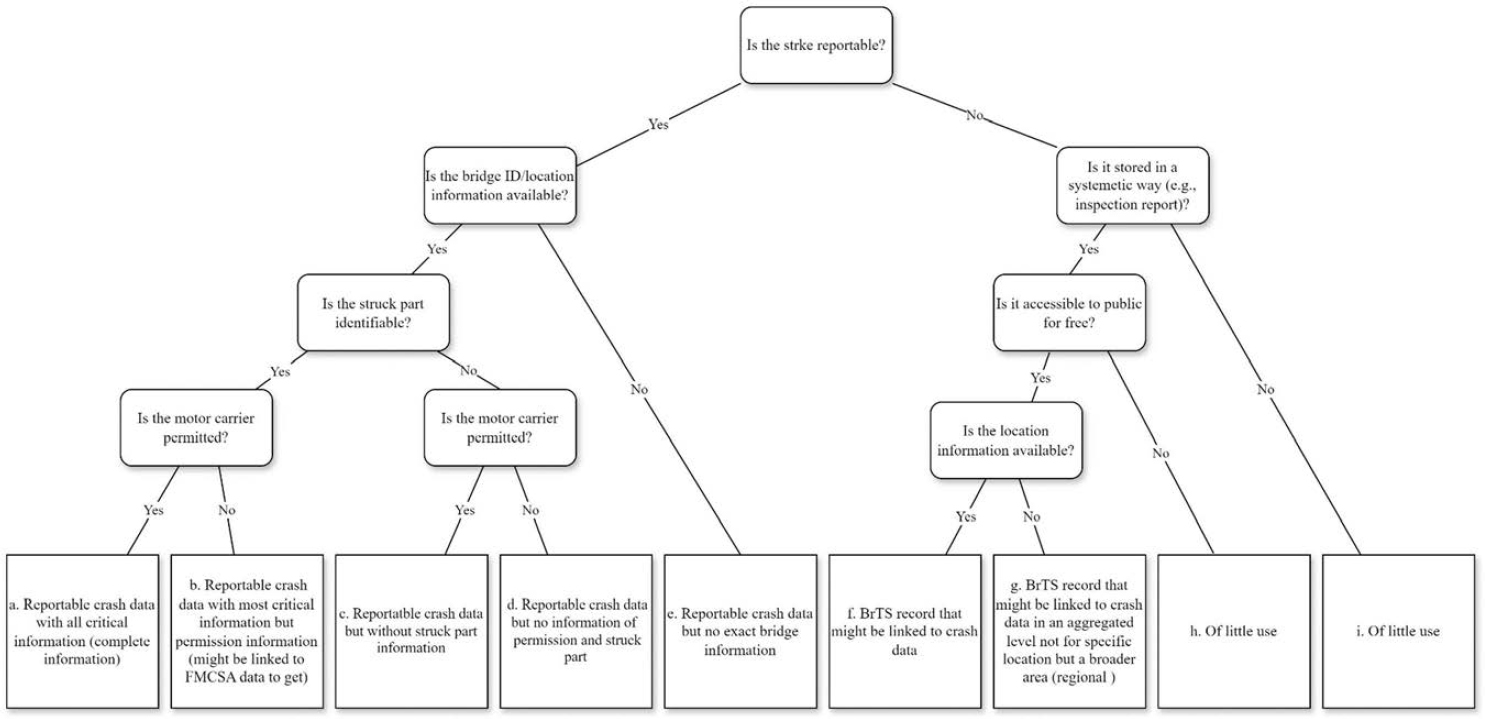
A proposed conceptual framework aims to standardize BrTS data collection by establishing a clearinghouse for systematically archiving BrTS information, addressing questions of reportability, systematic storage, location specificity, structural detail, permit availability, and public access. This concept is illustrated in Figure 2. It should also be noted that not all BrTS strike data would be useful or would serve the same purpose in BrTS analysis and modeling.
BrTS Applicable Technology
This section focuses on the gaps and limitations in technology and strategies that could better mitigate BrTS in practice and better support BrTS analysis and modeling. The following Table 2 summarizes key categories in BrTS applicable technology, offering a snapshot of the strategies and innovations aimed at reducing BrTS strikes. Detailed analyses can be found in Appendix C: Technical Memorandum: Identify Knowledge Gaps Related to BrTS Data Management, including examples of some best practices for each category.
Table 2. Brief Summary of BrTS Mitigation Technologies and Best Practice Examples
| Category | Brief Description | Best Practices Examples |
|---|---|---|
| Driver Education and Training | Enhancing driver skills for safer navigation and lowering BrTS incidents. | PIARC guidelines, NTSB report on the 2013 Skagit river bridge collapse highlighting the need for better driver awareness and escort vehicle guidelines. |
| OSOW Compatible Navigation System | Integrating bridge clearance information into GPS systems for professional drivers. | Rand McNally’s Motor Carriers’ Road Atlas, Drivewyze’s up-to-date hazard alerts, Here’s 3D maps, and Illinois DOT’s audible navigation app. |
| Measuring the Height of the Load/Load Securement | Using devices and best practices for accurate load height measurement and securement. | FMCSA load securement criteria, safeopedia guidelines, Commercial Vehicle Safety Alliance (CVSA) workshops, and vision-based systems for height measurement. |
| Measuring Bridge Clearance | Acquiring accurate bridge clearance measurements to aid in route planning. | Use of traditional methods and mobile lidar by state DOTs, with some states implementing consultant-conducted Lidar measurements. |
| Real-Time Reporting of Hits | Implementing systems for immediate notification of bridge/tunnel strikes. | HyPoint Solutions’ bridge collision notification system using accelerometers and cameras for real-time hit detection and reporting. |
| Prevention and Mitigation Strategies | Employing technology and training to prevent BrTS and mitigate impacts. | Use of laser vision, radar systems, OVHD, and computer vision technologies like HyPoint Solutions’ Hawkscan for real-time vehicle measurement, alongside SC&RA’s educational efforts and advocacy for improved safety measures and standardization. |
Summary
This chapter identifies knowledge gaps in BrTS from three key areas: 1) information communication, 2) data collection and management, and 3) applicable technology. Effective communication is crucial for BrTS prevention and mitigation, with potential gaps existing within and among various entities involved in the BrTS ecosystem. Challenges include inconsistent OSOW permit policies across states, varied adherence to federal guidelines like the Manual on Uniform Traffic Control Devices (MUTCD) and MMUCC, and inadequate BrTS event tracking due to non-standardized data collection methods. Issues also arise from motor carriers’ improper load handling and route planning, compounded by technological gaps that hinder effective BrTS management. Despite these challenges, successful cost-effective practices for BrTS mitigation have been implemented, with state DOTs collecting bridge clearance data to meet federal requirements and improve infrastructure, alongside the use of innovative technologies for clearance measurement, permit automation, and collision notification systems.


