Geospatial Data Governance Policies and Procedures: A Guide (2025)
Chapter: Summary
SUMMARY
Geospatial Data Governance Policies and Procedures: A Guide
Background
With the amount of development happening nationwide at airports, the need for current and accurate geospatial data to support the design, delivery, and maintenance of both existing and new facilities has never been more important. Existing facilities’ geospatial data are changing at a pace that is difficult to track, which can result in data inaccuracies. At the same time, deploying geospatial-related software systems and applications—such as geographic information system (GIS), computer aided design (CAD), and building information model (BIM)—has become easier with the advent of cloud-based and modular solutions. The amount of data generated by these systems can, among other things, create security concerns, hinder development, impact costs, and increase risk across an organization. Data governance policies drive airports toward an organized and systematic method that ensures quality data is developed, maintained, and disseminated for specific airport business needs.
Data governance policies and procedures should at least address data distribution, data privacy and security, information life cycle, data architecture, metadata management, overarching data management, and data quality and accuracy issues. Furthermore, data policies and procedures must be resilient to technology and personnel changes. Federal, state, and local municipalities create regulations and guidance the airports may need to adhere to, such as the Geospatial Data Act of 2018.
Objective
The objective of this research is to develop a guide that helps airports create geospatial data governance policies and procedures. The adoption of these policies and procedures will be driven by the unique characteristics of each individual airport. The guide includes tactics and strategies that can help airports adopt these policies and procedures. A roadmap of the data life cycle was developed to allow airports at various levels of geospatial data maturity to engage at multiple points. The guide addresses the life cycle of data, including development, maintenance, appropriate access and use, security, and archiving or disposal of legacy and new geospatial data.
The guide includes the following elements: (1) a sample data governance policy and procedure for airport geospatial data developed by the contractor; (2) roadmaps for developing the policies and procedures applicable at different size airports and types of operations; (3) training tools that support those policies and procedures; (4) an executive-level multimedia presentation that lays out the argument for data governance, including case studies that support the importance of data governance; (5) step-by-step considerations for each phase of the data governance development process, along with case studies that illustrate
these processes; and (6) sample data management plans that leverage existing federal and industry standards that could be used by airports throughout the United States.
The strategies under these policies and procedures must address, at a minimum, submittal standards, roles and responsibilities, data sharing protocols, data deliverables, data maintenance workflows, engagement of collaborators (both internal and external to the airport), and how data can effectively be shared throughout the life cycle.
Research Findings
Although airports do not generally have formally written data governance policies and practices, in many instances, they have implemented CAD, GIS, and BIM standards. Airports have also effectively implemented individualized business processes that work for data management within their organization. However, these specific processes can create data silos that are disconnected from an enterprise-wide standpoint. Of additional concern is that even though these standards exist, many airports seem to struggle to enforce them for a multitude of reasons. One key example is that electronic as-built data files are often not submitted in a timely manner, if ever, and seldom meet a comprehensive data standard in its entirety.
When airports implement a formal data governance practice, appoint key roles (such as data owners and data stewards), and deploy contract language that hold a consultant or contractor accountable for the delivery of accurate as-built data, they have taken a key step in consistently maintaining their geospatial data. Many large commercial airports are starting to look at concepts such as digital twins and virtual campus type information with three-dimensional robust data sets. With the promise of this capable 3D technology suite, it can be easy to forget the geospatial foundation of all these concepts and how their success relies on a well-managed, routine data governance program.
Many of the drivers for effective data governance include regulatory items and will be further explained in Chapter 2 of this guide. In addition to meeting regulatory requirements, an organization can have success if the geospatial data governance policies are structured, organized, and geared to benefit the users at every level. To maximize the value of an effective data publication system rooted in sound data and technology, the geospatial functions must be considered holistically and as an important enterprise resource to enhance the value provided by data maintained in other systems within an organization. An organization’s data enterprise must also serve the organization’s goals, policy, strategy, and processes.
Elements of Effective Data Governance
Effective data governance can vary greatly across different organizations. It is important to note that many airports have had successes without an overarching geospatial data governance program by implementing good policies and procedures across the organization. This is a critical piece of information, as incremental incorporation of geospatial data standards and policies can be a good place to start and can be followed by a more complete geospatial data governance program as the organization matures. Since many organizations vary in their maturity assessment, current capital improvement plan (CIP) projects, staffing levels, and many other areas, it is important that the organization assesses its priorities. An example of this would be within the Kansas City International Airport (MCI) case study, where an upcoming terminal project led the Kansas City Aviation Department (KCAD) to start with data standards. Throughout this research, and listed within this summary, are some of the many elements of effective data governance identified.
Quick Wins
Data governance implementation is done across the entire organization and requires involvement from many dedicated resources. An initiative of this size involves complex systems, various teams, processes, training, and large data sets—this can be very intimidating. However, developing a roadmap, starting small, and identifying quick wins are key and will lead to better results. It is advisable to divide the organization into sectors based on readiness and chances of successful implementation. This practice identifies any issues, allows for necessary adjustments, and ensures implementation is efficient, cost-effective, and robust.
Executive Management Support
Initiatives and projects have a higher success rate when executive management is on board and supports implementation. Of the initiatives and projects that fail, nearly all of them lacked executive management support (Arora Engineers 2019, 24).
Cultural Change
Implementing and driving data governance within an organization is a cultural change that should be addressed as part of the implementation process. Employees across the organization are used to completing their activities in an established manner. Establishing and implementing data governance disrupts the existing workflow. There are several ways to drive culture change, as follows:
- Identify the challenges and meet them head-on;
- Identify the individuals or groups that might have issues and put together a plan to engage them so they are part of the process;
- Identify the benefits of implementing data governance;
- Take a stepwise approach in implementation by starting simple and putting the challenging activities at a later stage;
- Offer incentives for successful implementation; and
- Communicate the change and make progress visible.
Identifying Benefits and Opportunities
Noting the benefits and opportunities of data governance can help to
- Establish the needed strategy(ies), policy(ies), and standard(s);
- Secure buy-in from leadership;
- Motivate individuals to improve data management and handling; and
- Identify the return on investment—there is no better way to engage executive leadership than to show a positive return on the costs of a data governance program.
Some of the benefits of data governance include improved data quality, informed decision making, enhanced operational efficiency, regulatory compliance, and increased revenue.
Establishing Metrics
An organization can measure successful data governance and determine if it is meeting its goals by identifying metrics. These metrics ensure that the organization is on the right path in data governance by identifying elements that are working well and those that should be improved.
The following metrics should be considered:
- Data quality, a measure of completeness, accuracy, and availability of data;
- Adoption rates, a measure of individuals or groups complying with standards and procedures; and
- Risk events, a measure of incidents, regulatory compliance, and lost revenue.
Benchmarking
Measuring the maturity of an organization in its data governance by benchmarking, or comparing, it against other similar organizations helps to develop a roadmap for success and identifies opportunities for improvement.
Data Champion(s)
The greatest successes identified within this research have occurred when an airport organization has a data champion or several data champion(s). A few key individuals who recognize the value of data and proactively promote this information to executive leadership can make a large difference in the success of a data governance program.
Organization Structure
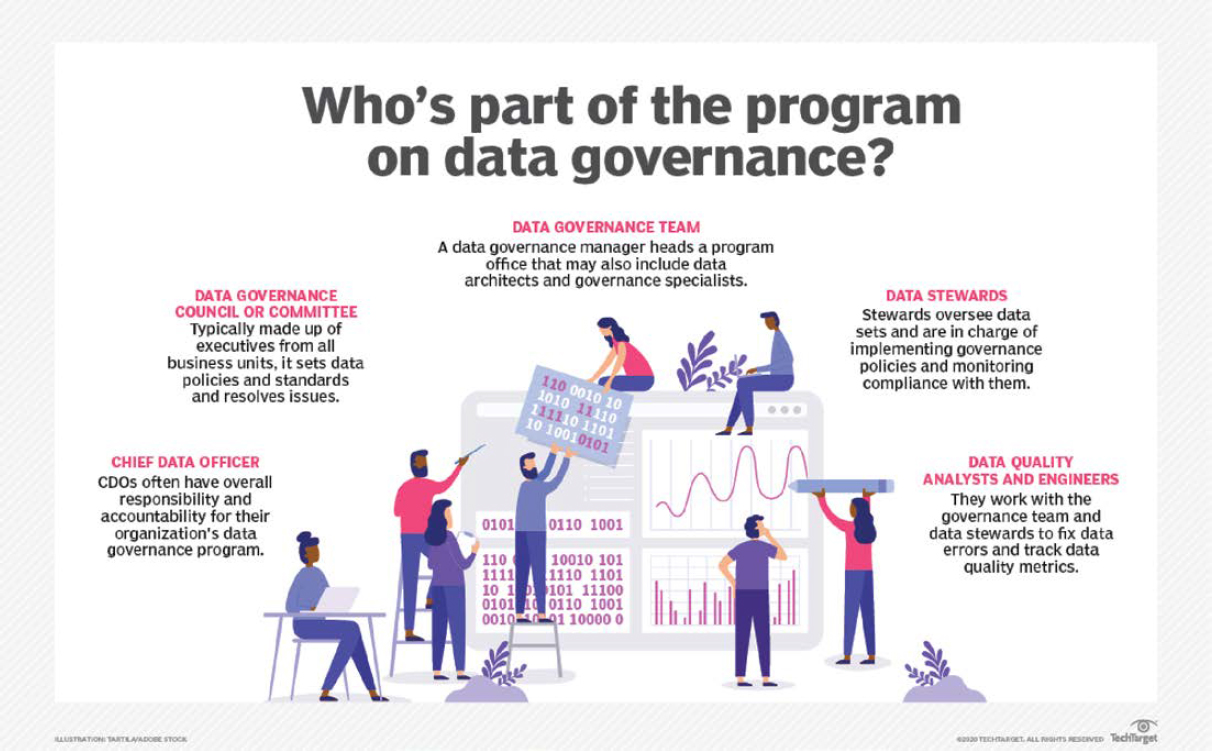
Developing a data governance organization structure is essential for its implementation and success. As part of the structure, some individuals will be working on data governance activities on a daily basis. Other individuals will provide support, will be informed, or only serve as users. As shown in Figure S-1, a suggested structure would include a geospatial data curator, such as the Council for Geospatial Data Governance, data owners, data stewards, data producers, data users, and collaborators.
Templates
Development of and continued access to a library of templates provide the flexibility to select and choose from preconfigured documents. Template creation and use reduce implementation time and cost. At the time of this research, software solutions provided data governance templates for metadata management, data quality, parent/child data management, and data integration.
Communication
Data governance buy-in, implementation, and success rest in the hands of individuals across various levels of an organization. A strong communication plan is required to coordinate with these individuals and for data governance to work and be successful. Communication plays a role in creating and implementing the strategy, developing the framework, conveying the benefits, establishing clear structure, setting roles and responsibilities, and making changes to a program.
Without proper communication, the implementation of data governance will be at risk for misunderstandings, lack of buy-in, delays in implementation, not meeting goals, and overspending.
Training
Establishing a training program with various modules for data governance across the organization is key for success. It standardizes the implementation and the day-to-day related activities. Training should include guides for each module, multimedia presentations, discussion groups, and lessons learned. The training material is updated frequently and communicated across the organization.
Conclusions
A powerful data governance strategy assists organizations in collecting, analyzing, protecting, and utilizing data and information for decision making. These strategies also drive a data-driven culture. The capacity to utilize and manage data and information permits the organization to impact the outcomes in an informed and reliable way.
Data governance is more than identifying and implementing a technology solution. It requires an organization at-large involvement and buy-in to identify the needs, develop the requirements, and have resources in place to successfully implement data governance.
Data governance will not look the same across different organizations. Once an organization’s priorities have been assessed, it should review the policies found in each chapter of this guide to develop the organization’s individual policies, standards, procedures, and data
maintenance. Small airports may decide to focus on safety critical assets, while medium and large airports may have a more comprehensive asset management plan. There is no right or wrong answer in either scenario; however, there is no point in capturing data that an organization will be unable to maintain and keep current.
Many sections of this guide emphasize that policies, standards, and procedures put in place must be enforced by the organization. There has been no single point of failure more commonly seen throughout this research than the failure to enforce standards both internally and externally to the organization. Internal enforcement can be guaranteed by the executive leadership team or by empowering the geospatial data governance committee, even if this is only a single person “wearing many hats” (as it may be at a small airport). External enforcement can stem from the contract language for consultants and contractors and by ensuring the data submitted meets the organization’s standards prior to issuing final payment. If the organization’s policies, standards, and procedures are worth the initial development efforts, the organization must remember that enforcement of these initiatives is also a worthwhile investment.


