Meeting Future U.S. Mineral Resource Needs: The Role of the U.S. Geological Survey Mineral Resources Program (2025)
Chapter: 5 Program Administration
5
Program Administration
MISSION AND EXECUTION STRATEGY
Overview
Mission Implementation Strategy
The mission, strategy, and priorities of the U.S. Geological Survey (USGS) and the Mineral Resources Program (MRP) are guided by and described in several documents. At the bureau level, the USGS Science Strategy (USGS, 2021) describes the mission and vision of the USGS with broad focus on its implementation strategy. Focus areas include technology, partnership, workforce development, and interdisciplinary integration. The document notes that a strategic planning framework is expected to follow in the next few years with more specifics on implementation. In between Science Strategy updates, the USGS and its mission areas issue annual bureau-wide and mission area–specific guidance to supplement the Science Strategy with additional details. The fiscal year (FY) 2024 Bureau Guidance (USGS, 2023a) discusses science activities and methodologies and provides specific guidance on recommended practices regarding technology utilization, partnership approaches, and organizational priorities.
Energy and Mineral Resources Mission Area (EMMA) and MRP strategy and priorities are described in annual science program guidance documents, which provide program-specific guidance to supplement the USGS-wide guidance. These documents provide significant detail on recent project accomplishments and activities envisioned for the next fiscal year. The FY2024 Guidance for EMMA document (USGS, 2023b) includes many proposed activities for FY2024 that the committee concurs are high priorities.
Project Selection Procedures
Central questions in the committee’s review were related to how priorities are set within MRP, how projects are selected, how budgets are allocated, and how projects are managed and sunsetted. The process of program and project management is particularly important in a matrixed organization where USGS staff are accountable both to their mission area or program and their science center. A description of how projects are selected based on descriptions from MRP leadership during the Reston site visit and subsequent conversations on December 20, 2024, is summarized below.
Mission area research priorities are determined by a program council and described in the annual mission area guidance, with an annual call for research project proposals based upon those priorities. The program council consists of EMMA senior leadership and science center leadership, plus two or three staff scientists who are subject-matter experts and can advise on mission area priorities but do not participate in funding decisions. Research projects typically operate on a 3- to 5-year funding timeline, with projects being proposed primarily in a bottom-up fashion. Approximately three-quarters of proposals are funded. Project researchers submit updates on accomplishments, publications, and similar metrics on a 6-month basis, and an annual review incorporates staffing, budgets, and scope for the upcoming year. Upon project completion, project staff present results and recommendations for follow-on work to the program council. Generally, research projects that are selected for funding are completed, whether as originally envisioned or folded into other projects. Support and operational projects, such as those overseeing analytical laboratories, are reviewed every 5 years by center and program management. The process for selecting Earth Mapping Resources Initiative (Earth MRI) projects is separate and is discussed in the Chapter 4 section Earth Mapping Resources Initiative.
A final category of projects and project management is related to outside partnerships. This includes engagement with industry through either Cooperative Research and Development Agreements or Technical Assistance Agreements. Industry typically provides the funds for these projects; they are undertaken if a measurable benefit to both industry and MRP exists. Cooperative Agreements with academia that are based upon research collaborations and funded by MRP also exist; these can originate either from the academic partner or by MRP research staff.
Challenges and Opportunities—Mission and Strategy
Lack of a Clear and Transparent Strategy
The most recent MRP strategic plan was developed in 2013 (Ferrero et al., 2013). Given the pace of change over the past decade, a refresh of the strategic plan is warranted. For example, recent initiatives like Earth MRI post-date the 2013 strategic plan yet are extremely important to MRP and EMMA goals. Refreshing the 2013 MRP strategic plan and keeping it up-to-date will enhance MRP’s ability to fulfill its mission (see Recommendation 6). An important part of the refreshed strategic plan is a clear
roadmap describing specific measures by which progress toward strategic objectives will be evaluated; if needed, alternative approaches will be adopted. The strategic plan would have additional sustained value if it were revisited on a regular basis and modified as necessary to adjust to changing conditions. For example, the United Kingdom’s (UK’s) critical minerals strategic plan is refreshed every 2 years. The UK government has external committees review plans and then responds to those reviews.1
While the annual guidance for EMMA provides details on the major EMMA priorities, it is not a strategic plan and does not discuss how MRP projects align with or contribute to the overall mission and vision. It was not made clear to the committee whether MRP projects were selected for their alignment to the mission or the strategic plan and how existing projects mesh with both the mission and strategic plan. It was also unclear how funding is distributed to support various science activities, data collection, and outreach activities, or how those relate to MRP’s mission. Finally, MRP leadership does not appear to have a well-articulated strategy to decide which proposed research activities or data collection activities to fund. Several responses from the questionnaire support these concerns, noting a lack of vision or clarity to meet mission goals. These are critical gaps for MRP. The committee notes, however, that MRP projects and activities do generally align well with the mission.
Improving alignment among mission, strategy, and activities will help to ensure that program priorities align with stakeholder needs, including those of other government entities, private industry, academia, and the general public (see Recommendation 6). As part of the USGS mission is to “deliver actionable information at scales and timeframes relevant to decision makers,” the lack of an established mechanism for external feedback risks misalignment of MRP projects and products with national priorities and stakeholder needs (see Chapter 7). One recommended mechanism to help accomplish this would be the establishment of an external advisory system (see Recommendation 5; Chapter 7). An external advisory group empowered to assess and critique MRP will strengthen the program. Several possible mechanisms and models could accomplish this such as a federal advisory committee, like the USGS’s Federal Advisory Committee for Science Quality and Integrity and the National Cooperative Geologic Mapping Program Federal Advisory Committee. Another possible model is the British Geological Survey’s (BGS’s) Science Advisory Committee, which is a group of experts from government, private industry, and academia who advise BGS on the development and delivery of a science strategy, its science portfolio, and products and services (BGS, 2024). A different potential mechanism is inclusion of external members on the program council to advise on setting mission area priorities.
___________________
1 See https://www.gov.uk/government/publications/critical-minerals-task-and-finish-group-government-response/uk-government-response-to-the-task-and-finish-groups-recommendations-on-industry-resilience-for-critical-minerals, accessed April 7, 2025.
Criteria and Direction in Project Selection
The committee was not provided with specific details about the project selection process, such as the criteria against which proposals are evaluated. Although the value of foundational research is often difficult to quantify, no discussions ensued as to how project outcomes are weighted, graded, or ranked. Project management such as that practiced by agencies doing applied research and development funding, like the U.S. Department of Energy (DOE) and the Defense Advanced Research Projects Agency, may not be appropriate for a more research-oriented organization like MRP. However, a lack of competitive review and active management could limit MRP’s ability to be more proactive in the face of dynamic changes such as the current minerals environment.
The desire for more active management of projects, including more guidance and direction from MRP leadership, clear project planning, and prioritization of resources was reflected in several questionnaire responses.
Conclusion 5-1: While the Mineral Resources Program (MRP’s) mission is reflective of the scope of its work, refreshing its strategic plan and strengthening alignment among mission, activities, and stakeholder needs through better planning, communication, and external input would enhance MRP’s effectiveness.
BUDGET
Overview
The USGS’s appropriated budget overall has increased in parallel with inflation, resulting in relatively flat real funding over the past four decades (see Figure 5-1). MRP’s budget was on a downward trajectory from the mid-1990s until 2018, with increases since that time. Over the past four decades, MRP’s real budget has decreased by close to 50%. EMMA’s budget has decreased from approximately 20% to 7% of the USGS’s budget, and MRP’s budget has decreased from 11% to 5% of the USGS’s budget over that same time.
On top of its base appropriated funding shown in Figure 5-1, MRP funding was significantly augmented by a temporary influx of $320 million over 5 years starting in 2021 and ending in 2026 if not extended. This additional funding specifically supports expanded efforts of the Earth MRI program (see Chapter 4, Earth Mapping Resources Initiative; Figure 4-7).
Challenges and Opportunities—Budget
As discussed further in the Earth Mapping Resources Initiative section in Chapter 4, MRP is making significant progress toward producing national assessments of critical mineral potential, but the supplemental 5-year funding is insufficient to complete the task before expiring. In order to complete national critical mineral assessments and perform other functions crucial to the United States’ minerals future, a higher sustained level of funding is needed over at least 15 years.
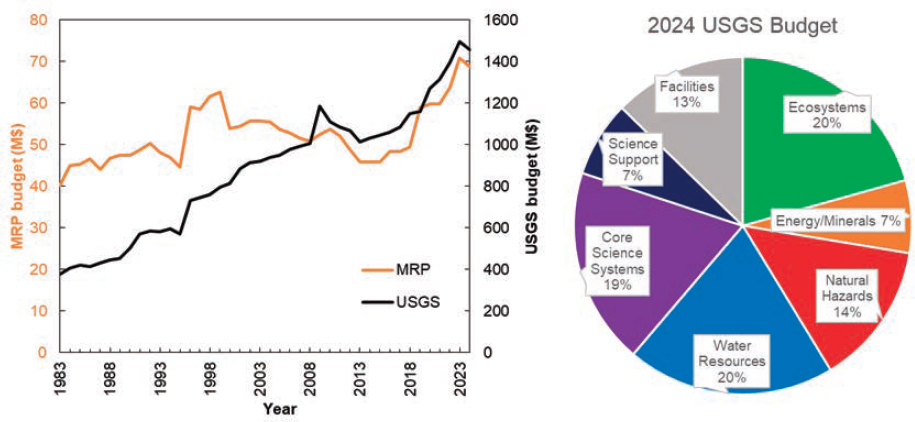
SOURCE: Data provided to the committee by the USGS.
Other nations are already allocating significant resources to critical mineral assessments and related work. Australia will invest $7.1 billion AUD in critical mineral initiatives over the next decade, including $1.7 billion specifically related to mineral exploration (Pacitti et al., 2024). In 2022, Canada allocated $3.8 billion CAD over 8 years to support implementation of the Canadian Critical Minerals Strategy (Office of the Auditor General of Canada, 2024). These allocations represent approximately 0.1% of the Australian and Canadian annual federal budgets, respectively. Germany, Italy, and France announced funding totaling € 2.5 billion for projects on extraction, processing, and recycling of critical raw materials (Sullivan & Cromwell LLP, 2024). China recently instituted a $1 billion, 6-year program that rivals Earth MRI in scope and support (Stone, 2024).
Because project-level funding details were not provided, the committee could not evaluate the allocation of funding among fundamental research, applied science and data collection for mineral assessments, or other activities. It is also unclear how much of the MRP budget is allocated to personnel, analyses, equipment, travel, facilities, overhead, etc. However, as national priorities continue to evolve, having an understanding of these allocations could benefit future MRP strategic decisions.
Conclusion 5-2: Appropriated and supplemental budget increases over the past few years have significantly kickstarted the Mineral Resources Program’s ability to assess the nationwide resource potential. Continued elevated budget levels are required to complete this and other work of national priority.
STAFFING, WORKFORCE, AND TRAINING
Overview
More than 300 USGS staff work in MRP, with approximately 40% of staff hours supporting mineral information and supply chain analysis, approximately 15% supporting Earth MRI, and the remaining 45% supporting research and assessments. Most staff are full-time USGS employees, although MRP makes use of term employees, contractors, postdoctoral fellows, and other temporary staff. MRP has historically been staffed with scientists who have specific qualifications and expertise (generally at the Ph.D. level) to undertake research and with technical support staff (at the M.S. or B.S. level) to operate and maintain equipment, undertake fieldwork, and serve other important technical functions.
Scientific staff may either work on multiyear projects of their own design (see Project Selection Procedures) or work on tasks of immediate program need such as data release from a geophysical survey or a request for decision support from another agency.
Challenges and Opportunities—Staffing
Despite the need for a workforce with broad skills and expertise, the USGS is finding it difficult to hire full-time permanent employees for a variety of reasons. The
number of graduate programs focused on mineral resources is small, and the number of geoscience college graduates is insufficient to meet national needs (Keane et al., 2022; NASEM, 2024). As a federal employer, the USGS can generally only hire U.S. citizens (Federal Register, 1976), which is problematic in fields where the United States does not produce many graduates, such as economic geology and exploration geophysics. In addition, the long federal hiring process and high cost of living near some USGS centers can deter top talent.
The committee learned from site visits and questionnaire responses that staffing and workforce challenges are among the most pressing issues facing MRP. The questionnaire responses indicate a passion for conducting impactful science but highlight structural, administrative, and funding barriers that hinder efficiency and collaboration. Addressing challenges such as reducing administrative burdens of the scientific staff, improving funding stability, fostering collaboration, modernizing data management, and strengthening workforce planning would significantly enhance the ability of MRP scientists to perform high-quality mission-oriented research.
The committee recognizes that MRP’s ability to hire new staff is limited by budget and federal hiring guidelines. However, the committee offers observations that could enhance MRP’s future workforce.
Draw from Beyond Geology
The broad mission and emerging activities of the USGS and MRP are potentially appealing to a wide variety of students beyond those coming from traditional geology programs. MRP can play a role in raising the profile of mineral-resource issues in the United States to help attract talent from other fields (see Chapter 7, Public Engagement, Publicity, and Outreach). Recruitment from fields such as data science, analytical chemistry, economics, and environmental sciences could be used to attract emerging talent and meet evolving needs at MRP.
Enhance Academic Collaborations
Increased collaborations with universities can benefit MRP in many areas. Employing student interns can expose numerous individuals to MRP and train students in topics that are priorities for MRP and other future employers. Costs could be covered externally, for example by National Science Foundation Non-Academic Research Internships for Graduate Students (INTERN) awards2 or by private industry, or internally through scholarships or fellowships. The EDMAP program3 is a potential model for this. Opportunities also exist through state surveys that are associated with universities and already employ graduate students on Earth MRI projects. Continuing to enhance these collaborations will provide avenues for workforce development in the minerals
___________________
2 See https://www.nsf.gov/eng/intern, accessed April 7, 2025.
3 See https://www.usgs.gov/programs/national-cooperative-geologic-mapping-program/science/edmap-0, accessed April 7, 2025.
sector as well as provide visibility for professional employment at the USGS. In addition, having MRP staff co-advise or serve as technical advisors to graduate students could be an attractive avenue for university professors with limited laboratory capabilities. The impending colocation of MRP staff at the Colorado School of Mines (CSM) is likely to enable closer academic collaborations with CSM. Notably, some top-tier U.S. universities, for example Stanford University through its Mineral-X program, are launching their own minerals programs to address rising national and global demands. MRP is encouraged to use this experience to design a framework for building partnerships with more universities in terranes across the nation that are prospective and where local knowledge and motivation will be of benefit. Such structured MRP–university collaborations can support USGS’s staff recruitment while contributing to the training of the nation’s minerals workforce.
Increase the Number of Technical and Support Staff
Supplementing scientific staff with an adequate number of technical and support staff could increase productivity by relieving the administrative burden felt by many employees and allow for more focus on the mission-oriented research for which they were hired. These staff could be used in areas such as data management, data quality control, administrative and compliance work, and other tasks. In Australia and Canada, these types of activities are often the responsibility of technical staff with B.S. or M.S. degrees who are trained to uniformly apply the standards set by research scientists. This is done extensively in the National Minerals Information Center (NMIC) as well. At the same time, some NMIC staff are interested in participating in other roles within the USGS but encounter barriers because of their lack of Ph.D. degrees.
One particular area of need is expansion of expertise in information technology and computer science. Many digital and data-centric tasks have become specialized beyond the expertise and training of research scientists. Individuals trained in these areas could be particularly useful in areas such as database management, data delivery, automation of data collection (e.g., for polling, pulling, and compiling public data to supplement NMIC canvassing data), digitization and metadata management of historical data, and AI-assisted projects such as resource assessments.
Increase Training and Retraining of Current Employees
USGS staff have skill sets that align with agency priorities at the time of hiring, but these priorities can change rapidly due to political or societal circumstances. Examples of such changes include the oil crisis of the 1970s, the shift to environmental stewardship, and the current push for critical minerals. In addition, the methodologies within fields continue to evolve, such as AI and cloud-based geoscientific data analysis. In these instances, retraining and upskilling the current workforce can be necessary to retain top talent and remain at the cutting edge of the field.
The successful internal effort to train current employees in resource assessments can serve as a model for retraining. In addition, expanding training can also stave off
the problem of expertise being held by a single individual. It can also promote an interdisciplinary workforce committed to fostering the collaboration across disciplines and research centers necessary to address mineral resource challenges comprehensively (see Recommendation 7).
Conclusion 5-3: The Mineral Resources Program (MRP) faces serious workforce challenges including recruitment barriers, skills gaps, and administrative burdens that hinder its ability to meet growing national demands for mineral science. Addressing these issues through targeted hiring, academic partnerships, workforce broadening, technical support staffing, and training will be critical to sustaining MRP’s mission and scientific excellence.


