Meeting Future U.S. Mineral Resource Needs: The Role of the U.S. Geological Survey Mineral Resources Program (2025)
Chapter: 7 Partners and Stakeholders
7
Partners and Stakeholders
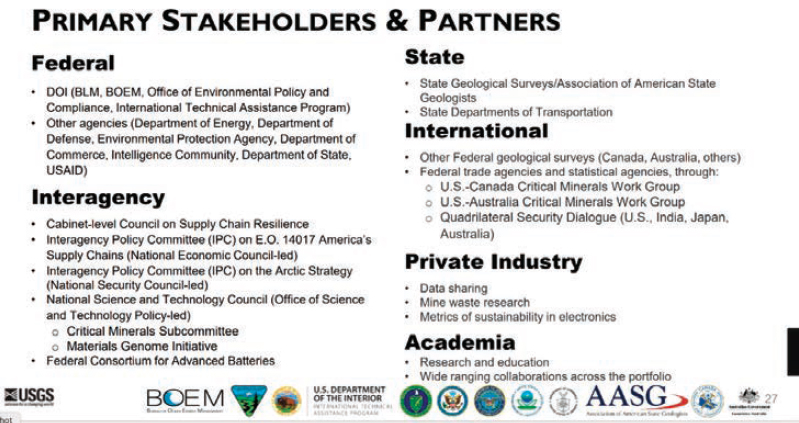
The far-reaching nature of the U.S. Geological Survey (USGS) Mineral Resources Program (MRP) mission means that MRP intersects with a variety of partners and stakeholders across various sectors (see Figure 7-1) including entities across government, private industry, and academia. MRP stakeholders are defined here as any individual, group, or entity that interacts with or has interest in MRP research, data, or products, while partners are those with whom MRP works or collaborates to achieve its mission. As described to the committee by the USGS, Figure 7-1 is not meant to be an exhaustive list of partners and stakeholders or activities with them. For example, MRP also engages with the public, Congress, and tribal nations, and interacts with many partners and stakeholders in ways not noted here. In this chapter, the committee briefly discusses major stakeholders and partners including government entities, academia, private industry, and the public.
GOVERNMENT ENTITIES
Overview
Government entities are critical stakeholders for MRP as well as important partners in research and exploration. Government entities can include other federal government agencies; state agencies—in particular, state geological surveys; tribal governments; and international governments.
Within the federal government, MRP’s role is to provide information, data, and interpretations that facilitate decision-making processes about all aspects of mineral resources. In many cases, the relationships between MRP and other government agencies are not formally established but rather rely on institutional knowledge and effective interpersonal relationships. However, some formal coordination channels such as
SOURCE: Williams, 2024.
the Federal Mining Dialogue and the Critical Minerals Subcommittee of the National Science and Technology Council, and the more recently established National Energy Dominance Council, leverage interagency interests in mining and critical minerals. Federal agencies may use MRP’s expertise for decision support or partnership in projects of mutual interest (e.g., see Box 7-1) both through formal channels and informal connections.
MRP maintains a close working relationship with states, most notably through its Earth Mapping Resources Initiative (Earth MRI) program. State surveys and other agencies have been an integral part of Earth MRI since its inception and work closely with MRP leadership to develop and carry out projects (see Chapter 4, Earth Mapping Resources Initiative). In the questionnaire distributed to state geological surveys, all 21 respondents indicated that they collaborate with the USGS though Earth MRI, and most also collaborate with the USGS in other ways. Additional work with state governments has improved the efficiency of gaining approval from various stakeholder groups, resulting in increased access to data collection opportunities and resources to carry out scientific programs. For example, a collaboration with the Nevada state government and geologic survey on geophysical and lidar data collection provided important information about potential target areas of interest. This approach allowed Nevada Bureau of Mines and Geology staff to assist with data collection and facilitated dissemination of geophysical data to important stakeholders in the state. During this program, airborne electromagnetic data were collected over the McDermitt Caldera, and stakeholders were invited to attend an informal presentation of the initial data collected and to observe the data collection process. This collaborative approach involving the USGS and state agencies and governments appears to be developing more broadly, with one state geologist noting on the questionnaire that the “USGS staff communicate with us
regularly about the status of our projects and the results of geochemical analyses and geophysical survey collection.”
MRP’s engagement with state geological surveys has allowed the Earth MRI program to expand its work in a relatively short period of time, answer important scientific questions about critical mineral resources in the interest of the public and industry, and ensure that information is communicated to local stakeholders where specific projects are relevant. Earth MRI’s emphasis on working and coordinating with stakeholders prior to data collection is critical to continued large-scale data acquisition and is an area in which MRP has demonstrated leadership. MRP is also ramping up additional actions on the post-data collection side of stakeholder communication, which the committee believes should be a more focused effort, particularly as more data are collected (see Recommendations 4 and 7).
Tribal partners also have interest in responsible resource development and have made important contributions to the MRP scientific research portfolio. This includes conveying historical knowledge, providing access to databases, coordinating on data collection efforts, and being active participants in the process of resource identification. For Earth MRI specifically, MRP has engaged tribal partners when seeking social license in specific areas prior to project completion, as well as during data collection or individual research projects. This has helped to facilitate data collection such as the country-wide lidar coverage that the USGS has acquired, which needs approval from or engagement with a variety of stakeholder groups, including tribal partners.
International geological surveys partner with MRP in global research on critical mineral systems and information, which has increased and leveraged the budgetary and expertise resources that the USGS has access to in investigating the critical minerals distributions on our planet. A prime example is the Critical Minerals Mapping Initiative undertaken by MRP in partnership with Geoscience Australia and the Geological Survey of Canada. The National Minerals Information Center (NMIC) also leverages sister agencies from international partners in its data gathering and compilation efforts. As was acknowledged to the committee by international partners, the longevity and excellence of science conducted by MRP (and its predecessors within the USGS) elevates it as global leader, providing international agencies and allies with cutting-edge data, science, and analysis on critical mineral deposits while at the same time allowing MRP to leverage best practices used by these partners. Collaborating with international partners to understand and communicate the global endowment and distribution of mineral resources is crucial to meeting U.S. resource needs now and in the future.
Challenges and Opportunities—Governments
Federal
MRP has recently seen a significant and impactful increase in the number and nature of data requests from other federal agencies, reflecting heightened awareness of the strategic importance of independent, science-based data. These requests—often urgent, unplanned, and outside existing work plans—place increasing strain on MRP’s
BOX 7-1
The Sagebrush Mineral Resource Assessment (SaMiRA)
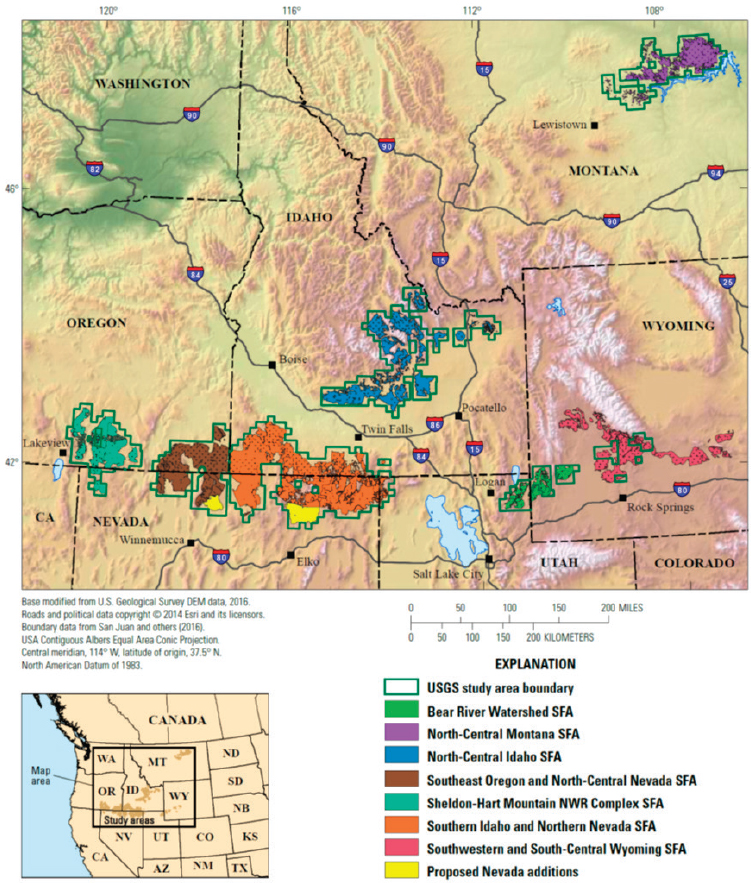
The resource assessment over sagebrush habitat that the USGS carried out per the request of the Bureau of Land Management (BLM) in 2015 is an example of successful interagency collaboration, effective prioritization and communication, and overall successful government cooperation in the critical minerals space (Day et al., 2016; see Figure 7-2). The BLM’s request was made through formal communication channels at the management level and required the dedication of several MRP staff members. Using the staff in this way was consistent with the overall goals of MRP to complete resource assessments across the entire country and helped the BLM to better understand the habitat and possible permitting regulations it might need. Such a task not only makes use of the knowledge and skill set of MRP but is also not likely something that any other agency in the federal government has the ability, resources, or knowledge to do in an efficient way. MRP produced a world-class assessment of this habitat in a timely manner for the BLM, demonstrating excellent collaboration and cooperation to enhance our understanding of mineral resources in this country. More work like this, that combines the efforts of multiple agencies and staff members to enhance our understanding of mineral resources in this country, will be a vital piece of meeting future U.S. mineral resource needs.
SOURCE: Frank et al., 2016.
limited staff and resources. To address this, interagency coordination could be formalized through structured committees and regular communication that allow partner agencies to engage in strategic planning, helping MRP anticipate needs and allocate time and funding more efficiently. While not all urgent or unexpected requests can be eliminated, such a framework would provide a clearer process for evaluating and prioritizing them within MRP’s broader mission (see Recommendation 5).
A related challenge is the lack of centralized leadership for or coordination of the federal agencies on mineral resource strategy, which can lead to duplication, gaps, or inefficient use of resources. As the nation’s oldest and most comprehensive federal mineral science program, the USGS and MRP are uniquely positioned to help lead and coordinate cross-agency efforts in mineral research, assessments, and data integration. Initiatives such as developing a national resource atlas (see Recommendation 3) or assessing U.S. critical mineral potential (see Recommendation 2) will require close collaboration with partners like the U.S. Department of Energy and the Bureau of Land Management—offering a powerful opportunity to align goals, share expertise, and amplify impact.
Congress also plays a central role in shaping and supporting MRP through annual appropriations. Ongoing engagement with Congress is essential, as its members are the elected representatives of taxpayers who ultimately benefit from MRP science. While initiatives like Earth MRI have made significant contributions to national geoscience data collection and have encouraged new mineral exploration, feedback from congressional staff suggests that MRP’s broader contributions are not always fully understood beyond marquee publications like the National List of Critical Minerals and Mineral Commodity Summaries. For example, some interest has been expressed in seeing direct exploration or development outcomes from Earth MRI data before considering additional funding, despite the long timelines typically involved in mineral projects. High staff turnover on Capitol Hill further complicates this understanding. Expanding targeted outreach and education to policy makers could help close this knowledge gap and build lasting support for MRP’s mission and long-term success.
State
The partnership between MRP and the state geological surveys is one of the program’s most valuable and longstanding collaborations. This relationship is essential for achieving national-scale data collection goals, such as those of the Earth MRI program. While this relationship is strong, feedback from state geologists suggests that coordination and communication could still be improved. Conducting truly nationwide geoscience relies on engagement with all state and territorial surveys, each with its own structure, leadership, and priorities. While this brings immense local expertise and institutional knowledge to the table, it also introduces challenges, including political shifts, funding variability or uncertainty, and differences in data standards and naming conventions across state lines. These issues can complicate the integration of regional data into consistent national datasets and pose risks to multiyear projects.
Beyond coordination, timely and consistent data sharing with state partners is also a challenge. The questionnaire to state geological surveys revealed variability in how
Earth MRI data products are disseminated—ranging from formal, regular updates to unclear timelines or informal releases. Standardizing data release protocols and clearly communicating delivery timelines would help ensure that state partners have equitable and predictable access to critical information (see Recommendation 4). Similarly, involving state surveys earlier in the project planning process—for example, in selecting which critical minerals to prioritize in each region—as well as in overall strategic direction (see Recommendation 5) could improve the relevance and impact of MRP’s work while leveraging local insights.
Finally, the visibility and transparency of MRP–state partnerships should be improved for the benefit of external stakeholders and data users (see Recommendation 7). In programs like Earth MRI, where strong collaboration is already in place, users are often unsure who to contact for specific data or questions. MRP could work with state partners to make points of contact more visible and to publicize the nature of these partnerships more broadly. Encouraging state geological surveys to take on a larger role in disseminating Earth MRI data and serving as public-facing contacts would both strengthen collaboration and improve service to data users.
Tribal
As Earth MRI and other MRP projects progress, tribal nations and Alaska Native Corporations are poised to become increasingly important stakeholders, particularly as mineral resource assessments expand to include tribal lands and as tribes seek to benefit from these resources. MRP has a unique opportunity to serve as a trusted point of contact for tribal entities seeking information on mineral resources, helping to build strong, mutually beneficial partnerships. Such partnerships are essential for ensuring scientific continuity across relevant areas and for supporting tribal sovereignty by providing access to data that inform decisions about current and future mineral development. A key step toward building these relationships is establishing a clear process for early and sustained engagement—inviting tribal input from the initial stages of project planning through the final presentation of scientific results. This approach fosters transparency, builds trust, and ensures that USGS science reflects both technical excellence and the perspectives of tribal communities. Importantly, it moves beyond simply requesting access to land and data by actively seeking tribal knowledge and scientific feedback, ensuring that all parties benefit from MRP’s nationwide data collection and research efforts.
International
MRP’s counterpart agencies in other countries often operate with different mandates, including a stronger emphasis on industry engagement and collaboration. These differences offer valuable models for how the USGS might expand its interactions with industry in a way that preserves scientific independence and avoids conflicts of interest (see Industry section later in this chapter). For example, Geoscience Australia—operating in a country heavily reliant on its mineral resource sector—tracks new exploration projects and actively consults industry to determine whether government datasets
contributed to project development. This feedback loop helps ensure that public data efforts are impactful and aligned with national resource needs. Similarly, the Geological Survey of Canada positions itself as a driver of investment in the Canadian mining sector. While the missions of these international agencies may differ slightly from that of the USGS, collaboration with them provides opportunities for mutual learning, particularly around the science of critical mineral systems and their global distribution (see Recommendation 7).
Conclusion 7-1: Government entities rely on Mineral Resources Program (MRP) data, products, and partnerships for minerals data and information. Including multiple government entities and levels in MRP strategic planning and ensuring that data are accessible and timely will facilitate the best decision making by those entities to help meet domestic critical mineral demand.
ACADEMIA
Overview
MRP represents the nation’s primary expertise in mineral resource science, particularly in economic geology—the study of mineral deposits and their formation, distribution, and discovery. As the number of academic programs offering classes and degrees focused on economic geology has declined over the past two decades, and funding for Earth science research has remained challenging to acquire, MRP has filled a critical gap by continuing to support scientific discovery and workforce development in this field. Today, academic institutions increasingly rely on MRP for geoscientific data, research collaborations, and training opportunities related to economic geology and mineral deposits. Cooperative agreements between MRP and universities have enabled joint research, student engagement, and co-location of staff on campuses, providing academic researchers access to funding and USGS expertise while expanding the program’s scientific reach. Notably, Earth MRI and other MRP initiatives have become foundational for academic investigations into critical mineral systems, particularly from a foundational data perspective. Within the questionnaire on data users circulated by the committee, 90% of academic respondents said that they rely on MRP datasets for their research—underscoring the essential role MRP plays as both a scientific partner and a data provider.
Challenges and Opportunities—Academia
Despite this strong foundation of academia–MRP collaboration, many opportunities remain across MRP for increased cooperation and collaboration with academic researchers that could greatly further our understanding of critical minerals in the United States and address the crucial challenges facing the nation (see Chapter 2). The national need for trained economic geologists and other earth resources professionals is acute (e.g., SEG Council, 2003; NASEM, 2024), yet with renewed national focus on
critical minerals, U.S. universities are only beginning to rebuild the capacity that was lost over decades of disinvestment. Currently, numerous academic positions in critical minerals are being advertised, competing for a very limited pool of qualified faculty. Meanwhile, MRP staffing in economic geology has also declined, further concentrating responsibility within a shrinking core of experts.
Partnerships with academia have been part of MRP’s history but are not common outside the work being done by academically affiliated state geological surveys funded through Earth MRI. The committee sees many opportunities available for MRP to engage more directly with academia. For example, the planned co-location of MRP staff and facilities with the Colorado School of Mines offers a promising model for deepening collaboration—fostering internships, student training, and adjunct appointments that could help rebuild the talent pipeline. Replicating the successful aspects of such partnerships across the country, both in locations with and without physical co-location, would allow MRP to support and benefit from academic institutions through research funding, internships, and access to national-scale data and models. Formal mechanisms for engagement—such as joint workshops, mentoring programs, and outreach at conferences—could also strengthen connections; leverage the expansive skills, experience, and talent in academia; and expand the reach of USGS science within academia. Additionally, opportunities like the Mineral Resource External Research Program,1 which ran from 2004 to 2014, could support and train students and researchers in areas of interest to MRP. This could result not just in a wider research portfolio in the arena of mineral resource studies but also in support for workforce development by engaging graduate and undergraduate students in research projects.
Furthermore, better coordination between academia and MRP could be afforded by including academic representatives in an advisory system (see Recommendation 5). Additionally, a comprehensive update to the MRP strategic plan (see Recommendation 6) would enable academic researchers to focus on areas that complement but not duplicate MRP’s work. Importantly, these potential engagements are not only about workforce development; academic research often extends and deepens the application of MRP data and understanding of mineral systems models in ways that go beyond the current federal science portfolio.
Conclusion 7-2: Academic institutions represent one of the largest user groups of U.S. Geological Survey mineral data and are key to training the next generation of geoscientists. While the Mineral Resources Program has made effective use of existing collaborations, a clear opportunity exists to apply best practices to expand and formalize these efforts. Strengthening academic partnerships will be critical to addressing the nation’s workforce gap in economic geology and to advancing the science needed to meet future critical mineral demands.
___________________
1See https://www.usgs.gov/programs/mineral-resources-program/science/mineral-resources-external-research-program, accessed July 20, 2025.
INDUSTRY
Overview
The industry landscape encompasses entities both upstream and downstream of mineral discovery and extraction, and spans various sectors. Most significant for MRP are exploration and mining, which are the primary foci of this section, although the financial and manufacturing sector can also be important to the minerals landscape (see Box 7-2). Private industry also includes contractors involved in data collection, such as lidar and geophysical and geochemical data collection under Earth MRI. That
BOX 7-2
Financial and Manufacturing Interests in Minerals and Mining
Early-stage or greenfield exploration is notoriously high risk, and funding is often predicated upon each year’s exploration results and volatile external factors such as commodity price. Moreover, the venture capital community expects early well-defined results and clear exit points, which generally do not align with most early-stage mineral exploration programs. Other countries have addressed this funding issue by directly supporting mineral exploration and upstream efforts. For example, the Japanese and Indian governments are directly investing in upstream activity (JOGMEC, 2024; PIB, 2025). The Australian government supports economic and feasibility studies. In Canada, “flow-through share” financinga “allow[s] companies to raise capital while transferring certain exploration expenditures incurred on Canadian soil to their investors” (Invest in Canada, 2025). Individual investors receive immediate and significant tax credits, with higher rates specifically applied to critical mineral exploration, thereby generating significant exploration activity within Canadian borders. No comparable financial support mechanisms for upstream and exploration efforts currently exist in the United States.
In the United States, the manufacturing sector and some original equipment manufacturers have invested directly into new mining operations. Some examples include offtake agreements for lithium production by General Motors, Ford, and Toyota-Panasonic, as well as direct equity interest in minerals projects by Tesla. This underscores the demand for certain critical minerals and manufacturers’ expectations of critical mineral shortages that need to be derisked by making increasingly early investments.
While direct financial support is outside the purview of MRP, MRP can support exploration efforts in the United States through a variety of ways detailed in this chapter.
a See https://pdac.ca/programs-and-advocacy/access-to-capital/flow-through-shares, accessed April 7, 2025.
relationship is discussed in more depth in the Earth Mapping Resources Initiative section of Chapter 4.
OVERVIEW
Importance of Industry
Private industry is essential to the pathway of developing new mines and therefore to increasing the domestic supply of critical minerals. Furthermore, recognizing that MRP and private industry contribute to the same goal of meeting U.S. critical mineral needs means that a strong partnership between MRP and private industry is essential. MRP’s role within this partnership is primarily to provide precompetitive geoscientific information that supports mineral exploration and mine development in the United States by private industry. Doing so would ensure that USGS data collection is relevant to private industry needs, and that data are disseminated in a manner and timeline that support industry work. As such, industry represents an important potential partner for the USGS—one that could be leveraged substantially within the next decade.
Many current U.S. mines have their origins in anomalous surface geochemical data, originally analyzed and published by the USGS. For example, in 1975, Chevron began an exploration program for uranium throughout the McDermitt Caldera in Nevada. Early in this program, the USGS (which had been investigating lithium sources) alerted Chevron to the presence of anomalous concentrations of lithium associated with the caldera, which encouraged Chevron to add lithium to its assays and begin a clay analysis program (Lithium Americas Corp, 2022). When results indicated high lithium concentrations in clays, Chevron began a drilling program focused on lithium targets. The resources found are now in the hands of Lithium Americas, and one in particular, Thacker Pass, is in construction to become the world’s largest known lithium resource and reserve, supporting U.S. lithium production in Nevada (Lithium Americas Corp, 2022). The exploration industry acknowledges the value of USGS national-scale datasets, and now the burden is on the USGS to maintain and augment these databases and physical samples in support of the exploration industry as one of its primary stakeholders.
To explore the status of industry engagement with MRP data, the committee distributed a questionnaire to data users, with a specific focus on industry professionals. The questionnaire was distributed primarily through the Geological Society of Nevada, which includes in its membership a large contingent of industry professionals from across the entire mountain west, as well as through the Society of Economic Geologists (SEG), a leading international professional society. The questions in the survey are listed in Appendix B. Of 182 responses received, 69% were from individuals who work within the mineral exploration and mining industries; 90% said they use USGS data, with 57% of those stating that they specifically use data generated from MRP; 32% answered that they actively collaborate with the USGS; and the types of data most used by industry professionals are geochemical data, maps, and NMIC reports.
The committee recognizes that the questionnaire results are not representative of all industry stakeholders and that responses might be biased toward individuals with
preexisting relationships or knowledge of the USGS and its data. Despite these caveats, the high percentage of data users illustrates the value of USGS science and data to exploration and mining industries.
Respondents widely echoed the usefulness of USGS data, some of whom have been using the data throughout the entirety of their careers. More specifically, respondents highlighted the Mineral Commodity Summaries. They also described the USGS as a “gatekeeper to a wealth of relevant information”; that the data are instrumental in “the search for new critical mineral resources”; and, notably, that the data are “very much needed to help the United States compete with other major mineral producers.” One respondent detailed the following:
I find the USGS data to be invaluable to my role in exploration. They are a critical data source for me and many other geologists. As the USA does not have any mandatory company reporting requirements (like those in Canada or Australia) the USGS data repositories are often the only source of geological/geochemical/geophysical data in an area. I greatly appreciate that the USGS makes all [its] data freely available, in a validated format, and that [it] continues to collect new data!
Industry as a Stakeholder
Private industry represents an important user group and client of MRP data, as foundational data such as those provided by MRP are fundamental to mineral exploration. While MRP’s role may not include identifying new mines, broadly and effectively disseminating data with the goal of meeting the future mineral resource needs of the United States is within its scope. The USGS’s ability to look across the critical mineral space and collate large public datasets results in immensely valuable datasets. This is reflected in the questionnaire results: 65% of respondents utilizing USGS data indicated that MRP data, specifically, are “essential” to their work.
Industry as a Partner
In addition to the value industry provides as a data user, collaboration and coordination of activities with industry can strongly enhance MRP initiatives. Private industry partners have primarily been involved with MRP through individual project research, Earth MRI–associated programs, mine waste research initiatives, and the compilation of production data in the NMIC group, generally utilizing Cooperative Research and Development Agreements or Technical Assistance Agreements (TAAs).
Current Industry Engagements
Some examples of strong and successful MRP engagement with industry include the following:
NMIC Production Data
NMIC staff described to the committee a strong relationship between MRP and industry, specifically with respect to U.S. production of mineral commodities. For example, NMIC collects production data from National Instrument (NI) 43-101 reports and surveys sent to industry individuals and companies. As stated on the NMIC website, “Contributions of data by mineral industry companies through canvass forms completed annually, monthly, or quarterly are the basis of U.S. mineral industry publications.”2 Furthermore, the commodity specialists within NMIC actively reach out to industry as part of their commodity research and attend industry-focused conferences like the Prospectors & Developers Association of Canada (PDAC) meeting. The partnership between NMIC and industry groups is evidently very strong, as industry organizations including the American Exploration & Mining Association (AEMA), the Geological Society of America, and SEG all encourage their members to complete the USGS NMIC production surveys.
Engagement Through Industry-Focused Conferences
USGS representatives of the Earth MRI and mine waste programs participate in industry-focused conferences geared toward exploration geologists, metallurgists, and mining professionals, including AEMA, SEG, the Society of Exploration Geophysicists, and the Society for Mining, Metallurgy & Exploration (SME). USGS staff have authored chapters within SME journals (e.g., Lederer et al., 2024) and presented at conferences (e.g., Jones et al., 2025). At AEMA 2024, for example, MRP scientists gave talks on the Earth MRI program and organized an Agency Special Session titled “USGS Mineral Resources Program: Data, Discovery, and Dialogue for the Future,” with the goal of facilitating open discussion among Earth MRI staff, state geologists, and industry professionals (AEMA, 2024). This style of discussion is an excellent example of how MRP scientists are attempting to engage their industry partners in developing collaborative science portfolios that lead to surveys and data releases, which benefit the exploration and mining industries directly. Continued participation in industry-focused geology, geophysics, and geochemistry conferences is an important avenue for industry professionals to interact with USGS staff, gain awareness of MRP data, and communicate their own needs as MRP considers which projects to pursue.
Collaboration on Specific Projects
Idaho Cobalt Belt.
The Earth MRI project within the Idaho Cobalt Belt is an excellent example of strong MRP and industry collaboration. The Idaho Cobalt Belt is an active region for exploration and mining for cobalt, copper, and rare earth element resources. This led Earth MRI to initiate an airborne magnetic and radiometric survey in the area to aid in the study of the geology and mineral resource potential of the district
___________________
2See https://www.usgs.gov/centers/national-minerals-information-center. Accessed April 7, 2025
and develop new technologies for mineral and geophysical analyses. The survey began in September 2021 and the geophysical data were released in August 2022. Mining companies working in the area including Electra Battery Materials, Idaho Strategic Resources, and Revival Gold contributed financially to expand the geophysical area flown (Phelps, 2022).
Boulder Batholith.
The Boulder Batholith region of Montana has become a focus of Earth MRI due to its prospectivity for several critical mineral resources. In 2022, a USGS collaboration with Rio Tinto allowed the area flown by a geophysical survey to be doubled. Data from the USGS-funded portion of the survey were released in July 2023, and the portion funded by Rio Tinto was withheld for about a year, until public release in April 2024 (Allen Langhans et al., 2024).
Spor Mountain.
MRP is collaborating with the mine operator at the Spor Mountain beryllium deposit in Utah to characterize the mineral system. The operator provided access to samples and site information, enabling USGS researchers to conduct independent scientific investigations. The objective of the study was to improve understanding of this type of beryllium deposit rather than to generate proprietary data for the operator (Ayuso and Foley, 2024). To maintain scientific integrity and avoid disclosure of confidential business information, such collaborations are structured to ensure objectivity.
Reanalysis of Selected Archived NURE-HSSR Sediment and Soil Samples.
As part of a TAA between the USGS and Rio Tinto Exploration, 60,000 archived samples collected as part of the National Uranium Resource Evaluation (NURE) Hydrogeochemical and Stream Sediment Reconnaissance (HSSR) project from selected areas in Arizona, California, Idaho, Montana, Nevada, New Mexico, and Utah were reanalyzed (Smith et al., 2018). The project began in November 2015, and results were published in 2021. Within the data release, the USGS recognized the usefulness of these data across multiple disciplines including geologic mapping, mineral resources assessments, as well as environmental impact assessments.
Challenges and Opportunities—Industry
The mineral exploration and mining industries have the potential to be valuable stakeholders as well as partners of MRP, but the current partnership could be strengthened, potentially using models from other countries as a guide (see Box 7-3). Existing collaborations between MRP and industry appear to be successful and fruitful for both sides, but these collaborations seem to be driven primarily by the relationships of individual scientists and specific mine operators rather than by a formal procedure or process created by MRP management. MRP, specifically, should be proactive to engage industry at multiple stages, from designing surveys to measuring the impact of MRP data on industry. MRP should engage industry when setting MRP science goals, and set clear expectations of what data will become publicly available and when, thereby creating a more formal partnership with private industry (see Recommendations 5, 6, and 7).
The committee observed that MRP faces obstacles in working broadly with private industry because it needs to avoid the appearance of conflicts of interest; MRP is, and should be, viewed as a purely impartial scientific agency. However, any unified vision
and urgency to provide the nation with mineral resources requires that the lines of communication both within and outside of MRP remain open (see Recommendation 7). The onus is also on industry to collaborate, help develop and innovate new tools, and support research into new arenas rather than simply digesting the data provided by MRP (see Chapter 2, Challenge 5). A more positive USGS attitude toward engaging industry as a current stakeholder and meaningful partner could not only recognize industry’s role in making new mineral discoveries in the United States but also facilitate additional investment into the U.S. mineral exploration industry by acting as a federal partner in the exchange of scientific data.
Some specific challenges and opportunities that could facilitate a stronger partnership between MRP and industry include the following.
BOX 7-3
Industry Engagement from Geoscience Australia
Outside of the United States, other national agencies have successfully forged synergistic relationships with industry—perhaps most notably, Geoscience Australia. While the fundamental relationship between the federal government and the mining industry is different in Australia than in the United States, some positive examples could serve as models of how MRP could evolve its partnership with the U.S. minerals industry:
- Geoscience Australia hosts workshops to teach the public (including industry professionals) how to interact with, download, and analyze data.
- Data become publicly available after collection and quality assurance/quality control, with little delay for interpretation (see Figure 7-3; compare “Final data to GA” and “GADDS release” columns).
- All data are hosted on the cloud, and internal Geoscience Australia staff are required to access data using the public portals, resulting in self-criticism and continuous improvements in data portals.
- Data releases are widely disseminated through mechanisms that the industry community is aware of and anticipates such as social media posts, listservs, and magazine publications (see Figure 7-3).
- New exploration programs are tracked, and claimants are asked how government data were used to stake claims and are encouraged to recognize publicly the role of government data.
- Geoscience Australia prides itself on speaking the language of economicsa to help explain and quantify the economic impact of its precompetitive data on the national mineral resources industry.
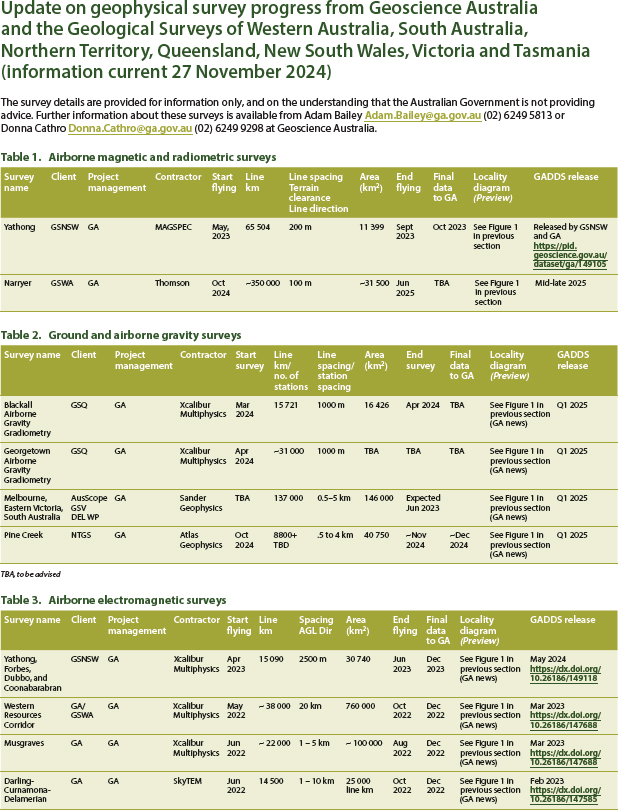
NOTE: This is the first page of approximately 10 in the bimonthly industry magazine Preview.
SOURCE: ASEG, 2024.
a See, for example, https://www.eftf.ga.gov.au/benefits, accessed April 7, 2025.
Data Access
Despite the central role MRP data play in industry activities, significant opportunity remains to increase data use and strengthen the MRP and industry relationship by improving data delivery and dissemination (see Recommendation 4). MRP data are largely being underutilized because they are not publicized widely enough and not stored or disseminated in a central web location that is easy to use (see Chapter 6, Data Products and Delivery).
Questionnaire respondents commented on the difficulties they experienced when they tried to access USGS data and recommended a centralized data portal that would be searchable by geographic area and encompass all USGS datasets available for that area. Comments included the following:
A spatial search tool of the type used to search satellite data but which can search for maps, reports, geophysical, geochemical, petrophysical etc. data would be a good start.
It is extremely hard to find the data itself to download and it tends to have so much metadata that it’s very difficult to work with. The USGS website is very nested and organized by programs/projects rather than by data.
Additional comments related to static databases and investment in continuously updated “live” databases.
Datasets are not always up to date. For example, the NGD [National Geochemical Database] does not contain the latest NURE re-analysis results. These are available elsewhere on the USGS website but not in an easy to extract compilation. And better digitization of historic reports—there are a lot of gems hidden in the text and tables!
Many data sets are historic, old, ongoing updates are needed, particularly with geochronology, mapping, and mineral occurrences.
I primarily use GIS [geographic information system] data. Having all USGS data on one page with old and new version[s] listed, would be extremely helpful. My biggest issue is determining what’s most recent and having to use multiple links to find data. Some old data also appears to be harder to find. Luckily I save locally most of the GIS data.
As is supported via responses in the questionnaire, live national-scale databases would be particularly useful to the exploration industry stakeholders. For example, reanalysis of rock or soil samples might indicate anomalous values of a particular critical mineral in an area that was not previously considered prospective, leading to additional exploration and potential discovery.
A final common thread from the questionnaire is the need for faster and generally more widespread information on data releases:
EMRI [Earth Mapping Resources Initiative] data releases are vague. A timetable of expected releases would be helpful.
A more timely release of data would be helpful. This could be facilitated by staffing of data management teams.
It would be good to have notifications by email of planned projects and data releases.
Certain programs within MRP are already moving toward these goals, such as the Image Project. This program acknowledges that difficulties with data standardization “can hinder cooperation with the broader science community and long-term usability of data”3 and is working toward more rapid and standardized data releases. Programs such as these could be enhanced to ensure that data delivery is both relevant and timely to industry stakeholders. Effort into this area, consistent with the assessment in Chapter 6 and Recommendation 4 to increase speed of data delivery and ease of access, would help streamline the relationship between MRP and industry stakeholders.
Inclusion in Decision Making
Ensuring that MRP data and products are aligned with the needs of industry stakeholders requires more than just introducing industry to ongoing and upcoming projects. While MRP has been effective at “highlighting Earth MRI research, outcomes, and planned directions” (Jones et al., 2025), the “opportunity for industry engagement” is poorly defined. Industry generally has no direct input into Earth MRI or other MRP project planning, except potentially via state geological surveys. Rather than presenting the program to industry, active discussion of the science portfolio and goals with industry professionals and companies would enable them to have a voice at the table, ensuring that the program better aligns with their needs as stakeholders (see Recommendations 5 and 7). Active industry input can also ensure that efforts are not duplicated; as the committee learned from discussions with both industry professionals and MRP staff, there have been cases in which MRP has designed geophysical surveys across areas where an active exploration company has already collected geophysical data.
As another example, to increase the efficiency of the congressional mandate to map the nation’s belowground and aboveground critical minerals, Earth MRI could integrate industry data into its national datasets and then prioritize areas of interest that are not being explored actively by industry. MRP has an opportunity to leverage a potential partnership with industry, whereby it approaches exploration companies and/or mines public reports, including NI 43-101 and JORC technical reports, to source geophysical data that are in, or could be brought into, the public domain and includes those data in its national datasets. MRP could also incorporate state-collected production data with industry-published mineral data to enhance the completeness of NMIC data and analysis.
___________________
3See https://www.usgs.gov/centers/community-for-data-integration-cdi/science/expansion-geophysical-survey-gs-data-standard, accessed July 20, 2025.
Furthermore, including the mineral exploration and mining industries in decision making would serve to increase MRP’s visibility. If private industry can serve as a more formal partner to MRP, that may result in more acknowledgment of USGS data in U.S. exploration programs. Where industry has been approached by the USGS to partner on a program, industry has acknowledged the impact of the USGS data. For example, Idaho Strategic Resources, Inc., put out a press release after increasing its land holding in Idaho and stated, “We are building from an impressive base of prior work published by the USGS.”4 Embracing industry partnerships could not only increase program productivity and efficiency but also provide credibility to the USGS as the nation’s leader in providing precompetitive geoscience data that are foundational to the discovery of new mines. A formal advisory system whereby industry (as well as other key partners and stakeholders) is included in MRP planning and decision making is one mechanism to ensure the alignment of MRP data and products with user needs (see Recommendation 5).
Creative Engagement at Industry Events
Special agency sessions at industry-focused conferences or other fora can increase dialogue and exchange of ideas between USGS staff and industry professionals. For example, geoscience Australia has found that hosting pre-/post-conference workshops can engage industry professionals effectively. The Canadian Exploration Geophysical Society hosts a symposium the day before PDAC to engage with industry professionals and encourage partnership and collaboration.5 The Australian CSIRO Discovery team hosts a two-day symposium for industry to show what is new, and to discuss future collaborative opportunities. A workshop hosted by MRP could provide industry professionals, researchers, and students an opportunity to learn how to interact with, download, and use MRP data in a tutorial or interactive environment.
Data Exchange/Open File System
Many other countries have a stakeholder open file system, whereby industry is incentivized to share information publicly. In Western Australia, for example, the Mining Act and Ministry of Mines state that “tenement holders are obligated to promptly report . . . all mineral of economic interest.” In other jurisdictions in Australia and Canada, companies granted a license to explore in a particular area are required to submit all geological, geochemical, and geophysical data they collect to the licensing authority. These data become public after a period of confidentiality. An incentive program for companies to provide information back to the national database might involve something like early access to Earth MRI data, access to interpretations, or detailed geological assessments. A future revision of mining legislation could introduce
___________________
4See https://idahostrategic.com/idaho-strategic-resources-adds-the-lemhi-pass-project-the-largest-known-concentration-of-thorium-resources-in-the-united-states/.
5See, for example, https://www.kegsonline.org/event-6021849, accessed April 7, 2025.
data-sharing requirements for companies operating in the United States, presenting an opportunity for MRP to help shape and support that transition.
Open Lines of Communication
When industry collaborates with MRP or partners’ interests align with MRP, mechanisms to ensure open communication can help both parties. A more formal approach to industry engagement with open lines of communication would increase opportunities beyond the current ad hoc basis. For example, an industry consortium or representatives could facilitate data and information exchange. An industry liaison within MRP could serve as a point of contact for industry professionals. Open houses and open-door policies at USGS sites could facilitate increased scientific partnerships and new collaborations between MRP and scientists, other individuals from industry, and other sectors including state geological surveys, academia, and national research laboratories.
The committee sees potential for more MRP–industry partnerships, while at the same time recognizing that confidentiality and privileged information concerns sometimes present obstacles in developing these partnerships. Guidance and transparency on how industry partnership projects are initiated and selected would help the public and private sectors become more aware of MRP activities and invite opportunities to participate.
Measuring Industry Impact
Leveraging industry as a formal partner would enable the USGS to quantify the economic impact of its data on the national mineral resources industry, as is done in other countries (Ernst & Young, 2020; Deloitte, 2023). Tracking any increase in exploration from new Earth MRI data releases, for example, would illustrate the impact of the MRP data and provide useful feedback to MRP as it relates to future programs and allocation of future funds. Furthermore, a strong and more formal collaboration between the USGS and private industry would allow MRP to leverage its industry partners to demonstrate to policy makers the ultimate economic benefit of its precompetitive data.
Conclusion 7-3: By acknowledging the joint interests and goals of discovering and developing new domestic mineral resources, strengthening and expanding industry engagement and partnerships could yield significant mutual benefit from program design through to measuring program outcomes.
PUBLIC ENGAGEMENT, PUBLICITY, AND OUTREACH
Overview
The public is one of the most important stakeholder groups for MRP. As a federally funded program, maintaining public trust and awareness is critical to sustaining support, securing congressional appropriations, and ensuring scientific literacy. Public outreach
helps expand support for data collection activities, especially in regions where access depends on community acceptance.
MRP actively engages the public through data releases, participation in science events like conferences including PDAC, and release of limited educational materials. Social media is incorporated into the larger social media of the USGS and is not specific to MRP. Public outreach through in-person events like open houses have taken place in the past.
MRP data are widely used by government agencies, international organizations (e.g., The World Bank, 2017; IEA, 2021), think tanks (e.g., Runde and Hardman, 2023), and private-sector groups (e.g., NMA, 2023), although these entities often serve as the public face of MRP science. Despite its pivotal role, MRP typically remains in the background as others communicate and frame its findings for broader audiences.
Challenges and Opportunities—Outreach
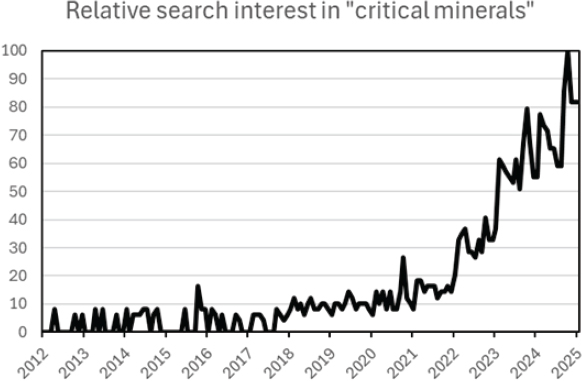
Despite growing public awareness of and interest in critical minerals (see Figure 7-4), a broad disconnect remains between modern material use and the reality of mineral extraction. In many countries, including the United States, public perception of mining remains poor, partly due to concerns about environmental impacts (GlobeScan, 2023; McKinsey & Company, 2023; NASEM, 2024). Yet research shows that education and exposure can improve understanding and foster interest in mining-related careers (Barton et al., 2021). International examples, such as Geoscience Australia’s outreach efforts and rebranding initiatives, show how public opinion can be improved through clear, consistent communication about the societal importance of minerals (Moffat et al., 2024).
The committee has found through feedback from stakeholders and partners that engagement in the research that MRP conducts, and the products that it produces, is a
SOURCE: Data from Google Trends.
critical component of maintaining its relevance as an agency and staying at the cutting edge of mineral resource science. While outreach could be increased overall across the USGS, increased exposure for MRP is critical in order to emphasize the relevance and importance of the work that MRP does to further the mineral resource industry in the United States. Currently, MRP’s outreach efforts are constrained by limited staffing: just one communications professional serves the entire Energy and Mineral Resources Mission Area. As a result, outreach duties often fall on individual scientists who are not incentivized or trained to prioritize public engagement. While some efforts to coordinate communication exist such as the Mineral Resources Program Outreach Project, project teams would be better served by dedicated engagement staff working across all programs of MRP and in collaboration with other USGS programs that work entirely on communicating with stakeholders and partners.
An additional challenge that MRP faces with public engagement is opportunity. While the USGS interacts with the scientific community at conferences and interacts with the government through known channels, the public as a group is entirely reliant on public outreach efforts by the USGS to gain access or insight into the work that the agency conducts. Yet, internal educational efforts to connect USGS scientists with the public at an agency scale have been significantly diminished in recent years. For example, educational publications for the public have lapsed, with the last such MRP release coming out in 2005 (Frank et al., 2005), and in-person events like open houses have become rare. These missed opportunities reduce public visibility and limit the reach of MRP’s science.
However, there are clear paths forward. MRP’s work has the potential to resonate with broad audiences because it relates to so many areas people care about, like national resilience and security, responsible mining and reclamation, and technology and infrastructure. Hiring dedicated outreach personnel and reinstating educational initiatives could greatly improve MRP’s ability to connect with the public and other stakeholders. Outreach via online media could also be another avenue to continued education and information distribution to all stakeholders and partners. An external advisory group (see Recommendation 5) could also help shape communication strategies and ensure that stakeholder needs are met. This could even extend to formalized cooperation, agreements, or funding for nonprofit education organizations that can help to extend Earth science education beyond the staffing resources of MRP and USGS programs.
The National Aeronautics and Space Administration (NASA) is an example of an agency that prioritizes outreach. NASA uses many strategies including compelling visuals and stories, livestreams, virtual engagement, and extensive educational materials distributed online and in person at conferences and educational events to capture the imagination and support of the general public. Emulating these strategies could help MRP remain relevant and responsive in a rapidly evolving minerals landscape.
Conclusion 7-4: Public outreach is essential to the Mineral Resources Program’s (MRP’s) long-term impact and relevance. By investing in dedicated communication capacity and re-emphasizing education, MRP can better inform the public, strengthen support for its mission, and remain a leading voice in mineral resource science.


