Carving Our Destiny: Scientific Research Faces a New Millennium (2001)
Chapter: Advancing Our Knowledge of the Universe
7
Advancing Our Knowledge of the Universe
David Wilkinson
Physics Department, Princeton University
HURRAY FOR PLODDERS
James S. McDonnell, who graduated from Princeton in 1921, majored in physics and is certainly one of the great Americans of this century. John McDonnell talked about his father’s ability to plod. That is, he did not avoid the hard work of taking care of details. I believe that John Carlstrom and Christopher Stubbs resonate with that characterization, because experimental physicists are plodders. Most of the time, physicists do fairly mundane things. The big ideas come quickly, often when least expected, but then begins the real work—mechanical and electrical design, overseeing fabrication (often doing much of it themselves), troubleshooting, long hours of data taking and analysis—things that they enjoy doing, but which do not attract a lot of attention. John Carlstrom and Christopher Stubbs are plodders. Like Mr. Mac, their work style is hands on, taking care of the details.
Coming from Princeton, which is a center for astrophysics and cosmology research, I often hear talks by leading people in the field as they visit the Institute for Advanced Study or the Astrophysical Sciences or Physics departments at Princeton. The chapters by Carlstrom and Stubbs are two of the most exciting essays that I have read in the past year. Important discoveries in astrophysics and cosmology almost always accompany large advances in sensitivity, resolution, sky coverage, and observing techniques, the things that Carlstrom and Stubbs are planning to
improve. They are very likely to substantially advance our understanding of the universe we live in. As Mr. Mac demonstrated, plodders can accomplish great things.
OUR STRANGE UNIVERSE
Carlstrom and Stubbs described a lot of what we already know about our universe, but here I will add a few things that may help to put their work into context. Figure 1 shows a slice through the universe as seen by observers at the vertex. In viewing this figure we need to remember that the speed of light is not infinite. There is a delay between when light is emitted and when we see it. Therefore, when looking out into deep space, we are also looking far back in time. In a sense, telescopes are time machines, allowing us to look into the past. The other remarkable fact about
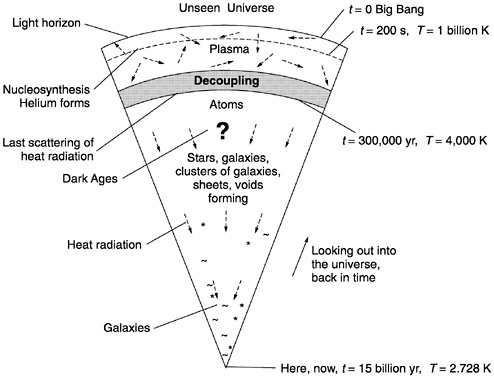
FIGURE 1 A slice of our universe showing some significant epochs in its evolution. The story is based on the big bang cosmological model, now well established by observations.
our universe is its general expansion. To us (and to everyone else in the universe) it appears that other galaxies are moving away— the greater the distance, the faster the recession speed. Curiously, because the expansion is linear (recession speed is proportional to distance), observers everywhere in this universe see other galaxies receding from themselves in all directions, giving the impression that they are at the center. Only two universes have this property; the other one is static and unstable. We do not understand why our universe has these peculiar properties; they seem to have been built in from the beginning.
Imagine that we are at the vertex of the slice looking out into the universe and back in time. On the right-hand side of Figure 1 the age of the universe is shown at the time that the light we see was emitted, the age of the galaxy as it appears to us. The nearby universe is about 15 billion years old and contains thousands of majestic galaxies with beautiful shapes and impressive complexity. Our most powerful telescopes can detect very distant galaxies as they were only a few billion years after the origin of the universe, the “big bang.” Thus, the universal time delay lets us study the evolution of the universe since very early times. The scale and complexity of our universe is mind-boggling. There are roughly 100 billion galaxies in our visible universe, and each galaxy is made up of about 100 billion stars. It is an astonishing universe that we live in, and we have only just begun to understand it.
When thinking about our place in this vast, inhospitable universe, I resonate with Mr. Mac’s use of the term “spaceship Earth.” We live in a universe of enormous scale and complexity, and as far as we know, Earth is the only place hospitable to life as we know it. Our Earth is a spaceship, and there is no place else to go at a cost that we can afford. We had better take very good care of this place!
In Figure 1, the large question mark signifies what cosmologists call the “dark ages.” Somehow the beautiful structure in our universe—galaxies, clusters of galaxies, huge voids, and sheets of galaxies —started to form in this epoch. Did the stars form first and then later gather to form galaxies? Or did the matter clump on galactic scales before stars started to burn? What were the first stars like? What role was played by the massive black holes we now find at the centers of galaxies? These questions are currently at the forefront of cosmology research. This whole mysterious epoch of cosmic time is just out of the reach of our most powerful telescopes. We are now observing youthful galaxies, like the ones we see in the Hubble Space Telescope’s marvelous “deep-field” picture. Perhaps the next generation of telescopes, now on the drawing boards, will penetrate the cosmic dark ages.
Ironically, we know more about our universe at epochs further away in space and time than the cosmic dark ages. In his chapter, John
Carlstrom discusses the “cosmic microwave background radiation” (heat radiation) that comes to us from an epoch when the universe was so hot that energetic particle collisions tore electrons off of atoms, keeping the material ionized. The universe was filled with uniform, hot “plasma” of negative electrons and positively charged atomic nuclei. How did we get from this relatively simple plasma universe of elementary particles and heat radiation to the very complex universe we see today? We do not know. But the work that Carlstrom discusses is very likely to unveil a good deal of what went on in these cosmic dark ages. Let me explain how we can learn about the formation of the cosmic structure billions of years ago by measuring fluctuations in the cosmic microwave radiation temperature now. In Carlstrom’ s chapter, he mentions that the cosmic microwave radiation is coming straight to us from a time just before the dark ages, when the radiation and the matter interact for the last time. In Figure 1 it is called the “decoupling” epoch, about 300,000 years after the big bang. Before decoupling, the heat radiation was scattered around strongly by the plasma. (Note the random directions of the radiation prior to decoupling.) However, at decoupling, something very special happened. The universe had cooled (due to the universal expansion) to a temperature of about 4,000 degrees, cool enough that the electrons could now stick onto the protons and form neutral hydrogen for the first time. Once the matter in the universe was electrically neutral, gravitational forces (always attractive) began to pull the matter into clumps wherever the density happened to be a bit higher than average. Inexorable gravity continued to tighten the clumps, forming the wonderful panorama of structure that we see in the universe today. By mapping the tiny temperature fluctuations in the cosmic microwave radiation at the time of decoupling, we are taking pictures of the density fluctuations that are the seeds of cosmic structure formation. It has taken 35 years to develop the technology and the know-how to make these observations possible, but most cosmologists believe that measurements like those described in Carlstrom’s chapter will make a huge advance in our understanding of the universe.
There are some other interesting features in the cosmic diagram in Figure 1. The epoch in the diagram called “nucleosynthesis” happened only a few minutes after the big bang. The temperature of the universe (a few billion degrees) and the density were just right for nuclear reactions to form helium nuclei from the protons and neutrons in this very hot plasma. Calculations show that about 24 percent of the matter should form into helium nuclei, the rest being hydrogen nuclei—protons. Remarkably, the Sun is composed of about 24 percent helium and so is every other sample of cosmic matter that we have been able to measure. It looks like the whole universe is composed of 24 percent helium in accord with
the big bang primordial nucleosynthesis model. This agreement of observations and theory, based on the big bang model, argues that cosmologists are on the right track.
Finally, why is the cosmic diagram terminated in a circle labeled big bang? That is as far away as we can see, about 15 billion light years in all directions. In the 15 billion years that the universe has existed, light has not had time to reach us from outside of that boundary, which is called the “light horizon.” Of course, as time goes on we see farther and farther into the “unseen universe” as our light horizon expands. What is beyond our light horizon? Probably the same stuff that is inside, but we are not sure of that. We cannot see out there directly. However, our imaginations can take us there via what Einstein called a “gedanken ” experiment. Imagine an observer on another galaxy far away from us. When that observer draws her light horizon circle, it goes outside of ours in the direction opposite from us. In that direction, light from outside our light horizon has already reached her position. If the stuff between our horizon and her horizon were different, she would see a lopsided universe, different in the directions toward and away from us. If we believe that the universe is homogeneous and isotropic (the same in all directions) for observers anywhere in the universe, the unseen (by us) universe must be similar to the part that we see. Otherwise, there is something very special about our placement in the universe, contrary to observations showing us on a very ordinary planet, orbiting a very ordinary star, far from the center of our galaxy.
HOW DO WE KNOW THAT?
So that is the big picture. Why should we believe such a fantastic story? I like to teach courses for nonscientists, and I always try to get them to ask the question: How do we know that? It is the most important question in science. How do we know (never for certain, but with a high confidence level) that the essential parts of the big bang story are true? Primordial nucleosynthesis is a good start. Astronomers have trouble explaining the observed abundance of low-mass elements, like helium, except by production in a very early stage of the hot big bang. I am particularly impressed that the physics that we have learned in our tiny corner of the universe can explain something as grand and remote as primordial nucleosynthesis.
Additional compelling evidence that we live in a big bang universe comes from a long series of observations of the spectrum of the cosmic background radiation. A spectrum measures radiation intensity at different wavelengths, as illustrated in Figure 2. George Gamow predicted the spectrum of the cosmic microwave background radiation in the late 1940s,
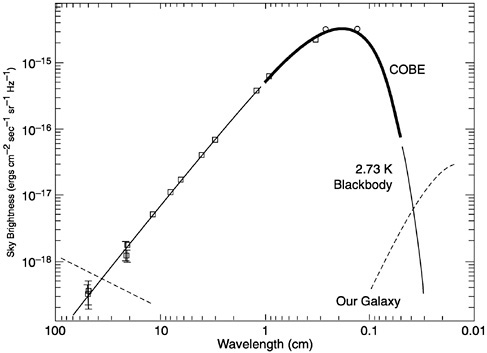
FIGURE 2 Cosmic Blackbody Radiation Spectrum. The results of many measurements of the spectrum of cosmic microwave background radiation. The thin solid curve is the theoretical prediction, a blackbody curve. The thick curve near the peak is the result from the Cosmic Background Explorer (CODE) satellite. The experimental errors on the CODE measurement are smaller than the width of the thick curve. The squares and circles are results from ground- and balloon-based measurements. Only the big bang model accounts for such accurate agreement between theory and measurement.
15 years before the radiation was discovered. Using the very hypothetical (at that time) big bang model, Gamow and his collaborators, Ralph Alpher and Robert Herman, found that the heat radiation remnant of a hot early universe should have an almost perfect “blackbody” spectrum. This is a spectrum that every undergraduate physics student studies because it describes a very common and simple phenomenon. All hot bodies that are good absorbers of radiation emit heatlike radiation with a blackbody spectrum, which is completely characterized by the body ’s temperature. (Sunlight is part of the Sun’s blackbody spectrum emitted by its 6,000-degree surface.) Interestingly, the blackbody spectrum played an important role in the discovery of quantum mechanics early in the twentieth century. Max Planck had to hypothesize quanta of radiation to concoct a theory explaining the peaked shape of the blackbody spectrum emitted by hot bodies. A critical test of the big bang cosmological model was to measure the spectrum of cosmic microwave background radiation to see
if it has the predicted blackbody shape. The measurements spanned 25 years, culminating in a very accurate measurement by NASA’s Cosmic Background Explorer (COBE) satellite in 1990. The data are shown in Figure 2 along with the theoretical blackbody curve. As can be seen, the data fit the theory extremely well, especially in the critical region of the peak of the curve. Note that the curve peaks at about a 2-mm wavelength, in the microwave band. This means that the current temperature of the radiation is a few degrees above absolute zero. The enormous expansion of the universe has cooled the radiation from billions of degrees at the time of nucleosynthesis to a few degrees at the current epoch. (The temperatures at several cosmic epochs are shown on the right-hand side of Figure 1. The unit of temperature is the Kelvin, or K, in degrees above absolute zero.) The COBE measurement gives a cosmic radiation temperature now of 2.728 ± 0.004 K. It is important to remember that the spectrum had been predicted before the radiation was discovered, using the big bang model. Furthermore, no other cosmological model comes close to explaining the measured blackbody spectrum. The agreement between theory and accurate measurements of the spectrum makes a very strong case for the big bang cosmological model.
There are two other interesting subplots of this story. I mentioned above that the blackbody spectrum was a cornerstone of the discovery of quantum mechanics. Now we find that blackbody radiation fills our universe and played a central role in the discovery that we live in a big bang universe. I doubt if any other physical phenomenon will be as important to our understanding of physics and cosmology over such an enormous range of scales. Second, in Figure 2, note that there are some dotted curves showing emission from our own Milky Way galaxy, radio waves on the left and emission from galactic dust on the right. Further to the left and right, these emissions from our galaxy rise to completely overwhelm the cosmic microwave background radiation. How remarkable that the heat radiation from the big bang happens to be centered in an excellent wave-length window for seeing out of our galaxy. There is no evolutionary reason for this; it is just pure luck. To observe the seeds of structure embedded in the cosmic microwave background, we need to measure intensity fluctuations with an accuracy of 1 part per million. I cannot believe how lucky we are that right at the peak intensity of the cosmic blackbody radiation our galaxy ’s emission is about a million times weaker!
FINAL REMARKS
Christopher Stubbs and John Carlstrom are working on two of the most important problems in cosmology today. We live in a universe apparently dominated by dark matter about whose composition and form
we know very little. There are so many possibilities—unknown elementary particles, black holes, dim or dark stars, neutrinos with mass—that we do not know where or how to look for the dark matter. One needs to try all reasonable and testable ideas. Christopher Stubbs is looking in the halos of galaxies, where many people think the dark matter resides. This is a very difficult problem.
Questions about the past and future evolution of our universe are better defined; we have a better knowledge base to build on. Studying the seeds of structure formation by measuring tiny fluctuations in the cosmic microwave background radiation is a very difficult technical problem, but at least one knows that this is the right place to look. John Carlstrom may not find what he expects, but he is bound to find something very interesting about the universe. Mapping the cosmic microwave fluctuations will give a big boost to our ongoing efforts to measure important cosmological parameters—the numbers that define the kind of universe that we live in. For example, the parameters will tell us whether we live in a universe that will expand forever, becoming more rarified and cold, or eventually stop and recollapse to a hot, highly compressed state. The cosmological parameters are being measured by combining the results of many different kinds of astronomical measurements. John Carlstrom’s work on the microwave background radiation fluctuations and on the Sunyaev-Zel’dovich effect in clusters of galaxies are two important pieces to the cosmic puzzle. I look forward eagerly to following the progress of these two very talented experimental physicists in the years ahead.