Touch the Universe: A NASA Braille Book of Astronomy (2002)
Chapter: NGC 2392--The Eskimo Nebula
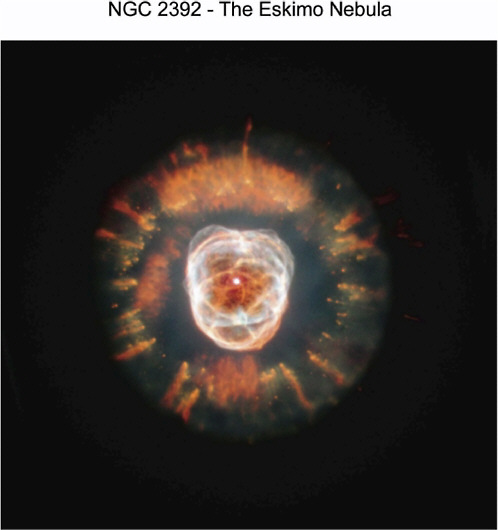
Figure 8.
NGC 2392 - THE ESKIMO NEBULA
As a star’s gases undergo nuclear reactions, they are converted from lower mass elements into higher mass ones. When a star can no longer create new elements, it becomes unstable.
About 10,000 years ago, a sun-like star in the constellation of Gemini became unstable and began to fling its gases into space. The gaseous relic of this star is called the Eskimo Nebula because it resembles the shape of a head surrounded by a fur hood from a winter coat. The “head” is a bubble of gas surrounding the dying star, and the “fur” is gaseous material moving away from the star. The Eskimo Nebula, also called NGC 2392, is visible only with a telescope.
A. Fruchter and the Early Release Observation (ERO) Team used the HST in January 2000 to take this image (Figure 8) of the Eskimo Nebula. The nebula’s glowing gases produce the colors used in this image: nitrogen (red), hydrogen (green), oxygen (blue), and helium (violet).
The “head” and surrounding gases are raised with tactile lines. Gases in the “fur” shell are shown as raised curved lines.